How we built this comparison
This page combines traveler discussion patterns, published price ranges, flight schedules, and seasonal data to help you decide between Australia and United States.
- Reviewed 50+ Reddit threads from r/travel, r/solotravel, r/australia, r/USAtravel, r/backpacking
- Verified costs and logistics against current booking platforms like Skyscanner, Booking.com, and specific airline/car rental sites
- Cross-referenced seasonal patterns and weather data from meteorological services for optimal travel times
⚡ The TL;DR Verdict
For most international travelers, Australia offers a more cohesive, albeit expensive, backpacking or road trip experience with singular natural appeal. The United States demands a more focused itinerary due to its immense size and varying travel costs across regions. Pick Australia for a classic 'big trip' feel; pick the US for specific regional explorations.
- Choose Australia: Travelers seeking expansive natural areas, unique wildlife, and a clear, well-trodden backpacker trail, despite higher costs and longer flights.
- Choose United States: Travelers interested in specific cultural experiences (e.g., NYC, New Orleans), diverse landscapes (mountains, deserts, beaches), and often more budget-friendly domestic travel options.
- Choose Both: Doing both requires at least 4-6 weeks and a substantial budget ($8,000+ USD minimum), given the distances and daily costs in both places.
Choose Australia
Choose Australia for an unparalleled "big trip" experience focused on breathtaking natural wonders and unique wildlife. Ideal for backpackers and road-trippers, you can explore the vibrant Great Barrier Reef, venture into the rugged Outback, or enjoy iconic coastal drives. While generally more expensive, it offers a cohesive, epic adventure for those seeking a truly distinct journey.
Choose United States
Opt for the United States when your interests are diverse and regional, offering a mosaic of experiences. Best for culture vultures wanting to explore New York City's urban pulse or New Orleans' vibrant music scene, alongside nature enthusiasts drawn to the Grand Canyon or Californian beaches. Its vastness allows for focused, often more budget-friendly, explorations across distinct regions.
Quick Comparison
| Category | Australia | United States | Winner |
|---|---|---|---|
| Getting There | Long, expensive flights; often requires significant layovers depending on origin. | Excellent global connectivity, direct flights from many continents; vast domestic flight network. | United States |
| Daily Costs & Budget | Generally higher costs for accommodation, food, and activities, especially in cities. | Costs vary significantly by region; major cities are expensive, but rural areas and smaller cities offer good value. | United States |
| Nature & Outdoors | Unique wildlife, ancient landscapes, vast deserts, and spectacular coastlines. | Diverse ecosystems from mountains to deserts, extensive national park system, varied landscapes. | Australia |
| Beaches & Coastal Life | Iconic surfing beaches, extensive pristine coastlines, tropical reefs, and unique marine life. | Vast stretches of diverse coastline, from rugged Pacific shores to warm Atlantic waters and Gulf beaches. | Australia |
| Food & Drink | Strong café culture, fresh seafood, Asian influences, and good quality produce. | Incredibly diverse regional cuisines, ethnic food variety, and a strong craft beverage scene. | United States |
| City Life & Culture | Relaxed, outdoors-focused cities with good public spaces, strong arts and cafe scenes. | Mega-cities with global influence, historical depth, diverse neighborhoods, and entertainment hubs. | United States |
| Getting Around | Best explored by car for flexibility, long distances between major points; limited public transport outside cities. | Extensive road network, cheap car rentals, domestic flights common; public transport strong in select major cities. | United States |
| Accommodation | Hostels and apartments are common; hotels can be pricey, especially in peak season. | Wide range of options from budget motels to luxury resorts; prices vary significantly by location. | United States |
| Safety & Travel Ease | Generally very safe; some remote hazards (wildlife, heat) require preparation. Easy to navigate. | Generally safe, but large cities have areas to avoid; road safety varies by state. Requires awareness. | Australia |
| Local Culture & People | Relaxed, friendly, outdoors-oriented; strong emphasis on sports and mate-ship. | Diverse, individualistic, regionally distinct; known for hospitality in certain areas. | Tie |
✈️ Getting There
Reaching Australia from most international hubs is a commitment. From Los Angeles (LAX) to Sydney (SYD), direct flights average 14-15 hours, with return fares typically ranging…
Australia
United States
Reaching Australia from most international hubs is a commitment. From Los Angeles (LAX) to Sydney (SYD), direct flights average 14-15 hours, with return fares typically ranging from $1,000-$2,000+ USD, varying greatly by season and booking time. From Europe, expect 20-30+ hours of travel, usually with two layovers, and fares easily exceeding $1,500-$2,500 USD return. Once in Australia, the main international airports are Sydney (SYD), Melbourne (MEL), and Brisbane (BNE).
The United States benefits from its central global position and a dense network of international airports like New York (JFK/EWR), Los Angeles (LAX), Chicago (ORD), and Miami (MIA). Flights from London to New York average 7.5-8 hours, with return fares often found for $500-$900 USD. From European cities to the West Coast, flights are typically 10-12 hours, costing $700-$1,200 USD. Domestically, the US has extensive flight options, making internal travel between major cities relatively quick and often affordable if booked in advance. The United States wins for its sheer accessibility and generally lower flight costs from most global origins.
- Winner: United States
- Why: The United States is significantly easier and often cheaper to reach from most global origins, with shorter flight times for many travelers.
- Who this matters for: Anyone on a tighter budget or with limited vacation time.
💰 Daily Costs & Budget
Australia generally presents a higher daily budget challenge for travelers. A hostel bed in Sydney or Melbourne averages $40-60 AUD ($26-40 USD), while a basic hotel room starts…

Australia

United States
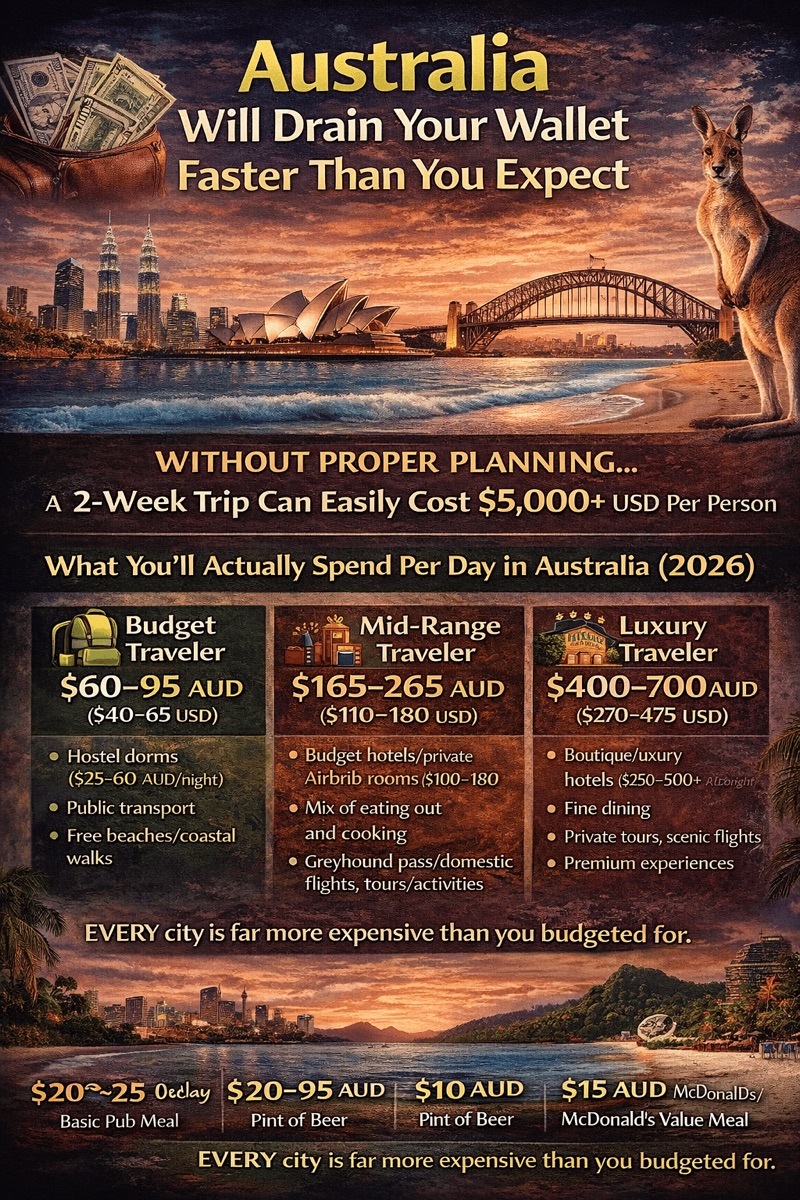
Australia generally presents a higher daily budget challenge for travelers. A hostel bed in Sydney or Melbourne averages $40-60 AUD ($26-40 USD), while a basic hotel room starts at $150-250 AUD ($98-163 USD). A casual meal in a cafe or pub can easily be $20-35 AUD ($13-23 USD), and a beer is around $10-14 AUD ($6.50-9 USD). A budget traveler focusing on cooking own meals and staying in hostels might budget $100-150 AUD ($65-98 USD) per day, but a mid-range traveler aiming for some restaurant meals and tours should plan for $180-250+ AUD ($117-163+ USD) daily.
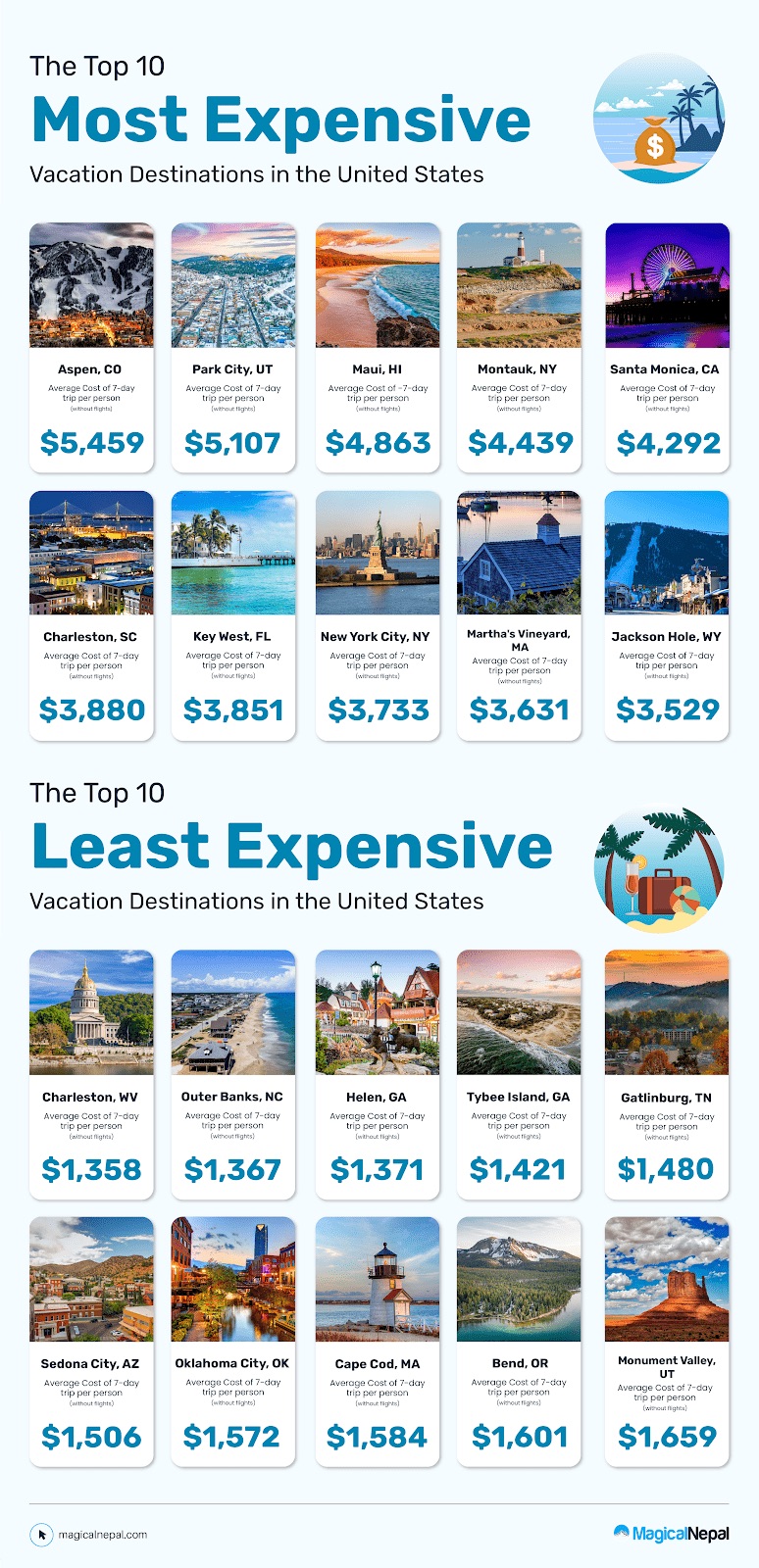
In the United States, costs fluctuate widely. A hostel bed in New York City or San Francisco can be $50-80 USD, but in a city like New Orleans or Denver, it might be $35-60 USD. Budget motels can be found for $80-150 USD outside major city centers. A casual meal costs $15-30 USD, while a craft beer is $6-9 USD. A budget traveler can manage $80-120 USD per day in less expensive regions, but in destinations like NYC or Hawaii, $150-250+ USD is more realistic. Groceries are often cheaper than in Australia, which helps stretch a budget. The United States edges out Australia on cost, primarily because its vast size allows for cheaper options outside of premium destinations.
- Winner: United States
- Why: The United States offers more opportunities for budget-conscious travel, particularly outside major city centers, making daily expenses more manageable.
- Who this matters for: Travelers with a strict budget seeking to maximize their trip duration.
🏞️ Nature & Outdoors
Australia offers a truly singular natural experience, defined by its ancient geology, unique endemic wildlife, and expansive, largely untouched wilderness. The Great Barrier Reef,…
Australia
United States
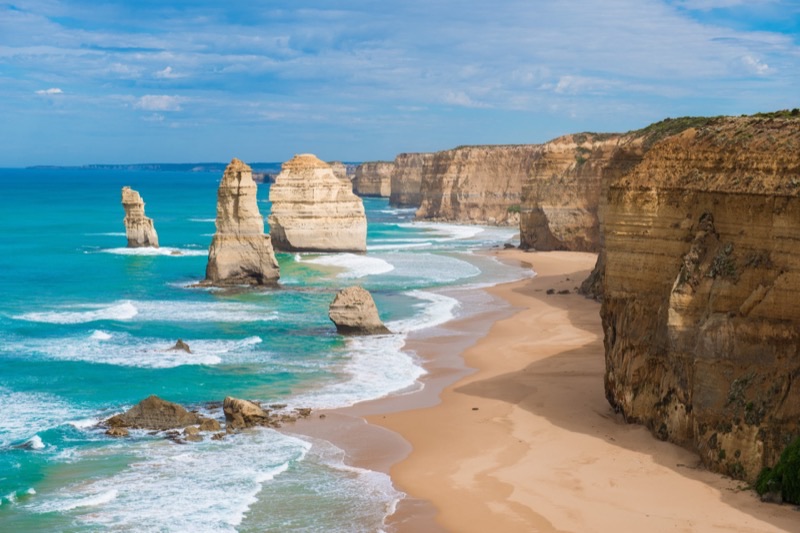
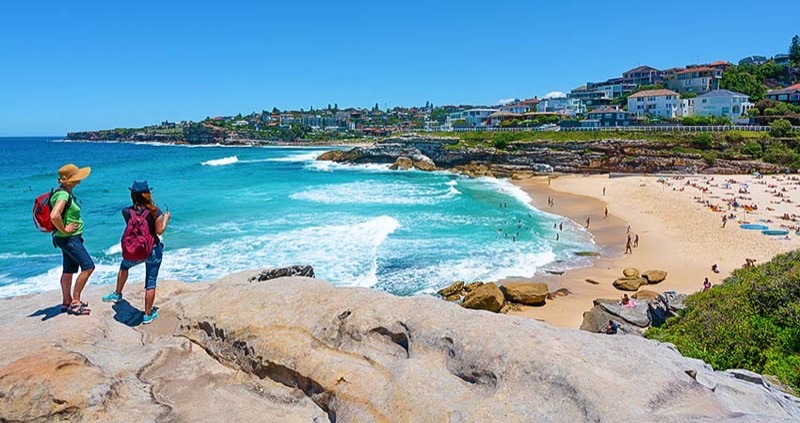
Australia offers a truly singular natural experience, defined by its ancient geology, unique endemic wildlife, and expansive, largely untouched wilderness. The Great Barrier Reef, accessible from Cairns, is a marine ecosystem unlike any other. Uluru-Kata Tjuta National Park presents a deeply spiritual desert landscape, while the Daintree Rainforest is the oldest tropical rainforest on Earth. Wildlife encounters, from kangaroos and koalas to platypuses and various bird species, are frequent outside urban areas. Places like Freycinet National Park in Tasmania or the Twelve Apostles along the Great Ocean Road offer coastal views. Exploring requires driving long distances, but the rewards are different from anywhere else.
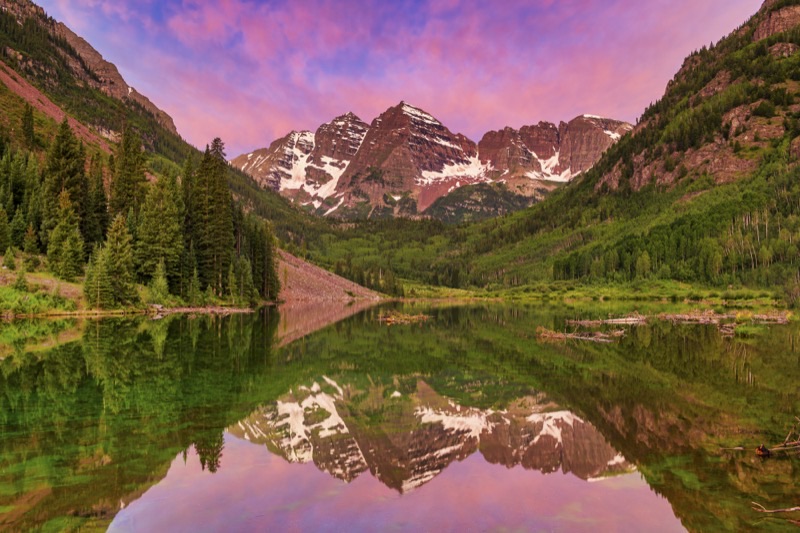
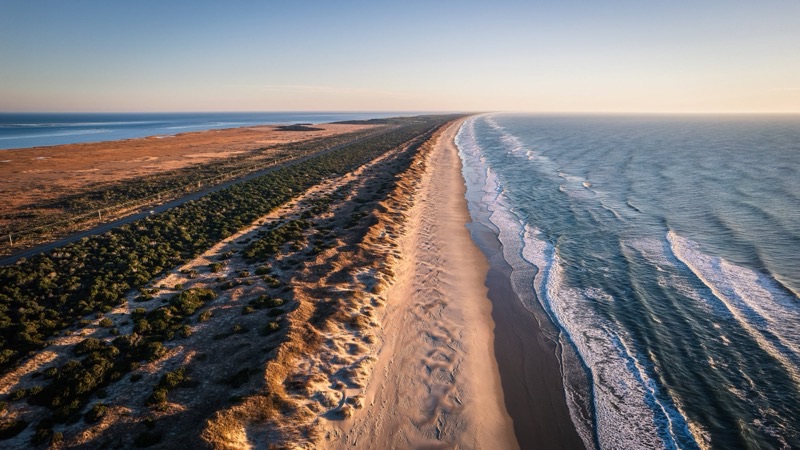
The United States boasts an incredible range of natural environments, from the towering peaks of the Rocky Mountains (e.g., Rocky Mountain National Park) to the deserts of the Southwest (e.g., Grand Canyon, Zion National Park). Its national park system, with the 'America the Beautiful' pass for $80 USD a year, provides access to over 2,000 sites, making it accessible. Coastal areas like California's Big Sur or the Outer Banks of North Carolina offer different ocean experiences. While the US has immense natural beauty and diversity, Australia's distinct ecosystems, ancient landscapes, and truly unique animal life provide a more specific and often more 'otherworldly' natural experience that is harder to find elsewhere. Australia takes this category for its truly distinct ecological offerings.
- Winner: Australia
- Why: Australia's nature is defined by its ancient landscapes, unique endemic wildlife, and ecosystems found nowhere else, offering an unparalleled experience.
- Who this matters for: Wildlife enthusiasts, adventurers seeking truly unique geological formations, and those wanting to immerse themselves in ancient landscapes.
🏖️ Beaches & Coastal Life
Australia is synonymous with beach culture. Its coastline stretches for over 50,000 kilometers, offering everything from the famous Bondi Beach in Sydney, popular for surfing and…

Australia

United States
Australia is synonymous with beach culture. Its coastline stretches for over 50,000 kilometers, offering everything from the famous Bondi Beach in Sydney, popular for surfing and sunbathing, to the remote, white sands of Whitehaven Beach in the Whitsundays. The country hosts thousands of beaches, many of them uncrowded and pristine, such as Lucky Bay in Esperance, where kangaroos can be found on the sand. The Great Barrier Reef, accessible from Queensland, provides unparalleled snorkeling and diving with its marine biodiversity. Surfing is a national pastime, with consistent waves available across many regions. Coastal road trips, like the Great Ocean Road, are central to Australian travel.
The United States also possesses extensive and varied coastlines. California offers rugged cliffs and surfing spots like Malibu, while Florida boasts warm, sandy beaches like South Beach in Miami and the Gulf Coast. The Outer Banks of North Carolina are known for their wild beauty and lighthouses, and Hawaii's beaches, like Waikiki, are famous for their tropical setting. While the US has excellent beaches for various activities and climates, Australia's sheer abundance of undeveloped, spectacular coastal areas, combined with its deeply ingrained beach culture and access to the Great Barrier Reef, gives it the edge. Australia's coastal offerings feel more integral to its national identity and offer more expansive, less commercialized options.
- Winner: Australia
- Why: Australia's vast, pristine coastlines, iconic surfing spots, and the singular experience of the Great Barrier Reef offer a more defining coastal adventure.
- Who this matters for: Surfers, snorkelers, divers, and anyone wanting expansive, natural beach environments.
🍔 Food & Drink
Australia's food scene is characterized by a strong café culture, particularly in Melbourne and Sydney, offering excellent coffee and brunch dishes. Fresh seafood, such as…
Australia
United States
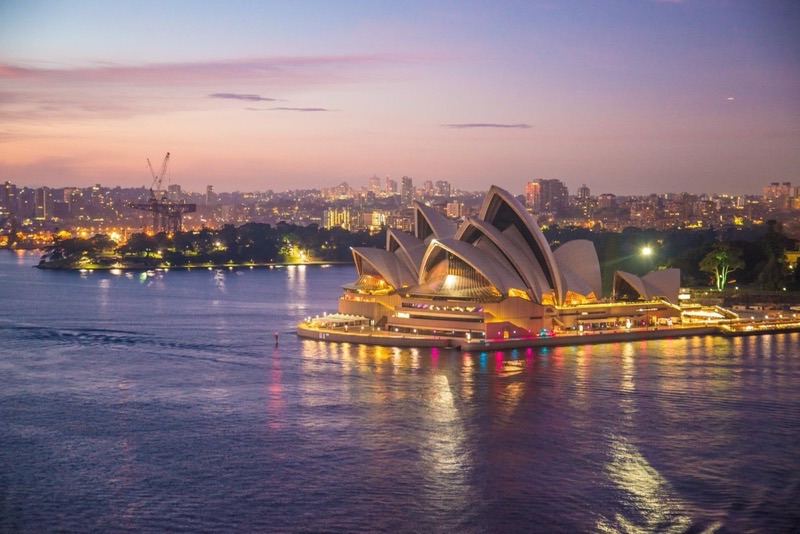
Australia's food scene is characterized by a strong café culture, particularly in Melbourne and Sydney, offering excellent coffee and brunch dishes. Fresh seafood, such as barramundi and prawns, is widely available. Asian influences, especially from Vietnamese and Thai cuisines, are common and often high quality. Traditional Australian fare includes meat pies, fish and chips, and BBQ. The wine regions, like the Barossa Valley or Margaret River, produce internationally recognized wines. While quality is high, dining out, especially beyond casual cafes, can be expensive, with a main dish often $30-50 AUD ($20-33 USD).
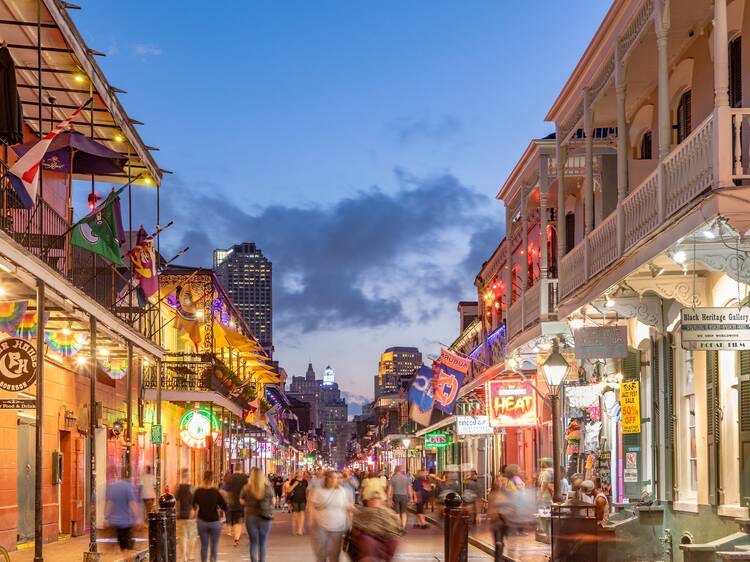
The United States offers a staggering range of food experiences, driven by its immigrant populations and regional specialties. From New York-style pizza and Jewish delis to New Orleans Creole and Cajun dishes, Texas BBQ, California-fresh cuisine, and Mexican food in the Southwest, the diversity is immense. Craft beer, wine, and cocktail scenes are prominent across the country, particularly in cities like Portland, San Diego, and Denver. Street food culture thrives in many cities, offering affordable and authentic options. A meal can range from a $5 taco truck special to a $50+ fine dining experience. The sheer variety, regional authenticity, and range of price points make the US a more compelling food destination overall. The United States simply offers a wider array of distinct, region-specific, and high-quality food experiences at all price points.
- Winner: United States
- Why: The United States provides unparalleled culinary diversity, with distinct regional cuisines, thriving ethnic food scenes, and a range of prices that cater to all budgets.
- Who this matters for: Foodies seeking specific regional specialties, diverse ethnic cuisine, and a broad range of dining experiences.
🏙️ City Life & Culture
Australian cities like Sydney and Melbourne offer a high quality of life with a relaxed pace, prominent cafe cultures, and extensive parklands. Sydney is known for its harbour,…
Australian cities like Sydney and Melbourne offer a high quality of life with a relaxed pace, prominent cafe cultures, and extensive parklands. Sydney is known for its harbour, the Sydney Opera House, and beach lifestyle. Melbourne is celebrated for its laneway cafes, arts scene, and sports. Brisbane and Perth offer warmer climates and access to natural attractions. While they have museums (e.g., National Gallery of Victoria) and performing arts, the urban experience feels less frenetic and less historically layered than many US cities. The cultural identity often revolves around outdoor activities, sports, and a generally laid-back attitude.
The United States features cities that are global cultural powerhouses. New York City, with its Broadway shows, world-class museums (Metropolitan Museum of Art, MoMA), and diverse neighborhoods, offers an intense urban experience. Washington D.C. is packed with free museums and national monuments. New Orleans provides a unique blend of music, food, and historical architecture. Chicago boasts impressive architecture and a strong jazz and blues heritage. Cities like Boston and Philadelphia are rich in American history. The US urban landscape is more varied, from the historical East Coast to the modern West Coast, offering more distinct cultural narratives and entertainment options. The United States provides a greater diversity and depth of urban cultural experiences, from history to entertainment to global influence.
- Winner: United States
- Why: US cities offer a greater depth of history, broader cultural diversity, and more globally influential entertainment and arts scenes.
- Who this matters for: Travelers seeking historical sites, diverse cultural experiences, and major entertainment options.
🚗 Getting Around
Traveling around Australia often involves long distances, making driving the preferred method for many, especially for exploring national parks and coastal routes. Car rental can…
Traveling around Australia often involves long distances, making driving the preferred method for many, especially for exploring national parks and coastal routes. Car rental can be expensive, starting from $60-100 AUD ($39-65 USD) per day, and fuel costs are comparable to the US. Remember to drive on the left side of the road. Domestic flights, particularly between major cities like Sydney, Melbourne, and Perth, are necessary for covering vast distances quickly but add to the budget. Public transport in cities like Sydney and Melbourne is efficient (e.g., Opal card for trains, buses, ferries), but intercity train travel is limited and generally slower and more expensive than flying.
In the United States, a car is often essential for exploring outside major urban centers, especially in areas like the National Parks of the West. Car rental prices are generally lower than in Australia, often starting from $30-70 USD per day, with fuel costs varying by state but usually reasonable. The national interstate highway system is extensive and well-maintained. Domestic flights are a popular and often affordable way to cover long distances between states, with airlines like Southwest and Frontier offering competitive fares. Public transport is excellent in a few major cities like New York City (subway, bus) and San Francisco (BART, Muni), but it is generally underdeveloped or non-existent in smaller towns and rural areas. The US wins for its cheaper car rentals, more affordable domestic flights, and a more comprehensive highway system.
- Winner: United States
- Why: The United States offers more affordable car rentals, a more extensive and efficient highway network, and generally cheaper domestic flights for covering its vast distances.
- Who this matters for: Road trippers, travelers on a budget for transport, and those who prefer self-guided exploration.
🏨 Accommodation
Accommodation in Australia, particularly in major cities or popular tourist spots, can be a significant budget item. Hostel dorm beds typically range from $40-60 AUD ($26-40 USD)…
Accommodation in Australia, particularly in major cities or popular tourist spots, can be a significant budget item. Hostel dorm beds typically range from $40-60 AUD ($26-40 USD) per night in Sydney or Melbourne, while private rooms in hostels or budget motels might start at $100-150 AUD ($65-98 USD). Mid-range hotels generally begin at $180-250 AUD ($117-163 USD). Airbnb and holiday rentals are popular, offering apartments and houses, but can also be costly. Booking in advance, especially during Australian school holidays or major events, is important to secure better rates.
The United States offers a more varied accommodation landscape with options for every budget across its diverse regions. Hostel beds in major cities can range from $40-80 USD, while budget motels (e.g., Motel 6, Super 8) are widely available across the country for $70-120 USD per night, offering basic but functional private rooms. Mid-range hotels like Holiday Inn or Marriott Courtyard typically start at $120-200 USD, though prices in cities like New York or San Francisco can easily double. Airbnb and vacation rentals are ubiquitous. The abundance of chain hotels and motels, particularly outside city centers, provides more consistent and often cheaper options for independent travelers. The United States offers a greater selection of budget-friendly private rooms, especially with its extensive network of motels.
- Winner: United States
- Why: The United States provides a broader range of accommodation types, including many affordable motel chains, offering more budget-friendly private room options nationwide.
- Who this matters for: Travelers seeking private rooms at a lower cost, or those prioritizing widespread availability of budget lodging.
🚨 Safety & Travel Ease
Australia is considered a very safe country for travelers, with low crime rates. The main safety concerns often relate to its natural environment: sun exposure, powerful ocean…
Australia is considered a very safe country for travelers, with low crime rates. The main safety concerns often relate to its natural environment: sun exposure, powerful ocean currents (swim between the flags), and unique wildlife (snakes, spiders, jellyfish in tropical waters). However, common sense and local advice usually mitigate these risks. Driving long distances in remote areas requires planning for fuel and supplies. The overall travel experience is straightforward due to clear signage, a well-developed tourism infrastructure, and English being the primary language. Travelers typically feel comfortable exploring independently, even in more remote regions. The laid-back culture contributes to a relaxed travel experience.
The United States is also largely safe for travelers, though safety can vary significantly by specific urban neighborhoods or rural areas. Major cities, like any large city globally, have areas with higher crime rates that travelers should research and avoid. Road safety is generally good, but driving conditions and laws vary by state. Gun violence is a concern for some international travelers, though it rarely affects tourists directly. Healthcare costs are exceptionally high without travel insurance. Navigating different state laws, sales taxes, and tipping culture can add layers of complexity for international visitors. Australia edges out the US for its consistently low crime rates across regions and less complex travel environment, making it feel more uniformly secure and easier to navigate.
- Winner: Australia
- Why: Australia offers a consistently safe and straightforward travel experience across the country, with fewer complex social dynamics or varied regional laws to navigate.
- Who this matters for: Solo travelers, families, and those who prioritize a very low-stress and uniformly secure travel environment.
🤝 Local Culture & People
Australian culture is often described as relaxed, egalitarian, and outdoors-focused. There's a strong emphasis on 'mate-ship,' sports (especially cricket and Australian Rules…
Australian culture is often described as relaxed, egalitarian, and outdoors-focused. There's a strong emphasis on 'mate-ship,' sports (especially cricket and Australian Rules Football), and enjoying the country's natural beauty. People are generally direct, friendly, and approachable. While Australia has a rich Indigenous history, discussions around it are still evolving within the broader societal context. The cultural experience tends to be quite cohesive across the country's major urban and regional centers, with a shared national identity often expressed through a love for the outdoors, barbecues, and a generally laid-back attitude. Pub culture is also prominent for socializing and casual dining.
The United States is a vast collection of regional cultures, making a single description difficult. From the East Coast's fast-paced, direct style to the Southern hospitality and slower pace, or the independent, outdoorsy West, cultural norms vary. American culture is often characterized by individualism, a strong work ethic, and a diverse array of subcultures influenced by immigrant communities. There is a deep historical context, particularly regarding civil rights and national founding, which shapes many cultural sites. Hospitality in the South, for example, is very different from interactions in a major Northern city. The sheer size and historical development mean you can find vastly different cultural experiences within the same country. This category is a tie because both offer rewarding, though different, cultural insights. Australia provides a more unified, relaxed experience, while the US offers an incredible spectrum of distinct regional cultures.
- Winner: Tie
- Why: Both countries offer compelling and distinct cultural experiences; Australia provides a cohesive, relaxed atmosphere, while the US delivers immense regional diversity.
- Who this matters for: Travelers seeking either a unified, friendly outdoor culture (Australia) or a vast array of distinct regional subcultures (United States).
🎯 The Decision Framework
Choose Australia If…
- You want to see kangaroos, koalas, and other unique wildlife in their natural environment.
- You dream of diving or snorkeling the Great Barrier Reef.
- You enjoy long coastal drives with vast, empty beaches.
- You prefer a consistently safe and low-stress travel environment.
- You want to experience a relaxed, outdoor-focused national culture.
- You are willing to spend more for a distinct, 'once-in-a-lifetime' natural adventure.
- You are comfortable with long flight times to reach your destination.
Choose United States If…
- You want unparalleled food diversity, from regional specialties to ethnic cuisine.
- You are interested in specific historical sites (e.g., Civil Rights, American Revolution).
- You want to explore iconic national parks like the Grand Canyon or Yellowstone.
- You prefer more affordable accommodation options, especially budget motels.
- You seek major entertainment hubs (Broadway, Hollywood, music festivals).
- You want a wider range of regional cultural experiences within a single country.
- You appreciate generally lower flight costs from many international starting points.
❓ Frequently Asked Questions
Which country is cheaper for a two-week trip?
For a two-week trip, the United States is generally cheaper, assuming you avoid the most expensive cities. A mid-range budget in Australia might be $180-250 AUD ($117-163 USD) per day, totaling $1,600-2,300 USD for two weeks, plus expensive flights. In the US, a similar style of travel outside major cities could be $120-180 USD per day, totaling $1,680-2,520 USD, but with cheaper flights from many locations.
How long should I plan to visit each country?
For Australia, due to long travel times and vast distances, a minimum of 3-4 weeks is recommended to see more than one region. For the United States, 2-3 weeks is sufficient to explore one specific region thoroughly (e.g., California, the Northeast, or the National Parks of the Southwest), but you'd need much longer for a broader overview.
Is driving a good way to get around in both countries?
Yes, driving is excellent for both, particularly for exploring natural areas and smaller towns. Australia requires left-hand side driving, while the US uses right-hand side. Both have extensive road networks. Car rental is generally cheaper in the US (starting $30-70 USD/day) than in Australia (starting $60-100 AUD/$39-65 USD/day).
Which country has better public transportation?
Major cities in both countries have functional public transport. Sydney and Melbourne have good train/bus/tram networks. However, for intercity travel and exploring outside urban centers, the US has more affordable and frequent domestic flights, and its highway system is more comprehensive for road trips. Australia's intercity public transport is less developed.
What are the visa requirements for US and Australian citizens?
US citizens traveling to Australia generally need an Electronic Travel Authority (ETA), which can be applied for online for a small fee, allowing stays up to 90 days. Australian citizens traveling to the US generally need an Electronic System for Travel Authorization (ESTA) through the Visa Waiver Program, also for a fee, allowing stays up to 90 days. Always check official government sites for current requirements.
Which country is better for a solo traveler?
Australia often feels more cohesive and safer for solo travelers, especially backpackers, with a well-established hostel network and 'backpacker trail' that makes meeting others easy. The United States can be good for solo travel in major cities or specific road trips, but less developed public transport outside urban hubs can make independent travel more challenging without a car.
What's the best time of year to visit each?
For Australia, spring (Sept-Nov) and autumn (March-May) are often ideal, avoiding peak summer heat and winter chill. Winter (June-Aug) is good for tropical north. For the United States, spring (April-May) and autumn (Sept-Oct) offer pleasant weather across many regions and fewer crowds. Summer (June-Aug) is popular for national parks but can be very hot, while winter (Dec-Feb) is cold in many areas but good for ski resorts.
Are there any specific health concerns for travelers?
In Australia, sun protection is critical due to high UV levels. Awareness of unique wildlife (snakes, spiders, marine stingers in tropical waters) and safe swimming practices (rip currents) is important. In the US, no specific endemic diseases are common for tourists, but travel insurance is essential due to extremely high healthcare costs for non-residents. Both countries have modern medical facilities.
Ready to plan your next trip?
Get a free custom itinerary for Australia, United States, or both — built from real traveler insights.
🎟️ Book Tours & Experiences
Hand-picked tours and activities for both destinations — book with free cancellation
Experiences via Viator — free cancellation on most tours