How we built this comparison
This page combines traveler discussion patterns, published price ranges, transit details, and seasonal data to make the Luang Prabang vs Siem Reap decision easier to resolve.
- Reviewed Reddit discussions from r/laos, r/travel, r/backpacking, r/solofemaletravellers, and r/solotravel.
- Checked numeric claims including accommodation ranges, food costs, transit routes, temple entry fees, and seasonal weather patterns.
- Each major section ends with a clear winner, reason, and traveler-use note.
Best read as a decision guide, not a universal truth: the right pick depends on your travel style, pace, and what kind of trip you actually want.
⚡ The TL;DR Verdict
This is a genuinely close call — but Siem Reap edges it for most first-time visitors. Angkor Wat is one of the world's great wonders and delivers an unmissable bucket-list moment. But Luang Prabang is the better destination for travelers who want transformation over spectacle — serene, UNESCO-protected, and one of the few places left in Southeast Asia that feels genuinely unhurried.
- 🏛️ Siem Reap wins: Angkor Wat, sheer visual impact, nightlife, more accommodation variety, easier logistics
- ⛩️ Luang Prabang wins: cultural authenticity, natural beauty, alms-giving ceremony, Kuang Si Falls, Mekong sunsets
- 💰 Budget: Both ~$35–60/day — Siem Reap has the $37 Angkor pass to factor in, Luang Prabang has pricier guesthouses
- ✈️ Logistics: Both require a stopover — neither has extensive direct international connections
⛩️ Choose Luang Prabang If…
You want a place that slows time down. Serene temples, the Mekong River, a pre-dawn alms ceremony, and waterfalls that look like screensavers. This one changes you.
🏛️ Choose Siem Reap If…
You want the most visually overwhelming experience in SE Asia. Angkor Wat at sunrise is one of the few things that genuinely exceeds the hype. Add good food and nightlife.
Quick Comparison
| Category | ⛩️ Luang Prabang | 🏛️ Siem Reap | Winner |
|---|---|---|---|
| Daily Budget (mid-range) | $35–60/day (USD-priced) | $30–60/day + Angkor pass | Tie |
| Budget Accommodation | $15–35/night | $10–25/night | Siem Reap |
| Main Attraction | 33 UNESCO wats + alms-giving ceremony | Angkor Wat complex (400 sq km) | Siem Reap |
| Cultural Authenticity | Deeply preserved Lao culture, UNESCO-protected | Touristy core, authentic outside town | Luang Prabang |
| Natural Beauty | Karst mountains, Mekong, waterfalls, lush jungle | Flat, mostly temples and rice fields | Luang Prabang |
| Food Scene | $1 night market buffet, Lao-French fusion | Good Khmer food, strong Western options | Luang Prabang |
| Nightlife | Quiet, closes midnight; Beer Lao by the river | Active Pub Street, bars, live music | Siem Reap |
| Walkability | Excellent — entire heritage zone on foot | Moderate — tuk-tuk needed for Angkor | Luang Prabang |
| Getting There | Via Bangkok or regional hubs (1–2 stops) | Via Bangkok or Kuala Lumpur (1 stop) | Siem Reap |
| Weather (Nov–Feb) | 18–30°C, cool and dry, perfect | 25–32°C, dry season, ideal | Tie |
| Visa | Laos e-visa: $35–50 most nationalities | Cambodia e-visa: $36 most nationalities | Tie |
| English Spoken | Basic in tourist areas | Widely spoken in tourist zone | Siem Reap |
⛩️ Temples & Culture
This is the core of both destinations — and they couldn't be more different in approach.
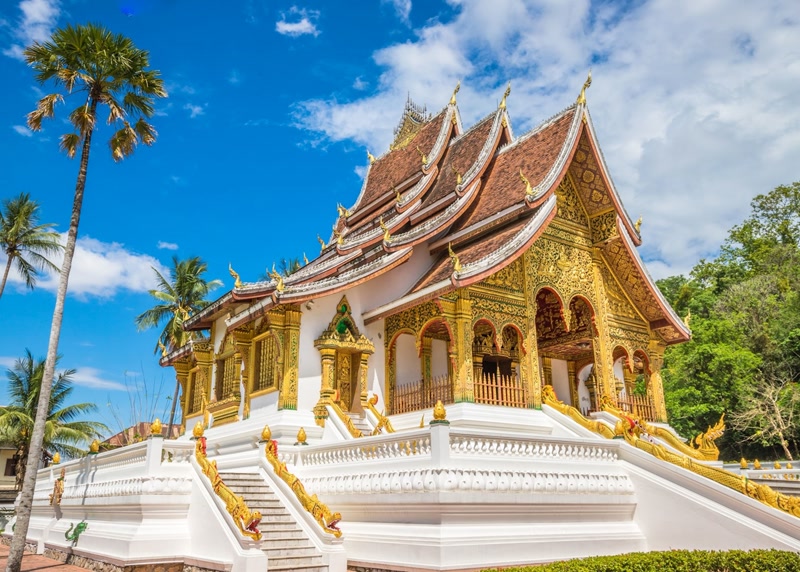
Luang Prabang's temples are intimate, golden, and embedded in daily life. The city has 33 wats, and the most extraordinary experience isn't any single temple — it's the Tak Bat alms-giving ceremony at dawn: hundreds of saffron-robed monks walk silently through the streets while residents offer sticky rice. It happens every morning around 5:30 AM and is one of Southeast Asia's most moving cultural rituals. Wat Xieng Thong, with its intricate glass mosaic walls and sweeping low roofline, is the architectural masterpiece. UNESCO regulations keep Luang Prabang frozen in amber — no McDonald's, no neon signs, no 7-Elevens inside the heritage zone. All signage must be painted gold on dark wood. The result is a city that genuinely feels like another century.
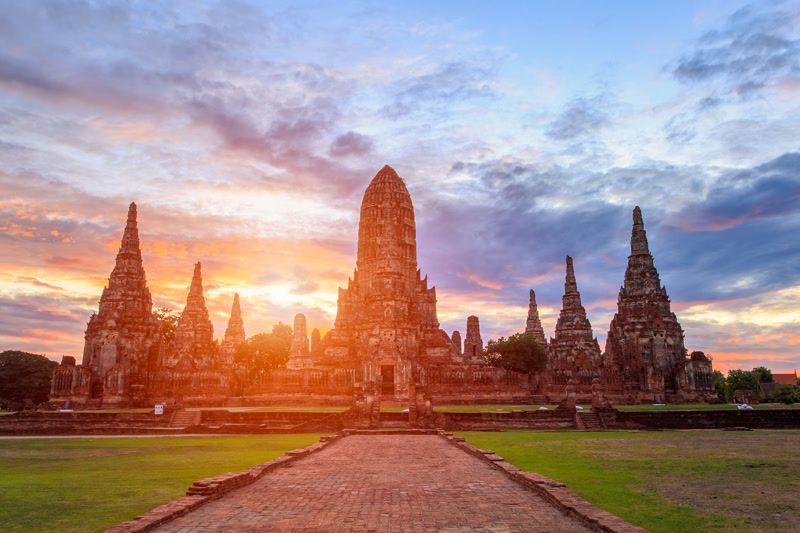
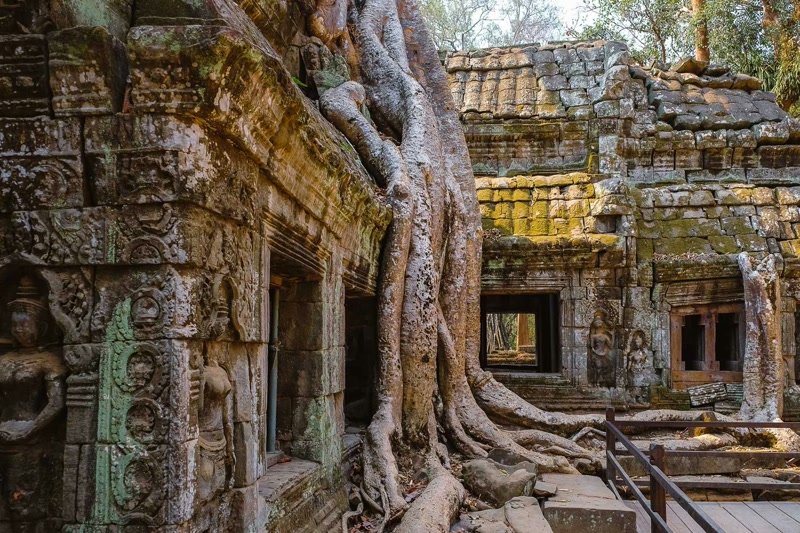
Siem Reap's temples operate at a completely different scale. The Angkor Archaeological Park covers 400 square kilometers and contains hundreds of temples — the most famous being Angkor Wat itself, a 12th-century masterpiece that is simultaneously the world's largest religious monument and one of its most beautiful. Angkor Wat at sunrise is one of the few travel experiences that genuinely exceeds the Instagram version. Then there's Bayon (the face towers), Ta Prohm (trees growing through crumbling walls), Banteay Srei (intricate pink sandstone), and the outer circuit temples that most visitors never reach. A 3-day pass ($62) is barely enough time.
🍜 Food & Dining
Both cities punch above their weight for food — but in completely different ways.
Luang Prabang's night market buffet is one of Southeast Asia's great culinary bargains: $1 for an all-you-can-eat spread of Lao dishes — laap (minced meat herb salad), mok pa (steamed fish in banana leaf), tam mak hoong (papaya salad), and sticky rice served in bamboo baskets. The French colonial legacy gives the city excellent baguettes and café culture — a baguette sandwich (khao jee) stuffed with Lao paté and herbs costs $1–2. Check out the best night market food in Luang Prabang for the full guide. Khao piak sen — a thick rice noodle soup that's Luang Prabang's version of pho — is outstanding at local stalls for $1.50–2. See the best khao piak sen spots for recommendations.
Siem Reap's food scene is more tourist-oriented but has genuine highlights. Fish amok — a Khmer classic of coconut curry steamed in banana leaf — is the must-try dish; see the best fish amok in Siem Reap. The Pub Street area has Western food in abundance (if you need a break from Khmer), but the real gems are in the Angkor Night Market and smaller restaurants on the back streets. Prices are slightly higher than Luang Prabang for equivalent quality — a sit-down Khmer meal costs $5–10.
💰 Cost Comparison
Both cities use USD as the de facto tourist currency, and both are cheaper than Thailand for equivalent experiences — but neither is truly "budget" in the SE Asia sense.
| Expense | ⛩️ Luang Prabang | 🏛️ Siem Reap |
|---|---|---|
| Budget guesthouse | $15–30/night | $10–25/night |
| Mid-range hotel | $40–80/night | $35–70/night |
| Street food meal | $1–3 | $2–5 |
| Sit-down dinner | $5–12 | $6–15 |
| Beer (local) | Beer Lao: $1–1.50 | Angkor Beer: $1–2 |
| Tuk-tuk (short) | $2–5 | $2–4 |
| Day trip | $15–25 (Kuang Si Falls) | $37–62 (Angkor 1–3 day pass) |
| Visa on arrival / e-visa | $35–50 | $36 |
| Budget daily total | ~$35–50/day | ~$30–50/day (excluding Angkor) |
The Angkor pass is the big differentiator: a 1-day pass is $37, 3-day is $62, 7-day is $72. It's non-negotiable — you can't visit Siem Reap without paying it. Factor this into your comparison. ATM fees in both cities are typically $3–6 per withdrawal; use a bank card that reimburses fees if possible.
🚃 Getting Around
Luang Prabang is one of the most walkable cities in Southeast Asia. The entire UNESCO heritage zone sits on a narrow peninsula formed by the Mekong and Nam Khan rivers — you can walk end-to-end in 30 minutes. Most wats, restaurants, and guesthouses are within a 10-minute walk of each other. Bicycles rent for $2–4/day and are the best way to explore. Tuk-tuks are available for the few outlying destinations (Kuang Si Falls, airport). Getting to Luang Prabang is the challenge: Luang Prabang International Airport receives direct flights from Bangkok (~1h), Chiang Mai (~1h), Vientiane, Hanoi, and a few regional hubs — but frequency is lower and prices are higher than Siem Reap. The famous slow boat from Huay Xai (2 days on the Mekong) remains one of SE Asia's great travel experiences.
Siem Reap requires transport for the main attraction. The Angkor complex starts 6km from the town center — tuk-tuks are the standard way to get around the temples ($15–20/day for a full day with a driver, who can also guide you between sites). Within town, tuk-tuks cost $2–4 for short trips. Grab (SE Asia's Uber equivalent) now operates in Siem Reap, bringing more price transparency. Siem Reap International Airport receives direct flights from Bangkok, Kuala Lumpur, Singapore, Phnom Penh, and several regional hubs — more options than Luang Prabang and generally cheaper. However: the airport recently relocated to a new facility 50km from town — factor in a $15–20 taxi rather than the old $6 ride.
🌸 Best Time to Visit
Both destinations share a similar ideal travel window, though the specifics differ slightly.
Luang Prabang sits at ~300m elevation on the Mekong, which moderates temperatures year-round. November–February is perfect: 18–30°C, almost no rain, clear skies. The Mekong is at its most navigable. March–April gets hot (up to 38°C) and the region can get hazy. May–October brings monsoon rains — lush and beautiful but waterfalls can flood access roads (Kuang Si Falls may be inaccessible in heavy rain periods). The Lao New Year (Pi Mai, April 13–15) is one of the most exuberant celebrations in SE Asia — massive water fights throughout town.
Siem Reap and Angkor sit in Cambodia's hot lowlands at roughly 20m elevation. November–March is the sweet spot: 25–32°C, dry, low humidity. Angkor Wat is spectacular in the dry season — the moats are full and the stone glows golden. April–May is extremely hot (up to 40°C) and uncomfortable for long temple walks. June–October is monsoon season — heavy afternoon rains, lower tourist crowds, cheaper prices, and the Angkor temples reflect in flooded grounds for dramatic photography. Just wear quick-dry clothes and carry an umbrella.
🏨 Where to Stay
In Luang Prabang, the entire city is compact enough that location matters less than in bigger cities. The main peninsula (UNESCO heritage zone) is where you want to be — close to everything, walkable, and atmospheric. Even budget guesthouses here tend to be charming wooden villas with gardens, not concrete blocks. Budget guesthouses run $15–30/night; mid-range boutiques (in beautiful French colonial buildings) run $50–100/night; luxury properties like Amantaka or Belmond La Résidence Phou Vao charge $300–600+. The side streets off Sisavangvong Road (the main tourist drag) offer the best combination of atmosphere and value.
In Siem Reap, accommodation is better value and more varied. The Pub Street / Old Market area is the social hub — walkable to restaurants, bars, and tuk-tuks. The French Quarter (near the river) is quieter and charming. Budget hostels start at $5–8/night (dorms), guesthouses from $15/night, mid-range hotels $35–80/night, luxury resorts (Amansara, etc.) $500–1,000+. Boutique "riad-style" properties with pools are excellent value at $50–80/night and widely available. The new airport location 50km from town hasn't changed accommodation patterns — town-center properties are still the best base.
🎒 Day Trips
Luang Prabang day trips are fewer but high-impact. Kuang Si Falls — tiered turquoise waterfalls 35km from town — are legitimately among the most beautiful in all of SE Asia; entry costs 20,000 LAK (about $1), tuk-tuk round trip $15–20. The pools below the main falls are swimmable and picture-perfect. Pak Ou Caves — riverside limestone caves containing thousands of Buddha statues — are reached by a 2-hour long-tail boat journey up the Mekong ($20–30 shared, includes a stop at a whisky village). Mount Phousi (328 steps, 30-minute climb) offers panoramic sunset views over the Mekong that are among the best free experiences in Laos. Village tours into the surrounding hills reveal traditional weaving villages and Lao hill tribe culture.
Siem Reap day trips beyond Angkor include: Tonlé Sap Lake (Southeast Asia's largest freshwater lake, 15km from town) with floating villages where entire communities live on water year-round. Banteay Srei temple (37km, pink sandstone carvings of extraordinary delicacy, often called the "Jewel of Khmer Art") and Beng Mealea (70km, jungle-swallowed temple that feels like Angkor before it was excavated) are excellent half-day additions. The Angkor complex itself is so vast that many visitors use Day 2 and Day 3 of their pass to visit the outer circuit temples they missed on Day 1.
🎉 Nightlife & Social Scene
Luang Prabang's nightlife is deliberately minimal — and that's a feature, not a bug. UNESCO heritage regulations, combined with Lao Buddhist culture, keep the city quiet after dark. Everything closes by midnight; the main "scene" is having a Beer Lao (the excellent local lager, ~$1–1.50) while watching the sunset over the Mekong from one of the riverside bars. The famous "bowling alley street" (a road with a few late-night bars and an actual bowling alley) is the closest thing to nightlife, and even that wraps up by 12:30 AM. Evenings in Luang Prabang are best spent: sunset on Mount Phousi, dinner at a river terrace restaurant, a quiet beer, early to bed to catch the 5:30 AM alms-giving ceremony.
Siem Reap's nightlife is the opposite: Pub Street is a full-on backpacker party zone, open until 3–4 AM, with cheap cocktails ($2–4), live music, and the kind of energy you'd find in Bangkok's Khaosan Road. Beyond Pub Street, there are rooftop bars, cocktail lounges, and a growing craft beer scene. The Angkor Night Market and surrounding food streets also buzz with activity until 11 PM. If nightlife matters to you, Siem Reap wins decisively.
🌿 Nature & Landscapes
This is where Luang Prabang and Laos as a whole pull decisively ahead.
Luang Prabang is surrounded by extraordinary nature. The Mekong River and its tributary the Nam Khan frame the city, and the surrounding landscape is karst limestone mountains covered in dense jungle. Kuang Si Falls — 30+ meters of tiered turquoise water flowing over limestone terraces — is world-class. The Mekong sunsets from the city are spectacular every evening. The slow boat journey from Huay Xai (the Thai border crossing, ~4h from Chiang Rai) offers two days of scenery that travelers rave about for years: passing through jungle hills, stopping at riverside villages, watching fishermen cast nets from wooden boats. Laos has far more dramatic geography than Cambodia's flat plains.
Siem Reap and Cambodia's landscape around the temples is predominantly flat. The Tonlé Sap lake ecosystem is genuinely impressive — it expands to 16,000 sq km in wet season and hosts hundreds of species of birds and fish — but for dramatic natural scenery, Cambodia doesn't compete with Laos. The Cardamom Mountains in western Cambodia and Kep/Kampot in the south are beautiful, but they're separate trips from Siem Reap.
🔀 Why Not Both?
Combining Luang Prabang and Siem Reap is absolutely doable on a 2-week SE Asia trip — it just requires a bit of transit planning. There is no direct flight between them. The standard routing:
- Day 1–4: Fly to Luang Prabang (via Bangkok or Chiang Mai) — alms-giving ceremony, temples, Kuang Si Falls, Mekong sunset
- Day 5: Fly Luang Prabang → Bangkok (1h), Bangkok → Siem Reap (1h 15m) — transit day
- Day 6–9: Siem Reap — Angkor Wat over 2–3 days, Pub Street, Tonlé Sap
Budget roughly $80–120 for the connecting flights (LPQ–BKK + BKK–REP). This is the most efficient combination for a first SE Asia trip that wants both cultural immersion (Luang Prabang) and historical spectacle (Angkor). See also: Chiang Mai vs Luang Prabang if you're considering adding northern Thailand, and Vietnam vs Thailand for the broader regional question.
🎯 The Decision Framework
Still can't decide? Here's how to think about it:
⛩️ Choose Luang Prabang If…
- You want authenticity over spectacle
- You've already seen Angkor Wat
- Natural beauty and landscapes matter to you
- You prefer quiet evenings to late nights
- You want to wake up at 5:30 AM for a ceremony that changes your perspective
- You're combining with Chiang Mai or northern Thailand
- You want a place that will make you move more slowly
- French-Lao food culture appeals to you
🏛️ Choose Siem Reap If…
- You haven't seen Angkor Wat — go. Just go.
- This is your first SE Asia trip
- Nightlife and social energy matter to you
- You prefer better-value accommodation
- You want more flight connectivity for onward travel
- You're combining with Vietnam or the Mekong Delta
- You have only 2–3 days and want maximum impact
- Photography of ancient ruins is a priority
❓ Frequently Asked Questions
Is Luang Prabang or Siem Reap better for first-time Southeast Asia visitors?
Both are excellent first-timer destinations, but for different reasons. Siem Reap wins on sheer impact: Angkor Wat is one of the world's great wonders, and the town has comfortable infrastructure. Luang Prabang wins on atmosphere and authenticity — it's UNESCO-protected, serene, and genuinely different from anywhere else in SE Asia. Reddit consensus: if you want a "wow moment," Angkor Wat delivers it. If you want a place that changes your perspective on time and life, Luang Prabang does that.
How far apart are Luang Prabang and Siem Reap?
About 900 km as the crow flies, but there's no direct flight. The most practical route is Luang Prabang → Bangkok (1h), then Bangkok → Siem Reap (1h 15m) — two separate flights totaling 4–6 hours with layover. Overland routes exist but take 2+ days via multiple countries and are rarely worth the time unless you're doing a long SE Asia circuit.
Which is cheaper, Luang Prabang or Siem Reap?
They're similarly priced — both USD-dominant and slightly pricier than Thailand for what you get. Budget travelers spend $30–50/day in Siem Reap (including a 1-day Angkor pass at $37). Luang Prabang runs $35–55/day — the night market buffet is a spectacular $1, but accommodation and restaurants tend to be pricier. The Angkor pass ($37/day, $62/3 days) is the single biggest cost differential.
How many days do you need in Luang Prabang vs Siem Reap?
Minimum 3 days each — ideally 4. For Luang Prabang: Day 1 for the alms-giving ceremony at dawn, main wats, and sunset on Phousi; Day 2 for Kuang Si Falls; Day 3 for slow boat, village tours, or Pak Ou Caves. For Siem Reap: 2–3 days at Angkor (sunrise at Angkor Wat, Bayon, Ta Prohm), plus one day to explore the town, Pub Street, and floating villages.
Is Angkor Wat worth visiting from Siem Reap?
Yes — Angkor Wat is one of the few travel experiences that genuinely exceeds expectations. The entire Angkor complex spans 400 square kilometers of temples; you'd need weeks to see everything. A 3-day pass ($62) gives you proper time at the main sites: Angkor Wat itself, the face towers of Bayon, the jungle-swallowed Ta Prohm, and the outer circuit. Most travelers say it's a genuine bucket-list moment.
What is the alms-giving ceremony in Luang Prabang?
Tak Bat is a daily pre-dawn procession where saffron-robed monks walk silently through Luang Prabang's streets while local residents offer sticky rice and food. It happens every morning around 5:30–6:00 AM and is one of Southeast Asia's most moving cultural experiences. Visitors are welcome to observe respectfully (maintain silence, dress modestly, don't use flash). It's free, and it alone is worth making the trip to Luang Prabang.
Is Siem Reap safe for solo travelers?
Yes — Siem Reap is very safe for solo travelers, including solo women. The city is heavily touristic, English is widely spoken, and tuk-tuk drivers are generally trustworthy (negotiate prices upfront). The main hazards are standard tourist-area ones: overpriced tuk-tuks, aggressive vendors near temple entrances, and occasional petty theft in crowded areas. Multiple Redditors call it one of the friendliest cities in SE Asia.
Can you visit both Luang Prabang and Siem Reap in one trip?
Yes, but they require separate flights via Bangkok — budget a full day for transit. The standard combination on a 2-week SE Asia trip: 3–4 nights Luang Prabang + 3–4 nights Siem Reap, with Bangkok as the hub between them. Most travelers who do both say it's worth the logistics. If time is short and you must pick one: Angkor Wat for visual impact, Luang Prabang for cultural transformation.
Ready to Plan Your Trip?
Get a personalized itinerary for Luang Prabang, Siem Reap, or the perfect combination of both — tailored to your travel style and budget.
🎟️ Book Tours & Experiences
Hand-picked tours and activities for both destinations — book with free cancellation
Experiences via Viator — free cancellation on most tours