How we built this comparison
This page combines traveler discussion patterns, published price ranges, transit details, and seasonal data to make the Yangon vs Mandalay decision easier to resolve.
- Reviewed Reddit discussions from r/myanmar, r/travel, r/solotravel, r/backpacking, r/Shoestring, and first-hand trip reports from 2024–2025.
- Checked numeric claims including accommodation ranges, food costs, transit routes, entry fees, and seasonal weather patterns.
- Addressed Myanmar's 2025–2026 safety situation directly with current traveler reports.
- Each major section ends with a clear winner, reason, and traveler-use note.
Best read as a decision guide, not a universal truth: the right pick depends on your travel style, risk tolerance, and what kind of Myanmar experience you're after.
⚡ The TL;DR Verdict
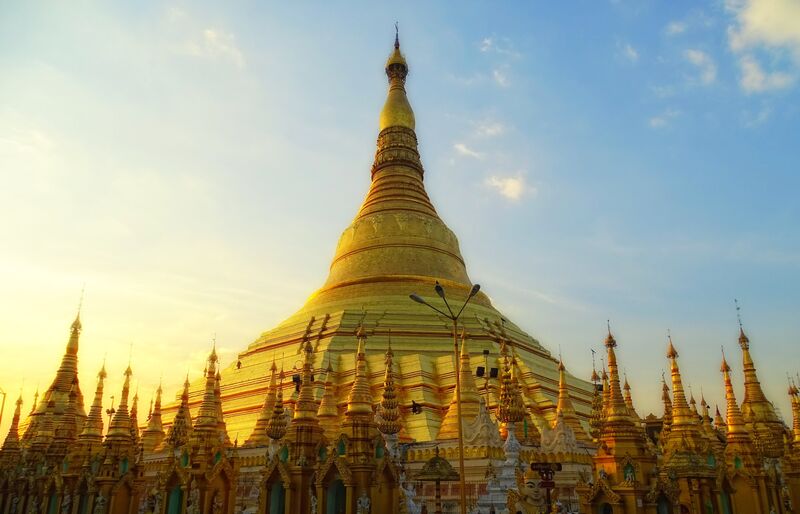
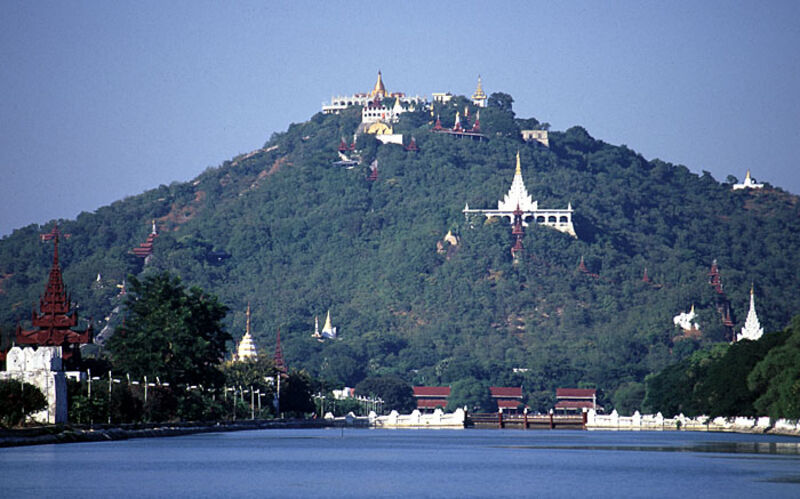
Yangon for food, colonial atmosphere, and easier logistics. Mandalay for temples, royal history, and cultural depth. If you're visiting Myanmar for the first time and have limited days, Yangon is the safer and more accessible choice: better airport connections, Shwedagon Pagoda (one of Asia's greatest religious sites), and a more functional city infrastructure for foreign travelers. Mandalay rewards travelers who want to go deeper — it's the gateway to Bagan, home to the last royal palace, and the center of Myanmar's lacquerware and silk weaving crafts. The honest truth in 2025–2026: Yangon is meaningfully safer and easier than Mandalay, where proximity to conflict zones adds a level of caution that most first-time Myanmar visitors don't need.
Choose Yangon if: First Myanmar trip. You want Shwedagon Pagoda plus great street food. You prefer lower-risk logistics and more reliable city infrastructure.
Choose Mandalay if: You've done Yangon. You want royal palaces, temple-hill views, and a base for Bagan. You're comfortable with more unpredictable conditions.
Quick Comparison
| Category | 🏙️ Yangon | 🏯 Mandalay | Winner |
|---|---|---|---|
| Daily Budget (mid-range) | $35–55/day | $30–50/day | Mandalay |
| Budget Accommodation | $15–30/night | $10–25/night | Mandalay |
| Main Landmark | Shwedagon Pagoda (world-class) | Mandalay Hill + Royal Palace | Yangon |
| Food Scene | Myanmar's best: mohinga, Indian, Chinese, Shan | Good local spots, fewer options | Yangon |
| Colonial Architecture | Extensive British-era buildings in downtown | Very limited | Yangon |
| Royal History | Limited | Last capital of Burmese kingdom | Mandalay |
| Temple Count | Moderate (Shwedagon, Sule, Chaukhtatgyi) | High (Mandalay Hill, Kuthodaw, Mahamuni) | Mandalay |
| Proximity to Bagan | ~1h flight or ~8h bus | ~5h bus or ~1h flight | Mandalay |
| International Airport | Yangon International (best connections) | Mandalay International (fewer routes) | Yangon |
| Safety (2025–2026) | Safer — away from active conflict zones | More complex — near Sagaing conflict area | Yangon |
| ATM Reliability | Moderate (best in Myanmar) | Low | Yangon |
| Nightlife | Limited but present | Very limited (most closes by 9pm) | Yangon |
⛩️ Temples & Landmarks
This is the core reason most travelers visit Myanmar — and both cities deliver extraordinary religious architecture, just at very different scales and styles.
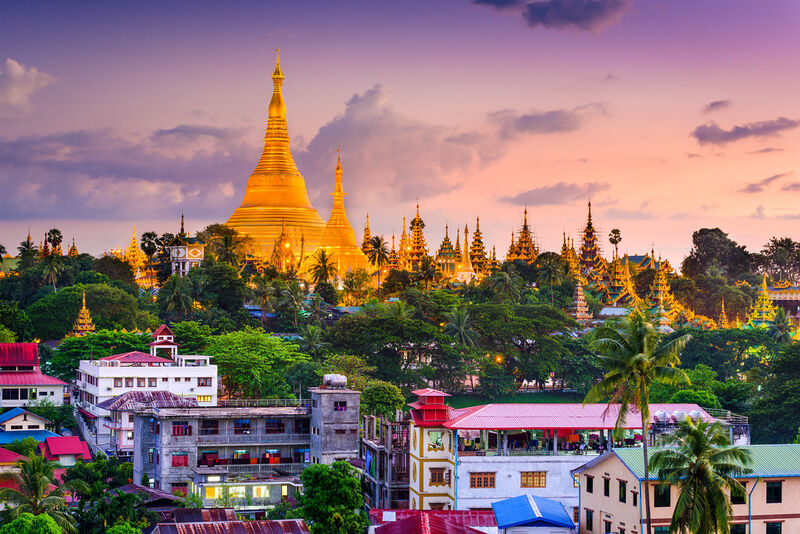
Yangon's crown jewel is the Shwedagon Pagoda — one of the most sacred Buddhist sites in the world and arguably Myanmar's single greatest sight. The main stupa soars 98 meters and is clad in genuine gold, surrounded by dozens of smaller shrines, Buddha images, and prayer halls spread across a massive hilltop platform. Entry costs 25,000 kyat (~$12) for foreigners. Go at sunset — the complex comes alive with worshippers, monks, and the golden stupa glowing in the fading light in a way that photographs cannot capture. Complement with the Sule Pagoda (right in the city center, 2,500 years old, with a traffic roundabout circling it), the reclining Buddha at Chaukhtatgyi Pagoda (90 meters long, one of Myanmar's largest), and a walk through the colonial downtown district — a remarkably intact collection of British-era buildings now half-reclaimed by tropical vegetation.
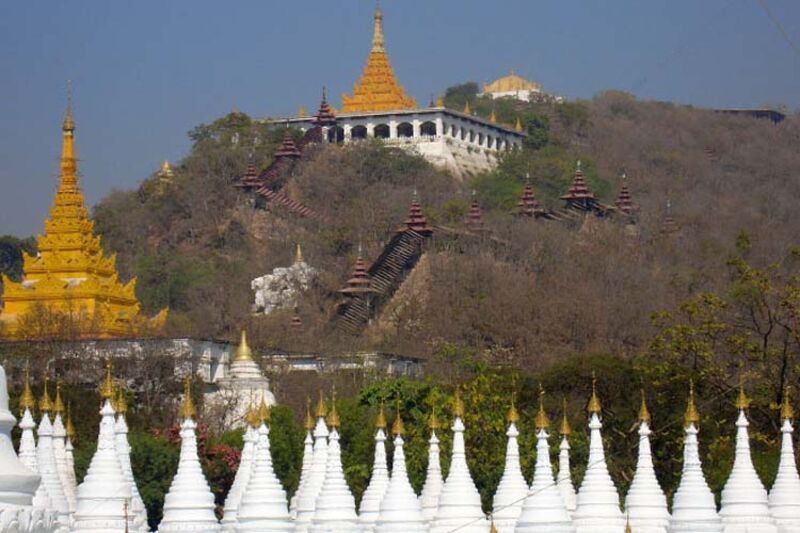
Mandalay's highlights are more spread out but collectively more numerous. Mandalay Hill (236 meters, accessible by covered escalator or a 1,729-step climb lined with pagodas) offers panoramic views of the city, the Irrawaddy plain, and distant hills — sunrise here is magical. Mandalay Royal Palace (reconstructed after WWII damage, inside a 2km moated compound) is the last royal palace of the Burmese kingdom; the reconstruction is partly wooden but the scale impresses. Mahamuni Buddha Temple contains one of Myanmar's most revered images — a solid bronze Buddha figure that male devotees cover daily in gold leaf (so thick from centuries of application that it has lost its features). Kuthodaw Pagoda holds what's called the world's largest book: 729 marble slabs inscribed with the entire Tipitaka Buddhist canon, each housed in its own small pagoda. The silk weaving village of Amarapura (20 min south) and the teak bridge of U Bein (the world's longest at 1.2km, across a lake) are both within day-trip distance.
🍜 Food & Dining
Myanmar's food scene is genuinely underrated globally — and both cities give you access to it, though Yangon has the distinct edge.
Yangon is Myanmar's culinary capital. The city's diversity reflects its history as a port city and colonial capital: you'll find genuine Burmese regional cuisines sitting next to Indian biryani stalls, Chinese noodle shops, and Shan noodle houses all within a few blocks of each other. Mohinga — Myanmar's national breakfast dish, a rich fish-based soup with rice noodles, banana stem, and crispy onions — is best in Yangon, where you'll find family-run stalls serving bowls for $0.50–1. The teashops (sa-moke hkain) are a Yangon institution: arrive for breakfast, pay for tea (free refills), and order fried items, samosas, and pa-la-ta (flaky flatbread) off wandering trays. The Indian quarter around Mahabandoola Park serves excellent biryani and curry for $2–4. The Chinese night market around Chinatown fills with $1–3 street food every evening. Sit-down Burmese restaurants offer full meals with multiple curries, salads, and rice for $4–8.
Mandalay has its own specialties worth seeking out. Mandalay mont di — thin rice noodles in a mildly spiced fish soup with chickpea fritters, a distinctly different bowl from Yangon's mohinga — is the local breakfast staple at $0.50–1. Nan gyi thoke (thick rice noodle salad with chicken, chickpea powder, and fish sauce) is found at market stalls for $1. The Myoma market is the city's food hub: Mandalay's version of a wet market where locals buy everything from fresh produce to street snacks. Mandalay also has several craft beer and riverside restaurants, though the selection is thinner than Yangon's. Most restaurants close by 8–9 PM due to the current security situation.
💰 Cost Comparison
Both cities are inexpensive by Southeast Asian standards, though Myanmar's cash-only reality means the most important "cost" is how much USD you bring.
| Expense | 🏙️ Yangon | 🏯 Mandalay |
|---|---|---|
| Budget guesthouse | $15–30/night | $10–25/night |
| Mid-range hotel | $40–80/night | $30–60/night |
| Street food meal | $0.50–2 | $0.50–2 |
| Sit-down restaurant | $3–8 | $3–7 |
| Beer (local Myanmar Beer) | $1–2 | $1–2 |
| City taxi (Grab) | $1–5 (Grab works) | $2–8 (negotiate) |
| Shwedagon entry | 25,000 kyat (~$12) | N/A |
| Mandalay Palace entry | N/A | 10,000 kyat (~$5) |
| Mandalay Hill | N/A | Free (covered escalator) |
| Budget daily total | ~$25–45/day | ~$20–40/day |
The cash reality applies to both cities. Myanmar's banking system remains severely disrupted post-2021. Yangon has the most ATMs and the highest success rate — some KBZ Bank and Ayeyarwady Bank machines work for international Visa/Mastercard, but failure is common. In Mandalay, one 2024 traveler reported currency exchange at a ratio of 1€ = 4,600 kyat (vs. 2,300 official rate) — finding a reliable exchange shop matters. Bring enough USD in clean, undamaged small bills to cover your whole trip. The black market exchange rate effectively makes everything significantly cheaper than official pricing suggests.
🚌 Getting Around
How you move around each city reflects each destination's character — and the contrast is significant.
Yangon has Grab — the region-wide ride-hailing app works in Yangon and makes getting around the sprawling city straightforward. Airport to downtown costs 15,000–20,000 kyat ($7–10) by Grab. City taxi rides run $1–5 for most trips. The downtown core is walkable for short distances, but Yangon is a large, sprawling city (population 8+ million) — you'll need transport for anything beyond the immediate city center. The Circular Train is a famous local experience: a slow (3-hour) loop around Yangon's suburbs used mainly by locals, costing just 200 kyat ($0.10). It's not efficient transport but it's a genuine local experience. Buses are dirt cheap but complex for foreign visitors without local knowledge.
Mandalay requires more negotiation. Grab doesn't operate in Mandalay — you'll hire motorcycle taxis (5,000–10,000 kyat/trip depending on distance), tuk-tuks, or taxis negotiated in advance. A full-day hired car with driver for the Mandalay temple circuit (Mandalay Hill, Royal Palace, Mahamuni, Kuthodaw) costs $30–50/day and is the most efficient way to cover the spread-out sites. For Amarapura and U Bein Bridge, a tuk-tuk half-day runs $10–20. Renting a bicycle (3,000–5,000 kyat/day) works for the city center.
✈️ Getting There & Between Cities
Yangon is Myanmar's primary international gateway; Mandalay is the secondary hub and makes more sense as a departure point after visiting Bagan.
Reaching Yangon: Most international travelers arrive at Yangon International Airport (RGN) — it has the most connections including Bangkok (1h on Thai Airways, AirAsia), Singapore (2.5h), Kuala Lumpur (2h), Dubai (7h), and a few others. From Bangkok, budget $60–150 return. From Singapore, $80–200 return. Yangon Airport is 16km from downtown; taxi costs $7–12 by Grab, or $15–25 from the official taxi stand. Apply for a Myanmar e-visa at evisa.moip.gov.mm — $50, takes 2–3 business days.
Reaching Mandalay: Mandalay International Airport (MDL) has fewer but growing connections — direct flights from Bangkok on Bangkok Airways (~1.5h), plus regional connections via Chiang Mai and domestic connections from Yangon (~1h, $30–80 on Air KBZ or Myanmar Airways). Many travelers fly into Yangon and reach Mandalay via domestic flight, overnight bus, or the famous overnight train. The overnight bus from Yangon to Mandalay (8–10h, $8–15 on Aung Mingalar Bus Terminal express services) is the popular budget option — departs evenings, arrives mornings. Book via mmbusticket.com or through your hotel. The Mandalay Express train takes 15h but is a scenic experience.
Between Yangon and Mandalay: Domestic flight ($30–80, ~1h) is most practical. Bus ($8–15, 8–10h) is fine for budget travelers. Train (15h) is for the experience, not efficiency.
🌸 Best Time to Visit
Both cities share Myanmar's same three-season climate pattern, though Mandalay's inland location makes it significantly hotter and drier than Yangon.
November to February is ideal for both: temperatures of 18–30°C, almost no rain, clear skies, comfortable humidity. This is peak season — expect more tourists and slightly higher prices. Yangon at this time is breezy and pleasant; Mandalay can have cool mornings (sometimes sweater weather in December) followed by warm afternoons.
March to May is brutal, especially in Mandalay. Yangon hits 35–40°C; Mandalay regularly touches 42–44°C, earning its reputation as one of Southeast Asia's hottest cities. Unless you have a high heat tolerance, this window is very uncomfortable. The air gets hazy from agricultural burning in March–April, degrading visibility.
June to October is monsoon season. Yangon (coastal climate) gets heavy rain — flooded streets, high humidity, frequent downpours. Mandalay is in Myanmar's dry zone so it gets less rain than Yangon but the heat remains high. Crowds thin dramatically and accommodation prices drop 20–40%. Some minor flooding occurs in Yangon.
Thingyan (Water Festival/Myanmar New Year) in mid-April is one of Southeast Asia's great street celebrations — massive water fights, music, and dancing for 4–5 days. Yangon's celebration is the biggest. Book months ahead and expect everything to shut down during the festival itself.
🏨 Where to Stay
Both cities have distinct neighborhood choices that shape your experience significantly.
Yangon neighborhoods to consider:
- Downtown/Chinatown area — the most walkable zone, near Sule Pagoda and the colonial buildings. Budget guesthouses $15–30/night, mid-range $40–70. Best for first-timers who want to explore on foot.
- Near Shwedagon Pagoda — staying close to Myanmar's greatest sight lets you visit at multiple times of day (sunset and dawn are both spectacular). Mid-range $40–80/night. Quieter residential area.
- Dagon/Pyay Road — upmarket hotels, expat restaurants, embassies. $80–200/night. Safer at night but isolated from local atmosphere.
Mandalay neighborhoods:
- City center (26th–30th Street area) — most guesthouses, restaurants, and easy access to Mandalay Hill. Budget $10–25/night. The practical choice.
- Near Mandalay Royal Palace — slightly more upscale. Mid-range $30–60/night. The moat-side location is atmospheric.
- Avoid west of the Irrawaddy — Sagaing and Mingun, which were worth visiting pre-2021, are now in conflict-adjacent areas. Hotels will advise you not to go.
🛡️ Safety & Practical Tips
This section requires honest assessment. Both cities are in Myanmar, which has been in civil conflict since the February 2021 military coup. The safety picture is meaningfully different between them.
Yangon (2025–2026): Yangon is in central Myanmar, away from active conflict zones concentrated in border regions (Rakhine, Kachin, Shan, Chin States) and, more critically for Mandalay visitors, in the Sagaing region across the Irrawaddy. Multiple travelers report visiting Yangon in 2024–2025 without incidents. The city feels relatively normal for visitors staying in tourist areas. There are occasional political demonstrations and some military checkpoints on major roads, but violence in Yangon itself has been limited. Standard city precautions apply: watch your belongings, don't photograph military installations, follow local guidance.
Mandalay (2025–2026): Mandalay is closer to active conflict. One October 2024 traveler from r/travel reported their hotel explicitly advising: (1) don't cross to the west bank of the Irrawaddy (Sagaing area, which has seen fighting), and (2) don't go out after 10 PM due to rebel attacks on the royal palace area at night. A March 2025 earthquake caused significant infrastructure damage — some ancient buildings damaged, though most major tourist sites are reported as intact. The overall risk level is higher than Yangon, and travelers should take local safety guidance from their accommodation seriously.
Practical tips for both cities:
- Cash is king. Bring enough USD in small, clean bills ($1, $5, $10, $20) to cover your entire stay plus buffer. ATMs fail unpredictably.
- VPN essential. Facebook, Instagram, WhatsApp blocked by government. NowVPN is what locals recommend; have it installed before arrival.
- SIM cards: Available at Yangon airport ($3–5 for MPT or Ooredoo with data). Buy in Yangon — Mandalay options are more limited.
- Power cuts: Frequent across Myanmar. Avoid elevators; budget hotels may lack backup generators for A/C.
- Travel insurance: Buy coverage that explicitly covers "politically unstable regions."
🌿 Day Trips & Surrounding Attractions
Both cities offer excellent day trip options, though Mandalay's options are particularly compelling.
From Yangon: The nearby town of Bago (80km, 2h by bus) is a worthwhile half-day trip with several impressive pagodas including the Shwemawdaw (golden stupa taller than Shwedagon) and the Hintha Gon shrine. The beach towns of Chaung Tha and Ngwe Saung (3–4h) offer sand and sea, though these require more planning. The Circular Train around Yangon's suburbs (3h, 200 kyat) is a slow local experience for those who want to see everyday Myanmar life. Yangon itself is large enough that the Shwedagon, colonial district, Botataung Pagoda, and Chinatown fill 2–3 full days without needing to leave the city.
From Mandalay: More compelling day trips. U Bein Bridge in Amarapura (20 min south) — the world's longest teak bridge (1.2km) across Taungthaman Lake — is best at sunset with monks crossing and fishermen in longboats below. Inwa (Ava) — another former royal capital, reached by short ferry, where you ride horse carts past crumbling monasteries and leaning watchtowers. Sagaing Hill (formerly a top day trip) is currently off-limits for most visitors due to conflict. Bagan (5h by bus, 1h by plane) is the obvious big excursion — 2,000+ ancient pagodas on a plain, legitimately one of the world's great archaeological sites. Many travelers base themselves in Mandalay specifically to reach Bagan more efficiently. See our Bagan vs Luang Prabang comparison for a deeper dive.
🔀 Why Not Both?
For most travelers who've committed to Myanmar, visiting both Yangon and Mandalay is the obvious right answer — and the logistics are manageable.
The classic Myanmar circuit:
- Days 1–3: Yangon — Shwedagon at sunset, colonial downtown walk, Chinatown breakfast, Circular Train, Bogyoke Market
- Day 4: Overnight bus Yangon → Bagan (8–10h, departs evening)
- Days 5–7: Bagan — e-bike the 2,000 pagodas, sunrise from a hilltop, optional hot air balloon
- Day 7 or 8: Bus or domestic flight Bagan → Mandalay (5h bus or 1h flight)
- Days 8–10: Mandalay — Mandalay Hill sunrise, Royal Palace, Mahamuni Buddha, U Bein Bridge at sunset, Inwa horse cart
- Day 10: Fly home from Mandalay International Airport (Bangkok, Singapore, or back to Yangon first)
This 10-day circuit is Myanmar's greatest hits without backtracking. Budget $600–900 total for accommodation, transport, food, and entry fees. International flights add $150–400 depending on origin. See also: Bagan vs Luang Prabang if you're deciding whether to add Bagan separately.
🎯 The Decision Framework
Still can't decide? Here's how to think about it:
🏙️ Choose Yangon If…
- This is your first Myanmar trip and you want the best intro with lowest friction
- Food matters to you — Yangon has Myanmar's most diverse, exciting food scene
- You're visiting for 2–3 days and want one iconic sight (Shwedagon delivers)
- You prefer reliable Grab/taxi options over negotiated transport
- You have any concern about safety and want to minimize risk
- You love colonial architecture and urban walking
- You're arriving on an international flight (Yangon has the best connections)
- You want to experience modern Myanmar city life alongside the religious sites
🏯 Choose Mandalay If…
- You've been to Yangon before and want to go deeper into Myanmar
- Temples, royal history, and craft culture are your priority
- You're including Bagan in your itinerary (Mandalay is the natural base)
- You want to see U Bein Bridge at sunset (one of Asia's iconic images)
- You're comfortable with less predictable logistics and following hotel safety guidance
- You want to see where Myanmar's traditional silk weaving and lacquerware are made
- You're combining with Inle Lake (Mandalay to Inle is 6h by car)
- You have 5+ days and can do the full Mandalay circuit properly
❓ Frequently Asked Questions
Is Yangon or Mandalay better for a first-time Myanmar visitor?
Yangon is easier for first-timers: better airport connections, more developed tourist infrastructure, reliable ATMs (by Myanmar standards), and the magnificent Shwedagon Pagoda alone justifies a visit. Mandalay is for travelers who want deeper cultural immersion — the royal palace, Mandalay Hill, and proximity to Bagan make it a more historically rich experience. If you only have 3–4 days in Myanmar, start in Yangon.
Is Mandalay safe to visit in 2025–2026?
Mandalay requires more caution than Yangon. Multiple 2024 traveler reports from Reddit note that Mandalay is 'closer to the fighting zone' — hotels advise guests not to go on the west side of the Irrawaddy River (toward Sagaing) and not to go out after 10 PM. Tourists visiting the city center in daylight have generally reported no incidents, but the risk level is meaningfully higher than Yangon. Check current advisories and follow local advice strictly.
How far is Yangon from Mandalay?
Approximately 715 km. Options: domestic flight (~1h, $30–80), overnight bus (~8–10h, $8–15), or overnight train (~15h). Most travelers take the bus or plane. The bus departs evenings from Yangon's Aung Mingalar Terminal; book through mmbusticket.com or your hotel.
Which city has better food, Yangon or Mandalay?
Yangon wins on food diversity — it's Myanmar's largest city with Burmese regional cuisines, Indian food in the 19th Street quarter, Chinese restaurants in Chinatown, and the best mohinga (fish noodle soup) anywhere. Mandalay has genuine local specialties (mont di, nan gyi thoke) worth trying, but the overall scene doesn't match Yangon's depth. Both have $0.50–2 street meals at local stalls.
Do I need a visa to visit Myanmar?
Most nationalities need a Myanmar e-visa (~$50 USD, apply at evisa.moip.gov.mm, takes 2–3 business days). Apply before departure — do not rely on visa on arrival as that system has been unreliable. Bring your approval letter printed out. Check your government's current travel advisory for the latest requirements.
What is the best time to visit Yangon and Mandalay?
November to February is ideal: 18–30°C, low humidity, clear skies. March–May is brutal heat (Mandalay hits 42–44°C). June–October is monsoon season with heavy rain in Yangon and significant heat in Mandalay. Book Thingyan (Water Festival, mid-April) visits months ahead — it's extraordinary but crowds are intense and everything shuts down.
Can I use ATMs in Yangon and Mandalay?
ATM access is unreliable across all of Myanmar post-2021. Yangon has the most ATMs with the highest success rate for foreign cards (KBZ Bank and Ayeyarwady Bank occasionally work). Mandalay is less reliable. Standard advice: bring enough USD in small, clean bills ($1, $5, $10, $20) to cover your entire trip plus 50% buffer. The unofficial exchange rate (2–3x official rate) makes everything significantly cheaper for visitors.
Should I visit both Yangon and Mandalay?
Yes, if you have 7+ days. The classic Myanmar circuit is Yangon (2–3 days) → Bagan (2–3 days) → Mandalay (2 days). Both cities are worthwhile; skipping either leaves a significant gap. Yangon for colonial history, street food, and Shwedagon; Mandalay for the royal palace, Mandalay Hill, and Bagan access. Fly in via Yangon, fly home from Mandalay.
Ready to Plan Your Myanmar Trip?
Get a personalized itinerary for Yangon, Mandalay, or the complete Myanmar circuit — tailored to your travel style and budget.
🎟️ Book Tours & Experiences
Hand-picked tours and activities for both destinations — book with free cancellation
Experiences via Viator — free cancellation on most tours