⚡ Before You Go — Essentials
🌤️ Late April Weather
Chongqing in late April is warm and pleasant — expect 18–25°C (64–77°F) during the day, dropping to 15–17°C at night. Spring showers are common but brief. Pack layers, a light rain jacket, and comfortable walking shoes — this city is built on hills and stairs. Chongqing is famously foggy, which adds atmosphere but means sunscreen isn't always needed.
🚇 Getting Around
Chongqing's metro is extensive, cheap (¥2–7 per ride), and covers most tourist areas. Line 1 and Line 2 are the most useful. The famous Liziba Station — where the monorail passes through a residential building — is worth a visit itself. Didi (China's Uber) is widely available and affordable. For 5+ people, splitting two Didi rides is often cheaper than individual metro fares.
🌿 Vegetarian in Chongqing
Chongqing's signature hot pot uses beef tallow broth, but nearly every hot pot restaurant offers a split pot (鸳鸯锅, yuānyāng guō) with a non-spicy mushroom or tomato broth on one side. Order vegetable, tofu, and mushroom platters — the variety is enormous. Buddhist temple restaurants (素菜馆) serve fully vegetarian meals. Say 'wǒ chī sù' (我吃素, I eat vegetarian) — locals are accommodating. Many noodle shops will make meatless versions on request.
💰 Budget Tips
Chongqing is one of China's most affordable major cities. Street food meals: ¥10–25 ($1.50–3.50). Hot pot for 5 people: ¥200–350 ($28–50). Metro rides: ¥2–7. Two Rivers Night Cruise: ¥100–150/person ($14–21). Temple entry: free to ¥30. A group of 5 can easily spend under $1,000 total for 3 days including food, transport, and activities. WeChat Pay and Alipay are essential — set up before arriving or carry cash as backup.
Arrival, River Views & Neon Nights
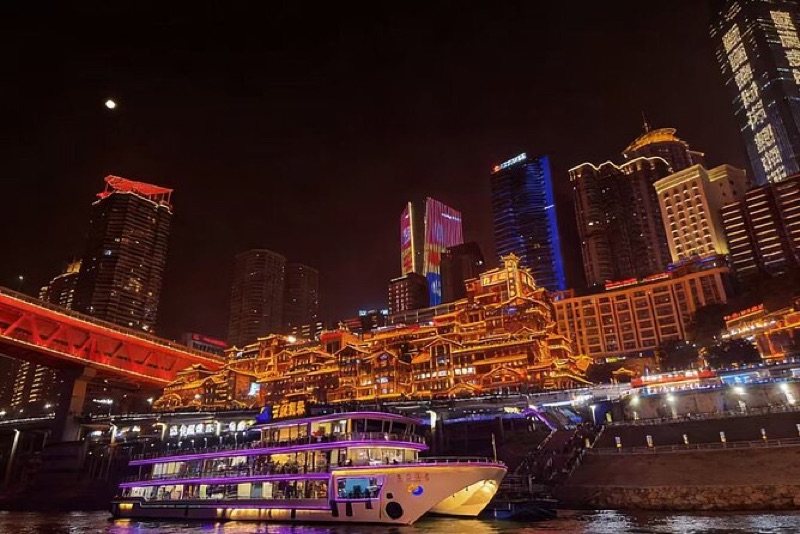
Hit the ground running in downtown Chongqing — explore the buzzing Jiefangbei pedestrian district, discover the stacked hilltop architecture that makes this city unlike anywhere else, watch the sun set from the iconic Hongya Cave stilted complex, and end with a magical Two Rivers Night Cruise as the entire city skyline erupts in neon.
Jiefangbei Walking Street & People's Liberation Monument
After arriving and checking in, start at Chongqing's beating heart — Jiefangbei (解放碑). This massive pedestrian plaza is surrounded by towering skyscrapers, packed with shoppers, street performers, and snack vendors. The People's Liberation Monument at its centre is where locals gather. It's chaotic, loud, and thrilling — pure Chongqing energy.
Luohan Temple (Arhat Temple)
Hidden among the downtown skyscrapers, Luohan Temple is a tranquil Buddhist oasis dating back over 1,000 years. The entrance corridor is lined with 524 painted clay arhat statues — each with a unique expression. The temple courtyard is peaceful, incense-filled, and a perfect contrast to the surrounding city.
Hongya Cave (洪崖洞) at Sunset & Night
This is the image of Chongqing — an 11-storey stilted building complex carved into the cliff face above the Jialing River, resembling a real-life Spirited Away bathhouse. Visit at sunset to watch the transition from golden hour to full neon — the building lights up spectacularly against the darkening river. Walk through all 11 floors: restaurants, shops, a waterfall courtyard, and rooftop bars overlooking the Jialing River Bridge.
Two Rivers Night Cruise (两江夜游)
The absolute must-do experience in Chongqing. Board a cruise ship at Chaotianmen Wharf and sail where the Yangtze and Jialing rivers merge. For 90 minutes, you'll glide past a skyline of illuminated skyscrapers, neon-wrapped bridges, and Hongya Cave glowing like a lantern from the water. The scale of Chongqing's night view is staggering — this is one of China's great urban spectacles.
Ancient Town, Mountain Tea & Hilltop Gardens
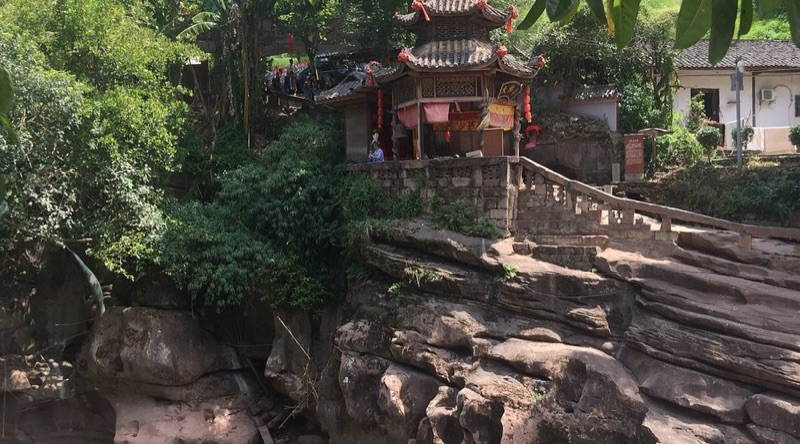
Today balances culture, food, and relaxation. Wander through the thousand-year-old streets of Ciqikou Ancient Town, find tranquillity at Eling Park's hilltop Chinese garden, hike the forested trails of Nanshan Mountain for panoramic city views and traditional tea, and end with a sunset stroll along the riverside Nanbin Road promenade.
Ciqikou Ancient Town (磁器口古镇)
A 1,000-year-old porcelain trading town preserved on the banks of the Jialing River. The narrow flagstone streets are lined with tea houses, traditional crafts shops, incense-filled temples, and some of the best street food in Chongqing. Arrive early (before 10am) to experience it before the crowds — the morning light on the river is beautiful, and the tea houses are peaceful.
Eling Park (鹅岭公园)
A peaceful hilltop Chinese garden with the best daytime panoramic views in Chongqing. From the Kansheng Tower at the summit, you can see both the Yangtze and Jialing rivers curving around the city peninsula. The park is beautifully landscaped with pavilions, a rope bridge, a lakeside pavilion, and manicured gardens — the perfect spot to relax after a morning of walking.
Nanshan Mountain (南山) — One Tree Viewing Platform & Tea Gardens
Cross the Yangtze to Nanshan — Chongqing's green lung. The famous 'One Tree Viewing Platform' (一棵树观景台) offers arguably the most iconic panoramic view of the city, with the entire downtown peninsula, both rivers, and all the bridges spread out below you. After the viewpoint, wind through the mountainside tea gardens where locals spend lazy afternoons sipping tea amid lush greenery.
Nanbin Road Riverside Promenade (南滨路)
After descending Nanshan, walk along Nanbin Road — Chongqing's riverside promenade on the south bank of the Yangtze. As darkness falls, the entire city skyline across the river lights up. This is a relaxed, locals-favourite evening stroll with restaurants, cafés, and unobstructed views of the illuminated downtown peninsula.
Urban Adventures, Museum & Farewell Feast
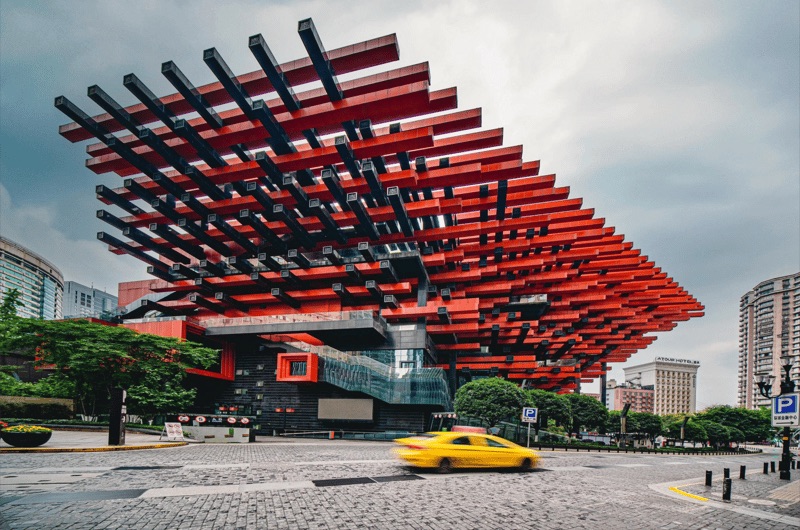
Your final day is a greatest-hits tour of the things that make Chongqing unique: the famous monorail-through-a-building at Liziba Station, the historic Shibati (18 Steps) neighbourhood, the world-class Three Gorges Museum, and a farewell vegetarian feast. Pack it all in before you head onwards.
Liziba Monorail Station (李子坝站)
One of the most viral travel moments in China — a monorail train passes directly through the 6th–8th floors of a residential apartment building. It sounds impossible, but it's real, and it's spectacular. Stand at the viewing platform below and watch the train glide into the building, disappear, then emerge from the other side.
Shibati (十八梯) — 18 Steps Old Town
Shibati — '18 Steps' — is a recently restored historic neighbourhood built on the steep hillside connecting upper and lower Chongqing. Once a working-class warren of narrow alleys and staircase streets, it's been beautifully restored to showcase traditional Chongqing architecture. Wander through the stepped streets, explore small museums on old Chongqing life, and admire the traditional stilted-building architecture.
Three Gorges Museum (重庆中国三峡博物馆)
Chongqing's flagship museum, directly facing the grand People's Assembly Hall across a landscaped plaza. The Three Gorges exhibit is the centrepiece — an immersive recreation of sailing through the Yangtze gorges before the dam, with a 360° film experience. Other galleries cover Chongqing's WWII role as China's wartime capital, Ba-Yu culture, and ancient Three Gorges artefacts. World-class and completely free.
People's Assembly Hall (人民大礼堂)
Directly across from the museum, this magnificent Ming/Qing-inspired dome was built in the 1950s and seats 4,000 people. The green-tiled roof and red columns are stunning — it looks like a piece of Beijing's Forbidden City transplanted to Chongqing. The plaza between the hall and the museum is one of the city's most photogenic spots.
Yangtze River Cableway & Farewell Views
Before leaving Chongqing, ride the Yangtze River Cableway (长江索道) — a retro cable car that swoops across the Yangtze River between Yuzhong and Nan'an districts. The 4-minute ride gives you a bird's-eye view of the river, the bridges, and the city stacked up the hillsides on both sides. It's cheap, thrilling, and a perfect farewell to the Mountain City.
💰 Budget Breakdown
| Category | Budget | Midrange | Luxury |
|---|---|---|---|
| Accommodation (per room) | ¥150–300/night ($21–42) | ¥400–800/night ($56–112) | ¥1000–2500/night ($140–350) |
| Meals (group of 5) | ¥150–250/day ($21–35) | ¥300–500/day ($42–70) | ¥600–1200/day ($84–168) |
| Transport (metro + Didi) | ¥50–80/day ($7–11) | ¥100–150/day ($14–21) | ¥200–400/day (private) |
| Night Cruise (5 people) | ¥500–600 total ($70–84) | ¥600–840 total ($84–118) | ¥840+ total (VIP deck) |
| Attractions | ¥100–200 total ($14–28) | ¥200–400 total ($28–56) | ¥400+ total |
| 3-Day Total (5 people) | $300–550 | $600–1,000 | $1,200–2,500 |
✈️ Getting There
- Chongqing Jiangbei International Airport (CKG) is 30km from downtown
- Metro Line 3 runs direct from airport to city centre — 50 min, ¥6
- Taxi/Didi from airport: ¥60–80 (~$8–11), about 40 minutes
- High-speed rail from Chengdu: 1–1.5 hours on the Chengdu–Chongqing HSR
🏨 Where to Stay
- Jiefangbei / Yuzhong — walking distance to Hongya Cave, night cruise, and metro ($$–$$$$)
- Nanbin Road — south bank riverside views of the skyline ($–$$$)
- Near Chaotianmen — convenient for the night cruise wharf ($–$$)
- For 5+ people, consider two adjoining rooms or a family suite — very affordable in CQ
🌡️ April Weather
- Spring: 18–25°C (64–77°F) daytime, 15–17°C at night
- Frequent but brief rain showers — always carry a compact umbrella
- Humid and often foggy — the famous Chongqing haze
- Comfortable for walking — not yet the intense summer heat (35°C+)
- Sunset around 7:15pm — long, pleasant evenings
💳 Money & Payments
- WeChat Pay and Alipay dominate — set up before arriving if possible
- International credit cards accepted at hotels and some larger restaurants
- Cash (CNY) useful for small vendors, temples, and street food
- ATMs widely available — Bank of China and ICBC accept foreign cards
- Tipping is not customary in China
📱 Connectivity & Apps
- Get a China SIM or eSIM with data — local apps need Chinese internet
- Download: DiDi (taxi), Alipay/WeChat (payments), Baidu Maps (navigation)
- VPN recommended for Google, WhatsApp, Instagram access
- Free WiFi available at hotels and some cafés
- Amap (高德地图) or Baidu Maps work better than Google Maps in China