⚡ Before You Go — Essentials
☀️ June in Seoul
Early June is prime Seoul: warm (25–28°C / 77–82°F), relatively dry before the monsoon arrives mid-month to early July. You'll get long evenings (sunset ~7:45 PM) perfect for rooftop bars and riverside picnics. Pack light breathable clothes, a compact umbrella (sudden showers happen), a light layer for aggressive air conditioning indoors, and comfortable walking shoes — you will walk 15,000+ steps per day. Koreans dress well; you'll fit right in with clean casual style.
🚇 Getting Around
Seoul's subway is one of the world's best: cheap (₩1,250–2,000 per ride), clean, extensive, with English signage everywhere. Get a Tmoney card at any convenience store (₩3,000 + top up) and tap in/out. The subway runs ~5:30 AM to midnight; after that, taxis are affordable (₩4,800 base fare) and KakaoTaxi app works in English. Avoid rush hours (7:30–9:00 AM, 6:00–7:30 PM) if you value your personal space.
💳 Money & Tipping
South Korea is nearly cashless — card payment is accepted everywhere, even at street food stalls. Tipping is NOT expected and can actually cause confusion or be refused. A 10% VAT is usually included in menu prices. For currency exchange, the ATMs at convenience stores and banks accept foreign cards; the rates inside the airport are worse than in Myeongdong exchange booths. Budget roughly ₩70,000–100,000/day for food and activities if you're eating well but not fine dining.
📱 Connectivity & Apps
Get a Korean SIM or eSIM at Incheon Airport (Tmoney / KT / SKT kiosks, ~₩20,000–30,000 for 2 weeks of unlimited data). Essential apps: Naver Maps (better than Google Maps in Korea — Google doesn't have transit routing here), KakaoTalk (messaging + KakaoTaxi), and Papago (Naver's translation app, far superior to Google Translate for Korean). Download all three before you land.
🍽️ Solo Dining in Seoul
Solo dining is completely normal in Korea — many restaurants have counter seating specifically for solo diners (honbap culture is huge). Korean BBQ is the one exception: it's designed for groups and many places charge per person (minimum 2). Solution: look for "1인" (for 1 person) signs, hit gimbap shops, pojangmacha street tents, and food courts in department stores. Convenience stores (CU, GS25, 7-Eleven) are shockingly good for quick meals — their triangle gimbap and instant ramyeon stations are legitimate food.
Touchdown, Street Food & Neon

Land at Incheon, drop your bags, and plunge straight into the sensory overload of Myeongdong — Seoul's shopping district turned street food carnival. Tonight is about adjusting to the time zone while eating everything in sight.
Arrive & Check In
Take the AREX Airport Railroad Express from Incheon to Seoul Station (43 min on the express, ₩9,500). From there, transfer to the subway to your accommodation. Myeongdong, Hongdae, or Jongno are all solid bases for a solo trip. Drop your bags, get your Tmoney card from a convenience store, and step outside.
Myeongdong Street Food Night
Myeongdong transforms after 5 PM into a labyrinth of food carts selling things you didn't know you needed: tornado potatoes (a single potato spiral-fried on a stick), cheese-loaded grilled lobster tails, egg bread (gyeran-ppang) fresh from the mold, and giant cups of fresh-squeezed pomegranate juice. The cosmetic shops blare K-pop from every doorway and the energy is infectious. This is your welcome to Seoul.
Myeongdong Kyoja — Knife-Cut Noodle Institution
This legendary noodle shop has been serving the same four dishes since 1966: kalguksu (knife-cut noodles in rich chicken broth), mandu (dumplings), bibim-guksu (spicy cold noodles), and kongguksu (cold soy milk noodles). The kalguksu is the move — silky hand-cut noodles in a milky chicken broth with a single plump dumpling. It's fast, cheap, and deeply satisfying after a long flight.
Royal Palaces, Hanok Villages & Traditional Tea
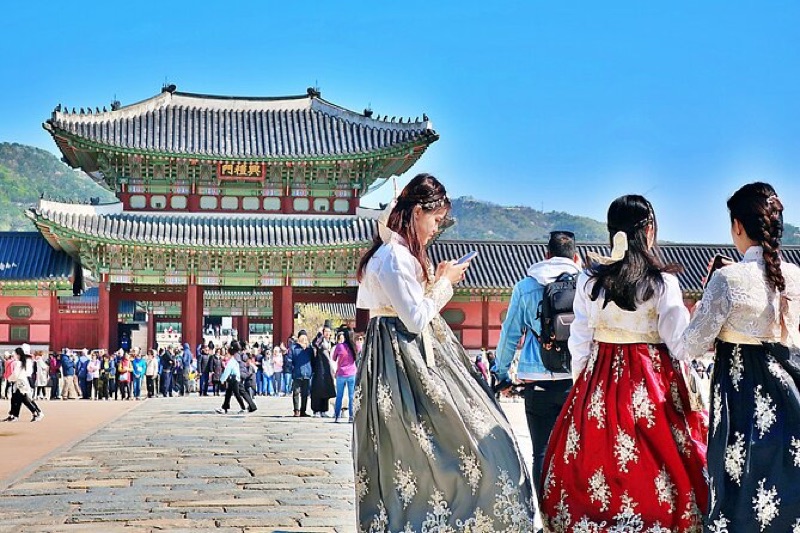
Start with Seoul's grandest palace, wander through centuries-old hanok houses, and end the day in Insadong's antique shops and tea houses. This is the Seoul of Joseon Dynasty paintings — and it's all real.
Gyeongbokgung Palace & Royal Guard Ceremony
Built in 1395 as the main palace of the Joseon Dynasty, Gyeongbokgung is Seoul's most magnificent historical site. The name means "Palace Greatly Blessed by Heaven." Arrive by 10:00 AM for the Royal Guard Changing Ceremony (Sumungun) at Gwanghwamun Gate — guards in full traditional armor perform a precise, ceremonial drill that's been reenacted since 1996. Then explore the palace grounds: the Geunjeongjeon Throne Hall where kings received foreign envoys, the Gyeonghoeru Pavilion floating on a lotus pond, and the Hyangwonjeong Pavilion at the northern end — one of the most photographed spots in all of Korea.
Bukchon Hanok Village
Walk 10 minutes east from Gyeongbokgung into Bukchon — a residential neighborhood of 900+ traditional hanok houses dating back 600 years. This isn't a museum; people actually live here (please be respectful of residents). The streets between Gahoe-dong and Samcheong-dong are the most photographed in Seoul: tiled roofs, wooden gates, stone walls, and hidden courtyards. Rent a hanbok from one of the many rental shops near the entrance and walk the alleys in traditional dress — it's the done thing, and the photos are extraordinary.
Insadong — Antique Shops, Galleries & Tea Houses
Insadong-gil is Seoul's cultural artery: a pedestrian-friendly street lined with antique shops, calligraphy stores, pottery galleries, and traditional tea houses. Explore the main drag, then duck into the alleyways — that's where the real finds are. Visit Ssamziegil, a spiral-shaped shopping complex for Korean crafts, and the Kyungin Museum of Fine Art. The tea houses in the back alleys serve traditional Korean teas (yujacha citron tea, omija five-flavor berry, saenggang ginger) in settings that feel frozen in time.
Tosokchon Samgyetang — Ginseng Chicken Soup
End the cultural day with Korea's most nurturing dish: samgyetang, a whole young chicken stuffed with glutinous rice, ginseng, garlic, jujubes, and chestnuts, slow-simmered until the meat falls off the bone. Tosokchon is the most famous samgyetang restaurant in Seoul, housed in a beautiful hanok compound near Gyeongbokgung. In Korea, samgyetang is traditionally eaten on the hottest days of summer (sambok) to restore energy — but it's perfect any time.
Secret Gardens, Market Feasts & Design Plaza Nights
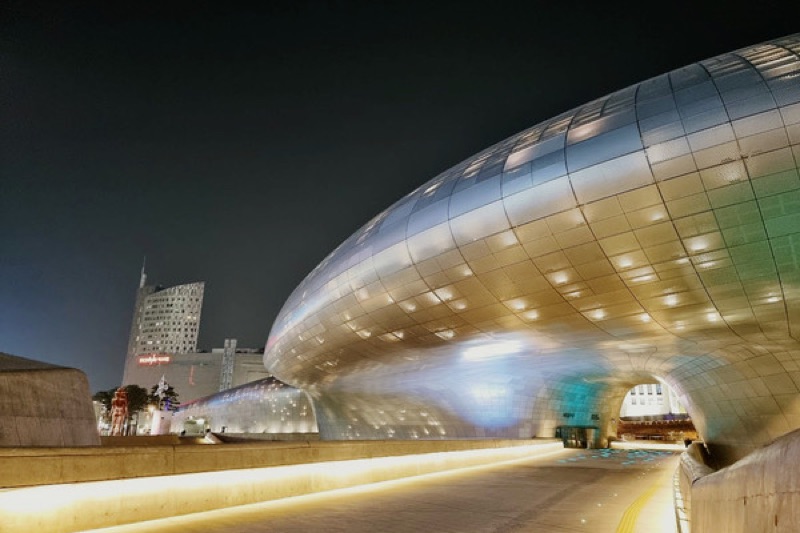
Morning at Korea's most beautiful palace and its UNESCO-listed Secret Garden, afternoon eating your way through Gwangjang Market, and evening at the futuristic Dongdaemun Design Plaza — Zaha Hadid's curving masterpiece.
Changdeokgung Palace & Huwon Secret Garden
If Gyeongbokgung is Seoul's grandest palace, Changdeokgung is its most beautiful — and UNESCO agrees (it became a World Heritage Site in 1997). The palace itself is stunning, but the real treasure is the Huwon (Secret Garden): a 78-acre private royal garden with lotus ponds, pavilions, ancient trees, and stone bridges that feels like stepping into a Korean ink painting. Access to the Secret Garden is by guided tour only (limited slots), so book ahead online. The Buyongjeong Pavilion reflected in Buyongji Pond is one of the most peaceful scenes in Seoul.
Gwangjang Market — The Food Pilgrimage
Gwangjang Market is Seoul's oldest continuously running market (est. 1905) and the undisputed champion of Korean street food. The second-floor fabric vendors are fascinating, but you're here for the ground-floor food alleys. Start with bindaetteok (crispy mung bean pancakes the size of your face) at the stall closest to the east entrance — they've been making them the same way for 50 years. Then mayak gimbap (mini seaweed rice rolls nicknamed "drug gimbap" because they're addictive), fresh raw beef yukhoe (if you're feeling adventurous), and hotteok for dessert. This is the meal you'll think about for years.
Dongdaemun Design Plaza (DDP)
Zaha Hadid's flowing, alien-metallic structure is Seoul's most futuristic building — a non-orthogonal, curving spaceship of aluminum panels that houses design exhibitions, fashion shows, and a 24-hour shopping complex. Walk the roof (it's a public park with undulating paths), explore the design museum inside, and come back after dark when the LED rose garden outside lights up with 25,000 illuminated white roses. The DDP at night is one of Seoul's most surreal photo spots.
Dongdaemun Night Shopping & Late Dinner
The Dongdaemun shopping district is Seoul's late-night retail beast — massive wholesale malls (Doota, Migliore, APC) that stay open until 3–5 AM. Even if you're not shopping, the energy is wild: models rushing garments between stalls, Korean university students hunting bargains, and food stalls feeding the nocturnal crowd. Grab dinner at one of the pojangmacha (orange tent street stalls) selling tteokbokki, odeng, and sundae (Korean blood sausage) — the perfect late-night Korean comfort food.
The DMZ — Edge of the World's Most Dangerous Border
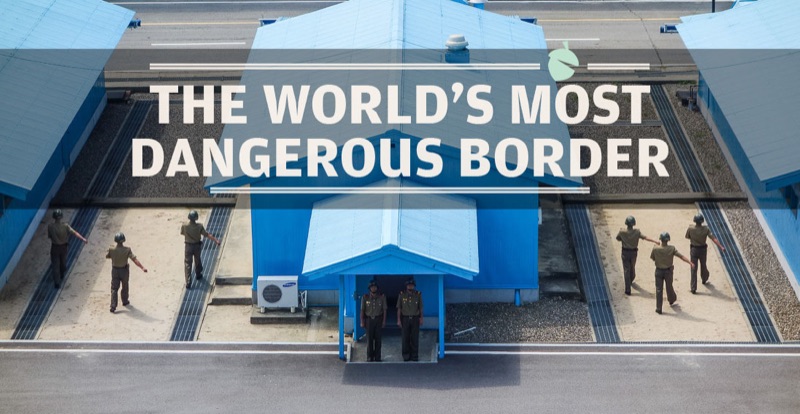
A full-day excursion to the Korean Demilitarized Zone — the 250 km strip of land that has separated North and South Korea since 1953. This is history you can touch, see, and feel in your gut. Book a tour in advance.
DMZ Tour — Imjingak, Dora Observatory & Third Tunnel
The standard DMZ tour (book via Klook, Trazy, or a local agency — ₩50,000–80,000) picks you up in Seoul around 7:30 AM and drives north toward the 38th parallel. You'll visit: Imjingak Peace Park (monuments to displaced families and the Bridge of Freedom where POWs were exchanged), the Third Infiltration Tunnel (dug by North Korea under the DMZ, discovered in 1978 — you walk 300 meters underground to the concrete wall blocking the border), Dora Observatory (binoculars pointed at North Korea — on clear days you can see Kaesong city and the giant North Korean flag pole), and Dorasan Station (the northernmost South Korean train station, with a sign reading "To Pyongyang" that has never been used). The experience is sobering, surreal, and unforgettable.
Optional: JSA (Joint Security Area) Tour
If you want the full experience, book a JSA/Peace Trail tour (more expensive, ₩100,000–130,000). This takes you into the actual blue UN buildings straddling the border where soldiers from both sides stand face-to-face. You can technically step into North Korea inside the conference room. Requires booking weeks ahead, passport checks, and a signed waiver.
Hongdae — Indie Music, Street Art & Cafe Culture
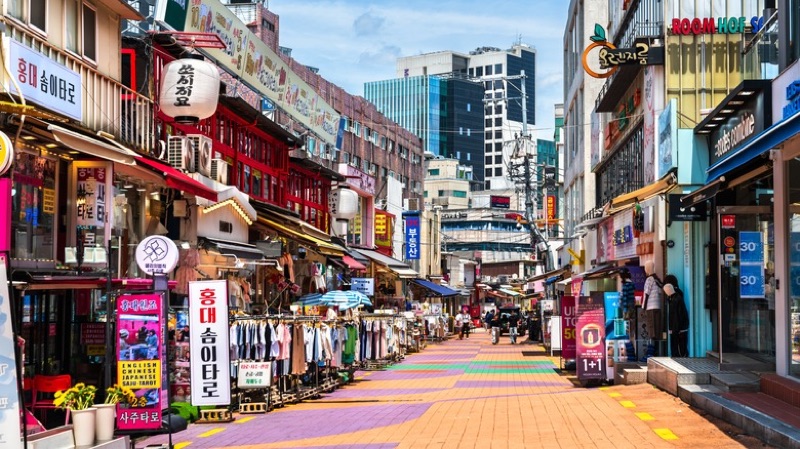
The neighborhood around Hongik University is Seoul's creative heart — buskers on every corner, themed cafes in every direction, murals on every wall, and a nightlife that doesn't start until midnight. Today is about wandering, cafe-hopping, and soaking up the energy.
Hongdae Cafe Street & Themed Cafes
Hongdae has more cafes per square meter than any neighborhood on Earth, and many of them are deeply weird in the best way. Choose your adventure: a board game cafe (₩5,000/hour, unlimited games), a raccoon cafe (yes, live raccoons), a 2D comic-book cafe (black-and-white interior that looks hand-drawn), or one of the dozens of stunning specialty coffee shops. But first, start at Onion Cafe — a wildly popular bakery in a converted hanok serving the best pandoro (Italian-style bread) in Seoul. Get there before 10:30 AM or the line wraps around the building.
Hongdae Street Art & Shopping
Walk Hongik University Street (the "Hongdae Street" everyone talks about) where fashion boutiques, vintage shops, and design studios are packed into narrow alleys. The street art here rotates constantly — murals, paste-ups, stencil work, and installations by Hongik's art students. Check out the Korean cosmetic shops (Nature Republic flagship, Etude House), browse Yes24 Music for K-pop vinyl, and explore the underground market at Hongdae Station. Don't miss the accessory alleys where you can buy handmade jewelry for ₩3,000–10,000.
Sangsang Madang — Art Complex
Sangsang Madang ("Imagination Space") is a multi-story cultural complex hosting indie art exhibitions, a cinema, live music venue, and a rooftop garden. The galleries on floors 3–5 showcase rotating contemporary Korean art — always free, always interesting. The indie cinema on B1 screens Korean independent films with English subtitles. This is where Seoul's creative class actually hangs out.
Hongdae Nightlife — Live Music & Bars
Hongdae's nightlife is where Seoul's underground music scene lives. Start at a pojangmacha for makgeolli (cloudy rice wine) and pajeon (green onion pancake) — the perfect Korean happy hour. Then catch live music at one of the dozens of venues: Strange Fruit for indie bands, Club FF for rock, Faust for electronic, or Rolling Hall for acoustic sets. On weekends, buskers perform on every corner — singers, dancers, magicians, comedians. The street itself is the show. Hongdae doesn't truly wake up until 10 PM.
Gangnam Style — Luxury, K-Pop & Starfield Library
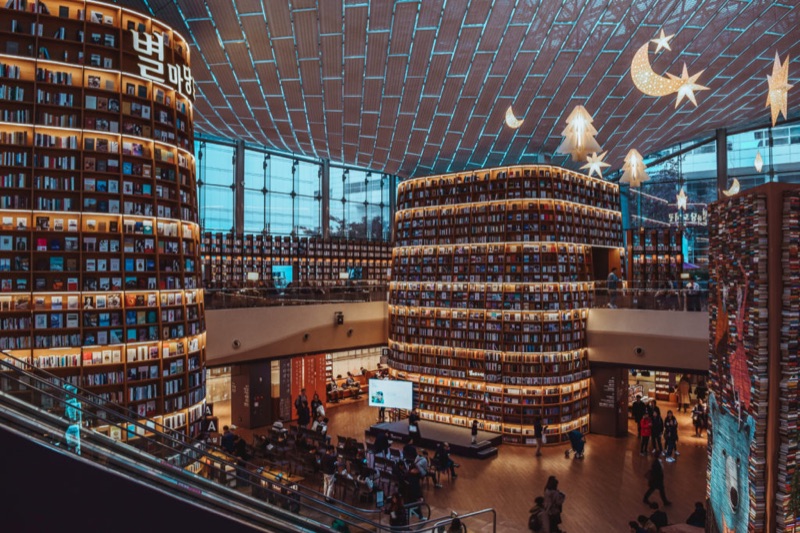
Cross the Han River into Seoul's sleek southern half — where K-pop agencies, luxury boutiques, and the world's most beautiful bookstore await. Gangnam is a different city from north-of-the-river Seoul, and understanding both is understanding Korea.
Starfield Library at COEX Mall
The Starfield Library isn't really a library — it's a two-story open-air book installation inside the COEX mega-mall, with 50,000 books and magazines displayed on towering shelves that reach the ceiling. The space is breathtaking: natural light floods through glass walls, reading nooks are scattered among the stacks, and the scale makes you feel like you've shrunk. It's free to enter, surprisingly peaceful, and one of the most Instagrammed places in Korea. Grab a coffee at the in-library cafe and just sit for a while.
COEX Mall & SMTOWN Museum
COEX is Seoul's largest underground shopping complex — a climate-controlled city with 260+ shops, restaurants, a cinema, an aquarium, and the Kimchi Museum. If you have any interest in K-pop, the SMTOWN Museum inside COEX is a must: interactive exhibits, VR experiences, hologram concerts, and merchandise from SM Entertainment artists (EXO, Red Velvet, aespa, NCT). Even if K-pop isn't your thing, the production values are stunning.
Garosu-gil — Tree-Lined Boutique Street
Garosu-gil ("Tree-Lined Street") in Sinsa-dong is where Seoul's fashion elite shop and cafe-hop. Gingko trees canopy a street of independent boutiques, Korean designer shops, beauty flagships, and stunning cafes. This is where Korean fashion trends start. Browse the stores (much more interesting than the chain-filled Myeongdong), grab a specialty coffee at Anthracite or Fritz, and people-watch — the fashion here is an event in itself.
K-Star Road & Entertainment Agencies
Walk from Garosu-gil into Cheongdam-dong — the neighborhood where K-pop agencies (SM, JYP, YG, Cube) have their headquarters and where trainees are spotted coming and going. K-Star Road has Gangnamdol — bear statues painted in the style of famous K-pop groups (BTS, Blackpink, EXO, etc.). The area is also packed with luxury boutiques and Korean plastic surgery clinics (a cultural phenomenon in itself). Even if you're not a K-pop fan, the concentration of wealth and culture is fascinating.
Korean BBQ in Gangnam
Gangnam has some of Seoul's best Korean BBQ — premium hanwoo (Korean beef) grilled over charcoal at sleek, modern restaurants. For a solo traveler, look for places with "1인" signs or counter seating. Maple Tree House near Gangnam Station is solo-friendly and serves excellent premium cuts. The experience: the server grills the meat at your table, you wrap it in lettuce with ssamjang sauce, garlic, and kimchi, and eat it in one bite. This is the Korea you came for.
The Brooklyn of Seoul — Seongsu's Creative Renaissance

Seongsu-dong is Seoul's hottest neighborhood — a former industrial district of shoe factories transformed into the city's coolest cluster of cafes, galleries, concept stores, and creative studios. Pair it with the adjacent Seoul Forest park for a perfect creative-nature day.
Seoul Forest Park
Seoul Forest is the city's third-largest park — 1.2 million square meters of forest, wetlands, butterfly conservatory, deer enclosure, and sculpture gardens, all built on a former royal hunting ground and later water treatment plant. In June, the park is lush and green with families picnicking, cyclists on rental bikes, and photographers shooting the ecological wetlands. The deer enclosure (yes, actual deer in the middle of Seoul) is charming. Rent a bike (₩3,000/hour) and cruise the dedicated cycling paths through the woods.
Seongsu-dong Cafe & Gallery Hopping
Welcome to the Brooklyn of Seoul. Seongsu-dong's old shoe factories and warehouses have been converted into Seoul's most Instagram-worthy spaces: exposed-brick cafes with 6-meter ceilings, concept stores selling Korean indie design, pop-up art exhibitions, and the kind of creative energy that makes you want to quit your job and open a ceramics studio. Key stops: Onion Cafe Seongsu (a different location from Hongdae — this one is in a converted shoe factory with a stunning courtyard), Dior Cafe (if you want luxury), and the Seoul Design Fair if it's on. The alley between Yeonmujang-gil and Seongsui-ro is the main drag — just walk and explore.
Seongsu Handmade Market
If you're here on a weekend, the Seongsu Handmade Market sets up in various locations around the neighborhood — local artisans selling ceramics, leather goods, candles, prints, and jewelry. Even on weekdays, the permanent craft shops along the main drag are worth browsing for unique souvenirs you won't find anywhere else in Seoul.
Seongsu-dong Dinner & Craft Beer
Seongsu's dining scene is where traditional Korean flavors meet modern plating. For dinner, try a Korean bistro (many dot Yeonmujang-gil) serving creative takes on classics like bossam (boiled pork wraps), galbi-jjim (braised short ribs), or Korean-style pasta. After dinner, hit one of the craft beer bars — Magket Brewing, Seoul Brewery, or Booth Craft Beer all have taps featuring Korean microbrews (a rapidly growing scene). Seongsu is quieter at night than Hongdae — more intimate, more conversation-friendly.
Global Seoul — Itaewon's International Flavors & Namsan Sunset
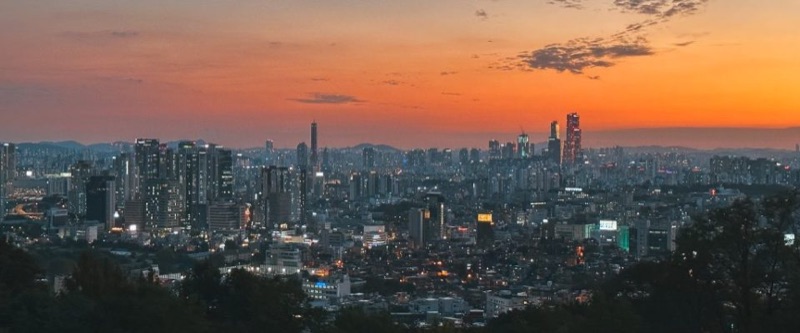
Itaewon is Seoul's international neighborhood — where expats, diplomats, and travelers from every country mix in a strip of global restaurants, bars, and shops. Combine with a hike up Namsan for sunset views over the entire city.
War Memorial of Korea
Before reaching Itaewon, stop at the War Memorial of Korea — a massive, deeply moving museum documenting Korea's military history from ancient times through the Korean War. The outdoor display of tanks, planes, and artillery is impressive, but the indoor exhibits on the Korean War are devastating: letters from soldiers who never came home, photographs of divided families, and a replica of the DMZ. The memorial hall with the names of fallen UN soldiers is profoundly affecting. Allow 2 hours minimum.
Itaewon Global Food Street
Itaewon's main drag is a culinary world tour: Turkish kebabs, American burgers, Indian curry, Mexican tacos, Middle Eastern falafel, Japanese ramen, and everything in between. For lunch, try Vatos Urban Tacos (Korean-Mexican fusion — kimchi carnitas fries are legendary), or go traditional at a halal Korean BBQ spot (Itaewon has Seoul's largest Muslim community). The side streets off the main road are where the gems hide — tiny restaurants run by expats cooking their home cuisines.
Namsan Park Hike & N Seoul Tower Sunset
Walk off lunch with a hike up Namsan (South Mountain) — the forested hill in the center of Seoul with the iconic N Seoul Tower on top. Three hiking routes start from different points (the northern entrance near the cable car is most popular). The walk takes 30–45 minutes through a beautiful wooded park with exercise stations and city peek-a-boo views. At the summit, the N Seoul Tower observation deck (₩16,000) gives you a 360-degree panorama of Seoul — 10 million people spread out below you. Come for sunset, stay for the city lights. The fence of thousands of love locks at the tower base is one of Seoul's most iconic scenes.
Haebangchon (HBC) — Rooftop Drinks
Descend the south side of Namsan into Haebangchon ("Liberation Village") — a steep, narrow neighborhood of tiny bars, restaurants, and rooftop terraces with million-dollar views. Once a shanty town, now one of Seoul's most atmospheric nightlife spots. Find a rooftop bar, order a Korean craft beer or soju cocktail, and watch the Seoul skyline light up as darkness falls. The vibe is mature and conversation-friendly — a world away from Hongdae's chaos.
Deep Korea — National Museum & Han River Sunset Picnic
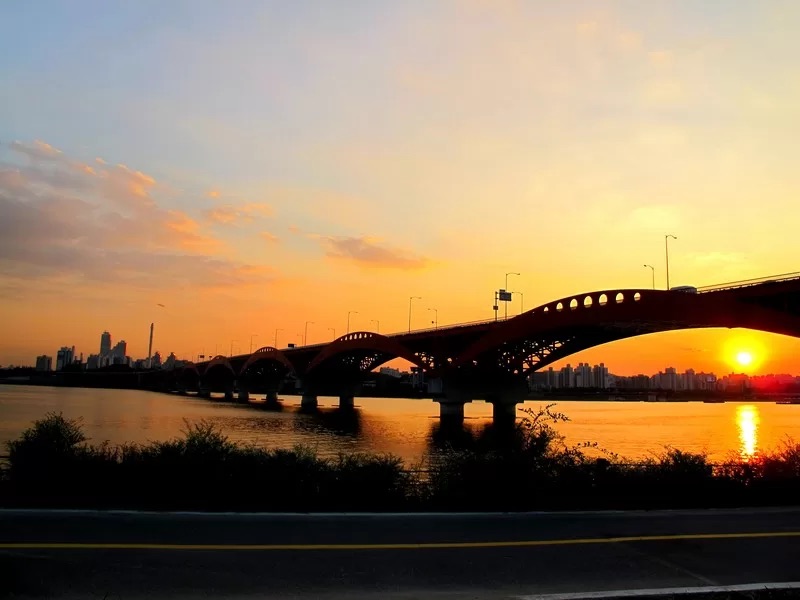
Morning diving deep into Korean history and art at the nation's flagship museum, afternoon at Seoul's riverside financial district turned recreation paradise, and an evening Han River chimaek picnic.
National Museum of Korea
South Korea's largest museum is a masterpiece of architecture and curation — a building so vast (307,000 square meters) that you could spend two days here. The permanent collection spans 5,000 years of Korean history: Goryeo Dynasty celadon pottery that glows like jade, Joseon Dynasty screens painted in mineral pigments still vivid after 500 years, Buddhist sculptures of extraordinary delicacy, and the Pensive Bodhisattva (National Treasure #83) — a 7th-century gilded bronze statue that the museum built its entire layout around. The path through the three floors is chronological and beautifully paced. Don't skip the outdoor garden with its pagoda and pond. Free entry to permanent collections.
Yongsan I-Park Mall & Lunch
Right next to the museum, Yongsan Station houses one of Seoul's mega-malls. The food court here (Baedamui Jeongwon, "Garden of Flavors") is exceptional — individual stalls serving regional Korean specialties, all labeled in English. It's the perfect place to try dishes you haven't encountered yet: cold naengmyeon buckwheat noodles (ordered at the end of a BBQ meal, traditionally), kimchi jjigae (the national stew), or dolsot bibimbap in a sizzling stone bowl.
Yeouido Hangang Park — Han River Culture
Yeouido is Seoul's riverside paradise — the Han River park here is where the city comes to breathe. Rent a bike (₩3,000/hour) and ride along the river path with Seoul's skyline on one side and the water on the other. Watch couples on tandem bikes, families flying kites, and groups playing soccer or badminton. The Banpo Bridge Rainbow Fountain show (7:30 PM and 8:30 PM in summer) shoots water 570 meters to music — it's gloriously kitschy and unmissable.
Chimaek Picnic — Fried Chicken & Beer by the River
The essential Seoul evening: order Korean fried chicken and beer for delivery directly to your spot on the Han River. Use the Baedal Minjok (Baemin) or Yogiyo app, or just flag down one of the delivery bikers cruising the park. A whole fried chicken (whole, not half — this is Korea) with yangnyeom sauce (sweet-spicy garlic) and a cold draft beer (Cass or Terra) eaten cross-legged on a mat by the river as the sun sets and the Banpo fountain dances. This is peak Seoul.
Suwon — UNESCO Fortress Walls & Fried Chicken Holy Land
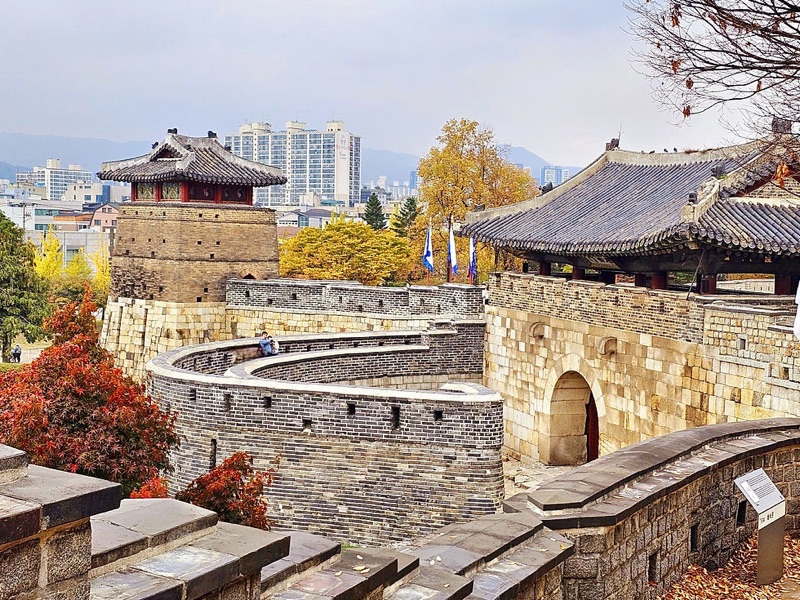
Take the subway one hour south to Suwon — a UNESCO World Heritage fortress city with 5.7 km of walkable walls, royal palace ruins, and the best Korean fried chicken street in the country. The perfect day trip from Seoul.
Hwaseong Fortress — Walk the Walls
Suwon's Hwaseong Fortress (UNESCO, 1997) is a masterpiece of 18th-century military architecture — 5.7 km of stone walls ringing the old city, punctuated by watchtowers, command posts, secret gates, and floodgates. King Jeongjo built it in 1796 to honor his father, and it's remarkably intact. Walk the full circuit (2–2.5 hours) for sweeping views of Suwon's modern cityscape beyond the ancient walls. The Hwahongmun Gate (North Gate) with its seven-arched water bridge and the Changnyongmun (East Gate) are the standout structures. Start at the Hwaseong Haenggung (the auxiliary palace inside the walls) for context, then climb up.
Hwaseong Haenggung Palace & Suwon Museum
Hwaseong Haenggung is the largest auxiliary palace in Korea — the king's residence when he visited Suwon. It was partially destroyed during the Japanese occupation and meticulously reconstructed. The architecture blends military pragmatism with royal elegance. Next door, the Suwon Museum of Art hosts rotating exhibitions of contemporary Korean art in a striking modern building. If time permits, visit the Korean Folk Village (30 min bus ride from Suwon Station) — a recreated traditional village where Korean historical dramas are filmed.
Suwon Fried Chicken Street — The Chimaek Pilgrimage
Suwon is the undisputed capital of Korean fried chicken. The street near Suwon Station (and the famous Jinmi Pyeonghwa Tongdak alley) has been perfecting the art since the 1970s. Jinmi Pyeonghwa Tongdak is the OG — a whole chicken fried to order, crackling skin, juicy meat, served with pickled radish and cold beer. The alley is a row of chicken restaurants with plastic tables spilling onto the sidewalk, smoke rising from every direction, and the kind of communal dining atmosphere that makes solo travel feel social. This chicken will ruin all other fried chicken for you permanently.
Trendy Hanoks & Retro Alleys — Hidden Seoul

Explore the neighborhoods where old Seoul meets new: Ikseon-dong's trendy hanok cafes, Jongno's traditional main street, and Euljiro's hidden retro bars in industrial alleys. This is the Seoul that hipster guidebooks fantasize about.
Ikseon-dong Hanok Cafe District
Ikseon-dong is Seoul's most photogenic neighborhood — a grid of 1930s hanok houses converted into cafes, restaurants, and concept shops that went viral on Korean social media. Unlike Bukchon (which is residential and museum-like), Ikseon-dong is all about commerce and hanging out. The alleys are impossibly charming: wooden facades, hanging plants, vintage signage, and cafes so beautiful you'll spend 20 minutes photographing your latte. Arrive by 10 AM — by noon the narrow alleys are packed. Don't miss Nach madang (an outdoor courtyard cafe), and the ikseondong 1920 bakery complex.
Jongno — Seoul's Historic Main Street
Jongno ("Bell Street") has been Seoul's main thoroughfare since the Joseon Dynasty. Walk its length from Jongno 1-ga to 5-ga and you'll pass: Bosingak Bell Pavilion (where the New Year's bell-ringing ceremony happens), Tapgol Park (where the March 1st Independence Movement began in 1919), Jongmyo Shrine (UNESCO World Heritage — the royal ancestral shrine, book a timed slot), and the Cheonggyecheon Stream (a restored urban river running through downtown — perfect for an afternoon stroll). Jongno is where Seoul's historical weight is most concentrated.
Euljiro — Retro Industrial Seoul
Euljiro is Seoul's time capsule — a grid of industrial alleys where printing presses, hardware stores, and welding shops operate behind sliding metal doors. In the evenings, these same alleys transform: hidden behind unmarked doors are some of Seoul's best cocktail bars, natural wine bars, and speakeasies. The Euljiro area (especially Euljiro 3-ga to 5-ga) is the city's coolest secret — come back after 7 PM to find the bars. During the day, browse the tool shops and vintage bookstores, and eat at one of the area's legendary old-school restaurants that have been here since the 1960s.
Euljiro Speakeasy Bar Hopping
Euljiro's nighttime transformation is one of Seoul's best-kept secrets. Behind the industrial shutters are award-winning cocktail bars with serious craft. Look for: Le Chamber (behind an unmarked door, classic cocktails in a moody space), Alice Cheongdam (wait, no — this is in Cheongdam), but try D/Steady, Southside Parlour's Euljiro outpost, and Bar Kim Chung (natural wine in a print shop). The aesthetic is industrial-chic: exposed pipes, concrete floors, Edison bulbs, and bartenders who take their craft very seriously.
Last Call — Markets, Souvenirs & the Farewell Feast

Your final full day is for everything you've been meaning to get to: Namdaemun Market for last-minute shopping, that one neighborhood you skipped, and a final blowout Korean BBQ dinner to say goodbye to Seoul properly.
Namdaemun Market — Dawn to Noon
Namdaemun is Korea's largest traditional market — over 10,000 stalls spread across a labyrinth of covered alleys near the old South Gate (Sungnyemun). It's been operating since 1414. Come early (the market stirs at 6 AM, fully alive by 8 AM) to see the wholesale trade in action: vendors haggling over ginseng, grandmothers stacking kimchi, tailors measuring fabric. The food stalls are legendary — galchi-jorim (braised hairtail fish), hotteok (the Namdaemun hotteok lines are the longest in Seoul for good reason), and kalguksu alley where a dozen restaurants serve the same perfect noodle soup. This is also the best place in Seoul for souvenirs: Korean ceramics, ginseng products, traditional fans, socks (Korean socks are genuinely excellent), and weird Korean snacks for people back home.
Lotte World Tower & Seoul Sky Observatory
For your last afternoon, go to the top. Lotte World Tower is Korea's tallest building (555 meters, 123 floors) and the Seoul Sky observatory on floors 120–123 gives you a view that puts everything in perspective — you can see the DMZ to the north on clear days. The glass floor section is not for the faint-hearted. The Lotte World Mall below is one of Seoul's mega-shopping complexes if you need last-minute anything.
Free Time — Revisit Your Favorite Spot
You've been here 12 days — there's a neighborhood, a cafe, a street food stall, or a park that you've been thinking about since you left it. Go back. Have the same thing you had the first time. Notice what you notice differently now. That's the real souvenir.
Farewell Korean BBQ Feast
Your last dinner in Seoul deserves to be the best Korean BBQ of the trip. If you haven't had premium hanwoo (Korean beef) yet, tonight's the night. Head to a proper BBQ restaurant — Mapo area for pork (the original pork belly alley near Gongdeok Station is the real deal), or Jongno/Cheongdam for beef. Order galbi (marinated short ribs), samgyeopsal (pork belly), and/or chadolbaegi (thin-sliced beef brisket). The server grills it at your table, you wrap it in lettuce with garlic, ssamjang, and kimchi, and wash it down with soju or beer. Eat slowly. You're not going to have this again for a while.
One Last Bite & Fly Home

Your final morning in Seoul — grab the breakfast you'll miss most, buy the snacks you can't leave without, and head to the airport with enough time to browse Incheon's excellent duty-free and eat one last bibimbap.
Final Korean Breakfast
One last Korean meal before you fly. If your hotel serves a Korean breakfast (rice, soup, banchan, grilled fish), have it — you won't get this at home. Otherwise, hit a convenience store for triangle gimbap (₩1,200) and banana milk (₩1,700) — the breakfast of Korean commuters and, for 13 days, you. Buy extra for the plane. Also: Korean convenience stores sell the best airplane snacks. Stock up on Pepero sticks, shrimp crackers, and any Korean candy that catches your eye.
AREX to Incheon Airport
Take the AREX Airport Railroad from Seoul Station or Hongik University Station to Incheon International Airport. The all-stop train takes ~60 minutes (₩5,000) and the express takes 43 minutes (₩9,500). Check in, clear security, and browse the airport — Incheon is consistently rated one of the world's best airports for a reason.