Go try to register for the Imgur API right now. Head to https://api.imgur.com/oauth2/addclient — the official developer registration page, documented in their public API docs, linked from their developer portal. You'll be silently redirected to the Imgur homepage. No error. No explanation. No announcement. Just a wall.
That's the state of the open internet in 2026. Not a dramatic shutdown announcement — just a quiet redirect, and the door is closed.
What's happening to Imgur isn't isolated. It's the end point of a decade-long trend that's accelerating. The open API era — the era that built Twitter clients, Reddit apps, Spotify integrations, and thousands of developer ecosystems — is over. Platforms are systematically closing their data access, and the reasons are deeper than just monetization. They're structural. And the implications for developers, startups, and the open web are significant.
Key Takeaways
- Every major platform has restricted, priced out, or silently closed its public API in the last decade — the trend is accelerating, not slowing.
- AI training data is the primary accelerant: platforms realized free APIs were feeding the models that now compete with them.
- The playbook is predictable: open access → developer ecosystem growth → monetization pressure → price shock or silent closure.
- Startups and developers who build core features on single third-party APIs are building on sand. The tide is going out.
The Timeline: A Decade of Doors Closing
This didn't happen overnight. Each closure set a template the next platform followed.
Netflix: The Early Signal
Netflix shut down its public API in November 2014 — quietly, without much fanfare, and years ahead of what everyone else would eventually do. At the time it seemed like an outlier. Netflix had a legitimate developer ecosystem built on their API, and they simply decided they didn't want one anymore. They wanted to own the experience end to end.
It seemed prescient then. Now it looks like a blueprint. Netflix saw something most platforms hadn't internalized yet: a public API is a loss of control over how your product is experienced. And control over the experience is worth more than the developer goodwill.
Google Maps: The Price Shock Template
Google Maps was the pioneer of the modern API pricing shock. Until 2018, Google offered a famously generous free tier — 25,000 map loads per day at no cost. Thousands of startups, nonprofits, and hobby projects built on it. Then Google restructured their pricing, and some developers saw increases of up to 1,400% overnight.
They also required a credit card for any usage — meaning the "free tier" was now a free trial with billing information attached. Small projects that couldn't afford the new rates either shut down their map features or migrated to OpenStreetMap alternatives. The goodwill Google had built with years of free access evaporated in a pricing email.
What Google established here was the template: the free tier isn't a business model, it's a customer acquisition strategy. Once you've acquired the customers and built network effects, you restructure the pricing and capture the value. Every platform that followed did variations of the same move.
Reddit: The AI Training Data War Begins
Reddit's API change in June 2023 was the most publicly combustible of the bunch — and also the most revealing about what's really driving these closures.
Reddit changed their API pricing to $0.24 per 1,000 API calls. To put that in perspective: the developer behind Apollo, the most popular third-party Reddit client with millions of users, calculated that sustaining Apollo at that rate would cost him $20 million per year. Apollo shut down. Reddit is Fun shut down. Sync shut down. Dozens of smaller apps shut down. Thousands of subreddits went dark in protest.
But the most significant part wasn't the price — it was what Reddit said publicly about why. They were explicit: they didn't want AI companies training models on Reddit data for free. Their user-generated content was valuable, and they wanted to be paid for it.
Within months, Reddit signed a deal with Google reportedly worth $60 million per year for training data access. The API shutdown wasn't about developer revenue. It was about controlling who gets to use the data, and at what price. Reddit IPO'd in March 2024, and those data licensing deals were a key part of the business narrative.
Twitter/X: Nuclear Option
While Reddit at least maintained API access (at a price), Twitter/X under Elon Musk took a more aggressive approach. In February 2023, Twitter eliminated its free API tier entirely — no grace period, minimal notice, immediate effect.
The new pricing: $100/month for Basic (extremely limited access) and $5,000/month for Pro. The previously free tier had given developers access to up to 500,000 tweet reads per month. For anyone who'd built something useful on that — research tools, social listening apps, community bots, academic datasets — it was gone overnight.
The casualties were substantial. Hundreds of academic research projects lost access to historical Twitter data that had been the foundation of papers and studies on everything from political polarization to pandemic misinformation. Community tools that had been running for years shut down. The developer ecosystem that Twitter had spent years cultivating was effectively detonated.
Spotify: The Slow Squeeze
Spotify's approach has been quieter but arguably more insidious — a slow, rolling closure rather than a single price shock.
In November 2024, Spotify removed access to several key endpoints for new apps: Recommendations, Audio Features, Audio Analysis, Related Artists, and 30-second preview URLs. Existing apps were grandfathered in, but anything new couldn't access these features. The official reason cited was "security." The real reason is more obvious: these endpoints were powering third-party music discovery tools that competed with Spotify's own recommendation algorithm — their core product differentiator.
Then in February 2026, Spotify tightened further: new apps are now limited to just 5 authorized users in development mode, with no clear path to extended access. In practice, you can't ship a real product on the Spotify API as a new developer. You're building a prototype with no production future.
Imgur: The Ghost API
And then there's Imgur — the purest example of the genre. No announcement. No pricing change. No explanation. The API registration page just... redirects to the homepage. Silently.
What makes Imgur particularly remarkable is that they still maintain full API documentation as if everything is working normally. The docs describe how to get a Client ID. The registration page is linked. But when you go to register, you're bounced back to the gallery. It's a ghost API — documentation with no access behind it.
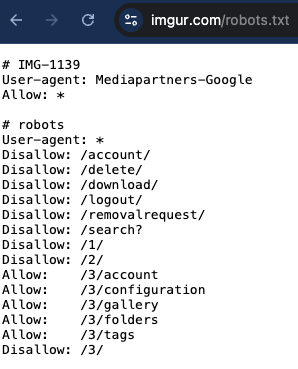
Their robots.txt tells the same story. It aggressively blocks crawling across most paths — a platform that built its entire existence on being a shareable, embeddable, open image host is now treating automated access like a threat. The combination of API closure and aggressive robots.txt blocking is not an accident. It's a deliberate data access strategy, even if they're too embarrassed to announce it.
Why This Is Happening
These closures aren't random. They're driven by four overlapping forces that are only getting stronger.
1. The AI Training Data War
This is the most important driver, and it's the one platforms are most willing to be explicit about. Billions of dollars are being spent training large language models, and the training data is the moat. Every platform that has decades of user-generated content — Reddit posts, tweets, Imgur images, Spotify listening data — is sitting on something that AI companies want badly.
Free API access was, in retrospect, a direct pipeline to that data. OpenAI and Anthropic and Google didn't need to scrape everything by hand — they could hit the APIs. Platforms figured this out, and the API shutdowns are one side of the response. The robots.txt restrictions are the other side.
The Reddit/Google data deal is the business model these closures are pointing toward: instead of giving data away through free APIs, license it exclusively to the highest bidder. The developer ecosystem gets killed in the process, but that's a feature, not a bug — fewer people with API access means fewer people training models on your data without paying.
2. Pre-IPO Monetization Pressure
Reddit IPO'd in March 2024. Twitter was taken private in 2022 with $13 billion in debt that needed servicing. Spotify has faced years of margin pressure. Google has always optimized its cloud revenue.
There's a predictable pattern: platforms offer generous API access during the growth phase, when developer ecosystem is a competitive advantage. Then, as the platform matures or faces capital markets pressure, "API revenue" becomes a line item someone is asked to optimize. The free tier gets repriced, the generous rate limits get tightened, and the calculus flips from "how do we attract developers?" to "how do we extract value from them?"
3. Controlling the Experience
Every third-party app built on an API is, to some degree, a competing user experience. Apollo was arguably a better Reddit client than Reddit's own app. Third-party Twitter clients offered cleaner, less algorithmic feeds. Spotify integrations could route users toward discovery outside Spotify's own recommendation engine.
When you shut down the API, you force everyone back into your first-party experience — where you control the algorithm, the ads, the upsells, and the data collection. Netflix understood this in 2014. Everyone else took a decade to reach the same conclusion.
4. Enshittification in Action
Cory Doctorow named this pattern "enshittification": platforms are good to their users until they have enough users, then they're good to their business customers until they have enough leverage, then they extract value from everyone. The API lifecycle follows the same arc — generous access to attract developers, then extraction once the ecosystem is established and the developers are locked in.
The open API era was never a gift. It was a customer acquisition strategy. The bill always comes due.
What This Means for Developers and Startups
If you're building something today that has a meaningful dependency on a third-party API, you're carrying risk that you may not have priced in.
The practical lessons from the last decade:
- Assume any free API tier is temporary. The companies operating those free tiers have investors, boards, and revenue targets. The free tier is a liability on their books. Budget for the cost of API access in your business model from day one, or accept that you may have to shut down or migrate when the pricing changes.
- Never build a core product loop on a single third-party API. Apollo had no fallback when Reddit changed its pricing. If the API your product depends on disappears, your product should degrade gracefully — not cease to exist. Diversify data sources wherever possible.
- Open alternatives exist and are worth the friction. OpenStreetMap instead of Google Maps. Mastodon instead of Twitter. Lemmy instead of Reddit. These alternatives are less polished and have smaller networks, but they're not going to price you out or redirect your registration page to the homepage with no explanation.
- The data you generate is the asset, not the API. Build your own data collection wherever feasible. User-generated data you own can't be priced away. The platforms that win long-term are the ones that own the primary data, not the ones renting access to someone else's.
What This Means for the Open Web
The open web was built on a principle of interoperability: data could flow between systems, developers could build on top of platforms, and the result was an explosion of innovation that no single company could have produced alone.
That era is ending — not with a single event, but through a thousand redirects and pricing emails and silent robots.txt additions. The platforms that benefited most from that openness are the ones closing it down most aggressively, because they've extracted the value from the network effects and now want to defend it.
What replaces the open API era isn't clear yet. The candidates are:
- Federated protocols (ActivityPub, AT Protocol) that aren't owned by any single company and can't be repriced away
- On-chain data where access is governed by smart contracts rather than corporate pricing teams
- Data cooperatives where users own and monetize their own data rather than donating it to platforms
None of these are mature enough to replace the ecosystem that's being dismantled. In the meantime, developers are operating in an environment where the rules can change without notice, and the platforms hold all the leverage.
The Tabiji Perspective
We built tabiji.ai's API because we believe structured travel data should be accessible to developers building useful things. 1,428 JSON files covering 706 destinations, 3,755 curated places, and 324 itineraries — all free, no registration required, no usage limits.
We're aware of the irony: writing about the death of free APIs while running one. But the decision isn't naive. We've watched this industry long enough to understand that the platforms locking down their data aren't doing it from a position of confidence — they're doing it from a position of fear. Fear that the data they've accumulated will be used to build something that competes with them.
We don't have that fear, because the data is the product. An agent using our API to plan a better itinerary is what we're here for — not a threat to it. The more developers build on top of structured travel data, the more valuable structured travel data becomes.
That's the bet we're making. Explore the Tabiji API →
Frequently Asked Questions
Why are platforms shutting down their APIs?
Three forces are converging: (1) AI training data wars — platforms realized their free data pipelines were feeding the models that now compete with them; (2) monetization pressure — especially from pre-IPO companies that needed to show revenue growth from developer ecosystems; and (3) competitive consolidation — locking down the API means locking users into the first-party experience. It's rarely one reason, usually all three at once.
What happened to Reddit's API?
In June 2023, Reddit changed API pricing to $0.24 per 1,000 calls. The developer behind the popular Apollo app calculated this would cost him $20 million per year to sustain — making the app economically impossible. Reddit was explicit that controlling AI training use was a motivation, and later signed a $60M/year deal with Google for training data access.
Is Imgur's API still available?
In practice, no. As of 2025, the API registration page silently redirects to the homepage. New developers cannot obtain a Client ID. Imgur still maintains API documentation as if the API is available, but registration is effectively closed with no public announcement explaining the change.
What did Twitter/X do to its API?
In February 2023, Twitter eliminated its free API tier entirely. The new pricing: $100/month for Basic (very limited access) and $5,000/month for Pro. The previously free tier had allowed up to 500,000 tweet reads per month. The change killed thousands of bots, research tools, academic projects, and community utilities that had been built on the free tier.
What can developers do as APIs close?
The practical responses: (1) diversify data sources — never build a core product feature on a single third-party API; (2) budget for API costs from day one; (3) explore open alternatives (Mastodon, OpenStreetMap, Lemmy); (4) build your own data pipelines where feasible; and (5) stay lean on API-dependent features in your core product loop.