The AI discourse is obsessed with the wrong number.
Every week, another thread on X or Hacker News debates which model is cheapest per million tokens. GPT-4o vs Claude Sonnet vs Gemini Flash — fractions of a cent per request, racing to zero. Founders pitch "AI-powered content" as if the hard part is getting a language model to produce paragraphs.
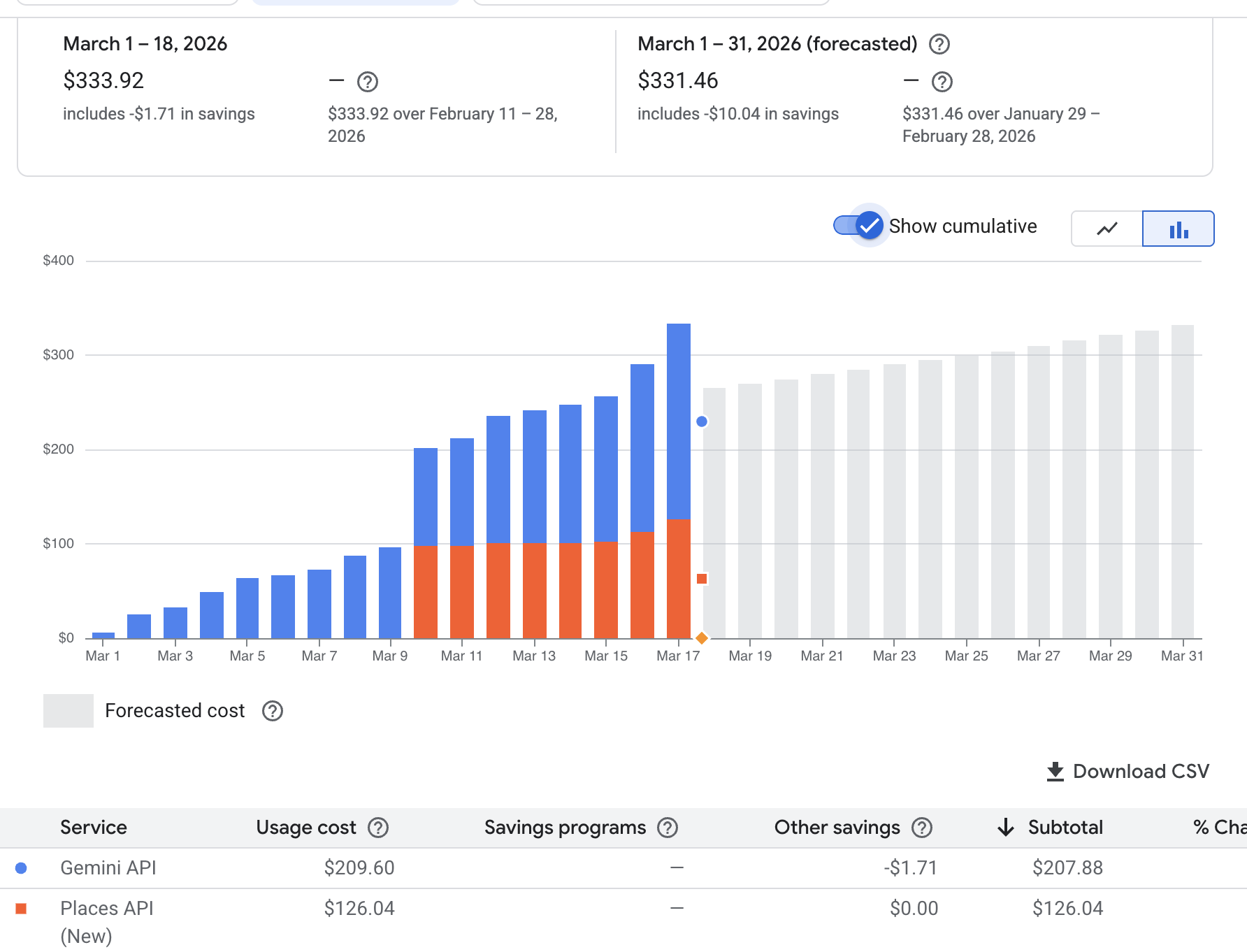
We've spent the last six weeks building tabiji.ai — 386 local restaurant and activity guides, 324 travel itineraries, 706 destination pages, and 200+ short-form videos. All AI-assisted. And after looking at where the money actually goes, we can tell you: token costs are a rounding error. Data enrichment is the real expense.
The Numbers Nobody Talks About
Here's our actual monthly cost breakdown for producing content at scale:
| Category | What It Does | Monthly Cost |
|---|---|---|
| LLM tokens (Gemini, Claude, GPT) | Writing, structuring, reasoning | ~$80 |
| Image generation (Gemini Flash) | Hero images, social graphics | ~$15 |
| Google Places API | Ratings, hours, contact info, reviews | ~$115 |
| SerpAPI (Google Search + Images) | Photo sourcing, research validation | ~$50 |
| Video generation (MiniMax / Veo) | Instagram Reels, YouTube Shorts | ~$120 |
| Cloudflare Pro + R2 storage | CDN, image hosting, deployment | ~$25 |
| Music generation (Suno) | Background audio for video | ~$10 |
The LLM — the thing everyone argues about — accounts for roughly 20% of our production costs. Data enrichment and media production account for the other 80%.
Why a 4.8-Star Rating Costs More Than a 1,000-Word Article
Consider what it takes to produce a single local restaurant guide. The AI can write beautiful prose about "the best ramen in Tokyo" in seconds. That's the easy part. The hard part — the part that makes the content actually trustworthy — is enrichment:
- Google Places API — For each of the ~15 restaurants on a page, we hit the Places API to pull live ratings, review counts, opening hours, phone numbers, price levels, and direct Google Maps links. That's 15 API calls at $0.032 each, roughly $0.50 per page.
- Reddit scraping — Every recommendation is sourced from real Reddit threads. Not training data. Actual posts from r/JapanTravel or r/FoodNYC with upvotes, timestamps, and direct quotes. This is manual curation work that no model can replicate from its weights alone.
- Photo sourcing — Each venue needs a real photo. We use SerpAPI to search Google Images, download candidates, score them with a vision model for quality and relevance, then optimize and host them on our CDN. Five API calls and a vision inference per photo.
- Schema markup — Every enriched page gets JSON-LD structured data with aggregateRating pulled from live Google data, so search engines can display star ratings in results.
A single popular-picks page costs roughly $0.50 in Places API calls, $0.30 in search/photo sourcing, and maybe $0.02 in LLM tokens for the actual writing. The "AI" part is 4% of the unit cost. The data layer is 96%.
The Data Moat Nobody Sees
This cost structure is actually good news if you understand what it means: data enrichment is a moat.
Anyone can prompt Claude to write "10 Best Restaurants in Barcelona." The output will be plausible, generic, and indistinguishable from a thousand other AI-generated listicles. But nobody else has our dataset: 3,755 places with live Google ratings, real Reddit quotes with upvotes and dates, verified opening hours, and curated photos — all cross-referenced and kept current.
We learned this the hard way. Our early itineraries were pure LLM output — well-written, structurally sound, and utterly generic. The recommendations were the same ones every travel blog regurgitates because that's what the training data contains. The moment we started enriching with real-time data from Google Places, Reddit, and Foursquare, the content became something models can't hallucinate: verifiably accurate.
When a page shows that Klimataria in Athens has a 4.5 rating from 3,200 reviews and is open until 11 PM on Thursdays — that's not AI creativity. That's an API call. And it's the thing that makes a visitor trust the recommendation enough to actually go there.
Video Makes It Even More Obvious
Our Instagram Reels pipeline produces 20+ videos per day across 10 formats. The cost breakdown is even more skewed:
- MiniMax video generation: ~$0.27 per 8-second clip
- Image generation for I2V input: ~$0.01 per image
- Text overlay + FFmpeg compositing: $0 (local compute)
- Music generation: ~$0.01 per track
- LLM for script/hook writing: ~$0.005 per video
The video model — the "AI" that everyone talks about — is 93% of the per-unit cost here. But that's only because video generation hasn't commoditized yet the way text has. Give it six months. The research pipeline (finding the right scam to warn tourists about, sourcing the cultural context, validating the facts) will remain the bottleneck long after video generation hits a penny per clip.
What This Means for Anyone Building with AI
If you're building AI-powered content at any scale, here's the uncomfortable truth: your model costs will approach zero. Your data costs won't.
Gemini Flash already generates perfectly serviceable text for fractions of a cent. Image generation is following the same curve. Video will get there. But the Google Places API still charges $32 per 1,000 requests. SerpAPI still charges per search. Reddit doesn't have a public API with structured sentiment data. And the curation work — deciding which Reddit threads are trustworthy, which photos actually represent a place, which hours are current — that requires either human judgment or expensive multi-step AI pipelines that dwarf the cost of the final text generation.
The companies that will win the AI content race aren't the ones with the cheapest model access. They're the ones building proprietary data pipelines that feed those models something worth writing about.
The model is the pen. The data is the ink. Everyone's arguing about the pen.
We publish our data as a free static API — 1,428 JSON files covering 706 destinations and 3,755 curated places. The data cost us orders of magnitude more to assemble than the AI cost us to write about it. And that's exactly why it's valuable.
Stop optimizing for tokens. Start investing in data.