Tabiji.ai Travel Safety Series · Book 7

Don’t lose ¥2,000 to a “free student gallery” on Wangfujing.

98 documented tourist scams across 16 mainland-Chinese cities — drawn from Chinese press (China Daily, Global Times, Xinhua, Shanghai Daily) and Public Security Bureau (110) records. You’ll learn the exact scripts English-speaking tea-ceremony pairs use on the Bund, the moves that stop Xi’an Muslim Quarter jade touts, and the Mandarin phrases that end an argument in seconds.

📖 ~328 pages paperback / ~260 Kindle 📱 Kindle eBook 🌍 16 mainland-Chinese cities ⚠️ 98 scams
$4.99 · launching 2026
China: Tourist Scams book cover — China — Tiananmen-area art-student scam scene

Inside this book

A preview of what’s documented — scripts, red flags, and the moves that shut each scam down.

98 scams 16 mainland-Chinese cities Chinese press & Public Security Bureau records Updated annually
Excerpt · Beijing

The Wangfujing “Art Student” Gallery

You step off Line 1 at Wangfujing and turn south toward the Oriental Plaza, and two young women in modest clothing stop you: “Excuse me, we’re art students — we have a free exhibition just around the corner, only one week.” They walk you a block east into a narrow commercial gallery. A patient older teacher serves tea, walks you through student pieces, and closes with catalog prints at 2,000–4,000 RMB each. The script has run at every Wangfujing subway exit since at least 2010, and China Daily has covered it annually…

Red flag: Any unsolicited fluent-English invitation to a gallery, tea ceremony, or student exhibition at a scenic site.
Full script, the gallery address pattern & the phrase that ends it — inside.
Excerpt · Shanghai

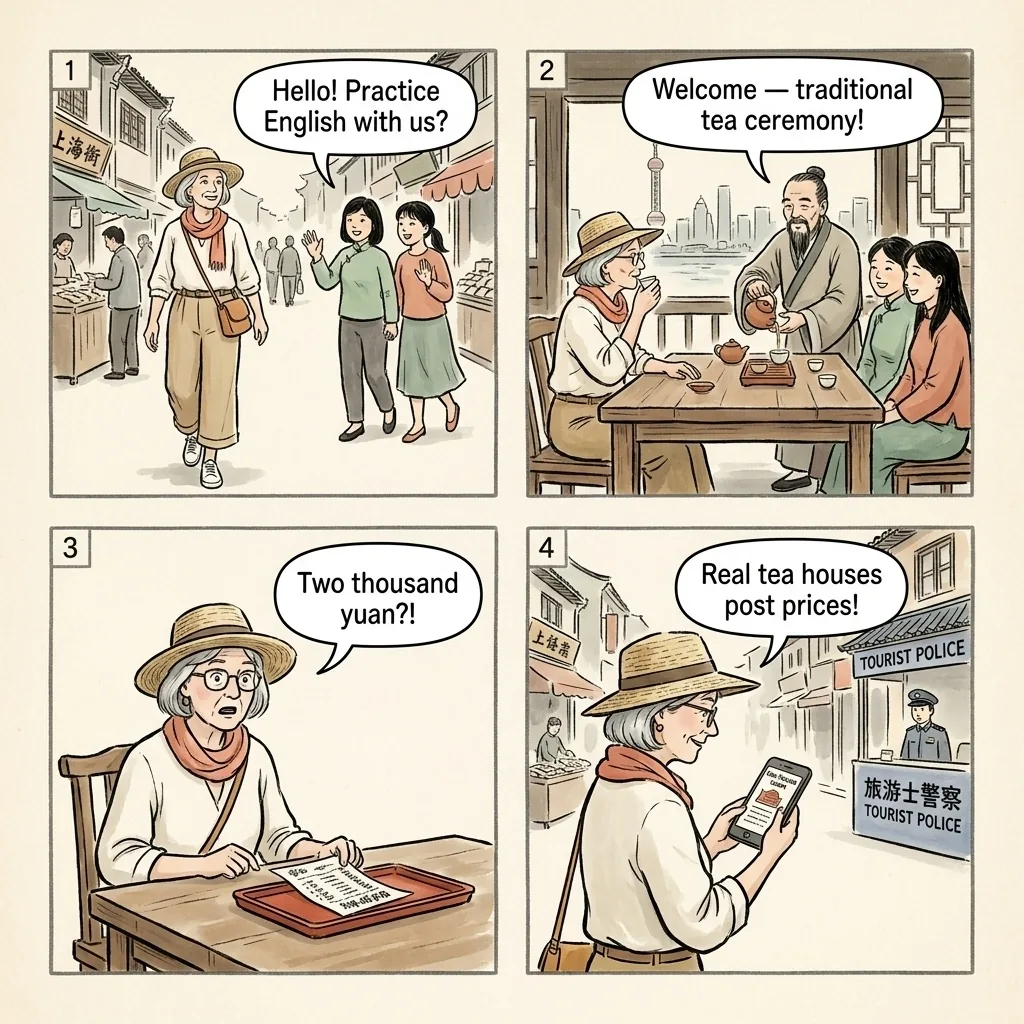
The Bund Tea-Ceremony Scam

You step off the Bund sightseeing tunnel and a friendly pair asks in fluent English if you’d like to “experience a traditional Chinese tea ceremony.” Four small cups in a 12-seat venue later, the bill arrives at 3,000–10,000 RMB for the two of you, with line items like “tea-master performance fee” and “seat fee.” Shanghai Daily has covered the scam in at least six reports between 2019 and 2025; Shanghai PSB posts English warnings at both the Bund tunnel entrance and the Nanjing Road walking-street kiosks…

Red flag: Any English-speaking Shanghai pair walking you toward “just one tea ceremony nearby.”
Full script, the 12-seat venue type & the Mandarin refusal — inside.
Excerpt · Xi’an

The Terracotta Warriors Minibus Switch

You arrive at Xi’an North Railway Station and a freelance driver offers a “Terracotta Warriors day tour, 200–300 RMB, English guide.” The tour substitutes four commission stops — jade, silk, tea, “imperial medicine” — for meaningful time at the actual warrior pits. The legitimate public Bus 游5 / 306 (7 RMB) departs from Fangzhicheng Coach Station and delivers you straight to the site in 80 minutes; the official Metro Line 9 connects Fangzhicheng to downtown Xi’an…

Red flag: Any English-speaking minibus “tour” at a mainland-Chinese railway station with an unadvertised commission circuit.
Full switch mechanic, the Metro route & the real tickets — inside.

16 mainland-Chinese cities covered

From Wangfujing “art student” gallery pitches to Xi’an Muslim Quarter jade-certificate circuits, from the Bund tea ceremony to Zhangjiajie combined-ticket confusion — full coverage of where foreign visitors actually get caught out on the mainland.

🏯 Beijing
🌆 Shanghai
🏛️ Xi’an
🐼 Chengdu
🏙️ Chongqing
🗼 Guangzhou
🌉 Shenzhen
🍵 Hangzhou
🌳 Suzhou
⛰️ Guilin
🛶 Yangshuo
🏮 Lijiang
🌿 Kunming
🏰 Pingyao
❄️ Harbin
🏞️ Zhangjiajie

Hong Kong and Macau are covered in separate dedicated volumes of the series — both are Special Administrative Regions with their own legal systems, currencies, and tourism-safety frameworks.

Why tabiji.ai writes these books

Volumes 1 (Japan), 2 (Italy), 3 (France), 4 (Thailand), 5 (Spain), and 6 (Vietnam) set the series structure. China (Volume 7) covers sixteen mainland-Chinese cities by tourist volume — Beijing, Shanghai, Xi’an, Chengdu, and the Jiangnan and Yunnan scenic tier below them — and is ordered so the flagship city chapters are first and the scenic-area outliers (Pingyao, Harbin, Zhangjiajie) last.

📰

Chinese-press sourced, not Reddit-only

Every scam is documented against Chinese and China-facing English news coverage — China Daily, Global Times, Xinhua, Shanghai Daily, Beijing Review — plus Public Security Bureau (dial 110), China National Tourism Administration (12301), and State Administration for Market Regulation (12315) bulletins, and firsthand traveler accounts. Named circuits and dated incidents where we have them.

🗣️

Mandarin phrases with Pinyin + characters

A full appendix of Mandarin exit phrases — “bù yào, xièxie” (no thanks), “qĭng dǎ biǎo” (please start the meter), “wǒ yào bàojǐng” (I’m calling the police) — with simplified Chinese characters you can show on your phone, Pinyin with tone marks, and pronunciation cues.

🔄

Updated annually

Scams evolve. Wangfujing “art student” teams rebrand every few months. Shanghai Bund tea houses move and rename. Xi’an Muslim Quarter jade-certificate language gets updated seasonally. We re-research and update each book every year. Buy once, re-download future editions from your Amazon library.

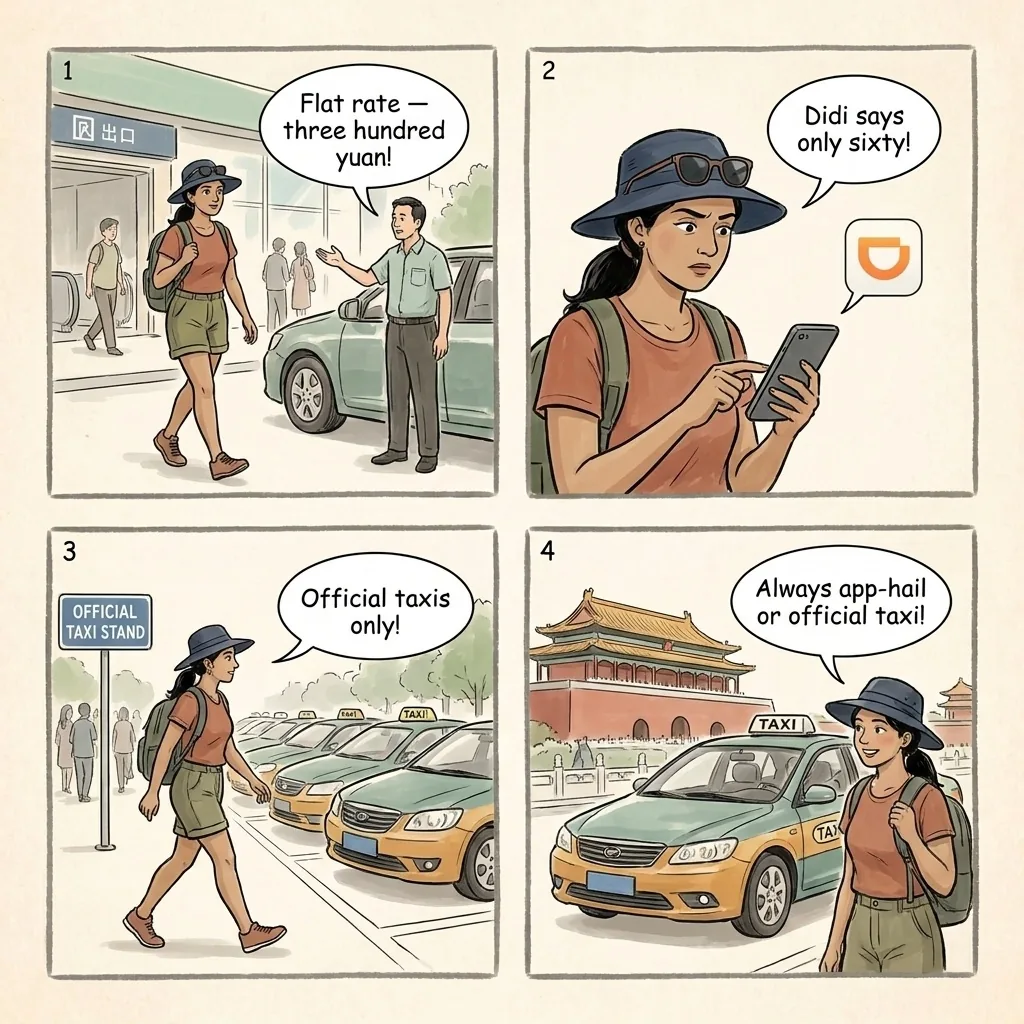
TABIJI · TRAVEL SAFETY What the guidebooks won’t tell you. Wangfujing runs an “art student” script you can’t opt out of. The Bund tea-ceremony extracts 3,000–10,000 RMB per couple. Xi’an Muslim Quarter “auntie-tours” end at an 8,000-RMB jade counter. This book documents 98 specific scams across 16 mainland-Chinese cities — drawn from China Daily, Global Times, Xinhua, Shanghai Daily, and Public Security Bureau (110) records. You’ll learn the exact scripts scammers use, the red flags that give them away, and the Mandarin phrases that shut them down on the spot. INSIDE 98 scams with exact Mandarin scripts and RMB amounts Six universal red-flag patterns covering every scam in China A four-panel watercolor comic for every scam entry Beijing, Shanghai, Xi’an, Chengdu & 12 more mainland cities Mandarin phrases with Pinyin & simplified Chinese characters PLUS A Mandarin exit-phrase card you can screenshot to your phone A post-scam recovery playbook (first 15 min, first hour, first day) Emergency contacts: 110 PSB, 12301 tourist-help, every major hospital KINDLE EDITION · 2026

“What the guidebooks won’t tell you.”

Part of the Travel Safety Series

China is Volume 7 of 15 flagship titles. Japan (Volume 1), Italy (Volume 2), France (Volume 3), Thailand (Volume 4), Spain (Volume 5), and Vietnam (Volume 6) are live. Each country gets the same treatment — real traveler stories, local-press sourced, annual updates.

Frequently asked

Quick answers about the book, pricing, and updates.

What format is this book?

Kindle eBook — readable on any phone, tablet, or computer with the free Kindle app, as well as on any Kindle device. A ~328-page paperback edition is planned for 2026.

How long is it?

Approximately 328 pages in paperback, ~260 pages on Kindle — written to be read in a single flight over and referenced on your phone in-country.

How much does it cost?

$4.99 USD on Amazon Kindle. Price varies slightly by Amazon region.

Will the book be updated?

Yes — we re-research and update each book annually as scams evolve. Buy once, re-download future editions from your Amazon library at no extra cost.

Can I get a refund?

Yes. Amazon’s standard Kindle refund policy applies — you have 7 days from purchase to return for a full refund, no questions asked.

Launching 2026 on Amazon Kindle

The book isn’t live yet — but the research behind it is. Read our free mainland-China scam pages while you wait.