
Key Takeaways
- The #1 reported scam is the Airport Black Taxi & Daxing (PKX) Scam.
- 4 of 8 scams are rated high risk.
- Use app-based ride services or official metered taxis — avoid unmarked vehicles near tourist areas.
- Never accept unsolicited offers from strangers near tourist sites in Beijing.
⚡ Quick Safety Tips
- At PEK and Daxing (PKX) airports, walk past anyone offering 'taxi' inside the terminal — use the Airport Express train (¥25 from PEK, ¥35 from PKX) or the official outdoor taxi queue, saying 'da biao' (打表) before boarding.
- Walk past any stranger near Wangfujing, Tiananmen, or Qianmen who speaks fluent English and invites you to tea, art exhibitions, or 'cultural experiences' — both the gallery and tea-house variants run the same ring with ¥3,000–¥8,000 bills.
- Book Great Wall via the S2 train from Huangtudian to Badaling (¥6, 1h15m) or licensed operators (Viator, GetYourGuide, Beijing Hikers) — avoid hotel-lobby 'all-inclusive' tours at ¥150–¥250.
- For Peking duck, book Da Dong (dadongdadong.com), Siji Minfu, or Quanjude direct — never follow a driver's or tout's 'famous restaurant' recommendation; Traveler reports warn all near-Qianmen gold-lettered 'Peking duck' venues pay driver commissions.
- Save English-line 12315 (consumer complaints) and 110 (police) confirms 12315 handles tourist scams in English and the line is responsive.
Jump to a Scam
- High Airport Black Taxi & Daxing (PKX) Scam
- High Art Student / Art Teacher Gallery Trap
- High Wangfujing & Qianmen Tea House Scam
- Medium Forbidden City Trishaw / Rickshaw Price Flip
- Medium Great Wall Fake Ticket & 'All-Inclusive' Budget Tour
- Medium Fake Peking Duck 'Famous Restaurant' Swap
- High Sanlitun Tinder / Dating App Bar Trap
- Medium Temple of Heaven & Summer Palace Fake Guide Ambush
The 8 Scams
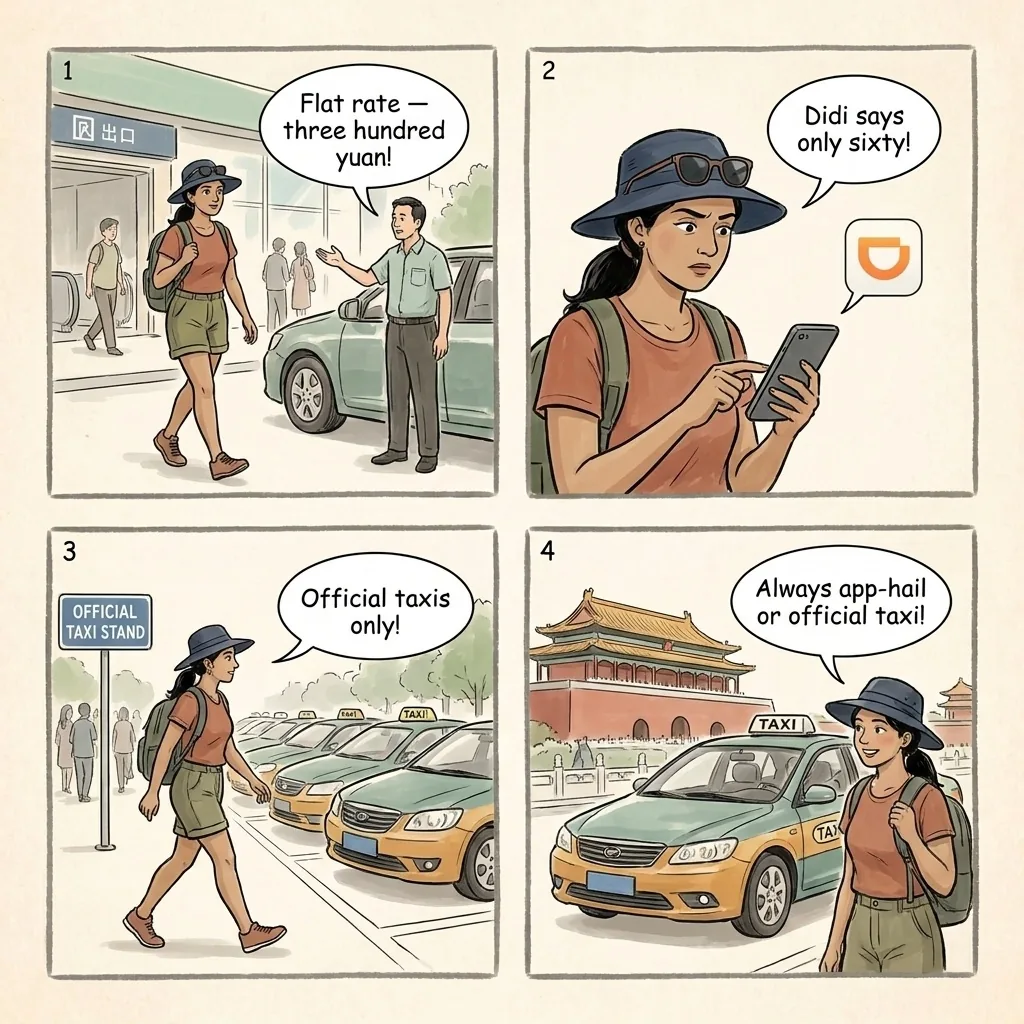
Unauthorized black-taxi touts inside Beijing Capital (PEK) and Daxing (PKX) airports approach arriving passengers and quote "fixed prices" of ¥400–¥800 to central Beijing — three to five times the metered fare — counting on traveler fatigue and unfamiliarity with the Airport Express trains to convert the overcharge.
Inside both airports, touts in suits or casual dress station themselves near the arrivals gate and move in before passengers reach the official taxi rank. The pitch is direct: "Taxi? Where you go? Fixed price, no meter." The quoted rate to a central hotel sounds plausible to someone arriving for the first time, especially when the official signage is still some distance ahead and the offer comes with a helpful, confident manner.
The metered fare from PEK to central Beijing is ¥90–¥120 (25 km, 30–40 minutes); from Daxing (PKX), the meter runs ¥140–¥180 for the 46 km trip. The Airport Express train from PEK Terminal 3 to Dongzhimen costs ¥25 and takes 25 minutes. Daxing's metro link to Caoqiao costs ¥35 and takes 19 minutes. Any unsolicited tout offering a "fixed price" is charging two to five times these benchmarks.
Walk past any driver who approaches inside the terminal, follow the official "Taxi" signage to the outdoor rank, and insist on "da biao" (打表 — "use the meter") before the car moves. The Airport Express trains are the safest option for solo travelers arriving at peak hours — regulated, well-signed, and impossible to overcharge. If you take a metered taxi, photograph the plate number from the rear window as you enter; it is a deterrent and a record for any later dispute.
Red Flags
- Man in suit or casual dress approaches you inside the terminal or just outside arrivals offering 'taxi' without you requesting
- Driver quotes a 'fixed price' of ¥300+ to central Beijing and refuses to use the meter ('da biao')
- Driver claims meter is 'broken' after you've already boarded
- Meter runs oddly fast or switches to night rate during daytime hours
- No printed receipt (fapiao) offered on arrival; genuine Beijing taxis always provide one
How to Avoid
- Never engage drivers who approach inside the terminal — all are unauthorized.
- Follow 'Taxi' signage to the official outdoor rank and queue for the next available metered taxi.
- Install DiDi app with international number before arriving; it has an English interface and regulated fares.
- Take the Airport Express train from PEK (¥25, 25 min) or Daxing Airport Express metro from PKX (¥35, 19 min) as the scam-proof alternative.
- Say 'da biao' (打表) firmly before the driver pulls away; photograph the taxi plate number on entering.
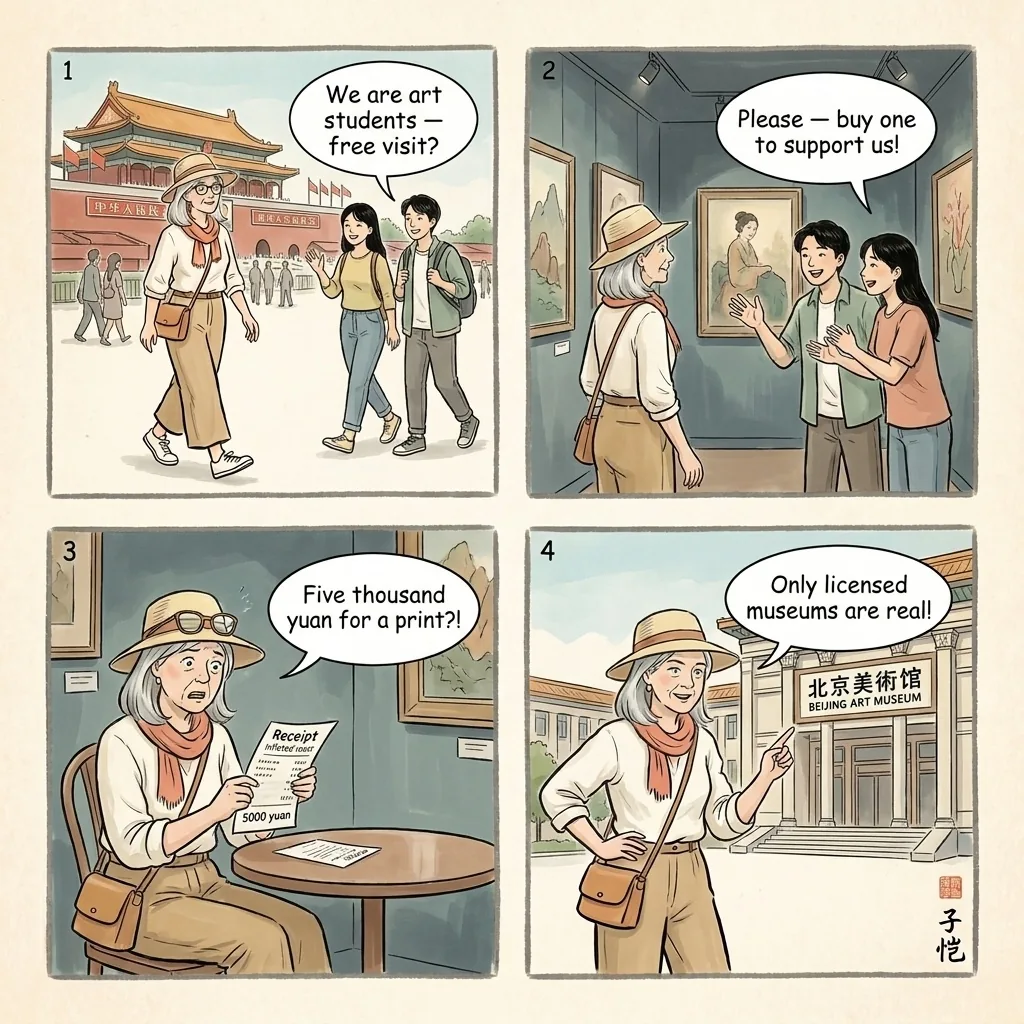
Organized crews posing as art students from Beijing's Central Academy approach tourists on Wangfujing Street and near Tiananmen Square with invitations to a "free student exhibition" — a back-room high-pressure salesroom for mass-produced scroll paintings and calligraphy priced at ¥500–¥3,000.
A well-dressed young man or woman approaches in fluent English near Wangfujing or along the Tiananmen approach: "Excuse me, I am an art student at the Central Academy — we have a student exhibition just around the corner, free to view, do you like Chinese culture?" The invitation feels spontaneous and the person sounds knowledgeable. The gallery is a short walk away, typically in an upper-floor space or a side-alley location that was not visible from the main street.
Inside, tea is poured and scroll paintings, calligraphy prints, and ceramics are displayed as student work. Once you have settled, a "teacher" or second operator explains that buying a piece "supports the students," starting at ¥500 for smaller items and climbing to ¥3,000 for the supposed "master's work." The same organized crews rotate between Wangfujing, Qianmen, and Tiananmen Square's north side; the same individuals sometimes pivot from the art pitch to a tea-house invitation if the gallery approach stalls.
Do not follow any stranger from a tourist street to an "exhibition," "gallery," or "cultural show" — regardless of how genuine or personable the approach seems. Beijing's legitimate art world is in the 798 Art District in the north-east of the city and the Songzhuang artist village, both of which have posted prices and no on-street solicitors. A firm "bu yao, xie xie" (不要,谢谢 — "no thank you") while continuing to walk is all the response required.
Red Flags
- Fluent-English speaker approaches you on Wangfujing, near Tiananmen, or Qianmen claiming to be an 'art student' or 'English teacher'
- They invite you to a 'free' exhibition, art show, or student gallery 'just around the corner'
- Gallery is in a back alley or upper-floor location, not a visible main-street shop
- Prices only revealed after you've spent time viewing; pressure escalates to 'must buy'
- Same scam pattern rotates between Wangfujing, Tiananmen north side, and Qianmen
How to Avoid
- Walk past any stranger approaching in fluent English at Wangfujing, Tiananmen, or Qianmen with a firm 'bu yao xie xie' (不要谢谢).
- Never follow a stranger to a 'just around the corner' exhibition, tea ceremony, or gallery.
- Do not engage in casual conversation about 'where are you from' or 'how do you like China' — it is the scam's opening.
- For genuine art, visit 798 Art District (north-east Beijing) — official galleries with posted prices.
- If invited to 'tea together,' say no — the art scam often transitions to the tea-house scam.
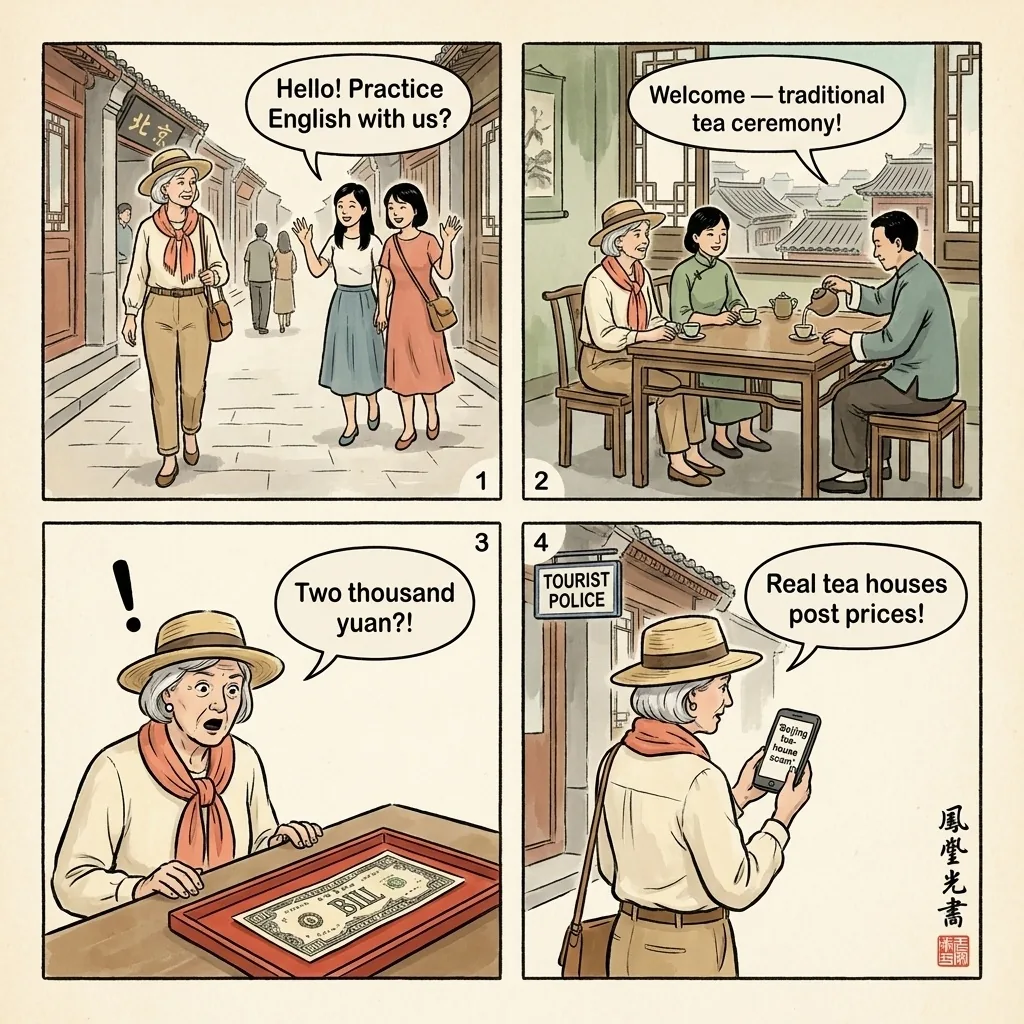
Smooth-talking strangers near the Forbidden City, Wangfujing, and Tiananmen Square befriend tourists with a photo-taking opener, then steer them to a nearby "tea ceremony" in a side-street venue where a bill of ¥3,000–¥8,000 per person arrives, the door closes, and staff block the exit until payment is made.
Near the Forbidden City's south gate or along Wangfujing, a young man or woman approaches and asks if you can take their photo. You do; they offer to take yours; conversation about where you're from flows naturally. Minutes later, they suggest joining a "traditional Chinese tea ceremony" they've just heard about nearby. A short walk leads to a small, well-decorated tea house on a side street you would not have chosen yourself. Tea is served, the company is pleasant, and the experience feels entirely genuine.
The bill arrives when the last round of tea is poured. Per-person totals run ¥3,000–¥8,000 — sometimes with a vaguely worded "menu" that was flashed briefly at the start and cannot be verified now. When guests attempt to leave without paying, the door is blocked and men appear from a back room. Modern variants include showing a menu up front to complicate credit-card chargebacks, but the coercive exit pressure remains. Six or seven rotating fake tea houses in the same neighborhood share the operation, swapping which venue is "open" each week.
Never follow a new acquaintance from a tourist street to a tea house, tea ceremony, or any venue you did not select yourself from a map or prior recommendation. The photo-taking opener, the fluent English, and the spontaneous invitation are all scripted steps in a rehearsed routine. For genuine tea culture, Maliandao Tea Street in south-west Beijing is a wholesale market with hundreds of vendors and posted prices, reachable by metro. If you are held inside a venue, call 12315 — the consumer-protection English line — and refuse to pay until police arrive.
Red Flags
- Stranger(s) approach you near the Forbidden City, Wangfujing, or Qianmen asking you to take their photo
- They invite you to tea, 'cultural experience,' or 'traditional ceremony' just minutes after meeting
- Tea house is in a small side street, upper floor, or location you did not choose yourself
- No menu visible or menu shown too briefly to read before ordering
- Staff become hostile or block the door when the bill arrives
How to Avoid
- Never accept tea-house or 'cultural' invitations from strangers met in tourist areas — walk past with 'bu yao.'
- Do not take photos for strangers who then strike up conversation; it is the scam's opening move.
- Refuse to enter any venue you did not choose yourself from a published map or guide.
- Always check the menu and prices BEFORE ordering; if a menu cannot be shown, leave.
- Call 110 (police) or 12315 (consumer-protection English line) if trapped; Traveler reports confirm 12315 handles these cases.
Like what you're reading? Get a full Beijing itinerary with safety tips built in.
Browse travel-safety books →
Trishaw drivers near the Forbidden City and Houhai lake call out a low ride price of ¥30–¥50, then demand ¥300–¥1,000 at the destination by claiming the quote was per minute, per person, or subject to an undisclosed service charge — with the driver's English conveniently disappearing when the dispute begins.
Between the Forbidden City's north gate and the Houhai lakefront, trishaw drivers call out: "30 yuan! Hutong tour! 30 yuan!" The price sounds reasonable for a charming ride through Beijing's historic lanes, and the three-wheeled vehicles are genuinely picturesque. The driver is friendly and chatty as you set off into the hutongs.
At the drop-off, the agreed price is reinterpreted. The driver now demands ¥300, ¥500, or more, explaining that the ¥30 quote was per person per minute, per segment, or subject to a charge he did not mention at the start. His English has stopped working. A companion driver or group of associates may appear at the destination to intensify the pressure. The Houhai lakefront and Bell and Drum Tower area see the highest concentration of incidents because both are photogenic pedestrian zones where tourists naturally slow down and linger.
Before boarding any trishaw near the Forbidden City or Houhai, agree on the total round-trip price in writing — show the driver a number on your phone screen and photograph the agreed figure before the ride starts. If the price is flipped at the destination, refuse the inflated amount and call 110; Beijing police have become meaningfully more responsive to tourist overcharge complaints in recent years. The cleanest alternative is to walk Nanluoguxiang hutong north of the Forbidden City independently — it is free, well-signed, and requires no negotiation at all.
Red Flags
- Trishaw driver calls out a suspiciously low price (¥30, ¥50) near the Forbidden City or Houhai
- Driver does not write down the price or show a posted rate card
- Route takes you on a longer loop than agreed or stops at unplanned 'shop' locations
- Driver's English 'stops working' when bill time arrives
- Companion or partner driver joins at the drop-off point to add pressure
How to Avoid
- Book hotel-arranged or licensed hutong tours (¥150–¥250, 1 hour, posted price) rather than street trishaws.
- If you do hire one, agree total price in writing on your phone screen before boarding.
- Photograph the driver's face and license plate on entering.
- Walk Nanluoguxiang hutong independently — genuine, well-signed, free.
- If price is flipped, refuse the inflated amount and call 110; Beijing police are responsive to tourist complaints in 2025.

Hotel-lobby tour desks sell "all-inclusive Great Wall day trips" for ¥150–¥250 — a price made possible by padding the itinerary with four to five commission-generating shopping stops at jade, silk, and tea "museums," leaving only 90 minutes at Badaling's most crowded section with no time to reach the quieter towers.
The brochure looks comprehensive: Badaling Great Wall entry, a Ming Tombs visit, lunch, and round-trip transport — all for ¥150–¥250. What the itinerary doesn't show is the four to five "government-approved" jade, tea, and silk "museum" stops that turn the day into a commission-driven shopping circuit. Each stop is a high-pressure retail venue; the guide's interest in lingering is directly proportional to the kickback the tour operator receives for delivered customers.
By the time the bus reaches Badaling, the morning is largely gone. The 90-minute Great Wall allowance puts you in the middle of the most overcrowded section, nowhere near the photogenic unrestored towers that require at least three hours of walking to reach. The Ming Tombs "visit" is a hurried walk through a gift shop at one of the outer gates. Lunch is a fixed-menu group meal at a restaurant that also pays commission to the tour operator for the booking.
Never buy a Great Wall day trip from a hotel-lobby tour desk or street flyer — the ¥150–¥250 price point is structurally dependent on shopping-stop commissions and cannot exist without them. The S2 suburban train from Huangtudian station to Badaling costs ¥6 and takes 75 minutes, with no diversions. For Mutianyu — less crowded and cable-car accessible — book directly through Viator or GetYourGuide and verify in writing that the itinerary has zero shopping stops; any operator who won't commit to that in writing is running the same commission model.
Red Flags
- Tour price under ¥200 for a full-day Great Wall trip (genuine cost is ¥400–¥600)
- Itinerary includes 'jade museum,' 'tea ceremony,' 'silk factory,' or 'TCM clinic' stops
- Guide's English is perfect when selling but 'stops working' at shopping stops
- Brochure is in English-only, printed on cheap paper, distributed in hotel lobbies
- Tour pickup is from an unmarked bus in a street location, not a licensed tourist bus station
How to Avoid
- Take the S2 suburban train to Badaling (¥6, 1h15m) — scam-free and well-signed from Huangtudian station.
- Book Mutianyu with Viator, GetYourGuide, or Tiqets — verify ZERO shopping stops in writing.
- For Jinshanling, use Beijing Hikers or similar licensed small-group operators (~¥500–¥700 per person).
- Avoid hotel-lobby tour booths offering 'all-inclusive' at ¥150–¥250; they all include shopping stops.
- Check itinerary on Reddit (traveler reports search for operator name) before paying any deposit.

Trishaw drivers, taxis, and Qianmen street touts steer tourists to commission-paying Peking duck venues with gold-lettered signs and laminated English menus, delivering a mediocre meal billed at ¥600–¥1,200 per person — three to four times the price of the genuine Beijing institutions the tout claimed to be recommending.
You ask your trishaw driver or a friendly stranger near Qianmen about Peking duck, and they respond with immediate conviction: "I know the most famous restaurant in Beijing — they do the best duck." The venue they take you to has gold characters over the door, laminated English menus with glossy duck photos, and an English-speaking host greeting you at the entrance. The only customers inside speak English.
The driver or tout collects ¥100–¥200 for every tourist delivered to the venue. The duck is edible but ordinary; the bill arrives at ¥600–¥1,200 per person for a meal that the genuine Da Dong or Siji Minfu chain would serve for ¥200–¥450. Hotel concierge recommendations follow the same commission pattern. The operation runs across Qianmen Street, around Wangfujing, and throughout the tourist-facing hutong areas near the Forbidden City.
Book Peking duck directly through the restaurant's official website or WeChat mini-program at a named, verified institution — Da Dong (dadongdadong.com), Siji Minfu, or Lao Beijing — rather than acting on any recommendation from a driver, tout, or concierge. Genuine duck at these venues costs ¥200–¥450 per person; a quote above ¥600 signals you are in the wrong place. Verify the venue name on Dianping before going; overcharge disputes can be filed with 12315, the consumer-protection English line.
Red Flags
- Trishaw, taxi, or stranger recommends 'the most famous Peking duck restaurant' near Qianmen or Wangfujing
- Restaurant has gold-lettered signs, laminated English menus with photos, but no Chinese-language chalkboard specials
- Bill at ¥600–¥1,200 per person for Peking duck that should be ¥150–¥300
- Host speaks fluent English before ordering but 'loses' English when the bill arrives
- Venue name is not Da Dong, Siji Minfu, Quanjude, Lao Beijing, or another community-verified institution
How to Avoid
- Book Da Dong (dadongdadong.com), Siji Minfu, Quanjude, or Lao Beijing directly via website or WeChat.
- Ignore driver/tout/concierge recommendations for 'famous duck' — all pay commissions.
- Verify restaurant name on traveler reports and Dianping reviews before going.
- Peking duck should cost ¥150–¥450 per person at genuine restaurants, not ¥600–¥1,200.
- Photograph the menu before ordering; request itemised bill before paying.

Dating-app matches in Beijing — set up on Tinder, WeChat, or Bumble — steer solo travelers to a specific nearly-empty bar near Sanlitun or Worker's Stadium where drinks are priced at ¥200–¥400 each and exit is blocked by staff until a total bill of ¥2,000–¥8,000 is paid.
A match from Tinder, WeChat, or Bumble suggests meeting at "her favorite bar" in Sanlitun or near Worker's Stadium. The bar is nearly empty when you arrive, but that seems coincidental for an off-peak hour. She orders drinks for both of you without showing you the menu. The beer or cocktail tastes ordinary; the conversation is pleasant. Two or three rounds later, the bill arrives at ¥2,000–¥8,000 for drinks that verified bars nearby charge ¥30–¥60 for.
This version of the trap uses dating apps to pre-qualify victims and make the meeting feel self-initiated — unlike the older hostess-bar version, which required a street tout. The structural elements are identical: the empty venue, the match who orders without showing you the menu, the bill that bears no relationship to market prices, and the bouncers who appear when payment is disputed. The match, the conversation, and the venue are all coordinated by the same operation.
For any dating-app meetup in Beijing, choose the venue yourself from Dianping or a hotel bar, and look up drink prices for that specific venue before you arrive. A Qingdao beer at a legitimate Beijing bar costs ¥20–¥60; any bar charging ¥200+ per drink is either a tourist-trap or a trap venue. Always view the menu before ordering and do not let your companion order on your behalf. If presented with an inflated bill and exit is blocked, call 110 and pay only what the drinks would cost at verified market rates.
Red Flags
- Tinder/Bumble/WeChat match suggests a specific bar you've never heard of
- Bar is mostly empty despite being in a popular nightlife area
- No posted prices or menu; your date orders for both of you
- Drink prices ¥200–¥400 each when residential rates are ¥30–¥60
- 'Date' disappears when bill arrives; staff/bouncers block the door
How to Avoid
- Choose the venue yourself for any dating-app meetup — hotel bar or Dianping-verified venue.
- Look up expected prices; Qingdao beer should be ¥6–¥60 depending on venue, not ¥300+.
- Set a personal spending limit and stick to it; if a round costs more than expected, leave.
- Never let your date order without you seeing the menu.
- If trapped with an inflated bill, pay only what you reasonably consumed at reasonable prices and call 110.

Plain-clothes touts wearing improvised "official guide" vests approach tourists at the gates of the Temple of Heaven and Summer Palace, charge ¥200/hour for an unlicensed service, then demand ¥800 by claiming four hours elapsed in twenty minutes — or steer victims into a commission-generating "traditional Chinese medicine clinic" or tea-house stop mid-tour.
At the main entrance of the Temple of Heaven or Summer Palace, a man in a vest approaches in decent English: "I am official guide — 200 yuan per hour, I show you everything." He carries a laminated ID that looks plausible, knows facts about the site, and seems entirely legitimate. Neither park uses this kind of at-the-gate freelance guide service, but a visitor arriving for the first time has no immediate way to know that.
After twenty minutes of touring, the guide declares that four hours have elapsed and demands ¥800 in cash. Alternatively, the route passes through an affiliated tea house or "traditional Chinese medicine clinic" where a doctor delivers a vague diagnosis and recommends expensive herbs for purchase on the spot. None of the guide's credentials are issued by the park; no official fapiao receipt is offered; any paperwork shown was printed privately.
All legitimate guide services at the Forbidden City, Temple of Heaven, Summer Palace, and Lama Temple are booked in advance through the site's official ticket office or arranged by a licensed tour company — no genuine guide solicits tourists at the park gate. Official audio guides are available at the entrance of each site: ¥40 at the Temple of Heaven, ¥60 at the Summer Palace. Walk past anyone approaching at a park entrance with "bu yao" and proceed directly to the ticket desk; do not engage in any conversation before entering.
Red Flags
- Plain-clothes person at park entrance approaches with an 'official guide' pitch
- 'Guide' shows a laminated ID but cannot show a current year's licensing sticker
- Price quoted per hour but the 'hour' extends without notice
- Tour incorporates a 'tea ceremony,' 'TCM clinic,' or 'jade shop' stop midway
- Guide demands cash payment; no printed fapiao receipt offered
How to Avoid
- Rent the official audio guide at park entrances: Temple of Heaven ¥40, Summer Palace ¥60, Forbidden City ¥40.
- Book guided tours in advance via Viator, GetYourGuide, or your hotel — never accept gate-approach guides.
- Walk past anyone approaching at park entrances; do not engage in conversation.
- For Temple of Heaven, the main buildings are well-signed in English; no guide strictly needed.
- If a 'guide' has attached himself, stop walking, refuse to pay, and threaten to call 110 — the tout will leave.
🆘 What to Do If You Get Scammed
📋 File a Police Report
Go to the nearest Chinese Police (公安局) station. Call 110 (Police) or 120 (Ambulance). Get an official crime report — you'll need this for insurance claims. You can also report online at mps.gov.cn.
💳 Cancel Your Cards
Call your bank immediately. Most have 24/7 numbers on the back of the card (keep a photo saved separately). Block any suspicious transactions before the thieves use your details.
🛂 Lost Passport?
Contact your nearest embassy or consulate. The US Embassy in Beijing is at No. 55 An Jia Lou Road, Chaoyang District, Beijing 100600. For emergencies: +86 10-8531-3000.
📱 Track Your Device
If your phone was stolen, use Find My (iPhone) or Find My Device (Android) from another device. Don't confront thieves yourself — share the location with police instead.
Frequently Asked Questions
You just read 8 scams in Beijing. The full Travel Safety Series has 780+ more across 20+ countries.
Tokyo's Kabukichō ¥130,000 bar trap. Rome's gladiator photo extortion. Paris's gold-ring trick. Bali's ATM skimmer scams. Bangkok's grand-palace closure ruse. Every documented scam across 20+ destinations — with the exact scripts, red flags, and local-language phrases that shut each one down. Drawn from Reddit traveler reports, embassy advisories, and consumer-protection cases.
- 780+ documented scams across Tokyo, Rome, Paris, Bali, Bangkok, Rio & 100+ more cities
- 20+ countries covered, with country-by-country phrase cards for every destination
- Updated annually — buy once, re-download future editions free
- All titles $4.99 each on Amazon Kindle