
Key Takeaways
- The #1 reported scam is the Taoyuan Airport & Jiufen Day-Trip Illegal Taxi Scam.
- 3 of 4 scams are rated high risk.
- Use app-based ride services or official metered taxis — avoid unmarked vehicles near tourist areas.
- Never accept unsolicited offers from strangers near tourist sites in Taipei.
⚡ Quick Safety Tips
- Take the Taoyuan Airport MRT directly from inside the terminal to Taipei Main Station — 35 minutes, contactless via EasyCard, zero scam risk.
- In Ximending, Zhongxiao Dunhua, and Taipei 101 concourses, keep walking past kiosk staff who step into your path with free skincare samples.
- At Taipei Main Station and 228 Park, decline 'Where are you from?' approaches within 10 seconds and never follow strangers to a second location.
- Demand an itemized receipt at every souvenir shop, night-market stand, and tea store before paying — verify line items match what was handed over.
Jump to a Scam
The 4 Scams
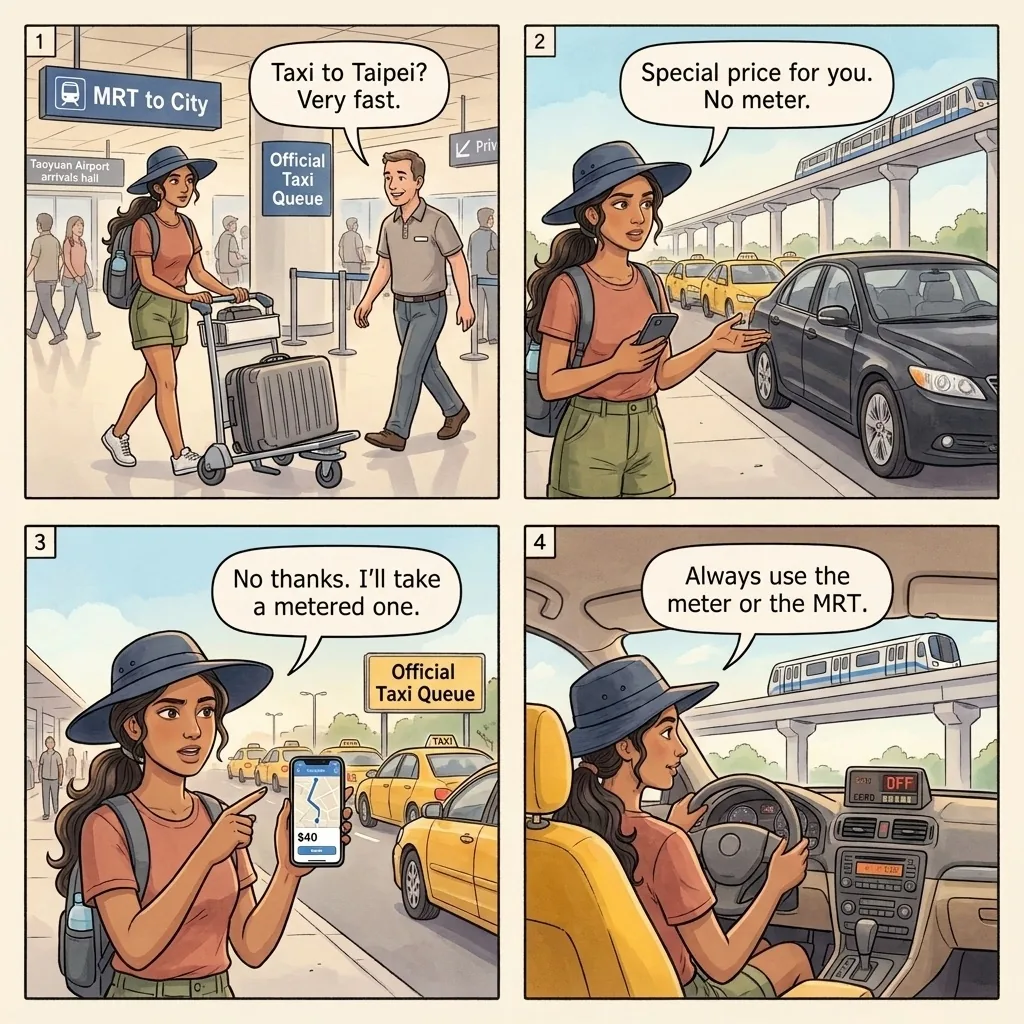
Taiwan's taxi drivers are among Asia's most honest, with meters used by default on almost every legitimate ride.
The exceptions cluster in two places — Taoyuan airport arrivals, where unlicensed touts solicit arriving foreigners, and the Jiufen day-trip circuit, where a small number of drivers quote three to four times the legitimate fare.
At Taoyuan Terminal 1 and Terminal 2 arrivals, the pitch begins as a friendly offer inside the baggage-claim area or just past customs — 'Taxi? Taipei?' — from a man in plain clothes who is not part of the licensed yellow-taxi queue. He walks luggage to a private sedan parked on the perimeter of the arrivals curb. No meter, no visible plate, no receipt. Cash is demanded upfront or on arrival at a 'Taipei hotel price' several times the legitimate metered fare.
The legitimate option for most tourists is the Taoyuan Airport MRT from inside the terminal to Taipei Main Station in about 35 minutes, contactless via EasyCard. A licensed metered taxi from the official coupon queue is comparably priced — 2024–2025 traveler reporters cite roughly NT$400 to NT$500 for 11 km intra-city rides, and the Taoyuan–Taipei leg is a fixed multiple of that range posted in English at the taxi queue. The Jiufen variant targets day-trippers with inflated round-trip quotes, often after the driver insists the TRA train from Ruifang is 'sold out' or 'not running today.'
On Thursday 5 June 2025, a Spanish tourist jumped from a moving unlicensed sedan near Terminal 2 on West 3rd Road when the driver tried to flee airport police, per Taipei Times and Taiwan News reporting published 7 June 2025. She landed with arm abrasions; the 58-year-old operator surnamed Hsu was fined NT$9,600 on the spot and faced a separate fine of up to NT$25 million for illegal taxi operation, with the Aviation Police Bureau noting Hsu was a repeat offender.
For arrivals: take the Taoyuan Airport MRT from inside the terminal directly to Taipei Main Station. If a taxi is preferred, use only the official yellow-taxi coupon queue beyond the arrivals hall — fares are posted in English and the meter is mandatory. For Jiufen: take the TRA train from Taipei Main Station to Ruifang (about 45 minutes), then bus 788 or 1062 to the Old Street.
If a quoted fare looks wrong, photograph the license plate and the dashboard ID card before loading any luggage. For pressure, overcharging, or a refusal to release bags, call Taiwan's tourism hotline 0800-011-765 (or +886 2 2717 3737 from abroad) and for serious incidents dial 110 for police. Taiwan's consumer-protection hotline is 1950 and the American Institute in Taiwan main line is +886 2 2162 2000.
Red Flags
- unmarked sedan picking up from the Taoyuan arrivals curb — no taxi signage, no visible plate on the dashboard
- driver approaching inside the baggage-claim area or just past customs with a quiet 'Taxi? Taipei?'
- quoted flat fare several times the metered rate from Taoyuan to Taipei with the meter disabled or claimed 'broken'
- curbside driver at Ruifang or Taipei Main Station insisting the Jiufen train is sold out or not running today
- request for cash upfront before luggage is loaded, or payment demanded before the meter engages
How to Avoid
- Take the Taoyuan Airport MRT express from inside the terminal to Taipei Main Station, about 35 minutes, contactless via EasyCard.
- If a taxi is preferred, use only the official yellow-taxi coupon queue past the arrivals hall where English fare signage is posted.
- Photograph the license plate and the dashboard driver-ID card before loading any luggage into the vehicle.
- For Jiufen, take the TRA train from Taipei Main Station to Ruifang and then bus 788 or 1062 — refuse any 'train cancelled' claim from curb drivers.
- If overcharged or threatened, call Taiwan's tourism hotline 0800-011-765 or 110 for police and file a report within 24 hours.
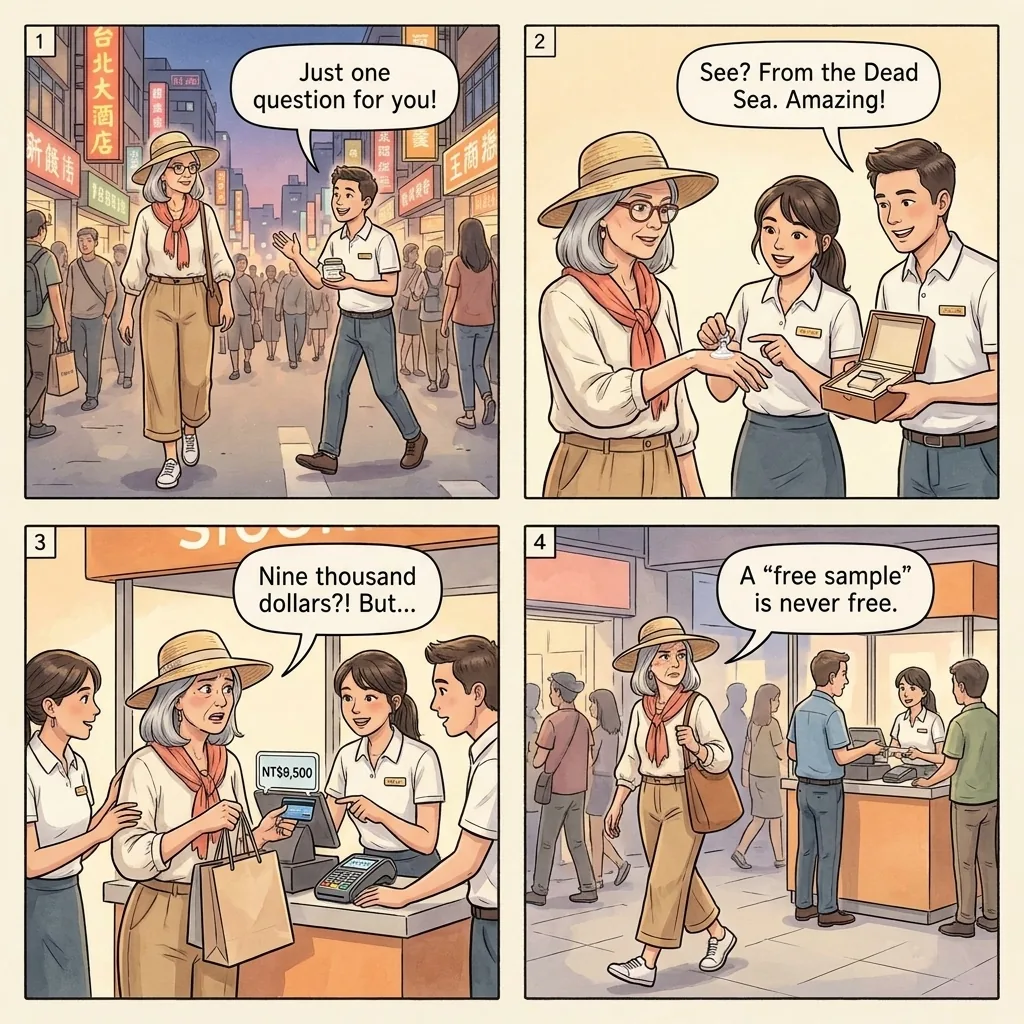
Ximending's Dead Sea skincare kiosks are consistently named on traveler reports as the most commonly reported tourist scam in Taipei.
The operation is a multi-country playbook — Israeli-branded cosmetics sold via high-pressure kiosk closes — that has been running in Taiwan since at least 2018 and continues to fleece foreign visitors in 2025.
Young, energetic salespeople position themselves several meters in front of small kiosks along the Ximending pedestrian strip, Zhongxiao Dunhua, and the Taipei 101 mall concourse. They target people making eye contact or browsing without purpose. The opening is always casual — 'Can I ask you one question?' or a dab of cream applied directly to the back of the hand before consent is meaningful.
From there the pitch follows a rehearsed script. The free sample transitions into a 15-minute demonstration, then a 'today only' pitch for a starter kit. Social pressure builds as two or three more staff appear; the tourist is handed a shopping bag to hold. The scam.travel database confirms end-prices in the hundreds to low thousands of NT$ for products whose wholesale value is a small fraction of that amount.
The scam is not unique to Taiwan — traveler reports 2022 documents the same kiosks working Canadian malls — but the Ximending density is exceptional because of foot traffic. The brands use Israeli-sounding names and claim Dead Sea mineral origin, though product testing routinely shows the active ingredients are common cosmetic fillers. Taiwan News and scam.travel both rank this as a top Taiwan tourist scam as of 2026.
For defense: if a stranger on a pedestrian strip asks 'Can I ask you a question?' or tries to apply cream to your skin, keep walking and do not make eye contact. Never accept a free sample, garland, or 'gift' from a kiosk worker — the product-in-hand is the psychological hook. If the cream is already on your skin, wipe it off with a tissue and leave immediately; nothing has been sold yet.
If pressured to buy or blocked from leaving the kiosk, call 1950 (Taiwan's consumer-protection hotline) in front of them — credible-looking enforcement typically ends the interaction. For charges already made, Taiwan's Consumer Protection Committee accepts complaints at the Department of Legal Affairs within 7 days for a refund claim, and credit-card disputes work for purchases over NT$500. The AIT main line is +886 2 2162 2000 for US citizen assistance.
Red Flags
- friendly salesperson stepping into the path of tourists on Ximending, Zhongxiao Dunhua, or Taipei 101 concourse
- dab of cream applied to the back of the hand before the tourist has agreed to anything
- Israeli-branded or 'Dead Sea' labelled skincare sold only at kiosks, never at department stores or Watsons/Cosmed
- price escalation from a 'free sample' to a starter kit to a 'VIP gift set' within 15 minutes
- two or three staff appearing around the tourist at the close, with a shopping bag already in hand
How to Avoid
- Keep walking past any kiosk staff who step into your path in Ximending, Zhongxiao Dunhua, or a mall concourse.
- Never accept a free sample, cream on the skin, or a 'gift' from a kiosk worker — the product-in-hand is the hook.
- If cream is already on your skin, wipe it off with a tissue and leave the kiosk immediately; nothing has been sold yet.
- Refuse every 'today only' or 'VIP discount' pitch — real Taiwanese skincare is sold in Watsons, Cosmed, and department-store beauty counters.
- If pressured or blocked from leaving, call Taiwan's consumer-protection hotline 1950 in front of the staff to break the close.
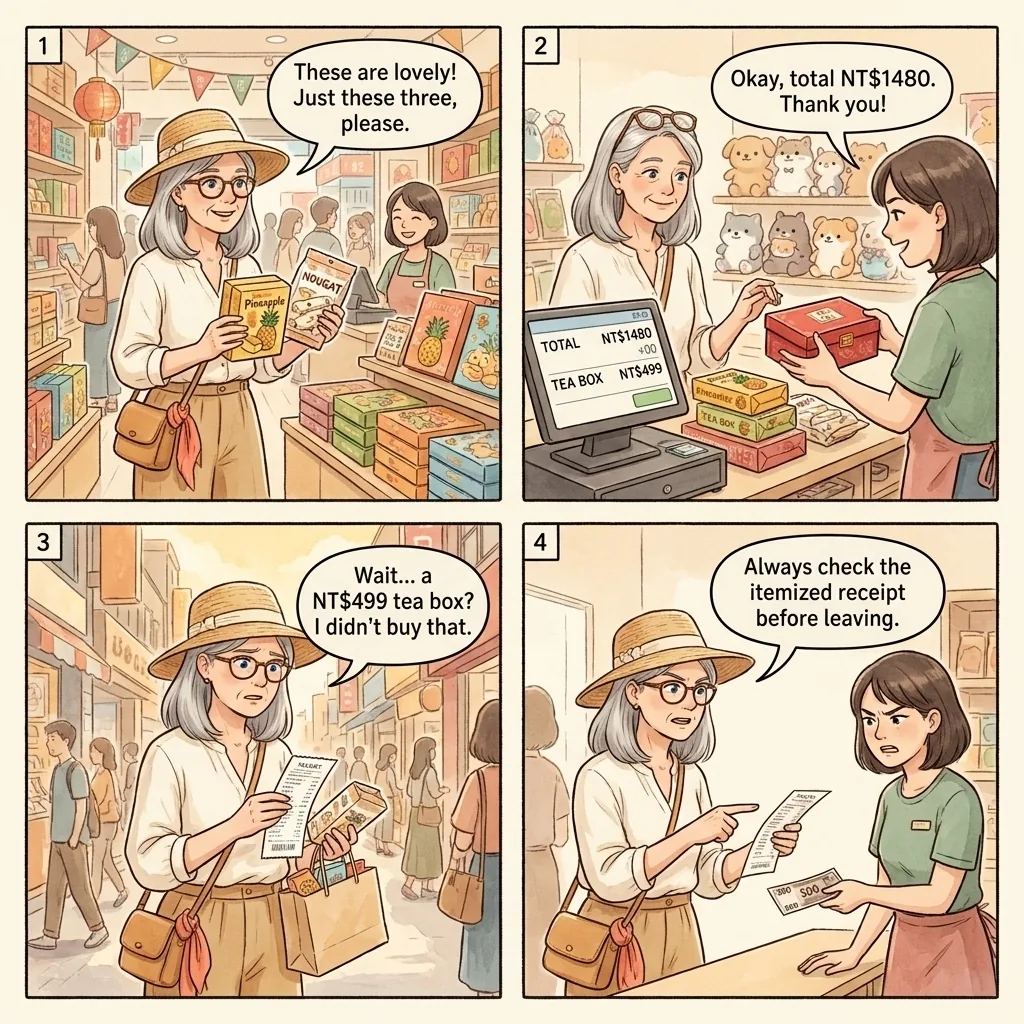
A South Korean tourist's Threads post in early March 2026 went viral after a Ximending souvenir shop padded her receipt.
Taiwan News reported on 4 March 2026 that Taipei's Department of Legal Affairs accepted the formal complaint, and CNA picked up the story the same week. The shop had added an NT$499 box of tea she never bought; she got NT$500 back after raising it in person.
The pattern shows up in several forms across Taipei's busiest tourist strips. Ximending's souvenir stalls, the Shilin Night Market fruit and snack vendors, and Raohe Night Market food rows are where most of the 2024 and 2025 first-person reports cluster. Shops with no clearly-posted prices or price tags below counter height are the common thread.
The primary variant is the receipt pad — tourists buy three or four items, the clerk rings up an extra item the customer never selected, and hopes the visitor does not check the itemized receipt before leaving. A traveler reports 2024 thread documented one tourist paying NT$980 for a small bag of seasonal fruit that a local expected to cost a fraction of that price at the same stand. The uplift targets visible foreigners and non-Mandarin speakers.
Tea and dried-goods stalls run a related overcharge — an traveler threads documented a Taiwanese seller charging NT$2,500 for 600 grams of oolong that a registered Taipei tea shop would sell for about a third of that rate. The the traveler community has documented these markups back to 2023, and a 2026 TIL thread confirmed the gap between influencer-brand tea and legitimate vendors is still widening.
For defense: demand an itemized receipt before paying at any Taipei souvenir shop, night-market stand, or tea store. Cross-check every line against what was actually handed over. If the price is not clearly posted on the item or a menu, walk away — legitimate vendors in Taipei display prices in both NT$ and often a second currency for international shoppers.
If overcharged, call Taiwan's consumer-protection hotline 1950 while still in the shop — most clerks will refund the difference immediately to avoid a formal complaint. For larger disputes, Taipei's Department of Legal Affairs accepts walk-in complaints, and the Tourism Administration hotline 0800-011-765 can dispatch a Mandarin-English interpreter for on-site resolution. Card disputes via Visa or Mastercard also work for charges over NT$500.
Red Flags
- souvenir shop or night-market stall with no clearly-posted prices on items or a visible price board
- clerk ringing up items without showing a running total or with an obstructed register screen
- receipt with line items the tourist did not purchase or quantities larger than what was handed over
- 'premium' tea or dried goods quoted at several times comparable prices at registered Taipei tea shops
- price escalating from what was verbally quoted to a higher amount at the register, especially for foreigners
How to Avoid
- Ask for the price of every item before it is rung up, and check that a price tag or posted menu is visible.
- Demand an itemized receipt at every souvenir shop, night-market stand, and tea store before handing over cash.
- Cross-check the receipt against the items in the bag before leaving the counter — not after walking away.
- Pay by credit card for any purchase over NT$500 so a dispute is possible if the charge does not match the goods.
- If overcharged, call Taiwan's consumer-protection hotline 1950 from inside the shop — most clerks refund immediately.
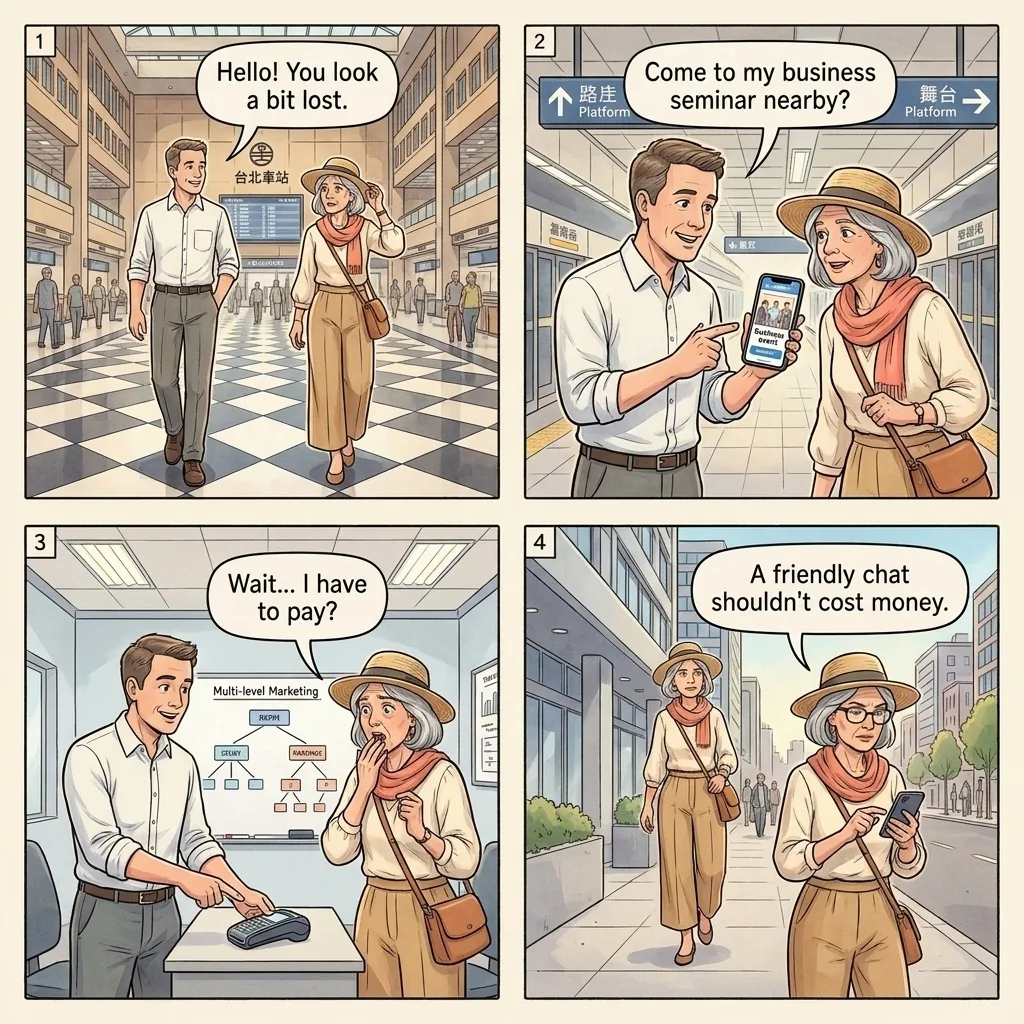
Taipei Main Station and 228 Peace Memorial Park are the two highest-volume spots where solo foreign travelers get approached.
The pitch is never aggressive — that is the point. Well-dressed English-speaking strangers open friendly conversations, then steer toward business, tea, or 'language exchange' within minutes. Recent traveler reports and traveler threads from 2024 and 2025 describe the same three-beat pattern played out dozens of times per week.
The opening is a casual question inside the station concourse or near a park bench — 'Where are you from?' or 'Can you help me with this map?' The stranger is usually well-dressed and speaks fluent English. They mention a language exchange, a local Taiwanese event, or a relative studying in the tourist's home country. The conversation feels warmer than expected for a random pedestrian encounter.
From there the approach branches. The MLM variant — a traveler reports 2025 post described an Indian stranger at the Main Station east exit inviting a tourist to a 'business seminar' in a Zhongxiao office — ends in a three-hour multi-level marketing pitch with pressure to hand over credit-card details or recruit friends. The confidence-scam variant, documented in traveler reports 2024 as an 'almost kidnapping scheme,' has the stranger insisting the tourist come to a 'quiet place' to discuss business over tea, with an accomplice joining midway.
On 22 April 2026 Taipei Times reported that the Taichung District Prosecutors Office indicted 18 people running a related fraud ring. The ring used AI-generated video calls of fake Chinese police and prosecutors to defraud victims, part of a broader pattern documented in Japan Times 2026-03-04 coverage of 62 indicted Prince Group scam-center operators across Taiwan. Taiwan's Criminal Investigation Bureau issued a public warning in August 2025 about fake AI police and prosecutor impersonation scams as the fastest-growing scam category nationwide.
For defense: a stranger who initiates a conversation with 'Where are you from?' or 'Do you want to practice English?' in a Taipei Main Station concourse or in 228 Park is almost never making a good-faith contact. Politely decline in 10 seconds or less and keep moving toward a staffed counter or information desk. Never follow anyone to a second location — a 'café,' 'friend's office,' or 'language school' — for any reason, no matter how reasonable the pitch sounds.
If pressured or followed, step into any 7-Eleven or FamilyMart (both have cameras and 24-hour staff) and ask the clerk to call 110 for police. Taiwan's tourism hotline 0800-011-765 provides English-speaking support and can dispatch tourist police to major stations. The American Institute in Taiwan (+886 2 2162 2000) and British Office Taipei (+886 2 8758 2088) provide citizen-assistance services for theft, fraud, or coerced transactions.
Red Flags
- well-dressed English-fluent stranger initiating conversation inside Taipei Main Station concourse or 228 Park
- opening line of 'Where are you from?' or 'Can you help me with this map?' from someone who then steers to a business topic
- invitation to a 'language exchange,' 'business seminar,' or 'tea at a quiet place' within 5 minutes of meeting
- stranger insisting the tourist move to a second location — a café, office, or language school
- accomplice joining the conversation partway, or pressure to share phone number, WhatsApp, or Line account immediately
How to Avoid
- Decline any unsolicited 'Where are you from?' or 'practice English?' approach in Taipei Main Station or 228 Park within 10 seconds.
- Never follow a stranger to a second location for any reason — café, office, language school, or 'friend's place.'
- Keep moving toward a staffed counter, information desk, or store clerk if the stranger persists after a polite decline.
- Refuse to share phone number, WhatsApp, Line, or KakaoTalk contact with anyone met at a station or park under 10 minutes ago.
- If followed or pressured, step into a 7-Eleven or FamilyMart and ask the clerk to call 110 for police.
🆘 What to Do If You Get Scammed
📋 File a Police Report
Go to the nearest National Police Agency (NPA) station. Call 110 (Police) or 119 (Fire/Ambulance). Get an official crime report — you'll need this for insurance claims. You can also report online at npa.gov.tw.
💳 Cancel Your Cards
Call your bank immediately. Most have 24/7 numbers on the back of the card (keep a photo saved separately). Block any suspicious transactions before the thieves use your details.
🛂 Lost Passport?
Contact the American Institute in Taiwan (AIT) at No. 100, Jinhu Road, Neihu District, Taipei 11461. For emergencies: +886 2-2162-2000.
📱 Track Your Device
If your phone was stolen, use Find My (iPhone) or Find My Device (Android) from another device. Don't confront thieves yourself — share the location with police instead.
Frequently Asked Questions
You just read 4 scams in Taipei. The full Travel Safety Series has 780+ more across 20+ countries.
Tokyo's Kabukichō ¥130,000 bar trap. Rome's gladiator photo extortion. Paris's gold-ring trick. Bali's ATM skimmer scams. Bangkok's grand-palace closure ruse. Every documented scam across 20+ destinations — with the exact scripts, red flags, and local-language phrases that shut each one down. Drawn from Reddit traveler reports, embassy advisories, and consumer-protection cases.
- 780+ documented scams across Tokyo, Rome, Paris, Bali, Bangkok, Rio & 100+ more cities
- 20+ countries covered, with country-by-country phrase cards for every destination
- Updated annually — buy once, re-download future editions free
- All titles $4.99 each on Amazon Kindle