Key Takeaways
- The #1 reported scam is the Gangnam Plastic-Surgery Clinic Foreigner-Pricing Surcharge.
- 1 of 5 scams are rated high risk.
- Use app-based ride services or official metered taxis — avoid unmarked vehicles near tourist areas.
- Never accept unsolicited offers from strangers near tourist sites in Seoul.
⚡ Quick Safety Tips
- In Itaewon and Hongdae nightlife areas, check that any bar you enter has visible prices before ordering.
- Book taxis through KakaoTaxi app for metered, accountable rides — avoid street hails at night in entertainment districts.
- Ignore anyone who says you've won a prize, been 'selected,' or offers unsolicited help near Gyeongbokgung.
- At hanbok rental shops, confirm what's included before paying — surprise photo service charges are common.
Jump to a Scam
The 5 Scams
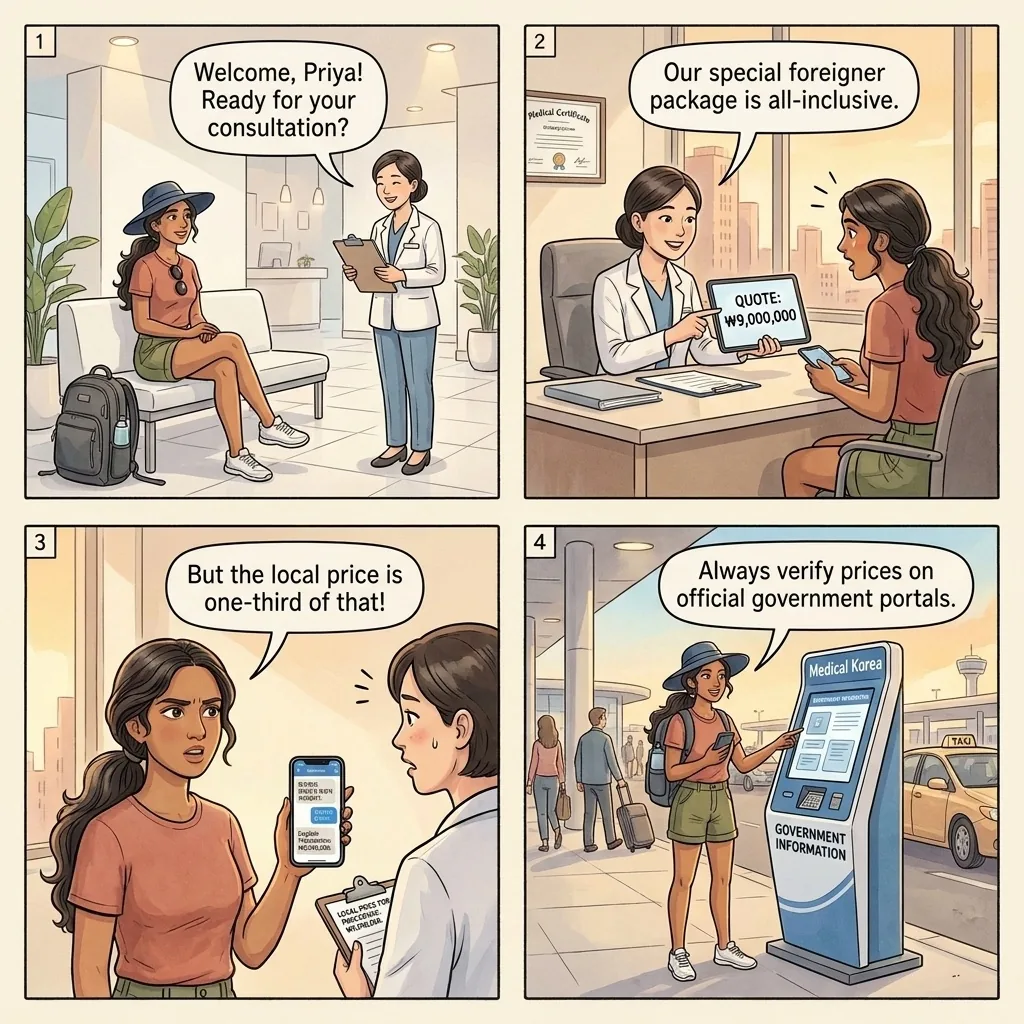
You've spent six months researching Korean plastic-surgery clinics on Reddit and YouTube, you've narrowed it down to a Gangnam clinic with a polished English-language website and an Instagram account with 200k followers, and you fly to Seoul for a one-week consultation-and-procedure trip.
The clinic is real. The doctor is qualified. The procedure happens. But at the consultation, the quote is nearly three times what Korean patients pay for the same procedure on the same surgeon's schedule that same week. The clinic justifies the gap with 'English-speaking coordinator fees,' 'foreign-patient package' framing, and an 'aftercare hotel arrangement.' The base procedure runs the Korean-patient rate of, say, ₩3 million; the foreigner package is ₩9 million. The 'English coordinator' is a part-time staffer who translates the post-op instructions.
The Korean medical-tourism market has institutionalised dual pricing for foreign patients in a way that the Korean government has weighed in on repeatedly. The Ministry of Health and Welfare and the Korea Health Industry Development Institute (KHIDI) have published guidelines suggesting transparent foreign-patient pricing, but enforcement against the larger Gangnam clinics is weak and the dual-rate structure persists at most operators. As travelers report across Reddit, Reddit, the TripAdvisor Seoul forum, RealSelf consumer reviews, and a long-running set of investigative pieces by The Korea Herald and Korea JoongAng Daily, the Gangnam foreigner-pricing surcharge averages 2–3× Korean-patient rates and is highest at the influencer-marketed clinics with strong English-language social presences.
The economic model is straightforward. Korean patients are price-sensitive and have access to government-published rate benchmarks; foreign medical tourists are not price-sensitive (they are comparing to U.S. or U.K. prices, where the same procedure costs 5–10× more) and don't have access to the Korean-language pricing channels. A clinic can charge a foreigner 3× and still be 'a great deal' from the foreigner's reference frame. The economic incentive aligns toward the markup.
The structural defences are concrete. Cross-check prices using Korean-language clinic-comparison sites (Naver, Babitalk, Gangnamunni) rather than English-language Google. Ask for itemised written pricing in advance, not just verbal estimates. Verify the surgeon's licence and clinic's certification on the KHIDI medical-tourism portal. Use a medical-tourism agency that specialises in foreign-patient transparency (the larger ones publish Korean-vs-foreigner price comparisons on request) rather than booking direct via the clinic's English-language website. Pay by credit card so chargeback is available if the procedure underdelivers.
Research Korean plastic-surgery clinic prices on Korean-language platforms (Naver, Babitalk, Gangnamunni) before consulting in English. Get itemised written quotes in advance — base procedure cost, anaesthesia, hospital stay, follow-up — separately from any 'foreigner package' wrapper. Cross-check the same clinic's Korean-patient rate via a Korean-speaking friend or a medical-tourism agency that publishes side-by-side comparisons. Verify the surgeon's licence and clinic certification on KHIDI's medical-tourism portal. Pay by credit card for chargeback protection. If the actual cost on the day exceeds the written estimate by more than 10%, halt the procedure and dispute. Emergency: 112 (Police) or 119 (medical/fire); Korea Tourism Hotline: 1330; the U.S. Embassy in Seoul is at +82 2 397 4114.
Red Flags
- Clinic immediately identifies you as foreign before quoting any price
- Quote is vague or doesn't match any online information in Korean
- Clinic is heavily advertised on English-language foreigner influencer channels
How to Avoid
- Research clinics using Korean-language sites (Naver, not just English Google).
- Join traveler reports and verify quotes through community members.
- Ask for itemized pricing in writing before any commitment.
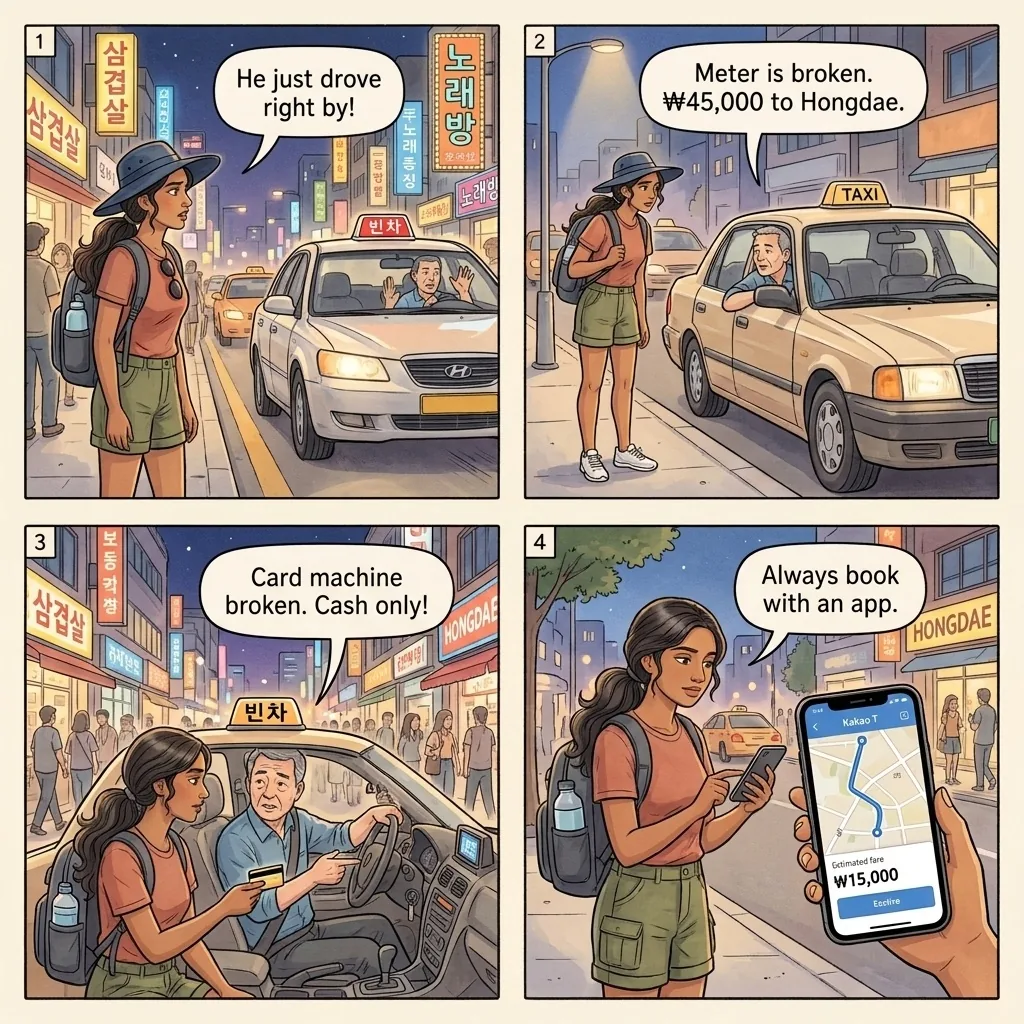
It's 1 a.m. on a Friday in Itaewon, you've just left a bar near Hamilton Hotel, and you need a taxi back to your accommodation in Hongdae — but every empty cab that approaches the kerb either keeps driving when they see you or pulls over only to wave you off when you say the destination.
After fifteen minutes of refusals, an older driver in a private (non-Kakao) cab pulls up and agrees to take you. He says the meter is 'broken' and quotes a flat ₩45,000 — about three times the legitimate metered fare for the Itaewon-to-Hongdae crossing. You agree because the alternative is another twenty minutes on the kerb. He takes a longer route via Yongsan that adds ten minutes, and at Hongdae demands cash because his 'card reader is broken.' What should have been a ₩15,000 metered ride is now ₩45,000 cash with a route detour you can verify on Google Maps after the fact.
The Seoul taxi-refusal phenomenon has been documented for years. Korean drivers are formally required by the Seoul Metropolitan Government to accept all fares regardless of destination, but enforcement is light and a meaningful minority of drivers — especially older private-taxi operators (개인택시) on the Friday and Saturday night nightlife strips — refuse short fares, foreign passengers, or destinations they perceive as inconvenient. The Korea Tourism Organization's tourist-complaint hotline (1330) handles thousands of taxi-refusal and overcharge complaints annually. As travelers report across Reddit, the TripAdvisor Seoul forum, the Lonely Planet Korea thorntree, and KTO's published consumer-protection logs, the Itaewon-and-Hongdae weekend-night taxi friction is the single most-reported Seoul tourist annoyance.
The mechanism has two stages. The 'refusal' stage filters out short or low-margin fares so the driver only takes high-value rides. The 'overcharge' stage, on rides accepted, runs a flat-fare or 'broken meter' framing to extract above-meter prices. The combination is the friction tourists encounter: a long wait followed by an inflated ride. Both stages are illegal under Korean transport regulation but rarely prosecuted.
The defence is structural and uses Korean apps. The Kakao T app (Korea's near-universal ride-hailing) lets you book a taxi with a fixed app-displayed price, route preview, and driver-rating accountability — drivers cannot refuse a Kakao T booking once accepted. Uber operates in Seoul as 'Uber Black' and 'Uber Taxi' with similar reliability. The Seoul Metro runs until just past midnight on weekdays and 1 a.m. on weekends. The N-bus night-bus network covers all main districts after subway hours at ₩2,150 per ride. The KTX and AREX express trains handle Incheon Airport runs at a fraction of taxi cost.
Download the Kakao T app before arriving in Seoul — it is the dominant Korean ride-hailing app, prices are app-displayed and fixed, and drivers cannot refuse the booking once accepted. Use Uber as a backup. For airport runs, take the AREX express train (₩9,500 to Seoul Station, 43 minutes) rather than a taxi. After subway hours (12:30–5 a.m.), use the N-bus night network rather than hailing private cabs. If a taxi driver refuses your fare or claims a 'broken meter,' walk away and book Kakao T instead. Report taxi refusals or overcharges to the Korea Tourism Hotline at 1330 with the cab's plate number — KTO follows up with the operator. Emergency: 112 (Police) or 119 (medical/fire); Korea Tourism Hotline: 1330.
Red Flags
- Driver declines to use the meter or Kakao T app route
- Driver says the card reader is 'broken' (implies cash only)
- Route appears longer than necessary on Google Maps
How to Avoid
- Download Kakao T app before arriving — it has a preset price system with no surprises.
- AREX train from Incheon Airport is much cheaper and faster than any taxi.
- If refused, use public transit — Seoul's subway runs until midnight and is excellent.
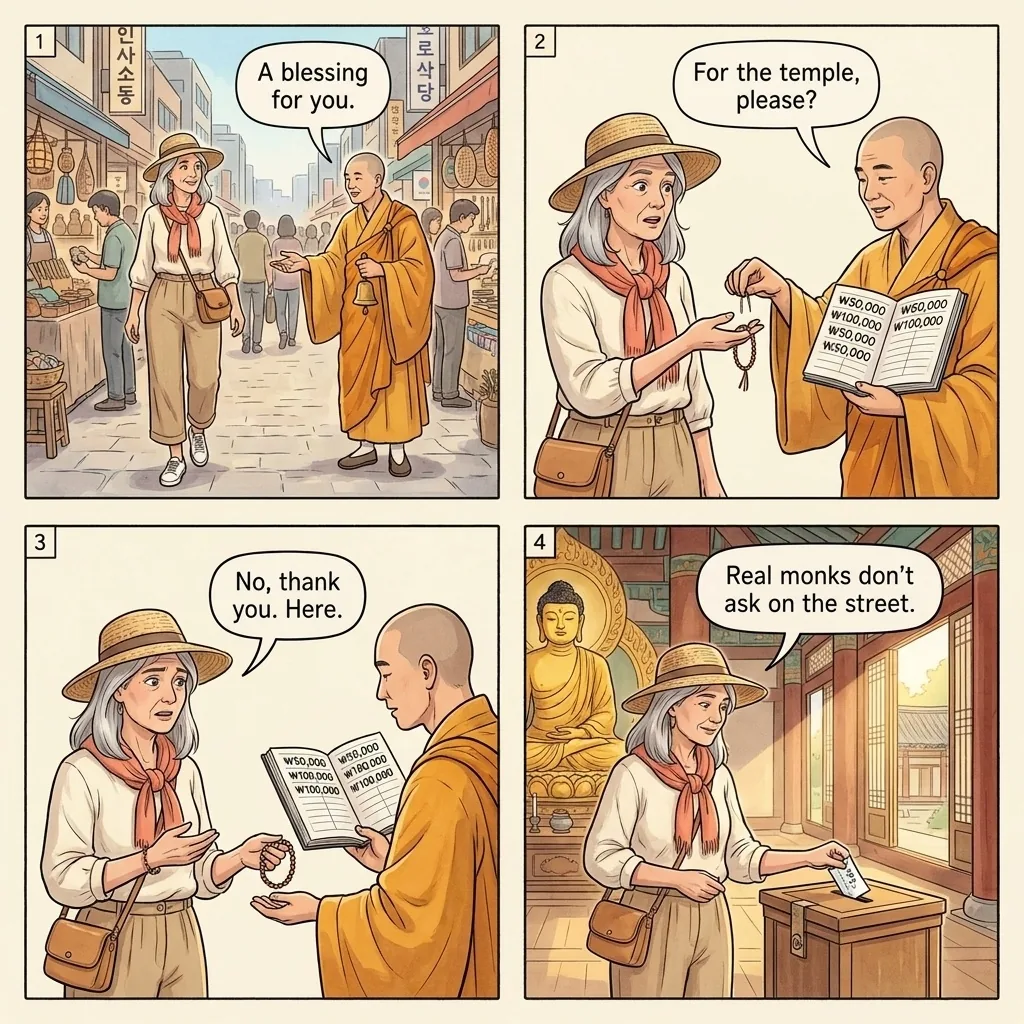
It's an afternoon in Insadong, you're walking the cultural-craft pedestrian street toward Gyeongbokgung Palace, and a person in saffron Buddhist robes approaches you with a small wooden bell, strikes it gently three times, and offers you a prayer-bead bracelet.
They place the bracelet in your hand without asking. They smile, bow slightly, and produce a small leather-bound donation ledger with previous 'donations' written in: ₩50,000, ₩100,000, sometimes ₩200,000. They indicate the bracelet is yours but a 'donation for the temple' would be appreciated, with the ledger showing you what's appropriate. The pressure is gentle but the social-pressure mechanic is sharp — refusing a 'monk' in front of other tourists feels rude, and the bracelet is already in your hand.
These are not real Buddhist monks. The Jogye Order — South Korea's largest Buddhist organisation, representing about 90% of the country's monastic Buddhists — has explicitly banned street solicitation by monks since the early 2000s and has issued repeated public statements identifying the Insadong, Gyeongbokgung, and Myeongdong street operators as fraudulent. Real Korean Buddhist monks do not solicit donations on the street; donations to legitimate Buddhist organisations happen at temples, through the Jogye Order's online portal, or via established charitable channels. The 'fake monk' phenomenon has been the subject of multiple Korea Herald and Korea JoongAng Daily exposés. As travelers report across Reddit, the TripAdvisor Seoul forum, and the Korea Tourism Organization's published consumer alerts, the fake-monk pitch is the single most-encountered Seoul street-fraud category.
The mechanism is exploitative of cultural deference. Visitors who don't know Korean Buddhist norms assume the robed figure is legitimate and either pay (out of guilt) or feel awkward declining. The dollar damage is small — typically ₩10,000–50,000 per encounter — but the operators run multiple Insadong-and-palace circuits per day with high volume. The Korean police have pursued individual cases when the operators escalate to aggressive demands, but the lower-pressure version is too low-stakes to prosecute and the operators rotate.
The structural giveaway is the 'donation ledger' itself. Real Korean monks do not carry donation ledgers with pre-filled amounts because they don't solicit on the street. The ledger is the entire mechanism — a piece of social-pressure theatre to anchor your donation at a calibrated number. The bracelet they place in your hand is a cheap commercial item bought wholesale; the 'temple' the donation supposedly supports does not exist or is unaffiliated with Jogye.
Decline 'monk' street solicitations in Seoul — the Jogye Order has confirmed these are not real monks. Hand back any bracelet, prayer card, or item placed in your hand and walk on; if pressured, raise your voice slightly and they disperse. If you genuinely want to support Korean Buddhism, donate at the Jogyesa temple in central Seoul or via the Jogye Order's official portal. Insadong cultural-craft purchases at registered shops are fine; street-monk donations are not. Report aggressive operators to the Korea Tourism Hotline at 1330. Emergency: 112 (Police) or 119 (medical/fire).
Red Flags
- Person in robes approaches you specifically (not inside a temple)
- Donation ledger shows large pre-filled amounts
- Item placed in your hand before any price discussion
How to Avoid
- Legitimate monks in Korea do not solicit donations from tourists on the street.
- Hand any item back immediately.
- The Jogye Order officially banned this practice — these are confirmed scammers.
Like what you're reading? Get a full Seoul itinerary with safety tips built in.
Browse travel-safety books →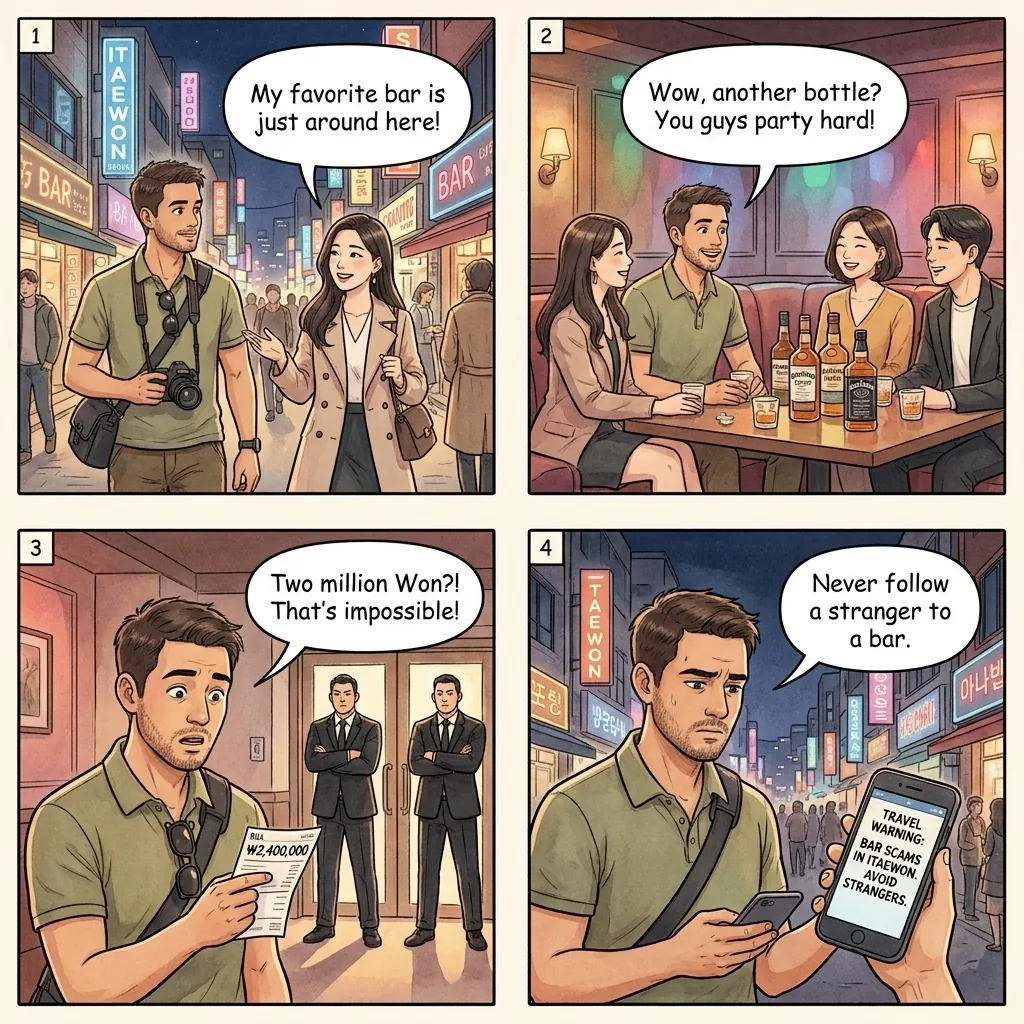
It's a Saturday night in Itaewon, you've been at one of the more popular foreigner bars, and outside on the street a friendly Korean local invites you and your friends to her 'favourite bar' a few blocks away — quieter, cheaper, better music, no foreigner crowd.
She walks you down a side street and into a basement venue with low lighting and four or five other women already at the bar. Drinks arrive without prices being stated; the women at the bar join your table; bottles materialise; the tab runs up quickly. After ninety minutes you ask for the bill and it's ₩2,400,000 — about USD $1,800 — for what should have been a ₩200,000 night. The 'friend' from outside has disappeared. Two large men appear at the door before you can leave.
The Itaewon escort-bar bill ambush is a documented variant of the bar-bill ambush pattern that runs across multiple Asian capitals (Bangkok, Tokyo, Manila, Seoul). The Korean version concentrates on the Itaewon side streets and the more obscure Gangnam venues, and specifically targets foreign men in groups of two or three. The 'friendly local' is a paid recruiter; the 'bar' is a confederate venue running unposted prices; the women at the bar are escorts on commission against your tab; the security cohort enforces payment. As travelers report across Reddit, the TripAdvisor Seoul forum, the U.S. Department of State Korea country information, and a 2019 Korea Herald investigative series, the escort-bar pattern is the highest-dollar Seoul tourist scam outside of medical-tourism overruns.
The legal framing is hostile to the victim. The bar produces a 'menu' on the closing bill that nominally lists the inflated prices, the credit-card slip is signed under duress, and the police escalation route is slow and uncertain. Korean law has tightened on this category — the 2018 amendment to the Tourism Promotion Act criminalises 'price ambush' practices at venues marketed to foreigners — but enforcement is uneven and the operators rotate venues faster than prosecution can catch up.
The structural giveaways are visible at the recruiter step. The 'invitation' from a Korean local you've just met is the entire mechanism. The venue is unbranded or only locally branded, never on Naver Maps or Google Maps with reviews. The route involves a side street the recruiter chooses. The drinks menu is not on the table. The first time prices are visible is on the closing bill. The defence is to never accept a venue suggestion from a stranger met on the street; to choose your own venues from Naver Maps with documented review histories.
Choose your own Seoul nightlife venues from Naver Maps or Google Maps with documented review histories — never accept an invitation from a stranger met on the street, no matter how friendly. Decline 'better bar' / 'cheaper bar' / 'no-foreigner crowd' framings — those are the entire mechanism of the ambush. Ask for the drinks menu with prices before any drink is served; confirm the bill before each subsequent round. Refuse to sign any bill or authorise payment under duress. If a venue attempts an inflated bill ambush, do not pay; call the U.S. Embassy duty officer (+82 2 397 4114), file a Korea Tourism Hotline complaint at 1330, and dispute the charge with your card issuer. Emergency: 112 (Police) or 119 (medical/fire); Korea Tourism Hotline: 1330.
Red Flags
- Led to a venue by a new acquaintance rather than going independently
- Venue has no listing on Naver Maps or Google Maps
- Drinks arrive without anyone asking for your order
How to Avoid
- Choose your own venues using Naver Maps (Korean equivalent of Google Maps).
- Set a drink limit mentally before entering any bar.
- Avoid venues with no online reviews entirely.
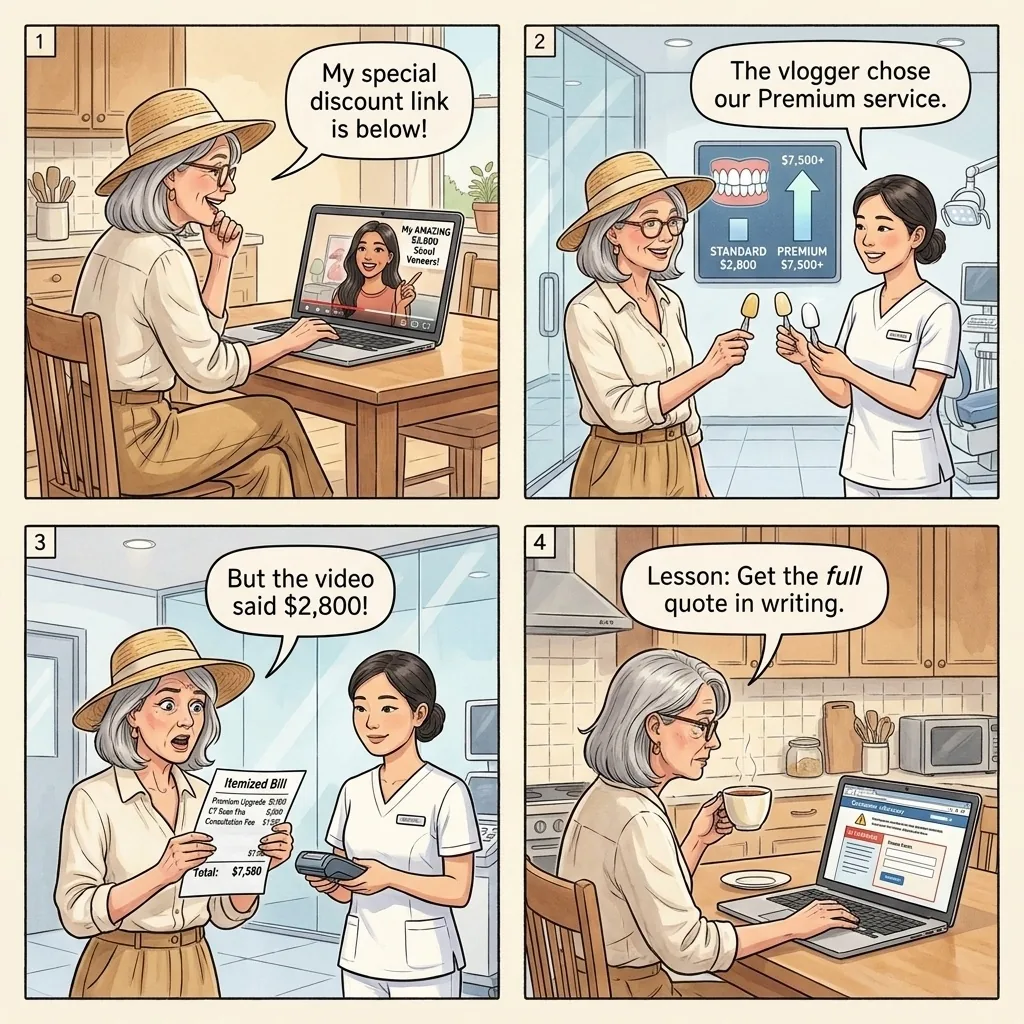
It's six months before your trip and a YouTube influencer with 800k subscribers has been raving about a Gangnam dental clinic — full-mouth porcelain veneers for $2,800 versus the $30,000 her hometown dentist quoted, and the influencer is showing dazzling before-and-after photos.
You DM the clinic through the link in the influencer's video, get a friendly response from an English-speaking coordinator, and book a one-week trip to Seoul for the consultation and procedure. On arrival the clinic confirms the $2,800 quote — but for 'standard' veneers, not the 'premium' ones the influencer was wearing. The premium upgrade (which is what the influencer's photos actually showed) is $7,500. The clinic also adds 'consultation fees,' 'CT scan fees,' and a 'cancellation fee' if you decline. You end up either paying $7,500 (almost three times the bait quote) or losing $1,200 in non-refundable upfront fees on the way out.
The Korean dental-tourism influencer-bait pattern is documented across Reddit, Reddit, RealSelf, and a Korea Herald investigative series on influencer-marketing fraud. The mechanism uses the influencer as the customer-acquisition channel: the clinic pays the influencer either a flat fee per video or a per-converted-customer commission, the influencer demonstrates the high-end procedure but the bait quote is the entry-level version, and the upgrade pressure happens after the customer has already flown to Korea and is committed by the deposit. The downstream-quality-of-work reports vary widely — some travelers get genuinely excellent procedures at the bait price, but the more common report involves the upsell or, worse, lower-quality work that fails within months and a clinic that refuses any refund or remediation.
The Korea Health Industry Development Institute (KHIDI) has published medical-tourism transparency guidelines and the Korean Dental Association maintains a clinic-licensure registry, but enforcement against influencer-marketing manipulation is weak. The most extreme variants involve veneers that crack within weeks, root-canal procedures that require post-trip remediation by the customer's home dentist at multi-thousand-dollar additional cost, and clinics that threaten legal action if customers post negative online reviews — a Korea Herald 2022 piece documented multiple such defamation-suit threats.
The structural defences are concrete. Cross-check influencer-promoted clinics against Korean-language review platforms (Naver, Babitalk, Gangnamunni) where Korean patients leave more candid feedback. Verify the clinic's dental-association licensure on KDA's published portal. Get itemised written quotes — base procedure, materials, anaesthesia, follow-up, any 'fees' — before flying. Pay deposits by credit card and full procedure cost only on the day, by card, never wire transfer. Read recent (last 12 months) negative reviews specifically.
Treat influencer-marketed Korean dental clinics with strong skepticism — the influencer is likely paid per converted customer and the bait quote is rarely the same procedure as the photos. Cross-check on Korean-language review platforms (Naver, Babitalk, Gangnamunni) for Korean-patient reports. Verify clinic licensure on the Korean Dental Association portal. Get itemised written quotes including all fees BEFORE flying to Seoul; refuse 'premium upgrade' upsells that arrive after deposit; pay by credit card for chargeback protection. If a clinic threatens defamation litigation over your honest negative review, that is itself a red flag — file a complaint with KHIDI and the U.S. Embassy. Emergency: 112 (Police) or 119 (medical/fire); Korea Tourism Hotline: 1330; the U.S. Embassy in Seoul is at +82 2 397 4114.
Red Flags
- Clinic is primarily marketed through social media influencers
- Price quoted online is dramatically different from consultation quote
- Limited negative reviews (clinic may be actively suppressing them)
How to Avoid
- Verify clinics through traveler reports and Korean-language review sites, not influencer content.
- Influencer-promoted clinics often pay for promotions, not endorsements based on quality.
- Get itemized written quotes before any procedure.
🆘 What to Do If You Get Scammed
📋 File a Police Report
Go to the nearest Korean National Police station. Call 112. Get an official crime report — you'll need this for insurance claims. You can also report online at police.go.kr.
💳 Cancel Your Cards
Call your bank immediately. Most have 24/7 numbers on the back of the card (keep a photo saved separately). Block any suspicious transactions before the thieves use your details.
🛂 Lost Passport?
Contact your nearest embassy or consulate. The US Embassy is at 188 Sejong-daero, Jongno-gu, Seoul. For emergencies: +82 2-397-4114.
📱 Track Your Device
If your phone was stolen, use Find My (iPhone) or Find My Device (Android) from another device. Don't confront thieves yourself — share the location with police instead.
Sources & further reading
Every scam here is cross-checked against official government advisories, police bulletins, and established reporting. Confirm current details with the primary sources below before you travel.
-
UK Foreign, Commonwealth & Development Office (GOV.UK) — Safety and security - South Korea travel advice
Government advisory
“Take care when travelling alone at night and only use legitimate taxis or public transport.”
-
Seoul Metropolitan Government — Seoul Simplifies Taxi Complaint Reports for International Tourists with QR Codes
Official tourism
“The Seoul Metropolitan Government (SMG) is stepping in to stop illegal taxi operations targeting international tourists with an all-new simplified QR-based survey channel for travelers to report unfair practices, such as overcharging…”
-
The Korea Herald — Seoul cracks down on taxis overcharging foreign tourists
News report
“The initiative will focus on illegal taxi activities such as overcharging, demanding tips, refusing to pick passengers up for short rides, and other inconveniences experienced by many overseas tourists when hailing taxis…”
-
The Korea Herald — Foreigner ripoff: discriminatory pricing for plastic surgery in Korea
News report
“Foreigners are often charged higher prices than locals for cosmetic surgeries in Korea, a local media outlet reported Sunday.”
-
The Korea Times — Itaewon bar allegedly spiked foreigners' drinks in rip-off scam
News report
“Three bar owners and five employees in Seoul's Itaewon district -- a popular expat nightspot -- were booked after the owners allegedly ripped off over 25 million won ($22,000) from foreign tourists”
-
Al Jazeera — As South Korea draws visitors chasing beauty, dodgy practices pose risks
News report
“While Korean medical advertising law prohibits the use of influencers for testimonial marketing, the practice is widespread, especially involving foreign patients.”
Frequently Asked Questions
You just read 5 scams in Seoul. The full Travel Safety Series has 780+ more across 20+ countries.
Tokyo's Kabukichō ¥130,000 bar trap. Rome's gladiator photo extortion. Paris's gold-ring trick. Bali's ATM skimmer scams. Bangkok's grand-palace closure ruse. Every documented scam across 20+ destinations — with the exact scripts, red flags, and local-language phrases that shut each one down. Drawn from Reddit traveler reports, embassy advisories, and consumer-protection cases.
- 780+ documented scams across Tokyo, Rome, Paris, Bali, Bangkok, Rio & 100+ more cities
- 20+ countries covered, with country-by-country phrase cards for every destination
- Updated annually — buy once, re-download future editions free
- All titles $4.99 each on Amazon Kindle