How we built this comparison
This page combines traveler discussion patterns, published price ranges, transit details, and seasonal data to make the Bagan vs Luang Prabang decision easier to resolve.
- Reviewed Reddit discussions from r/myanmar, r/travel, r/solotravel, r/backpacking, r/laos, and r/digitalnomad.
- Checked numeric claims including accommodation ranges, food costs, transit routes, temple entry fees, e-bike costs, and seasonal weather patterns.
- Addressed the Myanmar safety situation directly with 2024–2025 traveler reports.
- Each major section ends with a clear winner, reason, and traveler-use note.
Best read as a decision guide, not a universal truth: the right pick depends on your travel style, risk comfort, and what kind of trip you actually want.
⚡ The TL;DR Verdict
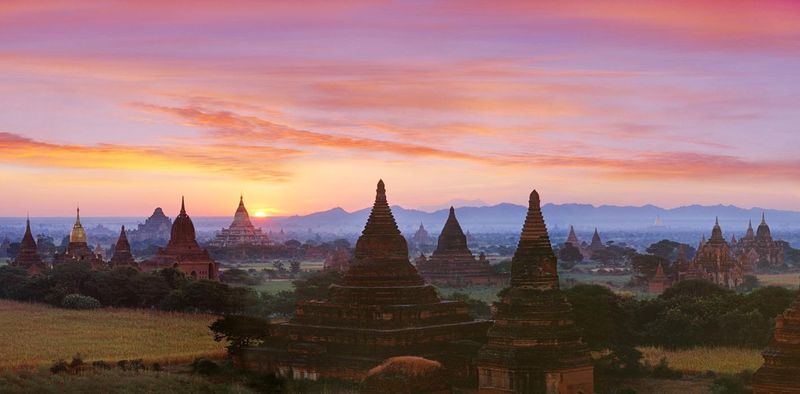
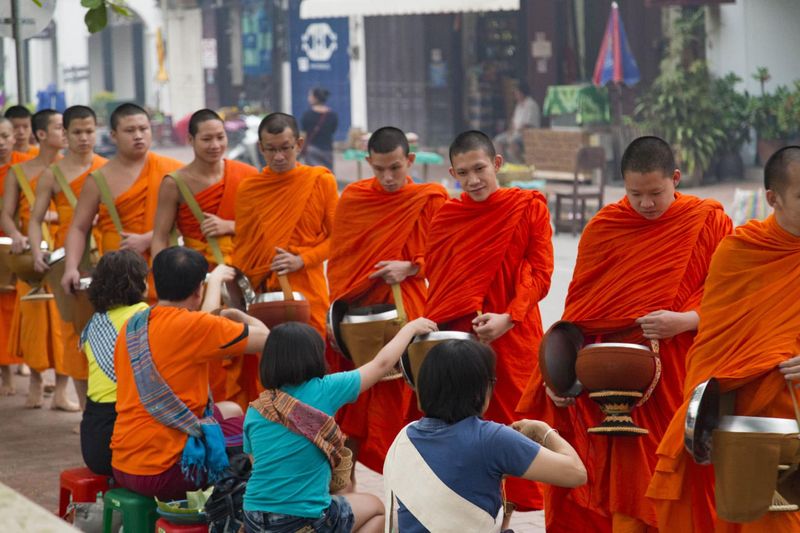
Bagan is more visually overwhelming — 2,000+ pagodas on a plain is one of the world's great sights. Luang Prabang is more emotionally resonant, more accessible, and carries zero political baggage. For most travelers in 2025–2026, Luang Prabang is the default answer: a UNESCO-protected riverside town where monks file through golden-lit streets at dawn, the waterfalls are turquoise, and Beer Lao costs $1.50. For travelers who've done the Laos circuit and want something genuinely different — and are comfortable checking current Myanmar advisories — Bagan rewards the effort with a scale and ancient grandeur you won't find elsewhere in SE Asia.
- 🛕 Bagan wins: Archaeological scale (2,000+ pagodas), e-bike freedom, hot air balloon sunrises, lower daily costs
- ⛩️ Luang Prabang wins: Safety, accessibility, alms-giving ceremony, Kuang Si waterfalls, Mekong culture, food scene
- 💰 Budget: Bagan $20–35/day (cash only) vs Luang Prabang $30–50/day
- ✈️ Logistics: Luang Prabang is far easier — direct flights from Bangkok. Bagan requires Myanmar e-visa and Yangon connection.
🛕 Choose Bagan If…
You want archaeological scale that rivals Angkor — 2,000 pagodas on a misty plain, explored solo by e-bike at sunrise. And you're okay doing your Myanmar homework first.
⛩️ Choose Luang Prabang If…
You want UNESCO perfection with zero complications: saffron monks at dawn, turquoise waterfalls, French-Lao café culture, and a riverside town that slows time down.
Quick Comparison
| Category | 🛕 Bagan | ⛩️ Luang Prabang | Winner |
|---|---|---|---|
| Daily Budget (mid-range) | $30–50/day (USD cash dominant) | $35–55/day (USD prices) | Bagan |
| Budget Accommodation | $10–25/night | $15–35/night | Bagan |
| Main Attraction Scale | 2,000+ pagodas, 67 sq km plain | 33 wats, UNESCO peninsula | Bagan |
| Cultural Depth | Ancient Pagan Empire archaeology | Living Buddhist culture, Tak Bat ceremony | Tie |
| Temple Entry Fee | 25,000 kyat (~$12) zone pass | Free (most wats) or 20,000 LAK (~$1) | Luang Prabang |
| Food Scene | Simple Burmese food, cheap teashops | $1 night market buffet, Lao-French fusion | Luang Prabang |
| Walkability | E-bike required (40 sq km zone) | Fully walkable heritage peninsula | Luang Prabang |
| Getting There | Via Yangon (complex, USD cash needed) | Via Bangkok or Chiang Mai (easy) | Luang Prabang |
| Safety/Political Situation | Stable in tourist zones; national advisory exists | Stable, safe, no issues | Luang Prabang |
| Natural Beauty Nearby | Dry scrub plains; Irrawaddy River | Jungle, karst, turquoise waterfalls | Luang Prabang |
| Best Sunrise Experience | Pagoda plain sunrise (world-class) | Alms-giving ceremony at dawn | Tie |
| Visa | Myanmar e-visa: $50 (most nationalities) | Laos e-visa: $35–50 | Tie |
⛩️ Temples & Religious Sites
This is what both cities are built around — and the contrast couldn’t be more striking in scale and experience.
Bagan’s temple plain is one of the world’s genuinely jaw-dropping sights. Between the 9th and 13th centuries, the kings of the Pagan Empire built over 10,000 religious structures on a 67-square-kilometer plain. More than 2,000 survive. Exploring by e-bike — ducking through dusty tracks, emerging beside a crumbling red-brick pagoda with nobody else around, watching the mist roll across the plain at sunrise — is a genuinely different experience from any other temple circuit in Asia. The standout structures include the Ananda Temple (12th-century white-washed masterpiece, considered Bagan’s finest), Shwezigon Pagoda (golden stupa of immense scale), and Dhammayangyi Temple (the largest in Bagan, built by a parricide king). You don’t need a guide for most of this — the joy is in wandering and discovering your own favorites. UNESCO listed Bagan in 2019; post-earthquake restoration (2016) has been controversial but most structures are intact.
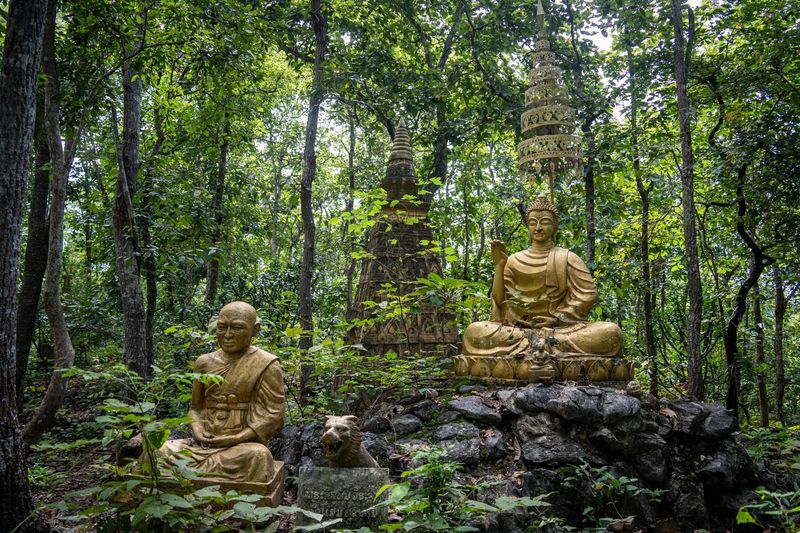
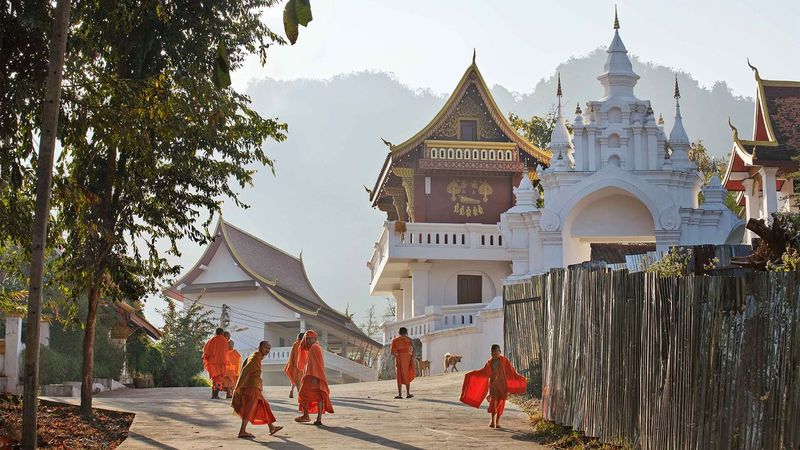
Luang Prabang’s temples operate at a completely different scale — 33 wats in a compact UNESCO heritage zone on a riverside peninsula. What makes them extraordinary isn’t quantity but living context. The Tak Bat alms-giving ceremony happens every morning at 5:30 AM: hundreds of saffron-robed monks process silently through the streets while residents kneel to offer sticky rice and sweets. It’s one of Southeast Asia’s most moving cultural rituals — and it’s free to witness (respectfully, from a distance). Wat Xieng Thong, with its low-sweeping roofline and intricate glass mosaics, is the architectural gem. Wat Mai and Wat Visoun reward slow exploration. UNESCO heritage status means the entire town is preserved — no neon signs, no chain restaurants in the zone, all signage in gold on dark wood.
🍜 Food & Dining
Both cities serve as genuine windows into their national cuisines, though Luang Prabang’s food scene is the more celebrated of the two.
Luang Prabang’s food is one of Southeast Asia’s great bargains. The night market buffet — $1 all-you-can-eat spread of Lao dishes laid out in rows along the main street every evening — has become legendary on Reddit for good reason. Pile your plate with laap (minced meat and herb salad), mok pa (steamed fish wrapped in banana leaf), tam mak hoong (Lao papaya salad), and sticky rice served in bamboo baskets. The French colonial legacy means excellent baguettes and café culture: khao jee (a baguette stuffed with Lao paté, herbs, and cucumber) costs $1–2 and is arguably better than anything in Paris. Khao piak sen — the thick, silky rice noodle soup unique to Luang Prabang — is extraordinary at local stalls for $1.50–2. Riverside restaurants offer proper sit-down Lao meals for $6–12.
Bagan’s food scene is simpler and less celebrated — Burmese cuisine is underrated globally but Bagan specifically doesn’t have a major food identity of its own. The local teashops (saṑe hkain) are the real cultural experience: for $0.50–1, you get bottomless green tea, a small table, and a rotating selection of mohinga (fish noodle soup — Myanmar’s national breakfast dish), samosas, and fritters. Restaurants catering to tourists in Nyaung U serve reliable Burmese curries (a thoke — Burmese salad — is the local specialty), Indian food, and Western options for $2–5 a plate. Cold Myanmar Beer runs $1–2. The quality is decent but nobody flies to Bagan for the food.
💰 Cost Comparison
Both destinations are genuinely affordable by global standards, but there are meaningful differences — especially once you factor in Myanmar’s cash-only economy.
| Expense | 🛕 Bagan | ⛩️ Luang Prabang |
|---|---|---|
| Budget guesthouse | $10–25/night | $15–35/night |
| Mid-range hotel | $35–70/night | $50–100/night |
| Street food meal | $1–3 | $1–2 (night market buffet $1) |
| Sit-down dinner | $4–8 | $6–12 |
| Beer (local) | Myanmar Beer: $1–2 | Beer Lao: $1–1.50 |
| Local transport | E-bike: $5/day | Bicycle: $2–4/day |
| Main attraction entry | 25,000 kyat (~$12) zone pass | Free to ~$1 per wat |
| Hot air balloon | $320–450 (Balloons over Bagan) | N/A |
| Visa | Myanmar e-visa: ~$50 | Laos e-visa: $35–50 |
| Budget daily total | ~$20–35/day | ~$30–50/day |
The Myanmar cash caveat is critical. ATMs in Bagan are unreliable and often out of service; the banking system has been severely disrupted since the 2021 coup. Come with enough USD in small bills ($1, $5, $10) to cover your entire stay plus a buffer. Some guesthouses accept USD directly at a rate close to the black market rate. This isn’t a dealbreaker, but it requires planning that Luang Prabang doesn’t.
🚲 Getting Around
How you move around each city is fundamentally different — and this shapes the entire experience.
Bagan’s temple zone covers roughly 40 square kilometers. Walking is theoretically possible but impractical given the distances and heat. The canonical way to explore is by e-bike: $5/day for a quiet electric scooter that lets you weave between pagodas, pull off-road onto dirt tracks, and discover temples that tour buses never reach. It’s one of the great simple pleasures in travel. Horse carts ($15–25/half day) are slower and more atmospheric. Guided tours by car or van run $40–60/day. The main zones are: Nyaung U (most budget accommodation and restaurants), Old Bagan (upscale hotels and the densest temple concentration), and New Bagan (mid-range hotels, slightly quieter). Most temples are accessible by e-bike without paved roads.
Luang Prabang is one of the most walkable cities in Southeast Asia. The entire UNESCO heritage zone sits on a narrow peninsula between the Mekong and Nam Khan rivers — you can walk from one end to the other in under 30 minutes. Bicycles rent for $2–4/day and extend your range to the slightly outlying wats. Tuk-tuks cover the few destinations outside the walking zone: the airport ($5–8), Kuang Si waterfall ($15–20 round trip), the Pak Ou cave boat landing. Within the heritage area, you simply walk. The city rewards this — getting lost in the side streets between temples at dusk, stumbling on monks sweeping courtyards, finding a riverside café with views of the Mekong — is the experience.
✈️ Getting There & Logistics
This is where the gap between the two destinations becomes clearest — especially in 2025–2026.
Getting to Luang Prabang is relatively straightforward. Direct flights from Bangkok on AirAsia (~1h, from $60 return), from Chiang Mai on Lao Airlines (~50 min), and from Hanoi and Vientiane on various carriers. International connections are limited but reliable. The China–Laos Railway (opened 2021) now links Vientiane to Luang Prabang in ~2 hours — accessible via overnight train from Bangkok to Nong Khai. The legendary slow boat from Huay Xai (Thai border near Chiang Rai) takes 2 full days on the Mekong and remains one of SE Asia’s great journeys: it costs ~$35–45 for the boat, includes riverside scenery and village stops, and drops you in Luang Prabang having truly arrived. Laos visa-on-arrival or e-visa: $35–50 for most nationalities.
Getting to Bagan is more involved. Most travelers fly into Yangon (served by Bangkok Airways, AirAsia, and others from Bangkok, Singapore, and KL), then take a domestic flight to Nyaung U airport near Bagan (~1h, $50–100 on Air KBZ or Myanmar Airways). Overland alternatives: overnight bus from Mandalay (5–6h, $10–15), or the scenic but slow Irrawaddy River boat from Mandalay (~10–14h upstream, $25–40). Myanmar e-visa costs $50 for most nationalities and is available online — process takes 2–3 business days. Crucially: bring enough USD cash. ATMs in Bagan frequently fail and banking access is unreliable since the 2021 coup.
🌸 Best Time to Visit
Both destinations share the same optimal travel window, though the reasoning differs slightly.
Bagan sits in Myanmar’s dry zone at ~70m elevation in central Myanmar. November–February is the sweet spot: temperatures of 15–30°C, clear skies, ideal for early-morning sunrise photography without wilting heat. The Irrawaddy River is navigable. March–May gets brutal: 35–42°C with dust haze that obscures the plain photography many travelers come for. June–October is monsoon season — rain turns dusty tracks muddy, but crowds thin dramatically and prices drop. October and November mark the perfect transition: the plains are still green from monsoon rains, the haze clears, and temperatures are bearable. Hot air balloon season runs from October to April — outside this window, Balloons over Bagan doesn’t fly.
Luang Prabang sits at ~300m elevation on the Mekong, which moderates temperatures. November–February is perfect: 18–30°C, almost no rain, clear skies, low humidity. The Mekong is navigable and the surrounding waterfalls are flowing. March–April heats up sharply (up to 38°C) with regional haze. May–October brings monsoon rains — lush and green, but Kuang Si Falls can close access trails in heavy rain. Lao New Year (Pi Mai, April 13–15) is extraordinary: massive water fights throughout town, but book accommodation months ahead. Balloon Fiesta draws visitors in November.
🏨 Where to Stay
Both cities have three distinct zones — knowing which to pick shapes your entire visit.
Bagan accommodation zones:
- Nyaung U (2km from Old Bagan) — the backpacker hub. Most restaurants, the market, and budget guesthouses ($10–25/night). Best for social travelers on a budget.
- Old Bagan — inside the archaeological zone itself, surrounded by temples. Higher-end hotels ($80–200+/night). Magical location but fewer dining options. Worth it for sunrise photos with no crowds.
- New Bagan — mid-range option between the two. Less atmosphere but comfortable. $30–60/night range. Quieter than Nyaung U.
Luang Prabang accommodation zones: The entire city is compact enough that almost anywhere on the peninsula works. The main tourist drag (Sisavangvong Road) has the most guesthouses but also the most foot traffic. Side streets off the main drag — especially toward the Nam Khan river — offer more atmosphere at similar prices. Budget guesthouses: $15–35/night (often charming wooden villas with gardens). Mid-range boutiques in French colonial buildings: $50–120/night. Luxury (Amantaka, Belmond La Résidence Phou Vao): $300–700+/night. For the alms-giving ceremony experience, stay within a 5-minute walk of Sisavangvong Road — you’ll hear the bells and can join without a tuk-tuk.
🛡️ Safety & Practical Tips
This section matters more for Bagan than Luang Prabang — and it’s the honest conversation anyone planning a Myanmar trip needs to have.
Myanmar’s situation (2025–2026): Since the February 2021 military coup, Myanmar has been in a state of ongoing civil conflict. Many governments — including the US, UK, Canada, and Australia — advise travelers to “reconsider travel” or “avoid” Myanmar entirely, with conflict concentrated in border regions, Rakhine State, and parts of Shan, Chin, and Kachin States. The tourist zones — Bagan, Yangon, Inle Lake, and Mandalay — have remained relatively safe for tourists, with multiple travelers reporting normal visits in 2024–2025. That said, the situation is dynamic. Check your government’s current advisory the week before you travel, not when you book.
Practical Myanmar tips for Bagan:
- Cash is king. Bring enough USD in good condition ($1, $5, $10, $20 bills) to cover your entire stay plus 50% buffer. ATMs are unpredictable.
- SIM cards: Available at Mandalay or Yangon airports (MPT or Ooredoo, ~$3–5). Data works reasonably well in Bagan.
- E-visa: Apply at evisa.moip.gov.mm — ~$50, takes 2–3 business days.
- Travel insurance: Essential. Choose a policy that covers “politically unstable regions” explicitly.
Laos / Luang Prabang has no meaningful safety issues for tourists. Laos is one of SE Asia’s safest destinations. Standard precautions apply: watch your belongings at the night market, don’t ride a motorbike without experience on the mountain roads. Petty crime is minimal. Laos e-visa ($35–50) available at laoevisa.gov.la.
🌿 Day Trips & Nature
Both cities offer compelling excursions — but Luang Prabang has a significant natural advantage.
Luang Prabang’s day trips are among the best in mainland SE Asia. Kuang Si Falls — tiered turquoise waterfalls 35km from town — are legitimately world-class: the lower pools are swimmable, the water is a vivid aquamarine, and the walk to the top cascade passes through bamboo forest. Entry costs 20,000 LAK (~$1); tuk-tuk round trip $15–20 per person. Go early (before 10am) to beat tour groups. Pak Ou Caves — two limestone caves stuffed with thousands of Buddha statues — require a scenic 2-hour long-tail boat journey up the Mekong, passing villages and cliffs ($20–30 shared, includes a whisky village stop). Mount Phousi (328 steps, 30-minute climb) gives panoramic sunset views of the Mekong and city for free. Village treks into surrounding hills reveal traditional Kmhmu and Hmong weaving communities.
Bagan’s surrounding landscape is drier and less dramatic. The Irrawaddy River provides a backdrop for boat trips (sunset cruises from Nyaung U, ~$10–15/person), and Mount Popa — a volcanic plug topped with a gold-tiered shrine, 50km from Bagan — makes an excellent half-day trip ($20–30 by car/driver). The 777 steps to the top (guarded by cheeky macaque monkeys) reward with views of the surrounding plains. Some travelers combine Bagan with Inle Lake (spectacular floating gardens and stilt villages, ~45-min flight) for a fuller Myanmar picture. Bagan itself, though, is the day trip — the zone is large enough to explore for 3 full days without repeating routes.
🔀 Why Not Both?
Combining Bagan and Luang Prabang on a single trip is doable but requires planning — they’re in different countries with no direct flight and require going through at least one hub.
The practical routing for a 2-week SE Asia itinerary:
- Days 1–4: Fly into Yangon, domestic to Nyaung U (Bagan) — e-bike the temples, catch sunrise and sunset, optional hot air balloon
- Day 5: Fly Nyaung U → Yangon → Bangkok (transit, ~half day) → Luang Prabang (arrive evening)
- Days 6–9: Luang Prabang — alms-giving ceremony, wats, Kuang Si Falls, Pak Ou Caves, Mekong sunset
- Day 10: Onward to Bangkok, Chiang Mai, or Hanoi
Budget $150–250 for connecting flights (NYU–RGN-BKK + BKK–LPQ). The Chiang Rai → slow boat → Luang Prabang option adds 2 scenic days to the Laos leg if time allows. A Chiang Mai → Bagan → Luang Prabang loop works well as a northern SE Asia focused trip. See also: Chiang Mai vs Luang Prabang and Luang Prabang vs Siem Reap for adjacent planning decisions.
🎯 The Decision Framework
Still can’t decide? Here’s how to think about it:
🛕 Choose Bagan If…
- Archaeological scale is your priority — 2,000 pagodas is legitimately incomparable
- You’ve already been to Luang Prabang and want something different
- You’re comfortable checking Myanmar travel advisories and planning cash carefully
- Hot air balloon over an ancient temple plain is on your bucket list
- You want to feel like you’ve discovered somewhere genuinely off the mass-tourism path
- You’re combining with Yangon or Inle Lake for a fuller Myanmar picture
- You want to ride an e-bike through history with almost no one else around
⛩️ Choose Luang Prabang If…
- This is your first SE Asia trip and you want zero complications
- You want a UNESCO heritage town that’s genuinely preserved — no neon, no chains
- You want to wake at 5:30 AM for an alms-giving ceremony that resets your perspective
- Natural beauty matters: turquoise waterfalls, Mekong sunsets, jungle surroundings
- You want to eat remarkably well on $1–2 a meal
- You’re combining with Chiang Mai, northern Thailand, or Vietnam
- You prefer walkable cities over e-bike-required zones
- You have any hesitation about Myanmar’s current political situation
❓ Frequently Asked Questions
Is Bagan or Luang Prabang better for a first-time Southeast Asia visitor?
For most first-timers in 2025–2026, Luang Prabang is the safer and easier choice. Laos is stable, accessible, and the UNESCO heritage town delivers an extraordinary cultural experience. Bagan is genuinely one of the world’s great archaeological sites — 2,000+ pagodas spread across a plain is jaw-dropping — but Myanmar’s current political situation means you’ll need to do your research before committing. If you want zero complications on a first SE Asia trip, Luang Prabang wins.
Is it safe to visit Bagan in 2025–2026?
Bagan and the main tourist zones (Yangon, Inle Lake) are generally considered safe for tourists as of 2024–2025, with multiple travelers reporting smooth visits. Myanmar has been under military rule since the 2021 coup, and many governments issue 'reconsider travel' advisories. Conflict is primarily in border regions — not Bagan. Check your government's current travel advisory before booking, carry USD cash (ATM access is unreliable), and have flexible return tickets.
How many pagodas are in Bagan?
Over 2,000 Buddhist temples, pagodas, and monasteries survive in the Bagan Archaeological Zone — remnants of more than 10,000 that once covered the plain during the Pagan Empire (9th–13th centuries). The zone covers roughly 67 square kilometers. UNESCO listed Bagan as a World Heritage Site in 2019. Most travelers spend 2–3 days exploring by e-bike, catching sunrise and sunset from key vantage points.
Which is cheaper, Bagan or Luang Prabang?
Bagan is marginally cheaper day-to-day: budget travelers can manage on $20–35/day including a guesthouse, local food, and e-bike rental. The Bagan Archaeological Zone pass costs 25,000 kyat (~$12). Luang Prabang runs $30–50/day — the $1 night market buffet is legendary, but accommodation skews pricier. Myanmar’s cash-only economy means arriving with adequate USD is essential since ATM access is limited in Bagan.
How do you get to Bagan?
Fly into Yangon (most international connections), then take a domestic flight to Nyaung U airport near Bagan (~1 hour, $50–100). Alternative: overnight bus from Mandalay (5–6 hours, $10–15), or the scenic Irrawaddy River boat from Mandalay (~10–14 hours, $25–40). Flights from Bangkok to Yangon run on AirAsia, Bangkok Airways, and others. Apply for your Myanmar e-visa 3+ days before departure (~$50).
How do you get to Luang Prabang?
Direct flights from Bangkok (~1 hour, from $60 return on AirAsia), from Chiang Mai (~50 minutes), and from Hanoi, Vientiane, and a few regional hubs. The legendary slow boat from Huay Xai (Thai–Laos border near Chiang Rai) takes 2 days along the Mekong — uncomfortable but unforgettable, costing ~$35–45 per person. The China–Laos Railway connects Vientiane to Luang Prabang in under 2 hours.
How many days do you need in Bagan vs Luang Prabang?
Bagan is best in 2–3 full days: e-bike the zone, catch sunrise, see the key temples, consider a balloon flight. More than 3 days gets repetitive unless you're a deep archaeology enthusiast. Luang Prabang rewards 3–4 days: Day 1 for the alms-giving ceremony and city temples, Day 2 for Kuang Si Falls, Day 3 for the Pak Ou Caves boat trip, Day 4 to slow down and breathe — the city rewards unhurried time.
Can you do Bagan and Luang Prabang on the same trip?
Yes, but there's no direct flight and they're in different countries. Practical routing: Nyaung U → Yangon → Bangkok (transit) → Luang Prabang. Plan a full transit day and budget $150–200 for connecting flights. A Chiang Mai → Bagan → Luang Prabang loop works well over 12–14 days as a focused northern SE Asia itinerary.
Ready to Plan Your Trip?
Get a personalized itinerary for Bagan, Luang Prabang, or the perfect combination of both — tailored to your travel style and budget.
🎟️ Book Tours & Experiences
Hand-picked tours and activities for both destinations — book with free cancellation
Experiences via Viator — free cancellation on most tours