Key Takeaways
- The #1 reported scam is the Kotoka phone-tax shakedown
- 5 of 6 scams are rated high risk
- Use app-based ride services (Uber, Bolt) instead of unmarked taxis — always confirm the fare before departure
- Never accept unsolicited offers from strangers near tourist sites in Accra
⚡ Quick Safety Tips
- From Kotoka International Airport (KIA), withdraw cedis at the indoor ATMs near the customs exit BEFORE stepping outside, then book Bolt or Uber from the air-conditioned seated waiting area — curb-side drivers commonly quote GH¢ 300–GH¢ 600 for trips that meter at GH¢ 50–GH¢ 120; Community reports document the routine
- REFUSE any 'phone duty' or per-device fee at the last KIA customs checkpoint — Ghana imposes no per-phone tourist tax on personal electronics; if pressed, demand a printed receipt with the officer's name and badge number, and ask to be escorted to the Aviation Police desk inside Terminal 3
- HANG UP on any caller claiming to be MTN MoMo, Ecobank, or GhanaPost asking you to read out a six-digit code or 'verify' your wallet — December 27, 2025 saw 100 arrests in Tabora and a December 28, 2025 sweep added 141 across Greater Accra; dial the number printed on your bank card directly and forward fraud SMS to MTN's 419 short code
- On Osu's Oxford Street and Labadi nightlife strip after midnight, carry under GH¢ 200 in a visible wallet and refuse to surrender your physical passport at any street stop — offer a phone photo of the bio page and ask any officer requesting 'something for the boys' to call the Police Professional Standards Bureau on speakerphone
- Pay only on cash-on-delivery (or via Jumia / Hubtel escrow) for any Instagram, TikTok, or WhatsApp Business shop — the Cyber Security Authority logged GH¢ 600,000 in online-shopping losses across the eleven months ending November 2025; verify the seller's MoMo number on TrueCaller before sending any prepayment
Jump to a Scam
The 6 Scams
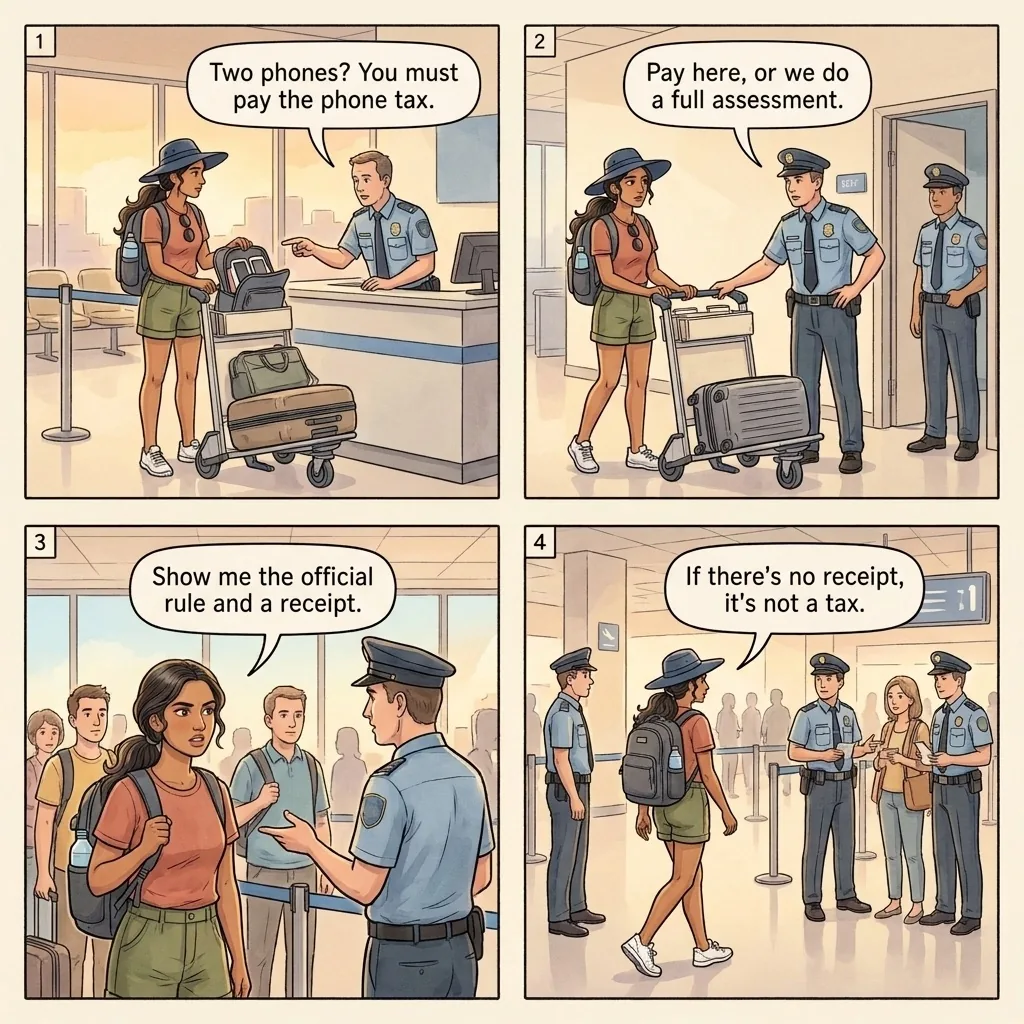
At Kotoka airport's last customs checkpoint, officers demand a 'phone duty' of GH¢ 500–GH¢ 1,000 per device from arriving tourists.
You clear immigration in Terminal 3, collect your bag, and approach the final post when an officer flips through your luggage tag, points at the second phone in your carry-on, and announces a rule about more than two mobile devices. There is no printed schedule, no receipt book, and no supervisor in sight — just a hand on your suitcase and a calm explanation that this can be sorted right here.
The figure quoted starts at GH¢ 500–GH¢ 1,000 per phone, sometimes in US dollars, and the moment you hesitate the officer signals a colleague to step closer. They ask whether you would prefer a side-room duty assessment while your driver waits outside. Hand over the cash and you keep moving; refuse and the line behind you is held up while the officer flips through your charger pouch and laptop sleeve looking for a second device to add to the tally.
The scam works because the last-checkpoint pause feels like a real customs procedure, even though Ghana imposes no per-phone tourist duty on personal electronics under fair-use limits. Multiple 2025 Reddit threads document the Terminal 3 play running on travelers carrying two phones plus a laptop, and most pay rather than miss their pickup. The Aviation Police desk and GACL ground staff sit inside the terminal, reachable only if you know to ask. The defensive move is to refuse to pay anything before you have a printed receipt with the officer's name and badge number.
Red Flags
- Officer steps in only at the final exit, after immigration and customs are already cleared
- No printed duty schedule or numbered receipt book on the counter
- Demand quoted in a flat range with no calculation shown or itemized
- A second uniformed colleague drifts within earshot the moment you hesitate
- Pressure tied to your waiting driver, not to any item actually in the bag
How to Avoid
- REFUSE to pay anything until you have a printed receipt showing the officer's name, badge number, and a duty code.
- ASK for a supervisor by name and walk back toward the customs hall rather than the exit if pushed.
- PHOTOGRAPH the officer, the counter, and any printed price list before reaching for your wallet.
- CALL the Aviation Police desk inside Kotoka Terminal 3 arrivals before handing over any cash.
- DECLARE personal electronics on the green channel and keep purchase receipts for anything new.
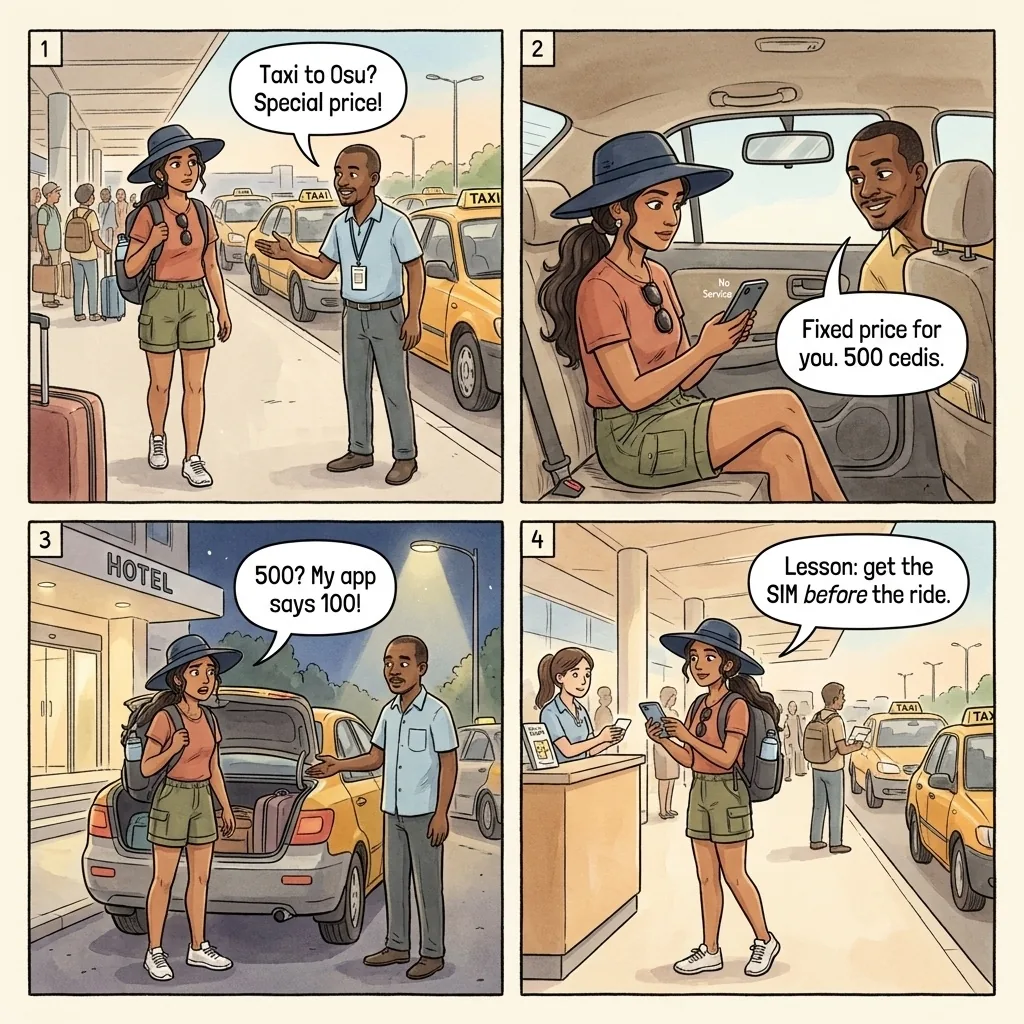
Drivers waiting outside Kotoka International Airport arrivals quote GH¢ 300–GH¢ 600 for a 15-minute ride to Osu or Cantonments, three to five times the metered Bolt or Uber fare for the same trip.
You step out of Terminal 3 with luggage, jet-lagged and without cedis on you, and a friendly man in a lanyard offers to carry your bag while saying his fixed price covers tip, parking, and the late hour. The forex desk inside is closed, the airport ATM line is twenty deep, and the driver's price feels almost reasonable for the speed it offers.
By the time you reach the hotel forecourt the agreed fare has crept up: a 'fuel surcharge', a 'night premium', or a charge for entering the gated estate. If you booked Bolt or Uber instead, the driver may pull over after a kilometer to ask whether you can pay cash off-app at a higher rate, and if you say no the trip gets cancelled mid-route. Some drivers idle until you tap cancel yourself, which closes the in-app dispute window and leaves you on a dark service road with the bag still in the boot.
The scam works because a tired arrival has no anchor price, no working SIM, and no leverage once the bag is in someone else's car. Reddit threads from 2025 document the routine at the Terminal 3 curb, with regulars suggesting a forex visit or a Bolt booked from inside the arrivals hall. The Ghana Civil Aviation Authority lists no airport-taxi rate card, and freelance drivers know it. The defensive move is to walk past the curb hustlers, withdraw cedis at the indoor ATMs near customs exit, and book your ride from the seated waiting area.
Red Flags
- Quoted fare three or more times the in-app Bolt or Uber estimate for the same route
- Driver insists on cash off-app and offers to wait while you visit an ATM
- Lanyard or fluorescent vest with no airport-issued ID or visible badge number
- 'Fuel surcharge' or 'night premium' added at the destination, not at booking
- Driver pulls over within a kilometer to renegotiate the rate or asks you to cancel the app trip
How to Avoid
- WITHDRAW cedis at the indoor airport ATMs near the customs exit before stepping outside.
- BOOK Bolt or Uber from the air-conditioned seated waiting area rather than the curb.
- REFUSE any off-app cash deal mid-trip and have the driver complete the booked route.
- CONFIRM a screenshot of the in-app fare estimate before the driver pulls away.
- SAVE the Aviation Police desk number and the Marina Mall taxi rank as a backup pickup.
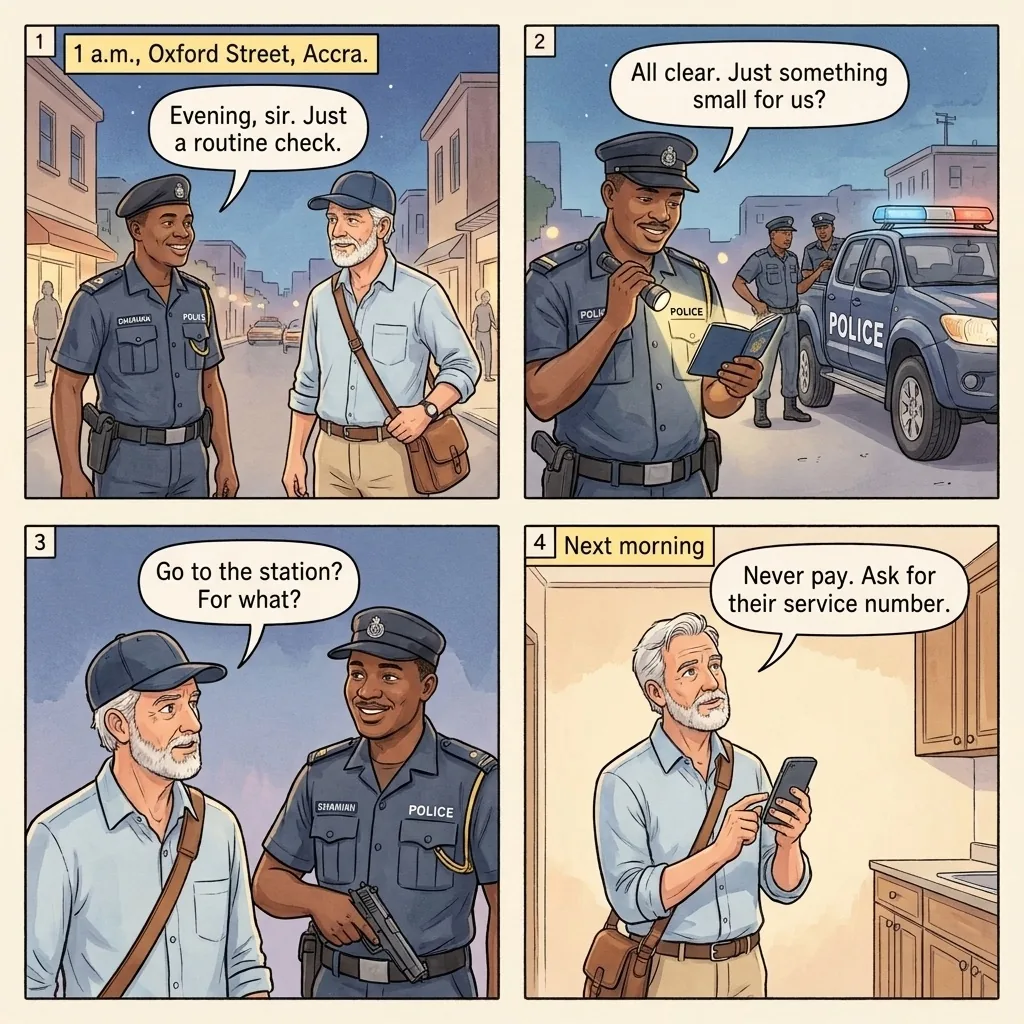
On Osu's Oxford Street after midnight, Ghana Police officers stop tourists at random ID checks and end with 'something small for the boys' — typically GH¢ 100–GH¢ 500.
You walk back from a club around 1 a.m. or pass a checkpoint in a friend's car, and the officer's torch lands on your face. The questions sound official: where are you staying, how long are you in country, can they see your passport. The phrasing is friendly, almost playful, and the gun on the hip is more decoration than threat.
Then the line shifts. They ask whether you have any 'small money' for them, or whether you would like to handle the matter at Osu Police Station instead. The wait at the station, they explain, can run several hours and your passport stays at the desk while paperwork is filed. Two more officers drift over from a parked pickup. The amount they want lands inside what feels reasonable to make the encounter end — GH¢ 100 buys a smile, GH¢ 200 buys an escort back to your hotel, GH¢ 500 closes whatever phantom violation you supposedly committed.
The scam works because a 1 a.m. shakedown weaponizes your fear of a foreign police station, a missed flight, or a passport you cannot afford to leave behind. A 2025 Modern Ghana corruption-perception poll ranked the Ghana Police Service first among institutions for daily bribe-taking, and 2025 Reddit threads describe the Osu pattern as routine rather than exceptional. The Police Professional Standards Bureau accepts complaints, and the IGP's 2026 'zero tolerance' directive exists on paper. The defensive move is to ask the officer to call the Police Professional Standards Bureau on speakerphone before any money is discussed.
Red Flags
- Stop happens between midnight and 4 a.m. usually within 200 meters of a club exit
- Officer opens with passport check and closes with 'anything for the boys?'
- No paper ticket, no patrol-car number repeated to dispatch, no body camera
- Two or three more officers drift over from a parked pickup once you slow down
- Suggested cash figure rises only when you say no, never falls when you negotiate
How to Avoid
- CALL the Police Professional Standards Bureau hotline on speakerphone before any money is discussed.
- REFUSE to hand over your physical passport — offer a phone photo of the bio page instead.
- RECORD audio openly on your phone the moment 'anything small' is mentioned.
- ASK to be taken to Osu Police Station and ride to the station in your own car.
- NEVER carry more than GH¢ 200 in a visible wallet on Osu nightlife trips.
Like what you're reading? Get a full Accra itinerary with safety tips built in.
Browse travel-safety books →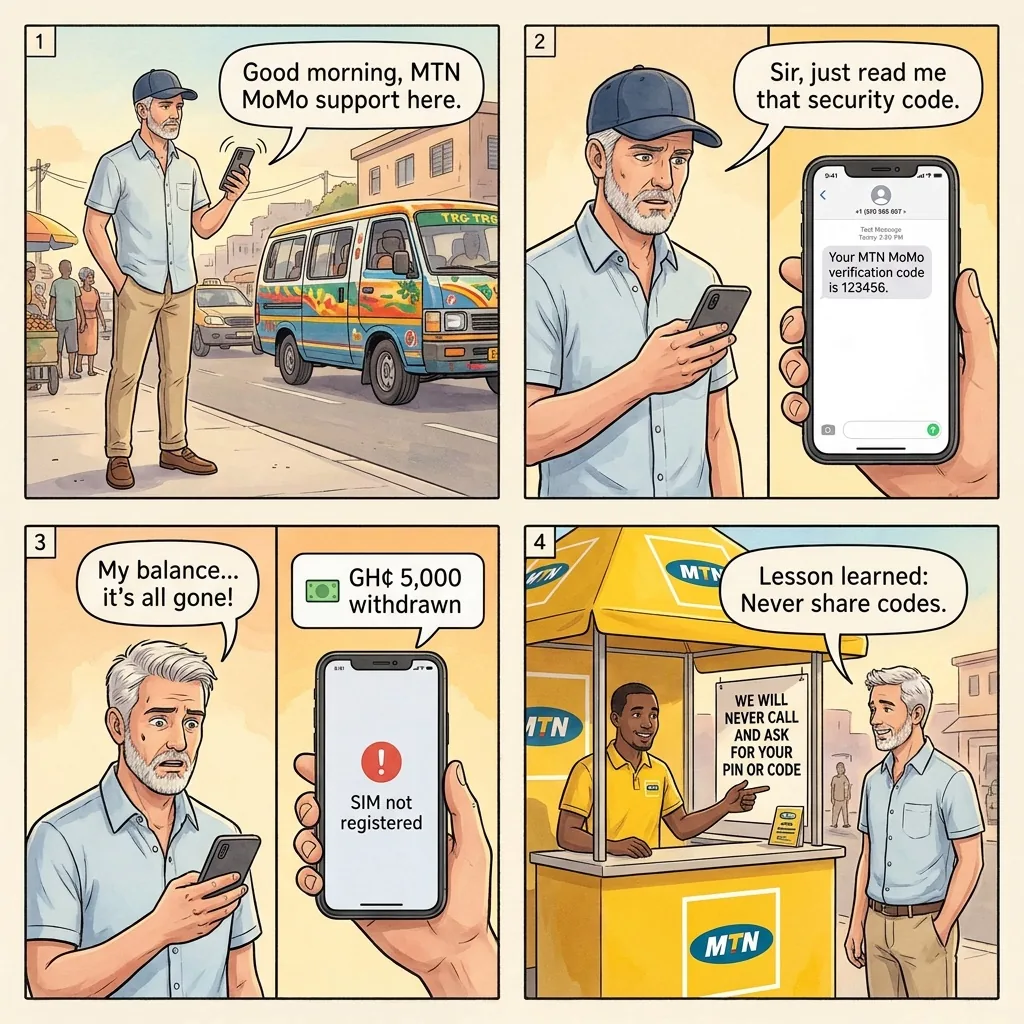
Callers posing as MTN MoMo or Ecobank agents talk Accra-area victims through a 'verification' menu — then drain GH¢ 1,000–GH¢ 11,000 from the linked wallet in under 60 seconds.
The pitch arrives clean: a polite voice from a Ghanaian number, a reference to a recent transaction or 'unusual login attempt', and a request that you read out the six-digit code on your screen so they can 'cancel' the alert. They already have your name, your last four MoMo digits, and the agent kiosk where you registered.
What they walk you through is a SIM-swap or a PIN-reset against your own wallet. Within 60 seconds the phone restarts and the wallet balance is gone, withdrawn through agent kiosks along the Tabora and Nima corridor where investigators say syndicates run dozens of cash-out points. A second variant skips the call and lands as a text: 'GhanaPost: parcel held — pay GH¢ 25 customs duty here', or 'Ecobank: confirm your card at this link'. Tap the link and the site harvests your card details, your MoMo PIN, or both, and the cash-out begins inside the same hour.
The scam works because MoMo is plumbing in Ghana — rent, school fees, taxi fares — and a caller who sounds official and quotes your last transaction defeats the instinct to hang up. On December 27, 2025, police arrested 100 suspects in Tabora in a coordinated MoMo-fraud raid, and a December 28, 2025 follow-up swept up 141 suspects across Greater Accra. The Cyber Security Authority logged over 700 online fraud reports in Q1 2026 alone. The defensive move is to hang up on any 'verification' call and dial the number on the back of your bank card directly.
Red Flags
- Caller already knows your name, the last four MoMo digits, and your agent kiosk
- 'Verification' requires you to read a code off your screen aloud
- Text contains a shortened or look-alike domain instead of ghanapost.com.gh or ecobank.com
- Polite Ghanaian-English script that escalates to urgency within 90 seconds
- Cash-out attempted at a chain of small agent kiosks rather than your usual one
How to Avoid
- HANG UP on any 'verification' call and dial the number printed on your bank card directly.
- NEVER read aloud, type, or screenshot a six-digit code your phone receives.
- BLOCK the caller and forward the message to MTN's 419 anti-fraud short code immediately.
- ENABLE biometric login on the MyMTN app and disable USSD PIN reset where possible.
- REPORT incidents to the Cyber Security Authority national cyber-incident channel and your bank.
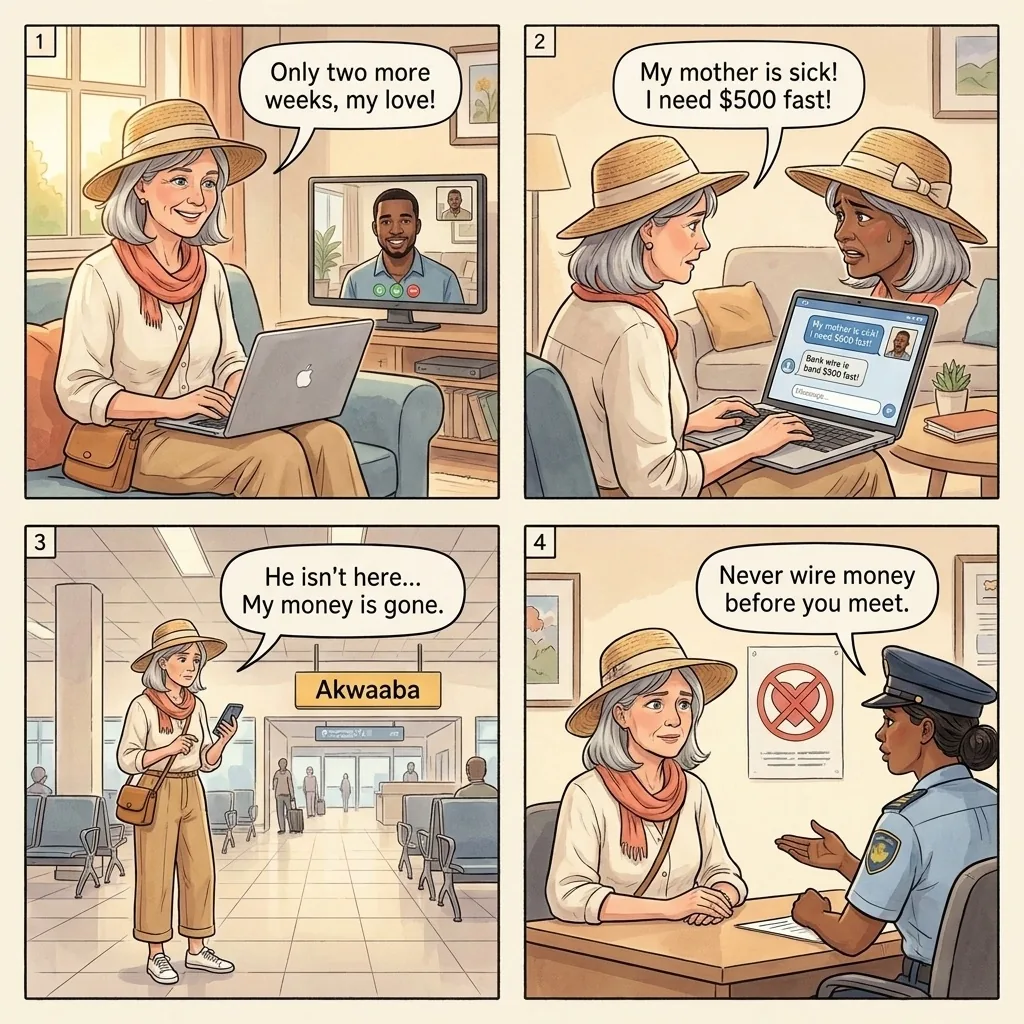
A six-month online romance with daily voice notes and video calls turns into a wire request to Accra — usually GH¢ 5,000–US$ 10,000 for an 'emergency' that escalates with every payment.
The relationship feels real because it has run for half a year, with consistent stories about a job in marketing or nursing and lighting in the calls that does not look staged. You may have already booked a flight to meet, and the request lands two weeks before departure when refusing feels colder than wiring.
The figure escalates each time you pay. After the first GH¢ 5,000 there is a customs broker fee, then a chief's land-document tax, then a hospital bill the family cannot front. By the time you land at Kotoka you have wired US$ 3,000–US$ 10,000 across MoneyGram, Western Union, and an MTN MoMo number tied to a name that does not match any document you have seen. In some variants your name has already been used as a 'land owner' on a chief's document for a plot you have never visited.
The scam works because a six-month script with real video calls and a real person on the other end defeats every red-flag list designed for cold DM bots. On October 2, 2025, a UK court jailed five Ghanaians for a £2 million sakawa scheme run from Accra; on December 23, 2025, an Accra court arraigned 'Abu Trica' over a US$ 8 million romance-fraud network. The defensive move is to refuse every wire under any framing until you have met in person and confirmed the recipient name on a Ghanaian ID.
Red Flags
- First wire request arrives within 14 days of a planned trip to Accra
- Recipient name on the wire does not match the social-profile name
- 'Family member' or 'chief' introduced only after the relationship is months old
- Story mixes tangible local props (chief's land paper, Tema customs, hospital invoice) with vague Western institutions
- Request escalates after every successful wire and never resolves
How to Avoid
- REFUSE every wire until you have met the person in Ghana and seen their national ID.
- VERIFY the name on the MoMo or Western Union pickup against the Ghana Card photo.
- REVERSE-image-search every photo and run the WhatsApp number through TrueCaller and Hiya.
- INSIST on a video call where the person reads a phrase you pick from a phone screen.
- REPORT suspected sakawa networks to the Cyber Security Authority and the FBI IC3 portal.
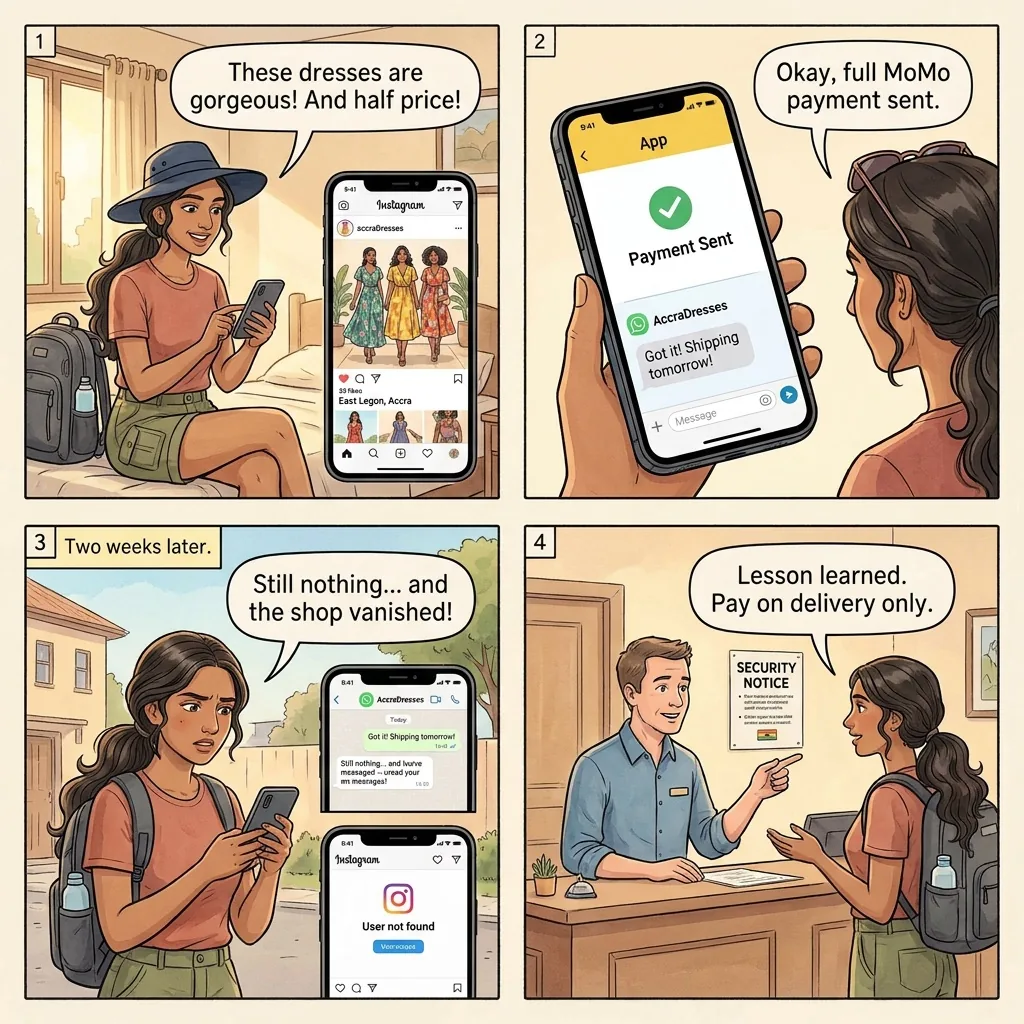
Accra-pinned Instagram and TikTok shops take full MoMo prepayment of GH¢ 200–GH¢ 1,500, then ship nothing — or ship a low-grade substitute that looks nothing like the listing photo.
You found the page through a friend's referral or a sponsored reel, the comments under each post look real, and the seller's bio names a physical Madina or East Legon address. The pricing for a wig, sneakers, or branded earbuds undercuts Jumia by 40–60 percent, which is exactly the hook.
You pay in full to the seller's MoMo number because every domestic Ghana store wants prepayment, and the delivery date passes without a tracking note. WhatsApp messages get one-word replies: 'soon', 'tomorrow', 'logistics'. Two weeks in, the seller blames a shipping agent in Tema or a customs hold and asks for GH¢ 80–GH¢ 150 more for a 're-routing fee'. Three weeks in, the page is renamed and the comment history scrubbed.
The scam works because a three-year-old page with thousands of comments and a real Achimota pickup address looks indistinguishable from a legitimate small business until the order misses its first deadline. The Cyber Security Authority logged GH¢ 600,000 in losses to online-shopping scams across the eleven months ending November 2025, and Q1 2026 data added more than 700 reports. The fastest civil recovery runs through the Accra Central MTTD office at Tudu, with a transaction screenshot and recipient name on file. The defensive move is to pay only on cash-on-delivery for any seller without an escrow option.
Red Flags
- Seller refuses cash-on-delivery and insists on full MoMo prepayment up front
- Pricing 40–60 percent below Jumia or established offline retail
- Address listed is 'East Legon' or 'Madina' with no specific street or shop name
- 'Re-routing fee' or 'customs hold' appears only after the deadline passes
- Page renamed or comment history scrubbed once you push for a refund
How to Avoid
- PAY only on cash-on-delivery, or use Jumia, Hubtel, or another platform that holds funds in escrow.
- VERIFY the seller's MoMo number on TrueCaller for prior fraud flags before sending money.
- SAVE every payment screenshot and chat log for a possible MTTD complaint.
- AVOID any seller refusing to share a physical shop address you can verify on Google Maps.
- REPORT delivery-default cases to the Cyber Security Authority and your MoMo provider's fraud line.
🆘 What to Do If You Get Scammed
📋 File a Police Report
Go to the nearest Ghana Police Service station. Call 191 (Police) or 112 (Emergency). Get an official crime report — you'll need this for insurance claims. You can also report online at police.gov.gh.
💳 Cancel Your Cards
Call your bank immediately. Most have 24/7 numbers on the back of the card (keep a photo saved separately). Block any suspicious transactions before the thieves use your details.
🛂 Lost Passport?
Contact your nearest embassy or consulate. The US Embassy in Accra is at No. 24, Fourth Circular Road, Cantonments, Accra. For emergencies: +233 30-274-1000.
📱 Track Your Device
If your phone was stolen, use Find My (iPhone) or Find My Device (Android) from another device. Don't confront thieves yourself — share the location with police instead.
Frequently Asked Questions
Heading to Accra?
Now you know what to watch for — browse the travel-safety guides before you go.
See Accra tourist scams →