
⚡ Quick Safety Tips
- The Grand Palace is never 'closed for a royal ceremony' mid-day — anyone who tells you so near the entrance is running the tuk-tuk gem-and-tailor tour; verify on royalgrandpalace.th before you leave your hotel.
- Insist on the meter at Suvarnabhumi and Don Mueang airports — the metered fare to Sukhumvit is ฿220–฿350 plus ฿45–฿75 toll; anything flat-rate above ฿500 is a scam.
- Avoid bucket cocktails on Khao San Road — these are the primary delivery vehicle for drink-spiking; order bottled beer or mix-at-bar drinks you can watch being made.
- On Patpong and Soi Cowboy, pay for each drink individually at the bar rather than running a tab — this caps your exposure when the padded bill arrives.
- Save Tourist Police 1155 (24/7 English support) — they resolve bar extortion, taxi overcharge, and fake-monk complaints faster than the standard 191 police line.
Jump to a Scam
- High Grand Palace 'Closed' Tuk-Tuk Gem Shop Tour
- High Suvarnabhumi Airport Taxi Meter Refusal
- High Patpong / Soi Cowboy Ping Pong Show Drink Bill
- High Tuk-Tuk Tailor Suit Scam
- Low Fake Monk Donation Racket (Sukhumvit / Asok / Nana)
- Medium Grab / Bolt Cancel-and-Pay-Cash Switch
- Medium Indian 'Lucky Face' Hair Supplement & Fortune Teller
- High Khao San Road Drink-Spiking & Pickpocket
The 8 Scams
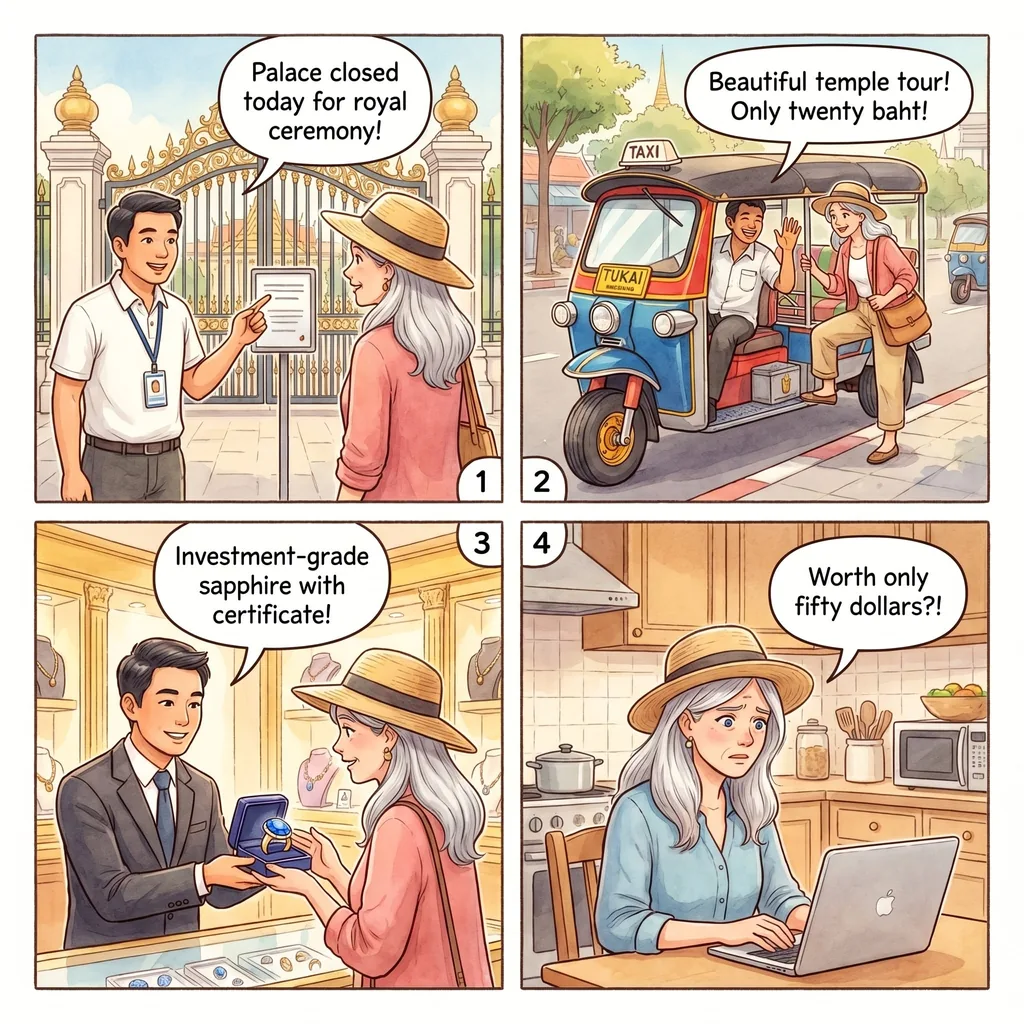
A friendly "palace officer" at the Grand Palace entrance tells you it's closed for a royal ceremony, then a 20-baht tuk-tuk takes you on a "hidden temple tour" that ends with a ฿63,000 sapphire ring and two polyester suits — the palace was never closed.
You walk up to the Grand Palace entrance on Thanon Na Phra Lan and a friendly man in a pressed shirt — often introducing himself as a teacher or "palace officer," sometimes with a laminated tourism-office lanyard — greets you with "Welcome, sir, where are you from?" Before you can orient yourself he shakes his head. The Grand Palace, he explains, is closed until 1 p.m. for a royal ceremony. But he can help. There's a beautiful tour of "hidden temples" that fills the time perfectly; a tuk-tuk is just there, twenty baht, half-day loop.
The loop visits one or two genuine wats, then makes its real stops: a gem store with men in suits and cold drinks, a tailor shop with English-speaking staff and a "Super 120 wool" pitch, occasionally a Buddha-amulet vendor. Each shop pays the driver 30–40% commission on whatever you buy, and the "palace officer" at the front of the funnel earns a flat ฿200–฿400 per tourist delivered. A Reddit thread titled "Because I'm an idiot my wife and I fell into the tailor-gem" has the poster admitting they spent roughly ฿63,000 (~$1,800 USD) on two suits and a "sapphire ring" whose real market value back home was closer to ฿1,800 ($50).
The Grand Palace is never closed mid-day for tourists — royal ceremonies close specific halls, not the complex, and the official site (royalgrandpalace.th) posts actual closure dates weeks ahead. Reddit runs a recurring warning pinned at the top of most "first-timer in Bangkok" megathreads, and a post titled "I filmed the Grand Palace is closed scam in Bangkok" remains the canonical evidence. The most damaging variant ends with a ฿17,500 polyester suit that arrives mismatched at your hotel the day before your flight home. Verify Grand Palace hours on royalgrandpalace.th the morning of your visit, enter through the main Visitor Centre gate on Na Phra Lan, and ignore anyone who intercepts you on the walk in — never accept a tuk-tuk "tour" priced under 300 baht because the driver's revenue comes entirely from shop commissions.
Red Flags
- A friendly English-speaking stranger near the Grand Palace tells you the palace is 'closed for a royal ceremony' — it is almost never actually closed during posted hours
- A tuk-tuk is already waiting and the driver offers an improbably cheap price (20–50 baht) for a multi-temple tour
- Your intermediary has an ID lanyard or 'tourism office' business card that looks laminated and generic
- The tour's stops include at least one gem store, tailor shop, or Buddha-amulet vendor
- Men in suits greet you inside with cold drinks and a polished pitch about 'export-grade' gems or 'wholesale' suits
How to Avoid
- Verify Grand Palace hours the same day on the official royalgrandpalace.th website or Google Maps before leaving your hotel.
- Enter the Grand Palace through the main Visitor Centre gate on Na Phra Lan — ignore anyone who intercepts you on the walk from the river or Sanam Luang.
- Never accept a tuk-tuk 'tour' priced under 300 baht — at that price the driver's revenue comes entirely from shop commissions.
- Book suits only from vetted tailors with posted prices (e.g. Tailor on Ten or Rajawongse on Sukhumvit Soi 4) — never from a shop you were taken to.
- If you're already in the tour, politely decline to enter any shop; the driver's revenue model collapses at the first refusal and they will drop you.
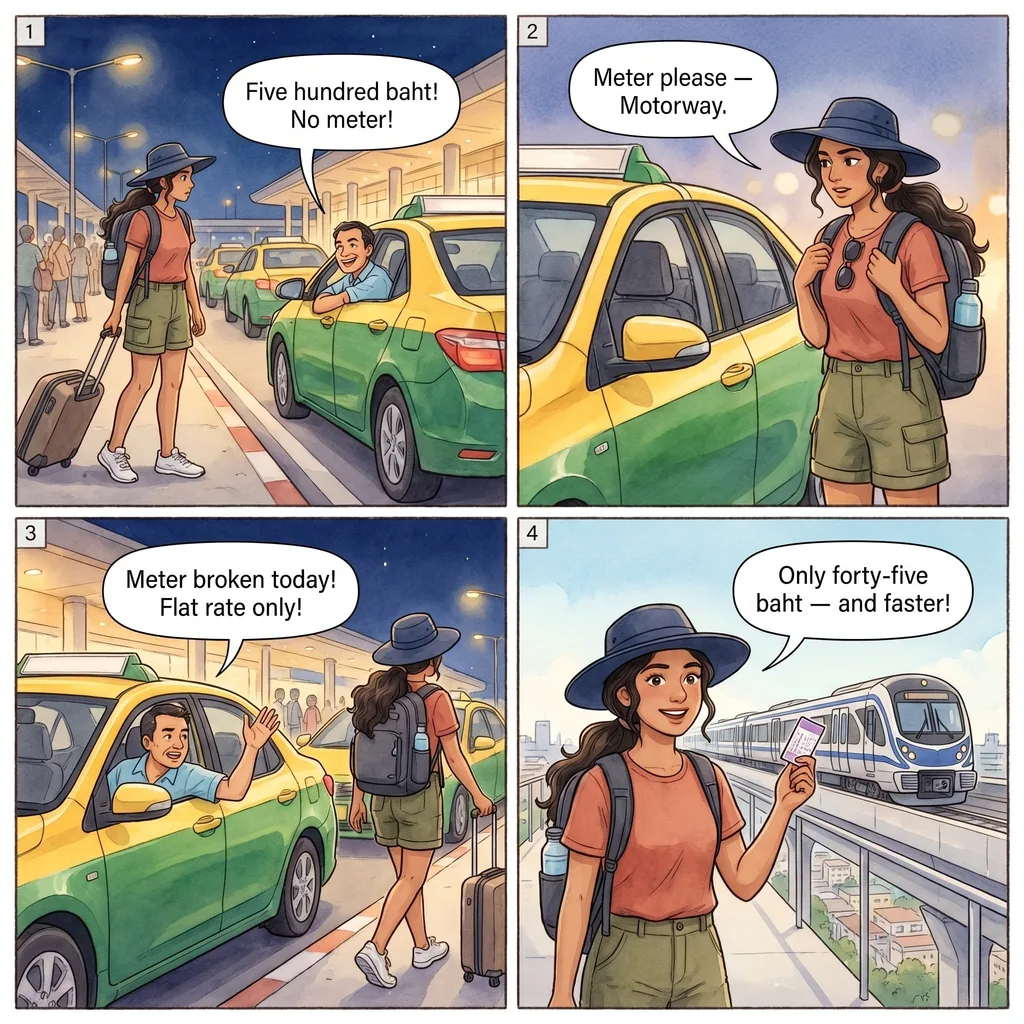
At Suvarnabhumi's official taxi queue, your assigned driver loads your bags and says "500 baht to Sukhumvit, no meter" — the legitimate metered fare is ฿220–฿350 plus a ฿50 toll, but enforcement collapses between 11 p.m. and 6 a.m. when jet-lagged tourists arrive.
You land at Suvarnabhumi at 1 a.m., make it to the official taxi queue in the basement of Terminal 1, and get assigned Car 847. The driver nods, loads your bags into the trunk, and slides into the front seat. Before he hits the meter button he says "500 baht to Sukhumvit, no meter — meter very slow tonight, traffic." You're carrying two suitcases and your kid is asleep on your shoulder. ฿500 feels manageable.
The legitimate metered fare to central Sukhumvit is ฿220–฿350 plus about ฿50 in tolls. You've just lost roughly ฿175 (~$5 USD) — modest in dollar terms but the start of a Thailand-wide pattern. Reddit and Reddit have logged thousands of variants ("No meter taxi," "Taxis not using the meter — is this just how it is?"). The airport queue is governed by rules requiring meter use, but enforcement collapses between 11 p.m. and 6 a.m., exactly when international flights arrive.
A more aggressive variant turns on the meter but takes Sukhumvit Road surface streets rather than the Motorway, converting a 30-minute ฿300 trip into a 75-minute ฿800 trip that's technically "metered" but uses a padded route. The driver shows the meter as proof the fare is legitimate. In 2025 the SCMP and Bangkok Post both named Bangkok the world's top city for taxi-fraud complaints. Skip the airport taxi queue at peak scam hours (11 p.m.–6 a.m.) and take the Airport Rail Link City Line — ฿45 to Phaya Thai, 45 minutes, with a short Grab to your hotel from there. If you do take a taxi, insist on "meter, please — Motorway" before getting in, and walk to the next car if refused.
Red Flags
- Driver quotes a flat rate before starting the meter, especially at Suvarnabhumi or Don Mueang after 10 PM
- Driver claims 'meter broken' — in 2025 Bangkok, taxi meters do not actually break this often
- Car at the airport does not have a printed receipt from the automated queue dispenser (legit queue gives you one)
- Driver refuses to take the Motorway (Thaang duan) even when you offer to pay the ฿45–฿75 toll
- At a hotel or tourist area, a driver stationed outside waiting for fares is almost always refusing the meter — flag one passing by instead
How to Avoid
- At Suvarnabhumi, skip the airport taxi queue entirely at peak scam hours (11 PM–6 AM) and take the Airport Rail Link City Line (฿45, 45 min to Phaya Thai).
- If you take an airport taxi, insist on 'meter, please — Motorway' before getting in; if refused, walk to the next car without negotiation.
- Use Grab or Bolt from anywhere in the city — the app guarantees a fixed price and records the route, which eliminates meter games and padded detours.
- Know the expected fare: BKK → Sukhumvit metered is roughly ฿220–฿350 plus ฿45–฿75 in tolls; DMK → Sukhumvit is ฿300–฿400.
- If a driver quotes a flat rate, photograph the car's license plate before walking away and report to Tourist Police 1155 — they maintain a complaint database.
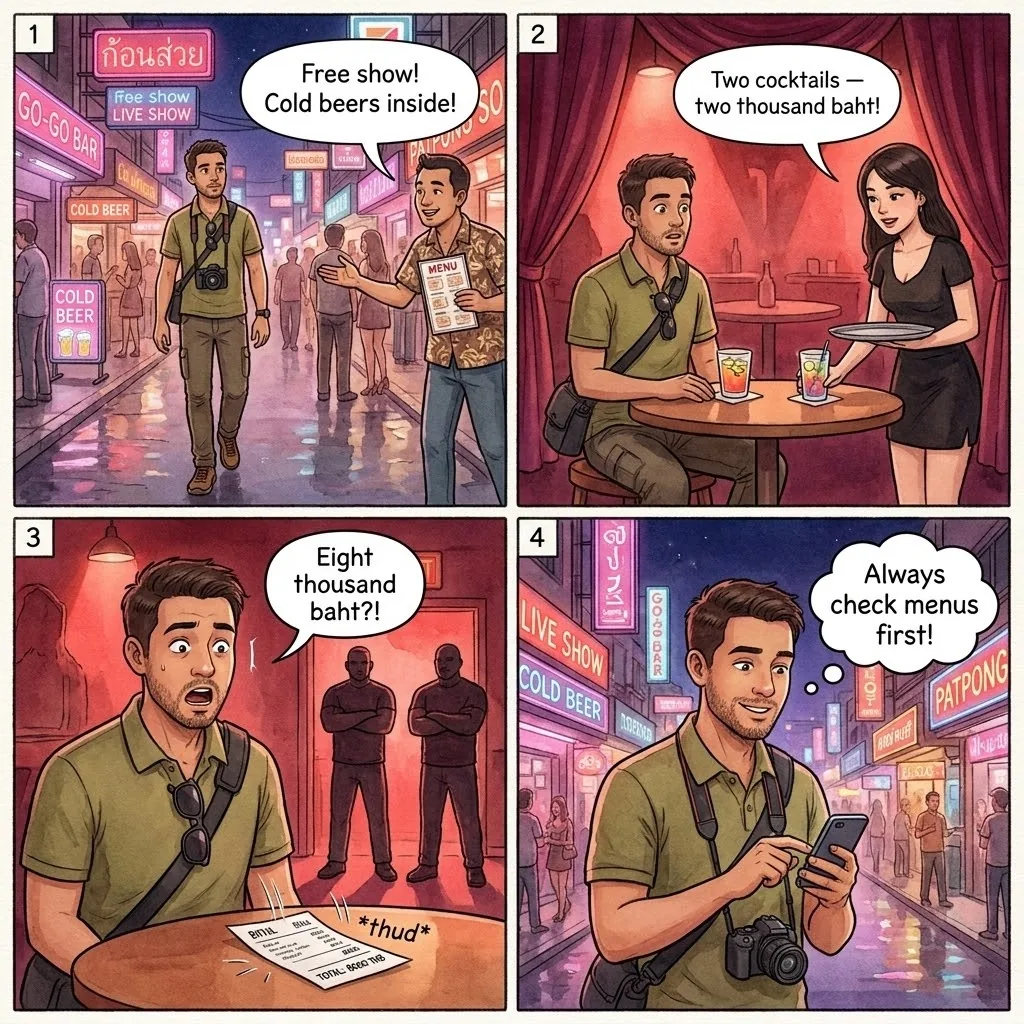
A Patpong tout's laminated menu promises "free entry, ฿100 beers, free show" — once you're inside the bouncers block the door, the real menu charges ฿700 per beer plus ฿2,000 "lady drinks" you didn't order, and the bill arrives at ฿8,000–฿87,000.
A tout on Patpong Soi 1 hands you a laminated paper menu: free entry, ฿100 beers, "free show" upstairs, two-for-one cocktails. The pricing matches what you'd pay anywhere else in Bangkok. You climb the narrow stairs, take a seat at a small table near the stage, and order a beer. The show is bizarre and short — twenty minutes. A hostess sits at your table without asking and orders a drink that you assume is on her tab.
When you ask for the bill, it's ฿8,000. The drinks listed on the menu you were shown are not the drinks you were served — the real menu appears now, with small print charging ฿700 per beer, ฿2,000 per "lady drink" you did not consciously order, plus a ฿500 "show fee per guest" and 20% service. Two staff members move to block the exit. Bangkok Post's 2023 reporting on a French tourist hit with a ฿87,000 bill at a Patpong ping-pong venue — he eventually paid because bouncers threatened violence — remains the case-study most often cited in 2025–2026 warnings.
The scam's core mechanic is menu substitution. The outside menu is unlaminated paper ("posted by the manager next door, not us") or has a tiny disclaimer reading "service charge 20%, show fee ฿500 per guest, drinks priced at server discretion." The Soi Cowboy variant is slightly different — bars are more regulated, but the "lady drink" scam runs universally, and a hostess at your table can run the bill to ฿10,000 in an hour. Reddit's veteran advice: "Maybe best not to drink anything at all inside. Remember they will lie to you constantly about prices." If you want to see a ping-pong show, go in early evening to venues with Google Maps reviews, printed prices at the door, and other tourists already inside — and ask in writing for a total before sitting down. If a scam bill arrives and staff block you, calmly call Tourist Police 1155.
Red Flags
- A tout on Patpong Soi 1/2, Nana Plaza, or Soi Cowboy actively pulls you toward a venue with a laminated menu of cheap drinks
- No posted menu visible at the table once you are seated — only verbal prices from staff
- A 'lady drink' or 'show fee' is applied to your bill that was never mentioned or agreed to
- Drinks you did not order keep appearing at your table — each one is a separate ฿500–฿2,000 charge
- Staff block the exit or stand between you and the door when the bill is questioned
How to Avoid
- If you want to see a ping pong show, go in the early evening to venues with Google Maps reviews, printed prices at the door, and ideally other tourists already inside.
- Before you sit down, ask in writing: 'Total price for 1 show + 1 beer.' If they won't write a number, walk out.
- Do not accept drinks offered to hostesses, tablemates, or staff — each is billed to you at scam rates.
- Pay each drink at the bar as you order it rather than running a tab — this limits the exposure at billing time.
- If a scam bill arrives and staff block you, calmly call Tourist Police 1155 — venues fold quickly at the word 'police,' and the number is answered 24/7 with English-speaking staff.
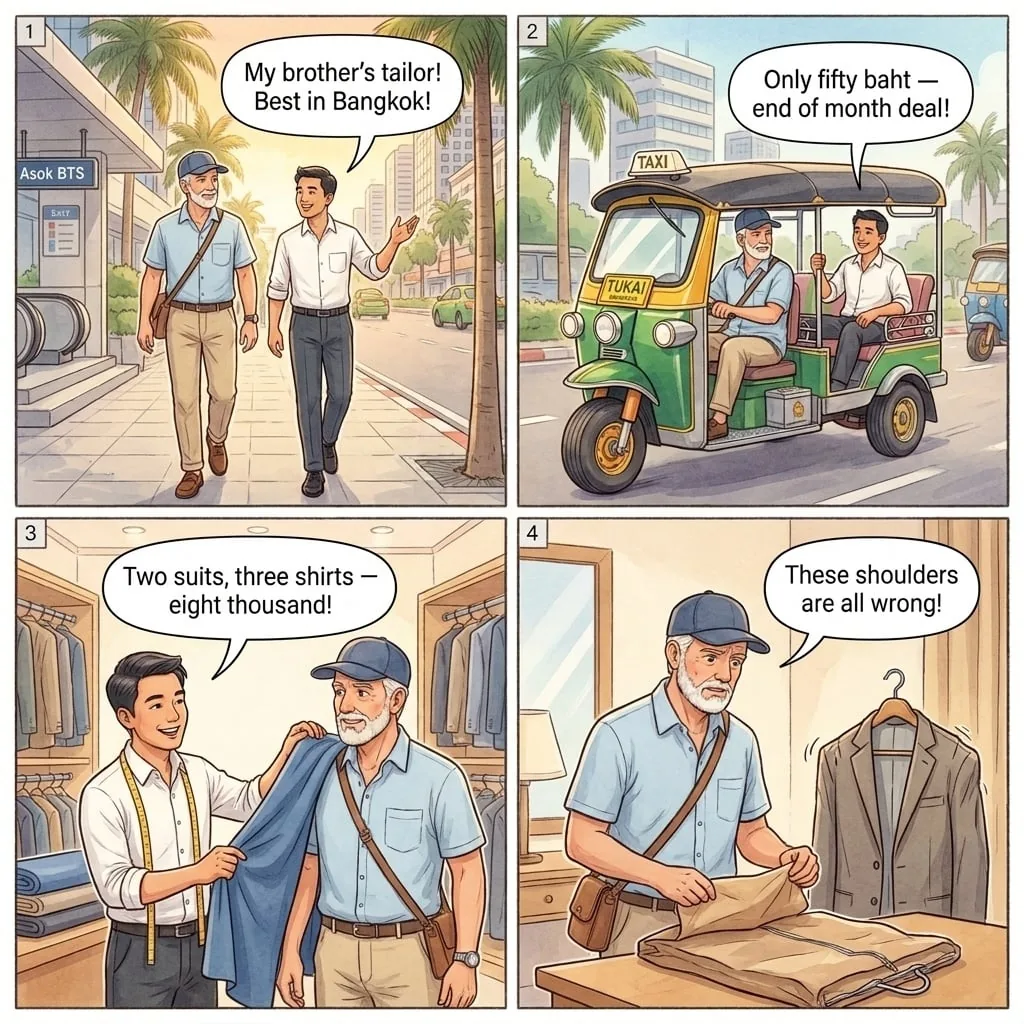
A well-dressed man near Asok BTS recommends "my brother's tailor on Sukhumvit 11" for a 50-baht tuk-tuk ride — you walk out with a ฿8,500 receipt for "Super 120 wool" suits that arrive 48 hours later as polyester-blend product with mismatched shoulders.
You come out of Asok BTS into the Sukhumvit afternoon heat and a well-dressed man falls into step. "My brother has a tailor shop, Sukhumvit Soi 11, very good price, end-of-month special. Tuk-tuk takes you for fifty baht." His English is good and the pitch is calm. You follow.
At the shop a charming tailor measures you up, recommends two suits in "Super 120 wool" for ฿8,500 (about $245 USD), and promises delivery in 48 hours. You pay the full amount in cash at his request. Two days later the suits arrive at your hotel: the "wool" is 40% polyester, the lining is acetate pretending to be silk, and the shoulders slope because the pattern was cut for a different body shape. By the time you notice, your flight is the next morning.
This scam has been running on Sukhumvit since at least the 1980s and appears in virtually every "first-timer in Thailand" thread on Reddit. What makes it especially sticky is the quality gradient — some Sukhumvit tailors are genuinely excellent (Rajawongse, Tailor on Ten, Narry's, 9 Tailors produce Savile Row-quality work at a fraction of London prices) — and the scam shops mimic their branding, borrow their phrases ("hand-stitched," "full canvas," "Super 120"), and hire English-speaking touts who speak knowledgeably about cut and fabric. The financial damage per victim is typically ฿14,000–฿70,000 for suits that are effectively worthless. Credit-card chargebacks sometimes work but often don't, because you physically received the suits you ordered. Never follow a tuk-tuk recommendation to any tailor — if the tailor needs a street tout, they're running on commissions, not craftsmanship. Stick to published names (Rajawongse, Narry's, Tailor on Ten, 9 Tailors), pay by credit card in stages with 20–30% deposit only, and build in 5+ days between first fitting and your flight.
Red Flags
- A stranger near a BTS station or tourist site offers to take you to 'my brother's tailor' for a discounted tuk-tuk
- The shop is not findable on Google Maps by name, or has reviews exclusively from 2-month accounts
- Quote is aggressive: '2 suits, 3 shirts, 2 ties — ฿8,500' — the real price of a decent Thai bespoke suit alone starts around ฿12,000
- Tailor insists on full or mostly-cash payment upfront, before a fitting
- Delivery window is compressed to 24–48 hours — real bespoke tailoring requires at least one intermediate fitting
How to Avoid
- Research tailors before your trip on traveler reports and askandyaboutclothes.com; stick to published names (Rajawongse, Narry's, Tailor on Ten, 9 Tailors) that have 10+ year reputations.
- Never follow a tuk-tuk recommendation to any tailor — if the tailor needs a street tout, they're running on commissions not craftsmanship.
- Pay by credit card in stages: a deposit of 20–30% only, with the balance due on satisfactory final fitting.
- Ask to see the actual bolt of fabric and photograph the mill label before fabric is cut; verify the composition matches what you were quoted.
- Build in at least 5 days between first fitting and flight so you have leverage to request corrections; if the tailor can't work in that window, find another shop.
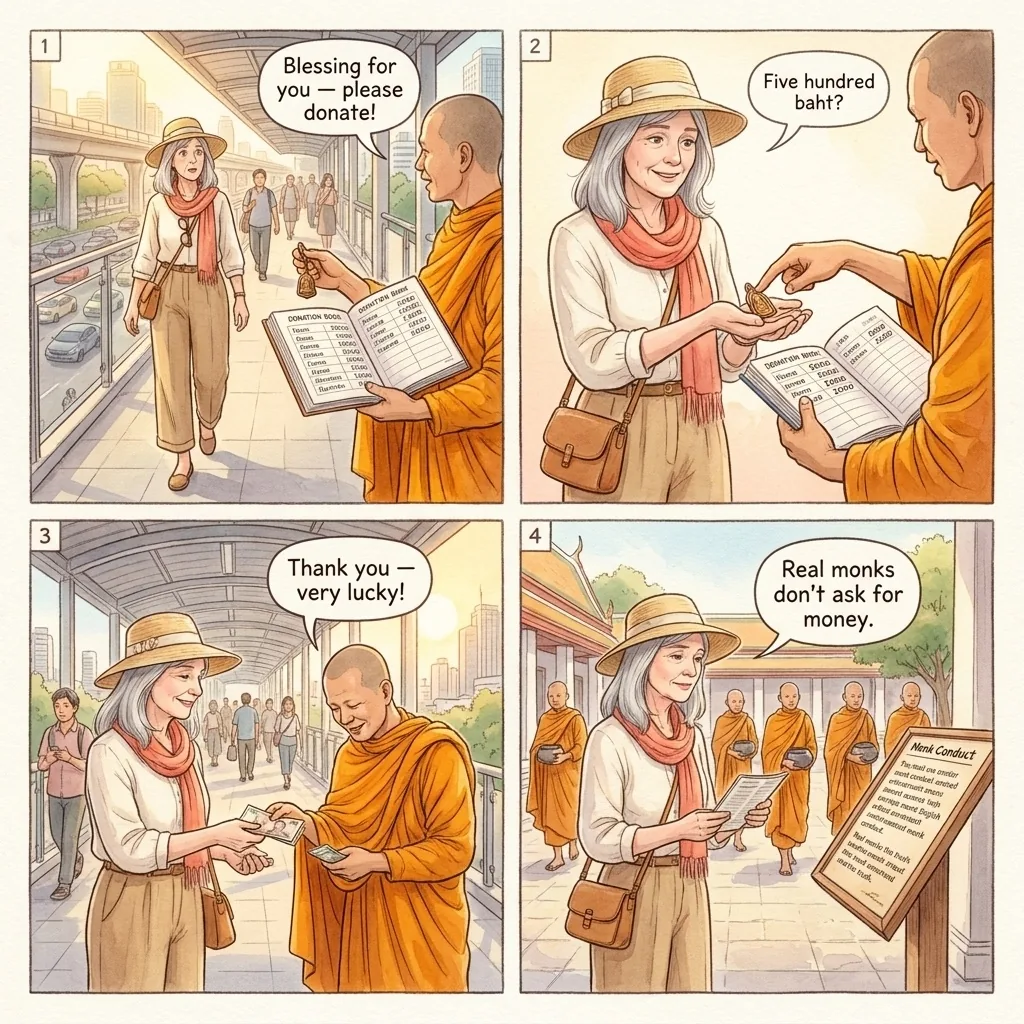
A "monk" in saffron robes on the Asok or Nana BTS skywalk presses an amulet into your hand and produces a donation book with pre-filled ฿500–฿2,000 amounts — real Theravada monks do not solicit cash from tourists on public walkways.
You're walking across the Asok BTS skywalk toward Terminal 21 when a man in saffron robes steps in front of you holding out a small bronze amulet and a leather-bound book. He makes a brief blessing gesture, presses the amulet into your hand, and opens the book to a page of "previous donors" — names and amounts in different handwriting, ฿500, ฿2,000, $50, €30. He points at the page and waits.
Social pressure does the rest. The amulet is in your hand, the book is open, the cause looks like temple construction or earthquake relief, you're embarrassed to refuse. You hand over ฿500 and feel briefly virtuous. You shouldn't — real Theravada monks do not solicit cash from tourists on BTS skywalks or busy commercial streets. Genuine alms-giving (tak bat) happens at dawn near the monk's home wat and involves food, not money.
The Sukhumvit operation has been large enough to draw police attention. The Thai Office of National Buddhism has publicly condemned the scam and posted multilingual signs on BTS skywalks, but enforcement waxes and wanes. The tells are behavioral: real Thai monks walk with eyes downcast, do not make sustained eye contact with laypeople, will not physically hand you an object, and cannot directly touch women (offerings are placed on a cloth). A "monk" who approaches you proactively, speaks broken English, and presents a donation book with pre-filled large amounts in matching handwriting is running the scam. Do not accept any object placed in your hands by a "monk" — hand it back and keep walking. If you want to make a temple donation, use the metal donation box inside any wat (Wat Pho, Wat Arun, Wat Benchamabophit all have them).
Red Flags
- Robed figure actively approaches you on a BTS skywalk or busy Sukhumvit street, rather than walking past with eyes down
- A laminated donation card or 'temple construction project' sign in multiple languages
- Pre-filled donation book with round-number amounts in similar handwriting (the social-proof prop)
- Interaction happens in a commercial, tourist-heavy spot — not inside or immediately adjacent to a wat (temple)
- Robes look unusually bright, new, or crisp, and the 'monk' is wearing modern sneakers, a watch, or smartphone on a visible strap
How to Avoid
- Know that real Thai monks do not solicit cash from tourists on the street — decline with a polite wai and keep walking.
- If you want to make an authentic temple donation, use the official metal donation box inside any wat (Wat Pho, Wat Arun, Wat Benchamabophit all have them).
- Do not accept any object placed in your hands by a 'monk' — hand it back immediately or drop it and walk on.
- Legitimate morning alms-giving (tak bat) near temples involves food offerings, not cash — never a donation book.
- Report persistent fake monks to Tourist Police 1155 or the Bangkok Metropolitan Police — they keep a database of active offenders.
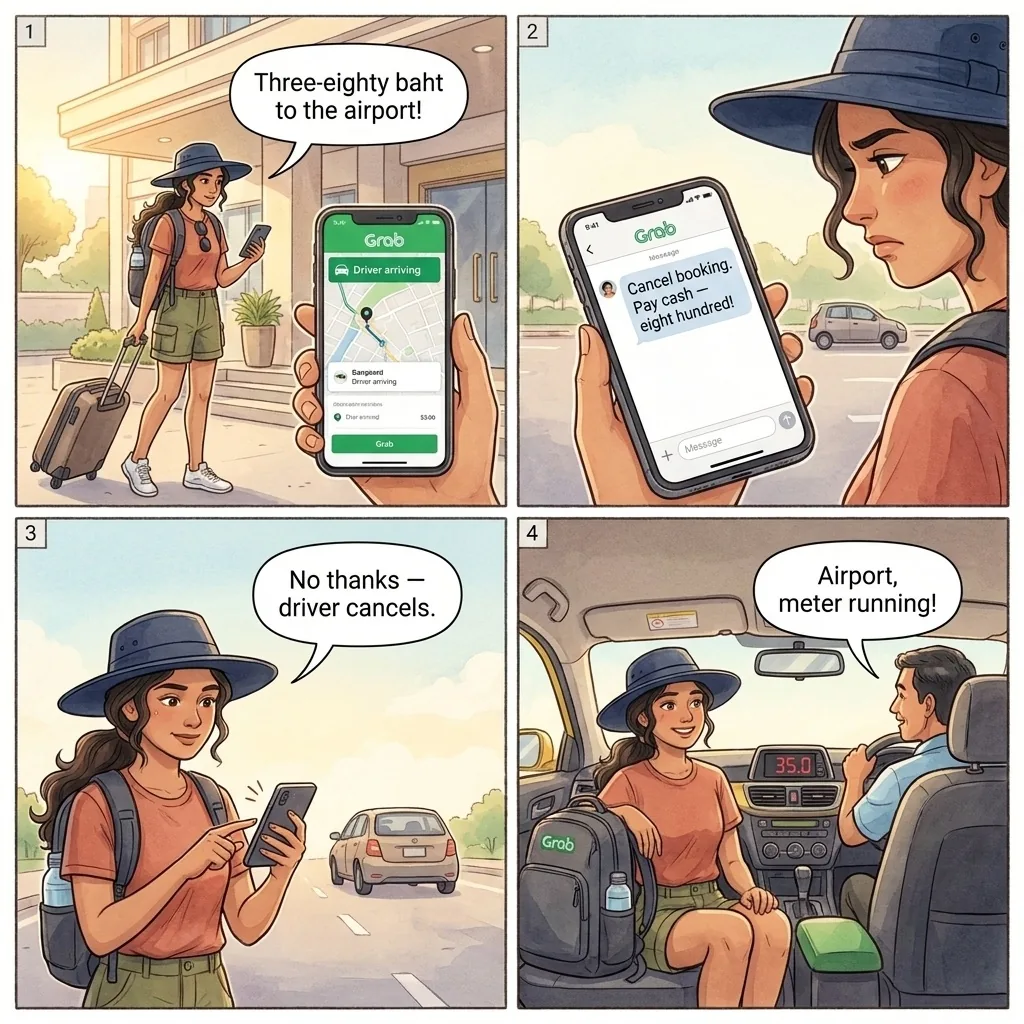
Your Grab driver accepts a ฿380 booking, parks 200 meters away, then messages "please cancel, pay me cash ฿800" — the app penalizes whichever party cancels, so you either lose the original fare or get charged a no-show fee.
You book a Grab from your Sukhumvit hotel to Suvarnabhumi for ฿380. The app accepts, assigns you a driver, shows him on the map. Three minutes later he's parked 200 meters away from your pickup point and not moving. A chat message arrives in broken English: "please cancel booking, pay me cash 800 baht now, traffic problem." You have 40 minutes until the airport express leaves.
If you cancel, Grab records it as your cancellation — you lose the fare record, the driver doesn't get a penalty, and you have no support claim. If you refuse, the driver idles until the app auto-cancels as a no-show and you get charged a cancellation fee anyway. Some drivers escalate, parking in sight but refusing to drive until you agree to cash, knowing your schedule pressure will fold first.
The scam exploits Grab's UX, which distinguishes between "passenger canceled" and "driver canceled" and penalizes whichever party does it. Bolt (which has lower commissions to drivers) has seen the scam spread even faster — one Reddit commenter quantified it: "I took 639 Grab rides in 2024 and had exactly 0 scams. Bolt, in 3 months, I had 5." A more aggressive Suvarnabhumi variant tells you to meet the driver off-airport "because airport won't let me in" — but the Grab pickup zone at Suvarnabhumi Level 4 (Departures) is fully legal. Never cancel a Grab/Bolt booking at the driver's request — respond "app price only, thank you" and wait. If the driver idles for 5+ minutes without moving, cancel from the app yourself; the cancellation logs their behavior and Grab/Bolt support refunds the fee.
Red Flags
- Driver chats you after accepting asking you to cancel the booking and pay cash — this is the single clearest scam indicator
- Driver parks nearby and idles rather than approaching the pickup point — they're waiting for you to cancel out of frustration
- Cash price quoted is 2x–3x the app fare (not 50 baht extra for toll — a complete re-pricing)
- Claims of 'motorbike accident,' 'traffic emergency,' or 'airport won't let me in' that don't match what you can see on the map
- Driver refuses to start the ride even after you refuse to cancel — counting on your schedule pressure
How to Avoid
- Never cancel a Grab/Bolt booking on the driver's request — respond 'app price only, thank you' and wait for the ride to start.
- If the driver idles for 5+ minutes without moving, cancel yourself from the app (the cancellation logs their behavior, which Grab/Bolt support refunds and penalizes).
- At Suvarnabhumi, use the designated Grab pickup zone at Level 4 (Departures) — Grab drivers can legally enter this zone.
- Keep screenshots of every booking (fare + route + driver ID) — Grab/Bolt in-app help refunds documented overcharges within 24 hours.
- Default to Grab over Bolt in Bangkok — Grab has tighter driver vetting and faster support response (though neither is immune).
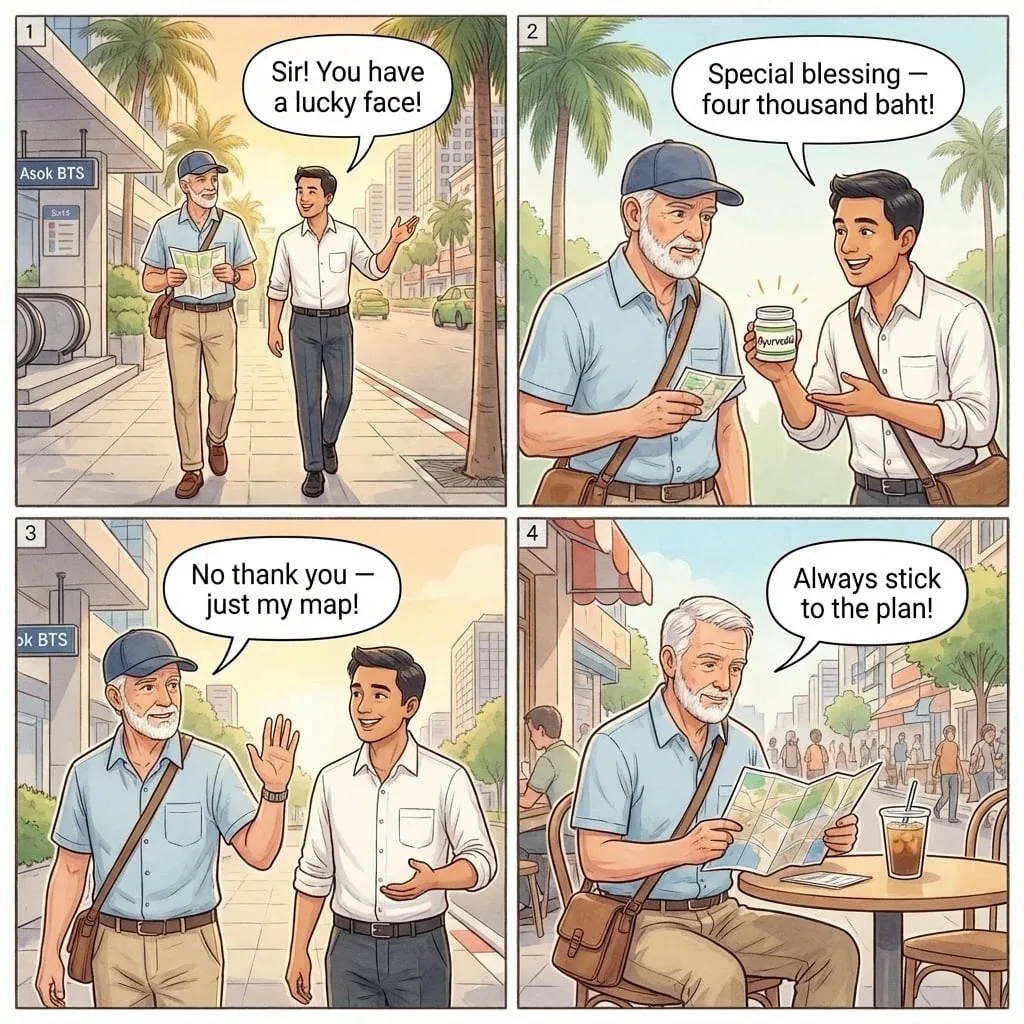
A well-dressed man at Asok BTS exits says "you have a very lucky face, sir" — the conversation pivots to a "blessing" or an Ayurvedic supplement at ฿1,500–฿4,000, and some victims report cash palmed during a "demonstration."
You walk out of Asok BTS and a well-dressed Indian man falls into step with you, smiles broadly, and opens with: "Excuse me, sir, you have a very lucky face." He asks where you're from, makes flattering predictions about your career or family, and slowly steers the conversation. The pitch flexes depending on your reaction — palmistry, numerology, or a wallet of "certified gems."
By the time you realize you haven't said you have hair loss or money worries, he's asking for ฿1,500 for a "lucky blessing," ฿4,000 for a "guaranteed Ayurvedic hair-growth paste," or pulling out a numerology chart with your "personal forecast." A Reddit thread quotes the script verbatim: "Sir, you have the lucky face" — even to a man with no visible hair loss, the script is fixed regardless of target. The crews rotate between Sukhumvit Soi 11 (near Nana Plaza), the Silom end of Patpong, the east end of Khao San Road, and the Asok skywalks; one Redditor encountered the same man at three different BTS stations in one week.
The financial damage is usually ฿500–฿4,000 per encounter, but the scam is sticky because the pitch escalates — "lucky face" compliment, then numerology reading, then a "blessing" requiring payment, then an upsell. Reddit warns specifically about the currency-display variant: tourists asked to produce local notes "just to see" have had ฿3,000–฿5,000 palmed during the demonstration. In 2024–2025 several arrests were made on Sukhumvit specifically targeting this crew. Do not stop walking when approached — brief eye contact and "mai ao, khop khun" ("no thanks") works; sustained engagement does not. Never hand your wallet, phone, or cash to any stranger for any reason, including "just to look."
Red Flags
- A stranger near Sukhumvit BTS stations compliments your 'lucky face' or 'special energy' unprompted
- Conversation pivots quickly from flattery to a product pitch (hair supplement, gems, blessings) or a request to see your money
- The seller produces a certificate, numerology chart, or laminated endorsement letter from a guru or authority
- The tout refuses to take 'no' for an answer and keeps shadowing you or stepping in front of your path
- You're asked to produce local currency 'just to see,' or handed items to hold 'for the blessing'
How to Avoid
- Do not stop walking when approached — brief eye contact and 'mai ao, khop khun' ('no thanks') works, sustained engagement does not.
- Never hand your wallet, phone, or cash to any stranger for any reason — including 'just to look' or 'to demonstrate.'
- If an item is placed in your hand, drop it on the ground or hand it back once without discussion and walk away.
- Real Ayurvedic practitioners operate out of clinics with addresses — street sellers are all running the same scam.
- Photograph the tout (from a distance) and report to Tourist Police 1155 if they follow or escalate — they track active crews on Sukhumvit.
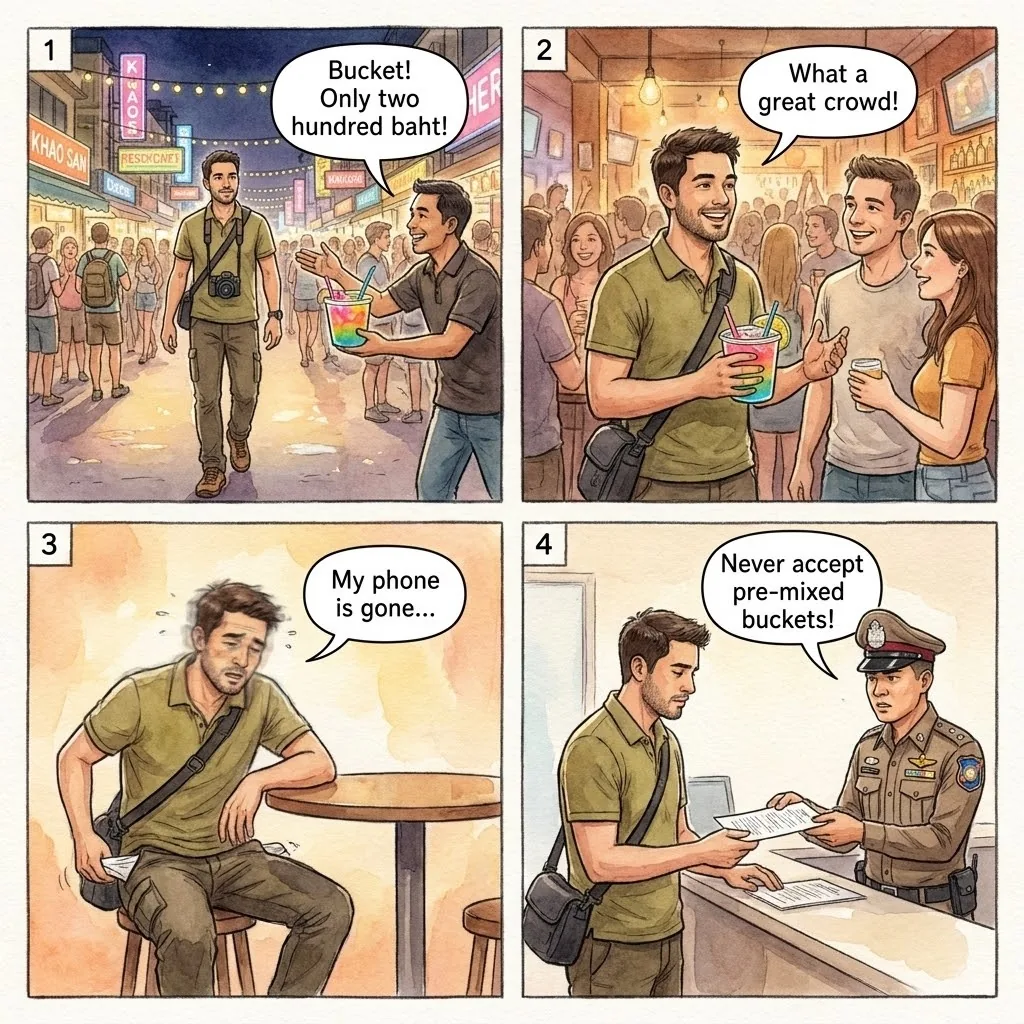
A Khao San bar at 1 a.m. offers buckets of rum-and-Red-Bull for ฿200 — you take two, wake up in a tuk-tuk with ฿19,500 missing, no phone, and four hours of memory gone. The bucket is the delivery vehicle: open-mixed and unwatched.
It's 1 a.m. on Khao San Road and a bar invites you in with small plastic buckets of rum-and-Red-Bull-and-cola for ฿200. The street is loud with EDM, neon, food stalls, backpackers from every continent. You take a bucket, then another, then chat with new friends from the next stool. Time stretches.
You wake up in a moving tuk-tuk somewhere east of Khao San with ฿19,500 missing from your wallet, your phone gone, and no memory of the last four hours. The active substance was almost certainly benzodiazepine (xanax-class) or GHB — both dissolve quickly, have no taste in a sugary spirit mixer, and cause memory loss within 20–40 minutes. The bucket is the key: unlike a bottled beer (tamperproof) or a bar-counter cocktail (watched), a bucket cocktail is mixed out of sight and delivered open.
Khao San hosts tens of thousands of backpackers nightly, and the party atmosphere is the perfect cover. Bangkok Metropolitan Police have run periodic sting operations in 2024–2025, but the scale of the street (300+ bars and vendors) means enforcement is inconsistent. A more common but lower-damage variant is the simple pickpocket — crowd density, music, and neon make pocket theft trivial: a stranger bumps you hard, a "friend" wraps an arm for a photo while their partner lifts your phone, a seller holds up trinkets at eye level while an accomplice works your pockets. Never accept a bucket cocktail — order bottled beer or cocktails mixed in front of you at the bar, watch your drink being made, and discard any drink you set down. Store passport and most cash in your hotel safe; carry only ฿1,000–฿2,000 and one card to Khao San.
Red Flags
- Open-container bucket cocktail delivered by someone you didn't watch mix it
- Your drink is left unattended for any period, even briefly
- A new 'friend' buys you drinks aggressively and insists you finish them
- Loud music combined with dense crowd pressure — ideal pickpocket environment
- You feel unusually drunk after one or two drinks, with symptoms (dizziness, memory gaps) disproportionate to alcohol alone
How to Avoid
- Never accept a bucket cocktail — order bottled beer or cocktails mixed in front of you at the bar.
- Watch your drink being made and keep it in your hand the entire time; discard any drink you set down.
- Travel in groups on Khao San — solo drinking here is the highest-risk scenario.
- Store passport, extra cards, and most cash in your hotel safe; carry only ฿1,000–฿2,000 and one card.
- If you feel suddenly drunk beyond your drinks, text a trusted contact your location and head to your hotel immediately; Grab is the safest exit.
🆘 What to Do If You Get Scammed
📋 File a Police Report
Go to the nearest Tourist Police station. Call 1155 (Tourist Police, 24/7 English) or 191 (General Police). Get an official crime report — you'll need this for insurance claims. You can also report online at touristpolice.go.th.
💳 Cancel Your Cards
Call your bank immediately. Most have 24/7 numbers on the back of the card (keep a photo saved separately). Block any suspicious transactions before the thieves use your details.
🛂 Lost Passport?
For passport replacement, contact the US Embassy Bangkok at 95 Wireless Road, Pathumwan, Bangkok 10330 (+66 2-205-4000, 24/7). In Chiang Mai, the US Consulate General is at 387 Witchayanond Road, Chiang Mai 50300 (+66 53-107-700). The UK Embassy is at 14 Wireless Road, Bangkok (+66 2-305-8333). The Australian Embassy is at 181 Wireless Road, Bangkok (+66 2-344-6300). Always call Tourist Police 1155 first — they speak English and will file the police report you need for passport replacement.
📱 Track Your Device
If your phone was stolen, use Find My (iPhone) or Find My Device (Android) from another device. Don't confront thieves yourself — share the location with police instead.
Sources & further reading
Every scam here is cross-checked against official government advisories, police bulletins, and established reporting. Confirm current details with the primary sources below before you travel.
-
U.S. Department of State — Thailand International Travel Information
Government advisory
“Other scams involving gems, city tours, entertainment venues, and credit cards are common, especially in tourist areas.”
-
Government of Canada (travel.gc.ca) — Thailand travel advice and advisories
Government advisory
“In scams involving gems and jewellery, merchants sell lower-quality items at inflated prices with promises that the items can be resold at a profit.”
-
UK Foreign, Commonwealth & Development Office (GOV.UK) — Thailand travel advice: Safety and security - GOV.UK
Government advisory
“Do not hand your passport over as a guarantee, for example to motorcycle or jet-ski rental businesses.”
-
The Thaiger — Top 10 scams in Thailand
News report
“After a couple of drinks, the woman will often make a sudden exit, leaving you with a large, inflated bill to settle.”
-
U.S. Embassy & Consulate in Thailand — Common Scams to Avoid
Government advisory
“Jet ski and scooter scams occur most often in popular beach destinations like Phuket and Pattaya.”
Frequently Asked Questions
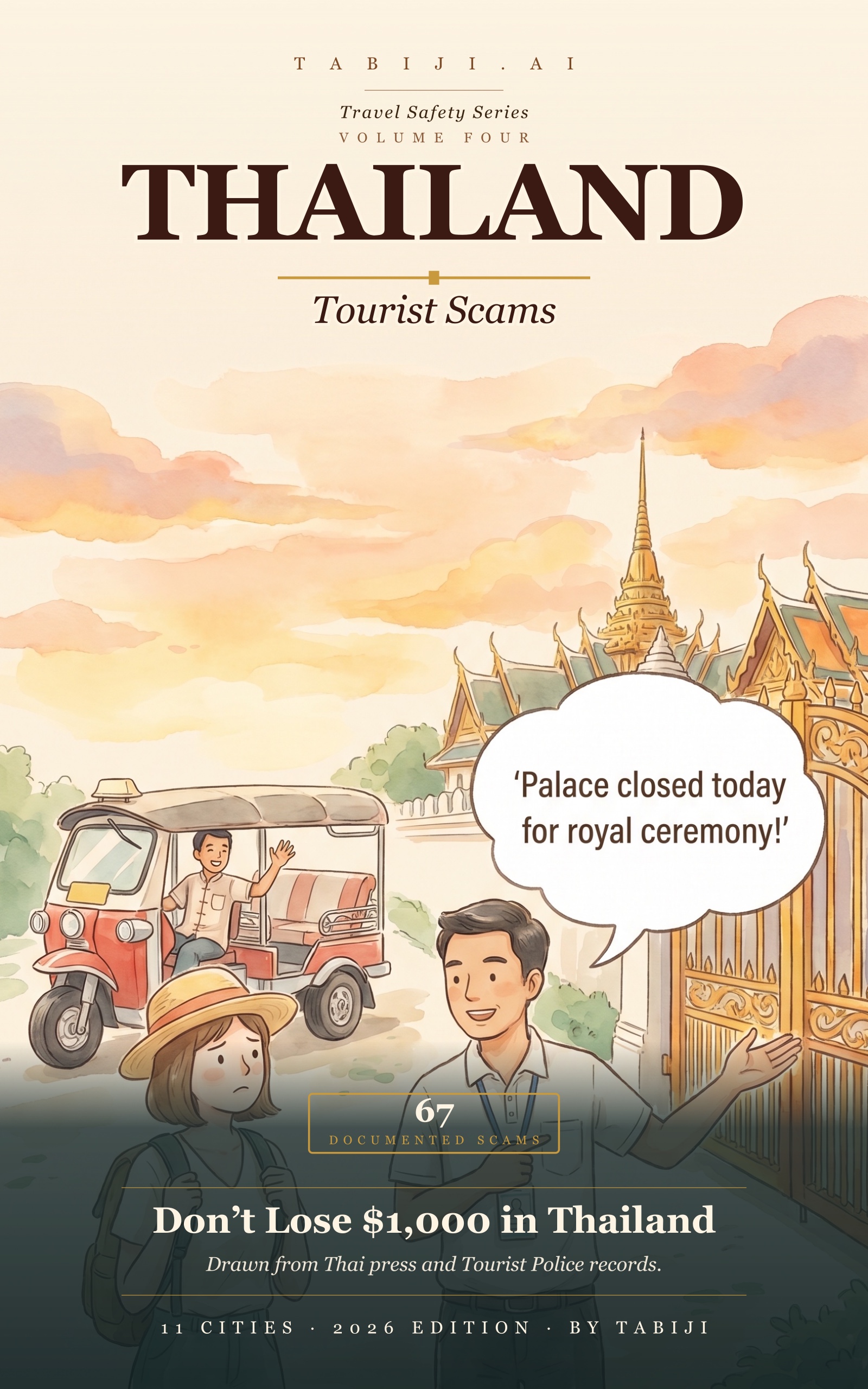
You just read 8 scams in Bangkok. The book has 59 more across 11 Thai destinations.
Bangkok's "Grand Palace closed today" tuk-tuk and gem-shop loop. Phuket's Patong jet-ski damage-deposit cycle. Chiang Mai's Doi Suthep kickback tours. Koh Tao's passport-hostage motorbike scratch racket. Every documented Thailand scam — with the exact scripts, red flags, and Thai phrases that shut each one down. Drawn from Bangkok Post, The Nation Thailand, Khaosod English, Thai PBS, and Tourist Police (1155) records.
- 67 documented scams across Bangkok, Phuket, Chiang Mai, Koh Samui & 7 more cities and islands
- A Thai exit-phrase card you can screenshot to your phone
- Updated annually — buy once, re-download future editions free
- Readable in one flight — $4.99 on Amazon Kindle