
Key Takeaways
- The #1 reported scam is the Bullring Pickpocket Team.
- Most scams in Birmingham are low-to-medium risk.
- Use app-based ride services (Uber, Bolt) or official metered taxis instead of unmarked vehicles.
- Never accept unsolicited offers from strangers near tourist sites in Birmingham.
⚡ Quick Safety Tips
- Exit Birmingham New Street or Grand Central straight into the station retail area — ignore sob-story beggars who claim 'need train fare': 'Anyone approaching you on the street. Ignore don't engage. Even charity. You don't do street donations.'
- In the Jewelry Quarter, avoid the large retail-facing 'big shops' names Eric's and Bicknells as retailer-markup venues; walk into the Warstone Lane / Vyse Street workshops for manufacturer-direct pricing (30-50% cheaper for equivalent gold/diamond quality).
- In the Balti Triangle (Sparkbrook), visit community-recommended restaurants (Adil's, Shababs, Al Faisals) rather than the tourist-hyped 'authentic Balti experience' venues; £10-£15 curry + rice + naan is the honest price.
- Verify Uber/private-hire surge pricing before confirming documents Birmingham-specific surge patterns around New Street during strikes, concerts, events; black-cab metered fares often cheaper during surges.
- Birmingham is actually LESS prone to pickpocket teams than London or Manchester — 'Pickpockets are unheard of' per locals; the real tourist scam risks are station beggars and JQ retailer markup.
Jump to a Scam
The 4 Scams
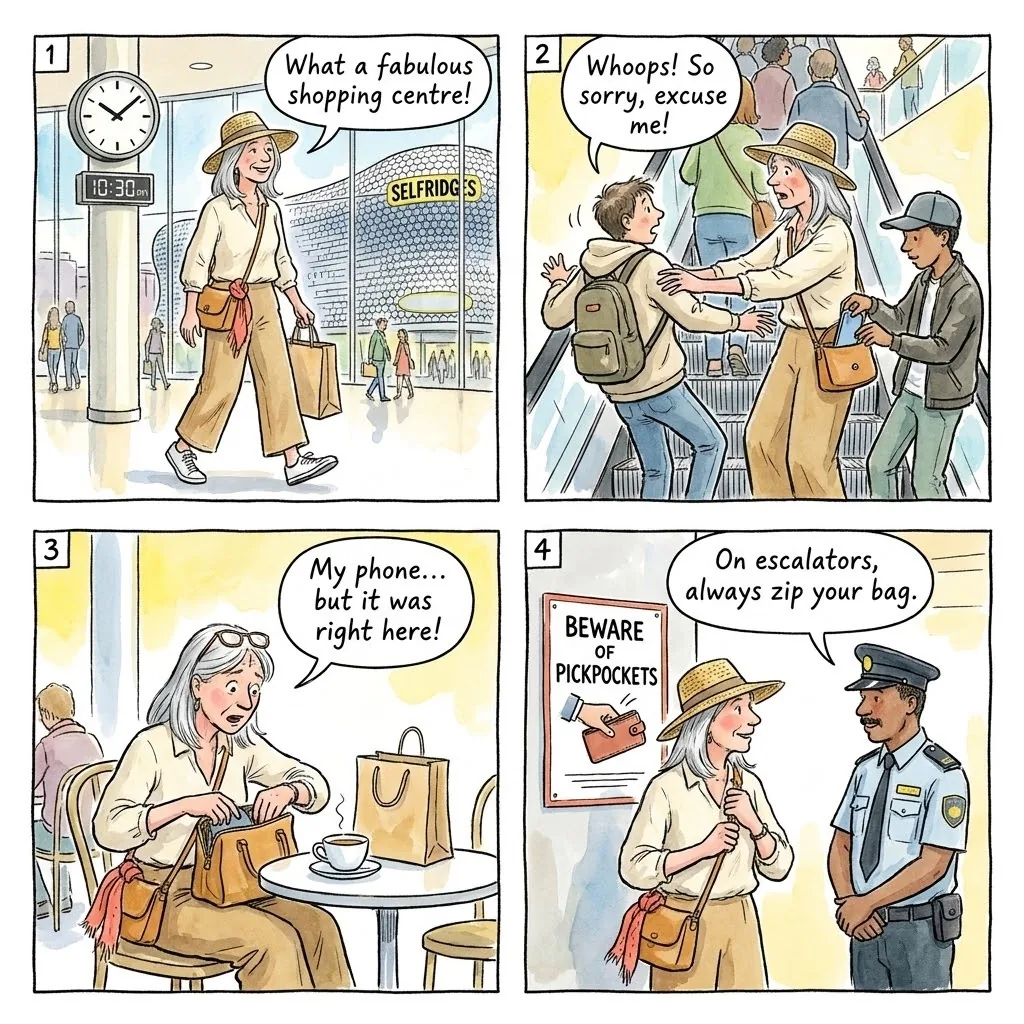
Coordinated pickpocket teams at the Bullring shopping center use a bump-and-press technique — one person stumbles into you from the front while a partner lifts your phone or wallet from behind in the confusion — a method documented by West Midlands Police across at least six incidents in 2024.
The Bullring is one of the UK's busiest retail destinations, connected directly to Birmingham New Street Station's main concourse and drawing tens of millions of shoppers annually. The ground-floor escalators, narrow aisles between shops, and Saturday peak crowds create exactly the controlled congestion that professional pickpocket teams look for: high density, limited personal space, and social norms that discourage pushing back when someone bumps into you.
The technique is precise. One team member approaches from the front and stumbles or presses against you — creating a moment of distraction and direct contact — while a second, working from behind, lifts your phone from a jacket pocket, removes a wallet from a back pocket, or reaches inside an unzipped bag. The interaction takes two to three seconds. West Midlands Police documented an international gang operating this method at the Bullring throughout 2024; CCTV captured at least six separate incidents before three members were convicted at Birmingham Magistrates Court in April 2025.
The physical defense removes the opportunity before the technique can work. Keep your phone in a zipped front pocket or a bag worn in front of your body when inside the Bullring or on its escalators, and check all your pockets immediately after any physical contact that felt unnecessary or deliberate. During the Christmas German Market season — when the Bullring reaches peak density — apply this posture throughout the visit. Report suspicious group behavior to Bullring security or call West Midlands Police on 101; the center has extensive CCTV and acts on pickpocket reports.
Red Flags
- A group of two or more people crowd you unnecessarily on escalators or in narrow aisles
- Someone bumps into you or stumbles into your path for no obvious reason
- A person drops something in front of you, forcing you to stop while others press close behind
- You feel a light tug on your bag or jacket pocket during the commotion
- The group disperses quickly in different directions after the contact
How to Avoid
- Keep your phone in a zipped front pocket rather than a back pocket or open bag when in the Bullring.
- Wear backpacks on your front in crowded areas of the shopping center.
- Be extra vigilant during the Christmas German Market season when the Bullring is at peak capacity.
- If someone bumps into you, immediately check all your pockets and bags before moving on.
- Report suspicious group behavior to Bullring security or West Midlands Police.
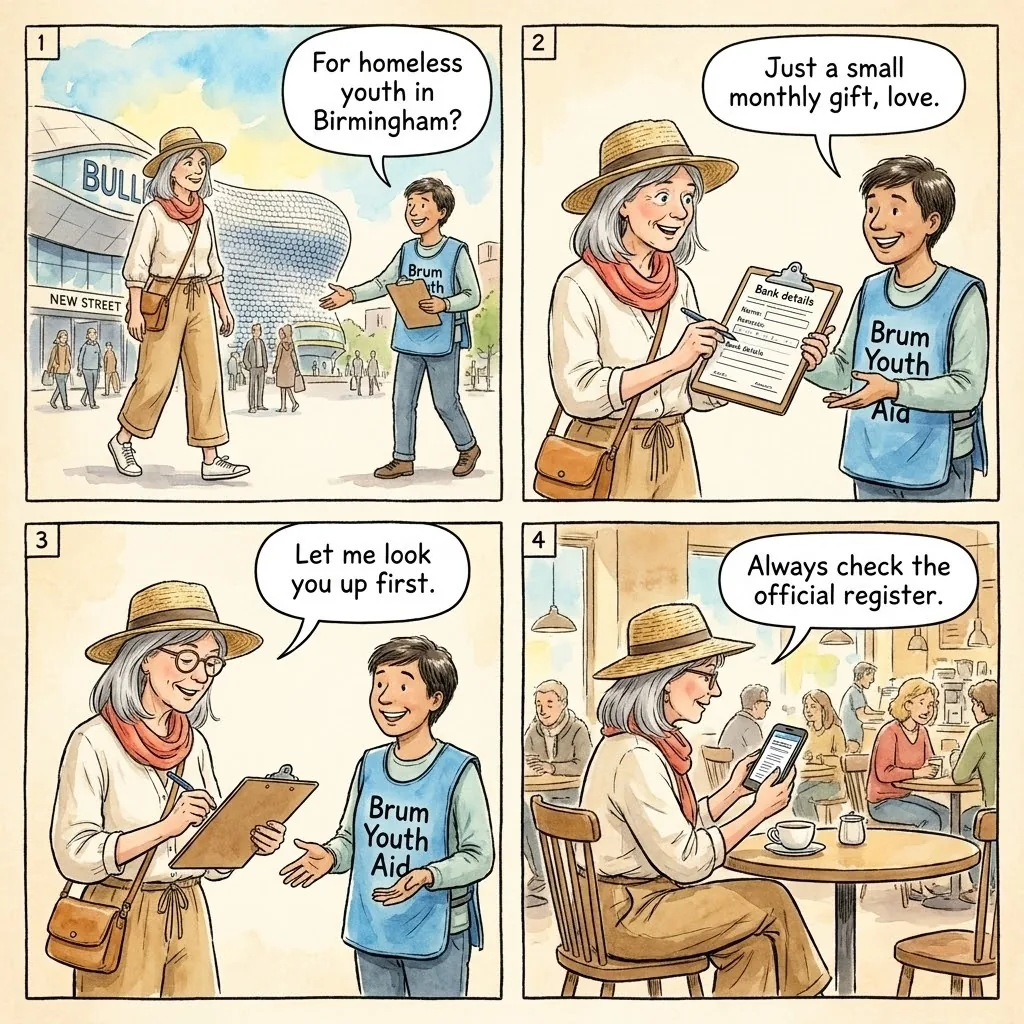
Fake charity collectors working Corporation Street and the area outside Birmingham New Street Station use official-looking bibs and fabricated charity names to collect bank details and direct-debit sign-ups from passersby — the money reaches no charitable cause and the details are used for unauthorized withdrawals.
New Street, Corporation Street, and the pedestrian area immediately outside Birmingham New Street Station see some of the highest foot traffic in the city, with commuters and visitors passing through the same stretch from morning to evening. Legitimate licensed street collectors do work this corridor — the density makes it productive — which gives fraudulent operators visual cover: a bib, a clipboard, and a printed charity logo are enough to appear credible to someone walking past in a hurry.
The fake collector approaches with a practiced emotional pitch about homeless youth or local crisis services, but unlike a cash donation request, they ask you to set up a monthly direct debit by handing over your bank account number and sort code. The charity name on the bib is one you've never heard of, or a close misspelling of a recognized name. As Action Fraud documents, these details are used for unauthorized direct debit submissions that can run for months before the victim notices. Legitimate collectors in Birmingham are required to display a local authority street collection permit; fraudulent ones cannot produce it.
The ask itself is the clearest signal — no legitimate street collection requires your bank details handed to a stranger on a pavement. Never provide bank account details or set up a direct debit on the street; if you want to donate, go directly to the charity's official website or verify the collector's registration number on the Charity Commission website before engaging. Ask any collector for their council-issued street collection permit. Report suspected fake collectors to Action Fraud at actionfraud.police.uk or on 0300 123 2040.
Red Flags
- The collector asks for bank details or direct debit information rather than a simple cash donation
- The charity name is unfamiliar and the collector cannot provide a registered charity number
- They use high-pressure emotional stories and guilt tactics to prevent you from walking away
- The collector does not have a local authority street collection permit visible
- Multiple collectors work the same area in coordinated shifts
How to Avoid
- Never give bank details or set up direct debits on the street -- donate online through verified charity websites.
- Ask for the charity's registration number and verify it on the Charity Commission website before donating.
- Legitimate charity street collectors in Birmingham must have a council-issued permit displayed visibly.
- If you want to support a cause, donate directly through birmingham.gov.uk's recommended charities page.
- Report suspected fake collectors to Action Fraud at actionfraud.police.uk or call 0300 123 2040.
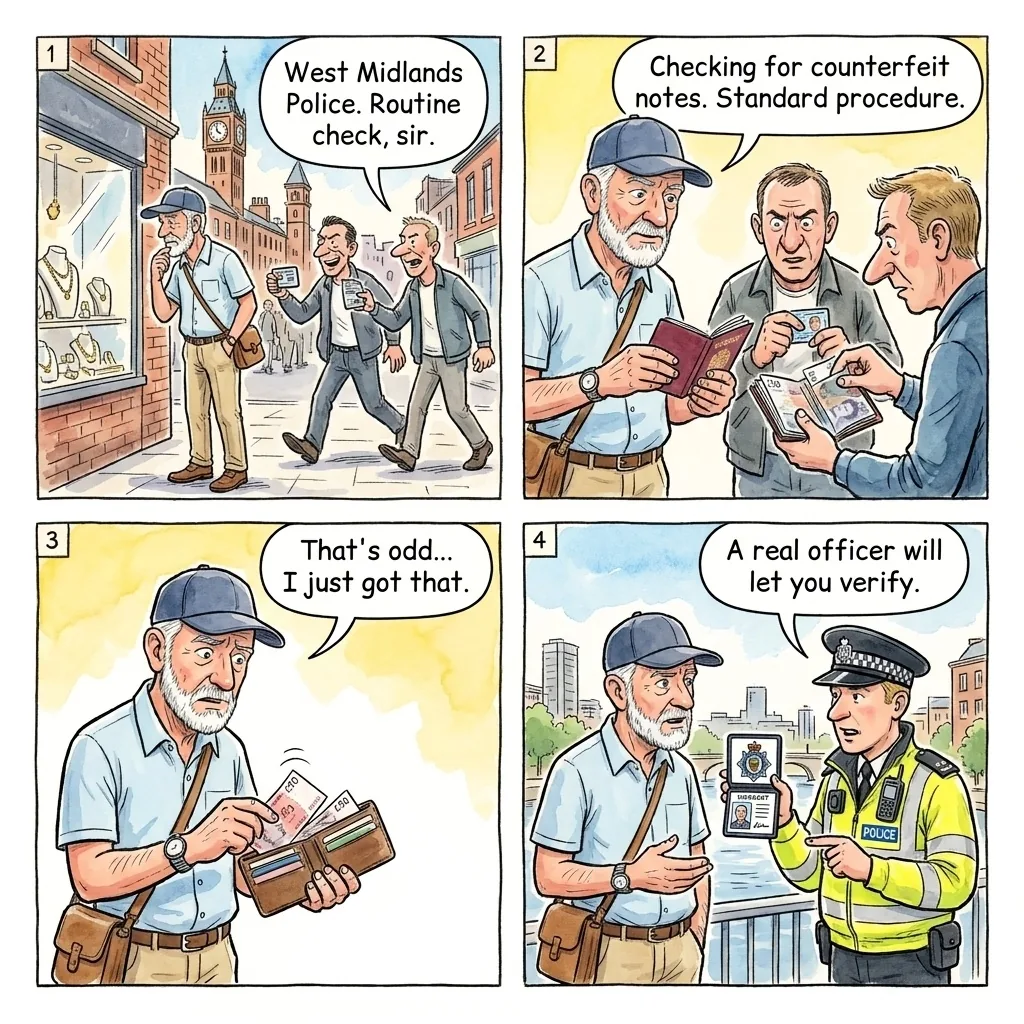
Two men in plain clothes near Birmingham's Jewelry Quarter and Broad Street flash fake police warrant cards, demand to inspect your passport and wallet for a "counterfeit currency check," then hand your wallet back with £50–£100 removed — real UK officers never ask to handle your cash.
The Jewelry Quarter is one of Birmingham's most-visited tourist districts, a compact historic area west of the city center known for independent jewelers and Victorian workshops. Broad Street's nightlife strip draws its own evening concentration of visitors unfamiliar with UK policing norms. Both areas share a feature that makes this scam workable: pedestrian density is moderate rather than tourist-dense, so an official-seeming approach feels credible and passes with fewer witnesses than it would on a crowded shopping street.
Two men in plain clothes approach, flash what appear to be police warrant cards too quickly for you to read the officer's name and collar number, and explain it is a routine check for counterfeit currency. One takes your passport while the second handles your wallet, counting notes aloud. When they hand the wallet back, somewhere between £50 and £100 has been palmed. They move away before you've had time to recount. Real plainclothes officers always state their name, rank, and collar number — and do not ask to handle your cash or inspect your wallet on the street.
Knowing what real UK police actually do is the complete defense. Ask any plainclothes person claiming to be police for their name, rank, and collar number, and tell them you would like to verify their identity by calling 101 — real officers will pause the encounter; fake ones will leave. Offer to carry your own documents rather than handing them over, and suggest walking to the nearest police station together if they insist. Carry a photocopy of your passport rather than the original when exploring the Jewelry Quarter.
Red Flags
- Plainclothes individuals ask to see your passport and wallet simultaneously
- They flash a badge too quickly for you to read the officer's name and number
- They ask to handle your cash or credit cards to check for counterfeits
- The encounter happens in a quiet area away from CCTV cameras
- They become impatient when you ask to verify their identity or call 101
How to Avoid
- Real UK police officers will always give their name, rank, and collar number -- ask for all three and write them down.
- You have the right to ask officers to verify their identity by calling 101 (the non-emergency police number).
- Never hand your wallet to anyone on the street -- real police do not ask to inspect your cash.
- If approached by supposed plain-clothes officers, suggest walking to the nearest police station together.
- Keep a photocopy of your passport in your hotel and carry only the copy when exploring.
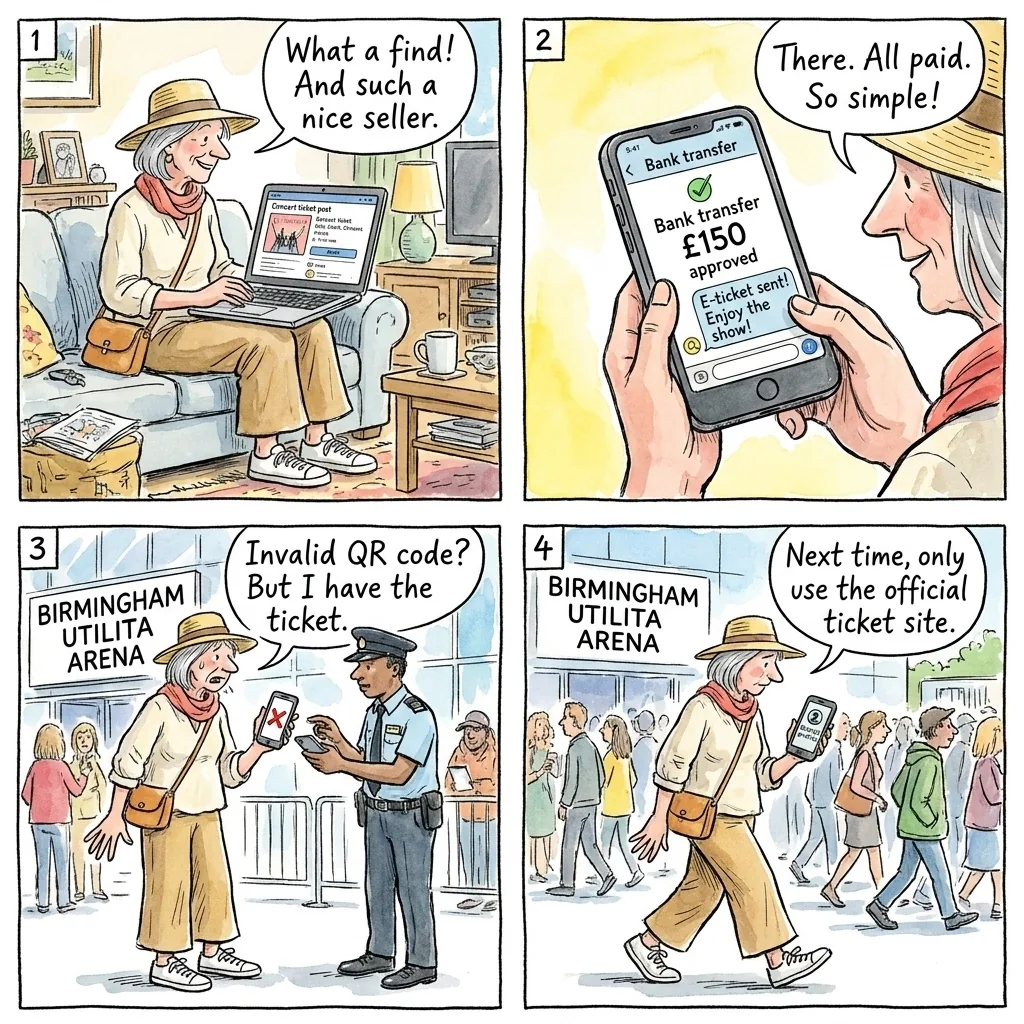
Social media listings targeting sold-out events at Birmingham's Utilita Arena, NEC, and O2 Academy sell fabricated or multiply-resold e-ticket screenshots for £100–£200 via bank transfer — Action Fraud recorded over £1.6 million in UK concert ticket fraud losses in 2024, with nearly half originating from social media marketplaces.
Birmingham's Utilita Arena, the NEC, and the O2 Academy collectively host some of the UK's largest touring acts, and sold-out events at these venues generate immediate secondary market demand. Facebook Marketplace, Instagram DMs, and X listings for sold-out shows appear within minutes of official box-office sell-outs, targeting fans who missed the original sale and are prepared to pay a modest premium to attend an event they want to see.
The seller's profile looks credible — a real photo, some post history, a plausible explanation for why they can no longer attend. They share a screenshot of the e-ticket with a scannable QR code and request payment via bank transfer, typically explaining they can't use PayPal or a protected platform. You transfer £150 and receive the ticket image. On the night of the show, the QR code is rejected at the gate: it was either the seller's own ticket already used or refunded through official channels, a fabricated image, or the same ticket sold to multiple buyers. Action Fraud's 2024 data places UK concert ticket fraud losses at over £1.6 million, with nearly half traced to social media listings.
The payment method is the single most reliable signal of fraud. Buy resale tickets only through official platforms — Ticketmaster Resale, StubHub, or Twickets — that guarantee the ticket's authenticity and refund you if the QR code fails at the gate, and treat any request for a direct bank transfer as an immediate disqualification regardless of how genuine the seller appears. For high-demand Birmingham events, set up Ticketmaster onsale alerts before the official sale date rather than chasing social media listings afterward. Report suspected ticket fraud to Action Fraud at actionfraud.police.uk or on 0300 123 2040.
Red Flags
- The seller insists on payment via bank transfer rather than through a protected platform
- The price is only slightly above face value to seem reasonable rather than suspiciously cheap
- Screenshots of tickets can be easily fabricated or the same ticket can be sold to multiple buyers
- The seller has a new social media account with little post history
- They pressure you to buy quickly because others are interested
How to Avoid
- Buy resale tickets only through official platforms like Ticketmaster Resale, StubHub, or Twickets which guarantee authenticity.
- Never pay for event tickets by bank transfer -- use credit card or PayPal for buyer protection.
- Verify the seller's identity and check for reviews or vouches from other buyers before purchasing.
- If a show at the NEC or Arena is sold out, check the venue's official resale or returns page first.
- Report ticket scams to Action Fraud at actionfraud.police.uk with all seller details and transaction records.
🆘 What to Do If You Get Scammed
📋 File a Police Report
Go to the nearest West Midlands Police station. Call 999 (emergency) or 101 (non-emergency). Get an official crime report — you'll need this for insurance claims. You can also report online at west-midlands.police.uk.
💳 Cancel Your Cards
Call your bank immediately. Most have 24/7 numbers on the back of the card (keep a photo saved separately). Block any suspicious transactions before the thieves use your details.
🛂 Lost Passport?
Contact your nearest embassy or consulate. The US Embassy is at 33 Nine Elms Lane, London SW11 7US. For emergencies: +44 20 7499 9000.
📱 Track Your Device
If your phone was stolen, use Find My (iPhone) or Find My Device (Android) from another device. Don't confront thieves yourself — share the location with police instead.