
⚡ Quick Safety Tips
- Never enter a bar on Sri Don Chai Road, Loi Kroh Road, or any venue where a tout is standing outside recruiting — the July 2025 Diamond Karaoke assault (9 staff charged) happened after a British tourist followed a street invite.
- Never hand over your original passport to a scooter rental shop — offer 3,000–5,000 baht cash deposit instead and photograph every panel before driving off (13,500+ baht damage claims are standard).
- Any tuk-tuk driver who tells you a temple is 'closed for cleaning' is running the gem shop tour scam — Wat Chedi Luang and Wat Phra Singh are never closed mid-day.
- Yi Peng lantern festival tickets: only khomloy.com is the official CAD Khomloy event — all other 'premium' ticket sites at $200–$450 are scams or gutted experiences.
- Save Chiang Mai Tourist Police at 053-247-318 (Charoen Rat Road) and the national hotline 1155 — they respond to bar extortion and passport-hostage cases and speak English.
Jump to a Scam
- High Tuk-Tuk Gem Shop Tour
- High Sri Don Chai Karaoke Bill Extortion
- High Scooter Rental Passport-Hostage Damage Charge
- High Tailor Shop Bait-and-Switch
- Medium Fake Elephant Sanctuary
- Medium Yi Peng Lantern Festival Ticket Fraud
- Medium Grab / Bolt Cancel-and-Pay-Cash Switch
- Low Fake Monk Donation Request
The 8 Scams
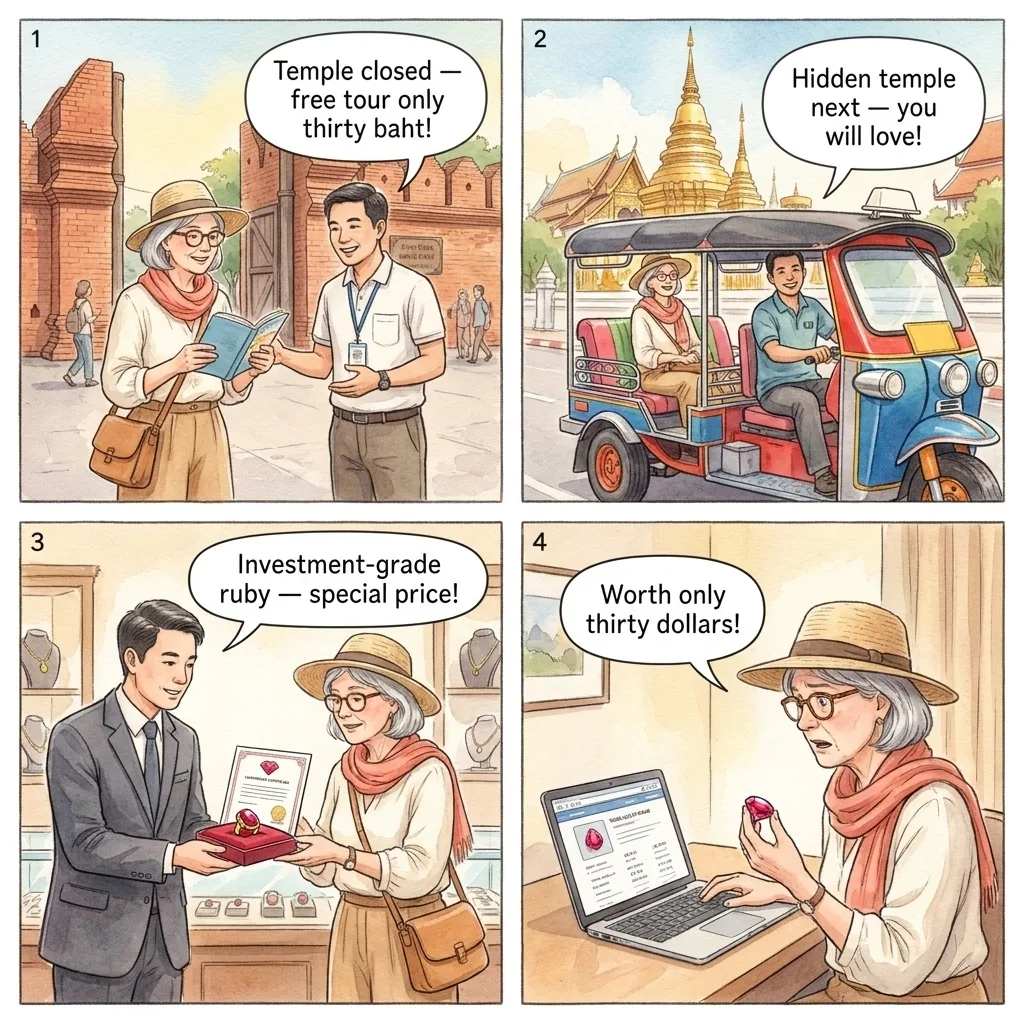
A "20-baht tuk-tuk" driver near Tha Phae Gate claims your destination temple is "closed for cleaning" and steers you to a gem shop where high-pressure sales staff pitch "investment-grade Thai sapphires and rubies" at 3× resale-value lies — shop owners pay drivers 200–400 baht per delivered tourist, and the scam has run on a daily rotation for decades.
You're standing near Tha Phae Gate with your camera out, admiring the 700-year-old moat, when a cheerful tuk-tuk driver pulls up and tells you the temple you were heading to — Wat Chedi Luang, just a block away — is 'closed for cleaning' until 3 PM. But lucky you, he knows a special temple that only locals visit, and since he's waiting anyway, he'll take you for just 20 baht. The story is convincing and the price is absurd. You climb in. The temple is lovely — but after five minutes your driver mentions his 'cousin' runs a gem shop just nearby, and since he gets fuel credit for bringing tourists, it costs you nothing to look.
Inside the air-conditioned shop, well-dressed staff pour you cold water and begin a polished presentation about Thai sapphires and rubies — 'certified investment grade,' they say. The pressure builds slowly. One staffer produces paperwork suggesting gems can be resold in your home country at three times the price. Traveler reports describe the identical psychological sequence — a stranger, a closed temple, a tuk-tuk, and eventually a shop where you spend far more than you planned — across hundreds of forum posts going back years. When you try to leave without buying, the tuk-tuk driver materializes and suddenly the 'free ride' comes with a price.
The machine is industrial: shop owners pay drivers 200–400 baht per customer delivered whether you buy or not, and multiple tuk-tuks cycle through Tha Phae Gate on a daily rotation. Veteran travelers describe deliberately taking the ride just to see how the scam unfolds because the script is so consistent — same closed-temple opener, same "cousin's shop," same investment-grade pitch — that the operation has clearly been coordinated for decades. Local Thai sources confirm the scam is run by a network rather than individual drivers, and it still catches visitors every week despite being one of the most-documented tourist traps in Thailand.
Red Flags
- Driver volunteers unprompted that your destination temple is 'closed' or 'has a special ceremony' today
- An unusually cheap or free tuk-tuk ride is offered anywhere near the Old City moat or Tha Phae Gate
- Driver steers conversation toward gems, jade, or 'Thai rubies' being exceptional investment value
- Shop staff produce official-looking certificates and claim gems resell for 3x price abroad
- Polished sales pitch with cold drinks in a suspiciously nice shop in an otherwise humble neighborhood
How to Avoid
- Verify temple hours on Google Maps before asking any tuk-tuk driver — Wat Chedi Luang, Wat Phra Singh, and Wat Phan Tao have never been 'closed for cleaning' mid-day.
- Never accept a 'free' or heavily discounted tuk-tuk ride that involves a stop at any shop.
- If you want gems, buy from reputable vetted shops on Wualai Road (Silver Street) during the Saturday Walking Street, not from anywhere a driver leads you.
- Use Grab or Bolt for transport — the app route prevents mid-ride detours and the fare is fixed.
- Say 'mai ao, khop khun' (no thank you) firmly and walk away — the 'closed temple' story collapses under 10 seconds of pushback.
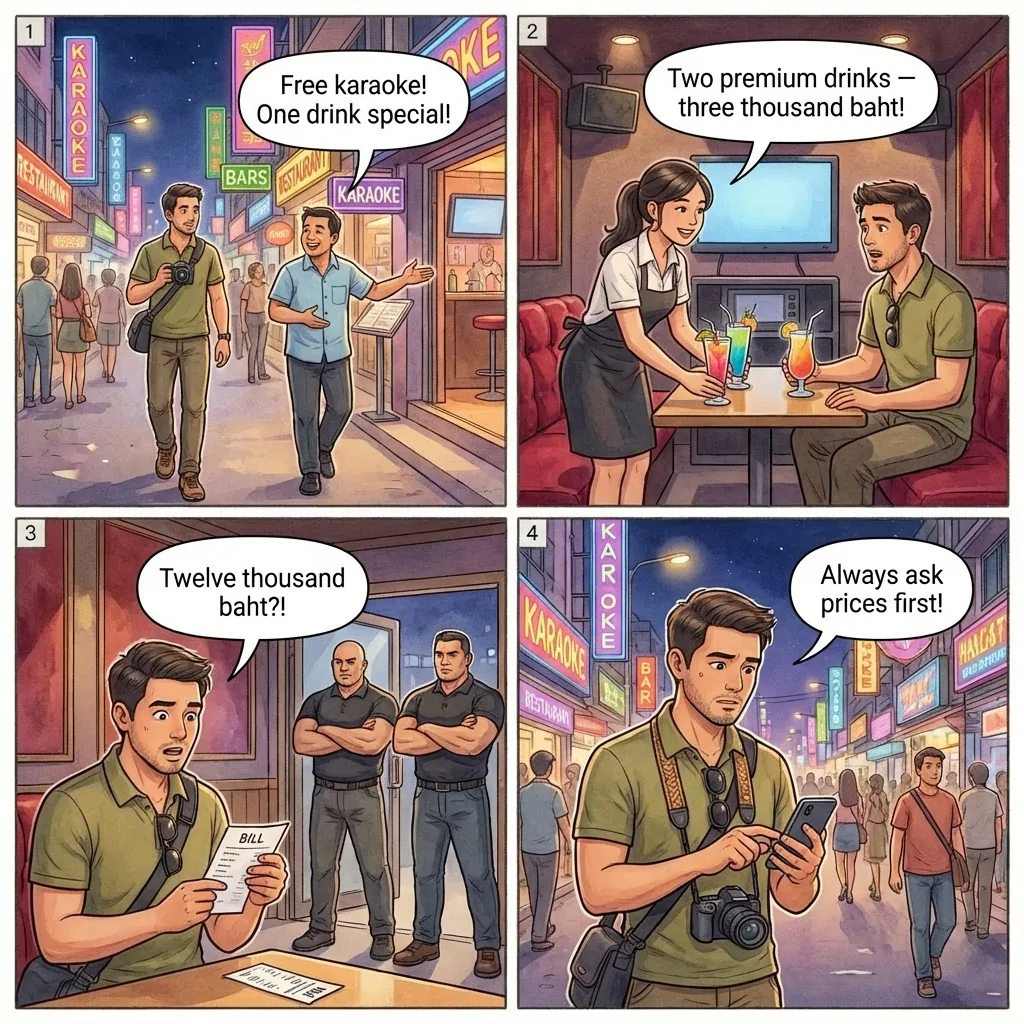
Sri Don Chai Road karaoke bars (Diamond, "67 bar," Pink Lady — same address cycling through names for 10+ years) hand tourists 20,000–160,000 baht surprise bills with 2,000–5,000 baht "host charges" per drink — and when you refuse, staff physically restrain and assault you, including the July 2025 incident where 9 employees beat a British tourist on the street.
On July 16, 2025, a 27-year-old British tourist spent the night at Diamond Karaoke Bar on Sri Don Chai Road in Chiang Mai's Chang Khlan subdistrict — two blocks from the Night Bazaar where hundreds of tourists shop every evening. When he tried to leave around 6:20 AM, staff handed him a bill for over 20,000 baht (roughly £460 / $615). When he disputed it and attempted to walk out, nine bar employees physically restrained him, dragged him onto the street, and kicked him repeatedly while a crowd watched. Nine staff members aged 18–28 were later arrested, charged with joint assault, and the venue was shut down for operating without a license and serving alcohol past legal hours. The incident made international news — The Sun, Metro, and VnExpress International all ran the video footage.
What makes this scam particularly dangerous in Chiang Mai is that it's not one rogue venue — the same Sri Don Chai Road address has cycled through names for over a decade, with travelers warning in November 2025 that the current incarnation called "67 bar" was extorting tourists for 50,000+ baht and assaulting those who refused. In 2018, a Korean tourist was forced to pay 160,000 baht at another Chiang Mai karaoke bar according to Coconuts Bangkok. In 2015, Bangkok Post reported a similar venue called "Pink Lady" was closed for tourist rip-offs. The address changes owners; the scam doesn't.
The operating pattern is consistent: touts outside invite you in with vague promises of karaoke or hostess service, no printed menu is visible, drinks arrive faster than ordered, a "host charge" and "service fee" of 2,000–5,000 baht per drink is applied to your final bill, and when you object, staff block the exit. Traveler reports describe further recent incidents at adjacent Sri Don Chai and Loi Kroh Road venues — typical signals are "girls sitting outside" recruiting passersby, and venues with no Google Maps presence or only a recent listing with thin reviews.
Red Flags
- A tout outside invites you in for karaoke, 'ping pong,' or cheap drinks — legitimate Chiang Mai bars do not need street recruiters
- Venue has no Google Maps listing with real reviews, or listing exists but has a pattern of 1-star assault warnings
- No printed menu with prices is visible at the entrance or on the table
- Hostesses or staff order drinks for you without asking — each bottle is a separate 1,500–5,000 baht charge
- Venue is on Sri Don Chai Road, Loi Kroh Road, or nearby alleys of the Night Bazaar, and occupies an address with name changes in the last 2–3 years
How to Avoid
- Before entering any bar in Chiang Mai, pull up Google Maps and check it has at least 50 recent reviews and no assault-related 1-star warnings.
- Never enter a bar at the suggestion of someone who approached you on the street — this is the single most reliable predictor of a scam venue.
- Stick to well-known bar districts with transparent pricing: Nimmanhaemin Soi 1/7/9, the North Gate jazz area, and Tha Phae East Gate rooftops.
- If you end up inside and realize the trap, call the Chiang Mai Tourist Police at 053-247-318 or the national hotline 1155 — they have English-speaking staff and have responded to Sri Don Chai venue complaints before.
- Keep most of your cash and all of your cards at your hotel if you're going out at night; carry only 1,500–2,000 baht you can afford to lose.
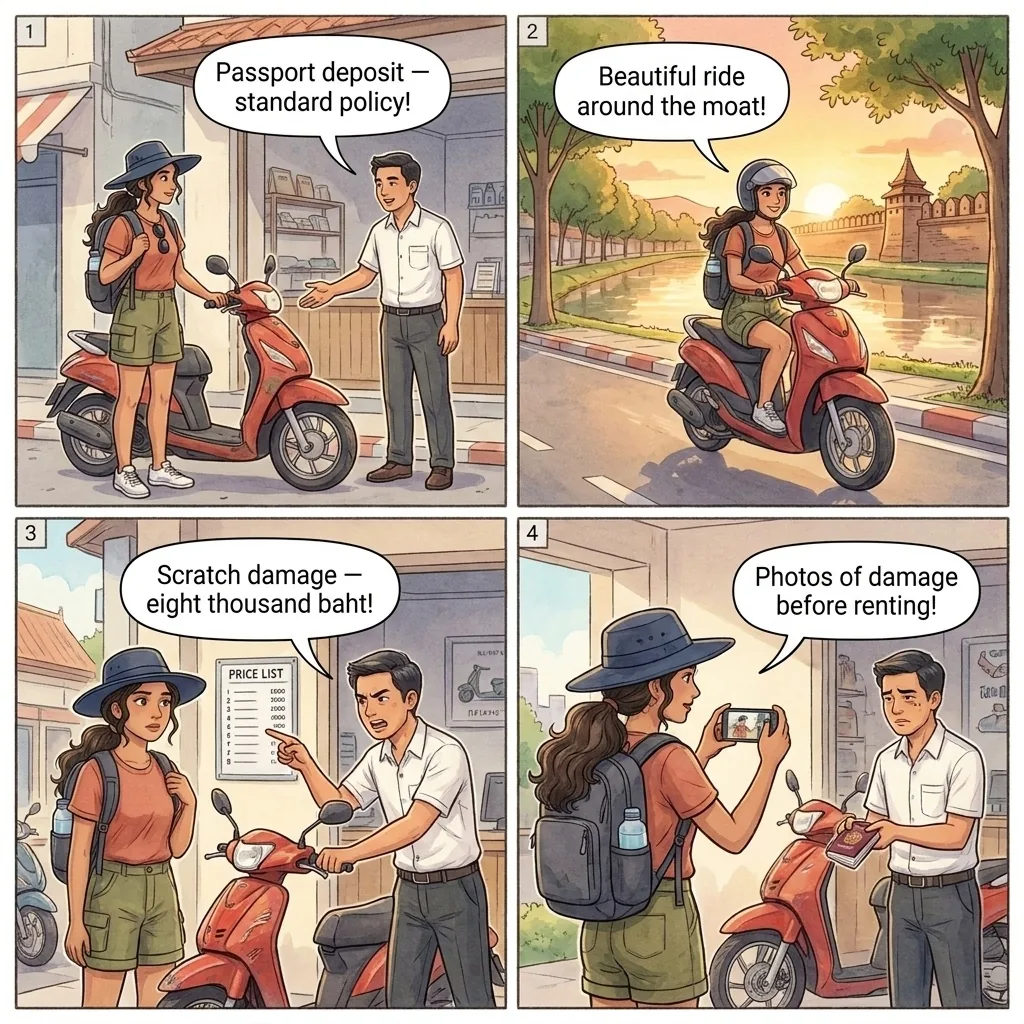
Tha Phae Gate scooter rental shops hold your actual passport as "deposit," then "discover" cosmetic scratches on return and demand 10,000–13,500 baht for repairs that cost 800–1,500 baht at a real Thai shop — and your passport stays locked in their drawer until you pay, with mandatory Thai "Por Ror Bor" insurance covering only third-party injury, never cosmetic damage.
You rent a 125cc Honda Click from a shop just inside Tha Phae Gate for 200 baht per day. The owner asks for your passport as a 'deposit' — which feels wrong, but every shop on the block does it and you're eager to get riding. You have a great week exploring Doi Suthep, Sticky Waterfalls, and the Samoeng Loop. When you return the bike, the owner's wife kneels down, runs her finger along the underside of the fairing, and points to a hairline scratch neither of you can be sure wasn't there before. The repair estimate: 13,500 baht. Your passport is in a locked drawer in the back office. You pay because you have a flight in 36 hours.
The damage claims are always more than the bike would actually cost to repair in Thailand (a full fairing respray is 800–1,500 baht at a real shop), and they always focus on cosmetic scratches, never mechanical issues. The passport-retention leverage is the entire mechanism: with your passport locked away, you can't board a flight, can't check into a hotel, and can't refuse the inflated bill. Detailed traveler-forum FAQs explicitly warn first-time Chiang Mai renters never to hand over the actual passport, but shops pressure new renters hard and accept nothing less.
The most dangerous variation happens when the shop rents you a scooter that already has damage they haven't told you about and that you didn't photograph. Some shops rent the same "already-damaged" bike to a dozen tourists a year and collect 10,000+ baht from each. Even honest-seeming shops will charge for "rental days while the scooter is at the repair shop" — another 1,000–3,000 baht added on top of the damage claim. Thai mandatory vehicle insurance ("Por Ror Bor") only covers third-party injury, not cosmetic damage, so you have no insurance fallback.
Red Flags
- Shop insists on holding your actual passport (not a photocopy) as deposit — every major Chiang Mai guidebook warns against this
- Owner does not conduct a written, photographed pre-rental damage inspection with you and hand you a signed copy
- Damage 'discovered' on return is on the underside, rear fairing, or other hidden area you couldn't have seen during the ride
- Repair quote is dramatically above real Thai workshop prices (a full fairing respray is 800–1,500 baht)
- Shop refuses to return your passport until you pay in cash — no receipt offered, no credit card accepted
How to Avoid
- Never hand over your original passport — offer a 3,000–5,000 baht cash deposit instead and a photocopy; walk away from shops that refuse (Mango Bikes, Tony's Big Bikes, and POP Big Bike are repeatedly recommended on traveler reports for accepting cash deposits).
- Before you drive off, photograph every panel of the scooter and the odometer, date-stamped, from multiple angles; email the photos to yourself so they're timestamped off-device.
- Walk the bike around the shop and point out every existing scratch out loud — make the owner acknowledge it verbally on video if possible.
- If damage is claimed on return, get an independent repair quote at a Honda or Yamaha dealership before paying — real repairs are a fraction of the claimed cost.
- If the shop refuses to return your passport, call the Tourist Police at 1155 immediately — they have responded to passport-hostage cases in Chiang Mai and the shop usually folds at the word 'police.'
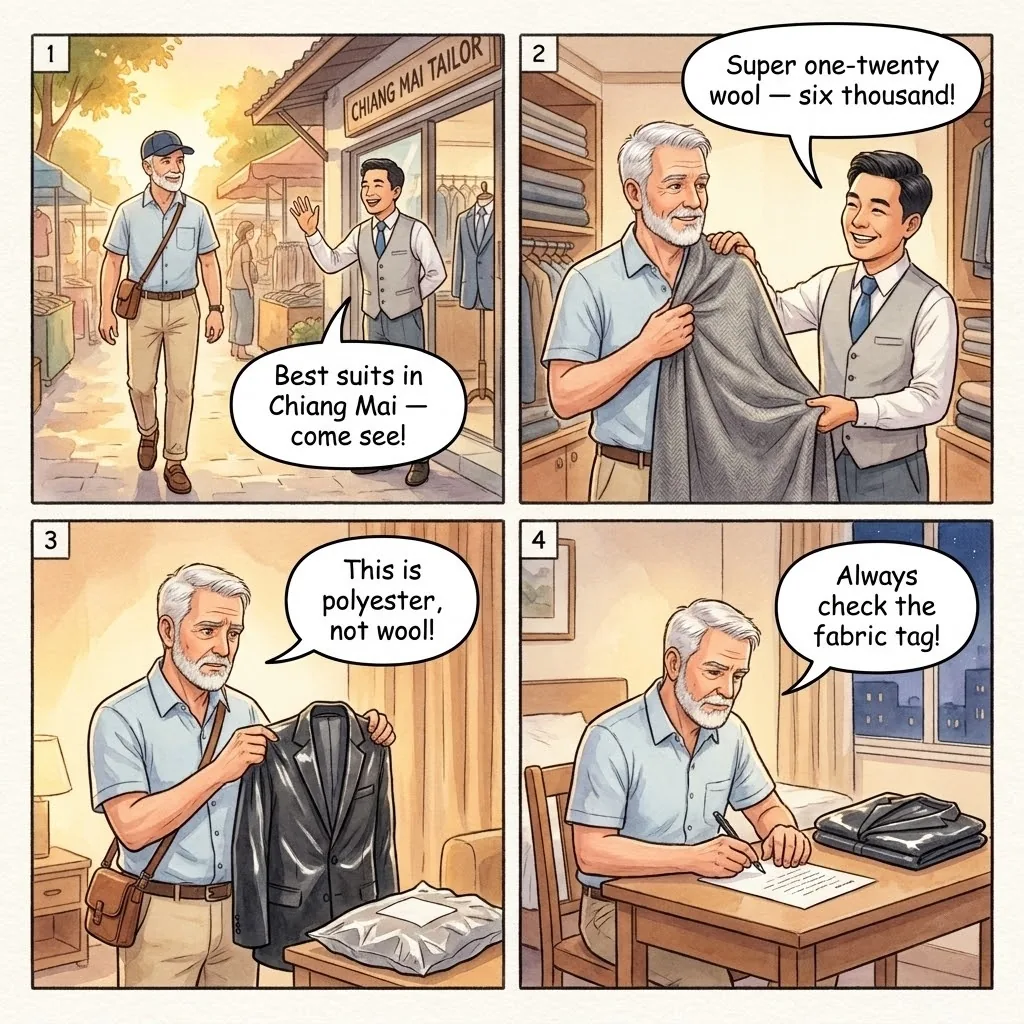
Night Bazaar street touts steer tourists to "Tony Tailors," "Tom Tailor," or "Siam Tailor" with €2,500-baht "custom suit" quotes — the suits arrive day three with polyester lining instead of silk, plastic buttons painted to look like horn, and shoulders that don't sit, after the delivery window has been pushed past your flight date so you can't demand corrections.
Walking through the Night Bazaar area on Chang Klan Road, you're approached by a well-dressed man holding fabric swatches. He mentions, casually, that a friend of his just picked up two suits here for a wedding and the work was beautiful. He walks you to a shop two streets over — or sometimes into a shop called "Tony Tailors," "Tom Tailor," or "Siam Tailor," all of which have been named specifically as scam shops by traveler reports across multiple forum threads. The tailor is polished, takes your measurements, and quotes you 2,500 baht for a custom suit. You're delighted. You pay the 1,000 baht deposit and come back the next morning for a fitting.
The first fitting looks rough but passable — "the stitching will be finished tomorrow," the tailor says. Collection day three: the suit has polyester lining despite your specified silk, the shoulders don't sit, and the buttons are plastic painted to look like horn. You paid tourist prices for Primark-grade goods. Traveler reports document customers who donated both finished suits because the workmanship was so bad to wear. The pattern fits Thailand's most elaborate scam template: a stranger who claims to have just flown in from Bangkok to buy suits is a classic shill plant, and the same script gets copied verbatim from Bangkok tailors to Chiang Mai venues every year.
The scam relies on three ingredients: a stranger who steers you to a specific shop (not "a recommendation" but a direct escort), a second fake customer inside vouching for the place, and a delivery window that pushes past your flight date so you can't return for corrections. Legitimate Chiang Mai tailors do exist — Sangthai Custom Tailor on Chotana Road and Harrods (no relation to London) on Chang Klan are repeatedly recommended for honest work — but they advertise with price lists outside, don't use street touts, and start at 5,000–7,000 baht for a proper suit. Anything under 3,000 baht for a "full wool suit, lined" is mathematically impossible given Thai fabric costs.
Red Flags
- A stranger approaches in the Night Bazaar area and specifically recommends or walks you to a tailor shop
- Another 'tourist' inside the shop enthusiastically vouches for the work while you're being measured — they're a planted shill
- Quote is dramatically below market (under 3,000 baht for a full suit with lining) — this is below fabric cost alone
- Tailor asks for full payment upfront rather than a deposit of 20–30%
- Delivery keeps being pushed by one day, making it difficult to reject before your flight out
How to Avoid
- Find tailors through hotel concierge recommendations or recent traveler threads — never follow anyone who approaches you on the street.
- Go shopping for a tailor independently and get written quotes from 2–3 shops before committing — real shops post prices on boards outside.
- Pay by credit card in stages: 30% deposit only, 40% after first fitting, final 30% only on satisfactory delivery — this gives you dispute leverage.
- At ordering, demand to see and touch the actual bolt of fabric being used; photograph the label and confirm material composition (silk lining should say 100% silk on the bolt).
- Build at least 3 days of buffer between collection date and your flight so you have leverage to request corrections or escalate.
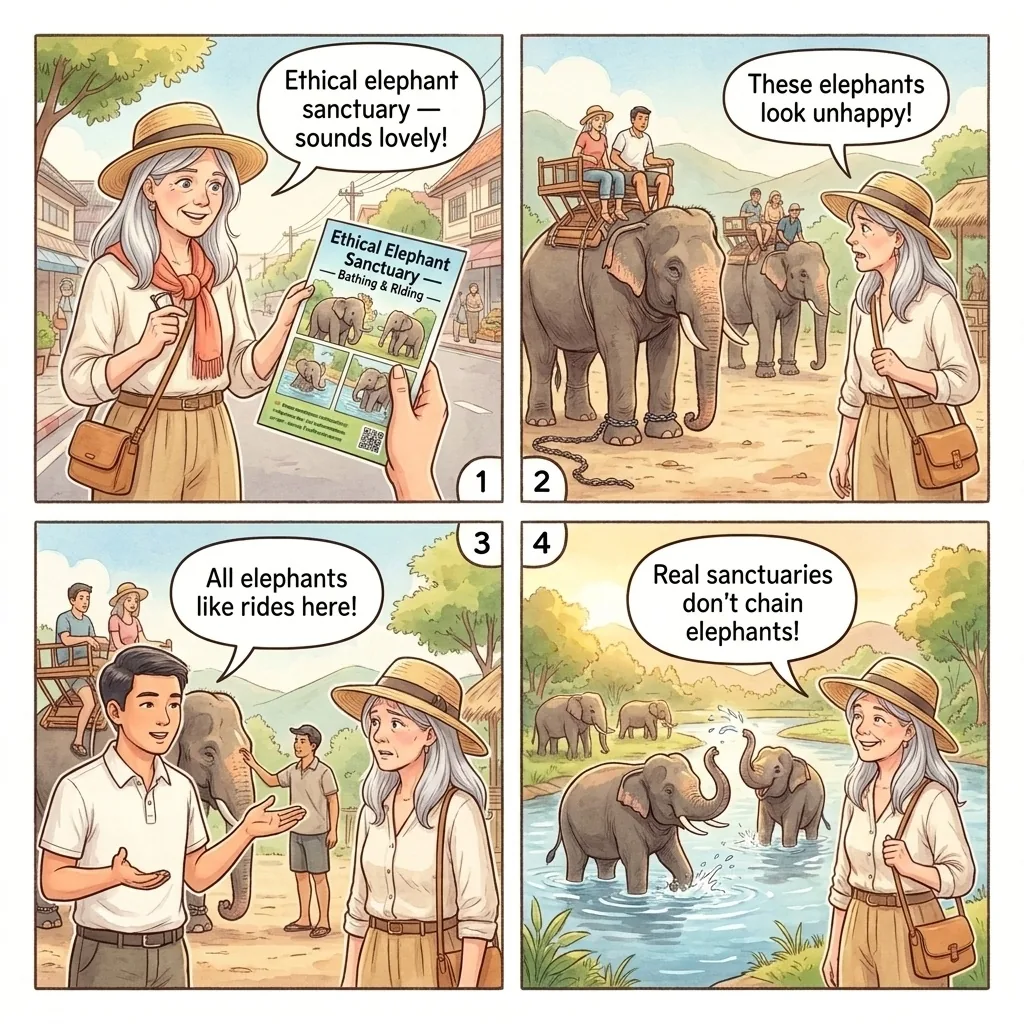
"Green Valley Elephant Sanctuary," "Hilltribe Elephant Care," and dozens of imposter operations along Route 107 (Mae Rim) and Route 108 (Hang Dong) charge 1,800–3,500 baht for a "sanctuary" experience that's actually a tourist camp — bullhooks hidden behind feeding stations, overnight chaining, 5–6 tours per day per animal, and fabricated rescue stories. The only verified ethical operations are Elephant Nature Park (Mae Taeng) and BEES.
You've done your homework — you want an ethical elephant experience, not a ride. A guesthouse near Tha Phae Gate shows you a nicely designed flyer for "Green Valley Elephant Sanctuary" or "Hilltribe Elephant Care" with photos of happy elephants bathing in rivers and "Klook 5-star reviews." You pay 2,500 baht for a half-day. At the "sanctuary," you're given a mahout uniform, fed an elephant sugar cane, and posed for photos. It feels real. But behind the food-feeding station, observant tourists have spotted bullhooks hidden behind structures and abraded skin on the elephants' legs from overnight chaining. The same animals do 5–6 tours per day; the "rescue" story is fabricated.
The scale is industrial. Traveler forums describe dozens of imposter operations along the Mae Rim corridor on Route 107 and Route 108 toward Hang Dong — so many fake sanctuaries that the word "sanctuary" has basically lost meaning in Chiang Mai. The legitimate facilities — Elephant Nature Park (ENP) in Mae Taeng, run by Save Elephant Foundation, and BEES (Burm And Emily's Elephant Sanctuary) — do not permit riding, use no bullhooks, and document the rescue history of every animal publicly. The imposters have copied the word "sanctuary" but meet none of those criteria.
Beyond the ethical problem, this is also a financial scam: you pay 1,800–3,500 baht expecting a sanctuary and get what is functionally a tourist elephant camp. The traveler-forum consensus is blunt — the majority of elephant "sanctuaries" in Chiang Mai are NOT real sanctuaries and are exploitative, especially ones where you can stay with them in a hotel. Some operators escalate: they collect your payment, then pick you up in a van to a different (cheaper, worse) location than the one pictured on the flyer. Traveler reports warn specifically about fake 5-star reviews flooding booking sites — some of the most-booked "ethical sanctuaries" on TripAdvisor are the same fake operations.
Red Flags
- Website or flyer uses the word 'sanctuary' but provides no verifiable rescue history, vet records, or World Animal Protection listing
- Program allows elephant riding, bathing with ropes, or painting — real sanctuaries permit none of these
- Price is suspiciously low (under 1,200 baht) for a full-day 'sanctuary' experience — real ENP visits start around 2,500 baht
- Your guesthouse or booking agent on Khao San Road or Tha Phae East Gate gets a commission for recommending it
- Operator avoids specific questions: 'Can we see where the elephants sleep?' 'How many tours per day?' 'Where are they sourced from?'
How to Avoid
- Book directly with Elephant Nature Park (elephantnaturepark.org) or BEES Sanctuary (bees-elesanctuary.org) — both have documented multi-decade ethical histories.
- Cross-check any operator against World Animal Protection's 'elephant-friendly venue' list and TripAdvisor's animal welfare filter before paying.
- Reject any experience that includes riding, circus tricks, painting, or pushing you up to more than two elephants — these all require coercive training.
- Read recent (2024–2025) TripAdvisor reviews that mention elephant behavior and skin condition, not just staff-supplied photos.
- Ask before booking: 'Can you name the elephants, where each came from, and send me their veterinary records?' Real sanctuaries answer within hours; fakes don't respond.
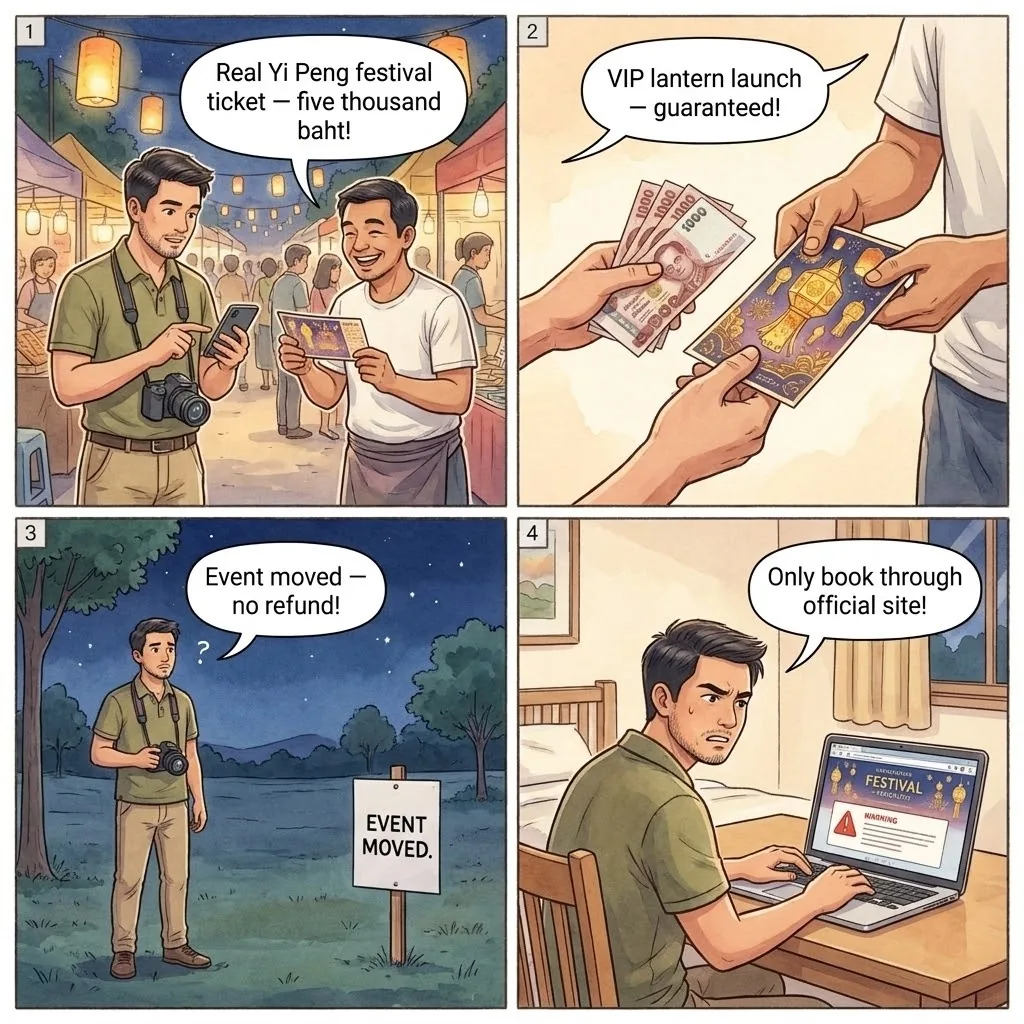
Lookalike "Yi Peng" festival websites ("Night Lights Sky Lantern Festival," "Magical Lantern Festival," "Yi Peng Premium Tickets Official") sell $150–$450 tickets to a remote rice field where you release one lantern alone and see nothing — the only genuine mass-release event is the CAD Khomloy Sky Lantern Festival at Mae Jo (khomloy.com), which sells out months in advance.
Every November, Chiang Mai's Yi Peng festival — when thousands of sky lanterns are released into the night — becomes a magnet for both tourists and scammers. The one genuinely spectacular mass-release event, the CAD Khomloy Sky Lantern Festival at Mae Jo, sells out its "Premium" and "Elite" tickets months in advance, sometimes at $150–$450 USD. By October, tourists who missed out start searching online and find dozens of lookalike websites — "Night Lights Sky Lantern Festival," "Magical Lantern Festival," "Yi Peng Premium Tickets Official" — many of which are outright scams or shells that take you to a remote rice field where you release one lantern alone and see nothing of the main event.
The traveler-forum consensus on Yi Peng tickets is blunt: most ticketed events are a scam — just enjoy the festivities throughout the city for free. Ticketed events take you to a remote location where you can't actually see any of the festival, and then release a small number of lanterns. Travelers regularly compare six near-identical-looking "official" websites and find that most aren't real. The scammers buy SEO ads in October, accept credit-card payments for the "event," and either deliver a gutted version of the experience or disappear with the money.
The parallel scam is lantern-release price gouging in the Old City. Floating krathongs and sky lanterns sell for 20–40 baht at legitimate Chiang Mai markets during the festival. In the tourist-dense stretch of Chang Klan Road and near Tha Phae Gate, vendors routinely sell the same lanterns for 150–300 baht each, especially in the evening hours when demand peaks. Tourists release them not knowing the 2022 Civil Aviation Authority of Thailand rules on lantern release zones — releasing outside the designated zones is technically illegal and occasionally results in fines. A "guide" offering to take you to a "legal release spot" for 500 baht is usually walking you to the same public park anyone can enter for free.
Red Flags
- 'Official' Yi Peng ticket website appeared in the last 30 days and doesn't match the actual CAD Khomloy domain (khomloy.com)
- Ticket price is over $200 USD but details about the venue, capacity, and lantern count are vague
- Seller requires Western Union, crypto, or bank transfer rather than accepting a regulated credit card
- Event location is listed as a generic 'Chiang Mai' or 'near Mae Jo' without GPS coordinates or a specific venue name
- Lantern vendors in the Old City or Chang Klan Road during festival quote 150–300 baht per lantern — the real price is 20–40 baht
How to Avoid
- Book CAD Khomloy Sky Lantern Festival tickets only at khomloy.com (the verified Mae Jo event) — anything else is unofficial.
- If you miss the main event, skip ticketed alternatives — locals on traveler reports universally recommend just walking the Old City, Tha Phae Gate, and Ping River on festival night for the best free experience.
- Buy lanterns at the Warorot Market or any legitimate street market at 20–40 baht; walk away from Chang Klan Road vendors who quote tourist prices.
- Release lanterns only at designated CAT-approved zones — the Nawarat Bridge area and Ping River banks are the traditional free-release spots during festival.
- Cross-reference any 'festival package' on Reddit (traveler reports search 'Yi Peng') before paying — the community will have flagged it if it's a scam.
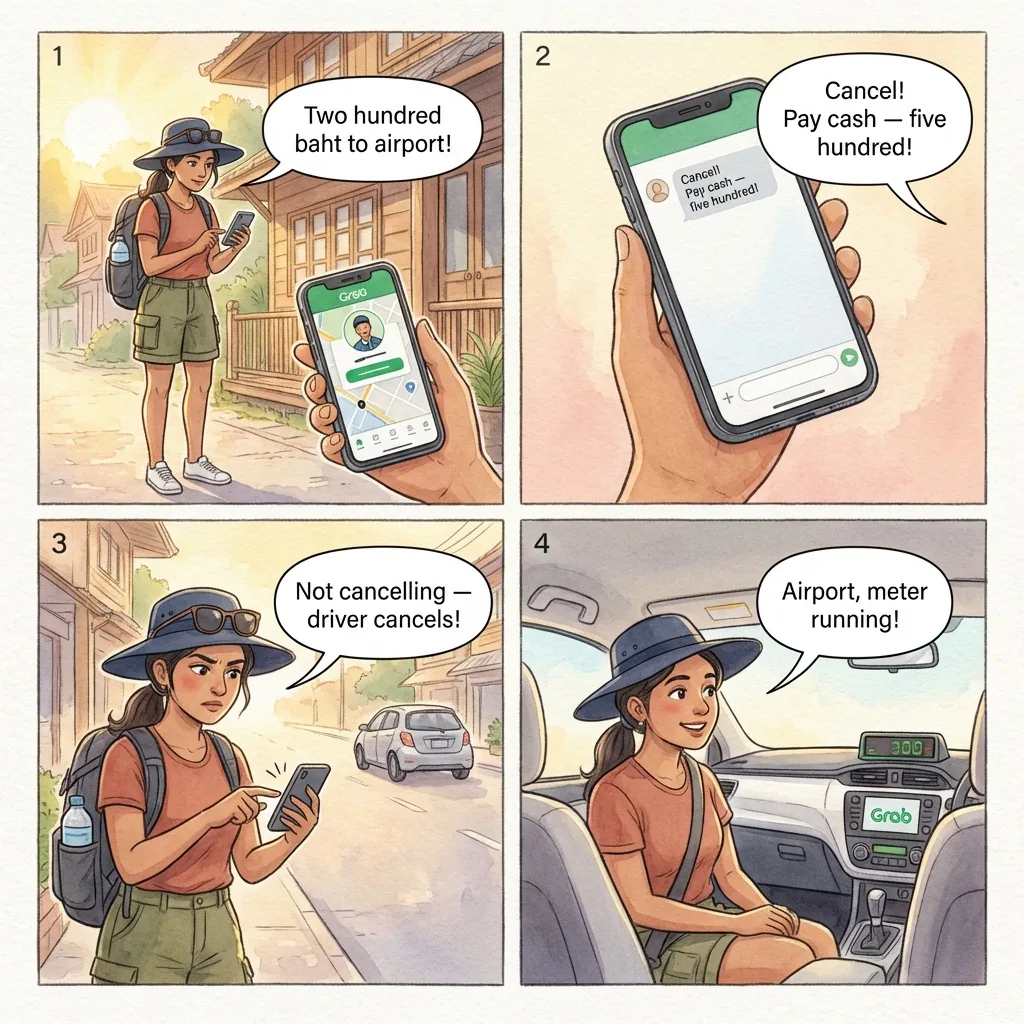
Chiang Mai Grab and Bolt drivers accept your booking then chat "cancel the booking and pay me 700 baht cash" instead of the 225-baht app fare — if you cancel, you lose the regulated price protection and have no receipt; if you refuse, they sit stationary and let the app time out, marking you as no-show with a cancellation fee.
You book a Grab from Mae Rim back to the Old City. The app shows 225 baht. The driver accepts, then sends a chat message: "Please cancel the booking and pay me 700 baht cash." Traveler reports document this exact demand verbatim. If you cancel, Grab/Bolt records it as your cancellation — you lose the regulated price protection, you have no receipt, and the driver pockets three times the normal fare. If you refuse to cancel, the driver sits in place and lets the app time out, then marks you as a no-show and still charges a cancellation fee.
The mechanism is simple: drivers make more money per ride with cash off-app than they do with Grab/Bolt's 20–25% commission, especially on longer trips like airport runs. Chiang Mai's "songthaew cartel" has also pressured the ride-hailing apps to limit operations, and the universal traveler-forum advice is consistent: if your taxi driver asks you to cancel the booking and pay cash, refuse. Some drivers escalate: they accept the job, drive in the opposite direction so you can see on the map they're getting further away, then demand you either pay extra cash "for the longer route" or cancel.
The specific Chiang Mai wrinkle: at Chiang Mai International Airport (CNX), Grab and Bolt drivers cannot legally pick up inside the airport taxi queue — they have to meet you outside the designated zone, which creates confusion and friction. The airport taxi union aggressively blocks Grab pickups in the inner zone. If your driver says "I can't come in, meet me across the bridge" that's usually legitimate (there's a well-known pickup spot). If they say "cancel and pay me cash because airport won't let me," that's the scam. The real pickup workaround is to walk 200m to the Route 121 frontage road and rebook.
Red Flags
- Driver chats you after accepting asking you to cancel the booking and pay cash — this always benefits them and always disadvantages you
- Driver sits stationary at pickup and waits for you to cancel rather than approaching the pickup point
- Cash price quoted is 2–3x the app fare, always — not '50 baht more for toll' but a complete re-pricing
- At CNX airport, driver asks for cash 'because airport won't let us pick up' rather than directing you to the known workaround pickup zone
- Driver claims app is 'broken' for adding tolls, or that you owe extra at destination on top of the app fare
How to Avoid
- Never cancel a Grab/Bolt booking on the driver's request — tell them calmly 'app price only, thank you,' and if they refuse, close the app's in-trip chat and wait for them to start the ride.
- If the driver sits stationary for 5+ minutes, cancel yourself from the app (note who canceled) and report via Grab/Bolt in-app help — you'll get a refund and driver penalty.
- At CNX airport, walk to the designated Grab pickup zone on the frontage road just outside Terminal 1; reference threads for the current spot.
- Keep screenshots of every booking (fare + route + driver ID) — if overcharged, in-app reports with screenshots are resolved within 24 hours.
- For airport-to-city trips, consider pre-booked private transfer via your hotel (300–450 baht fixed) as insurance against app-to-cash switching on peak days.
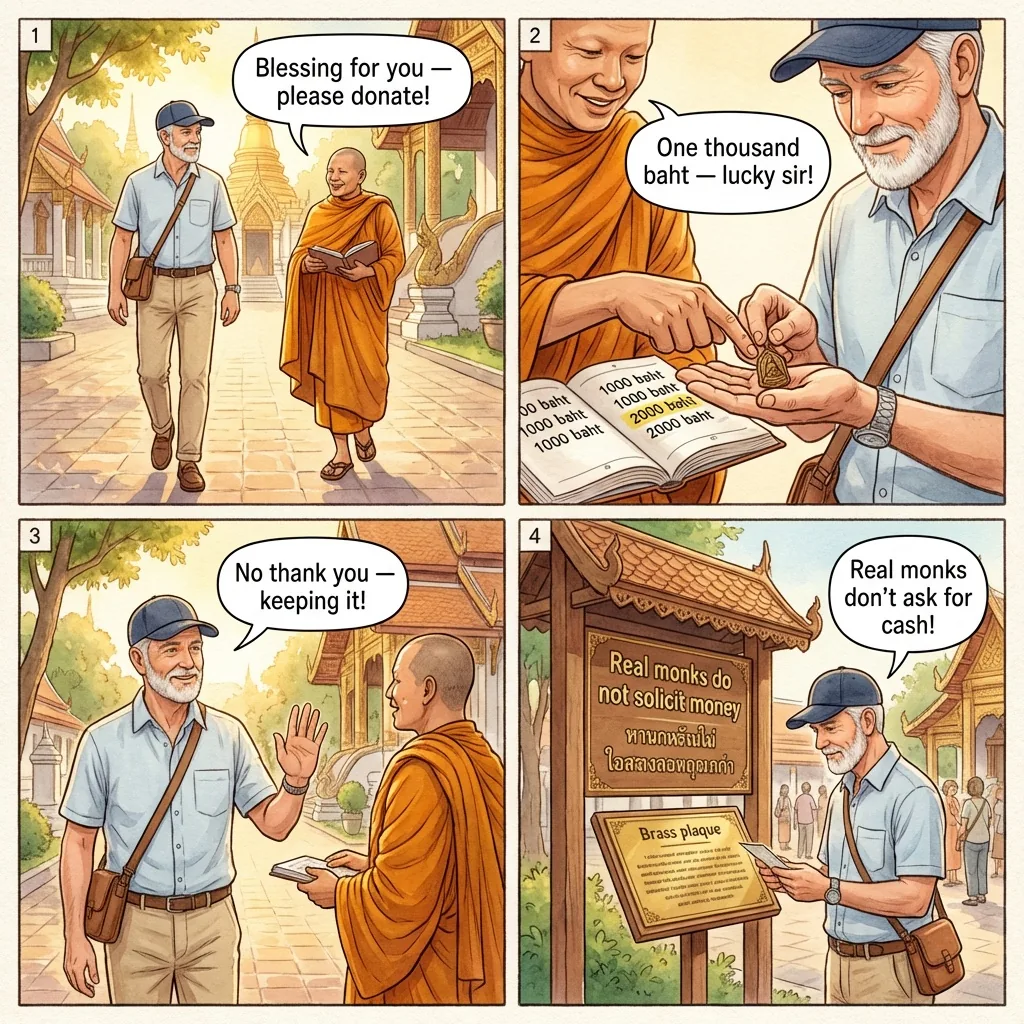
"Saffron-robed monks" near Wat Phra That Doi Suthep, the Old City Sunday Walking Street, and the northeast moat corner present laminated "temple project" cards with donation books listing pre-filled £20–$50 amounts to social-pressure 200–2,000 baht out of you — real Theravada monks never solicit cash from tourists, and many of these "monks" are Chinese nationals running a known scam.
You're climbing the 309-step naga staircase to Wat Phra That Doi Suthep when a man in saffron robes stops you near the top and presents a laminated card showing a temple building project. He speaks limited English but mimes writing in his book and hands you a pen. The book already has dozens of names with donation amounts — 500 baht, 2,000 baht, £20, $50 — written alongside visitors' nationalities. The social pressure to match those figures is the entire point. He blesses your forehead and seems sincere, so you hand over 500 baht. You feel good about it. You shouldn't.
Real Theravada Buddhist monks in Thailand do not solicit cash donations from tourists on temple steps or public streets. Genuine alms-giving (tak bat) happens at dawn in the streets near monasteries, and monks accept food — not cash — as part of a deeply structured religious practice. Travelers report seeing fake monks wandering around the Old City who refuse food and only accept cash, often in pairs working the same staircase or pedestrian street. The robed men near Doi Suthep, along the Old City's Sunday Walking Street on Ratchadamnoen Road, and near the northeast corner of the moat are not ordained monks — many are Chinese nationals who travel to Southeast Asia specifically to run this scam.
The donation book with pre-filled large amounts is a prop — check two books at two different "monks" and you'll often see the same handwriting style across both. The amulet or prayer card they press into your palm is a mass-produced trinket worth 5–10 baht wholesale. The amounts lost are generally modest (200–2,000 baht per encounter), but the scam is aggressive and repetitive — travelers report being approached by three different monk-costumed men near Tha Phae Gate in a single afternoon, none of them real. The Thai Office of National Buddhism has publicly condemned the practice and monasteries post warning signs at major temple entrances in Chiang Mai, but enforcement is minimal.
Red Flags
- A 'monk' actively approaches you, makes eye contact, or blocks your path rather than walking with eyes downcast
- Laminated donation card or English-language sign board showing a 'temple construction project'
- Pre-filled donation book with large amounts (£20, $50, 2000 baht) in similar handwriting to create social pressure
- Location is a tourist thoroughfare rather than inside an actual wat (temple) compound
- Robes look new and bright orange-yellow rather than the faded saffron of practiced monks, and he's often wearing sneakers or modern watches
How to Avoid
- Know that real Thai monks do not solicit cash from tourists — decline with a polite 'wai' (palms together, slight bow) and keep walking.
- If you want to make a temple donation, do so inside the wat's official donation box — every major Chiang Mai temple has one with a clear receipt option.
- At Wat Phra That Doi Suthep, take the official red songthaew (40 baht round-trip from Chiang Mai University) and enter through the main gate where fake monks cannot loiter.
- Ask your Chiang Mai guide or hotel to explain legitimate alms-giving (tak bat) — it happens at dawn and involves food offerings, never street cash.
- Photograph suspected fake monks from a distance and send to Chiang Mai Tourist Police 053-247-318 — they maintain a database.
🆘 What to Do If You Get Scammed
📋 File a Police Report
Go to the nearest Tourist Police station. Call 1155 (Tourist Police, 24/7 English) or 191 (General Police). Get an official crime report — you'll need this for insurance claims. You can also report online at touristpolice.go.th.
💳 Cancel Your Cards
Call your bank immediately. Most have 24/7 numbers on the back of the card (keep a photo saved separately). Block any suspicious transactions before the thieves use your details.
🛂 Lost Passport?
For passport replacement, contact the US Embassy Bangkok at 95 Wireless Road, Pathumwan, Bangkok 10330 (+66 2-205-4000, 24/7). In Chiang Mai, the US Consulate General is at 387 Witchayanond Road, Chiang Mai 50300 (+66 53-107-700). The UK Embassy is at 14 Wireless Road, Bangkok (+66 2-305-8333). The Australian Embassy is at 181 Wireless Road, Bangkok (+66 2-344-6300). Always call Tourist Police 1155 first — they speak English and will file the police report you need for passport replacement.
📱 Track Your Device
If your phone was stolen, use Find My (iPhone) or Find My Device (Android) from another device. Don't confront thieves yourself — share the location with police instead.
Frequently Asked Questions
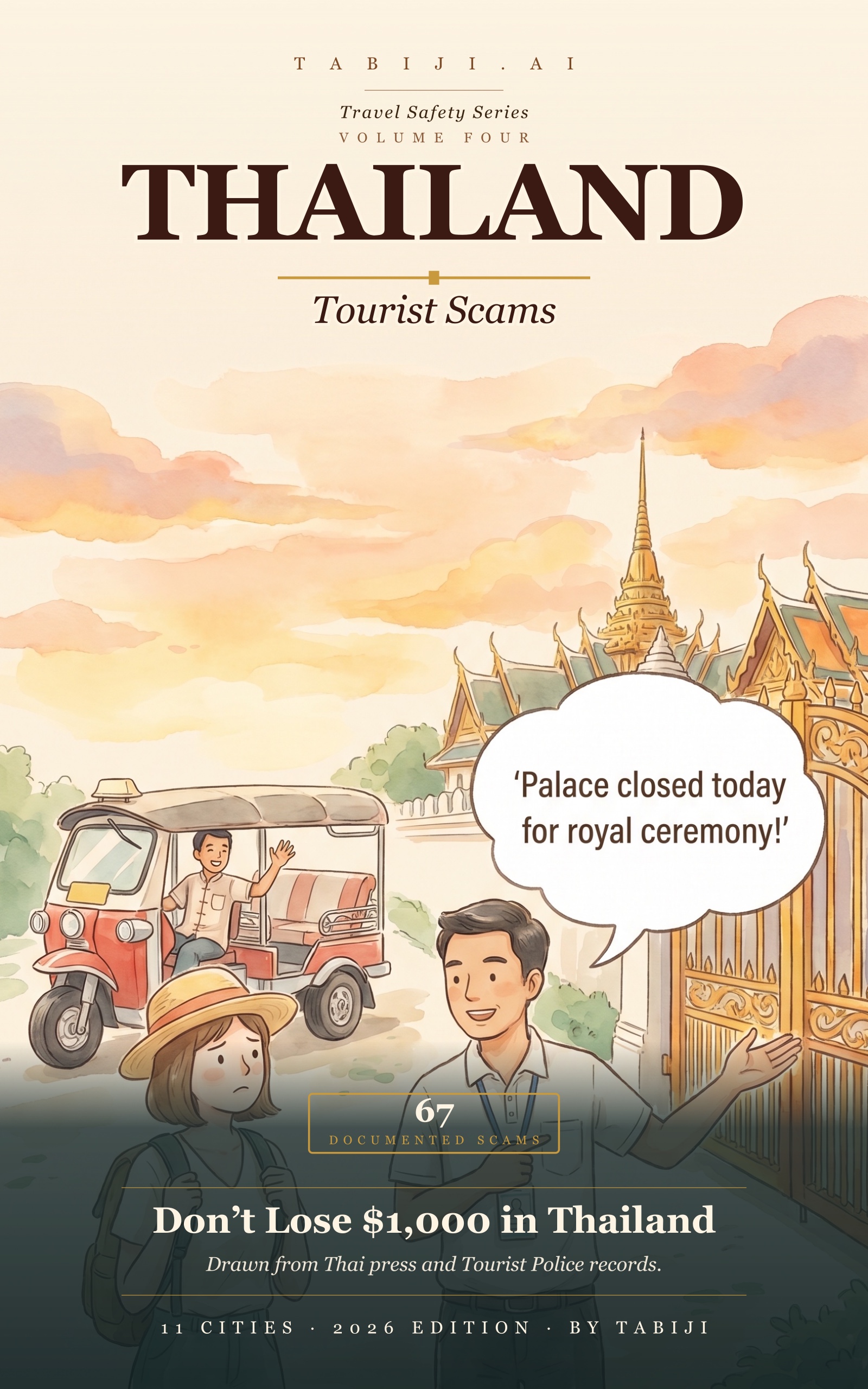
You just read 8 scams in Chiang Mai. The book has 59 more across 11 Thai destinations.
Bangkok's "Grand Palace closed today" tuk-tuk and gem-shop loop. Phuket's Patong jet-ski damage-deposit cycle. Chiang Mai's Doi Suthep kickback tours. Koh Tao's passport-hostage motorbike scratch racket. Every documented Thailand scam — with the exact scripts, red flags, and Thai phrases that shut each one down. Drawn from Bangkok Post, The Nation Thailand, Khaosod English, Thai PBS, and Tourist Police (1155) records.
- 67 documented scams across Bangkok, Phuket, Chiang Mai, Koh Samui & 7 more cities and islands
- A Thai exit-phrase card you can screenshot to your phone
- Updated annually — buy once, re-download future editions free
- Readable in one flight — $4.99 on Amazon Kindle