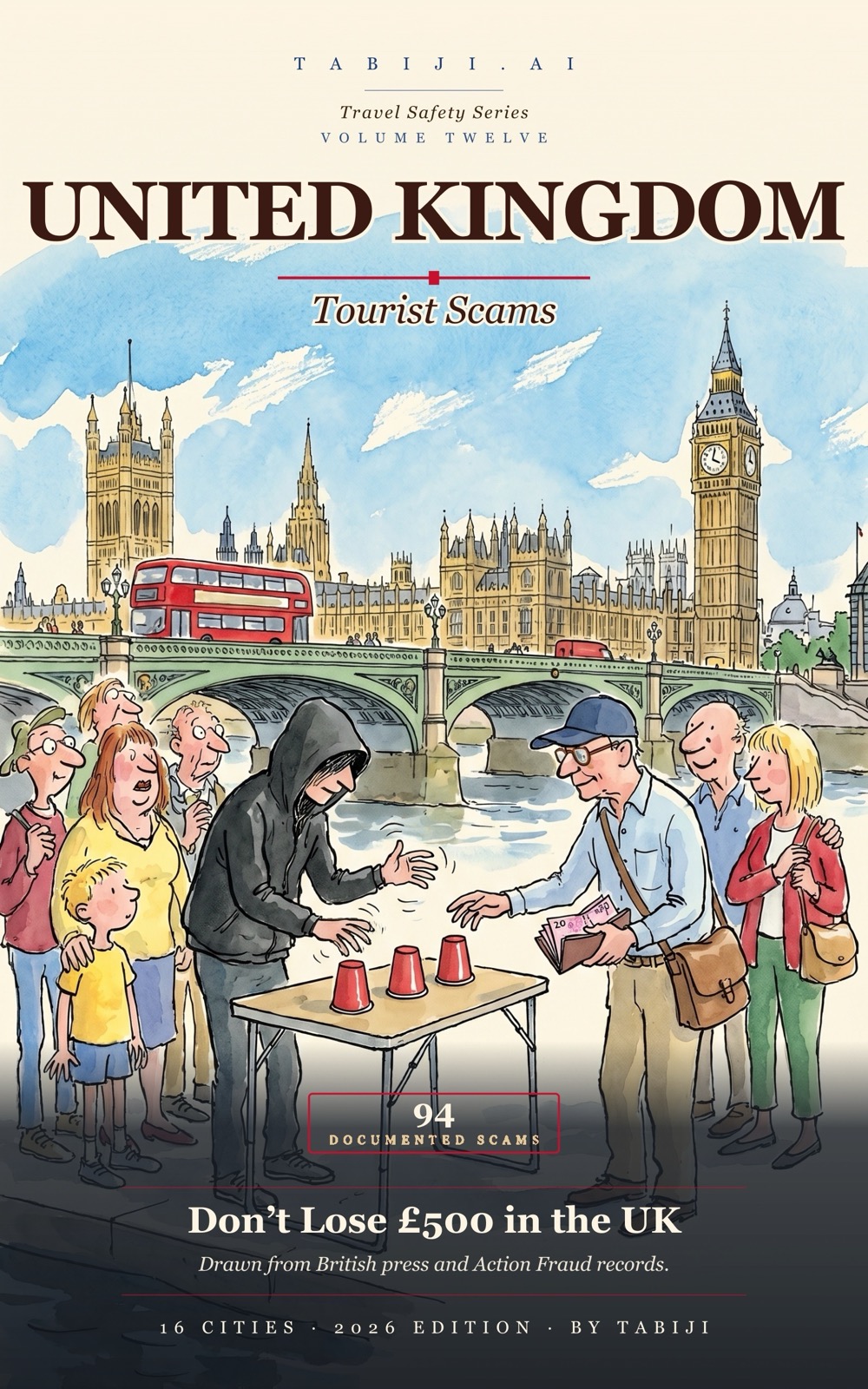
Key Takeaways
- The #1 reported scam is the Westminster Bridge Shell Game.
- 3 of 6 scams are rated high risk.
- Use app-based ride services (Uber, Bolt) or official metered taxis instead of unmarked vehicles.
- Never accept unsolicited offers from strangers near tourist sites in London.
⚡ Quick Safety Tips
- Walk past cup-and-ball/shell-game operators on Westminster Bridge without stopping; reports confirm 'rigged, only winners are plants'; the game also serves as a pickpocket distraction cluster.
- Keep your phone in a zipped front pocket and OFF restaurant tables; official/local reports document 10,000+ phone thefts around Oxford Circus/Regent Street; moped snatchers grab from open hands, bags, and outdoor tables.
- Avoid 'American candy' shops on Oxford Street — the named £899 anchor; these are money-laundering fronts (traveler reports 'not the candy itself, just money laundering').
- Book attraction tickets (Westminster Abbey £29, London Eye, Tower of London £34.80) ONLY at the official sites is blunt: 'Get Your Guide, Viator, etc are all scams. You will pay 4-5 times the price for the identical ticket.'
- Don't take a pedicab names the viral fare-extortion case; the Pedicabs (London) Act 2024 regulation is still rolling out, so illegal pricing remains the norm.
Jump to a Scam
The 6 Scams
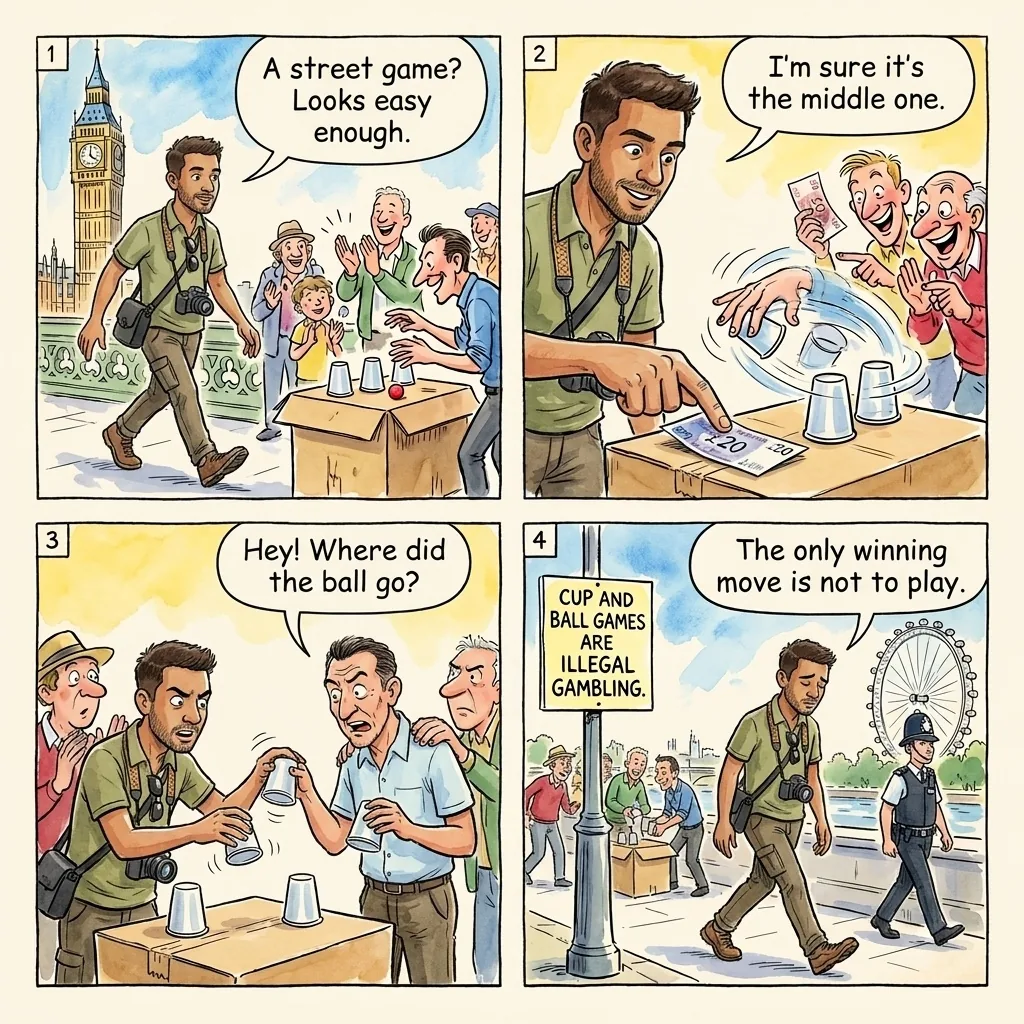
A crowd around a folding table on Westminster Bridge watches a man shuffle three cups over a ball — a "tourist" wins £50, then your £20 bet finds the cup empty. Every "winner" is a paid shill, the game is mathematically rigged via sleight-of-hand, and the operator scatters the moment uniformed Met Police appear.
You're crossing Westminster Bridge with the Houses of Parliament behind you and Big Ben in view when you spot a crowd of eight or ten people gathered around a folding cardboard table. A man with quick hands is shuffling three plastic cups around a small ball. A bystander lays down £50 and points confidently at the middle cup. The dealer lifts it: ball. He hands over £100. The crowd cheers.
You step closer. The next round the dealer's hands look slower — you can almost track the ball. You put down £20. The cup lifts. Empty. You try again with £40 to win it back. Empty. The man who "won" £100 a minute ago is now nudging the next mark; the crowd that was cheering you on has moved on. Six minutes later the dealer is restarting the same play with another tourist, and you're £60 down.
Every "winner" you saw was a paid shill — coordinated teams of 5–8 people work each game, with the dealer, multiple winning shills, lookouts watching the bridge approaches for police, and a "security" shill positioned to pressure anyone who somehow does win. The sleight-of-hand is professional-grade — even knowing the trick, you cannot beat it because the ball is palmed during the shuffle. The shell game has been running on Westminster Bridge for centuries, and the South Bank tourist crowds still feed it daily. Don't participate, don't watch — even spectating marks you as a target. Walk past without slowing down.
Red Flags
- Crowd of enthusiastic 'winners' around the table
- Operator moves quickly and distracts you
- Location near major tourist landmark
- Cash only, no receipts
How to Avoid
- Never bet money on street games — the house always wins.
- The spectators cheering you on are accomplices.
- Walk past, don't make eye contact with touts.
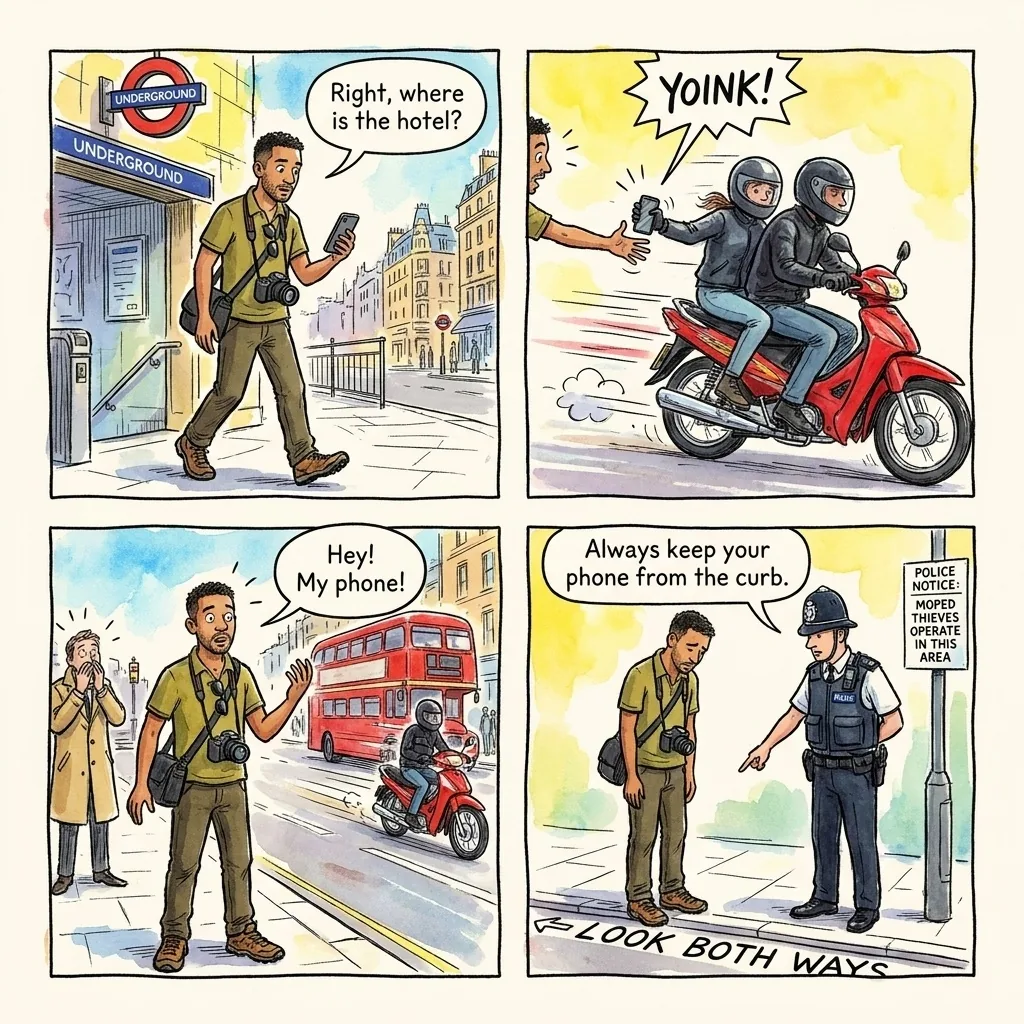
A moped passes you outside a Central London tube station as you check Google Maps — the pillion rider rips the phone out of your hand and they're gone before you can react. Tube theft has soared 83% in recent years and moped-snatch is the #1 crime tourists face in London.
You step out of the Bond Street, Oxford Circus, or Tottenham Court Road tube station and pull out your phone to check Google Maps for the walk to your hotel. The street is busy, mopeds are everywhere — that's London. You're standing within arm's reach of the curb, phone in hand, screen lit, eyes down.
A moped slows alongside you. The pillion rider — the passenger on the back — leans out, snatches the phone from your hand in one fluid motion, and the moped accelerates away into traffic before you fully register what happened. The whole snatch takes less than a second. By the time you process it, the moped has already turned a corner and the rider is long gone.
Tube theft in London has soared 83% in recent years according to Met Police data, and moped-based phone snatching is the single most common crime targeting tourists. The thieves park nearby watching for people who check their phones the moment they exit a tube station — the predictable behavior of disoriented visitors makes them easy targets. Put your phone away before exiting the tube — duck into a Pret, a Costa, or any shop to check directions, and download offline maps before arriving so you don't need data on the street. A wrist strap or grip case adds a second of resistance that often defeats the snatch.
Red Flags
- Standing at busy tube exits with phone visible
- Phone in hand for extended periods near road
- Distracted by screen in high-footfall area
How to Avoid
- Put your phone away before exiting the tube.
- Step inside a shop to check directions.
- Use a phone wrist strap or grip case.
- Download offline maps before arriving.
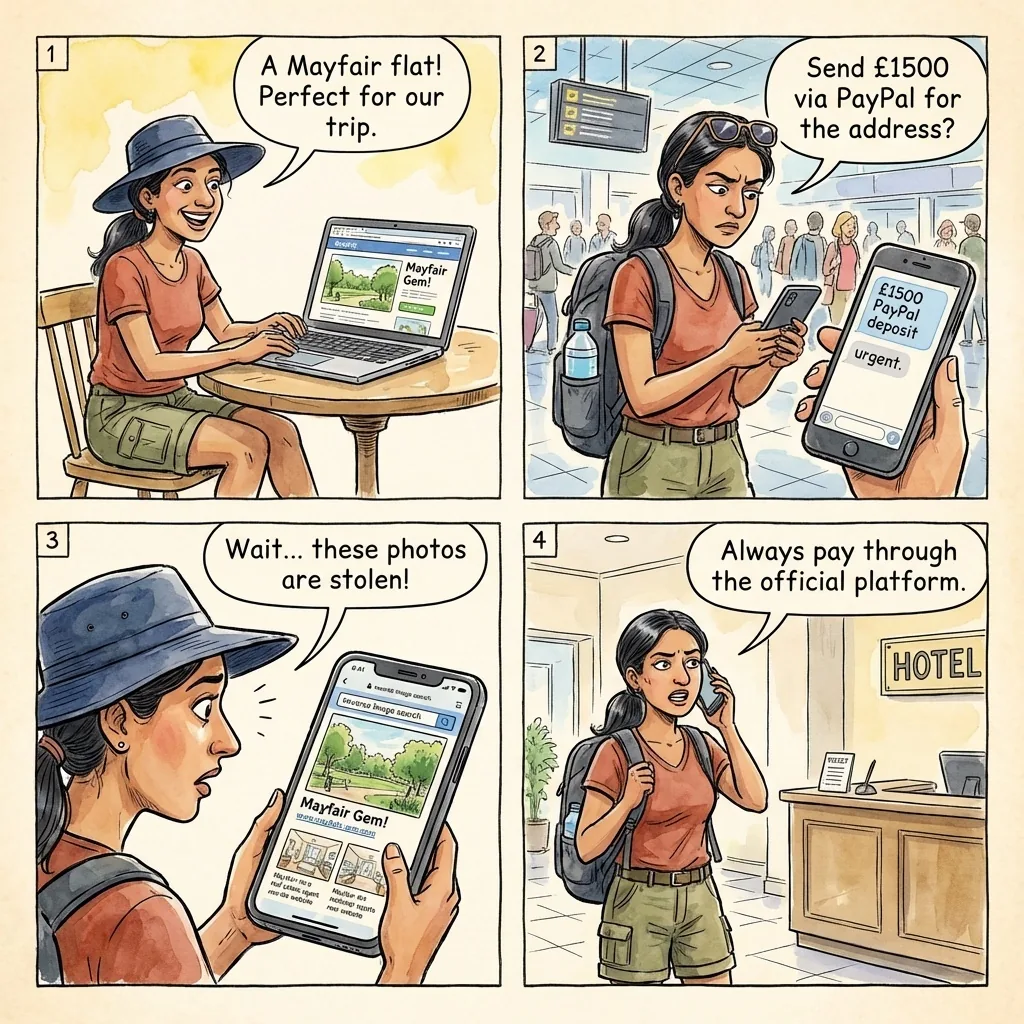
A "Mayfair flat" on Booking.com at £2,000 for 4 nights asks you to send a £1,500 "security deposit" via PayPal to receive the actual address — the listing photos were stolen from a real occupied property and the flat doesn't exist. A Wired UK investigation found operations running hundreds of these fake listings.
You book what looks like a gorgeous Mayfair flat on Booking.com — chandeliers, marble bath, view of Hyde Park, £500/night. The reviews are glowing and there are twelve photos. You pay £2,000 for four nights through what appears to be the standard Booking.com flow.
The day before check-in you receive a message from the "host": to get the actual address and the lockbox code, you need to send a £1,500 "security deposit" directly via PayPal "friends and family." The Booking.com booking will be released back when you check out. With the trip starting tomorrow and your luggage already packed, the urgency feels real and £1,500 feels like a refundable hold. You PayPal it.
A Wired UK investigation found entire operations running fake listings of real occupied London properties — the photos in the listing are stolen from a genuine flat across town, the "host" is a counterfeit account, and the address either doesn't exist or belongs to someone whose home you can't actually access. Hundreds of tourists are caught every year. The off-platform PayPal "friends and family" payment is the entire scam — it has zero buyer protection and is irreversible. Never pay outside the official booking platform — Booking.com, Airbnb, and VRBO all guarantee transactions only when payment stays in-app. Verify any listing's address on Google Street View before booking, and contact the platform's support immediately if a host asks for off-platform payment.
Red Flags
- Host requests payment outside the official platform (PayPal, bank transfer)
- Asked for a security deposit before receiving the address
- Price unusually low for the stated area
- Host says address will only be provided 'once confirmed'
How to Avoid
- Never pay outside the official booking platform.
- Verify listing address on Google Street View before booking.
- Book through platforms with guest protection policies.
- Contact platform support immediately if asked to pay off-platform.

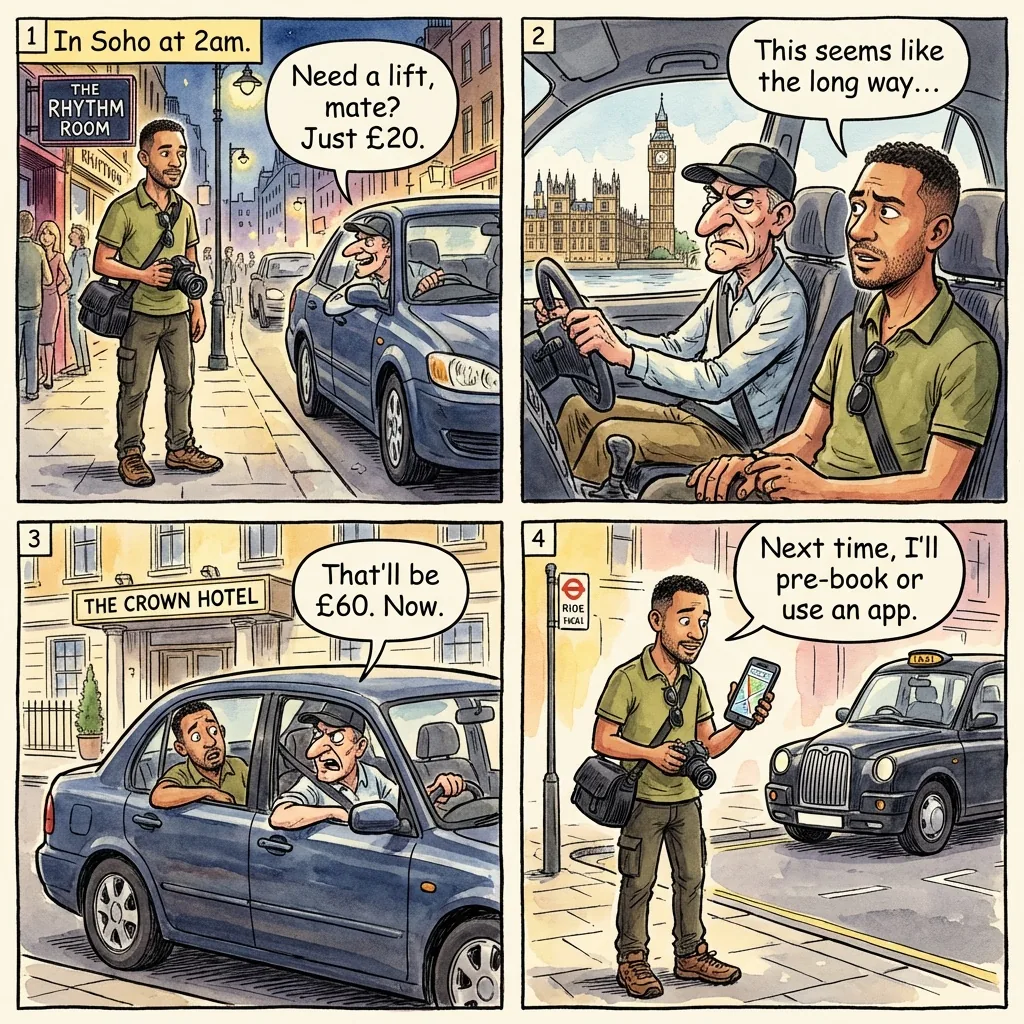
Outside a Soho or Shoreditch club at 2 a.m. after the tube has stopped, a "friendly bloke" offers a £20 cash ride home — the car is unlicensed, the route is winding, and the price climbs to £60 with the doors locked until you pay.
It's 2 a.m. outside a Soho club, the last tube ran ninety minutes ago, and your phone battery is dying. A friendly man at the curb says he can take you home for £20 cash. The car parked behind him looks like a normal sedan — no roof sign, no meter, no Transport for London (TfL) minicab badge in the windscreen. You're tired and slightly drunk; £20 sounds reasonable.
The driver takes a long, winding route through neighborhoods you don't recognize. When you arrive at your hotel, the price has magically become £60 — he claims it's "the night surcharge plus extra fares" — and he's not unlocking the doors until you pay. With your card in his hand for the terminal, the math is simple: pay or stay locked in the car.
Unlicensed minicab touts are specifically common late at night around Soho, Shoreditch, Leicester Square, and the major train stations, targeting tired or tipsy tourists who don't know that London licensing rules require minicabs to be pre-booked through a licensed operator — they cannot legally pick up off the street. The legitimate options are TfL-licensed black cabs (which CAN be hailed on the street, have meters, and accept cards), Uber, Bolt, FREE NOW, or a pre-booked minicab from a verified operator with the TfL roundel sticker. Never get into a car that approaches you proactively at night — open Uber, Bolt, or FREE NOW on your phone before you leave the venue, or hail a TfL black cab with the lit "TAXI" sign on the roof.
Red Flags
- Driver approaches you rather than you flagging them down
- No meter or meter covered/switched off
- Cash only, no app booking confirmation
- Price only given after the ride
How to Avoid
- Use Uber, Bolt, or a licensed app to pre-book.
- Black cabs can be hailed legally on the street and have meters.
- Never get into a car that approaches you proactively.
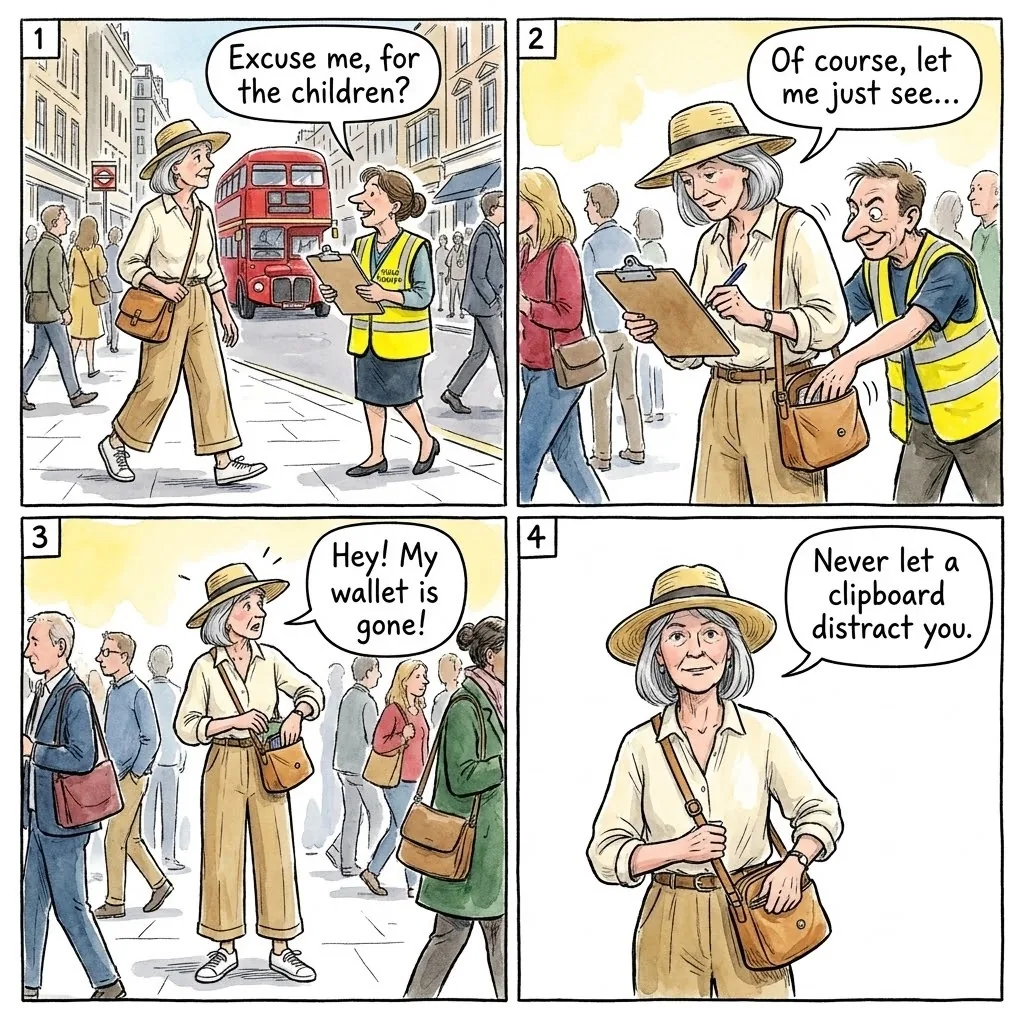
A young person on Oxford Street or in Covent Garden hands you a clipboard "collecting signatures for a good cause" — while you read, their partner brushes past and your wallet quietly changes pockets. The teams of three or four work the high-footfall stretches all day.
You're walking down Oxford Street between Marble Arch and Tottenham Court Road, or through Covent Garden's pedestrian piazza, when a young person with an earnest expression and a clipboard intercepts you. They claim to be collecting signatures for a charity — children's hospital, autism research, against drugs. The cover sheet has logos and a list of "previous signers."
You take the clipboard and start reading. Your eyes go down. Your stance opens slightly as you lean into the page. The accomplice you didn't notice is already behind your right shoulder, hand at the level of your back pocket. By the time you hand the clipboard back, your wallet has quietly moved — and a third member of the team has taken the handoff and walked the other direction down the pavement.
These gangs work in coordinated teams of three or four and are extremely practiced at the distraction-and-lift. Oxford Street's lunch-hour density and Covent Garden's tourist crowds are the highest-density zones, with Leicester Square and the Trafalgar Square approaches as the next tier. Keep your bag in front of you with one hand on it whenever a stranger approaches with a clipboard — say "no thanks" without breaking stride and keep walking. Real UK charities use registered fundraisers wearing visible ID badges, never unannounced clipboards on pedestrian streets.
Red Flags
- Unsolicited approach with clipboard in a tourist area
- Person standing unusually close during interaction
- Another person hovering nearby without apparent reason
How to Avoid
- Keep your bag in front and hand on wallet whenever approached.
- Simply say 'no thanks' and keep walking without stopping.
- Be especially alert on Oxford Street, Covent Garden, and Leicester Square.
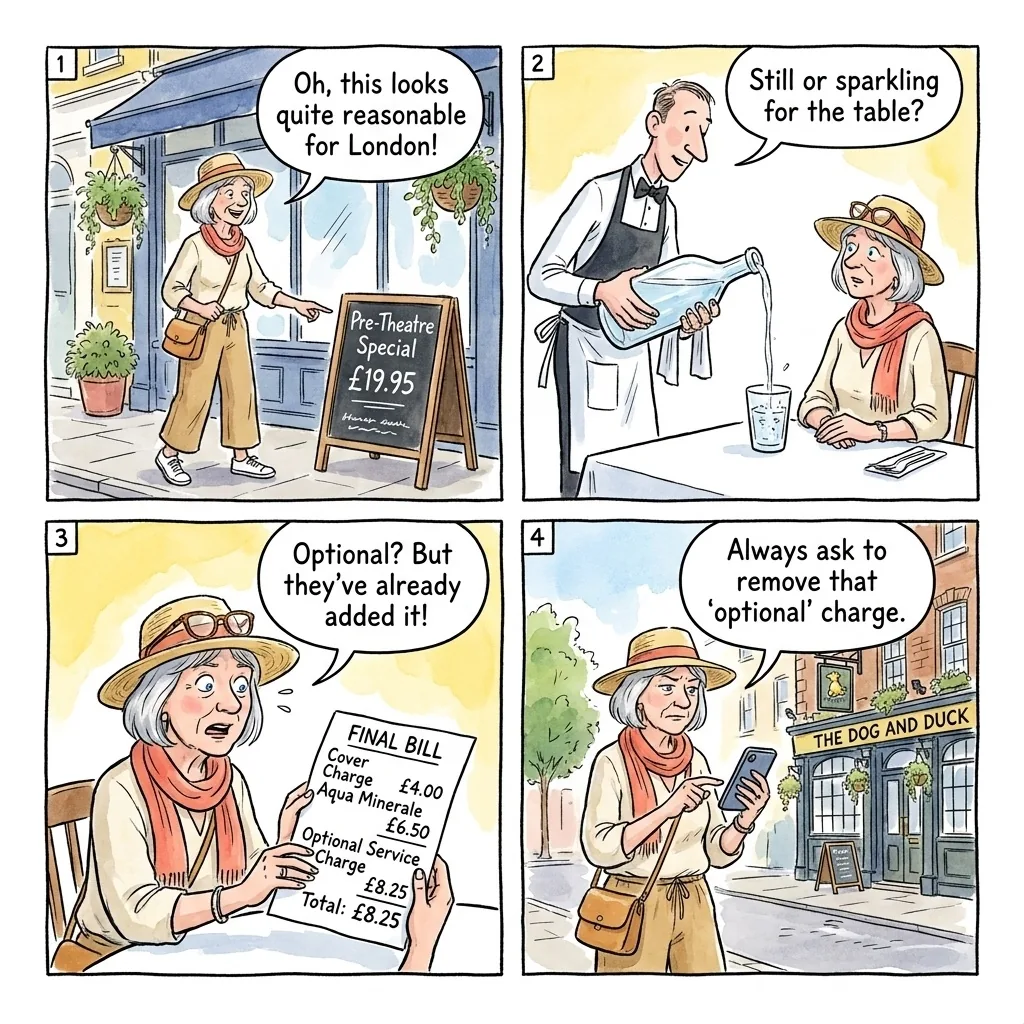
A "busy-looking" restaurant near Covent Garden lists reasonable prices outside, but the bill arrives with a 12.5% "optional" service charge already added, a cover charge, and £6 for the "still or sparkling" water you assumed was tap — a £20 lunch becomes £45.
You duck into a busy-looking restaurant near Covent Garden, Leicester Square, or the South Bank — somewhere with crowds outside that signals popularity. The menu posted by the door has reasonable prices: a £14 main, a £4 starter. You sit down. The waiter brings the menu, takes your order, and asks "still or sparkling for the table?" — without mentioning a price. You say "still." A bottle of branded mineral water arrives.
The bill arrives. The £14 main and £4 starter are correct. But there's a £4 cover charge, a £6 line for the water, and a 12.5% "optional" service charge already added that brings the total to £45 from what should have been £22. The waiter is friendly but explains the service charge is "discretionary" with a smile that suggests removing it would be a scene. You pay.
These aren't outright illegal scams in the UK sense, but they're aggressive tourist traps that rely on visitors not knowing to ask about charges upfront. The 12.5% "optional" service charge has become near-universal in London, and bottled water defaulting to a £6 charge instead of free tap is the everyday pattern. Ask "tap water please" the moment the waiter asks about water, and check whether service charge is included before ordering — UK law allows you to refuse a discretionary service charge if the service was not satisfactory. Walk one or two streets away from the immediate Covent Garden / Leicester Square / South Bank crush for honest gastropub prices.
Red Flags
- Menu outside doesn't list all charges clearly
- Waiter immediately asks 'still or sparkling?' without mentioning the cost
- Unusually prominent 'recommended' dishes that cost much more
How to Avoid
- Ask if service charge is included before ordering.
- Specify 'tap water please' to avoid bottled water charges.
- Check menu prices carefully — no-frills pubs near attractions often serve the same food for half the price.
🆘 What to Do If You Get Scammed
📋 File a Police Report
Go to the nearest Metropolitan Police station. Call 999 (emergency) or 101 (non-emergency). Get an official crime report — you'll need this for insurance claims. You can also report online at met.police.uk.
💳 Cancel Your Cards
Call your bank immediately. Most have 24/7 numbers on the back of the card (keep a photo saved separately). Block any suspicious transactions before the thieves use your details.
🛂 Lost Passport?
Contact your nearest embassy or consulate. The US Embassy is at 33 Nine Elms Lane, London SW11 7US. For emergencies: +44 20 7499 9000.
📱 Track Your Device
If your phone was stolen, use Find My (iPhone) or Find My Device (Android) from another device. Don't confront thieves yourself — share the location with police instead.