Key Takeaways
- The #1 reported scam is the Fake Concert Ticket Seller.
- 2 of 5 scams are rated high risk.
- Use app-based ride services (Uber, Bolt) or official metered taxis instead of unmarked vehicles.
- Never accept unsolicited offers from strangers near tourist sites in Manchester.
⚡ Quick Safety Tips
- Piccadilly Gardens is Manchester's #1 pickpocket hotspot and 'My iPhone was stolen in Piccadilly Manchester'; keep phones in zipped front pockets, OFF restaurant tables.
- If approached by sob-story beggars at Manchester Piccadilly Station or Market Street, walk past without engaging document the pattern: they claim 'need £20 for train home' or similar.
- Use only licensed Manchester Hackney Carriages (black cabs, rank at Piccadilly Station) or app-based rides documents 'license-shopping' drivers from other councils operating under weaker Manchester oversight; insist on metered fare.
- Ignore clipboard charity 'chuggers' on Market Street and Piccadilly Gardens and insider thread confirm these are commission-driven paid fundraisers, not charity staff.
- For Oasis reunion / AO Arena / Co-op Live concert tickets, book ONLY via Ticketmaster, See Tickets, or the venue direct and Facebook Marketplace resales are the dominant fraud vector; refuse any ticket sold via DM or off-platform.
Jump to a Scam
The 5 Scams
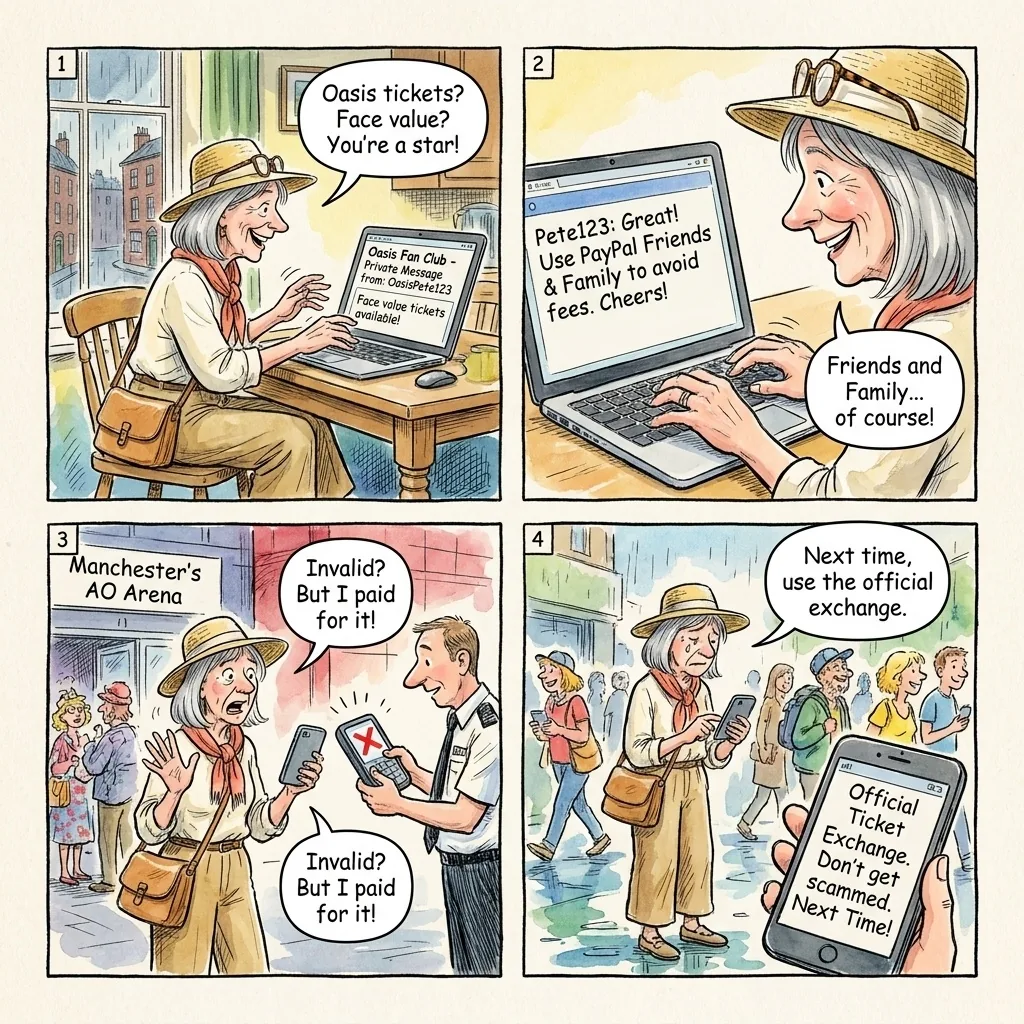
Counterfeit and already-used concert tickets for sold-out Manchester events are sold via Facebook Marketplace and street touts outside the AO Arena and Co-op Live, with sellers demanding PayPal Friends and Family or bank transfer — Action Fraud logged over 10,500 ticket scam complaints since early 2024, with losses exceeding £10 million, spiking during the 2025 Oasis Heaton Park residency.
Manchester's AO Arena and Co-op Live host some of the UK's most sought-after concerts, and tickets for major acts sell out within minutes of going on sale. The secondary market that follows splits between legitimate resale platforms — Twickets, the venue's official resale partner — and fraudulent listings on Facebook Marketplace and Gumtree, where seller accountability is low. Listings for sold-out shows appear at face value or slightly below, which creates urgency: the deal looks plausible enough to investigate but too good to wait on.
The seller appears legitimate, sharing screenshots of a booking confirmation that could be created in minutes using a template. They insist on PayPal Friends and Family or a bank transfer to "avoid fees" — both payment methods offer the buyer zero fraud protection. You send the money and receive a PDF that looks valid. On the night of the show, the QR code is rejected at the gate: it has already been used, or it is fabricated entirely. Greater Manchester Police flagged this pattern repeatedly during the 2025 Oasis Heaton Park residency. Action Fraud logged more than 10,500 ticket scam complaints since early 2024, with total losses exceeding £10 million nationwide.
Official ticketing transfers through the platform's app verify a ticket's validity in real time; a PDF sent by a stranger cannot be verified until you are at the gate. Buy tickets only from Ticketmaster, AXS, or the venue's own website, and for resale use platforms with buyer guarantees like Twickets — never pay via Friends and Family or bank transfer for event tickets, regardless of how convincing the seller's screenshots appear. If buying resale, ask the seller to transfer the ticket through the official ticketing app rather than sending a PDF; a legitimate seller with genuine tickets can do this and a fraudster cannot.
Red Flags
- Tickets for a sold-out event are offered at face value or slightly below on social media
- The seller insists on PayPal Friends and Family, bank transfer, or cryptocurrency rather than buyer-protected payment
- They provide screenshots of confirmation emails that could easily be forged or photoshopped
- The seller creates urgency -- 'someone else is interested, I need payment in the next hour'
- Their social media profile was recently created or has very few connections
How to Avoid
- Buy tickets only from official sources like Ticketmaster, AXS, or the venue's own website.
- If buying resale, use platforms with buyer guarantees like Twickets or the venue's official resale partner.
- Never pay via Friends and Family or bank transfer -- use payment methods with fraud protection.
- Verify the ticket by asking the seller to transfer it through the official ticketing app rather than sending a PDF.
- Check the seller's profile history and reviews -- legitimate sellers have established accounts.
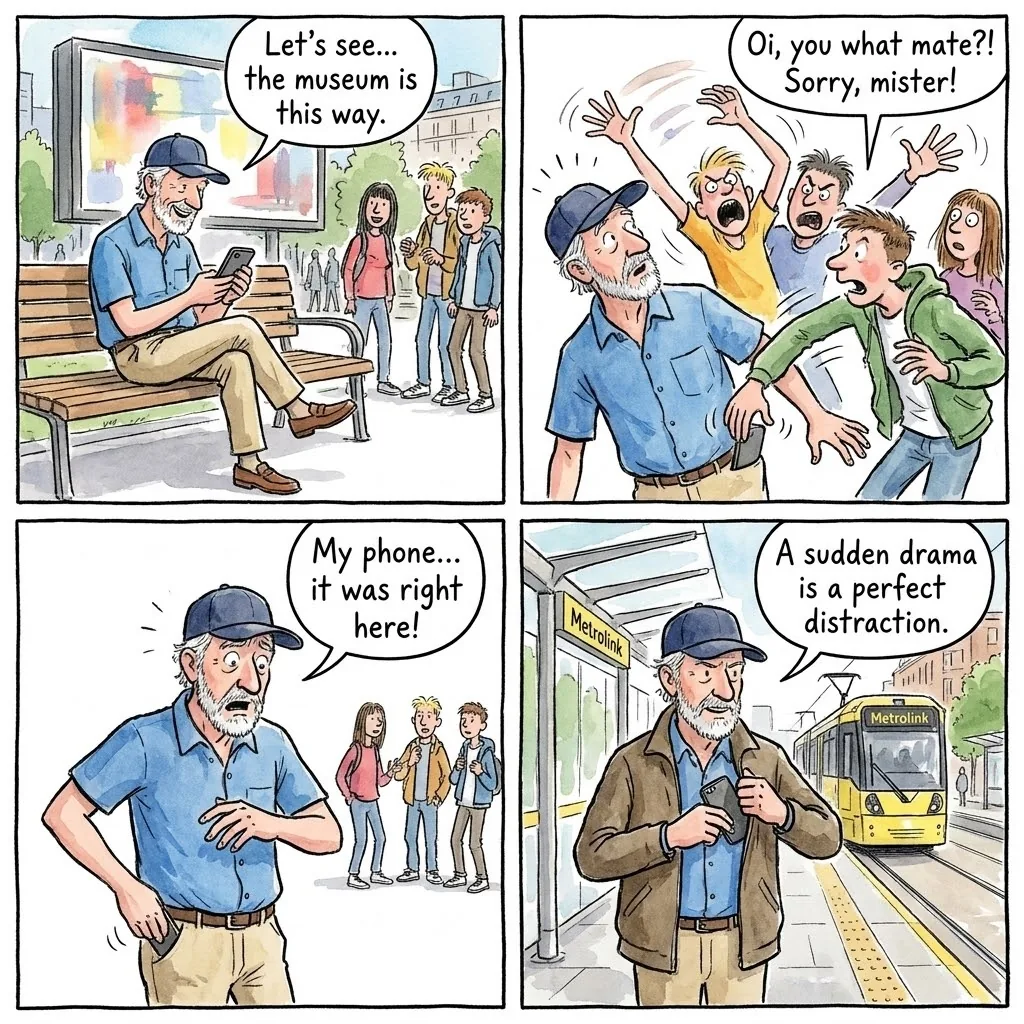
Piccadilly Gardens and the surrounding Metrolink tram stops are Manchester's documented pickpocket hotspot — teams stage loud arguments or controlled bumps to distract visitors while accomplices remove phones and wallets from jacket pockets, a pattern flagged by Greater Manchester Police in regular public warnings about the area.
Piccadilly Gardens is the main public square in Manchester city center, directly adjacent to the Piccadilly Metrolink stop and the bus interchange. It draws a constant mix of commuters, shoppers, tourists, and people with nowhere else to be. Greater Manchester Police issue regular public warnings about the square as an opportunistic crime hotspot. The benches, tram platforms, and open areas create multiple settings where a staged distraction is easy to execute without nearby witnesses registering what happened.
You are sitting on a bench checking your phone for directions when a group nearby starts a loud argument. It sounds real and draws everyone's attention. One person bumps into you while gesturing, apologizes, and moves on. Five minutes later your phone is gone from your jacket pocket. The staged argument is the distraction; the bump is the moment of contact when the item is lifted. Narrow benches and tram platforms make a quick hand to an unguarded pocket routine. Phones in jacket pockets, wallets in back trouser pockets, and unzipped bags on laps are the most common targets — they are the most accessible without the victim noticing contact.
Every pickpocket distraction at Piccadilly Gardens requires close access to an unguarded item. Keep your phone in a zipped inner pocket and your wallet in a front trouser pocket rather than a back pocket — when a loud distraction starts nearby, your first move should be to put your hands on your valuables, not to look at what's happening. Use a cross-body bag with the clasp facing your body rather than a backpack or open shoulder bag, and avoid lingering in the square after dark when opportunistic theft increases. Report any theft to Greater Manchester Police on 101.
Red Flags
- A loud argument or scuffle breaks out nearby that seems exaggerated or theatrical
- Someone bumps into you or brushes past closely in a space that isn't particularly crowded
- A stranger tries to engage you in conversation while you're using your phone or wallet
- People loiter around the benches and tram stops without seeming to wait for transport
- Your bag feels lighter or a zipper has been partially opened after a crowd interaction
How to Avoid
- Keep your phone in a zipped inner pocket and avoid using it while seated in the open.
- Stay aware of your surroundings -- if a commotion starts nearby, protect your belongings first.
- Use the Metrolink tram shelters rather than exposed benches when waiting in Piccadilly Gardens.
- Carry a cross-body bag with the clasp facing your body rather than a backpack or shoulder bag.
- Avoid lingering in Piccadilly Gardens after dark when opportunistic crime increases.
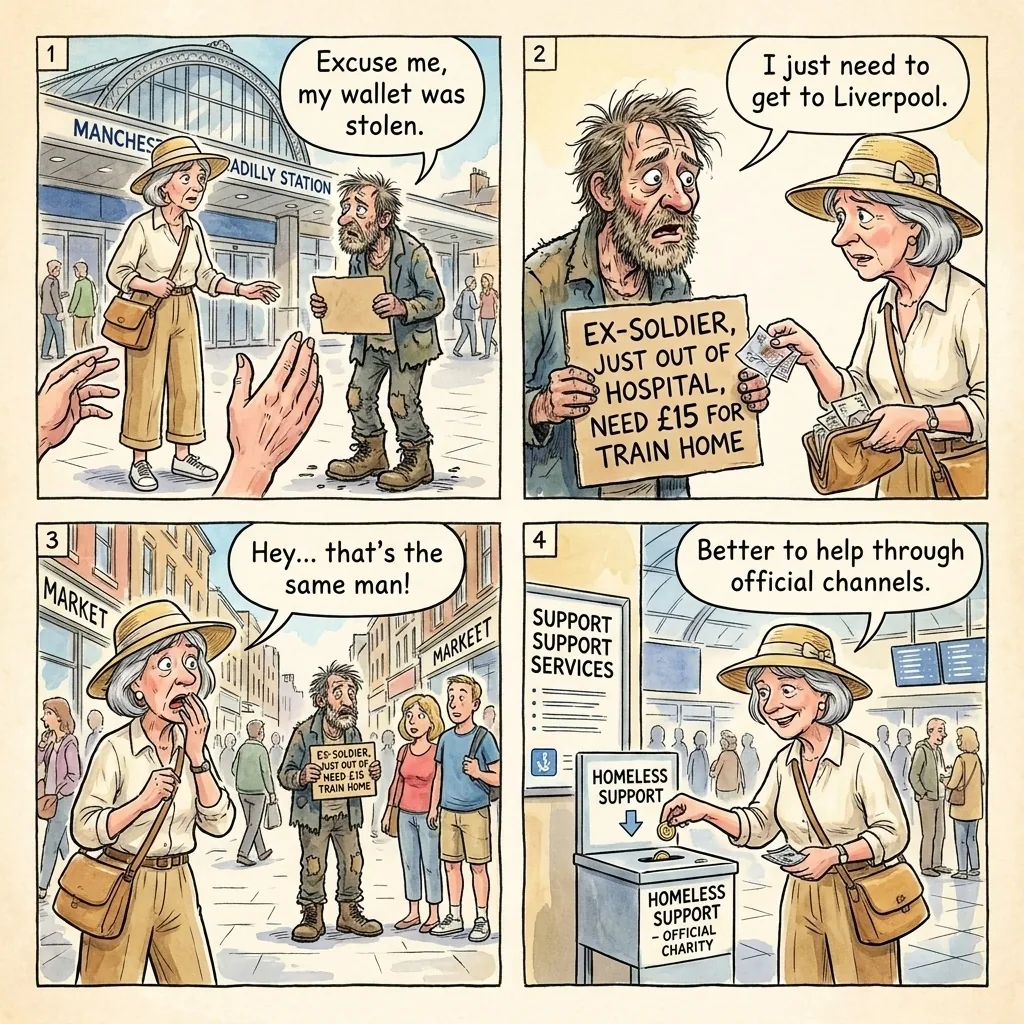
Coordinated teams on Manchester's city-centre pedestrian circuit rotate scripted "ex-soldier with stolen wallet" stories between Piccadilly Station, Market Street, and the Arndale area, collecting £15 cash for a "train ticket home" from visitors who later spot the same actor giving the same pitch to other tourists across multiple locations the same day.
Manchester's city-centre pedestrian circuit — Piccadilly Station, Market Street, the Arndale Centre, Exchange Square — draws consistent tourist and shopper foot traffic, making it productive for approaches that rely on empathy and time pressure. The operators are not individuals in genuine crisis but coordinated teams working the same territory in rotation, passing props — cardboard signs, hospital discharge papers, transit-branded lanyards — between shifts. The approach is designed to feel spontaneous and personal; it is a scripted production run at scale.
A well-spoken man approaches near Piccadilly Station looking distressed. He is an ex-soldier recently discharged from hospital, his wallet has been stolen, and he needs exactly £15 for a train ticket home to Liverpool. He shows a cardboard sign that reinforces the story. The amount is specific enough to sound genuine and small enough to feel like a minor act of kindness. You hand over the cash. An hour later you see the same man on Market Street giving the same pitch to another visitor with the same precision. The signs and props rotate between team members who work specific zones across different shifts; the story is a template.
A genuine person stranded at Manchester Piccadilly would be helped by station staff, British Transport Police, or the Booth Centre — not by approaching individual tourists with a rehearsed story. Offer to buy a train ticket directly at the counter rather than handing over cash — a person genuinely stranded will accept; a scammer will decline and move on. If you want to support people in genuine need on Manchester streets, donate to the Mustard Tree or Barnabus, which provide direct services. Persistent or aggressive begging can be reported to British Transport Police at the station.
Red Flags
- The person has a very specific, well-rehearsed story with a precise amount needed
- They specifically ask for cash rather than suggesting you buy them a train ticket directly
- A cardboard sign with a detailed backstory looks suspiciously well-made
- You see the same person or the same sign being used by different people throughout the day
- They decline offers of direct help like buying food or contacting a charity on their behalf
How to Avoid
- Offer to buy a train ticket at the counter rather than handing over cash -- a genuine person will accept.
- Direct them to Manchester's Street Support service or Booth Centre for real assistance.
- Politely decline and keep walking -- 'Sorry, I can't help' is sufficient.
- If you want to help the homeless, donate to local charities like the Mustard Tree or Barnabus.
- Report persistent aggressive begging to British Transport Police at the station.

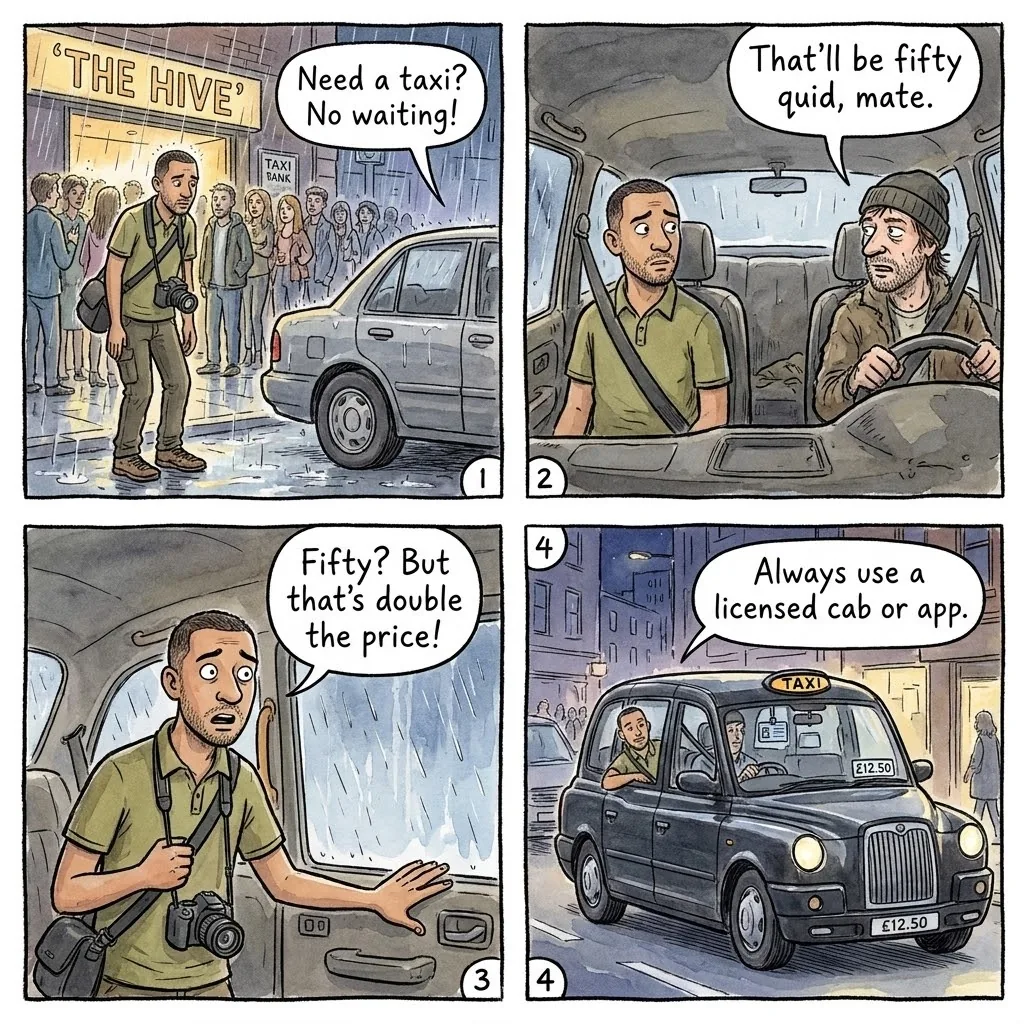
Unlicensed "pirate taxi" drivers outside Deansgate nightclubs and the Northern Quarter approach queueing tourists after 2 AM, luring passengers into unmetered cars with no licensing information, then naming double-fare prices once the door is shut — Greater Manchester Police describe these vehicles as entirely unregulated and have documented passengers driven to isolated areas under financial pressure.
Manchester's nightlife concentrates on Deansgate Locks, the Northern Quarter, and Canal Street, all emptying simultaneously after 2–3 AM on weekends. Licensed hackney cab queues stretch down the block and Uber surge pricing during peak exit windows can triple the normal fare. Cold weather, fatigue, and the prospect of a long queue combine to create exactly the conditions the unlicensed cab operator waits for. The car is unmarked, the driver is watching the taxi rank, and the pitch takes ten seconds.
A car with no taxi markings pulls alongside and the driver calls out: "Taxi? No queue, no wait." Relief overrides caution and you climb in. There is no meter, no partition, and no license information visible inside the car. The driver asks your destination, then names a price double the normal fare. Some passengers report being driven in the wrong direction before the price is stated, creating a situation where the choice is paying or getting out somewhere unfamiliar at 3 AM. Greater Manchester Police classify these as "pirate taxis" — unregulated, uninsured, and carrying no driver accountability.
The unlicensed cab approaches you precisely because you are already in a queue for a licensed alternative — the legitimate option is accessible if you are willing to wait. Pre-book a licensed private hire vehicle through Uber, Bolt, or a local firm like Street Cars before leaving the venue, and use only the official hackney cab ranks on Deansgate and Peter Street — a licensed hackney must display a valid plate on the rear and a driver badge on the dashboard, and no legitimate driver needs to approach you on the pavement. Travel in groups to reduce wait time and share the cost of licensed transport.
Red Flags
- The vehicle has no taxi sign, meter, or hackney carriage license plate
- The driver approaches you rather than being at an official rank or called through an app
- They refuse to quote a price until you're inside the vehicle
- The car has no partition between driver and passenger and no visible license information
- They only accept cash or request payment through unusual methods
How to Avoid
- Pre-book a licensed private hire vehicle through Uber, Bolt, or a local firm like Street Cars before you leave the club.
- Use the official taxi ranks on Deansgate and Peter Street where licensed Hackney cabs queue.
- Check that any Hackney cab has a valid plate on the rear and a driver badge on the dashboard.
- Travel in groups and share official taxis to reduce wait times and costs.
- Consider the night bus service or walk to a well-lit main road where licensed cabs are easier to find.
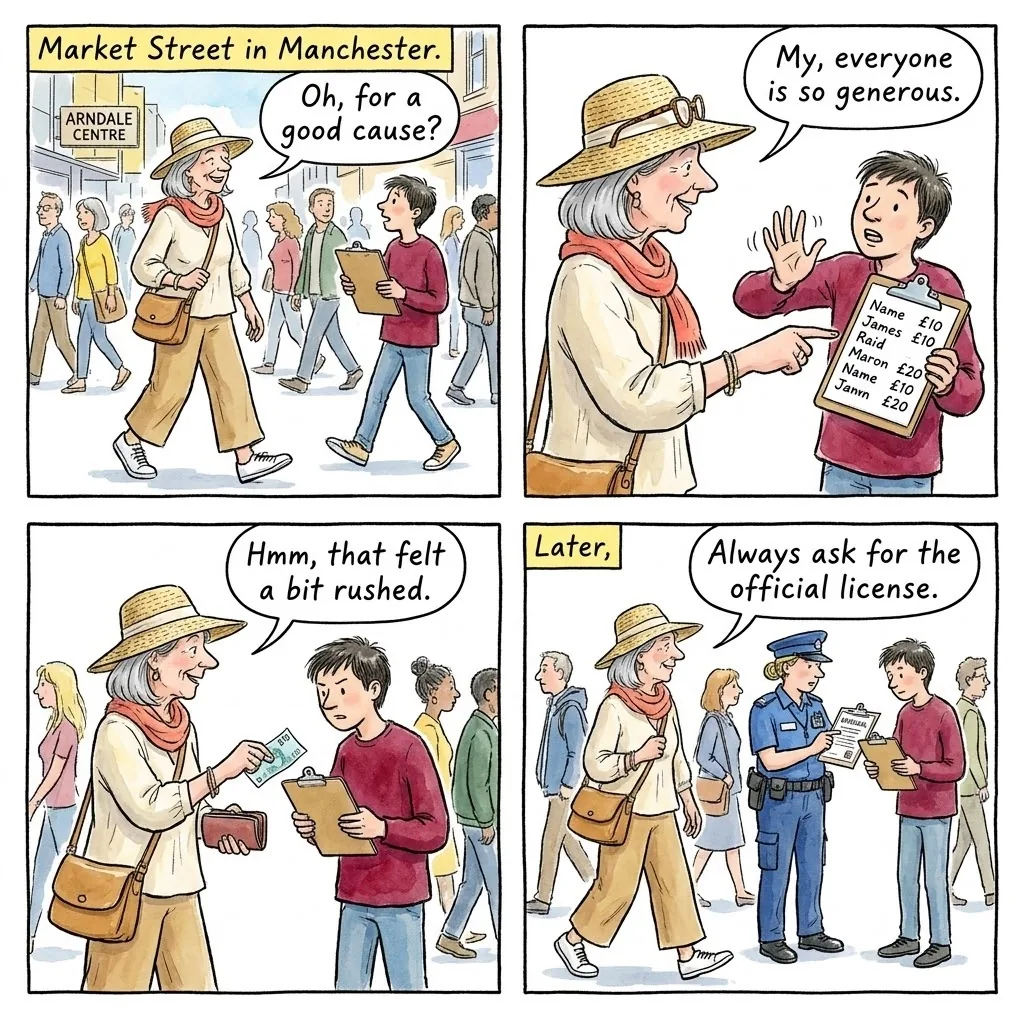
Unregistered charity collectors on Manchester's Market Street and Exchange Square use clipboards with pre-filled donation amounts and fake laminated badges to pressure tourists into signing and handing over £10–£20 — Greater Manchester Police have confirmed these collectors have no affiliation with registered charities and the money goes directly to the operators.
Market Street and Exchange Square are Manchester's highest-footfall pedestrian areas, connecting Piccadilly Gardens to the Arndale shopping complex and Deansgate. The steady flow of tourists, shoppers, and commuters makes it productive for street approaches that rely on brief, high-pressure interactions. Fake charity collectors position themselves at pedestrian pinch points — entry points to underpasses, narrowings near bus shelters — where it is harder to change direction once approached without making deliberate effort.
A person with a clipboard and a laminated badge steps in front of you. They gesture as if deaf or speak limited English, and push a sponsorship form toward you showing a charity logo and a column of names with donation amounts of £10–£20 already filled in. The form is designed to produce peer pressure: if everyone else gave £15, the implied expectation is that you should match it. You sign your name and hand over a £10 note. Greater Manchester Police have confirmed these collectors are not affiliated with any registered UK charity. The Charity Commission has no record of the organizations named on the forms. The money collected goes directly to the operators running the pitch.
Legitimate UK charity street collectors carry a council-issued license and official charity identification, and any registered charity can be verified on the Charity Commission website using their registration number. Ask for the charity registration number before giving anything — a legitimate registered charity will have one and the collector will have it on their ID; a fake collector will have neither, and that is the answer. Never write your name, address, or bank details on a street clipboard. If you want to support a Manchester-based charity, donate directly on their verified website rather than to a street solicitor you cannot identify.
Red Flags
- The collector aggressively blocks your path rather than standing to the side with a collection bucket
- The sponsorship form shows pre-filled names and large donation amounts to create social pressure
- The charity name doesn't appear on the Charity Commission register
- The collector cannot answer questions about the organization or provide a registration number
- They become hostile or follow you when you decline
How to Avoid
- Ask for the charity registration number and verify it on the Charity Commission website before donating.
- Legitimate UK street collectors carry a council-issued license and official charity ID.
- Say 'no thank you' firmly and keep walking -- you have no obligation to stop or sign anything.
- Never write your name, address, or bank details on a street clipboard.
- If you want to support a charity, donate directly online through their verified website.
🆘 What to Do If You Get Scammed
📋 File a Police Report
Go to the nearest Greater Manchester Police station. Call 999 (emergency) or 101 (non-emergency). Get an official crime report — you'll need this for insurance claims. You can also report online at gmp.police.uk.
💳 Cancel Your Cards
Call your bank immediately. Most have 24/7 numbers on the back of the card (keep a photo saved separately). Block any suspicious transactions before the thieves use your details.
🛂 Lost Passport?
Contact your nearest embassy or consulate. The US Embassy is at 33 Nine Elms Lane, London SW11 7US. For emergencies: +44 20 7499 9000.
📱 Track Your Device
If your phone was stolen, use Find My (iPhone) or Find My Device (Android) from another device. Don't confront thieves yourself — share the location with police instead.