Key Takeaways
- The #1 reported scam is the Marina Pez Vela Sportfishing Charter Advance-Fee Fraud
- 1 of 5 scams are rated high risk
- Use app-based ride services (Uber, DiDi) instead of street taxis — avoid unmarked vehicles, especially at night
- Never accept unsolicited offers from strangers near tourist sites in Quepos
⚡ Quick Safety Tips
- Book Marina Pez Vela charters only through marinapezvela.com or named operators on the marina's vessel list — never via dockside brokers or WhatsApp deposit links.
- Pre-book your La Managua (XQP) airstrip transfer through your hotel or Easy Ride; ignore the unmarked sedans at the gate quoting $40–$80 for a $10 metered run.
- Keep your daypack between your feet at the Quepos Tracopa terminal and on the Route 27 bus — pickpockets work the boarding scrum and the coffee-stand line.
- Eat at sodas (Soda Sanchez, Mercado Central stalls, El Patio de Cafe Milagro) and ask for la carta en colones — Calle 2 waterfront English-only menus run two to three times local prices.
Jump to a Scam
- High Marina Pez Vela Sportfishing Charter Advance-Fee Fraud
- Low Quepos Calle 2 Waterfront Restaurant 'Gringo Menu' Overcharge
- Medium La Managua Airstrip Pirate-Taxi Transfer Overcharge
- Medium Quepos Marina Jet-Ski And ATV Damage-Inflation Deposit Trap
- Medium Quepos Tracopa Terminal Boarding-Scrum Pickpocket And Daypack Theft
The 5 Scams
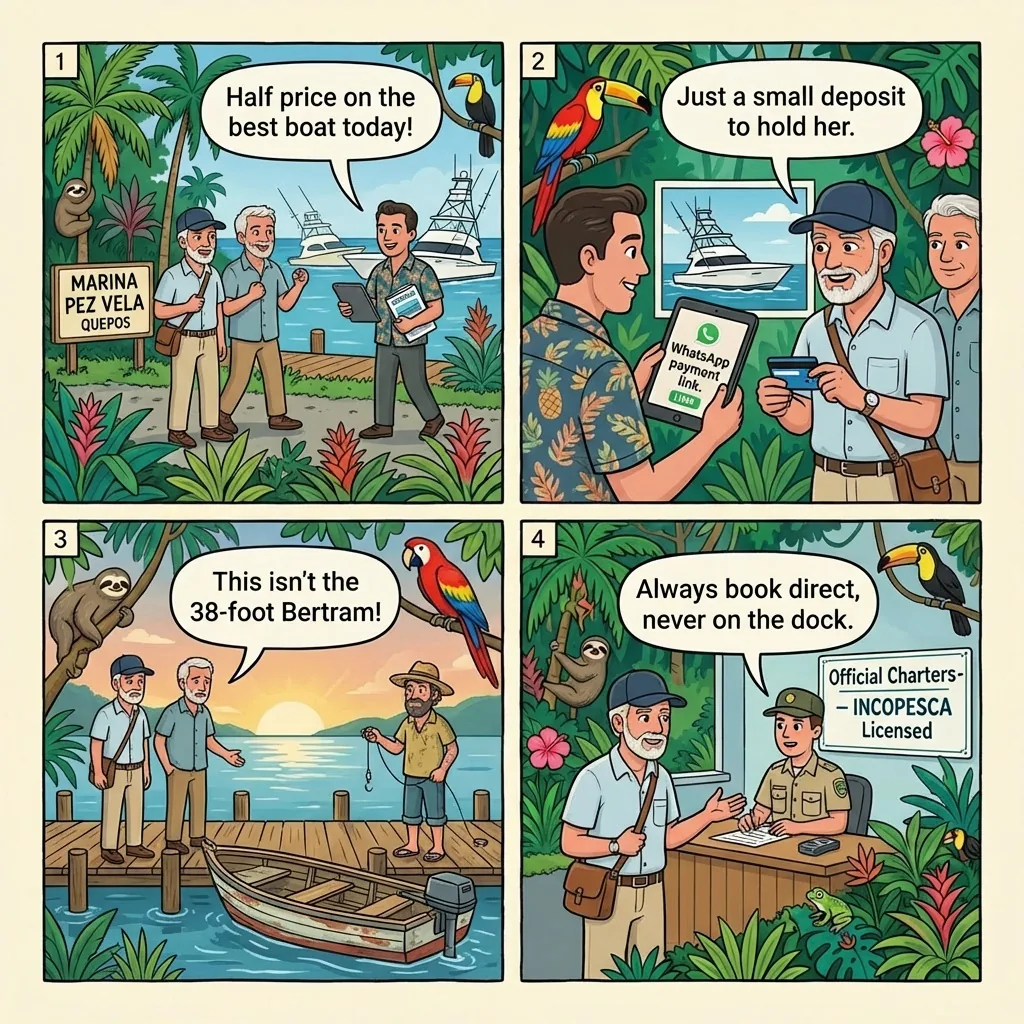
Unlicensed brokers on Marina Pez Vela's dock take $300–$1,500 wire deposits for premier sportfishing charters that either no-show or substitute a smaller boat.
Walk the floating dock at Marina Pez Vela on a weekday morning and you will see the setup: men with laminated charter brochures and tablets standing where anglers exit their hotel transfers, all promising the marina's top boats at half-price. They quote in fluent English, point at any 32–38 foot vessel on the water, and push WhatsApp deposit links that route to personal accounts rather than the actual operator. The 50% deposit lands. The booking confirmation email never arrives.
The pivot happens at 5 a.m. the next morning at the marina gate. Either no captain shows up at all and the WhatsApp number stops responding, or a different boat appears. The advertised 38-foot Bertram with twin diesels becomes a 26-foot inshore skiff with one outboard and a captain who cannot produce an INCOPESCA carnet. When you push back on the dock, the broker is gone — they work commission-only and rotate marinas. The captain shrugs and says you can fish or stand on the dock. Most groups fish to salvage the day and discover the offshore range and billfish tackle do not exist.
Legitimate Marina Pez Vela operators (Bluefin Sportfishing, Quepos Fish Adventure, the marina's own booking desk) accept a 50 percent deposit through a credit card with the balance dockside, never a wire to a personal name. Reddit threads on Quepos charters document the same theater running into 2026, with brokers conflating Marina Pez Vela in Quepos with Marina Los Sueños 80 km north so anglers wait at the wrong dock. Costa Rica's INCOPESCA sport-fishing license costs $15 for eight days and any commercial captain must hold and display the carnet. The defensive move is to book directly through marinapezvela.com, pay 50 percent on a credit card, and require the boat name plus captain's INCOPESCA carnet number in writing before any deposit.
Red Flags
- Dockside brokers with laminated brochures pointing at boats they do not operate
- WhatsApp-only deposit requests routed to a personal name rather than a registered operator
- Quotes that conflate Marina Pez Vela in Quepos with Marina Los Sueños 80 km north
- Refusal to put the boat name, captain name, or INCOPESCA carnet number in writing
- Pricing 30–50 percent below FishingBooker's $113-per-person floor for the same boat class
How to Avoid
- Book directly at marinapezvela.com or with a named operator on the marina's published vessel list, not a dockside tablet.
- Pay the 50 percent deposit on a credit card so a chargeback is possible if the captain no-shows.
- Require the boat name, captain's full name, and INCOPESCA carnet number in writing before any payment.
- Buy your own $15 eight-day INCOPESCA license at incopesca.go.cr so a captain cannot fake one for you.
- Confirm the marina address as Marina Pez Vela, Quepos — not Los Sueños in Herradura — on every booking message.
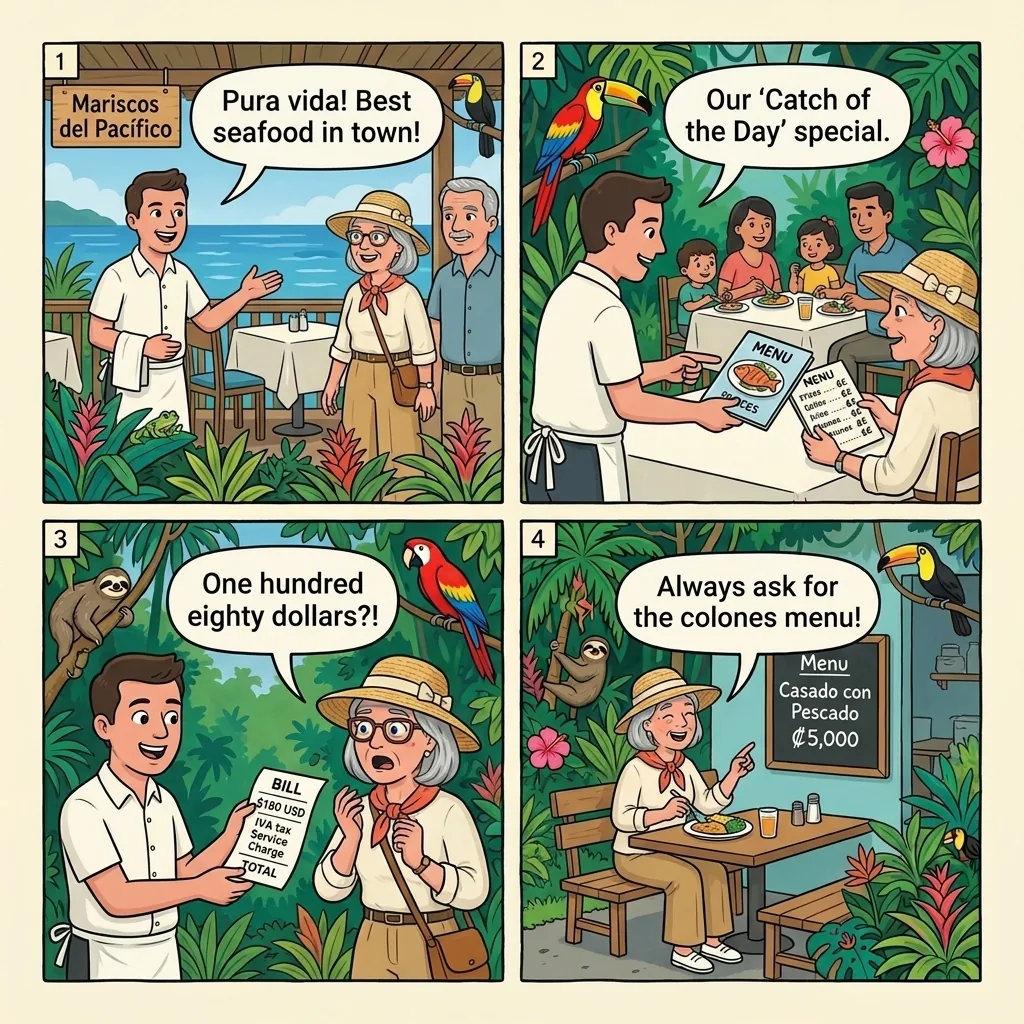
Quepos Centro hands tourists a no-prices English menu and the bill arrives at two to three times what locals pay at the same restaurant.
The corridor runs along Calle 2 and the marina-facing strip, distinct from the Manuel Antonio hillside restaurant strip 5 km south. A waiter sees foreign passports or hears English at the curb, walks back inside, and returns with a different menu — glossy, English-only, no colon prices, no tax line. The $40 plate of ribs, the $28 ceviche, the $18 'fresh catch of the day' that locals at the next table are eating from a 6,000-colón soda menu.
The bill lands without warning. There is rarely an aggressive escalation in Quepos — the model relies on you not knowing the difference. A four-person dinner that should run 35,000 to 50,000 colones at a soda becomes $180 to $240 with a 13 percent IVA tax, a 10 percent service charge, and an 'optional' propina line already added. The waiter brings the card terminal already set to dollars, applying a dynamic-currency-conversion rate roughly 5 percent worse than your card's interbank rate. (2026, flagged Lagarto in this same corridor for $40 ribs of teaching-kitchen quality and uniformly fake five-star reviews; the thread's top-voted reply is to skip the corridor entirely and eat at sodas.
Quepos has excellent sodas — Soda Sanchez, the Mercado Central food stalls, El Patio de Cafe Milagro for sit-down — where casados run 3,500 to 5,500 colones and a whole grilled fish runs 8,000 to 12,000. Locals walk straight past the English-menu corridor for a reason. Waterfront seafood spots that hand you the menu without asking what language you read, and that show colón prices to the right of dollar prices, are usually fair. The defensive move is to ask for la carta en colones and walk if the only menu is English-only with prices in USD.
Red Flags
- English-only menu with prices in dollars and no IVA tax line broken out
- Waiter switching menus after hearing English at the curb
- Card terminal pre-set to dollars with dynamic-currency-conversion enabled
- 10 percent service plus 'optional' propina pre-printed on the bill
- $40 ribs and $28 ceviche on a strip where soda casados sell for 4,000 colones
How to Avoid
- Ask for la carta en colones — colón pricing is the local-rate test.
- Walk to a soda — Soda Sanchez, Mercado Central stalls, El Patio de Cafe Milagro — for casados under 6,000 colones.
- Refuse dynamic currency conversion at the card terminal and pay in colones.
- Confirm the 13 percent IVA and any propina before signing the slip.
- Photograph the menu and bill — chargeback evidence if the totals do not match.
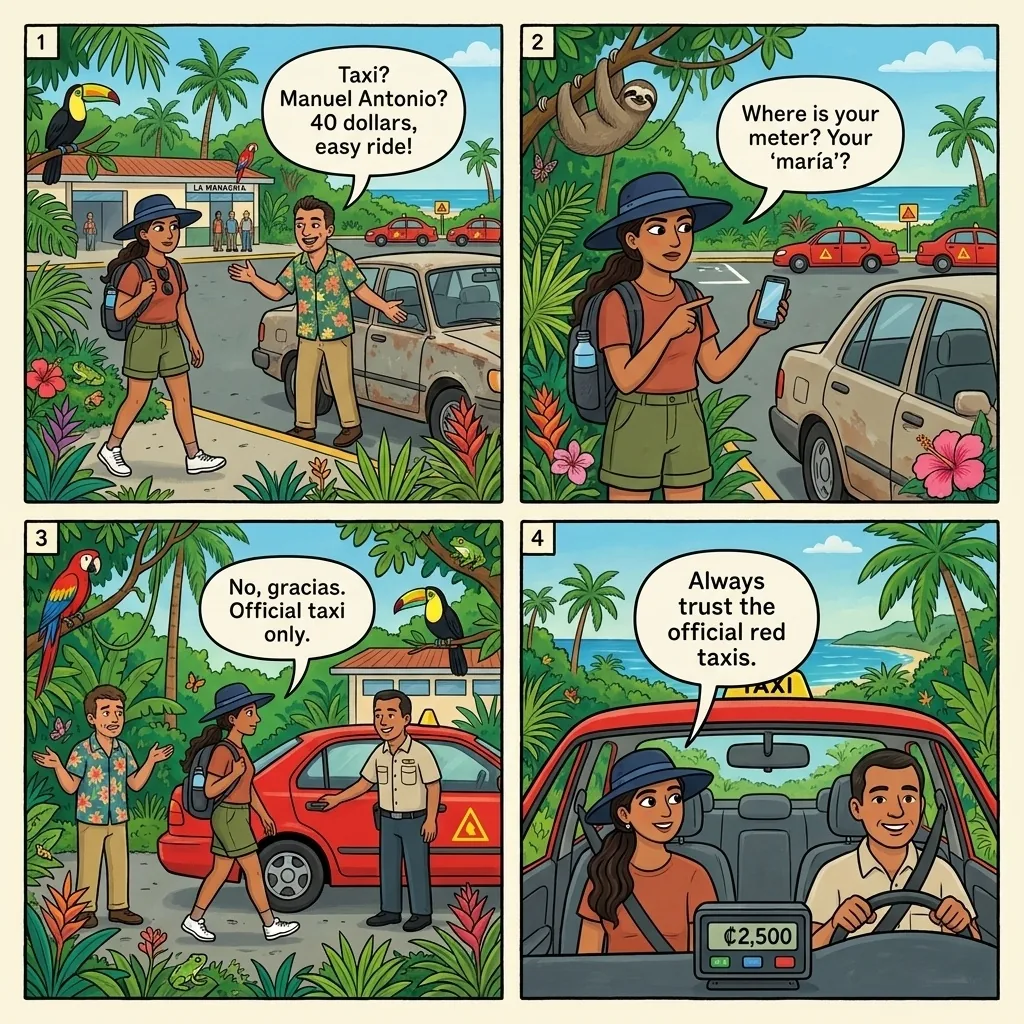
Pirate-taxi drivers at La Managua airstrip charge $40–$80 in cash for a $10 official run into Quepos or Manuel Antonio, and some are uninsured and unaccountable.
Sansa flight 521 from San José lands at the small La Managua field 3 km north of central Quepos, taxis a few minutes, and discharges 12 to 18 passengers with luggage onto a single curb. The official red taxis with yellow triangle decals and visible María meters wait further down. Closer to the gate, drivers in older five-seater sedans with no decals and no meters approach as you exit — soft voice, hand on the bag, 'Quepos? Manuel Antonio? Easy ride, 40 dollars.'
The quote is the trap. The legitimate red-taxi run from XQP to Quepos Centro is roughly 3,000–5,000 colones (about $6–$10) on the meter, and the run to Manuel Antonio hotels caps near $20–$25. Pirate taxis (taxis piratas) cite $40 for the same ride, $60–$80 for the hotel run, and produce no receipt. The car has no insurance under Costa Rica's Cabotaje regime, no commercial registration, and the driver's identity is not on file with the airstrip. Most rides end fine — locals use these cars all day at 700-colón fares — but for tourists with luggage at night, the lack of insurance becomes real exposure if there is an accident or detour.
The US Embassy San José Security Alert of November 25, 2025 flagged criminal gangs forcing foreigners to withdraw cash from ATMs as a rising pattern in Costa Rica, and isolated unmarked-vehicle rides at small regional airstrips are the textbook setup. Sansa and Skyway publish hotel-transfer partner lists on flysansa.com, and most Quepos and Manuel Antonio hotels send their own van for a fixed $20–$30. Easy Ride and Interbus pre-book online and meet at the curb with a printed name placard. The defensive move is to pre-book your hotel's transfer or an Easy Ride van before your flight lands and walk straight past the gate-side touts to the placard line.
Red Flags
- Five-seater sedan with no roof decal, no taxi-meter, and no driver-ID card on the dashboard
- Cash-only quote of $40–$80 for a run that meters at $6–$25
- Driver approaching at the gate exit before you reach the official red-taxi rank
- No printed receipt and no commercial-vehicle Cabotaje registration document on display
- Pressure to load bags before you confirm the price in colones
How to Avoid
- Pre-book a hotel airport transfer or an Easy Ride / Interbus van before you fly to XQP.
- Take only red taxis with yellow triangle decals and a visible María meter, never an unmarked sedan.
- Confirm the meter is on or agree a written colón price before the bags go in the trunk.
- Walk past the gate-side touts toward the official taxi rank further down the access road.
- Photograph the license plate and dashboard ID before you board any taxi at XQP.
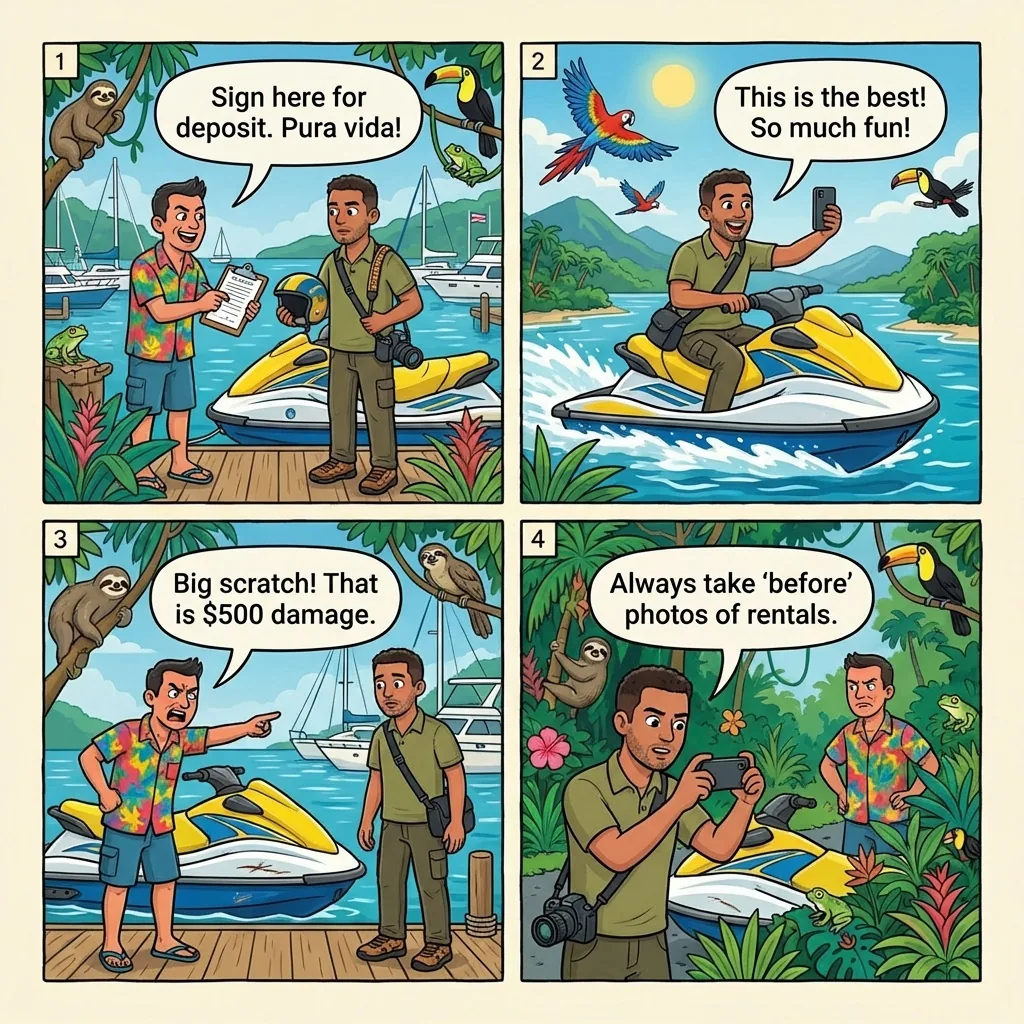
Marina-side jet-ski and ATV operators in Quepos hand renters equipment with pre-existing scratches, then bill $200–$600 for 'damage' against a credit-card deposit when the equipment returns.
The booking happens fast: a kiosk at Marina Pez Vela or an ATV office on Avenida Central, a one-page rental form in English, a credit-card deposit authorization for $500 to $2,000 that is signed but never finalized, a verbal walk-around that skips the underside of the jet-ski hull or the lower fairings of the ATV. The renter is encouraged to launch and ride. The damage inventory is not photographed in front of the renter. Two hours later, the equipment returns to the dock or yard.
The operator points to a scratch on the jet-ski hull, a chip on the ATV plastic, a crack in a mirror that nobody walked through together at start. The dollar amount lands: $200 for a hull buff, $400 for plastic replacement, $600 for what the operator calls 'engine inspection.' The deposit authorization is run as an actual charge before any dispute. Some operators ask for the renter's passport as collateral and refuse to return it until the damage charge clears, which is illegal under Costa Rica's tourism regulations but happens often enough that the US Embassy fraud-prevention guidance specifically warns against handing over passports as deposit.
The pattern matches Jacó's documented ATV/golf-cart damage-inflation scam 70 km north and runs on the same psychological hook: a vacation day already spent, a flight or transfer in two hours, a renter who will sign anything to leave with their card and passport. Reddit threads on Quepos rentals and Manuel Antonio jet-ski tours flag the same operators rotating between Marina Pez Vela and Playa Espadilla under different names. The defensive move is to walk a full timestamped video around every panel of the equipment, with the operator on camera, before you sign anything or hand over any card.
Red Flags
- Walk-around skipping the underside of the jet-ski hull or the lower fairings of the ATV
- Operator demanding a passport as collateral instead of a credit-card hold
- Credit-card deposit form that authorizes 'damage' charges without itemized cost ceilings
- No photos taken of the equipment with the operator present at start of rental
- Verbal-only damage inspection on return — no photos, no parts list, no body-shop quote
How to Avoid
- Record a full timestamped video around every panel before you sign — get the operator's face on camera.
- Refuse passport-as-deposit; insist on a credit-card hold that you can dispute later.
- Demand an itemized cost ceiling on the rental contract for any potential damage charge.
- Photograph hull, fairings, mirrors, tires from all sides at pickup and again at return.
- Pay only on a credit card that supports chargebacks for unauthorized rental charges.
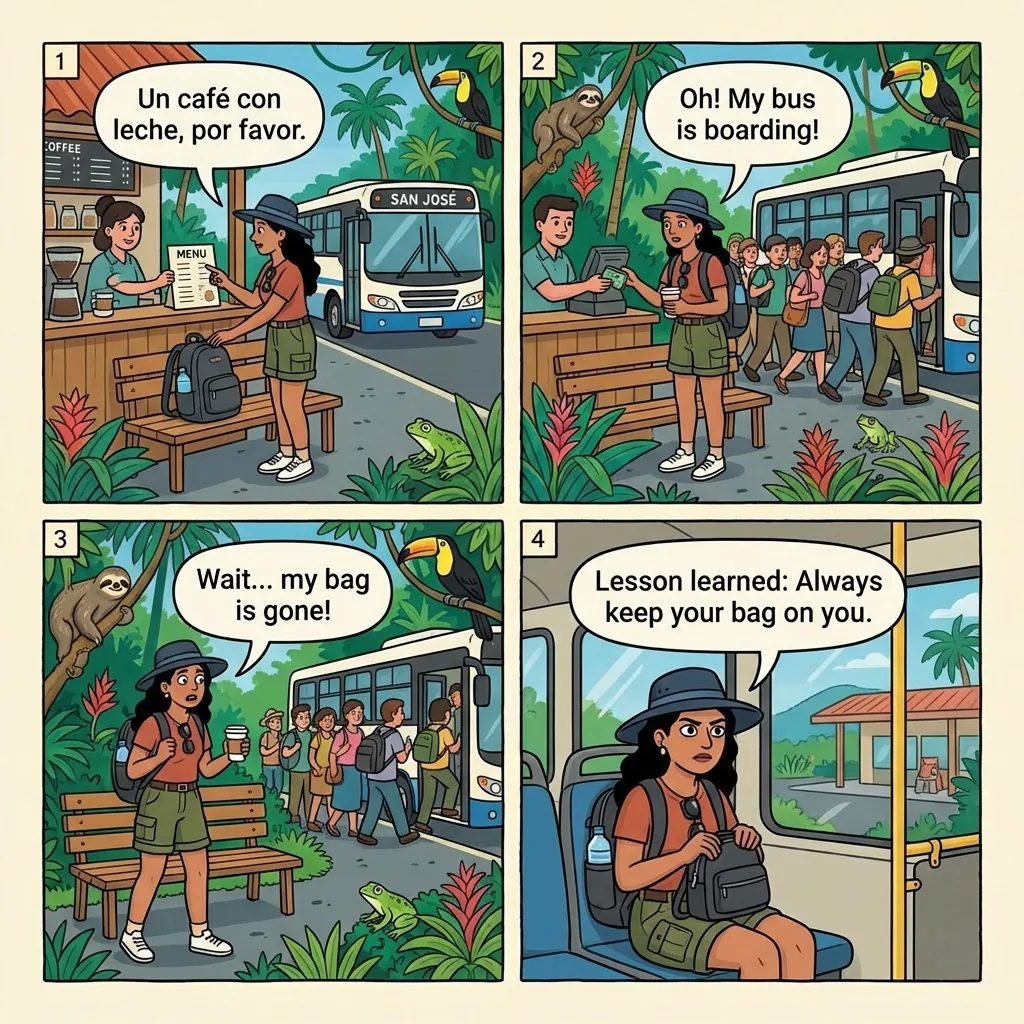
Pickpockets at Quepos's Tracopa terminal target the boarding scrum and the coffee-stand line, lifting wallets, phones, and daypacks during the first five minutes of platform chaos.
The Quepos terminal is small — a single-story building, one coffee counter, a few benches, a covered platform where Route 27 buses to San José pull in. When a colectivo or directo arrives, 30 to 60 passengers compress into a 10-meter slot trying to load luggage into the underbelly hold while also grabbing a seat. The pickpocket pattern hits at exactly that pinch point: one person waits near the coffee stand, watches a tourist set their daypack on a bench while paying for a snack, lifts it as the bus is announced.
The variant on the bus itself is more insidious. Tourists stash daypacks in the overhead bin or in the seat-back pocket and stretch their legs for the four-and-a-half-hour ride to San José. A second passenger boards two stops later, sits adjacent, and waits for the original passenger to fall asleep or use the on-board restroom. The phone or laptop disappears from the seat pocket; the daypack from the overhead bin opens just enough for a passport sleeve or wallet to vanish. The bus does not stop. The reporting trail begins at OIJ in San José hours later.
This pattern is distinct from the rest-stop luggage theft on the SJO–Quepos midpoint, which lives on the Manuel Antonio page. The Quepos-terminal version is documented across Reddit threads boarding threads from 2025 and 2026. The Tico Times reported in February 2024 that Quepos was among 10 Costa Rican areas with the highest tourist-crime concentration out of 1,447 nationwide reports, and the US Embassy San José Security Alert of November 25, 2025 noted rising property crime against foreigners. Tracopa's official ticketing happens through the Passer app or at the Quepos terminal counter. The defensive move is to keep your daypack between your feet for the full ride and never put valuables in the seat-back pocket or overhead bin.
Red Flags
- Loiterers near the coffee stand without luggage who watch travelers more than the platform
- Strangers standing too close in the boarding scrum during luggage-loading
- Adjacent passengers boarding at intermediate stops who immediately try to make conversation
- Daypacks left on benches during snack purchases at the terminal counter
- Tourists stowing valuables in seat-back pockets within reach of the row behind
How to Avoid
- Buy Tracopa tickets through the Passer app or at the terminal counter — never from sidewalk resellers.
- Keep your daypack between your feet for the full ride; never use the seat-back pocket for anything.
- Wear a money belt or front-facing crossbody for passport, cards, and phone during boarding.
- Photograph your luggage tag and the underbelly bin as you load — proof if a bag goes missing.
- Report any theft to OIJ at sitiooij.poder-judicial.go.cr and call the US Embassy on +506 2519-2000.
🆘 What to Do If You Get Scammed
📋 File a Police Report
Go to the nearest Fuerza Pública / OIJ (Organismo de Investigación Judicial) station. Call 911 (general) or 800-8000-645 (OIJ tip line). Get an official crime report — you'll need this for insurance claims. You can also report online at poder-judicial.go.cr.
💳 Cancel Your Cards
Call your bank immediately. Most have 24/7 numbers on the back of the card (keep a photo saved separately). Block any suspicious transactions before the thieves use your details.
🛂 Lost Passport?
Contact the US Embassy in San José at Calle 98 Vía 104, Pavas, San José. For emergencies: +506 2519-2000 (after hours +506 2220-3127). Policía Turística (Tourist Police) hotline: 2258-1008 / 2258-1022. ICT tourist info: 2286-1473 / 1-800-TOURISM.
📱 Track Your Device
If your phone was stolen, use Find My (iPhone) or Find My Device (Android) from another device. Don't confront thieves yourself — share the location with police instead.
Frequently Asked Questions
You just read 5 scams in Quepos. The book has 64 more across 11 Costa Rican destinations.
Manuel Antonio “park closed” fake-ranger $40 access-fee shakedowns. SJO airport taxi-meter overcharges. La Fortuna ATV / hot-springs bait-and-switch combos. Tamarindo 90-minute timeshare traps. Tortuguero turtle-tour “guide” demands. Every documented Costa Rica scam — with the exact scripts, red flags, and Costa Rican Spanish phrases that shut each one down. Drawn from Reddit, U.S. Embassy alerts, and OIJ (Organismo de Investigación Judicial) police reports.
- 69 documented scams across San José, Manuel Antonio, La Fortuna, Tamarindo & 7 more destinations
- A Costa Rican Spanish exit-phrase card you can screenshot to your phone
- Updated annually — buy once, re-download future editions free
- Readable in one flight — $4.99 on Amazon Kindle