
Key Takeaways
- The #1 reported scam is the Rose Seller Pressure.
- 1 of 7 scams is rated high risk.
- Use app-based ride services (Uber, DiDi) instead of street taxis — avoid unmarked vehicles, especially at night.
- Never accept unsolicited offers from strangers near tourist sites in Cartagena.
⚡ Quick Safety Tips
- Never leave drinks unattended in bars or accept beverages from strangers; scopolamine drugging is a documented threat in Cartagena's nightlife scene.
- Agree on taxi fares before getting in the car and keep a list of standard rates on your phone; alternatively, use Uber or InDriver for transparent pricing.
- Keep a photocopy of your passport in your hotel and carry it instead of the original; store valuables in the hotel safe with a code only you know.
- Stay in well-lit, populated areas after dark and avoid walking alone in Getsemaní or the Walled City side streets late at night; use taxis or ride-hail apps for nighttime transport.
Jump to a Scam
The 7 Scams
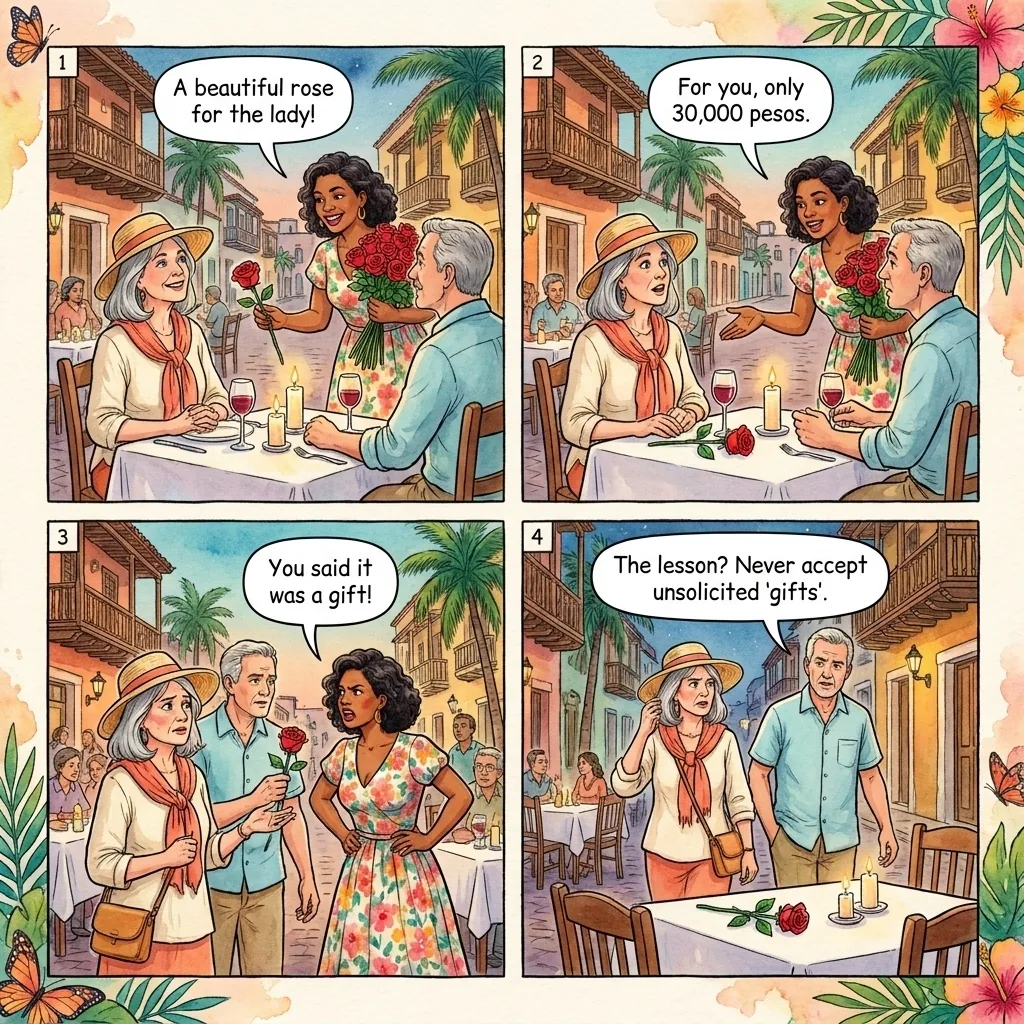
A woman with a bundle of roses appears beside your table on Plaza Santo Domingo and slips a flower into your partner's hand before you can wave her off, then turns back demanding 10,000 to 30,000 COP (~$3–$8). The flower is the contract — once it touches a hand, you're paying to get rid of it.
You're sitting at one of the open-air restaurants on Plaza Santo Domingo, Botero's bronze reclining woman a few meters from your table, the bell tower of the church silhouetted behind her. The waiter has just brought a bottle of rosé. A woman steps out of the dusk with a thin bundle of red roses in her arm and walks straight up to your partner. Before you can say "no, gracias," she has tucked a single rose into your partner's hand and is murmuring "regalo, regalo" — a gift, a gift — already half-turned to walk away. You exhale, half-charmed.
Then she stops, ten feet off, and turns back. The smile is gone. "Veinte mil," she says, holding out her palm. You try to hand the rose back. She steps back and won't take it, gestures at your partner's hand: "She accepted it." You set it on the table; she points at the table: "She accepted it." If you stand, the volume goes up — now half the restaurant is glancing over, your partner is flushed, the waiter is studiously not looking. You pull out a 20,000 COP note and put it in her hand to make it stop. She's already moved on to the next table before the bill is fully extended.
The whole play hinges on the half-second between gift and contract. Cartagena's Walled City vendor problem is so chronic that El Heraldo has run multi-year coverage of beach and plaza overcharging, and even the Italian YouTuber Federico "Zazza" Zompichiatti recorded a viral exposé in 2024 walking through Bocagrande and Centro Histórico to document vendors charging 30,000 COP for keychains and 10,000 COP for a single beer. Restaurant managers know who the rose women are — they've worked the same plazas for years — but most won't intervene because their tables are on a public square. The Policía de Turismo patrols Plaza de Bolívar and Plaza Santo Domingo in their teal vests, and El Tiempo has documented their "Plan Titán" interventions reversing absurd beach charges. Keep your hands flat on the table and say "no, gracias" before the rose ever touches you — once the flower lands, the script flips and the cheapest exit is to pay.
Red Flags
- Anyone approaching your table in Plaza Santo Domingo or Plaza de Bolívar with a flower already extended toward your companion
- A vendor who says "regalo" or "gift" while moving the object toward you, not away
- Vendors who refuse to take an item back once it has touched your hand or table
- A second person hovering nearby while the first does the approach
- Any pricing conversation that only happens after the object has changed hands
How to Avoid
- Say "no, gracias" before any flower or object reaches your table, not after.
- Keep both hands visibly on the table when vendors approach so a flower has nowhere to land.
- If a rose is already on your table, push it back across to the vendor's side and stand up if you must.
- Choose terraces or restaurants that have a roped barrier or hostess station between the street and the dining area.
- If pressure escalates, flag the Policía de Turismo officers patrolling the Walled City plazas in teal vests.
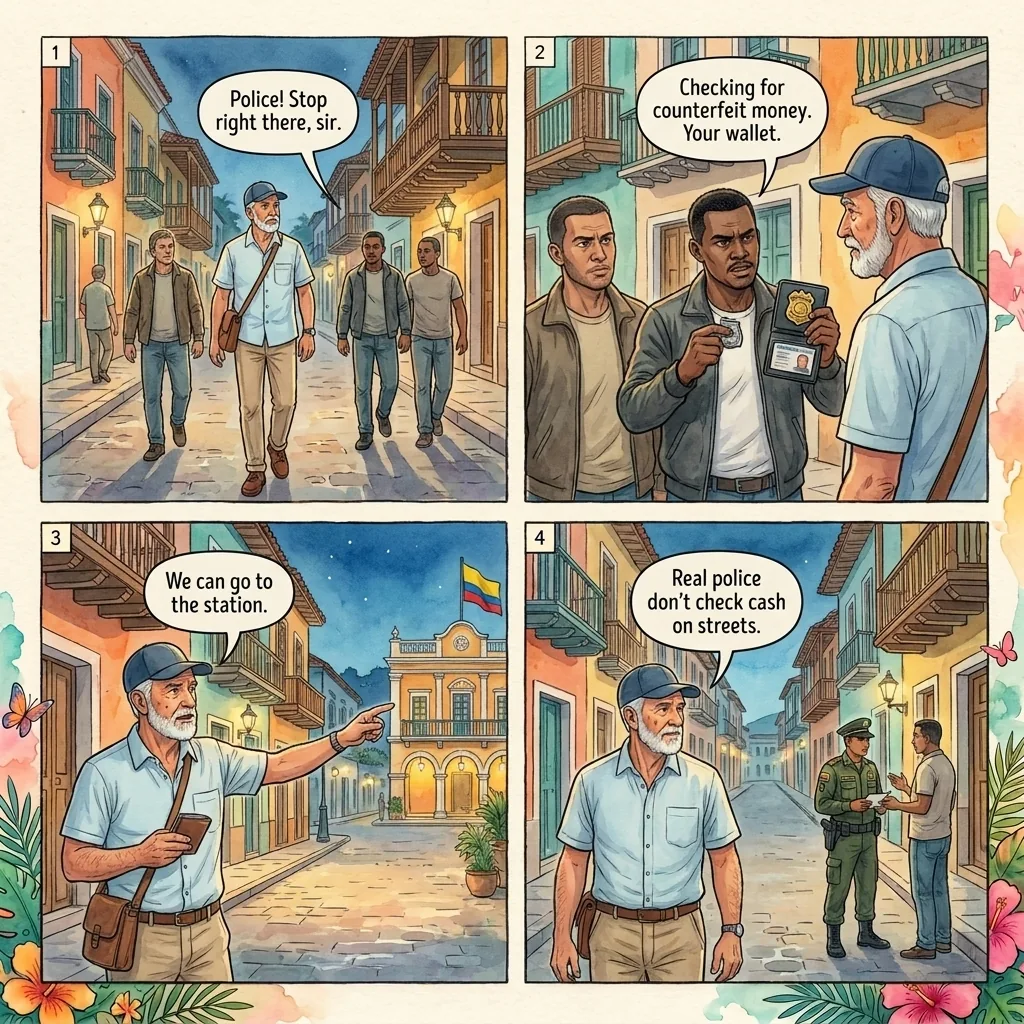
A friendly stranger in Getsemaní offers you a "free sample" of cocaine on the sidewalk, presses a baggie into your pocket, and minutes later two men flashing badges arrive accusing you of a drug buy and demand cash to make it disappear. The dealer and the cops are working the same script.
You're walking up Calle del Espíritu Santo toward Plaza de la Trinidad in Getsemaní after a couple of beers. A young man falls into step beside you, wide smile, "you having a good night, my friend, where are you from?" The chat is light. Then it tilts: "you want some perico, some weed, anything?" You wave it off. He stays cheerful and pulls out his phone — "let me give you my number, in case you change your mind." He fumbles the digits, asks to type it in himself, hands the phone back. Before you've taken three more steps, he says "free sample, just for you," his friend appears from a doorway, and a small baggie lands in your jacket pocket.
You're still trying to fish it out and hand it back when two men in plain clothes round the corner. One flashes a badge wallet. "Policía. Drugs?" They've already seen the baggie. The dealer has vanished. You try to explain — they cut you off. Now it's a station ride, or a fine, paid here. The number starts at 2,500,000 COP (~$650). When you say you don't have it, they walk you to an ATM. A second man steps in behind you. The "discount" lands at 1,200,000 COP (~$310). You withdraw, hand it over, and they melt back into the street. No paperwork, no card, no station.
The whole encounter is staged from the moment the dealer says hello — the same crew runs the bait, the planted baggie, and the fake badges. Reddit's "Coordinated Extortion in Cartagena" thread (190-plus comments) and a parallel Reddit case both describe the identical playbook, sometimes with real cops in shoulder-tag-covered uniforms appearing at the Airbnb hours later for a second pass. Real Policía Metropolitana de Cartagena and Policía de Turismo officers wear visible name tags, work in marked vehicles, and process all fines through the station — they will not negotiate roadside or escort you to a Bancolombia ATM. The US Embassy's Colombia security alerts repeatedly warn that criminals impersonate police, often in coordination with street drug dealers, to extort tourists. If anyone in plain clothes flashes a badge and starts steering you toward an ATM, demand to walk to the nearest CAI police booth or call 123 from your own phone — real officers will agree, the fake ones will scatter.
Red Flags
- A street stranger who escalates from small talk to drug offers within sixty seconds
- Anyone who asks to type their phone number into your phone instead of dictating it
- A "free sample" pressed into your hand or pocket that they refuse to take back
- Plain-clothes men with badge wallets but no marked vehicle, no name tags, and no body cameras
- Anyone in uniform who insists on settling a fine in cash on the sidewalk
How to Avoid
- Keep moving and answer "no, gracias" without stopping when offered drugs anywhere in Getsemaní or the Walled City after dark.
- Never let a stranger touch your phone — dictate or hand them a pen and paper if they insist.
- If something is dropped into your pocket, drop it on the ground and walk away immediately; do not keep it on you.
- Demand to walk to the nearest CAI police booth or call 123 yourself before any payment is discussed.
- Carry only a small amount of cash and a single card when going out at night, and leave your passport in the hotel safe.
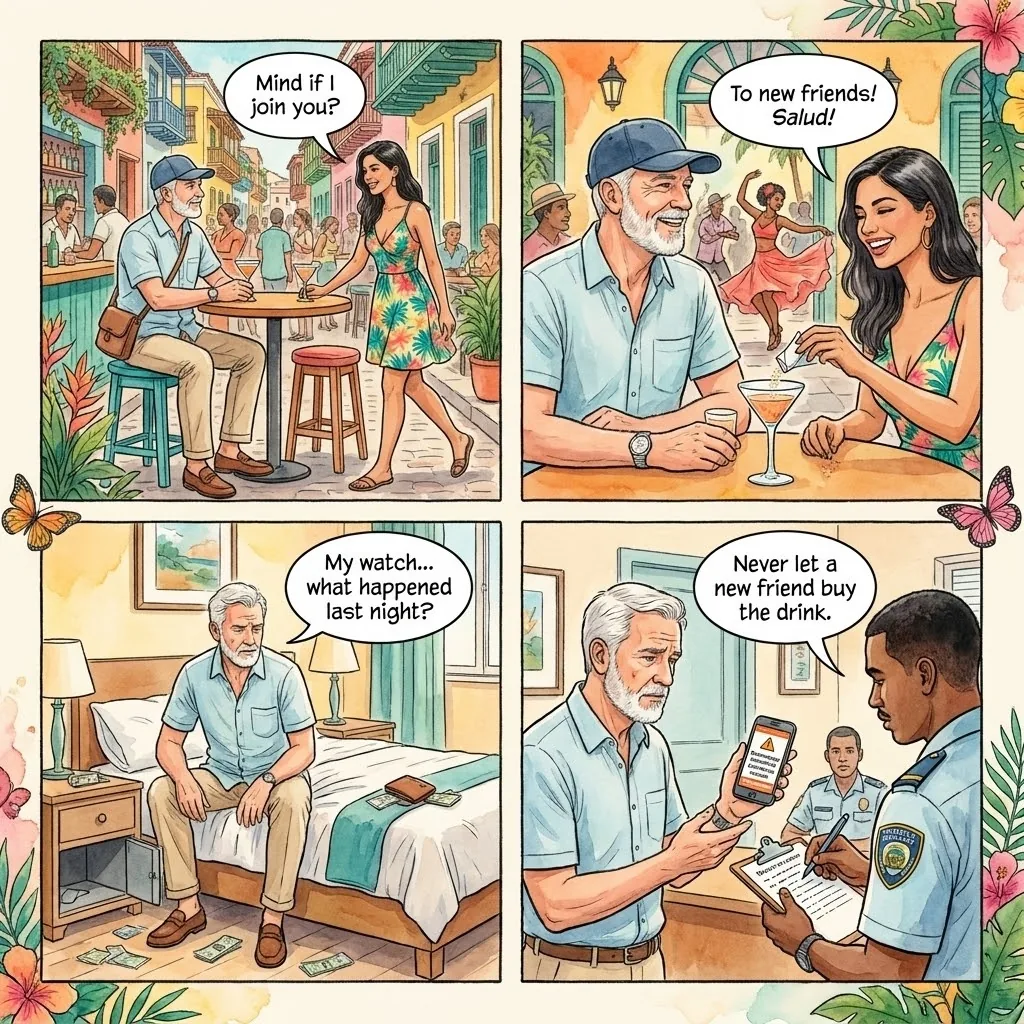
A woman you matched with on Tinder meets you for a drink at a Getsemaní bar, slips scopolamine — known locally as burundanga — into your second round, and an hour later you're voluntarily walking her into your hotel room and opening the safe with no memory you'll later be able to recover. The drug doesn't knock you out; it makes you compliant.
You match with her two days before flying in. The conversation moves fast, she's funny, the photos look real. She picks the bar — somewhere on Calle del Arsenal in Getsemaní, lots of people, music spilling out the door. She arrives, the drinks come, the conversation is great. Halfway through the second round you feel a wave of something — not drunk exactly, more like soft and obliging. She suggests one more somewhere quieter. You agree. The next coherent memory you have is a 6 a.m. blue-gray Cartagena dawn through hotel window slats, your phone gone, the safe open, your laptop gone, and her side of the bed cold for hours.
The drug is scopolamine, locally called burundanga or "Devil's Breath," extracted from the borrachero tree that grows wild across the Andes. Unlike a sedative, it doesn't put you out — it deletes the brake between intent and action. Victims voluntarily punch in ATM PINs, voluntarily unlock phones, voluntarily walk attackers into hotel rooms. The Mexican border-medicine database has documented cases of victims wiring money to their own attackers. RCN Radio reported a 2024 Cartagena case where a foreign tourist was dosed and lost luxury watches valued at 170 million COP (~$44,000); Semana ran a year-long arc on a gang called "Las Tóxicas" who specialized in scopolamine robberies of foreigners in the Walled City and Bocagrande.
The reason this works on Cartagena's nightlife corridor is that the bar staff don't know to look for it — there's no smell, no taste, no color in the drink. The 2024 New York Times feature "A Hazard for Visitors to Colombia" documented at least eight US deaths in Colombia between 2022 and 2023 linked to dating-app meetups and scopolamine. The US Embassy in Bogotá issued a formal security alert in early 2024 specifically advising US citizens to stop using dating apps in Colombia, warning that organized crime rings were using Tinder, Bumble, and Grindr profiles to identify and isolate male tourists with expensive watches and laptops. Colombia's Smartraveller equivalents from Australia, Canada, the UK, and Ireland have all updated their advisories with the same warning. Never accept a drink you didn't watch the bartender pour and keep your hand over the rim until the first sip — and meet first dates only in your hotel lobby bar where the staff knows you, never at her chosen venue.
Red Flags
- A dating-app match who insists on choosing the bar herself rather than meeting at your hotel
- A profile that responded to you within minutes and escalated to meeting in person within 48 hours
- A drink that arrives already poured rather than mixed in front of you
- A sudden wave of compliance or sleepiness disproportionate to what you've drunk
- A date who steers conversation quickly toward your hotel name, room number, or schedule
How to Avoid
- Meet first dates in your own hotel's lobby bar where the staff and security can see you.
- Keep your hand over your glass and never leave it unattended, even for a bathroom break.
- Order beer in a sealed bottle that you open yourself rather than mixed drinks.
- Tell someone — a friend back home, the hotel front desk — your date's name, the venue, and a check-in time before you leave.
- If you suddenly feel disproportionately compliant or foggy, get to the hotel bathroom, lock the door, and call your embassy's after-hours line and 123 immediately.
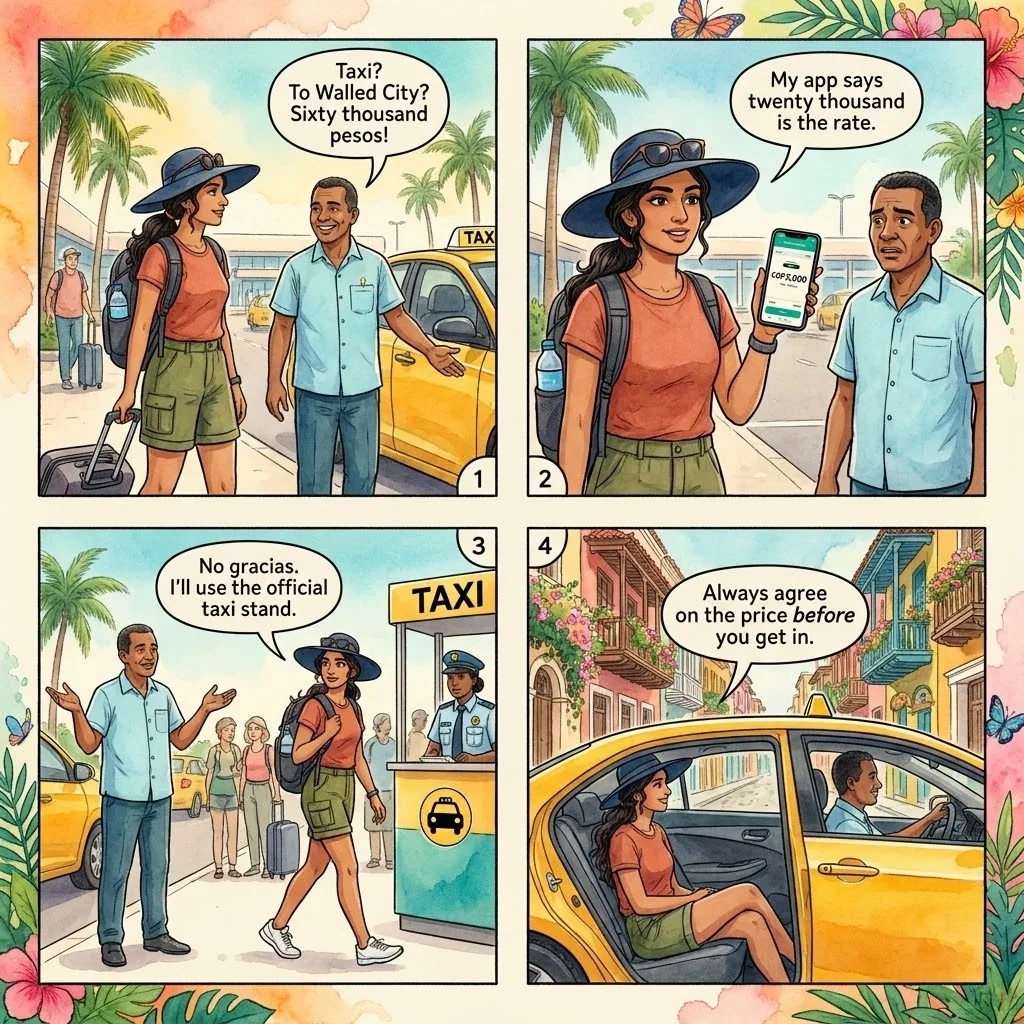
A driver outside Rafael Núñez airport quotes you 100,000 COP (~$26) for a ride to the Walled City when the regulated fare is around 20,000 COP (~$5), then "didn't understand" and demands more on arrival. Cartagena taxis run no meters — every quote is improvised, and tourists pay the improvised number.
You step out of Rafael Núñez arrivals at midnight after a long flight and six or seven men in matching white polo shirts swarm forward — "taxi, taxi, taxi, where you going, my friend?" One waves you toward a yellow car at the curb. You ask the price to the Walled City. He says "ochenta mil, eighty thousand pesos." You frown — Lonely Planet said it should be twenty. He shrugs, "night rate, festival rate, your choice." Behind him a second driver leans in: "noventa mil, ninety thousand." You're tired, the line for the next driver looks no better, and you climb in.
Twenty minutes later he stops in front of your hotel on Calle de la Factoría. You hand him an 80,000 COP note. He shakes his head — "no, ochenta dollars, eighty dollars, that was the price." He's pointing at his phone, where he's typed "$80." You start to argue and he pops the trunk button so your suitcase stays locked inside. A bellman from the hotel walks out and gets pulled into the conversation; the driver's price drops to 100,000 COP. You pay it. The trunk opens. He drives off without giving you change for the 100,000 note you handed him.
Cartagena's regulated minimum taxi fare was 9,800 COP in 2024 and rose to 10,800 COP for 2025, per the Lonely Planet city guide and the Cartagena Explorer fare cards posted at the airport's official taxi desk. The official airport-to-Old-Town fare sits at 15,000 to 25,000 COP depending on time of day. The El Tiempo file on tourist scams in Cartagena includes a 2024 case of a Cucuteña tourist forced to wait three hours at the airport because every driver demanded 100,000 COP for the run, and a separate case of Medellín tourists double-assaulted after being routed through an industrial zone in a fake taxi. Drivers run no meters because the city never required them — the fare is whatever the driver wants, and the only check is what you know walking in. Pull up the Lonely Planet airport taxi card or open Uber/InDriver before you walk out of arrivals, agree on a number in pesos (not dollars) before the trunk closes, and have it written down on the driver's phone screen.
Red Flags
- A taxi driver who refuses to quote a price until after the bag is in the trunk
- Quoted prices in dollars rather than pesos
- Multiple drivers all quoting the same inflated number — a sign of a curb cartel, not real competition
- A driver who claims "night surcharge" or "festival surcharge" without showing a fare card
- Refusing to give change for round-number bills
How to Avoid
- Open Uber or InDriver before walking out of Rafael Núñez arrivals; both work and show GPS-tracked upfront pricing.
- Use the official taxi desk inside the terminal where rates are posted and pre-paid.
- Agree on the fare in Colombian pesos, written down, before the trunk closes.
- Carry small bills (10,000s and 20,000s) so drivers can't claim no change for a 50,000 or 100,000.
- Ask your hotel to arrange airport pickup — most Walled City and Bocagrande hotels have fixed-rate transfer arrangements at 50,000 to 80,000 COP that beat curb rates.
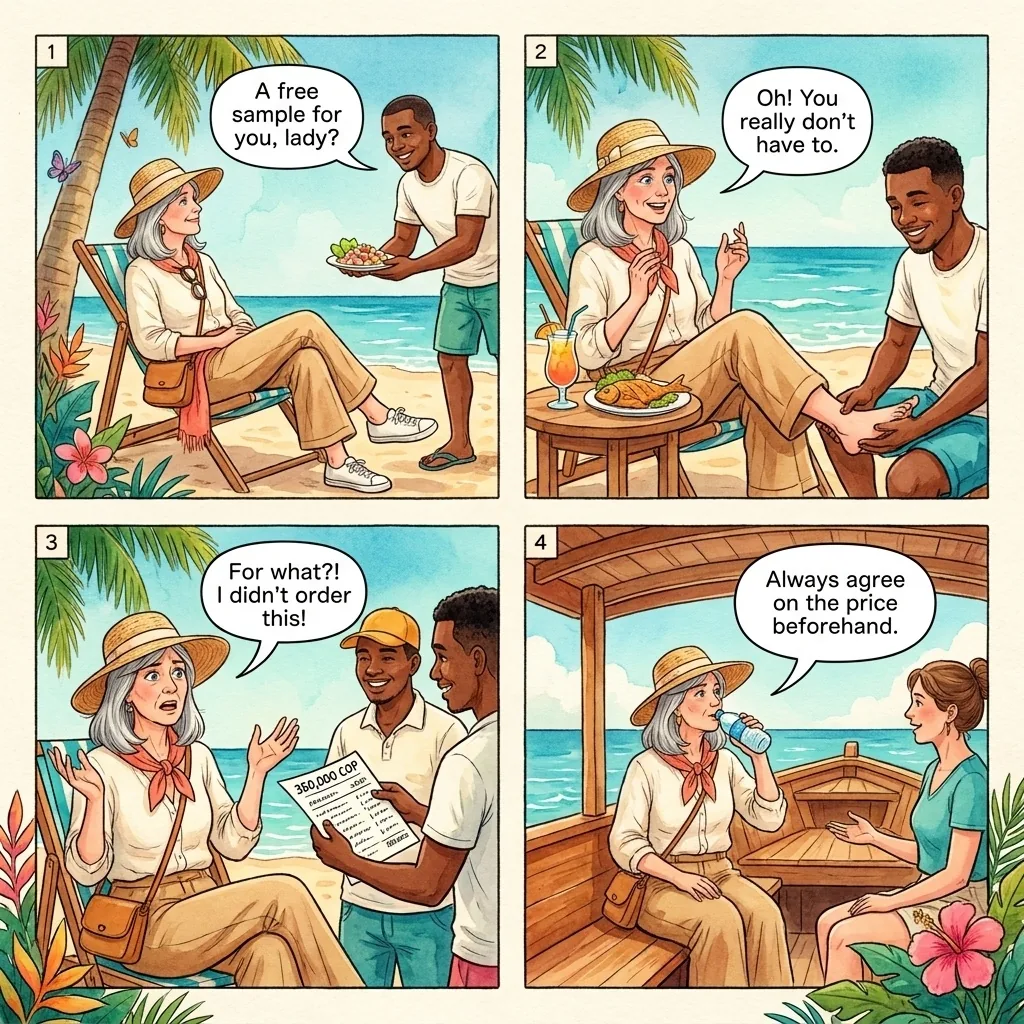
A vendor at Playa Blanca arrives with a free taste of ceviche, then a massage "sample," then a piña colada nobody priced, and at the end of the afternoon hands you a bill for 2,000,000 COP (~$520). Your boat back leaves in twenty minutes — that's the part of the scam they're charging you for.
The boat drops you on Playa Blanca at 10 a.m. You rent two sun loungers under a palm-thatch roof for 20,000 COP each, settle in. Within ten minutes the procession starts. A woman with a Tupperware of ceviche offers a "pruebita, just a little taste" — you accept, it's good. A man with bottles of aguardiente offers a small pour. A girl with braided hair offers to braid yours. A boy with a tray of fruit. Every transaction is "luego, luego" — pay later. Lunch arrives — fish, rice, plantain — without a printed price. The piña coladas keep coming. The afternoon dissolves.
At 3:30 p.m. the boat captain whistles you back. The vendor who has been orbiting your loungers since noon walks over with a hand-written paper. The bill is 2,100,000 COP (~$546). You stare. He starts itemizing — 200,000 COP per massage, 95,000 COP per coconut, 10,000 COP per beer, 30,000 COP per bracelet. You try to negotiate; his three colleagues drift over and form a loose semicircle. The boat is ten meters away, your hotel is on the other side of the bay, the next public boat is at 4 p.m. and the one after that doesn't exist. You pay 1,400,000 COP in cash and leave a card-tap for the rest. You make the boat with two minutes to spare.
The captive geometry of Playa Blanca and the Rosario Islands is exactly what makes the ambush work — boats run on schedule, there's no road off, and walking back means a 30-kilometer hike through Isla Barú. El Heraldo's December 2023 file on Cartagena beach scams documents a German couple charged 2 million COP for two juices and two plates of rice at a Playa Blanca cabaña; a separate El Heraldo report covers Argentine tourists charged 7 million COP for two lemonades on Barú. El Tiempo's January 2024 piece "Cartagena le declara la guerra al engaño de la pruebita" describes the city's formal crackdown on the "free sample" massage scam after enough viral videos that the alcaldía launched the Plan Titán enforcement protocol. The Italian YouTuber Federico "Zazza" Zompichiatti walked Bocagrande beach in 2024 wearing a hidden camera and was offered a single beer for 10,000 COP, a keychain for 30,000 COP, and a "pruebita" massage that the vendor later tried to charge 200,000 COP for. Refuse every sample, ask the price in pesos before anything touches you, and book your beach day through Blue Apple, Bora Bora, Fenix, or Makani — fixed-price clubs on Tierra Bomba where the vendor count drops from forty to two.
Red Flags
- Anyone who says "regalo" or "pruebita" before naming a price
- Vendors who say "luego, luego — pay at the end"
- Bills written by hand on torn paper rather than printed receipts
- Multiple vendors who appear together when you start to question the bill
- Pricing that only materializes when the boat is loading
How to Avoid
- Book your Rosario Islands or Barú day through a fixed-price beach club like Blue Apple, Bora Bora, Fenix, or Makani.
- Refuse every "free sample" of food, drink, or massage — there is no such thing on Playa Blanca.
- Get every price in writing in Colombian pesos before consuming anything.
- Pay-as-you-go in cash, never run a tab, and never hand over a card to a beach vendor.
- If a bill is inflated when the boat arrives, call 123 and ask for Policía de Turismo — El Tiempo has documented the Plan Titán protocol reversing absurd charges on the spot.
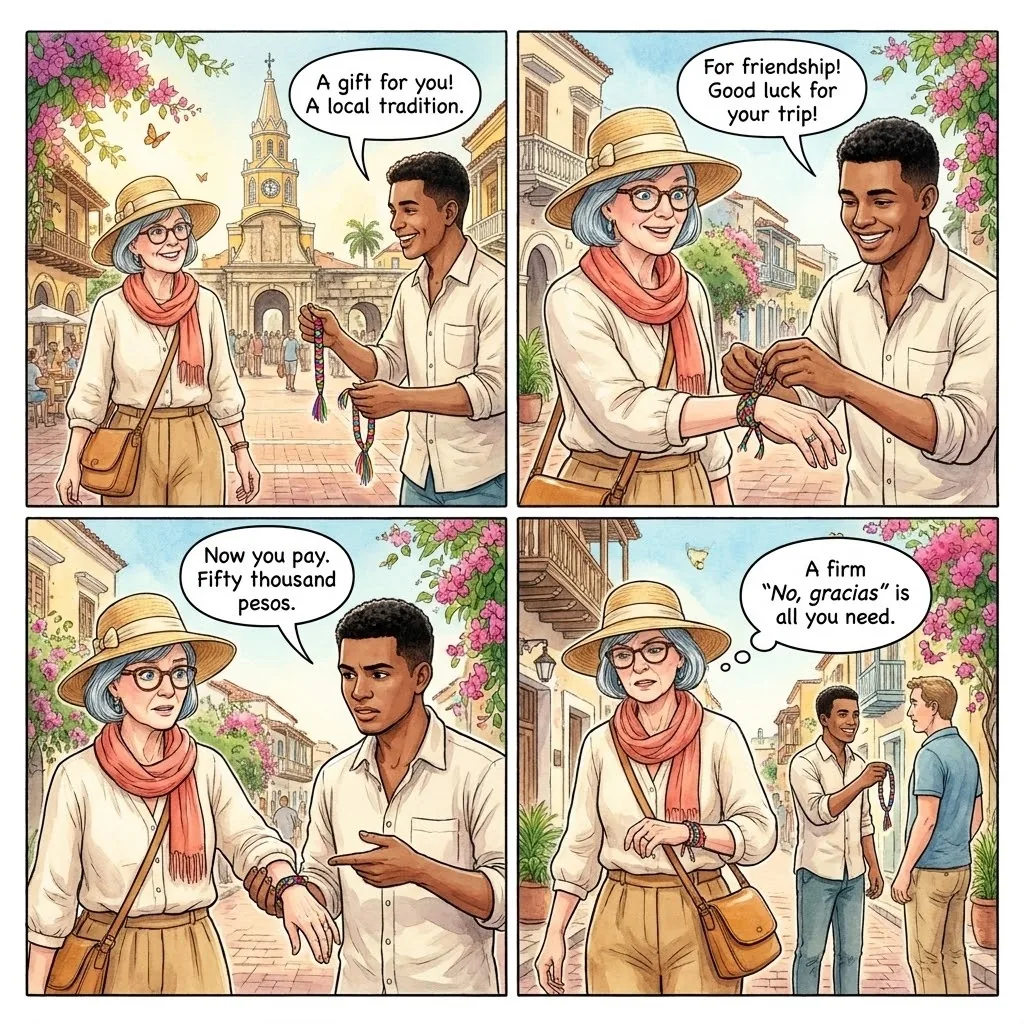
A young man at Torre del Reloj catches your hand in greeting, ties a colored woven bracelet onto your wrist in under three seconds, then asks for 30,000 to 50,000 COP (~$8–$13). The tie is the contract — by the time you process what's happening, the knot is already double-pulled.
You're walking through the arch of Torre del Reloj into the Walled City for the first time. The Plaza de los Coches opens up in front of you, the candy stalls of Portal de los Dulces under the colonnade, horses lined up for carriage rides. A young man with a fan of woven cotton bracelets in his hand smiles, says "amigo, where you from?" and reaches for your hand as if to shake it. Before your hand fully clears your pocket, his other hand is already looping a red-yellow-blue band around your wrist. You feel the tug of the knot tightening twice. He's still smiling.
"Friendship bracelet, my friend, Colombia's flag, fifty thousand." Your wrist is now wearing a thin braid he tied in maybe four seconds. You try to pull it off — it's a tight slipknot, not coming over your hand without scissors. He doesn't move, just keeps smiling. His friend, who you didn't notice before, is now standing two feet behind your shoulder. The price drops to 30,000 COP. You pay 30,000 COP. He cuts the bracelet off your wrist with a small folding knife, hands you the cut bracelet "as a souvenir," and waves to the next tourist behind you walking under the arch.
The same handful of vendors work the Torre del Reloj approach and the Plaza de los Coches every day, and the speed of the tie is practiced — they can knot a slipknot single-handed in under three seconds while keeping the other hand on yours. The tactical descendant is the chain-snatch: El Universal's Cartagena crime file documents almost weekly captures of "el Keiner," "el Walter," "el Joaco," and "el Paisa" — gold-chain snatchers who target tourists in Centro Histórico and Getsemaní with chains valued from 7 million to 35 million COP. The Policía Metropolitana de Cartagena reported 1,047 tourist-theft captures in early 2026 alone. The bracelet vendors don't snatch, but they exploit the same physical-contact playbook the snatchers do. Walk through Torre del Reloj with both hands in your pockets or holding your bag in front, never extend your hand to greet a vendor, and if a bracelet lands, walk away — there is no legal obligation to pay for an item tied onto you without consent.
Red Flags
- Anyone at Torre del Reloj or Plaza de los Coches who reaches for your hand as part of "hello"
- A vendor with bracelets pre-fanned in one hand and the other hand free
- A second person standing two or three feet behind your shoulder during the approach
- Pricing that only appears after the bracelet is already on your wrist
- A "discount" that drops 40 percent the moment you pull at the knot
How to Avoid
- Keep both hands in your pockets or holding your bag in front when walking through Torre del Reloj.
- Never extend your hand to greet a vendor — a verbal "no, gracias" is enough.
- If a bracelet is tied on, walk away; you owe nothing for an item attached without consent.
- Travel in pairs through the Walled City entrances so a partner can interrupt the approach.
- Leave visible jewelry, watches, and gold chains in the hotel safe — the same plazas see almost weekly chain-snatch arrests reported by El Universal.
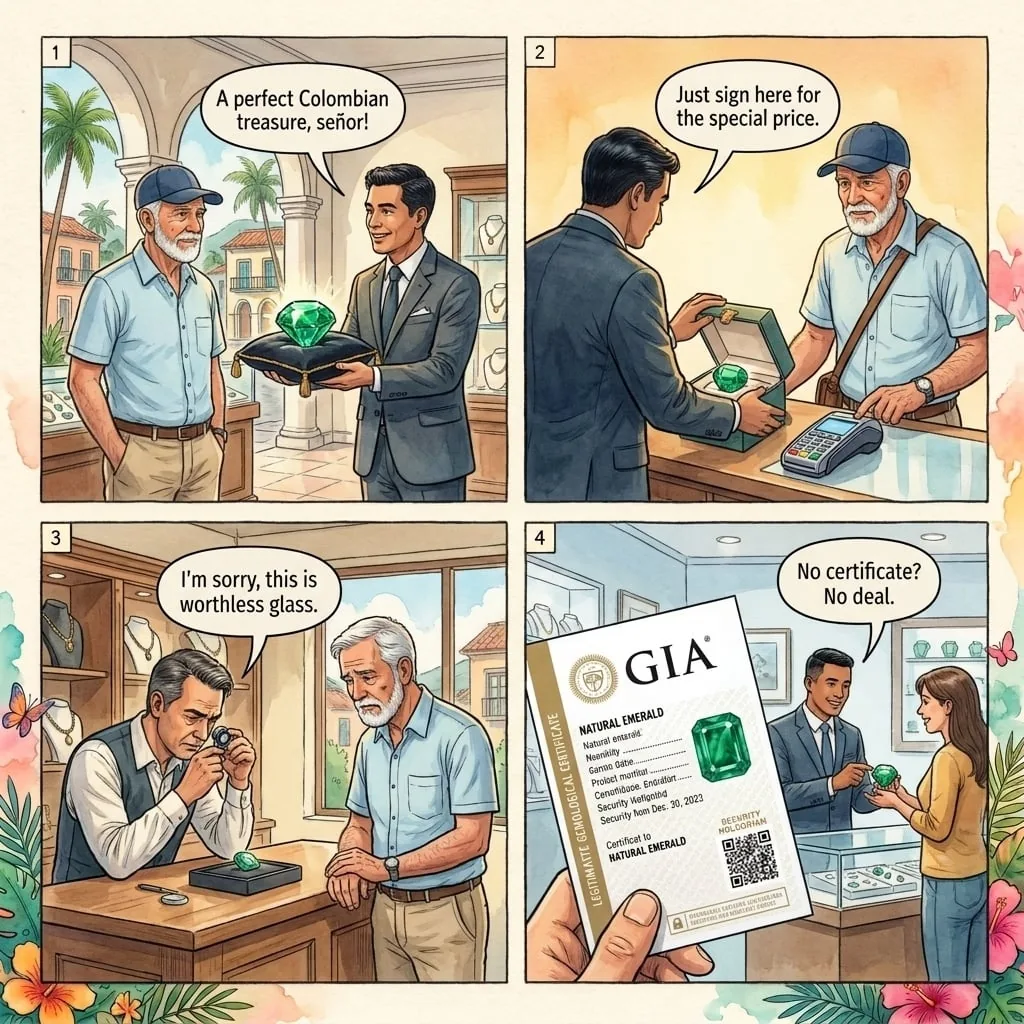
A jewelry shop near Plaza de Bolívar shows you a calculator reading 155,000 COP for a small silver necklace and stone, you tap your card, and the receipt comes through for 500,000 COP — and the "Colombian emerald" appraises at home for under $100. Cartagena's emerald row runs on opaque pricing and unverified stones.
You duck into a jewelry shop on Calle de la Iglesia near Plaza de Bolívar to escape the bracelet vendors outside. The shopkeeper is friendly, no English, but she has a calculator. You pick out a thin silver chain with a small green stone pendant — a "Colombian emerald," she says. She types "85,000" on the calculator for the chain, "70,000" for the stone, total 155,000 COP (~$40). You nod, hand her your card. She runs it. You walk out, glance at the bank push notification on your phone, and the charge is 500,000 COP (~$130). You walk back in.
She's all apologies, then she's not. She pulls out a paper receipt that does indeed read 500,000 COP and points at the calculator now, which has been cleared and re-entered: "500,000." Her boss appears from a back room. He explains, in slow Spanish, that because you paid by card you can't have a refund — but you can claim the 25 percent VAT at the airport. You don't believe him. You walk out and find two Policía de Turismo officers in teal vests on the corner of Plaza de Bolívar. They walk back with you. The boss gives you a cash refund — minus 25 percent he insists on keeping for the "VAT processing." The stone, when you examine it under your phone flashlight outside, is unstamped, lighter than silver should feel, and the green is clearly surface-coated.
Cartagena is the world's emerald capital — Colombia produces roughly 70 percent of the global supply — and the Walled City alone has dozens of jewelry shops competing for cruise-ship tourists. The TripAdvisor file on Caribe Jewelry, Adriana's Jewelry, and the cruise-line-recommended emerald museums runs hundreds of warning reviews, including a Royal Caribbean passenger who paid $900 for six "emerald" rings whose color faded within months. A November 2025 Reddit thread documents the same calculator switch at Joyería Arvaga: 155,000 COP on the calculator, 500,000 COP on the card. The 2015 Conor Woodman documentary "Scam City: Bogota" and his subsequent video on Colombian emeralds explained the bait-and-switch — a real high-grade stone shown during the pitch, then swapped for synthetic during the boxing. Genuine Colombian emeralds always have visible inclusions called the "garden"; flawless stones at tourist prices are synthetic. Buy emeralds only from shops that issue GIA, Gübelin, or CDTEC Colombia certification with a serial-numbered stone, watch the boxing process without looking away, and if the price on the receipt doesn't match the calculator before you tap, walk out and dispute the charge with your bank that day.
Red Flags
- A shop that prices via a calculator screen rather than a printed price tag
- A "Colombian emerald" that is perfectly clear with no visible inclusions
- A shop that won't issue GIA, Gübelin, or CDTEC certification with the sale
- A shopkeeper who insists you can claim a "VAT refund" at the airport instead of giving a card refund
- Boxing the stone in a back room out of your sight after payment
How to Avoid
- Buy emeralds only from shops that issue GIA, Gübelin, or CDTEC Colombia certification with a serial-numbered stone.
- Check the price on the card terminal screen and the receipt before you walk out, not after.
- Examine the stone for natural inclusions — flawless emeralds at tourist prices are synthetic.
- Watch the entire boxing process; never let the stone leave your sight after you've inspected it.
- If the receipt amount doesn't match the agreed price, dispute with your bank the same day and file a complaint at the nearest CAI or with Policía de Turismo on Plaza de Bolívar.
🆘 What to Do If You Get Scammed
📋 File a Police Report
Go to the nearest Policía Nacional de Colombia / Policía de Turismo station. Call 123 (emergency) / 112 (national line). Get an official crime report — you'll need this for insurance claims. You can also report online at ADenunciar (Colombian National Police Online Report - Spanish only).
💳 Cancel Your Cards
Call your bank immediately. Most have 24/7 numbers on the back of the card (keep a photo saved separately). Block any suspicious transactions before the thieves use your details.
🛂 Lost Passport?
File a police report (denuncia) at the nearest CAI (police station) or through ADenunciar online. Contact your embassy: the U.S. Embassy in Bogotá (+57-601-275-2000) can coordinate with the honorary consular agent in Cartagena. Bring a passport photo and any identification for an emergency travel document. The process typically takes one to three business days.
📱 Track Your Device
If your phone was stolen, use Find My (iPhone) or Find My Device (Android) from another device. Don't confront thieves yourself — share the location with police instead.
Frequently Asked Questions
You just read 7 scams in Cartagena. The book has 51 more across 10 Colombian destinations.
Bogotá's paseo millonario yellow-taxi express kidnapping (US State Department: leading cause of financial loss for Americans in Colombia). Medellín's Tinder scopolamine setups (reports tripled 2023–2025). Cartagena walled-city USD-pricing markups. Tayrona park “guide” rackets. Every documented Colombia scam — with the exact scripts, red flags, and Colombian Spanish phrases that shut each one down. Drawn from Colombian press (El Tiempo, Semana, El Espectador), Policía Nacional de Turismo records, and US State Department advisories.
- 58 documented scams across Bogotá, Medellín, Cartagena, Cali & 6 more destinations
- A Colombian Spanish exit-phrase card you can screenshot to your phone
- Updated annually — buy once, re-download future editions free
- Readable in one flight — $4.99 on Amazon Kindle