
Key Takeaways
- The #1 reported scam is the Scopolamine Drink Spiking.
- 3 of 7 scams are rated high risk.
- Use app-based ride services (Uber, DiDi) instead of street taxis — avoid unmarked vehicles, especially at night.
- Never accept unsolicited offers from strangers near tourist sites in Bogota.
⚡ Quick Safety Tips
- Never hail taxis on the street — always use Uber, DiDi, or InDriver for tracked rides with verified drivers.
- Keep your phone in a deep front pocket at all times — never use it visibly on the street or on TransMilenio.
- Watch your drinks being prepared and never leave them unattended — scopolamine drugging is a real and documented threat.
- Carry a photocopy of your passport and leave the original in your hotel safe — never hand documents to plainclothes 'police.'
Jump to a Scam
The 7 Scams
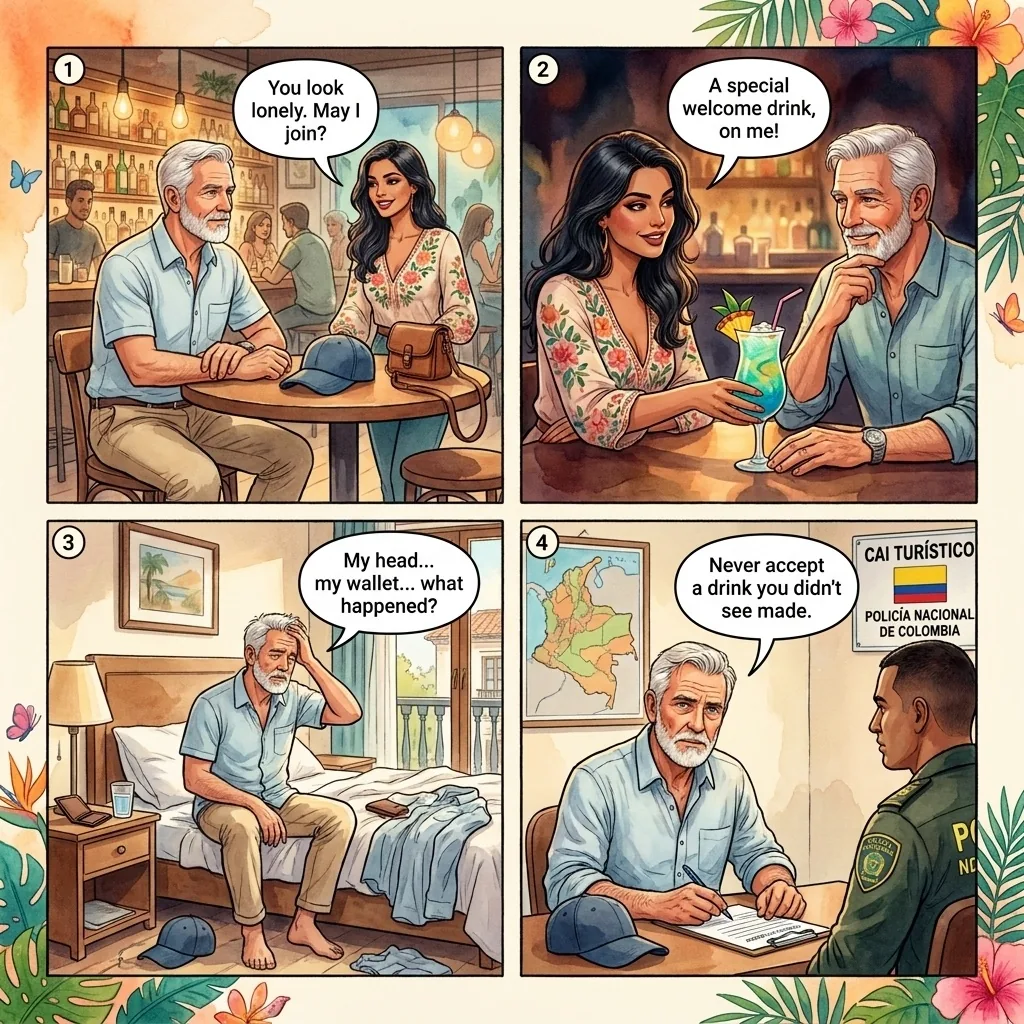
A friendly woman who speaks a little English approaches you at a Zona T bar in Chapinero and suggests a second venue she knows — three drinks later you're walking compliantly to your hotel ATM, and the next morning your laptop, watch, and 30 million COP (~$7,800) in account withdrawals are gone. The drug is called scopolamine. You won't remember any of it.
It's 11 PM in Zona T and you're at one of the open-front bars between Calle 82 and Carrera 13, watching the crowd spill onto the street. A woman at the next table catches your eye — she's with a friend, both well-dressed, and she leans over with a smile and a few words of English. "First time in Bogotá?" Within twenty minutes she's moved to your table. She's funny, she's interested, and after one round she suggests a smaller place she knows two blocks over — quieter, better music. You and your buddy follow her down Calle 84 and into a bar you wouldn't have found on your own. The bartender brings the round she ordered.
The drinks arrive. You take one sip, then another. Within thirty minutes the room tilts and your friend is laughing at something you can't quite hear. You feel completely awake — you'll remember thinking that — but your hands have stopped responding the way they should. The woman walks both of you back to your hotel in Chapinero with her arm around your shoulders, helps you into the elevator, and somewhere in the next four hours you hand her your phone passcode, your laptop, your watch, and stand at an ATM in the lobby while she enters your daily-max withdrawal at three different machines around the block. You wake up at 11 the next morning with no memory of any of it.
The drug is scopolamine — locals call it burundanga or "Devil's Breath" — odorless, tasteless, and powerful enough that the US Embassy in Colombia has issued repeated security alerts on its use against tourists. It doesn't knock you out. It erases your ability to refuse. The Bogotá Post documented Bogotá police dismantling the "La 57" gang in Teusaquillo and Chapinero, which used female accomplices and bartender accomplices to spike drinks in cheap second-venue bars; Semana separately reported a woman caught leaving a Chapinero hotel in 2024 after drugging two Brazilian tourists and walking out with 12 million COP in laptops, watches, and cash. The pattern is identical every time: a friendly approach in a legitimate Zona T bar, a suggested move to a second venue, a drink you didn't see prepared. Order every drink yourself, watch the bartender pour it, and never follow a stranger to a "better" second bar — the second bar is the trap.
Red Flags
- Anyone who approaches you at a bar in Zona T and suggests moving to a different, smaller venue
- Drinks brought to your table that you didn't watch the bartender prepare
- Sudden tiredness or compliance disproportionate to how much you've drunk
- A new acquaintance offering to walk you back to your hotel after one or two drinks
- Bartenders or wait staff who exchange glances with the person who approached you
How to Avoid
- Order every drink yourself directly from the bartender and watch it prepared in front of you.
- Refuse any invitation to leave a public, well-reviewed venue for a "better" second bar suggested by a stranger.
- Travel in pairs and agree in advance that neither of you leaves Zona T with anyone new.
- Stick to established bars in Zona T's main blocks (Calle 82–84, Carrera 13–15) and Parque 93.
- If you start feeling disoriented out of proportion to your drinks, get to a uniformed bar staff member immediately and tell them in Spanish: "Creo que me drogaron."
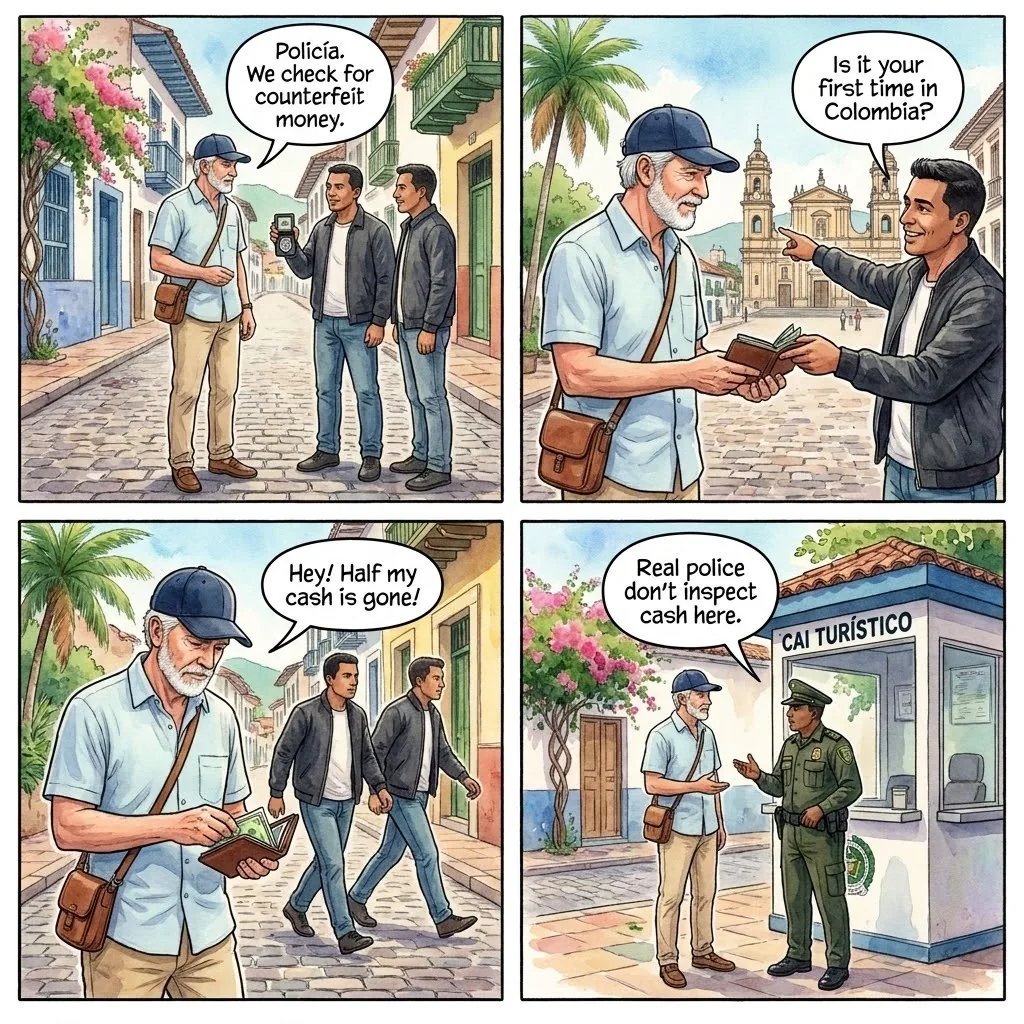
Two men in civilian clothes flash a laminated badge near Avenida Jiménez and tell you Colombia is running a counterfeit-currency operation — they need to inspect your wallet. By the time they hand it back with a "receipt," 600,000 COP (~$155) has quietly disappeared.
You're walking through La Candelaria toward the Botero Museum, map open on your phone, when two men in jackets and jeans cross from the opposite sidewalk and stop in front of you. One holds up a laminated card with a Policía Nacional crest and says, in fast but reasonable English, that there is a "counterfeit pesos investigation" running today and they need to verify any cash you're carrying. The other doesn't say anything — he's positioned slightly behind, watching the street. The badge looks real enough. You're a tourist. They asked nicely. You hand over your wallet.
He flips through the bills slowly, lips moving as he counts. The second man steps closer and starts asking questions — where are you staying, when did you arrive, do you have your passport. You answer him because that's what he wants you to do. When the first man hands the wallet back, he gives you a small printed slip and tells you to take any "marked" bills to a CAI station for exchange. They thank you, walk on, and you continue toward the museum. Forty-five minutes later, paying for a coffee on Plaza Bolívar, you realize the wallet is lighter — 500,000, maybe 600,000 COP gone, plus one credit card you never used so didn't notice missing.
The Policía Nacional do not stop tourists on the street to inspect cash. The Alcaldía Mayor de Bogotá has run public alerts under "¡Cuidado con los falsos Policías!" warning of plainclothes impersonators working La Candelaria, the Avenida Jiménez corridor, and arrivals at El Dorado; bogota.gov.co reported a 2024 case where two men were captured for posing as Sijin agents to rob a German tourist after she alerted real police. El Espectador covered an additional sting at El Dorado that same year. Real Colombian officers wear visible green uniforms, drive marked patrol cars, and never demand to handle your money. If anyone in plainclothes asks for your wallet or cash on the street, refuse and walk to the nearest uniformed officer or CAI booth — there's one inside Plaza Bolívar and another at Avenida Jiménez con Carrera Séptima.
Red Flags
- Plainclothes men flashing a laminated badge rather than wearing a green uniform
- Any "officer" who insists on inspecting your wallet, cash, or counting your bills on the street
- Mention of a "counterfeit currency operation" or "drug-money inspection"
- A second person standing slightly behind, asking distracting questions while the badge holder counts your money
- A printed receipt or slip telling you to "exchange" suspect bills at a station later
How to Avoid
- Carry a copy of your passport and leave the original in your hotel safe — there's no reason to hand over either to anyone in civilian clothes.
- If approached, say firmly "Vamos a la CAI" (let's go to the police booth) and start walking toward the nearest one — real officers will agree, fakes will leave.
- Never let your wallet leave your hand; if they want to see ID, hold it open yourself.
- Photograph the badge with your phone and call 123 immediately — the act of dialing usually ends the encounter.
- Walk on the busier side of any La Candelaria street — scammers avoid scenes with witnesses.
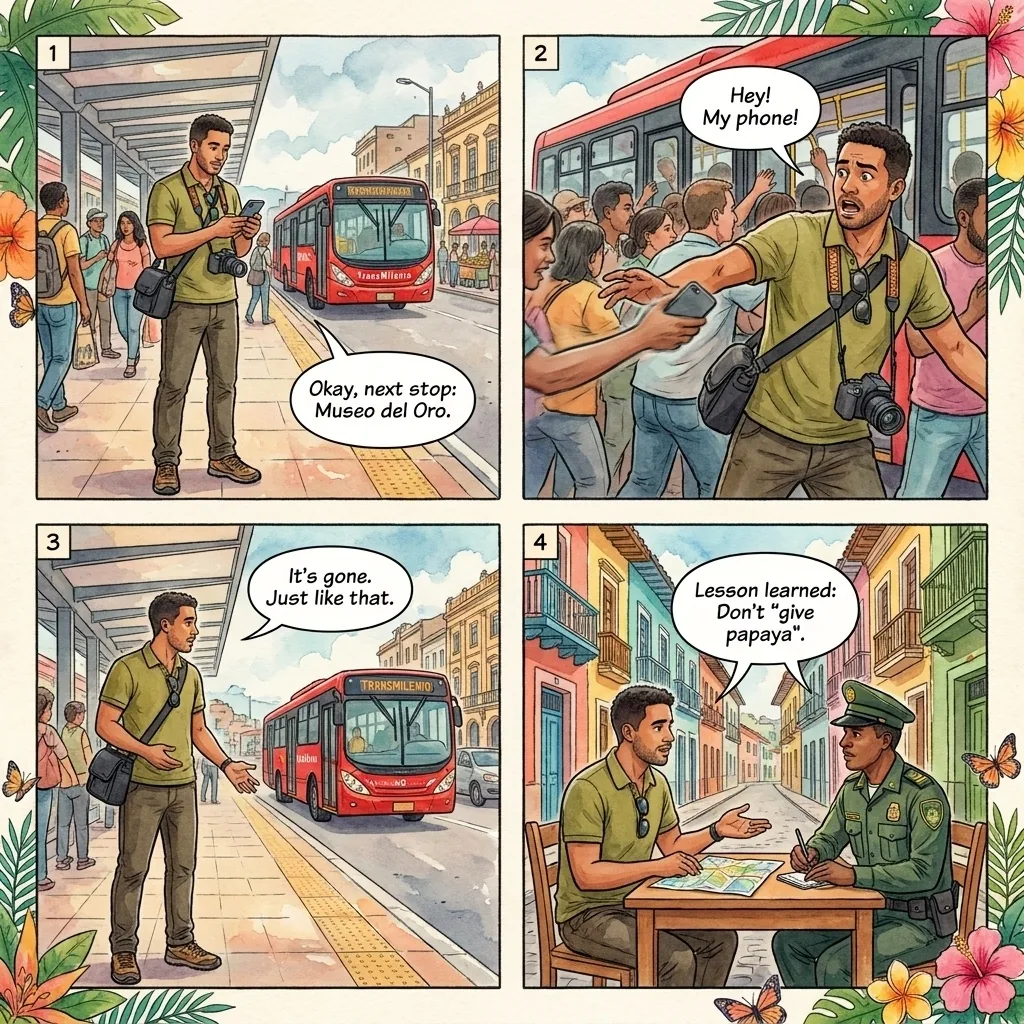
You're checking a map on Carrera Séptima and a motorcycle with two riders mounts the curb, the parrillero on the back grabs the phone from your hand, and they're three blocks away before you've finished saying "what." Locals call this "no dar papaya" — don't give papaya, don't make yourself easy.
You're standing at the corner of Carrera Séptima and Calle 13, three minutes from your hostel in La Candelaria, holding your phone at chest height to read a Google Maps direction. You hear an engine note rise — the high whine of a small displacement bike — and before your eyes track to it, the motorcycle has come up onto the sidewalk behind you. The passenger on the back, the parrillero, leans, hooks two fingers under your phone, and snaps it out of your grip. The whole motion takes less than a second. The bike is back on the street and weaving between cars before your hand has finished closing on empty air.
Or you're on TransMilenio, the bus pulling into Estación Calle 26, the doors opening into a packed crowd. You step forward to board and feel a body press into your back, then a faster body against your hip. By the time the doors close behind you, your phone is gone from the side pocket of your jacket and the two who pressed against you are already off the bus, walking the opposite direction. You realize what's happened ten minutes later, when you reach for the phone to text the hostel. It is not coming back. Bogotá's Secretaría de Seguridad logged 75,520 hurto cases between January and July of last year alone — phone snatching is the dominant crime against foreigners in the city, and the windows in which it happens are shorter than the time you've spent reading this paragraph.
"No dar papaya" — literally "don't give papaya" — is the Bogotano shorthand for the entire defensive posture: don't display anything that makes you a target, don't act like a tourist who hasn't read the situation. The motorcycle method dominates because two riders, one to drive and one to grab, can clear a block before bystanders register what happened; CityTV covered the November 2025 arrest of a serial snatcher in Kennedy who rode his bike onto sidewalks specifically to grab phones, and Metro.co.uk documented a Usaquén snatch in February 2025 where a victim's open video call captured the thief's face mid-grab. The Fiscalía dismantled the 'Los Chamos' gang in 2023 for downtown TransMilenio pickpocketing. Reddit and Reddit have running threads with the same advice every time. Keep your phone in a deep front pocket on the street, and step inside any shop or café before pulling it out — if you're holding a phone within arm's reach of the curb, you're giving papaya.
Red Flags
- Motorcycles slowing or mounting the curb behind you on Carrera Séptima or any commercial avenue
- Crowds pressing against you at TransMilenio doors during peak hours
- Anyone walking close enough to brush your jacket pocket on a narrow La Candelaria sidewalk
- A motorcycle with two riders idling near a corner where tourists are visibly using phones
- Bag straps on the curb-side shoulder rather than the wall-side shoulder
How to Avoid
- Keep your phone in a deep front pocket with a button or zipper — never in your hand on the street.
- If you must check directions, step inside a shop, café, or bank lobby first.
- Wear bags crossbody with the strap diagonal across your chest and the bag itself on the side away from the street.
- On TransMilenio, hold your bag in front of you with both arms and avoid peak hours (6:30–8:30 AM and 5–7:30 PM) entirely.
- Never react if you see someone snatch a phone — the bag or wallet you're carrying is worth more than the chase.
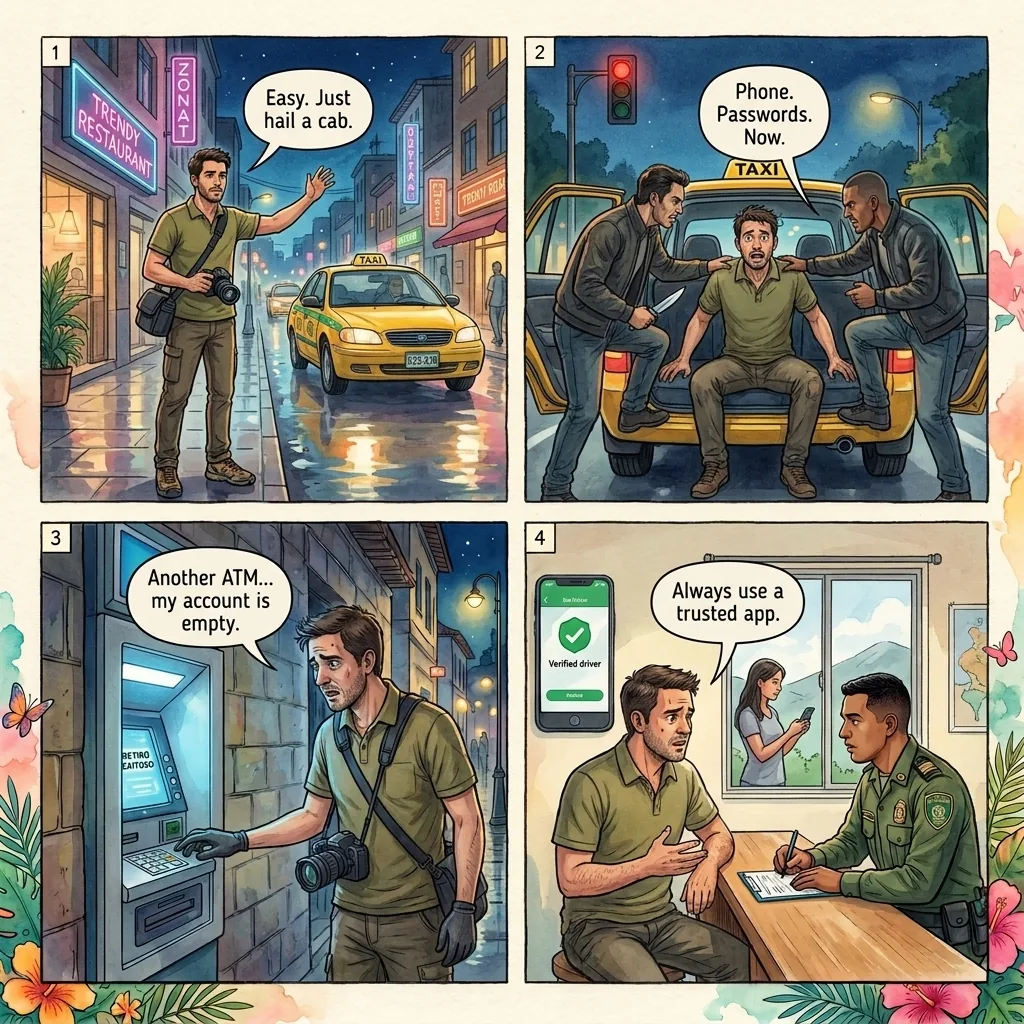
You hail a yellow taxi outside a Chapinero restaurant at 11 PM. Two minutes in, the cab stops at a red light and two men climb in beside you — for the next three hours they drive you between ATMs across Bogotá, draining the daily withdrawal cap on every card you own and wiring transfers through your banking app. They drop you in an unlit barrio at 3 AM with the empty wallet and your phone factory-reset.
You walk out of a restaurant at the corner of Calle 85 and Carrera 11 in Chapinero, wave for a yellow taxi, one stops, and you climb in. The driver is friendly enough — asks where you're from, complains about traffic. Two minutes in, at a red light on Carrera 13, both rear doors swing open and two men slide in on either side of you. The driver doesn't react. One of the new arrivals presses something hard into your ribs and tells you in Spanish, slowly so you understand, that you're going to unlock your phone and read your banking app password out loud. The other one is already pulling your daypack open in his lap.
For the next three hours they drive a circuit. ATM at a Banco de Bogotá branch — daily max, 1.2 million COP. Drive ten minutes. ATM at a Davivienda — another card, another daily max. Drive. ATM. Drive. ATM. Between machines they have you log into your Bancolombia app and authorize three transfers to accounts they read off a phone. They beat you once, in the cab, when you fumble a password — not hard, just enough. At 3 AM they drop you on an unlit residential block in Engativá or Usme, miles from anywhere you've been before, and the cab pulls away. Your phone is in your pocket but factory-wiped. You have your passport because they decided not to take it. They've drained the equivalent of $10,000.
This is paseo millonario — "the millionaire ride" — and El Tiempo, Semana, and Infobae have all covered the February 2026 case of Diana Ospina, a Bogotá woman whose paseo lasted long enough to clear three wire transfers and over 40 million COP (~$10,300) across multiple withdrawals before the cab let her out. Infobae's February 2026 explainer documents the standard playbook of intimidation, beating, or scopolamine sedation while the cab circuits ATMs; Reddit's October 2025 thread "Alerta turistas en Colombia: paseo millonario" had locals warning that hailing a cab in the Calle 85 corridor of Chapinero gives you an 85% chance of being targeted. The City Paper Bogotá calls it Bogotá's most notorious robbery method. The setup requires a street-hailed cab — it cannot happen in an Uber, DiDi, or InDriver because the app records the driver's identity and the vehicle's plate. Never hail a yellow taxi off the street in Bogotá; open the Uber, DiDi, or InDriver app instead, and if you must take a cab, only one called by a hotel or restaurant that knows the radio company.
Red Flags
- Any yellow taxi flagged from the curb rather than ordered through an app or a hotel desk
- Plate numbers on the door that don't match the numbers stenciled inside the cab
- A driver who locks the doors immediately after you get in
- Sudden stops at red lights in unfamiliar neighborhoods after pickup
- A driver who refuses to take a route your map app is showing you
How to Avoid
- Use Uber, DiDi, or InDriver — all three operate freely in Bogotá and the app records driver identity, plate, and route in real time.
- If apps fail and you must take a cab, ask your hotel or restaurant to call a registered radio taxi by phone — they read out a four-digit confirmation code.
- Set your bank's daily ATM and transfer limits to the lowest amount before traveling, and keep most of your money in a separate account you can transfer from later.
- Share your live location with someone outside the country every time you take any ride.
- Sit in the back-right seat; if a stranger opens the rear door at a light, exit immediately on the opposite side and run toward foot traffic.
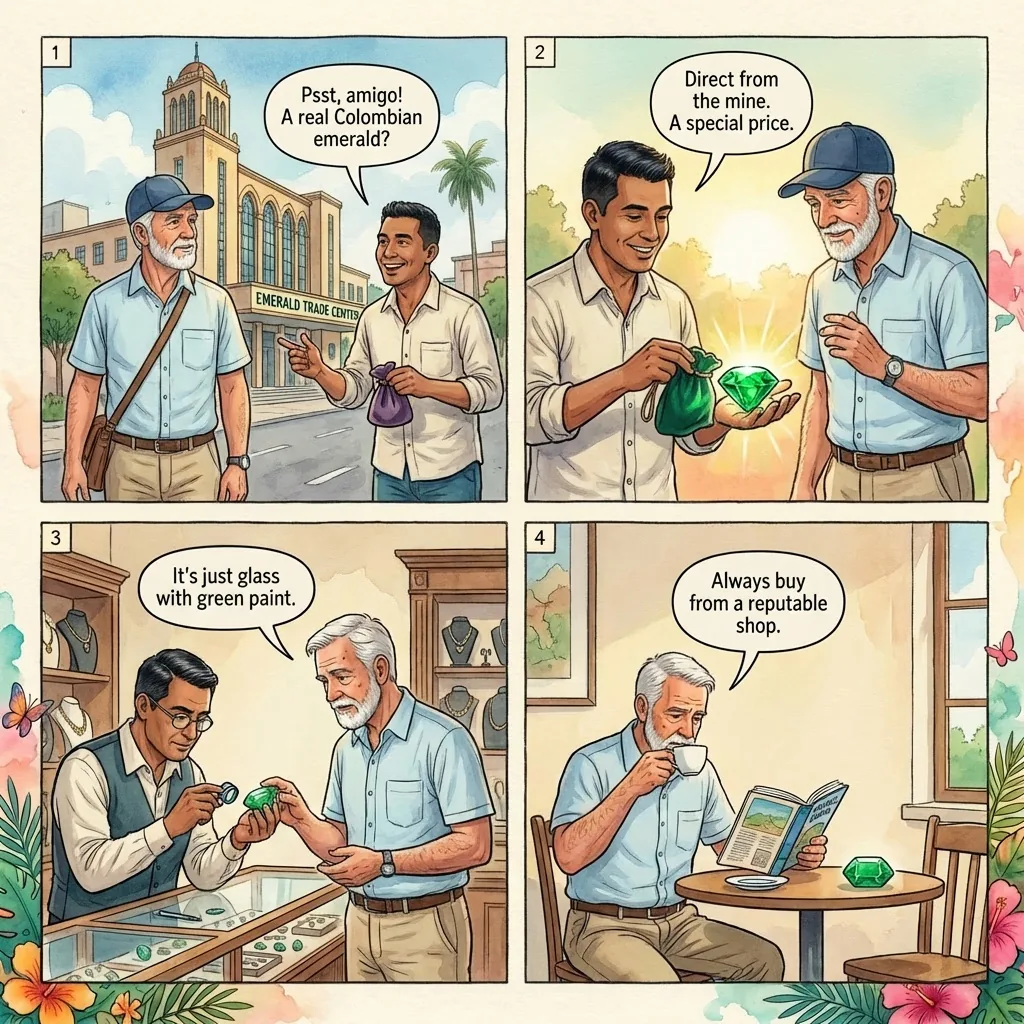
A friendly man unfolds a velvet pouch on the sidewalk between the Emerald Trade Center and Carrera Séptima and shows you four brilliant green stones — "directo de Muzo, no commission." You buy one for 800,000 COP (~$210); a jeweler back home tells you it's a quartz with green lacquer painted on the underside. Worth maybe $5.
You're walking down Avenida Jiménez between Carrera 5 and Carrera 7 — the one block in Bogotá known as the open-air emerald market, where the comisionistas (legitimate dealers) gather in suits with magnifying loupes — and a man in a leather jacket peels off from the cluster and falls into step beside you. He has a small velvet pouch in his hand. He opens it just enough that you see four green stones catch the afternoon light. "Directo de la mina, hermano. Muzo." He looks around like he shouldn't be doing this in the open. He'd give you a price 70% below what the shop next door is asking. The stone is warm in his fingers when he holds it out.
You take one back to the hotel for 800,000 COP — already a deal, in your head. Or 1.5 million for a "good" one. He gives you a hand-written receipt with no address. A jeweler in your home country puts the stone under a loupe a week later, scratches the underside with a fingernail, and the green color comes off — it's clear quartz or beryl with green epoxy lacquer painted on the back, a technique the Italian gem journal Rivista Italiana di Gemmologia documented years ago for the Avenida Jiménez sidewalk market. Or it's a synthetic hydrothermal emerald with oil filling, which is the version Expat Chronicles' March 2026 emerald episode focused on. Either way you paid for a 5-dollar stone.
Real Colombian emeralds at retail, including the ones from Muzo and Chivor, are sold inside licensed shops with certificates issued by the Federación Nacional de Esmeraldas. The Emerald Trade Center at Avenida Jiménez 5-43, Joyería Schumacher, and Joyería Glauser all sit within four blocks of where the street vendors operate; none of them sell to walk-up tourists from a velvet pouch. The block between Carrera 5 and 7 is famous specifically because the legitimate dealers cluster there — which is also exactly why the fakers cluster there. Tripadvisor's Bogotá emerald threads, the Jewels Abound emerald-district guide, and a viral 2025 Instagram reel ("nearly died in bogota scam, dont trust strangers with emeralds") all describe the same playbook: velvet pouch, "directo de la mina," 70% discount, lacquered stone. Buy emeralds only from a licensed shop with a certified gemologist on premises and a written certificate of authenticity — never from anyone holding stones on the sidewalk, even on the right block.
Red Flags
- Velvet pouches, hand-folded paper packets, or anything pulled from a jacket pocket on the sidewalk
- "Directo de la mina" or "no commission" pitches
- Prices 60–80% below a shop window two doors away
- Hand-written receipts with no business address, phone, or NIT (tax ID)
- Sellers who follow you for half a block lowering the price as you walk
How to Avoid
- Buy emeralds only inside the Emerald Trade Center (Av. Jiménez 5-43), Joyería Schumacher, or Joyería Glauser, with a written certificate.
- Ask any seller to scratch the stone's underside with a steel file or fingernail in front of you — lacquer comes off, real beryl does not.
- Hold the stone up to a phone flashlight and look for natural inclusions ("jardín"); a flawless emerald at a low price is always synthetic or fake.
- Insist on an independent appraisal before paying — legitimate shops will allow you to leave with a stone overnight to verify with a third-party gemologist.
- Understand the floor: a one-carat fine Colombian emerald retails above $1,500 — anything offered for $200 on the sidewalk is not what the seller says it is.
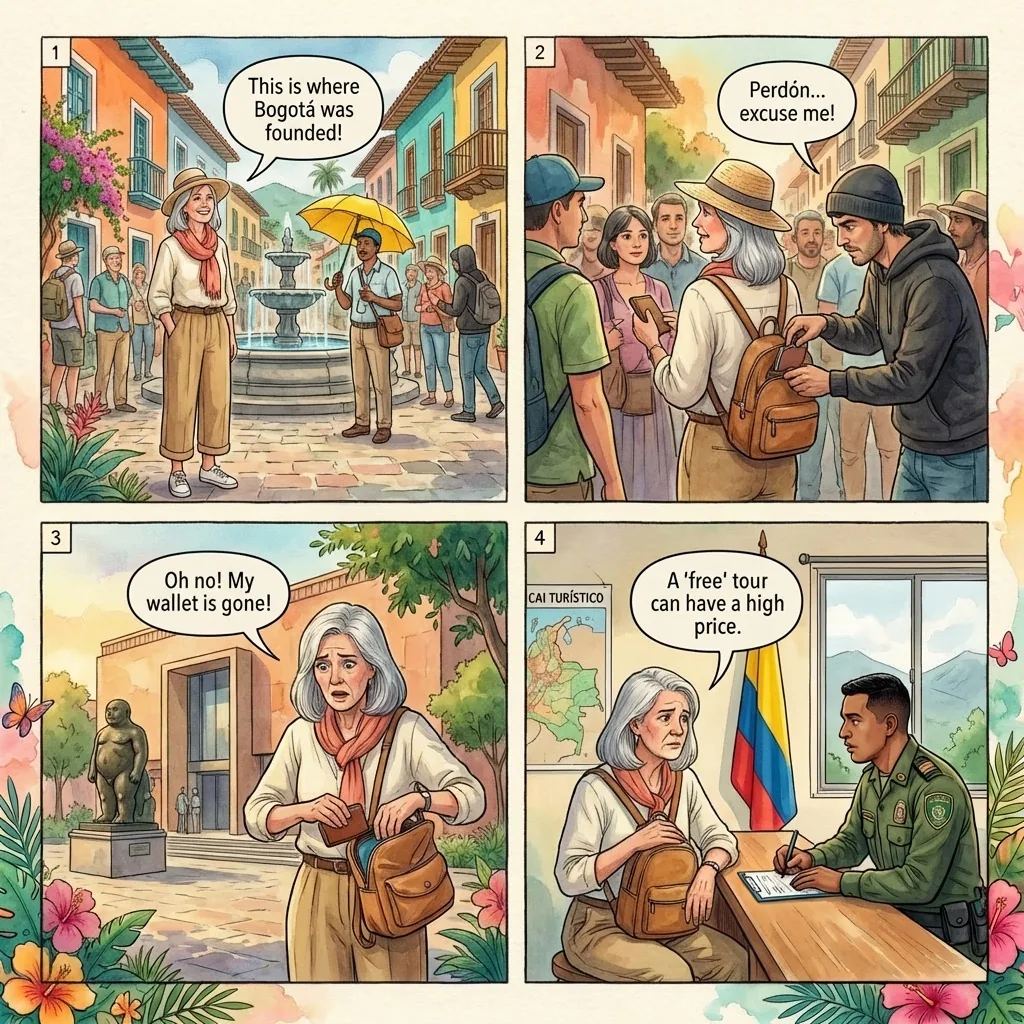
You're standing at Chorro de Quevedo with a free walking tour, listening to the guide explain the founding of Bogotá, when someone bumps you from behind. You assume it's the crowd. Forty minutes later your wallet is gone from the inside pocket of your daypack — and so is the woman who joined the tour ten minutes after you did.
Your free walking tour assembles at Plaza Bolívar at 10 AM — twenty-five strangers, a guide in a red shirt, a route that will move through La Candelaria's narrow colonial streets to Chorro de Quevedo, the Botero Museum, and back. The guide is good, the group bunches up at every stop, and at Chorro de Quevedo — the small triangular plaza where Bogotá was founded in 1538 — everyone gathers in close to hear the story over the noise of the buskers. A woman who wasn't on the original meet-up has slipped into the back of the group; you noticed her at the last stop. She's smiling, taking photos, and standing right behind you.
Someone bumps your backpack. You assume it's the crowd shifting. The guide moves the group on, you walk two blocks down to the next stop, and at some point in the next hour — you'll never be sure when — the woman peels off the back of the tour and disappears down a side street. You realize what's happened back at the hotel, when you reach into your daypack for your wallet and feel the empty pocket. The zipper of the inner compartment is half-open. Your passport copy is still there; the cash and one backup credit card are not. The tour guide has moved on with the next group already.
Free walking tours create perfect pickpocket conditions: a tight crowd, a focused speaker, narrow streets with chokepoints at every plaza, and tourists who arrive with daypacks they're not used to wearing in a city. La Candelaria's pickpocket gangs work the tour stops themselves — Chorro de Quevedo, Plaza Bolívar, the steps in front of the Botero Museum — and Bogotá's Secretaría de Seguridad has captured multiple gangs working this route, including the December 2023 takedown of "Los de los Cerros," who Semana documented preying on tourists and pilgrims along the Monserrate climb in a "cinematographic" police capture. Reddit still has active threads on the bird-poop and bracelet variants targeting tour groups specifically. The pattern works because tourists have already accepted being part of a stranger-cluster — one extra person joining the back of the group reads as normal. Wear your daypack reversed on your chest at every tour stop, and physically check your wallet pocket every time the guide stops talking — pickpockets work the listening moments.
Red Flags
- A new face joining the group between stops, especially mid-tour
- Anyone bumping into you from behind during a guide's explanation
- Crowded chokepoints at Chorro de Quevedo, Plaza Bolívar, or the Monserrate steps
- A daypack worn on the back with zippers facing outward
- Bird poop, mustard, or a "spilled" coffee on your shoulder while someone offers to help clean it
How to Avoid
- Switch your daypack to the front of your body at every tour stop, not just on the move.
- Carry only the day's cash and one card; leave passport, second card, and electronics in the hotel safe.
- Position yourself at the front edge of the tour group, near the guide, rather than the back where extras blend in.
- Never bend down to clean a sudden stain on your clothes without first removing your bag — bird-poop and mustard scams target the moment you're crouched and distracted.
- If anyone bumps you, immediately check both inner and outer compartments of your bag — the zipper is the tell.
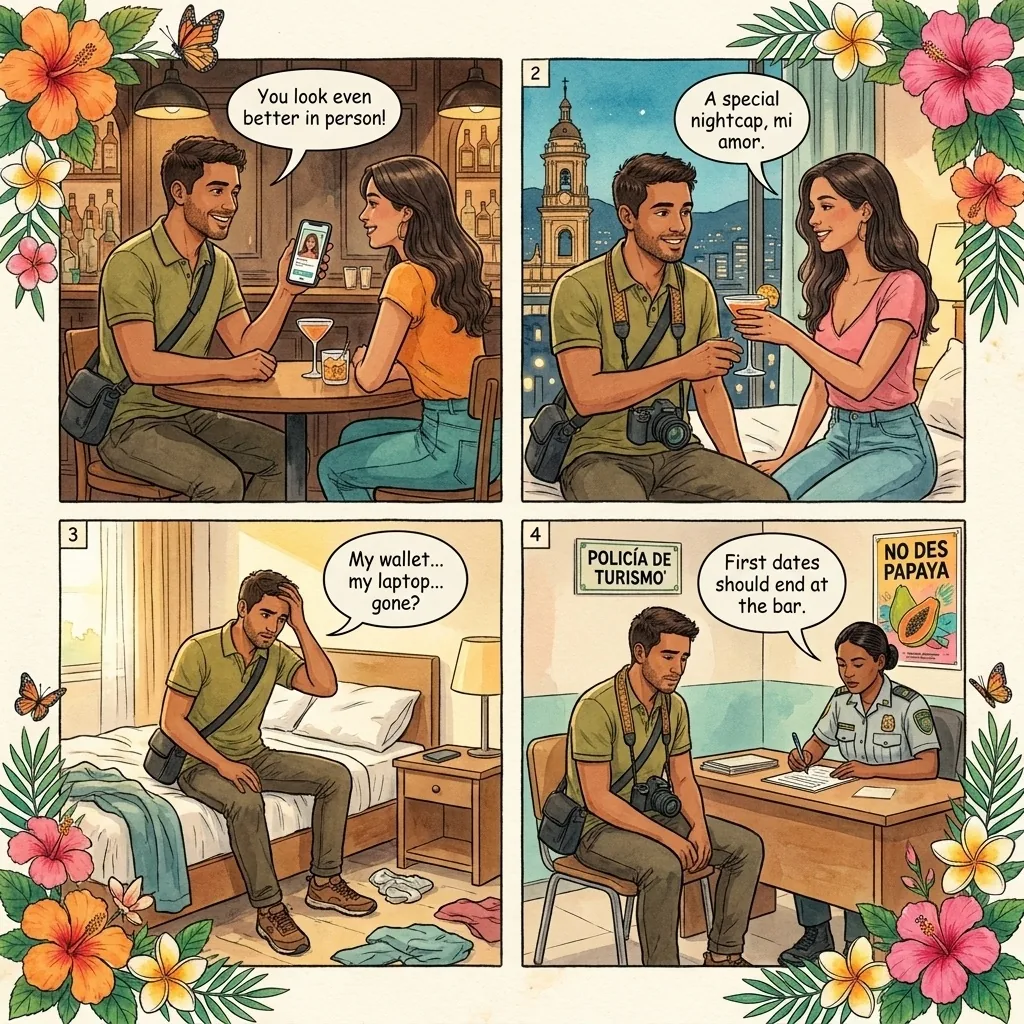
A Tinder match suggests meeting at a bar in Chapinero, has two drinks with you, and follows you back to your Airbnb to "use the bathroom." You wake up the next afternoon with no memory after the second drink — your phone, laptop, watch, and the contents of your wallet are gone, plus three transfers from your bank app totaling 35 million COP (~$9,100) you don't remember authorizing.
You're a solo male traveler in your thirties, three days into a Bogotá trip, and you matched with someone on Tinder who's strikingly attractive, replied quickly, and suggests meeting at a bar in Chapinero you've already heard of. She arrives on time, looks like her photos, speaks better English than her profile suggested, and within an hour the conversation is good enough that when she suggests moving back to your Airbnb in Zona T to keep talking, you say yes. She's holding her own drink. You've been buying yours. There's nothing you'd flag in retrospect except that everything has been a little too easy.
At the apartment she pours two glasses of wine from a bottle she opens in the kitchen. You take one sip. The next thing you remember clearly is sunlight through the curtains and a pounding pressure behind your eyes. It's the next afternoon. Your phone is on the floor, screen smashed. Your laptop, your watch, your camera, and the contents of your wallet are gone. When you log into your banking app from the Airbnb's iPad, you find three transfers you don't remember authorizing — to accounts you don't recognize — totaling roughly 35 million COP. The Tinder profile you were chatting with two days ago has been deleted. Building security tells you a woman left around 4 AM carrying what looked like a duffel bag.
This is one of the most documented tourist crimes in Colombia. The US Embassy in Bogotá issued a 2024 security alert specifically warning Americans about dating-app meetups with locals, citing eight suspicious US deaths in 2023 tied to Tinder, Bumble, and Grindr matches, and police captures of crews who "worked with women to rob nearly a dozen tourists of an estimated $20,000." The Guardian, CNN, Bloomberg, and Rest of World all covered the wave. Semana documented a German citizen drugged on a Bogotá date who was found "al borde de la muerte" — at the edge of death — in 2025; Infobae profiled a separate Grindr-driven case the same year where a German tourist woke up naked, drugged, in a Bogotá hotel after a date organized through the app. The drug used in nearly every case is scopolamine, slipped into the second drink. Meet first dates only in busy public venues, refuse to bring anyone you've just matched with back to your hotel or Airbnb, and watch every drink poured — the second drink at home is the one that ends the night.
Red Flags
- A match who responds within seconds, has only two or three photos, and suggests a specific bar you didn't pick
- Anyone who pushes to move from the bar to your apartment within the first meeting
- A date who insists on pouring drinks at your apartment instead of letting you do it
- Profile photos that look like model shots rather than candids
- A match who knows your hotel's neighborhood specifically before you've shared it
How to Avoid
- Keep first dates in well-lit, busy venues — Andrés Carne de Res, BBC Cervecería, La Hamburguesería on Carrera 11 — and never bring a new match to your accommodation.
- Video-call the match for at least five minutes before meeting in person, and verify their face matches their profile.
- Pour every drink yourself, including any drink at your apartment if you do bring someone home — and watch the bottle the entire time.
- Tell a friend abroad your match's name, dating-app screen name, photo, and the bar you'll be at; check in by text on a fixed schedule.
- Set bank app daily transfer limits to a low ceiling and require a separate device or biometric for transfers above that limit.
🆘 What to Do If You Get Scammed
📋 File a Police Report
Go to the nearest Colombian National Police (Policía Nacional) station. Call 123 (Emergency) or 112. Get an official crime report — you'll need this for insurance claims. You can also report online at policia.gov.co.
💳 Cancel Your Cards
Call your bank immediately. Most have 24/7 numbers on the back of the card (keep a photo saved separately). Block any suspicious transactions before the thieves use your details.
🛂 Lost Passport?
Contact the US Embassy in Bogotá at Carrera 45 No. 24B-27, Bogotá. Phone: +(57)(1) 275-2000. After-hours emergencies: +(57)(1) 275-4021. From the US: +1-202-501-4444 (24/7). The Embassy can issue emergency travel documents.
📱 Track Your Device
If your phone was stolen, use Find My (iPhone) or Find My Device (Android) from another device. Don't confront thieves yourself — share the location with police instead.
Frequently Asked Questions
You just read 7 scams in Bogotá. The book has 51 more across 10 Colombian destinations.
Bogotá's paseo millonario yellow-taxi express kidnapping (US State Department: leading cause of financial loss for Americans in Colombia). Medellín's Tinder scopolamine setups (reports tripled 2023–2025). Cartagena walled-city USD-pricing markups. Tayrona park “guide” rackets. Every documented Colombia scam — with the exact scripts, red flags, and Colombian Spanish phrases that shut each one down. Drawn from Colombian press (El Tiempo, Semana, El Espectador), Policía Nacional de Turismo records, and US State Department advisories.
- 58 documented scams across Bogotá, Medellín, Cartagena, Cali & 6 more destinations
- A Colombian Spanish exit-phrase card you can screenshot to your phone
- Updated annually — buy once, re-download future editions free
- Readable in one flight — $4.99 on Amazon Kindle