
Key Takeaways
- The #1 reported scam is the Lima Express-Kidnapping Unmarked Taxi.
- 2 of 6 scams are rated high risk.
- Use app-based ride services (Uber, DiDi) instead of street taxis — avoid unmarked vehicles, especially at night.
- Never accept unsolicited offers from strangers near tourist sites in Lima.
⚡ Quick Safety Tips
- Use InDriver or Uber for all transportation — avoid street taxis entirely, which have no accountability.
- In Miraflores and Barranco (safe zones), phone snatches still happen — keep devices pocketed while walking.
- Only exchange currency at banks or official exchange houses (casas de cambio) — never on the street.
- Book Machu Picchu and Inca Trail tickets only through the official government portal or your hotel.
Jump to a Scam
- High The Lima Express-Kidnapping Unmarked Taxi
- Medium The Lima Miraflores Fake Machu Picchu Agency
- Medium The Lima 'Gringo Price' Market Stall Reveal
- Medium The Lima Mustard-Smear Pickpocket Distract
- High The Lima 'Plain-Clothes Police' Counterfeit Money Check
- Medium The Miraflores ATM 'Helper' PIN Watch
The 6 Scams
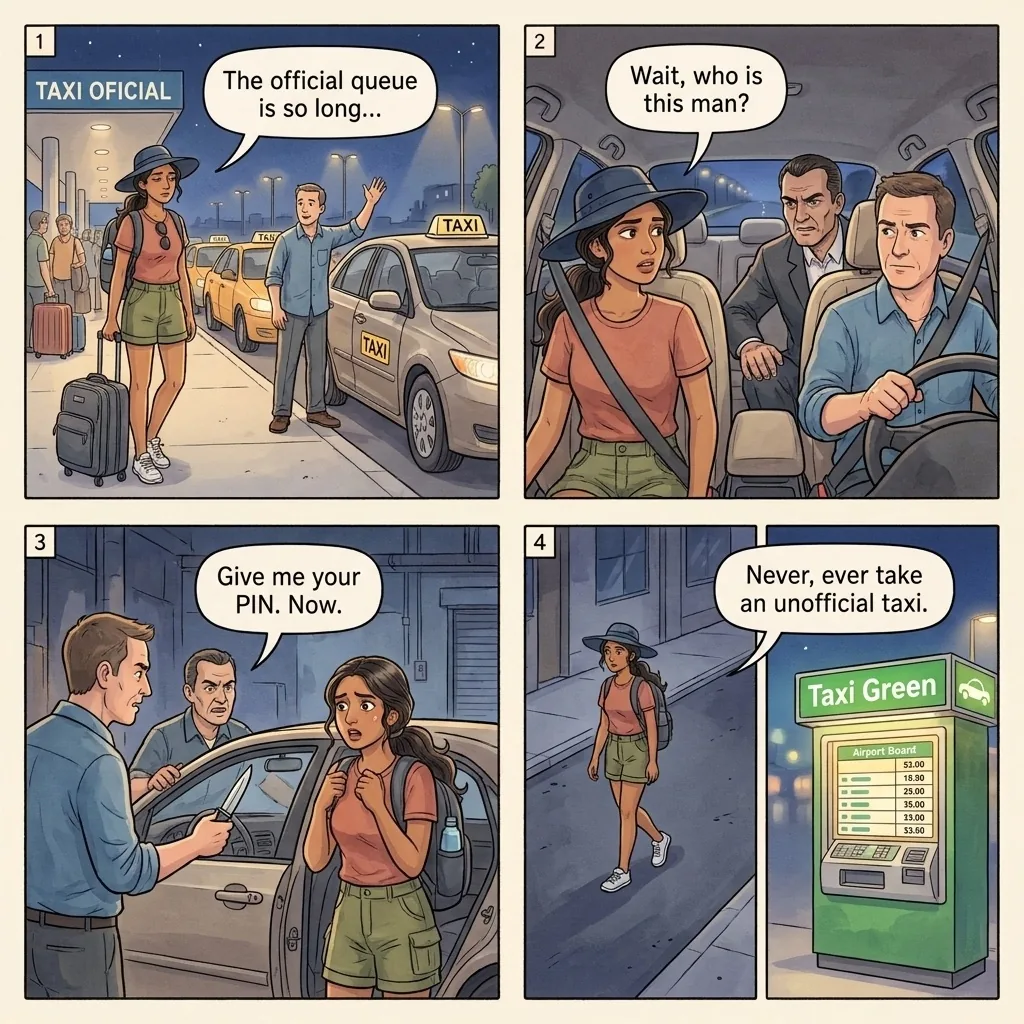
You arrive at Jorge Chávez airport at 11 p.m., the official taxi line is long, and a man in a polo shirt with a small 'TAXI' magnet on his car waves you over with a smile and a clean-looking sedan parked just past the queue.
He quotes 70 PEN to your hotel in Miraflores — about $19, similar to what the official rank quotes — and loads your bag into the trunk. You climb in. Five minutes onto the Costa Verde, the driver pulls over briefly to 'pick up a friend,' and a second man slides into the front passenger seat. You ask why. The driver smiles and says it is fine, just dropping him in San Isidro. The car keeps moving but the route is wrong; he has turned away from the coastal road toward an unfamiliar industrial stretch.
Within minutes, both men have produced knives or claimed to have a gun, the doors are locked, and the demands begin: phone, wallet, passport, all bank-card PINs. They drive you to a sequence of ATMs over the next two to three hours, forcing withdrawals up to your daily limit at each, and sometimes at multiple banks to bypass single-bank caps. The kidnapping ends with you dropped on a dark street in an unfamiliar district, with empty pockets but, in most documented cases, physically unharmed.
'Express kidnapping' (secuestro al paso) is the most serious tourist crime in Lima, documented extensively by the U.S. Embassy in Peru, the U.K. Foreign Office, the Peruvian Tourism Police (Policía de Turismo, POLTUR), and Reddit. The kidnappers target Jorge Chávez arrivals (especially late-night flights), Miraflores boulevards near tourist hotels, and San Isidro after dark. Total losses typically run $400–2,000 per victim, and the U.S. Embassy notes that most attacks end without violence as long as the victim cooperates.
A second variation — Lima's 'pirate taxi' — involves not picking up a second passenger but driving directly to a remote area where the kidnappers wait. The 2019 reform requiring all licensed Lima taxis to be yellow with a posted 'SETARE' license decal helped, but the unregulated market persists. Anyone curbside who is not in a yellow taxi with a SETARE sticker is, by definition, not part of the regulated system.
Book Uber, InDriver, Cabify, or Beat from inside the airport terminal — all four operate cleanly in Lima with GPS tracking and a verified driver. The fare to Miraflores is 60–90 PEN in-app. If you must use a curbside taxi, walk to the official 'Taxi Verde' or 'Taxi 365' airport rank inside the terminal exit hall, never accept rides from anyone approaching you on the curb, and never let a 'second passenger' get into the car. If a taxi diverts from the route, dial 105 (Peruvian Police) or POLTUR at +51 1 460 0921 immediately. If kidnapped, comply, do not resist, and contact your embassy as soon as possible (US Embassy Lima: +51 1 618 2000).
Red Flags
- Unofficial taxi with no markings or meter
- Driver picks up 'another passenger' mid-route
- Route doesn't match Google Maps
- Car doors locked from inside
How to Avoid
- Book taxis through your hotel or use InDriver/Uber.
- Never get into an unmarked vehicle.
- If in a bad situation, stay calm — express kidnappings in Lima are usually 'safe' as long as you comply and don't resist.
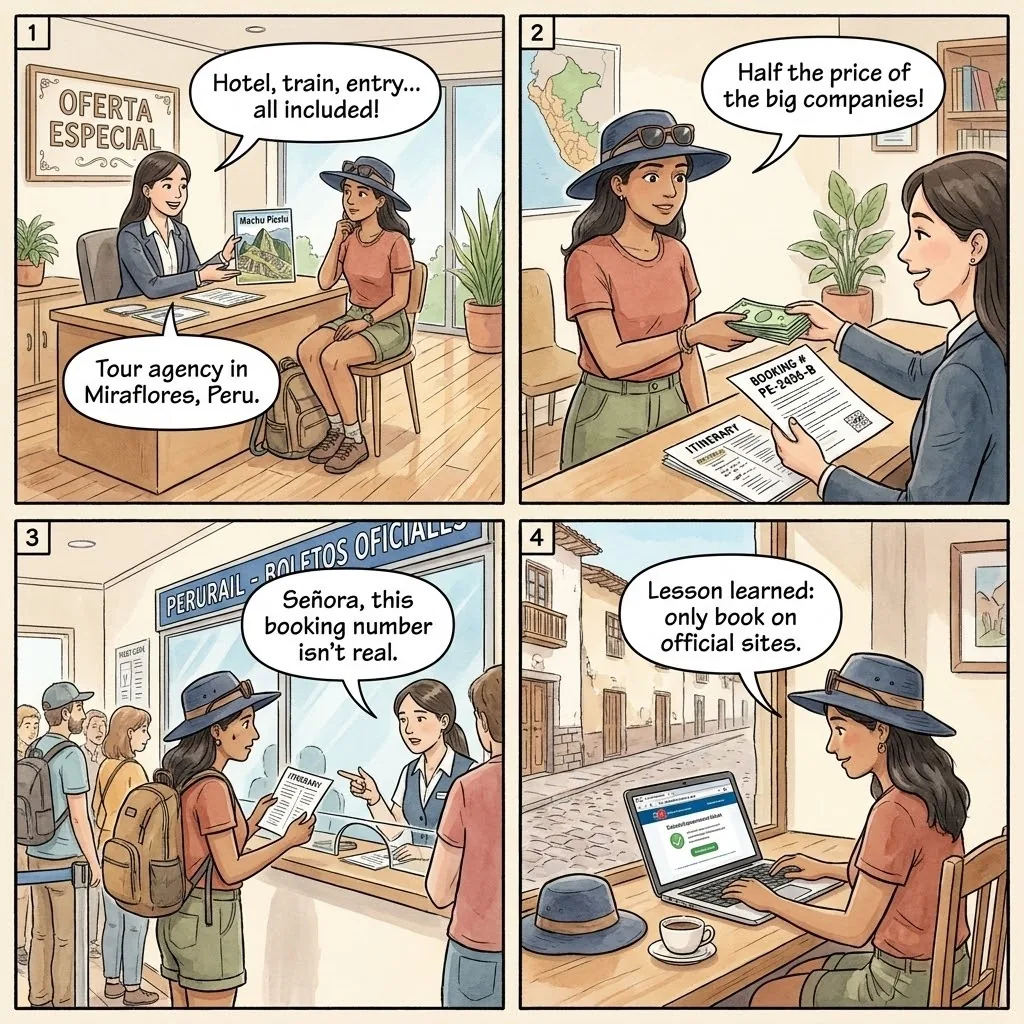
A small tour agency on Avenida Larco in Miraflores quotes you a four-day Machu Picchu and Sacred Valley package for $480 — about half what Peru Hop or established Cusco operators charge — and the office looks proper, with framed certificates, glossy brochures, and a confident agent.
She shows you photos of the train, the Inca ruins, the comfortable hotel in Aguas Calientes, the bus up to Machu Picchu. Everything is included, she says: train tickets, hotel, Machu Picchu entry, Sacred Valley tour, transport. You pay $480 in cash, receive a printed itinerary with a paper booking number, and fly to Cusco three days later expecting your tour to be ready.
In Cusco, things unravel. The train ticket reservation she promised never existed in PeruRail's system, or it was made for a different date, or it is for a Backpacker class she did not mention. The Machu Picchu entry ticket was never purchased — the official site at tuboleto.cultura.pe shows no record under your passport number. The hotel in Aguas Calientes does not have your booking. The Sacred Valley 'tour' is one you are expected to find on your own. The Miraflores agent has stopped answering her phone.
The Lima fake-Machu-Picchu-agency scam is documented across Reddit, Reddit, the U.S. Embassy Lima travel advisories, and the long-running TripAdvisor Peru forum. Total losses typically run $300–1,200 per victim, and the agencies rotate frequently — an office that runs the scam in October may be under a different name with different printed certificates by spring. The Avenida Larco strip is the densest concentration, but Lima Centro tour agencies and hotel-lobby tour desks run the same script.
The defense is that Machu Picchu entry tickets can only be purchased through the official government site (tuboleto.cultura.pe) or through a small list of authorized re-sellers, and PeruRail and IncaRail train tickets can only be booked on their respective official sites. Any 'agency' selling combined packages should be able to show you the actual booking confirmations on the official sites, in your name, before payment. If they cannot, the booking does not exist.
Book Machu Picchu entry directly at tuboleto.cultura.pe (or perurail.com / incarail.com for the train) — never through a Miraflores tour agency that cannot show you the official booking confirmations under your passport number before payment. Use established operators (Peru Hop, Llama Path, Alpaca Expeditions, Adventure Life) bookable on their official websites with TripAdvisor reputations. Pay by credit card for chargeback protection, never in cash. If you have already paid a fake agency, file a chargeback, dispute via your card issuer, and report to POLTUR (Tourist Police) at +51 1 460 0921.
Red Flags
- Price is significantly lower than any other operator
- Agency can't show you actual booking confirmations
- Booking is verbal with minimal paperwork
- Lots of laminated certificates that look like they were printed at home
How to Avoid
- Book Machu Picchu only through the official site tuboleto.cultura.pe.
- Use well-reviewed operators on TripAdvisor or verified by your hotel.
- Get every inclusion in writing with a receipt.
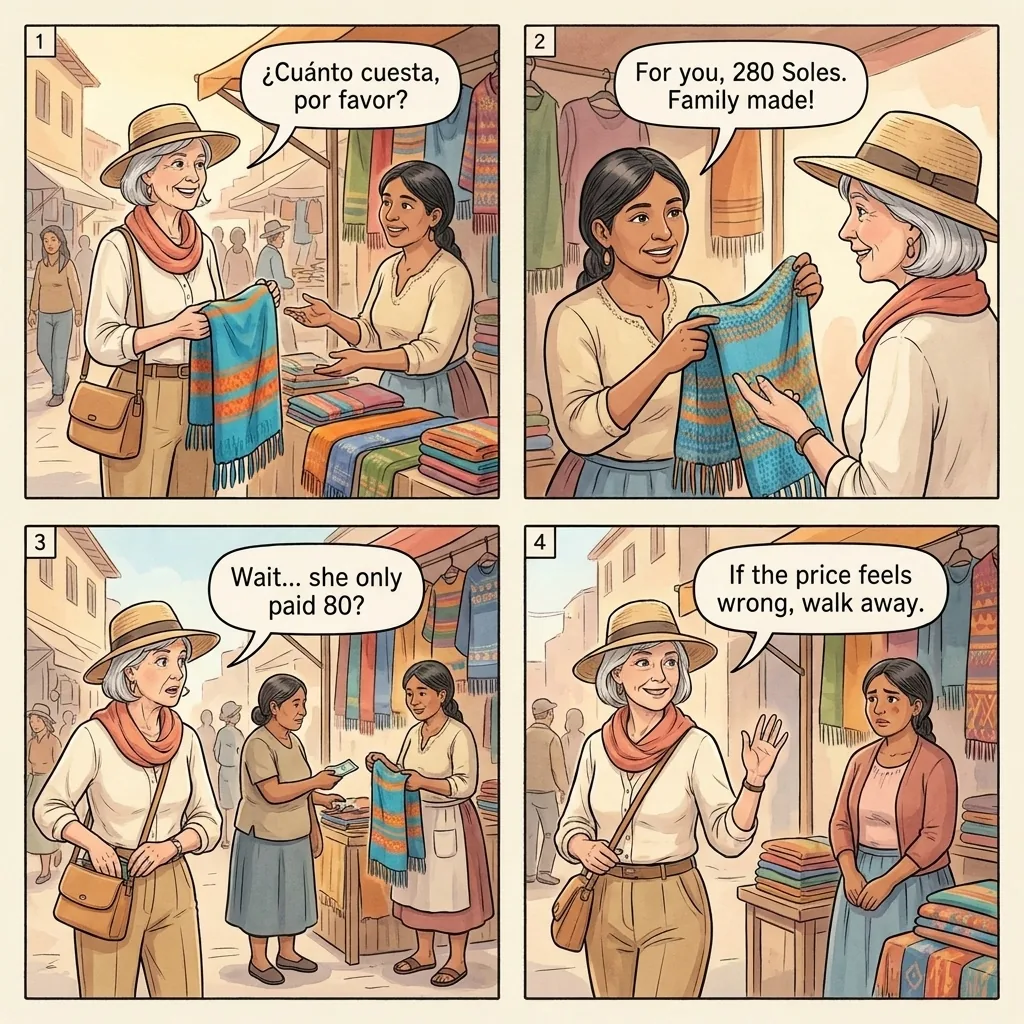
You stop at a stall in Mercado Indio in Surquillo, pick up a hand-loomed alpaca scarf you like, and ask the vendor in your tourist Spanish how much.
She glances up, takes you in for half a second, and quotes 280 PEN — about $75. You think the price is high but plausible for genuine alpaca, you nod, and you reach for your wallet. What you do not know is that the same scarf, sold to a Limeña customer ten minutes earlier, went for 80 PEN. The 280-PEN quote was set the moment you opened your mouth in a foreign accent.
When you make a soft attempt to negotiate, the vendor's expression hardens. She says the price is fair, that the alpaca is the finest quality, that her family weaves these by hand in Cusco. The framing is sincere enough that most travelers back down and pay full price. The scarf, in fact, is mass-produced acrylic-and-alpaca blend that the same vendor buys wholesale at 30 PEN. You have just paid roughly nine times the local price.
'Gringo pricing' is the universally documented Lima market practice, well-flagged across Reddit, the TripAdvisor Lima forum, and most updated guidebooks. The same dynamic applies to ceviche carts on side streets near Larco Mar, fruit-juice stands, taxi quotes (where covered separately), and even pisco sour 'tastings' offered at the entrance to bars. The scam is not malicious in intent — it is a local market norm — but the markup against tourists who do not know the floor price is consistent and large.
A second variation runs at small unlicensed restaurants in Miraflores side streets and around Larco Mar. The waiter brings food to the table and names the price only at the bill stage, when you have already eaten. A modest plate of ceviche that the menu (if any) shows at 30 PEN comes to 90 PEN. Some unlicensed operators have no posted menu at all, which is the warning sign — Peruvian law requires restaurants to display prices.
Always confirm prices before any market-stall purchase or restaurant order in Lima — ask 'cuánto cuesta?' and watch the response carefully. At Mercado Indio, walk the entire market once before buying anything to compare prices across stalls; legitimate alpaca scarves run 60–120 PEN, and craft items 20–60 PEN. At restaurants, eat only at places with a printed menu showing prices on the wall or at the table. For ceviche specifically, La Mar, Punto Azul, and El Mercado are the reputable Miraflores choices. Counter-offer at 40–50% of any inflated quote and walk away if the vendor refuses to negotiate; the price drops fast.
Red Flags
- Price is never stated before you sit down or commit to a purchase
- Restaurant has no visible menu with prices
- Vendor names price only after item is in your hands
How to Avoid
- Always confirm prices before committing.
- Eat at restaurants with menus and listed prices.
- Learn basic price phrases in Spanish.
Like what you're reading? Get a full Lima itinerary with safety tips built in.
Browse travel-safety books →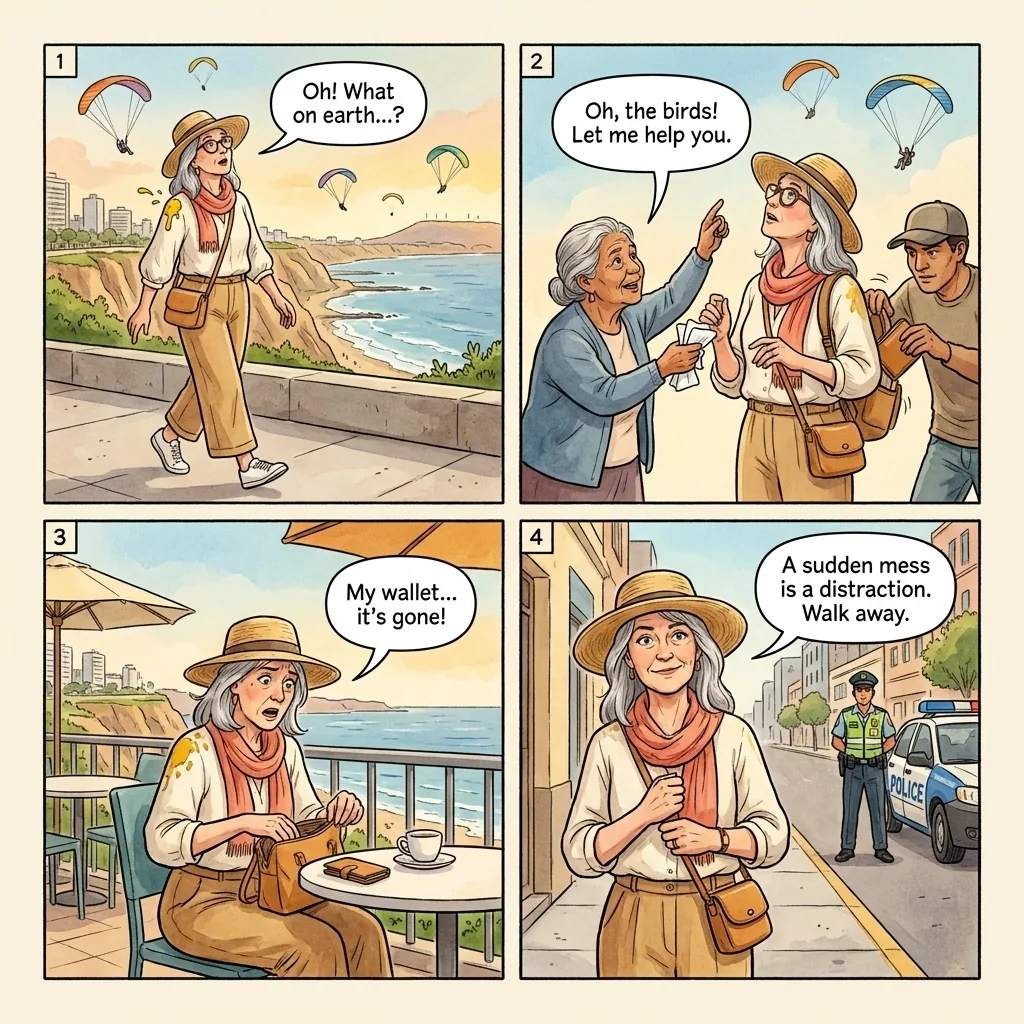
You are walking the Malecón in Miraflores along the cliff-top promenade, looking out at the surfers below, when something cold and yellow lands on your shoulder.
It is a thick smear of what looks like mustard, or maybe bird droppings, or a sticky coffee-colored stain. Before you have time to react, an older woman appears beside you with a packet of tissues, exclaiming sympathetically about the mess. She gestures up at the sky as if a bird is to blame, dabs at your shoulder, and asks if she can help you clean off the rest. Her tone is warm, motherly, almost concerned for you.
While her hand and the tissues are at your shoulder, a partner you have not noticed has stepped behind you. In the four to six seconds your attention is on the mess and on her face, the partner unzips your daypack and lifts your wallet, your phone, or whatever sits in the outer pocket. By the time you realize the woman has finished and stepped away, both of them have walked separately into the crowd. Your bag still feels normal, you have not noticed the lift, and you do not check until you reach for your phone twenty minutes later.
The 'mustard smear' (or its variants — bird-poop spray, ketchup, paint) is one of Lima's most consistent pickpocket distractions, documented across Reddit, the U.S. Embassy Peru advisories, and most updated guidebooks. The substance is sprayed deliberately by the partner just before the 'helpful' stranger appears, so the timing is too perfect to be coincidence. The Malecón Miraflores, the Larco Mar boardwalk, and the streets around Plaza de Armas are the consistent hotspots; San Isidro and the Kennedy Park area see secondary incidents.
A subtler variation skips the spray entirely. A 'helpful' stranger taps you on the shoulder to point out something on your back — 'señora, tienes algo en la espalda' — and offers to help brush it off. Even without the actual stain, the tap-and-touch sequence is a pickpocket setup. The same operators rotate between Lima and Cusco; Reddit threads document the same crews in both cities.
If something cold lands on you in Lima — mustard, bird mess, water, anything — step immediately away from all strangers, put a hand on your bag and pockets, and only then assess the mess yourself. Decline every 'helpful' tissue offer; the helper is part of the scam. Wear a crossbody bag on your front with a zipper, keep your phone and wallet in zipped front pockets, and stay in the middle of the Malecón path rather than near the rail where the spray angle works. If you are pickpocketed, dial 105 (Peruvian Police) immediately and file a report at the nearest POLTUR (Tourist Police) office.
Red Flags
- Sudden liquid or substance appears on your clothing
- A stranger immediately appears offering to help clean it
- You feel unnecessarily crowded
How to Avoid
- If something hits you, step away from all strangers immediately and check your belongings first.
- Keep your bag in front of you in crowded areas.
- Decline all unsolicited 'help.'
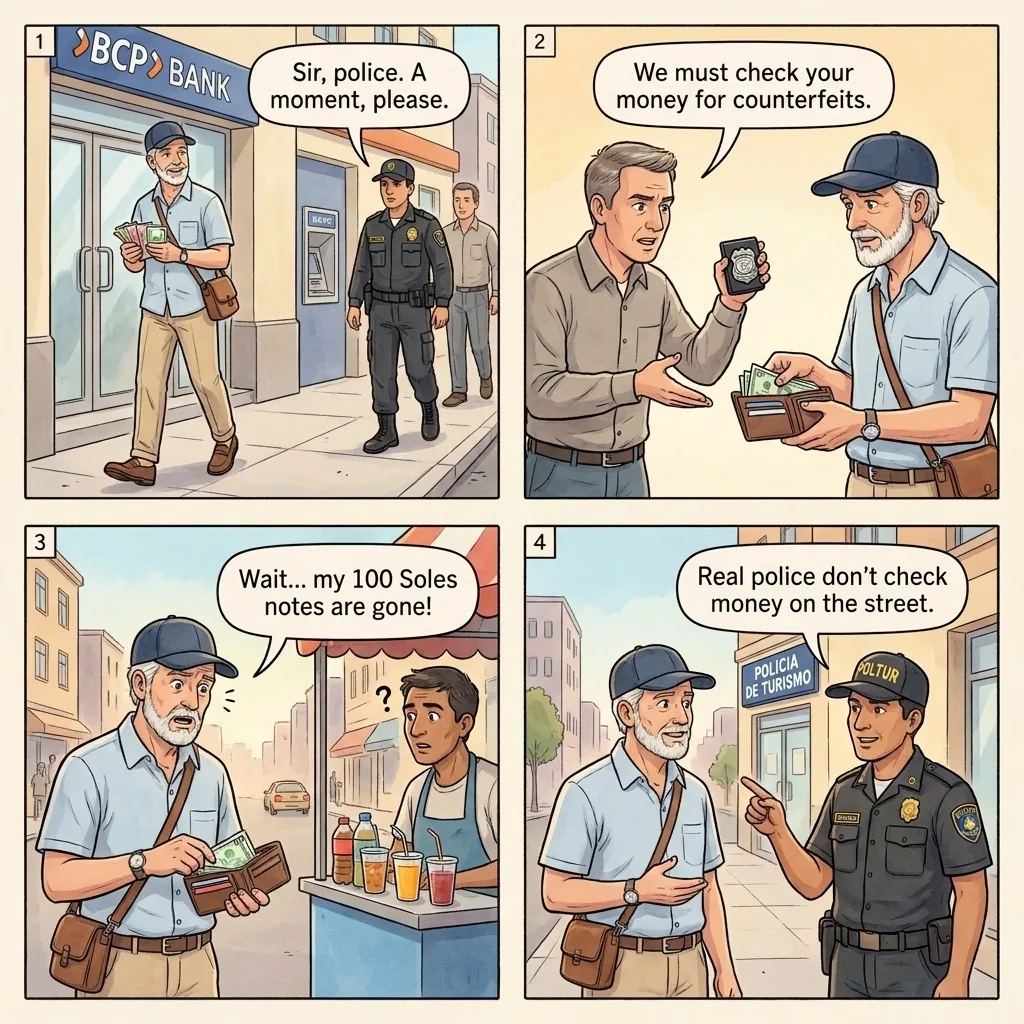
You are walking out of a bank branch in Lima Centro after a small currency exchange when two men step into your path — one in plain clothes, one in what looks like a Peruvian National Police uniform — and flash badges that flip closed quickly.
They explain in calm Spanish-accented English that there has been a counterfeit-currency operation in the neighborhood that morning, that they need to verify the bills you just received are not part of it, and that this will only take a moment. The plain-clothes officer holds out a hand expectantly. The 'uniformed' partner stands a step behind, lending visual authority. The whole encounter is framed as a polite professional courtesy.
If you hand over your wallet, the plain-clothes officer fans through the bills, ostensibly examining each note for counterfeits. He returns the wallet within thirty seconds. By the time you walk on, anywhere from 200 to 1,500 PEN is missing — slipped from the wallet during the 'inspection' by a hand kept low. Some operators also memorize your card numbers and the position of large bills, which they may swap for smaller denominations to delay your discovery.
A more serious variation pivots to identity capture. The officer asks to photograph your passport 'for the report,' takes a clear shot, and returns it. The passport image then enters the identity-fraud market and may show up in counterfeit travel documents weeks later. Real Peruvian National Police almost never engage tourists for counterfeit checks on the street, and any photograph of your passport requires a station-based formal report, not a sidewalk encounter.
The pattern is documented across Reddit, the U.S. Embassy Peru advisories, the U.K. Foreign Office Peru travel advice, and POLTUR's own consumer-protection materials. Lima Centro near Plaza San Martín, the streets around major bank branches (BCP, BBVA, Scotiabank), and the Cruz del Sur and Movil Tours bus terminals are the consistent hotspots. The 'uniformed' partner's outfit is sometimes a real Peruvian National Police uniform purchased on the surplus market, which is what gives the encounter its initial credibility.
Refuse any wallet or passport inspection by anyone in plain clothes claiming to be Peruvian National Police — real officers do not do this. Ask politely but firmly to see formal ID with a name and badge number, photograph it before it closes, and offer to walk together to the nearest comisaría to verify. If they walk away when you propose this, the scam is confirmed. Never hand over your wallet or passport on the street, and never let them photograph your passport. If pressured, dial 105 (Peruvian Police) or POLTUR (Tourist Police) at +51 1 460 0921 immediately.
Red Flags
- Police stop you without a specific stated reason
- They want to handle your wallet or cash directly
- One officer is in plain clothes with a questionable badge
- The 'uniformed' officer's badge flips closed before you can read it
- They ask to photograph your passport on the street
How to Avoid
- Real Peruvian police don't conduct 'money inspections' on the street.
- Offer to walk to the nearest police station instead — they will refuse.
- Ask to see a badge and official ID number (real officers won't object).
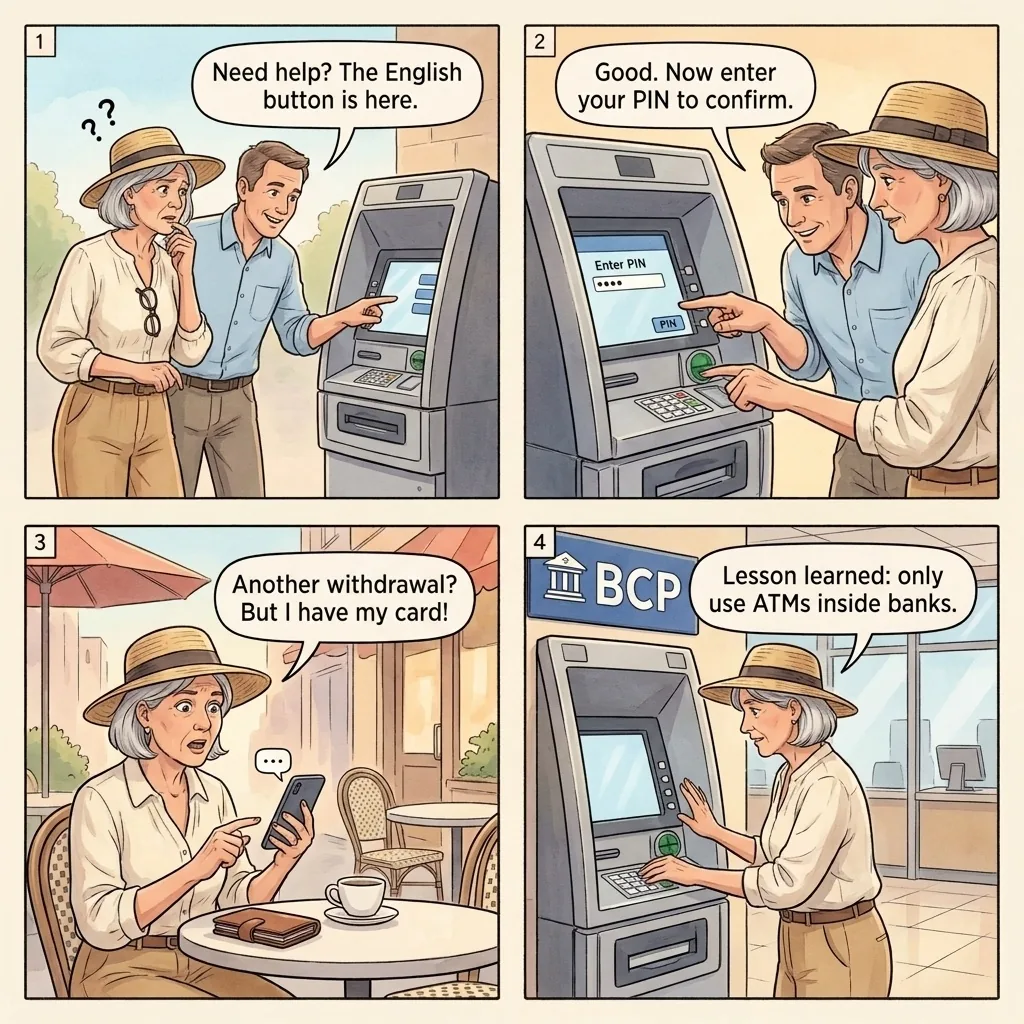
You walk to a free-standing ATM near Kennedy Park in Miraflores, slot in your debit card, and the screen prompts in Spanish — confusing if your español is shaky.
A friendly bystander in his thirties leans in helpfully and offers to translate the menu. He gestures at the buttons in turn — 'press this for English, then withdrawal, then your amount, then this for confirm' — and stands close enough to follow your finger movements as you enter your PIN. The withdrawal completes, the cash dispenses, and he steps back with a wave and a smile. You thank him and walk on with your bills.
The 'helper' watched and memorized your PIN over your shoulder during the menu navigation. Within hours, a cloned card (created from a skimmer that was likely also fitted on the same ATM) is being used at other Lima ATMs to drain the daily withdrawal limit. By the time your bank flags it, anywhere from 600 to 4,000 PEN is gone, plus whatever fraudulent purchases the partner card runs through retail that night.
A second variation involves a 'cash-trap' overlay that prevents the bills from dispensing. The 'helper' suggests entering your PIN again to release the trapped cash, then walks off with both your card details and (after you leave in frustration) the trapped bills themselves. The give-away is that ATMs do not, ever, ask you to enter your PIN twice in a single transaction.
The Lima ATM-helper pattern is documented across Reddit, the BCP and BBVA consumer-protection pages, and the U.S. Embassy Lima travel advisories. Free-standing ATMs at corner stores in Miraflores and Barranco are the consistent hotspots — particularly Avenida Larco between Kennedy Park and Larco Mar, the Barranco main strip after dark, and Lima Centro after the banks close. ATMs inside actual bank branches during business hours are far safer.
Use ATMs only inside bank lobbies (BCP, BBVA, Interbank, Scotiabank) during opening hours, where staff supervise and skimmer fitment is much harder. Cover the keypad with your other hand every single time you enter a PIN. Never accept help from a stranger at an ATM — if you cannot read the menu, cancel the transaction and find a bank branch where staff can help. Tug the card-slot bezel before inserting; a skimmer often wiggles or sits proud of the metal. If you suspect skimming, dial 105 (Peruvian Police) or call your bank immediately to freeze the card.
Red Flags
- Stranger approaches while you're at an ATM
- Someone standing unusually close while you use an ATM
- Helpful 'assistance' that requires them to touch the keypad
How to Avoid
- Always shield your PIN with your body and hand.
- If someone approaches at an ATM, cancel your transaction and find another machine.
- Use ATMs inside bank branches only.
🆘 What to Do If You Get Scammed
📋 File a Police Report
Go to the nearest Peruvian National Police (PNP) station. Call 105. Get an official crime report — you'll need this for insurance claims. You can also report online at pnp.gob.pe.
💳 Cancel Your Cards
Call your bank immediately. Most have 24/7 numbers on the back of the card (keep a photo saved separately). Block any suspicious transactions before the thieves use your details.
🛂 Lost Passport?
Contact your nearest embassy or consulate. The US Embassy is at Av. La Encalada Cdra. 17 s/n, Surco, Lima. For emergencies: +51 1-618-2000.
📱 Track Your Device
If your phone was stolen, use Find My (iPhone) or Find My Device (Android) from another device. Don't confront thieves yourself — share the location with police instead.
Sources & further reading
Every scam here is cross-checked against official government advisories, police bulletins, and established reporting. Confirm current details with the primary sources below before you travel.
-
Government of Canada (travel.gc.ca) — Travel advice and advisories for Peru
Government advisory
“A common scam involves spraying a substance on victims and then robbing them while pretending to help clean the stain, or distracting the victim by asking questions while another person perpetrates the…”
-
UK Foreign, Commonwealth & Development Office (GOV.UK) — Safety and security - Peru travel advice - GOV.UK
Government advisory
“Victims are taken hostage and forced to withdraw money from ATMs for their release, usually at night.”
-
U.S. Department of State — Peru International Travel Information
Government advisory
“Travelers have been assaulted or robbed after hailing an unknown taxi on the street.”
-
OSAC — Overseas Security Advisory Council (U.S. Department of State) — Peru Country Security Report
Government advisory
“Counterfeit currency is a concern.”
-
Infobae (Peru) — Falsos colectiveros en Miraflores realizaban robos, secuestros y hasta tocamientos indebidos a pasajeros
News report
“Los delincuentes captaban a sus víctimas presentándose como conductores de colectivo”
-
NBC News (Associated Press) — 'More profitable than cocaine': Peru becomes top source of counterfeit US cash
News report
“Peru has in the past two years overtaken Colombia as the No. 1 source of counterfeit U.S. dollars, says the U.S. Secret Service”
Frequently Asked Questions
You just read 6 scams in Lima. The full Travel Safety Series has 780+ more across 20+ countries.
Tokyo's Kabukichō ¥130,000 bar trap. Rome's gladiator photo extortion. Paris's gold-ring trick. Bali's ATM skimmer scams. Bangkok's grand-palace closure ruse. Every documented scam across 20+ destinations — with the exact scripts, red flags, and local-language phrases that shut each one down. Drawn from Reddit traveler reports, embassy advisories, and consumer-protection cases.
- 780+ documented scams across Tokyo, Rome, Paris, Bali, Bangkok, Rio & 100+ more cities
- 20+ countries covered, with country-by-country phrase cards for every destination
- Updated annually — buy once, re-download future editions free
- All titles $4.99 each on Amazon Kindle