
Key Takeaways
- The #1 reported scam is the Arequipa Express-Kidnapping Street Taxi.
- 3 of 6 scams are rated high risk.
- Use app-based ride services (Uber, DiDi) instead of street taxis — avoid unmarked vehicles, especially at night.
- Never accept unsolicited offers from strangers near tourist sites in Arequipa.
⚡ Quick Safety Tips
- Keep phones and valuables in secure pockets when in crowded areas.
- Use only licensed taxis or app-based ride services.
- Book tours and tickets through verified operators with online reviews.
- Keep a copy of your passport separate from the original.
Jump to a Scam
The 6 Scams
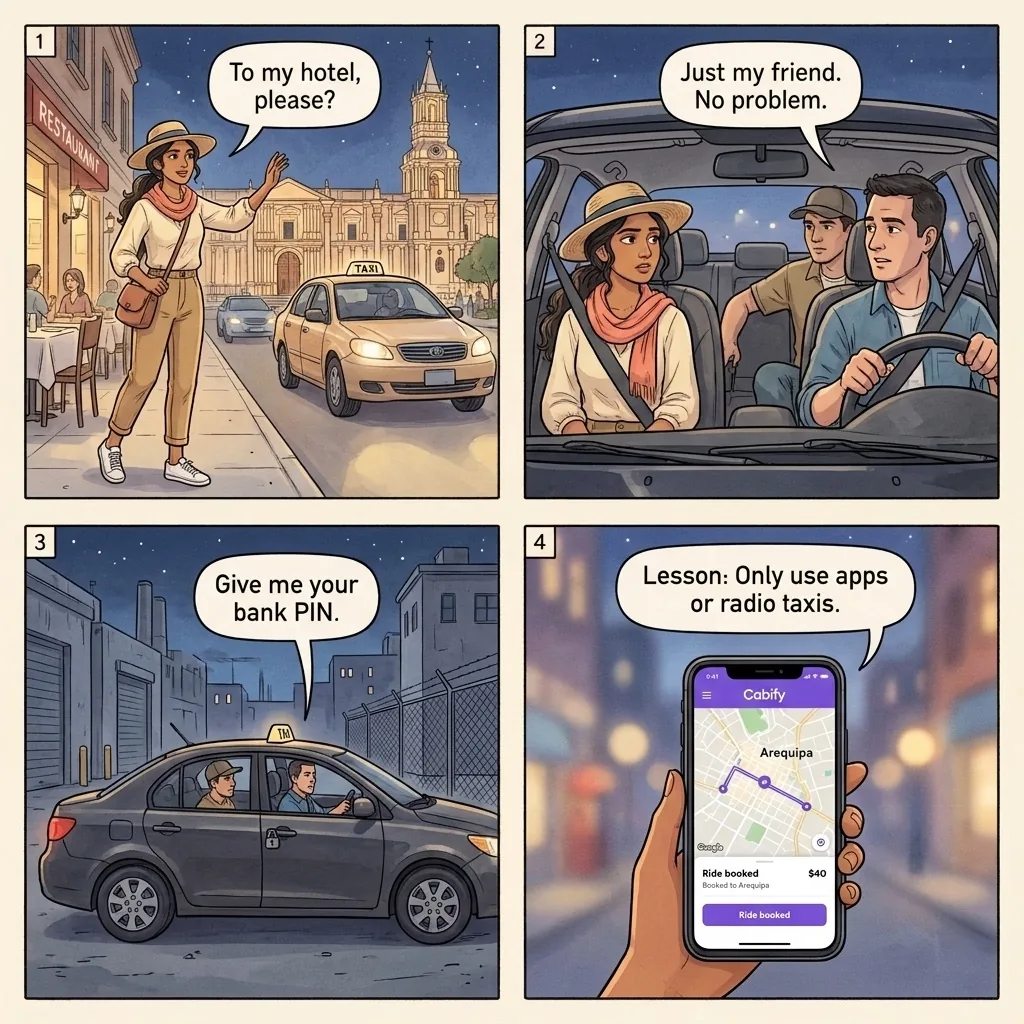
You hail a street taxi near Plaza de Armas after dinner around 10 p.m., the driver agrees on the fare to your hotel, you climb in, and the car pulls away into central Arequipa.
A few minutes in, instead of driving toward your hotel, the driver pulls over briefly and a second man slides into the front passenger seat. You ask why; the driver smiles and says it is fine, just dropping his friend somewhere on the way. The car keeps moving but the route is wrong; he has turned away from your hotel district toward an unfamiliar industrial stretch on the outskirts.
Within minutes, both men have produced knives or claimed to have a gun, the doors are locked, and the demands begin: phone, wallet, passport, all bank-card PINs. They drive you to a sequence of ATMs over the next two to three hours, forcing withdrawals up to your daily limit at each — sometimes at multiple banks to bypass single-bank caps. The most serious documented Arequipa cases have run 24+ hours, with victims bound and held while the operators returned to ATMs the next morning to withdraw under fresh daily limits.
Express kidnapping (secuestro al paso) in Arequipa is so consistent that the U.S. Embassy in Lima has explicitly prohibited all U.S. government personnel from hailing street taxis in the city. The U.K. Foreign Office, the Peruvian Tourist Police (POLTUR), and Reddit all flag Arequipa as a high-risk city for this scam, with the historic center near Plaza de Armas and late-night hails outside restaurants the consistent hotspots. Total losses typically run $500–3,000 per victim.
The cleanest fix is to skip every street taxi conversation. InDriver, Beat, Cabify, and Uber all operate in Arequipa with GPS tracking, in-app fare quotes, and verified drivers; an Uber from Plaza de Armas to most central hotels costs 8–15 PEN. Hotel-called taxis are the next-safest option, especially after dark. Anyone driving an unmarked car who offers a 'taxi' on the street is, by definition, not part of any of these systems.
Do not hail street taxis in Arequipa — this is the single most important safety rule in the city. Use InDriver, Beat, Cabify, or Uber for every ride, especially after dark; have your hotel call a trusted taxi if rideshare apps are unavailable. If you must use a street taxi, only use clearly branded company cars and confirm the driver's name and license matches what dispatch tells you. Never let a driver pick up a 'second passenger' mid-ride; if it happens, call 105 (Peruvian Police) immediately. If kidnapped, comply, do not resist, and contact your embassy as soon as possible (US Embassy Lima: +51 1 618 2000).
Red Flags
- An unmarked or unbranded car offers you a taxi ride
- The driver doesn't use a meter or official dispatch system
- The car has tinted windows or modified door locks
- The driver picks up another passenger after you're already inside
- The route deviates from what you expected
How to Avoid
- Don't hail a taxi on the street in Arequipa — this is critical.
- Use taxi apps like InDriver or Beat, or have your hotel call a trusted company.
- If you must take a taxi, use only well-known dispatch companies.
- Share your ride details with someone before getting in.
- Avoid taking taxis alone at night — use ride-share apps or hotel transport.
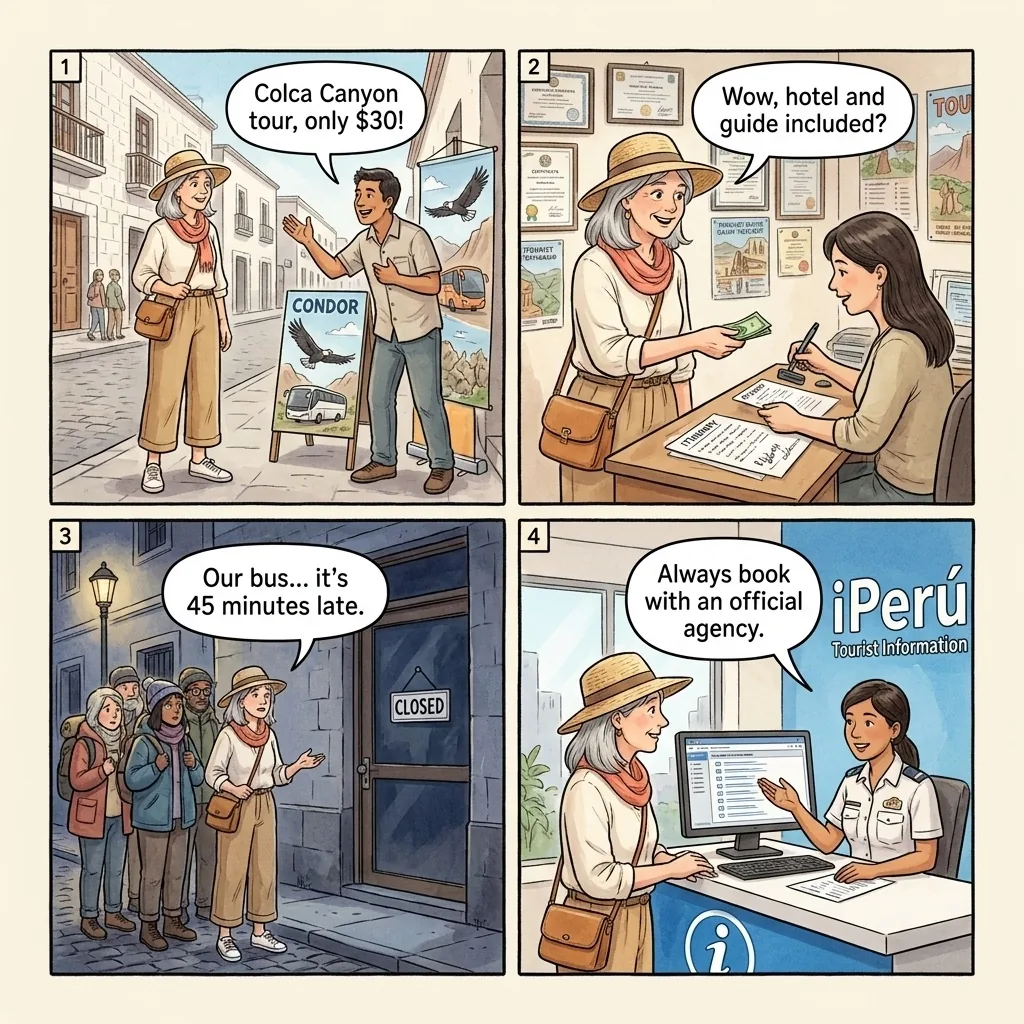
You walk through the historic center of Arequipa where every second storefront seems to sell Colca Canyon tours, and a friendly tout outside a small office on Calle Jerusalén offers a two-day Colca trek for $30 when established agencies are charging $60–80.
The office has a printed banner with photos of the Cruz del Cóndor viewpoint, a wall of laminated certificates, and a friendly woman at the desk who confirms the price and rattles off the included items: transport, hotel night in Chivay, breakfast, lunch, professional guide, and condor viewpoint entry fee. You pay $60 cash for two people, receive a handwritten itinerary stamped with the agency's name, and are told to be at the corner outside the office at 3 a.m. for pickup the next morning.
In the morning, nobody arrives. You wait at the corner for forty-five minutes in the cold pre-dawn dark before walking back to the office. The door is locked. The banner is still up but the lights are off and the woman is nowhere to be seen. Other tourists with the same handwritten itinerary are gathering on the same corner, looking at the same locked door. The agency was a pop-up that ran for a week or two, collected cash from tourists, and vanished overnight.
A worse variant produces an actual van. A rattletrap minibus arrives, no seatbelts, an uncertified driver, and a 'guide' who reads facts about Colca Canyon from a printed pamphlet in halting English. The hotel in Chivay turns out to be a hostel dorm, lunch is a single roll of bread per person, and the condor viewpoint entry fee is suddenly an extra 25 PEN per person 'not included.' By the time the tour limps back to Arequipa thirty hours later, the experience is nothing like what was sold.
The phantom-Colca-Canyon-agency pattern is documented across Reddit, Reddit, the long-running TripAdvisor Peru forum, and the U.S. Embassy in Lima's traveler-safety advisories. Specific named offenders rotate frequently — Trek The Colca, Andes Tour Operator, several others — but the structure is consistent: an unusually low quote, cash-only payment, no DIRCETUR (Regional Tourism Authority) registration number on display, no booking confirmation, and a handwritten receipt. Reputable Colca operators (Pablo Tour, Carlos Zarate Adventures, Colca Trek) all have established TripAdvisor reputations, websites with proper booking systems, and credit-card payment.
Book Colca Canyon tours only through agencies with verifiable DIRCETUR registration numbers and consistent TripAdvisor reputations — Pablo Tour, Carlos Zarate Adventures, and Colca Trek are the established names. Pay by credit card for chargeback protection, never cash. The legitimate two-day Colca tour rate is $60–100 per person; anything below $50 is a warning sign. Ask your hotel or hostel for vetted recommendations rather than booking from a street tout, and verify the operator's DIRCETUR number on dircetur.gob.pe before paying. If you have already paid a phantom agency, dispute via your card issuer (if applicable) and report to POLTUR (Tourist Police) at +51 1 460 0921.
Red Flags
- Price is significantly below the going rate for Colca Canyon tours
- Cash-only payment with no official receipt or booking confirmation
- The agency has no DIRCETUR tourism license displayed
- They operate from a street corner or social media page only
- No verifiable reviews on TripAdvisor or Google
How to Avoid
- Book through agencies with consistent positive reviews on TripAdvisor and Google.
- Verify the operator has a DIRCETUR (Regional Tourism Authority) registration.
- Pay with credit card where possible for chargeback protection.
- Ask your hotel or hostel for trusted agency recommendations.
- If a price seems too good to be true, it absolutely is.
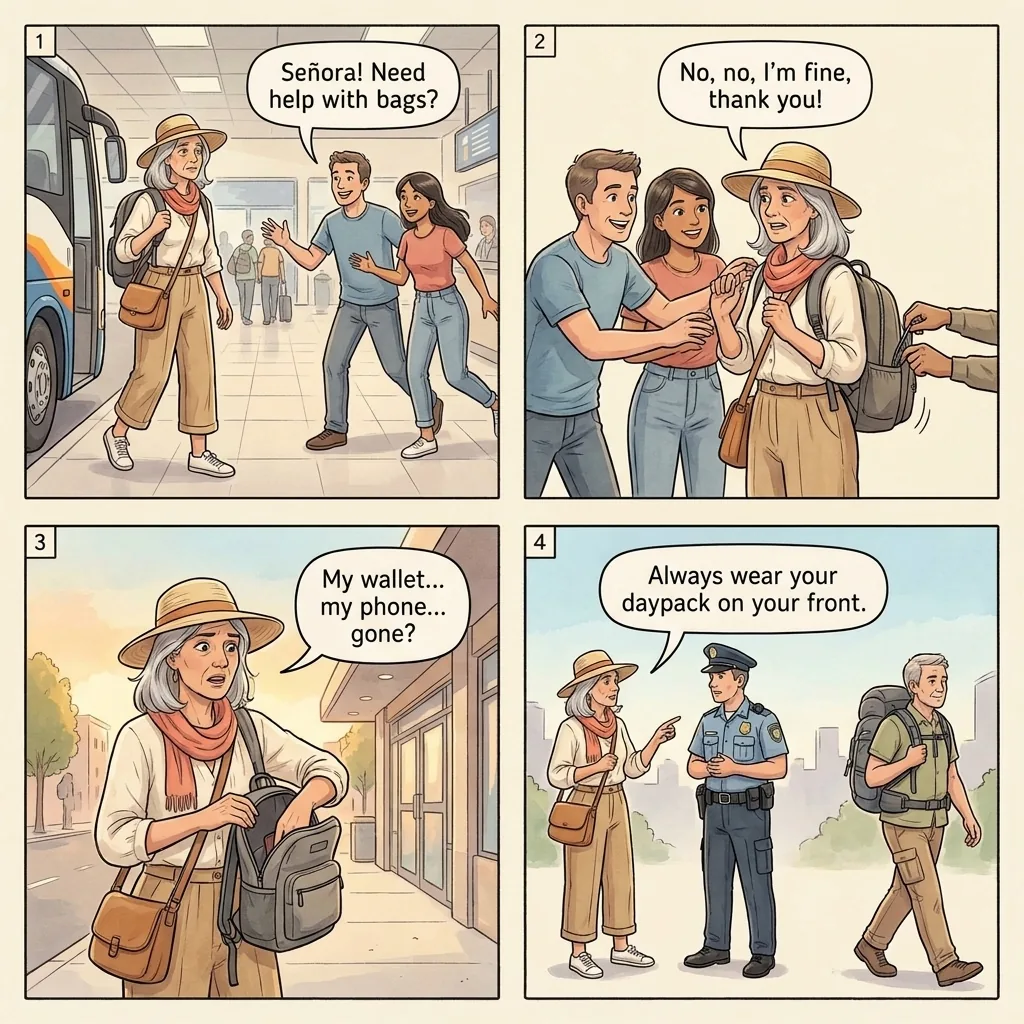
You step off your overnight Cruz del Sur bus from Lima at Arequipa's Terrapuerto at 5:30 a.m., still bleary, with a backpack on your front and a daypack at your feet on the platform.
As you reach for your daypack, two people rush forward — one offers to help you with the bus step, another reaches for your daypack 'to carry it for you.' Your hands are full, your reactions are slow from the overnight ride, and the friendly help feels normal in the chaos of a bus arrival. While you politely decline and try to wave them off, a third person you have not noticed has stepped behind you and unzipped the side pocket of your daypack.
By the time the two 'helpers' melt away after you firmly refuse, the third operator is gone too — and so are your phone, wallet, and any small items you had in the outer pocket. The lift took maybe five seconds during the conversation. You discover the loss only when you reach for your phone to call an Uber outside the terminal.
A second Terrapuerto variant runs the 'platform-switched' play. Someone in a fake uniform tells you your onward bus has been moved to a different platform and offers to walk you there — to a fake counter that charges a 're-booking fee' of 30–50 PEN. The fake counter is not part of the bus company, the fee is pure margin for the operators, and your real bus is still at the original platform.
The Terrapuerto distraction patterns are documented across Reddit, the long-running TripAdvisor Peru forum, and POLTUR (Peruvian Tourist Police) materials. The crews operate during peak arrival times — early morning when overnight buses from Lima and Cusco arrive, and late afternoon when day services land — and target obvious foreigners with luggage. The taxi rank just outside the terminal sees secondary incidents with unmarked-cab touts pulling the same kidnapping pattern as scam #1 above.
Keep valuables in front pockets or a hidden money belt at Arequipa's Terrapuerto — never in side pockets of a daypack accessible from outside. Politely but firmly decline all unsolicited 'help' with luggage; carry your own bags or use the terminal's official porters with visible ID. Verify any platform changes only at the official bus company counter with your ticket in hand. Skip the taxi rank entirely and pre-arrange hotel pickup or call an Uber from the waiting hall — the rank touts include the express-kidnapping crews from scam #1. If pickpocketed or scammed, dial 105 (Peruvian Police) and POLTUR at +51 1 460 0921.
Red Flags
- Strangers insist on helping you with luggage despite you declining
- Someone creates a commotion or distraction right as you exit the bus
- A person claims your bus departure has changed and offers to help rebook
- People crowd unusually close to you in an open terminal
- Someone bumps into you or blocks your path momentarily
How to Avoid
- Keep valuables in front pockets or a hidden money belt, never in accessible daypack pockets.
- Politely decline all unsolicited help with luggage.
- Verify any bus changes directly at the official counter with your ticket.
- Photograph your bag tags and keep a record of your booking.
- Pre-arrange hotel pickup to skip the taxi tout gauntlet outside the terminal.
Like what you're reading? Get a full Arequipa itinerary with safety tips built in.
Browse travel-safety books →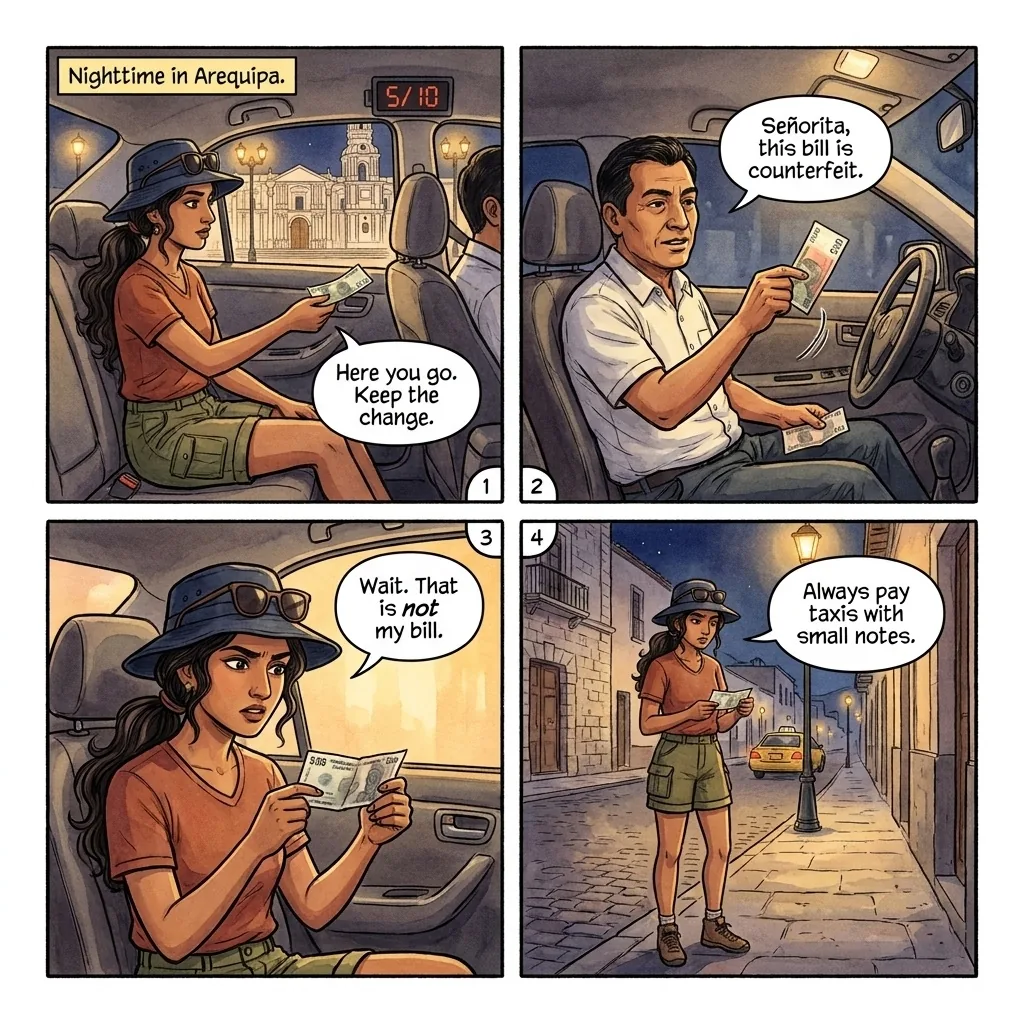
You take a short taxi from your hotel to dinner at a 10-sol fare and pay with a 50-sol note because you are out of small bills.
The driver takes the 50, glances at it, holds it up to the dim interior light, and shakes his head. He hands the bill back to you and says calmly that it is counterfeit, that he cannot accept it. You inspect the note in your hand — and it does look slightly off. The watermark is faint, the security thread is pasted-on rather than embedded, and the texture is wrong. You apologize, fish out a different 50, and pay with the second one.
The first 50-sol note you handed him was genuine. He palmed it on the way to checking it and produced a counterfeit from his pocket — a swap done with practiced sleight of hand under the dim light. The fake bill he handed back is now in your wallet, useless, and your real money is in his. The transaction took maybe twenty seconds and felt entirely normal. Peru's counterfeit-currency problem is well-documented; the country produces an estimated sixty percent of the world's counterfeit U.S. dollars, and fake soles are nearly as prevalent.
The Arequipa counterfeit-soles swap is documented across Reddit, the long-running Lonely Planet Peru forum, and the Banco Central de Reserva del Perú (BCRP) consumer-protection materials. Taxis, market stalls at San Camilo Market, and small shops near Plaza de Armas are the consistent locations. Vendors and drivers who handle bills quickly and confidently — often in dim light or below counter level — are the operators most likely to run the swap. The swap works at any denomination but the 50-sol and 100-sol notes are the most common targets because the loss is significant enough to be worth the risk.
A second variation runs at change. The driver or vendor takes a large bill, makes change, and returns the change in a confusing combination of small bills with one or two counterfeits mixed in. You count the total and it looks correct, but the fake notes are worth nothing once you try to spend them. Peruvian banknotes have specific security features — color-changing ink on the denomination number, a holographic strip, a watermark visible against light, and a raised tactile mark for the visually impaired — but you have to know to check.
Use small bills and exact change for taxis and small purchases in Arequipa whenever possible — this removes the swap surface entirely. Pay with Yape (Peru's mobile payment app) or card wherever accepted, especially for taxis and restaurants. If you must pay with a 50- or 100-sol note, photograph the serial number on your phone before handing it over, and if the driver claims it is counterfeit, demand to see a comparison or insist on going to a nearby bank to verify. Get cash only from ATMs inside major bank branches (BCP, BBVA, Interbank, Scotiabank). Learn the soles security features (watermark, security thread, color-shift ink) before your trip; the BCRP website has a guide.
Red Flags
- A driver or vendor claims your bill is fake right after you hand it over
- Quick, practiced hand movements when handling your money
- They insist on cash-only payment and won't take cards
- The 'returned' bill looks noticeably different from the one you gave
- A market vendor handles your bills below the counter or out of sight
How to Avoid
- Use small bills and exact change for taxis and small purchases.
- Note the serial number or take a photo of large bills before handing them over.
- Pay with Yape (Peru's mobile payment app) wherever possible.
- Get cash only from ATMs inside bank branches.
- Learn to identify genuine soles: check for watermarks, security threads, and color-changing ink.
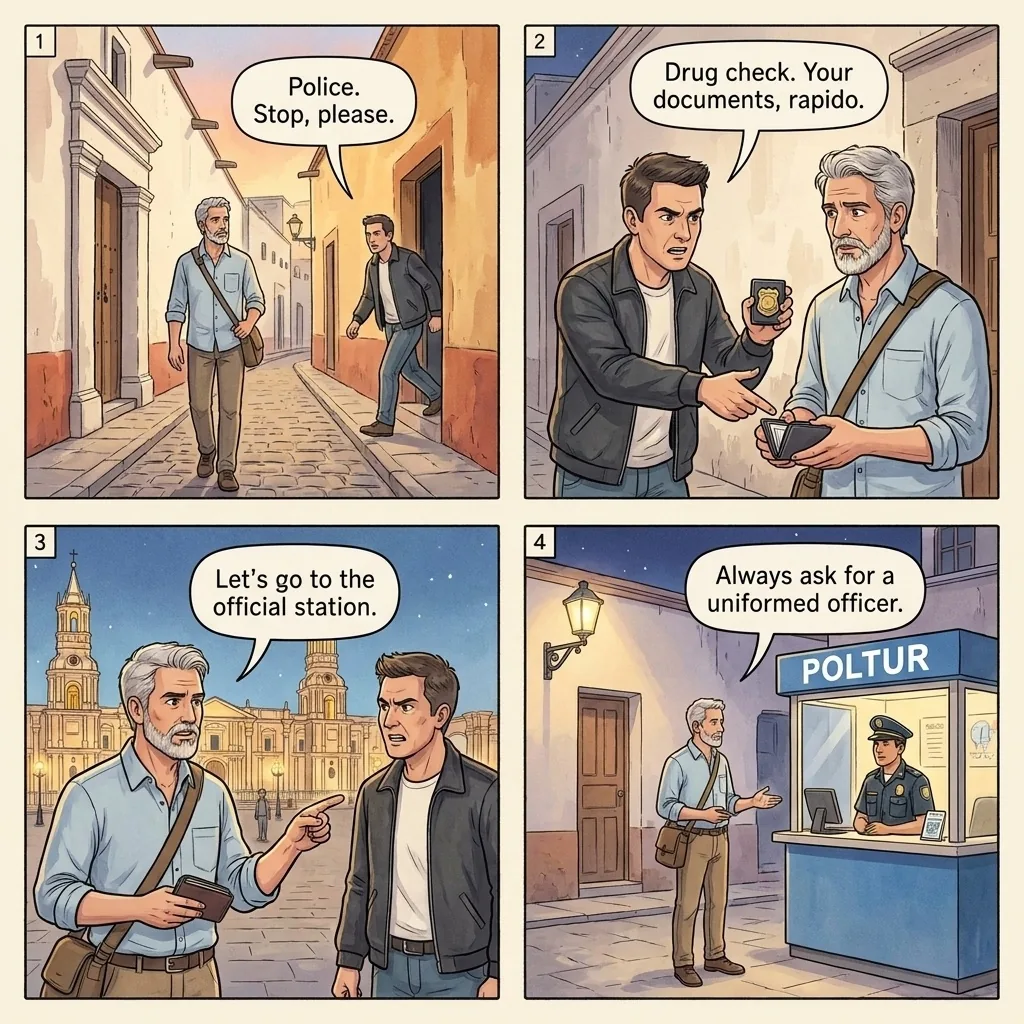
You walk back to your hotel through quiet side streets near Plaza de Armas at 11 p.m. when a man in plainclothes steps out of a doorway, flashes a metal badge, and identifies himself as a Peruvian National Police officer.
He explains in calm, professional Spanish-accented English that there has been a drug-trafficking incident in the neighborhood and that he needs to check your passport and bag as part of the investigation. The badge flips closed before you can read the unit name clearly. He gestures at your bag and says 'rapido, por favor' as if the entire interaction is routine. A second man stands a few meters back, watching.
If you hand over your passport, two outcomes are possible. He disappears into the night with your passport and wallet, and you spend the rest of your trip at the U.S. Embassy in Lima trying to obtain emergency travel documents. Or — slightly more common — he 'finds' something suspicious during his bag inspection (a small bag of white powder, some pills) that he claims are yours, and demands an on-the-spot fine of 200–500 PEN to make the problem go away.
The Arequipa fake-police document check is documented across Reddit, the U.S. Embassy in Lima's Peru advisories, the U.K. Foreign Office Peru travel advice, and POLTUR's own consumer-protection materials. The pattern is most aggressive on the dimly lit side streets fanning out from Plaza de Armas after dark, especially the alleys near Santa Catalina Monastery. The 'plain-clothes drug enforcement' framing is the most common variant.
Real Peruvian National Police almost never engage tourists for document checks on the street, and any photograph of your passport or bag inspection requires a station-based formal report, not a sidewalk encounter. Real PNP officers wear visible uniforms with name tags and badge numbers, carry properly issued PNP identification with photo and unit, and operate from marked vehicles. Plain-clothes officers, on the rare occasions they engage tourists, hold formal ID open for as long as you need to read it.
Refuse any plain-clothes 'police' document check on the street in Arequipa — real PNP officers do not search tourists for drugs in side streets at night. Carry only a passport photocopy when out at night; leave the original in your hotel safe. If 'police' demand to see documents, ask politely but firmly to see formal ID with a name and badge number, photograph it before it closes, and offer to walk together to the nearest comisaría to verify. If they walk away when you propose this, the impersonation is confirmed. If pressured aggressively, dial 105 (Peruvian Police) or POLTUR (Tourist Police) at +51 1 460 0921 immediately.
Red Flags
- A plainclothes person claims to be police and wants to see your documents on the street
- They approach you in an isolated or poorly lit area
- They refuse to show proper identification or go to a police station
- They want to inspect your wallet or bag contents specifically
- They mention drugs or fines before even checking anything
How to Avoid
- Never hand over your passport on the street — carry a photocopy instead.
- Insist on proceeding to the nearest police station or call 105 (Peru's emergency line).
- Real police won't demand on-the-spot cash fines.
- Don't walk alone on unlit side streets at night.
- Keep your original passport in your hotel safe.
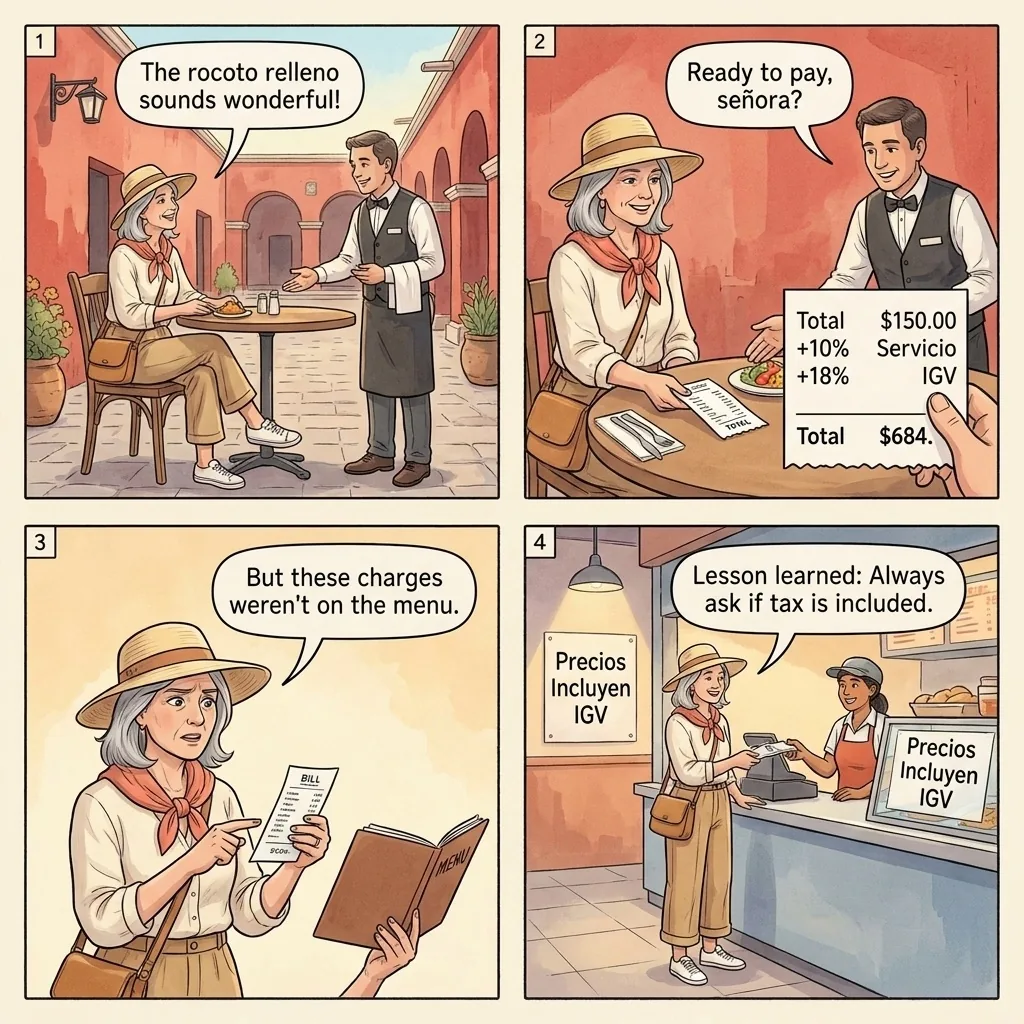
You enjoy a leisurely lunch at a nice restaurant near the Santa Catalina Monastery, the menu prices look fair, you order a rocoto relleno and a glass of chicha morada, and the food is excellent.
The menu shows the rocoto at 35 PEN and the drink at 12 PEN. You expect a bill around 50 PEN with a few small soles for tip. When the bill arrives, the total is 64 PEN — significantly higher than what the menu showed. The waiter hovers nearby, expectantly waiting for a tip on top.
The bill itemization reveals two layered surcharges. A 10% 'service charge' (servicio) has been added that was never disclosed at the table. An 18% IGV (Peru's value-added tax, equivalent to VAT) has been added on top of the menu prices, even though Peruvian consumer law requires menu prices to include IGV. The combined uplift is roughly 28%, which turns a 47-PEN expected meal into a 64-PEN actual bill — and the waiter still expects an additional tip beyond the 'service' charge.
The Arequipa hidden-surcharge pattern is documented across Reddit, the long-running TripAdvisor Arequipa forum, and the Indecopi (Peruvian Consumer Protection Authority) consumer-warning materials. Many tourist-facing restaurants around Plaza de Armas and Santa Catalina Monastery exclude IGV from menu prices and add an undisclosed 10% service charge — a practice that is technically illegal under Peruvian consumer-protection law but persists at restaurants whose business model depends on one-time tourists.
A second variation involves the 'special' or 'recommended' dish. The waiter recommends a dish verbally without mentioning the price, the dish arrives, and the bill shows it at 80–120 PEN — significantly above the menu's listed mains. The 'specials' are typically the highest-margin dishes with no posted price, and the recommendation is calibrated to extract the highest spend per table.
Ask before ordering whether menu prices include IGV (tax) and servicio (service charge) — say 'incluye IGV y servicio?' and decline if either is added on top. By Peruvian law, menu prices must include IGV; restaurants that do not are operating illegally and you can dispute the bill. A 10% service charge is the tip — you do not need to add more on top. Calculate your expected total before the bill arrives, and eat where locals eat (Picantería La Nueva Palomino, Hatunpa, Crepisimo) for transparent pricing and better food. If a restaurant adds undisclosed surcharges, dispute the bill at the table or via your card issuer, and file a complaint with Indecopi at indecopi.gob.pe.
Red Flags
- Menu prices don't specify whether tax and service are included
- The waiter pushes expensive items without mentioning prices
- A 'service charge' appears on the bill that wasn't mentioned
- The total seems significantly higher than what you mentally calculated
- Staff expect an additional tip beyond the already-included service charge
How to Avoid
- Ask before ordering whether prices include service charge and IGV tax.
- Check the fine print at the bottom of the menu.
- Calculate your expected total before the bill arrives.
- Know that a 10% service charge IS the tip — you don't need to add more.
- Eat where locals eat for transparent pricing and better value.
🆘 What to Do If You Get Scammed
📋 File a Police Report
Go to the nearest Peruvian National Police (PNP) station. Call 105. Get an official crime report — you'll need this for insurance claims. You can also report online at pnp.gob.pe.
💳 Cancel Your Cards
Call your bank immediately. Most have 24/7 numbers on the back of the card (keep a photo saved separately). Block any suspicious transactions before the thieves use your details.
🛂 Lost Passport?
Contact your nearest embassy or consulate. The US Embassy is at Av. La Encalada Cdra. 17 s/n, Surco, Lima. For emergencies: +51 1-618-2000.
📱 Track Your Device
If your phone was stolen, use Find My (iPhone) or Find My Device (Android) from another device. Don't confront thieves yourself — share the location with police instead.
Frequently Asked Questions
You just read 6 scams in Arequipa. The full Travel Safety Series has 780+ more across 20+ countries.
Tokyo's Kabukichō ¥130,000 bar trap. Rome's gladiator photo extortion. Paris's gold-ring trick. Bali's ATM skimmer scams. Bangkok's grand-palace closure ruse. Every documented scam across 20+ destinations — with the exact scripts, red flags, and local-language phrases that shut each one down. Drawn from Reddit traveler reports, embassy advisories, and consumer-protection cases.
- 780+ documented scams across Tokyo, Rome, Paris, Bali, Bangkok, Rio & 100+ more cities
- 20+ countries covered, with country-by-country phrase cards for every destination
- Updated annually — buy once, re-download future editions free
- All titles $4.99 each on Amazon Kindle