
Key Takeaways
- The #1 reported scam is the Plaza de Armas Alpaca-Photo Hustle.
- 1 of 4 scams are rated high risk.
- Use app-based ride services (Uber, DiDi) instead of street taxis — avoid unmarked vehicles, especially at night.
- Never accept unsolicited offers from strangers near tourist sites in Cusco.
⚡ Quick Safety Tips
- Keep phones and valuables in secure pockets when in crowded areas.
- Use only licensed taxis or app-based ride services.
- Book tours and tickets through verified operators with online reviews.
- Keep a copy of your passport separate from the original.
Jump to a Scam
The 4 Scams
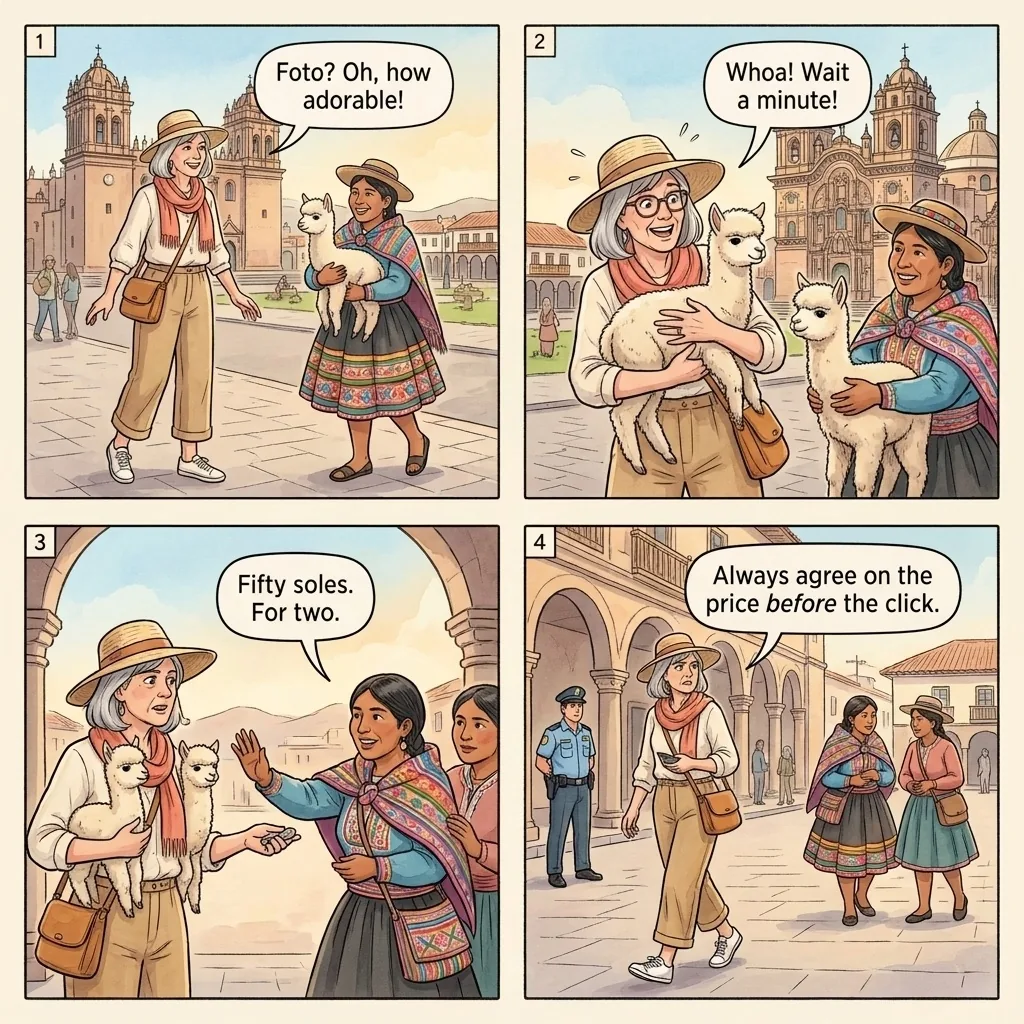
It's your first afternoon in Cusco, the altitude has you a little light-headed, and a Quechua woman in a brilliant red-and-gold pollera holding a baby alpaca walks straight up to you in the Plaza de Armas with a wide smile and the alpaca already half-extended toward you.
She says 'foto, foto' and gestures encouragingly. Before you can decide, she has placed the animal in your arms and a second woman has appeared at your other elbow with a second baby alpaca. A third woman with a phone camera takes the photo of you holding both animals, smiles approvingly, and the first woman extends her hand for payment. The price is suddenly 20–50 Peruvian soles per photo per animal — 'two animals, two photos.'
When you try to give her 5 soles instead, she blocks your path, raises her voice, and the second woman pushes the second alpaca firmly into your arms again as if to remind you that she is also owed. Other tourists watch from the plaza benches. The social pressure to pay the asked amount and walk away is the entire mechanism of the scam. As travelers report across Reddit, the TripAdvisor Cusco forum, the Lonely Planet South America thorntree, and the U.S. Department of State Peru country information, the alpaca-photo hustle is the most-encountered tourist friction in Cusco's historic centre.
The legitimate context exists alongside this. Many Quechua women in Cusco's Plaza de Armas and the lanes around the cathedral genuinely do offer alpaca photos for tips, and the fair price is 1–3 soles per photo with the animal — about $0.30–0.80 USD. The hustle variant differs in three structural ways: the women approach you (rather than waiting to be approached), the price is negotiated only after the photo is taken (rather than agreed beforehand), and a second animal is forced into your arms to double the bill.
The Municipalidad del Cusco regulates plaza activity and the Tourist Police (POLTUR) station is around the corner from the Plaza de Armas — but enforcement is light and the women are typically asked to move on rather than penalised. The dollar damage on a single encounter is small ($5–15), but the friction-quality of the experience and the social-pressure mechanic make it the most-complained-about Cusco tourist friction.
Agree on a price BEFORE touching any animal — 1–3 soles per photo is the fair rate, not 20–50. If a woman approaches with an alpaca already half-extended, keep your hands at your sides and decline with a firm 'no, gracias' until a price is named first. Never accept a second animal placed in your arms without a separate agreed price. If pressured aggressively after declining or after paying a fair amount, walk toward the POLTUR (Tourist Police) office near the Plaza de Armas — the women disperse the moment a tourist heads toward enforcement. Emergency: 105 (PNP); POLTUR (Tourist Police) +51 1 460 0921; the U.S. Embassy in Lima is at +51 1 618 2000.
Red Flags
- Women positioning animals near tourists at major landmarks
- No price discussed before the photo
- Second animal pushed into your hands immediately after the first
How to Avoid
- Agree on a price before touching any animal (1-2 soles is fair).
- Politely decline by not making eye contact and walking past.
- Keep your hands at your sides — don't accept anything placed in them.
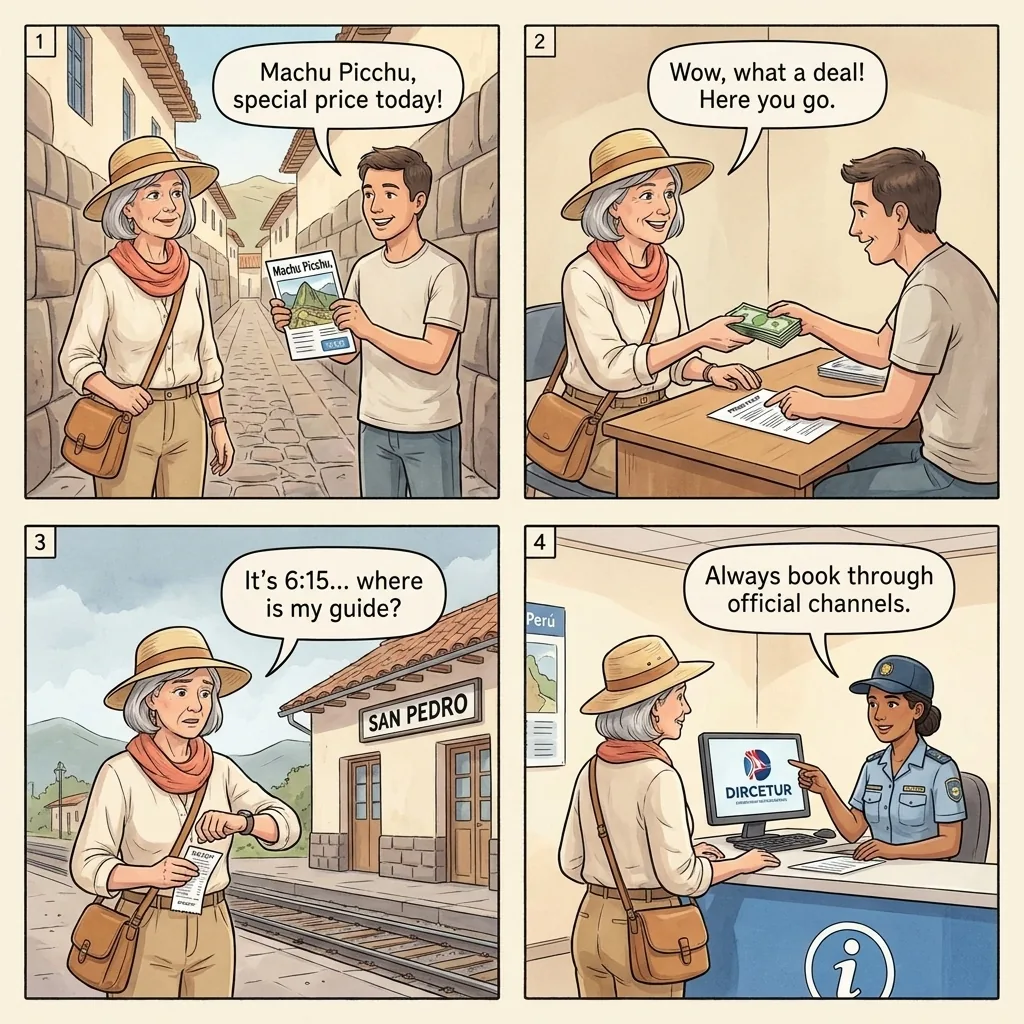
It's the morning of your second day in Cusco, you have three days before your Machu Picchu visit, and a friendly young man on Avenida El Sol stops you to offer a 2-day Machu Picchu package — train, entrance, hotel, guide — for $80, half the price your hotel quoted.
He walks you to a small storefront, shows you a printed itinerary, takes $80 cash per person, and hands you a hand-stamped receipt with a hotel name in Aguas Calientes and a meeting time of 6 a.m. tomorrow at the San Pedro train station. Two days later, at 6 a.m., nobody shows up at San Pedro. The phone number on the receipt rings unanswered. The storefront on Avenida El Sol has a different name on the door than the receipt, and the agent who took your money is gone.
The fake Machu Picchu tour agency is one of the most-reported tourist frauds in Peru. Roughly 80% of Cusco's freelance tour-pitch operators are unregistered with DIRCETUR (Dirección Regional de Comercio Exterior y Turismo), the regional tourism authority, and the registered/unregistered distinction is the load-bearing line between a real package and a vanishing one. The legitimate Machu Picchu day-trip cost — including the round-trip Inca Rail or PeruRail train, the bus from Aguas Calientes, the entrance ticket, and a guide — runs $200–350 per person, with no shortcut available. As travelers report across Reddit, the TripAdvisor Cusco forum, the Lonely Planet South America thorntree, the U.K. Foreign Office Peru travel advice, and DIRCETUR's published consumer-protection log, the $80 'discount' is the bait.
The script variants are calibrated. The 'classic vanishing operator' takes the cash and disappears entirely. The 'switch-and-disappoint' books you onto a bargain-basement chain — a colectivo van rather than the train, a budget-rate Aguas Calientes hostel rather than the promised mid-tier hotel, an unguided self-tour rather than a proper guide — and absorbs the spread. The 'partial fulfilment' delivers train tickets but not the entrance permit (which Peru's Ministry of Culture caps daily and which sells out months in advance for peak season).
The Peruvian Ministry of Culture caps daily Machu Picchu entrance at 4,500 visitors and tickets must be purchased through the official boletomachupicchu.gob.pe portal in advance. The legitimate aggregator operators (Inca Rail, PeruRail, Get Your Guide, and DIRCETUR-registered Cusco agencies with TripAdvisor reviews older than two years) handle the reservation chain transparently. The street-pitch operators do not.
Book Machu Picchu only through your hotel, a DIRCETUR-registered Cusco agency with verifiable TripAdvisor reviews older than two years, or directly through Inca Rail / PeruRail / boletomachupicchu.gob.pe. Pay by credit card for chargeback protection — never cash to a street agent. Verify the entrance permit is in your name on the official portal before paying. Reject 'discounts' below $200 per person for an all-inclusive 1-day trip — the missing margin is what doesn't get delivered. Avoid pop-up hostel-lobby pitches and street-corner agents on Avenida El Sol; the legitimate market is well-priced and well-reviewed and does not require a discount hunt. Emergency: 105 (PNP); POLTUR +51 1 460 0921; the U.S. Embassy in Lima is at +51 1 618 2000.
Red Flags
- Price significantly below market rate
- Cash-only payment with no official receipt
- No physical office or website you can verify
- Approach you on the street rather than you finding them
How to Avoid
- Book through your hotel or verified agencies with TripAdvisor reviews.
- Never pay cash on the street for multi-day tours.
- Verify the operator has a DIRCETUR tourism license.
- If a deal seems too good to be true, it is.
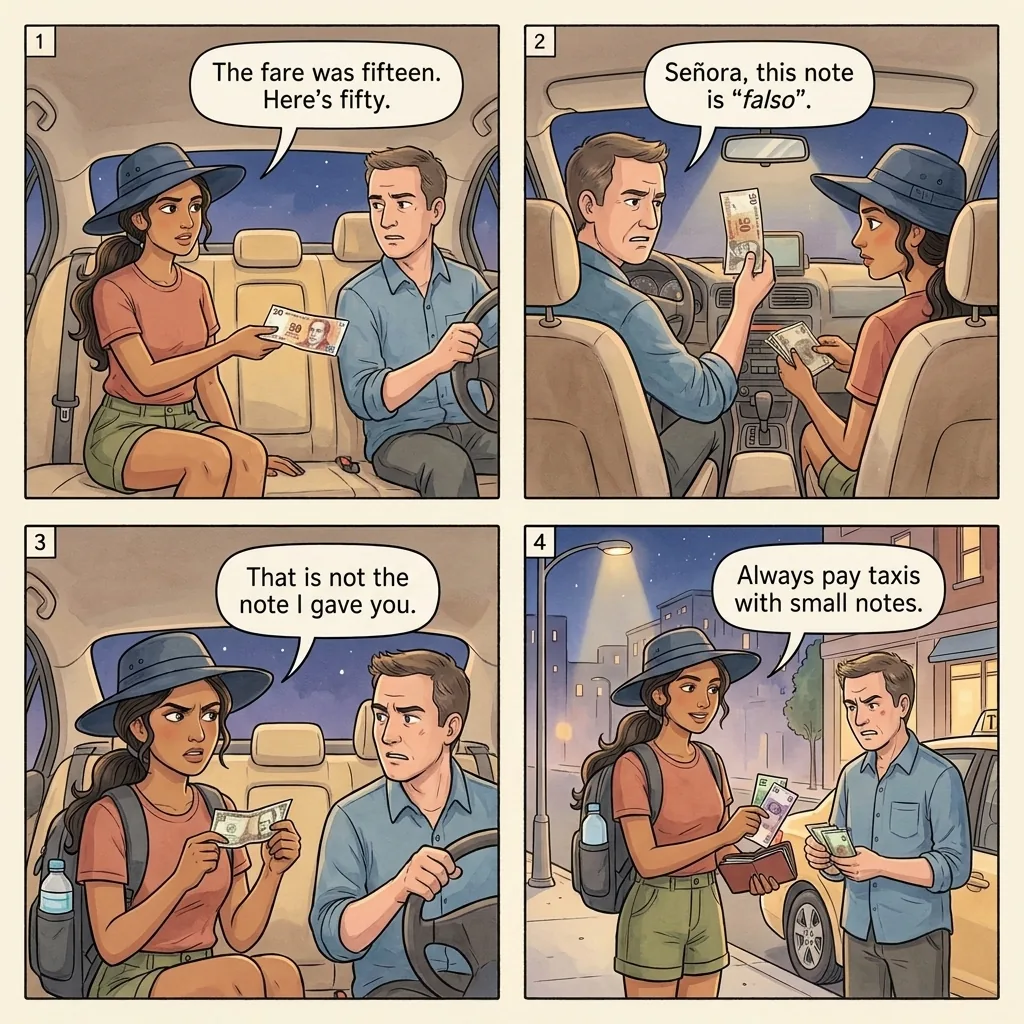
It's the end of a long Saturday in Cusco, you've just hailed a cab from San Pedro Market back to your hotel in San Blas, the agreed fare is 15 soles, and you hand the driver a 50-sol note expecting 35 soles in change.
The driver takes the note, holds it up to the cab's interior light for a moment, frowns, and tells you in apologetic Spanish that this bill is 'falso' — counterfeit — and that he cannot accept it. He hands you back a 50-sol note that is clearly a fake: the watermark is wrong, the texture is plasticky, the colour is faintly off. You are now on the kerb of your hotel with a fake 50-sol bill in your hand, the meter still running, and the driver insisting you pay with a different bill or he calls the police.
The driver palmed your real 50-sol note while pretending to inspect it and returned a counterfeit he had ready in his other hand. The switcheroo is one of the longest-running taxi scams in Peru, documented across Lima, Cusco, and Arequipa for two decades. The same script runs at San Pedro Market vendor stalls, at unofficial cambio (currency-exchange) booths near the Plaza de Armas, and at street-corner money changers on Avenida El Sol. As travelers report across Reddit, the TripAdvisor Cusco forum, the Lonely Planet South America thorntree, and Peru's BCR (Banco Central de Reserva) consumer guidance, counterfeit Peruvian sol notes circulate heavily in tourist-facing change transactions.
The mechanics of identifying real soles are useful. Real notes have a textured raised-print feel on the central portrait, a hidden watermark visible when held to light, a security thread that switches colour when tilted, and the BCR-published 'PERÚ' microprinting. The fakes typically miss the raised print and the colour-shift thread. Most Cusco residents check large notes briefly when received; tourists usually do not, and that gap is the entire scam.
Beyond the taxi version, the same switcheroo runs at street cambio booths where the operator counts your USD-to-PEN change quickly and palms a counterfeit 100- or 200-sol note into the stack. The defence in both contexts is the same: pay with smaller bills where possible, refuse to accept any large bill that hasn't been visibly inspected for the watermark, and use only registered cambio offices (with a posted Sunat tax-receipt board) rather than street operators.
Pay taxis with small bills (10s and 20s) and exact change where possible — never hand over a 50- or 100-sol note for a 15-sol fare. If you must use a large bill, photograph the serial number with your phone before handing it over. If a driver claims your note is counterfeit, demand he hand back the SAME bill and inspect it together for the watermark and raised print — never accept a 'returned' bill without verifying it is the one you gave him. Use only registered cambio offices for currency exchange (look for the posted Sunat tax-receipt board), never street-corner operators. Pay by Yape (Peru's near-universal mobile payment app) for taxis and small purchases when possible — most Cusco drivers and vendors accept it. Emergency: 105 (PNP); POLTUR +51 1 460 0921.
Red Flags
- Driver or vendor claims your bill is fake after accepting it
- Quick hand movements when handling your money
- Insistence on cash payment only
How to Avoid
- Use small bills and exact change for taxis.
- Take a photo or note the serial number of large bills before handing them over.
- Use ATMs inside banks, not standalone machines.
- Pay with Yape (Peru's mobile payment app) when possible.
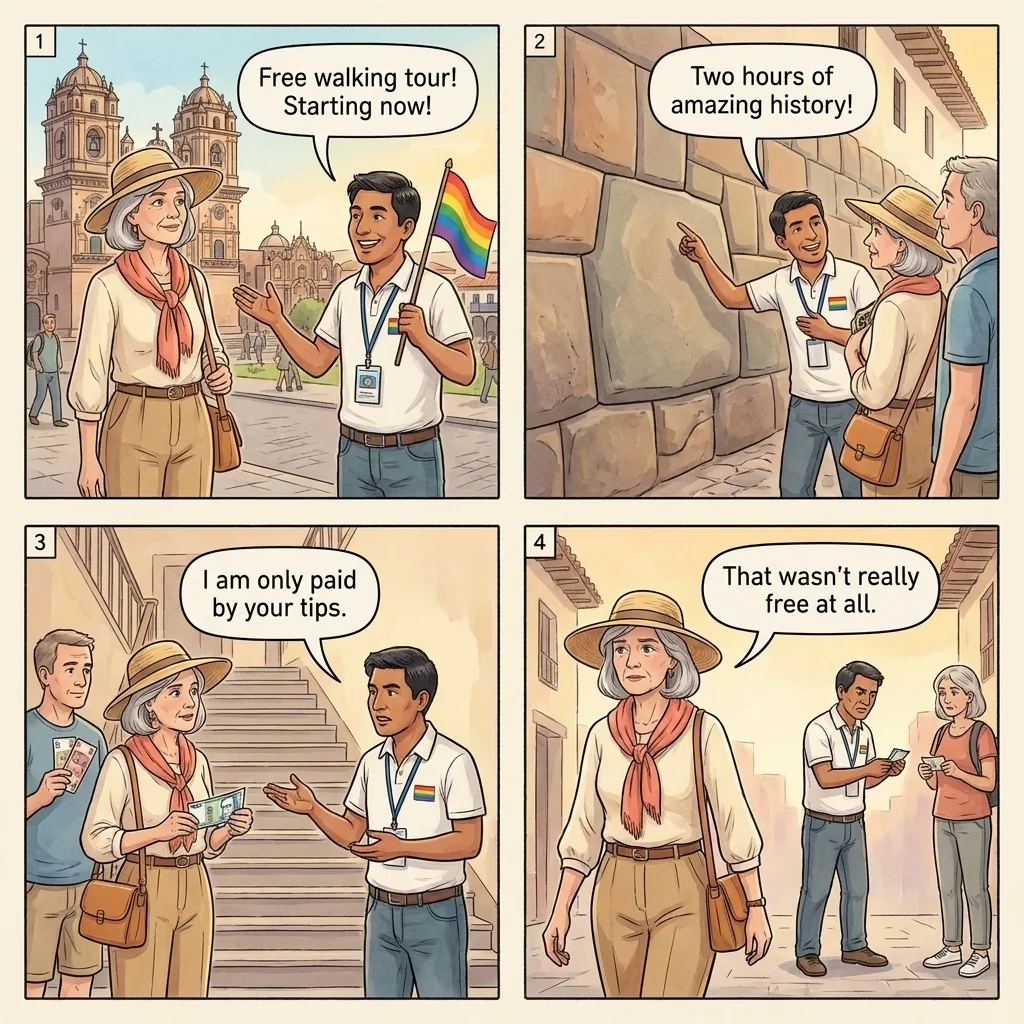
It's a Tuesday morning in the Plaza de Armas, you've just seen a flag-waving young guide call out 'free walking tour, 10:30, in English' to the gathered crowd of backpackers, and you join the group of fifteen people heading toward the Qoricancha temple.
The tour is genuinely good. Two hours of Inca history, Spanish-colonial architecture, the layered city under the city, the Twelve-Angle-Stone wall, the cathedral, the San Blas artisan district. The guide is funny and well-rehearsed and clearly knows the material. As the group winds back to Plaza de Armas at the end, he stops on a stairway and delivers a measured, emotional speech about supporting local Peruvian families, explaining that he is paid only by tips, that a 'fair donation' is 50–100 soles per person, and that 'we don't want to pressure anyone.'
When you offer 20 soles he smiles tightly. When the person ahead of you offers 10 soles he pulls them aside and asks if 'maybe there's a problem' with the tour. The social-pressure mechanic is tight: by the closing speech you've spent two hours with this person, you've enjoyed the content, and the prospect of looking like a stingy tourist in front of fifteen other tourists shifts your tip upward by 30–80 soles. As travelers report across Reddit, the TripAdvisor Cusco forum, and the Lonely Planet South America thorntree, the 'free' walking-tour guilt-trip mechanic is endemic across Cusco's plaza-departure tour ecosystem.
The framing is closer to aggressive tip-pressure than outright scam — the tour is real, the guide is knowledgeable, no one is taking your money and disappearing. But the headline 'free' is misleading: the operator has a target tip in mind, the structure is engineered to extract it, and the tip target (50–100 soles per person, $13–25 USD) is meaningfully higher than what most guidebooks suggest a comparable paid tour should cost. The 'donation' framing strips you of the option to compare quoted prices.
A fair tip for a good 2-hour Cusco walking tour is 20–30 soles per person ($5–8 USD), which is generous against the operator's actual cost base. The legitimate paid alternatives — booking a 2-hour Cusco historic-centre tour through Get Your Guide, Viator, or a DIRCETUR-registered agency — typically cost $20–35 per person all-in, with no donation pressure at the end. Several travelers report that the all-in clarity of a paid tour makes for a better experience than the donation pressure of a 'free' one.
Tip 'free' walking-tour guides 20–30 soles per person for a good 2-hour tour, regardless of the closing speech — that is a fair rate generous to the guide. Do not let the guilt-trip pitch shift your tip upward by 50–80 soles. If you prefer transparent pricing without the donation pressure, book a paid Cusco historic-centre tour through Get Your Guide, Viator, or a DIRCETUR-registered agency for $20–35 per person all-in. If the guide makes passive-aggressive comments about a fair tip, ignore them — the social pressure has no real cost beyond a moment's awkwardness. Emergency: 105 (PNP); POLTUR +51 1 460 0921.
Red Flags
- 'Free' tour with no upfront pricing discussion
- Emotional pitch about supporting families at the end
- Pressure to donate more than you're comfortable with
How to Avoid
- Ask upfront what the expected donation is.
- A fair tip is 20-30 soles for a good 2-hour tour.
- Don't feel guilty — pay what you think it was worth.
- Book official paid tours through your hotel instead.
🆘 What to Do If You Get Scammed
📋 File a Police Report
Go to the nearest Peruvian National Police (PNP) station. Call 105. Get an official crime report — you'll need this for insurance claims. You can also report online at pnp.gob.pe.
💳 Cancel Your Cards
Call your bank immediately. Most have 24/7 numbers on the back of the card (keep a photo saved separately). Block any suspicious transactions before the thieves use your details.
🛂 Lost Passport?
Contact your nearest embassy or consulate. The US Embassy is at Av. La Encalada Cdra. 17 s/n, Surco, Lima. For emergencies: +51 1-618-2000.
📱 Track Your Device
If your phone was stolen, use Find My (iPhone) or Find My Device (Android) from another device. Don't confront thieves yourself — share the location with police instead.
Frequently Asked Questions
You just read 4 scams in Cusco. The full Travel Safety Series has 780+ more across 20+ countries.
Tokyo's Kabukichō ¥130,000 bar trap. Rome's gladiator photo extortion. Paris's gold-ring trick. Bali's ATM skimmer scams. Bangkok's grand-palace closure ruse. Every documented scam across 20+ destinations — with the exact scripts, red flags, and local-language phrases that shut each one down. Drawn from Reddit traveler reports, embassy advisories, and consumer-protection cases.
- 780+ documented scams across Tokyo, Rome, Paris, Bali, Bangkok, Rio & 100+ more cities
- 20+ countries covered, with country-by-country phrase cards for every destination
- Updated annually — buy once, re-download future editions free
- All titles $4.99 each on Amazon Kindle