
Key Takeaways
- The #1 reported scam is the Scopolamine Drink Spiking via Dating App.
- 1 of 6 scams is rated high risk; 5 are medium.
- Use app-based ride services (Uber, DiDi) instead of street taxis — avoid unmarked vehicles, especially at night.
- Never accept unsolicited offers from strangers near tourist sites in Cali.
⚡ Quick Safety Tips
- Keep phones and valuables in secure pockets when in crowded areas.
- Use only licensed taxis or app-based ride services.
- Book tours and tickets through verified operators with online reviews.
- Keep a copy of your passport separate from the original.
Jump to a Scam
The 6 Scams
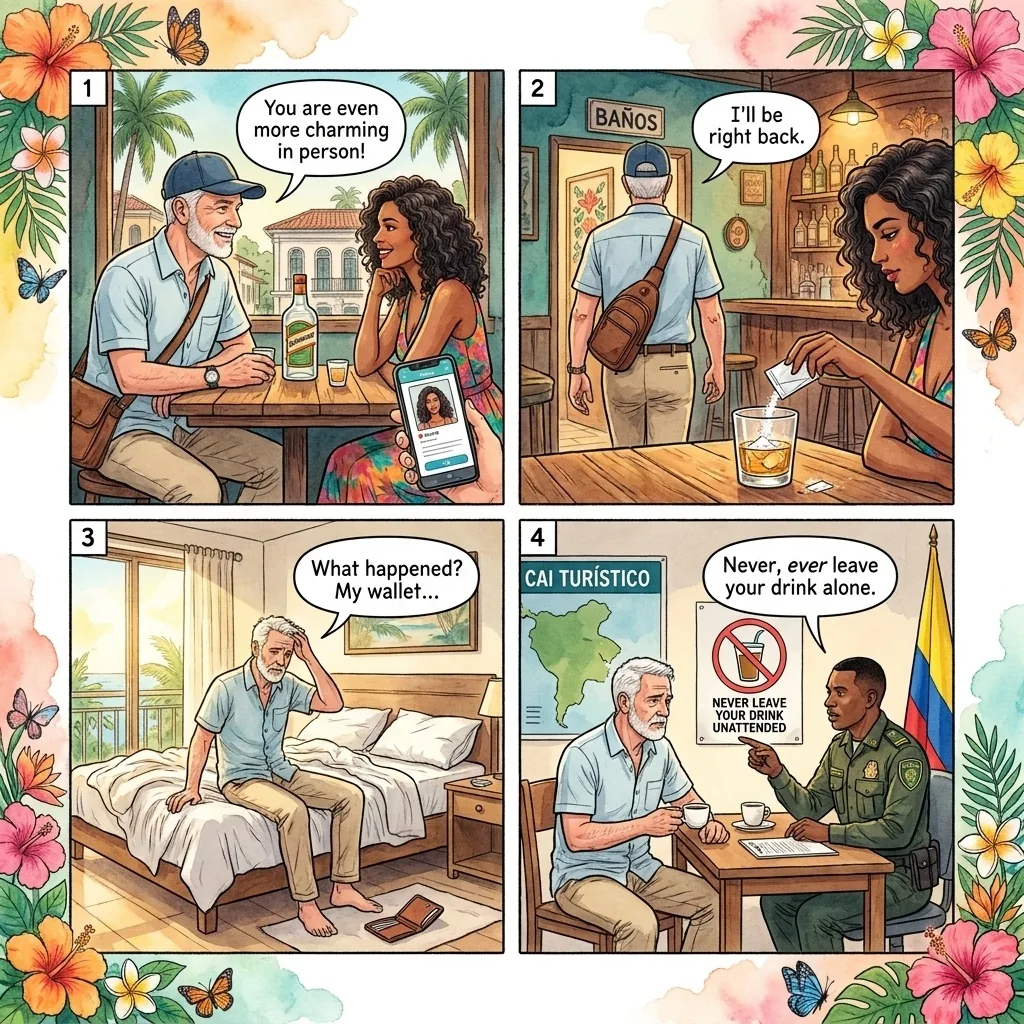
You match on Tinder with a charming caleña who insists on aguardiente at a Granada bar, you step away from the table for sixty seconds, and 14 hours later you wake up in your hotel with no phone, no wallet, and no memory of the night — the drink is the trap, and the dating-app profile is the bait.
She matches with you on Tinder the afternoon you land — beautiful, bilingual, suggesting a quiet bar in Granada rather than a salsa club because she wants to actually talk. You meet at a corner table on Avenida Sexta. The conversation flows. She orders a round of aguardiente shots, raises her glass, smiles. You toast and drink. She slides hers down too. Twenty minutes later you excuse yourself for the bathroom, leaving your half-finished glass on the table while she scrolls her phone. When you come back you finish the drink without thinking about it. The room starts to tilt about ten minutes after that.
You don't remember leaving the bar. You don't remember the taxi. You wake up at 2 p.m. the next day in your hotel bed with your shirt on backwards, no phone on the nightstand, no wallet in your jeans, no watch on your wrist. Your bank app — when you log in from the hotel front desk computer — shows three ATM withdrawals across the night, plus a 4 a.m. wire transfer for nine million COP. The Tinder match has unmatched. The number you texted her at goes to voicemail. The hotel staff say a man — not you, but wearing your jacket — walked you in at 11 p.m. and left two minutes later.
Scopolamine, known locally as burundanga, is colorless, odorless, and in a small enough dose leaves you fully ambulatory while erasing memory and short-circuiting refusal. El País de Cali ran a near-identical case under the headline "Extranjero en Cali fue robado por mujer que conoció en una aplicación móvil mientras iban a cenar" — a foreigner persuaded by his match to swap a public restaurant for her apartment, then drugged and emptied. The US Embassy in Bogotá's January 2024 sedatives alert and the State Department's Colombia advisory both call out dating-app meetups as the dominant vector after a wave of suspicious foreigner deaths, and the NYT and Guardian followed with eight US deaths linked to the same playbook. Cali sits in Valle del Cauca — a department under its own US Embassy "reconsider travel" alert — and Reddit threads document the same Granada-Tinder script running monthly. Never let a drink leave your sight, and if a match pivots from a public restaurant to her apartment, end the date right there.
Red Flags
- A new match who pushes hard for a same-night meeting at a bar of her choosing
- Anyone who orders shots for both of you and waits for you to drink first
- A match who suggests moving from a public restaurant to her apartment after one round
- A profile with only two or three photos, all professionally lit, no friends visible
- Sudden lightheadedness or tunnel vision within 10–20 minutes of finishing a drink
How to Avoid
- Take your drink with you to the bathroom, or order a fresh sealed beer when you return.
- Meet first dates only in busy public restaurants on Avenida Sexta or Granada — never her apartment.
- Send your hotel reception or a friend the match's name, photo, and meeting place before you go.
- Set your bank app to require app-approval for any wire transfer or ATM withdrawal over 200,000 COP.
- If you suddenly feel dizzy or detached, tell the bartender "estoy drogado, llame a la policía" before you lose the ability to.
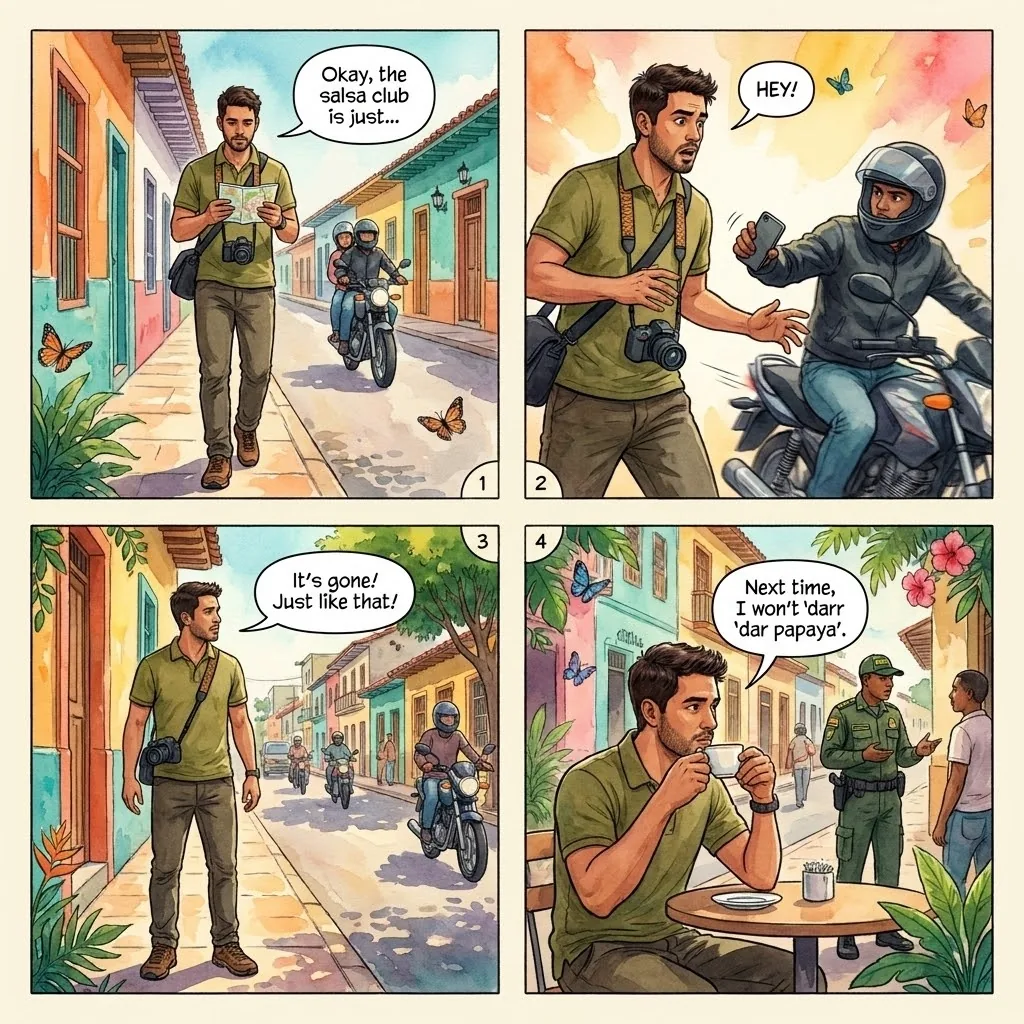
You stop at a Granada corner to check Google Maps, a motorcycle with two riders rolls up beside you, the passenger reaches across and rips the phone clean out of your hand — by the time you look up, they're already weaving through traffic on Avenida Sexta and there's no plate to write down.
It's 4 p.m. and you're walking from your hostel in San Antonio toward the Iglesia La Ermita, phone in hand, working out which bridge to cross the Río Cali at. The sidewalk is busy enough that you don't register the motorbike idling at the curb until it pulls up alongside you. Two riders, both in helmets with the visors down, the passenger sitting backwards-relaxed on the seat. You half-glance at them and start to step away, but the passenger has already reached out and closed his hand around your phone. There's a sharp tug. You instinctively pull back — and then the strap is gone, the phone is gone, and the bike is already accelerating into the next block of traffic.
You stand there for four seconds with your hand still extended, expecting to see your phone. People walking by glance at you, then look forward and keep going — they've watched this happen a dozen times before. By the time you reach for your other pocket and start to shout, the motorcycle has merged into the southbound flow on Avenida Sexta and split off down a side street. The plate, if you saw one at all, was mud-smeared. There's no security camera angled at this corner. A Cali Metropolitana officer two blocks away takes the report, hands you a denuncia number, and tells you straight: phones disappear in this city at the rate of about one every twelve minutes, and the recovery rate for motorbike snatches is essentially zero.
El País de Cali runs these stories almost weekly — the 37-year-old French tourist robbed at Calle 8 con Carrera 12 at 4 p.m. by two minors who were captured an hour later is a typical entry, and the paper's judicial desk catalogs identical motorcycle grabs from Granada to Yumbo. The technique is the same one that took a "lujosa cadena" off a Dutch visitor in Granada and a phone off a Mexican tourist outside the Betty la Fea house in Bogotá: two riders, the passenger as the snatcher, mud on the plate, a planned exit route. Colombia's national folk principle — "no dar papaya," don't give papaya, don't make yourself easy — exists precisely because this is the daily friction tax of urban life. If you must check your phone outside, step inside a shop or restaurant doorway first and put a wall between you and the street.
Red Flags
- A motorcycle with two riders slowing to your walking pace at a curb
- Riders with full-face helmets and tinted visors in a city where most locals ride with the visor up
- A muddied or partially obscured rear license plate on an otherwise clean bike
- Anyone who positions themselves at curbside while you're stopped checking your phone
- Phones held out at arm's length while walking on Avenida Sexta, Avenida Roosevelt, or near the Río Cali
How to Avoid
- Walk on the building side of the sidewalk so traffic can't reach you in one motion.
- Use earbuds for navigation and keep your phone in a front zippered pocket between consultations.
- If you must look at your phone outdoors, step into a café, hotel lobby, or shop entrance first.
- Skip visible gold chains, expensive watches, and DSLR cameras anywhere outside Granada and San Antonio.
- Clip your phone to your belt or bag with a short lanyard so a clean grab pulls you, not the device.
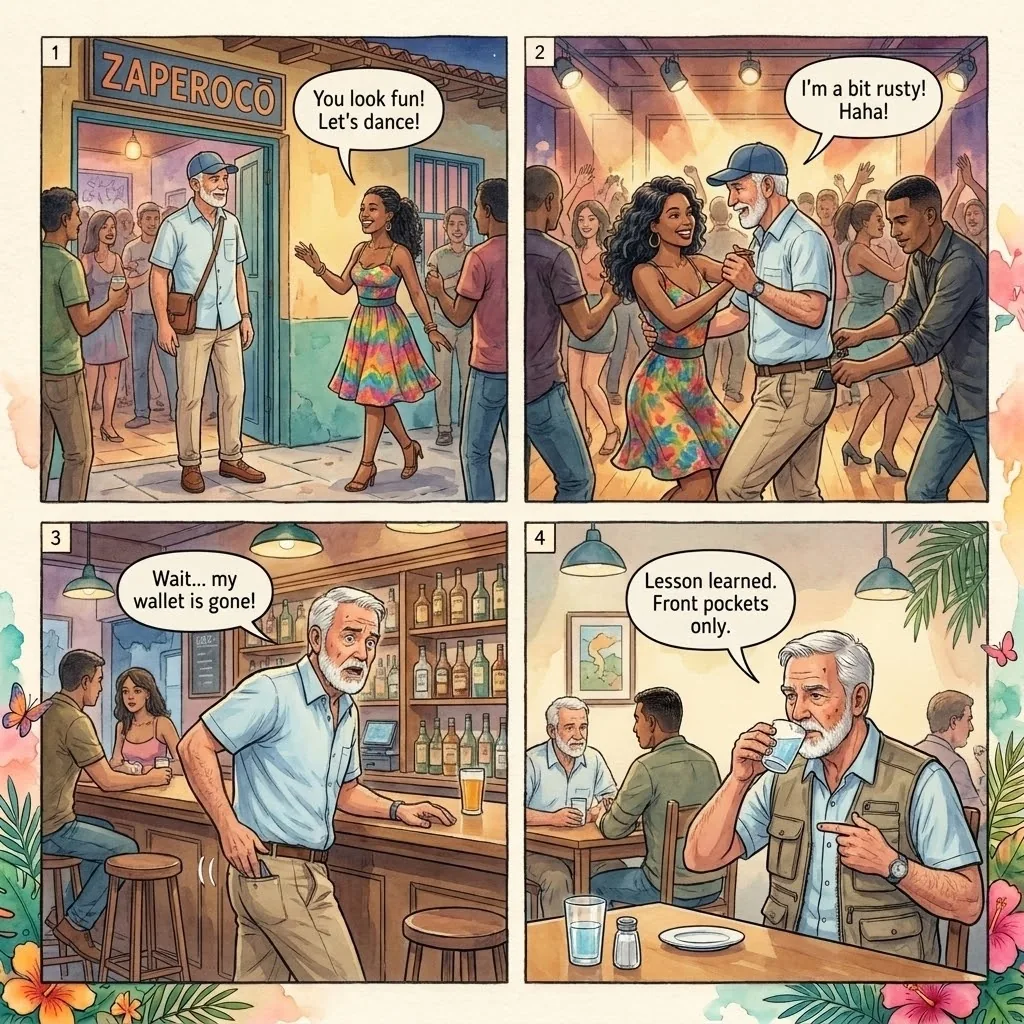
You take a salsa lesson at Tin Tin Deo, a local woman pulls you onto the dance floor at La Topa Tolondra, and while you're focused on the cross-body lead her partner lifts your phone off the table or your wallet from your back pocket — the dance is the cover, the close contact is the tool.
It's a Friday night in Cali and you've taken the cab out to Juanchito because every guidebook says you have to. The clubs along the strip are packed — Changó, Las Brisas, the venues spilling onto the riverbank — and the music is so loud you can feel the timbales in your sternum. Inside La Topa Tolondra in San Antonio, or Tin Tin Deo a few blocks east, a woman who's been watching from the bar steps up and asks if you want to dance. You leave your beer and your phone on the table. She pulls you onto the floor and starts the basic step. Her hand rests at the small of your back. You laugh, you stumble, you start to get the timing.
Three songs in, you walk back to the table for a drink and your phone is gone. Or you reach for your wallet to pay the tab and the back pocket is empty. Or your bag, which you'd hooked over the chair back, has been unzipped by someone you never noticed leaning past you. The dance partner has melted back into the crowd, and the friend who lifted the phone left through the side exit two minutes ago. The bartender has seen this exact play often enough that he just shakes his head — "avísale a la policía, pero ya no aparece"— tell the police, but it won't come back.
Cali's salsa clubs are world-class, and the medellinguru "Is Cali Safe?" guide notes flatly that pickpockets work the city's MIO bus stations and dance venues at the same intensity — Semana covered the arrest of one woman who knifed a victim while working the MIO line and had a string of prior thefts at packed stations. The mechanic is identical inside the clubs: salsa is the only social setting where total strangers are expected to put their hands on your hips, your back, your shoulders, in a crowded dark room. Reddit and Reddit threads name the same flagship venues — Tin Tin Deo, Zaperoco, La Topa Tolondra — as places where solo travelers consistently lose phones and cards from tables, not from pockets. Bring exactly one card, one ID, and one night's cash to any salsa club, and never leave a phone on the table when you go to dance.
Red Flags
- A dance partner who appears alone but keeps glancing toward a specific friend at the bar
- Anyone who steers you specifically to leave your bag or phone on the table before dancing
- Repeated "accidental" body contact with strangers near the bar or coat-check line
- A bag or jacket left over a chair back when no one is sitting at the table to watch it
- Crowds that surge unexpectedly near exits or bathroom corridors at the end of a song set
How to Avoid
- Carry only one card and the cash you're willing to lose — leave passport and backup cards in the hotel safe.
- Use a slim front-pocket wallet or zip pouch worn under your shirt for the night's cash.
- Never leave a phone, camera, or bag on a table — keep them on your body or check them at the door.
- Go in a group of at least two so one person can always watch the table during dances.
- Choose venues with formal coat check or lockers (Tin Tin Deo, Zaperoco) over open-table places when you can.
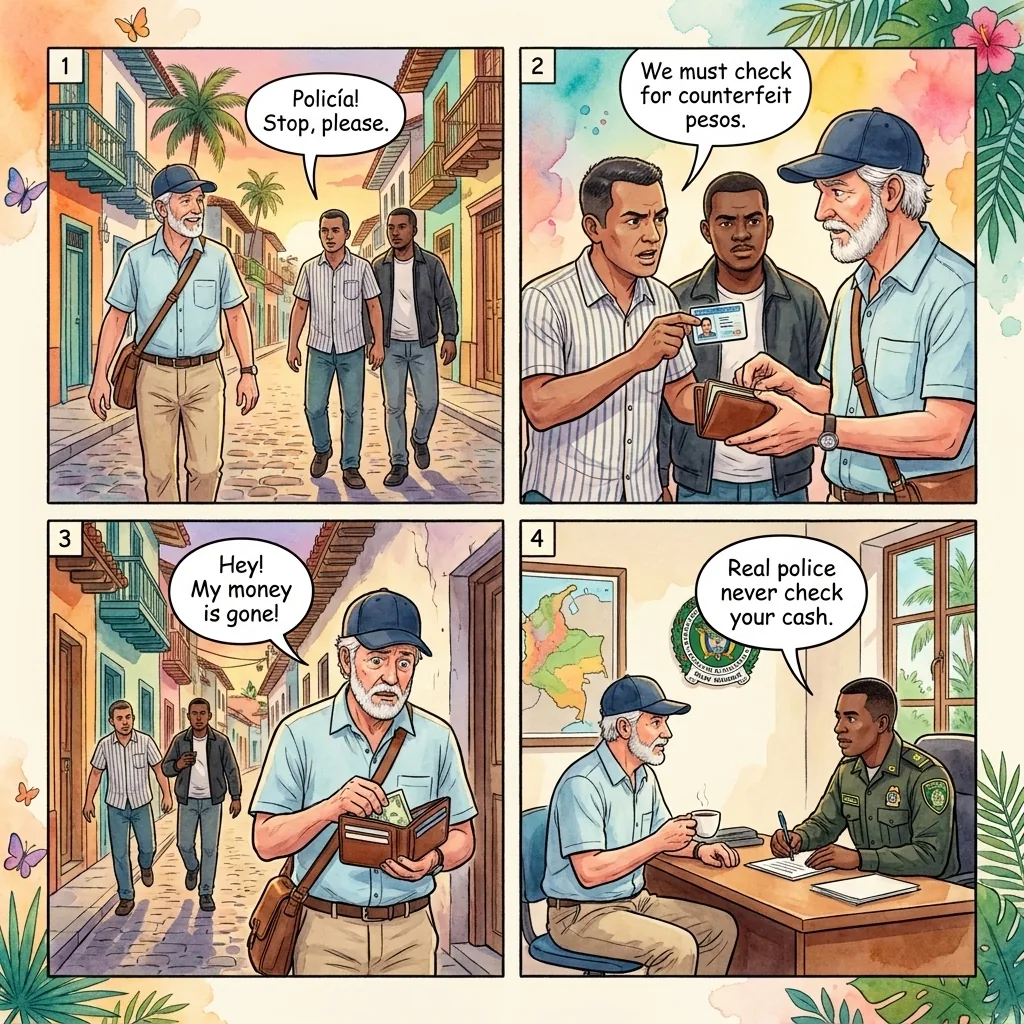
Two men in plain clothes stop you on a quiet street near Parque del Perro, flash a badge, claim there's a drug problem in the neighborhood and that they need to inspect your wallet — by the time they hand it back, two or three hundred thousand pesos have been palmed and you've been told to keep walking.
You're walking back from a late dinner near Parque del Perro, heading toward your guesthouse in San Antonio. The street is half-empty. Two men in jeans and plain button-downs step out of a doorway and angle into your path. The taller one flashes a card from a lanyard around his neck — too quickly to read — and says, in mostly-Spanish, "Policía. Hay un problema con drogas en esta zona. Necesito revisar su cartera." Police. We have a drug problem here. I need to check your wallet. His partner takes a half-step around to your other side. You're alone, it's almost midnight, and the badge looked legitimate enough.
You hand over the wallet. He thumbs through the cash slot — "para verificar billetes falsos," to check for counterfeit bills — fanning the notes between his fingers, holding the wallet at hip-height where you can't quite track every movement. He pulls out your foreign ID, examines it, hands the wallet back, and says everything looks fine, you can go. Both men step aside. You're already two blocks farther on when you stop in a 24-hour pharmacy under a streetlight and count what's left: 350,000 COP (~$85) is gone from a stack you knew was 600,000 COP an hour earlier. The credit cards are still there. The ID is still there. The cash is just lighter.
El País de Cali sat down with Coronel José Edwin Espitia, comandante of the city's Gaula anti-extortion unit, for a piece titled "Cuidado con la estafa de falso servicio en Cali" — the colonel's blunt headline message: a real Colombian officer will never ask to inspect your cash or check for counterfeit bills on a public sidewalk. The "falso servicio" play — fake service, fake authority, fake enforcement — runs across San Antonio and Parque del Perro, and the same paper has tracked an emerging variant where scammers send fake SMS multas pretending to come from Cali's Secretaría de Movilidad. The fix is the script Cali's own Gaula commander recommends: make the encounter happen on the police's terms, not the scammers'. If anyone in plain clothes asks to see your wallet, say loudly "vamos a la estación" — let's go to the police station — and start walking; a real officer will agree, a scammer will vanish.
Red Flags
- Plain-clothes men flashing a badge from a lanyard rather than a wallet-style ID
- Anyone who claims to need to inspect your cash, wallet, or "check for counterfeit bills" on the street
- A "partner" who positions himself behind or beside you while the first man talks
- Demands phrased as warnings about a drug problem or a recent crime in the immediate area
- Encounters that happen on quiet blocks of San Antonio or Parque del Perro after dark
How to Avoid
- Never hand over your wallet, cash, or original passport to anyone on the street.
- Carry only a color photocopy of your passport's data page and entry stamp; lock the original at the hotel.
- Say loudly "Vamos a la estación de policía" — let's go to the police station — and start walking that way.
- Step into the nearest open shop, hotel lobby, or restaurant if the encounter feels coercive.
- If they claim to be police, ask for the officer's full name and placa (badge number) and photograph the ID before showing yours.
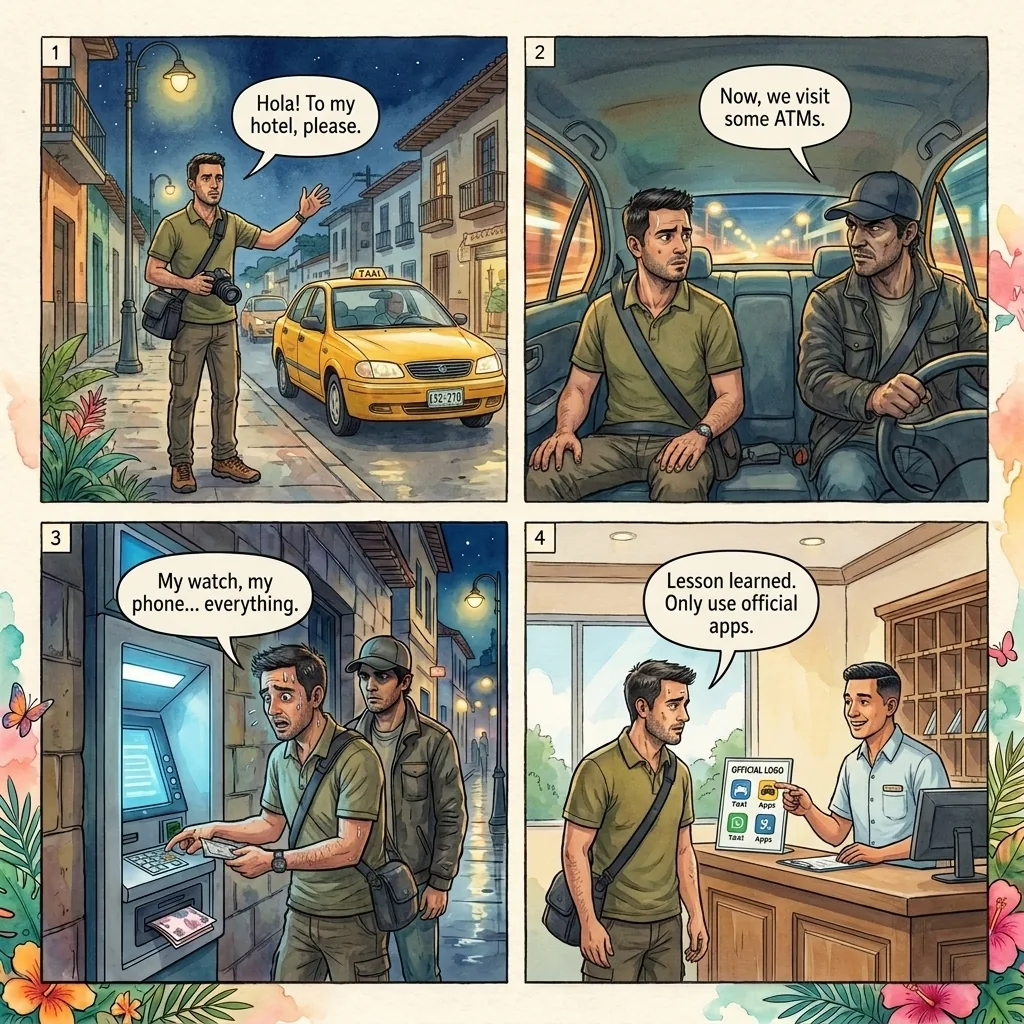
You hail a street taxi outside a Menga club at 2 a.m., the driver picks up an "extra passenger" four blocks later, and the next four hours are an ATM tour of southern Cali at knifepoint until your daily withdrawal limits hit zero — the taxi is the trap, and you walked into it with your hand up.
It's late, your phone is dead, and the InDrive line at the curb outside your Menga bar shows a 25-minute wait. A yellow taxi rolls past, the driver flicks his lights, you wave him over. He nods, asks where you're going, names a normal-sounding fare. You climb into the back, pull the door shut, and sink into the seat — you're tired, the night was good, you're heading back to Granada. The driver pulls away and turns north, then immediately east into a side street you don't recognize. You glance up. He's watching you in the rearview mirror.
Four blocks in, the taxi slows. A man on the corner steps off the curb and opens the front passenger door before you can react — he's already inside, one hand under his jacket, half-turned to face you. "Tranquilo, hermano," the driver says, calmly. Don't worry. The new passenger holds up a folding knife. They want your phone unlocked, your bank app open, your cards lined up on the seat. The taxi rolls toward the first ATM on the route. Over the next three hours, they take you to four machines, withdrawing the daily maximum at each one — about two million COP (~$485) total — and they stay with you until midnight rolls into a new banking day so they can hit the daily limits again before sunrise.
Cali Hoy ran a piece this year titled "Voy y vuelvo: la pesadilla de ser secuestrados en un taxi" — and the lede says it plainly: "el 'paseo millonario' que creíamos extirpado de las calles de la ciudad ha vuelto. Y la modalidad se repite: un taxi, unos cómplices, una víctima." The millionaire's ride we thought we'd uprooted is back. Same modality every time: a taxi, accomplices, a victim. El País de Cali and Infobae have tracked recent cases where victims woke up with 20-million-peso debts on their accounts after a single street-hailed taxi ride; the US Embassy Valle del Cauca security alert warns explicitly against street-hailed transport in the city. The fix is structural: ride-hailing apps log the driver, vehicle, and route in real time, and that log is what scammers cannot operate around. Never hail a taxi from the curb in Cali — open InDrive, Uber, or DiDi, and if no app driver is available, have the bar or hotel call a registered radio-taxi by phone instead.
Red Flags
- A taxi that stops for you uninvited or flicks its headlights to flag you down
- Any driver who picks up a second passenger after you've boarded
- Routes that veer onto unlit side streets within the first five minutes of a ride
- A driver who asks early in the ride whether you have a debit card or how much cash you have on you
- Taxis hailed from outside Menga clubs, the Terminal de Transportes, or anywhere in Cali after midnight
How to Avoid
- Use InDrive, Uber, or DiDi for every ride in Cali — the trip log is the protection.
- If apps are unavailable, ask the bar, restaurant, or hotel to call a registered radio-taxi for you.
- Set your bank's daily ATM withdrawal limit to a low number (around 500,000 COP) through your banking app before you arrive.
- Share your live location with a friend or family member from the moment you board to the moment you reach your hotel.
- Never tell a driver — even a legitimate one — that you have a high cash balance or that you're traveling alone.
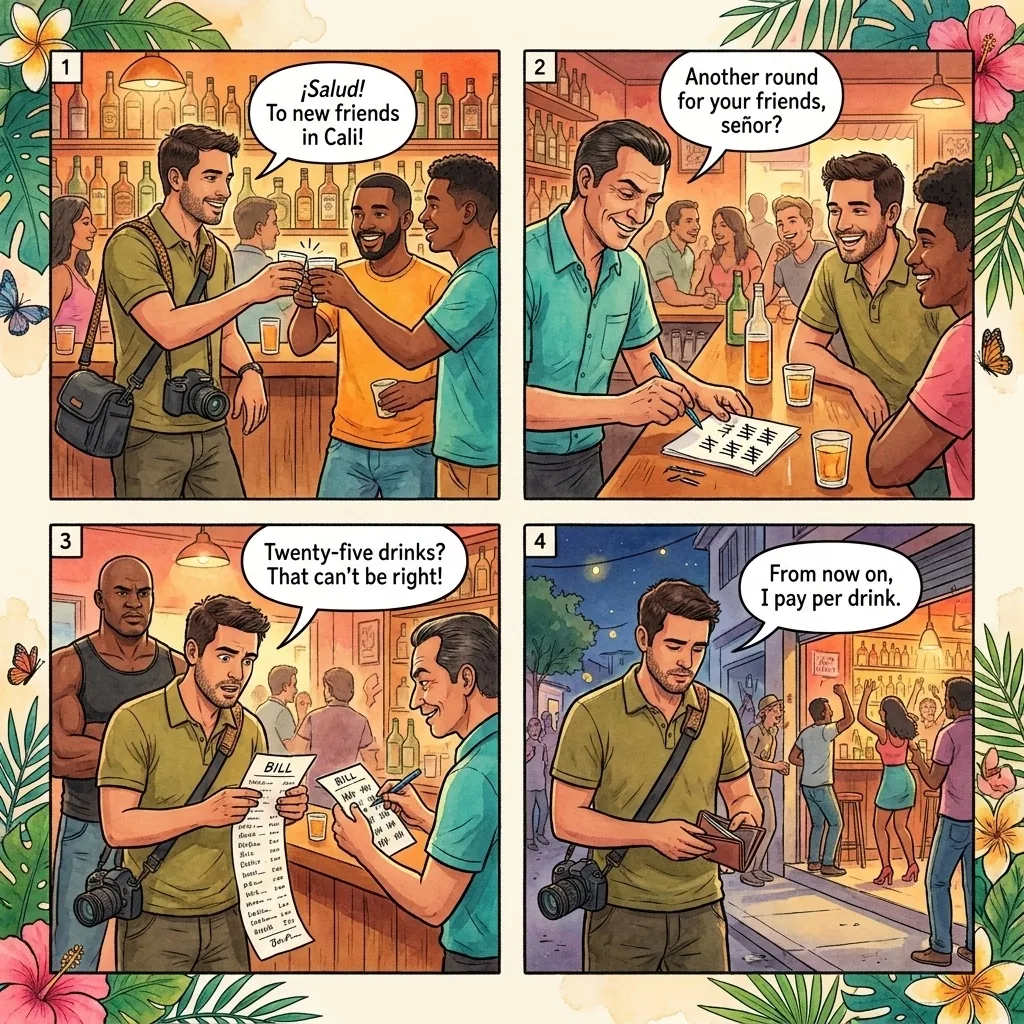
You open a tab at a bar on Avenida Sexta, order beers and aguardiente shots through the night, and at closing time the bill shows 25 drinks instead of the 12 you actually had — when you push back, a bouncer materializes and you pay the 450,000 COP (~$110) tab to make the scene end.
You start the night at a bar near Parque del Perro and end up at one of the bigger places on La Sexta — the strip of Avenida Sexta lined with neon signs and clubs that fill up after 11 p.m. A waitress hands you a tab card on a clipboard, you wave it away — "abrimos cuenta" — and start a tab. Beers come, aguardiente shots come, you buy a round for the two new friends you met on the dance floor. Tally marks accumulate on a napkin you can't actually read in the strobe light. The night is good. You're not counting drinks because you're not the kind of person who counts drinks.
At 3 a.m. you wave for the bill. The waitress brings a printout: 25 aguardientes, 8 beers, two bottles of mineral water, a 10% service charge, totaling 450,000 COP — about 110 USD. You know for a fact you didn't have 25 aguardientes; you had maybe 12. You point at the bill. The waitress shrugs and points at the napkin tally. You ask for the manager. A bouncer appears at your elbow before the manager does — broad, polite, standing close enough that you understand without him saying anything. Your two new friends have somehow disappeared. You tap your card on the reader and walk out, knowing exactly what just happened and not seeing a way to undo it.
Bar tab inflation runs across Cali's tourist-facing nightlife from La Sexta to Menga to the Juanchito strip, and El País de Cali documented one of its uglier variants in "Cuatro amigos fueron robados y extorsionados durante la Feria de Cali" — a small group rolled for cash and indebted at a Feria-period venue where the staff worked the bill rather than picking pockets. Reddit and Reddit threads catalog the same play at La Sexta clubs almost weekly, with bouncers used as pressure to close out inflated tabs against tourists who don't want a scene in front of their friends. The legal recourse exists — Colombian consumer protection allows you to demand an itemized receipt and refuse undocumented charges — but at 3 a.m., outnumbered, with a flight in six hours, almost no one uses it. Pay round-by-round in cash on La Sexta and in Menga, never run a tab, and if you see tally marks instead of a printed running ticket, walk to the next club before the second drink.
Red Flags
- A bar that opens a tab for you without scanning your card or showing a printed running total
- Tally marks on a napkin or scrap paper instead of a register-printed running ticket
- New "friends" met on the dance floor who keep ordering you drinks you didn't ask for
- Bills that mysteriously include service charges, "cubierto" cover charges, or bottle minimums never disclosed
- Bouncers who appear at the table the moment you start to question a charge
How to Avoid
- Pay for each round in cash as it arrives — never run a tab in Menga, La Sexta, or Juanchito.
- Ask the price of every drink before ordering and keep your own count in your phone's notes app.
- Refuse drinks you didn't order; never accept rounds bought by strangers expecting reciprocation.
- If you must run a tab, take a phone photo of the running ticket every 30 minutes so you have evidence at closing.
- If the bill is wrong and a bouncer is leaning over the table, pay with a credit card (not debit), then dispute the charge with your bank from the hotel the next morning.
🆘 What to Do If You Get Scammed
📋 File a Police Report
Go to the nearest Colombian National Police (Policía Nacional) station. Call 123 (Emergency) or 112. Get an official crime report — you'll need this for insurance claims. You can also report online at policia.gov.co.
💳 Cancel Your Cards
Call your bank immediately. Most have 24/7 numbers on the back of the card (keep a photo saved separately). Block any suspicious transactions before the thieves use your details.
🛂 Lost Passport?
Contact your nearest embassy or consulate. The US Embassy in Bogotá is at Calle 24 Bis No. 48-50, Bogotá. For emergencies: +57 1-275-2000.
📱 Track Your Device
If your phone was stolen, use Find My (iPhone) or Find My Device (Android) from another device. Don't confront thieves yourself — share the location with police instead.
Frequently Asked Questions
You just read 6 scams in Cali. The book has 52 more across 10 Colombian destinations.
Bogotá's paseo millonario yellow-taxi express kidnapping (US State Department: leading cause of financial loss for Americans in Colombia). Medellín's Tinder scopolamine setups (reports tripled 2023–2025). Cartagena walled-city USD-pricing markups. Tayrona park “guide” rackets. Every documented Colombia scam — with the exact scripts, red flags, and Colombian Spanish phrases that shut each one down. Drawn from Colombian press (El Tiempo, Semana, El Espectador), Policía Nacional de Turismo records, and US State Department advisories.
- 58 documented scams across Bogotá, Medellín, Cartagena, Cali & 6 more destinations
- A Colombian Spanish exit-phrase card you can screenshot to your phone
- Updated annually — buy once, re-download future editions free
- Readable in one flight — $4.99 on Amazon Kindle