
Key Takeaways
- The #1 reported scam is the Taxi Bill-Switch and Counterfeit Change.
- 5 of 7 scams are rated high risk.
- Use app-based ride services (Uber, DiDi) instead of street taxis — avoid unmarked vehicles, especially at night.
- Never accept unsolicited offers from strangers near tourist sites in Santa Marta.
⚡ Quick Safety Tips
- Keep phones and valuables in secure pockets when in crowded areas.
- Use only licensed taxis or app-based ride services.
- Book tours and tickets through verified operators with online reviews.
- Keep a copy of your passport separate from the original.
Jump to a Scam
- High Taxi Bill-Switch and Counterfeit Change
- High Fake Police Document Inspection
- High Beach Distraction Theft
- High Scopolamine (Devil's Breath) Drink Spiking
- Medium Overpriced Unofficial Tayrona, Lost City, and Minca Tour
- Medium Bird-Poop and Friendship-Bracelet Distraction Theft
- High Knifepoint Robbery on Side Streets Near the Centro Histórico
The 7 Scams
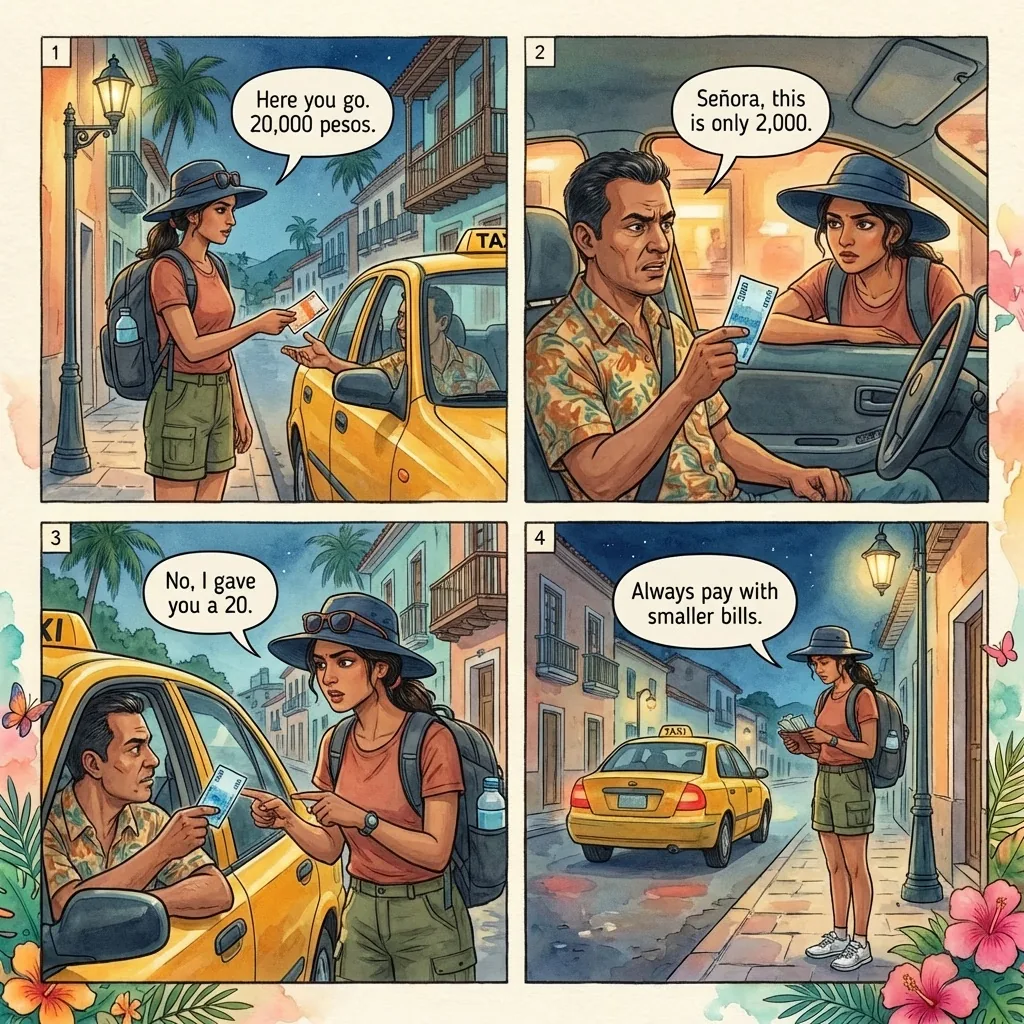
A taxi from El Rodadero to the Centro Histórico runs 10,000 COP (~$2.50). You hand the driver a 20,000 note, he palms it, holds up a 2,000 note, and tells you that's all you gave him — the bill in his hand is the trap.
You climb into a yellow taxi outside your hotel in El Rodadero and ask for the Centro Histórico. The driver nods, no meter, no app, no problem. Ten minutes later he pulls up near Parque de los Novios and says the fare is 10,000 COP. You hand over a 20,000-peso note. He glances at it, turns slightly toward the dashboard, and a beat later holds up a different bill. "You only gave me 2,000. Look." The note in his hand really is 2,000 COP. The denominations look almost identical at a glance — both are orange, both feature Débora Arango — and he is already halfway through a second sentence.
The reverse version closes even faster. You hand over a 50,000-peso note for the same ride. He inspects it, says "no tengo cambio" or "este billete es malo," and hands it right back. You apologize, dig out a different bill, and walk away. The next afternoon at a tienda in the Centro the cashier holds your 50,000 up to the window, points at a missing security strip, and refuses it. The driver kept your real bill and slipped you a counterfeit during the moment your eyes were on your wallet. You are now holding worthless paper, and the cab is long gone.
The whole play hinges on the handoff: orange notes, low light, a second of distraction, a story you can't easily disprove. El Tiempo reported in 2024 that Santa Marta led Colombia for tourist theft and fraud complaints in 2023 with 154 documented cases — more than Medellín or Cartagena — and Hoy Diario del Magdalena has run a recurring "Billetes falsos" series tracking counterfeit notes circulating through the city at holiday season. Santa Marta has no Uber for yellow taxis the way Medellín does, so the standard defense doesn't apply here. Use InDriver or Didi instead, where the fare and driver are locked in the app before you sit down — and if you must pay cash, state the denomination out loud as you hand it over: "Aquí veinte mil pesos."
Red Flags
- Driver who refuses to use a meter or an app and quotes a flat fare
- Sudden turn toward the dashboard or center console at the moment of payment
- Returned bill that "won't work" or "is fake" with no explanation of what's wrong
- Anyone who tells you they have no change for a 50,000 note in a busy tourist corridor
- Hotel doormen waving you toward a specific unmarked taxi rather than calling one for you
How to Avoid
- Use InDriver or Didi for taxis in Santa Marta — the fare is fixed in the app and counterfeit-switching breaks down when payment is digital.
- Carry small bills in 5,000 and 10,000 COP denominations and pay with exact change whenever possible.
- State the denomination out loud as you hand a bill to the driver and confirm with your phone camera if the moment feels off.
- Familiarize yourself with the security thread, watermark, and color-shifting ink on Colombian notes before you arrive — fakes usually fail at one of the three.
- Agree on the fare before the doors close, and if a meter is being used, confirm it's running.
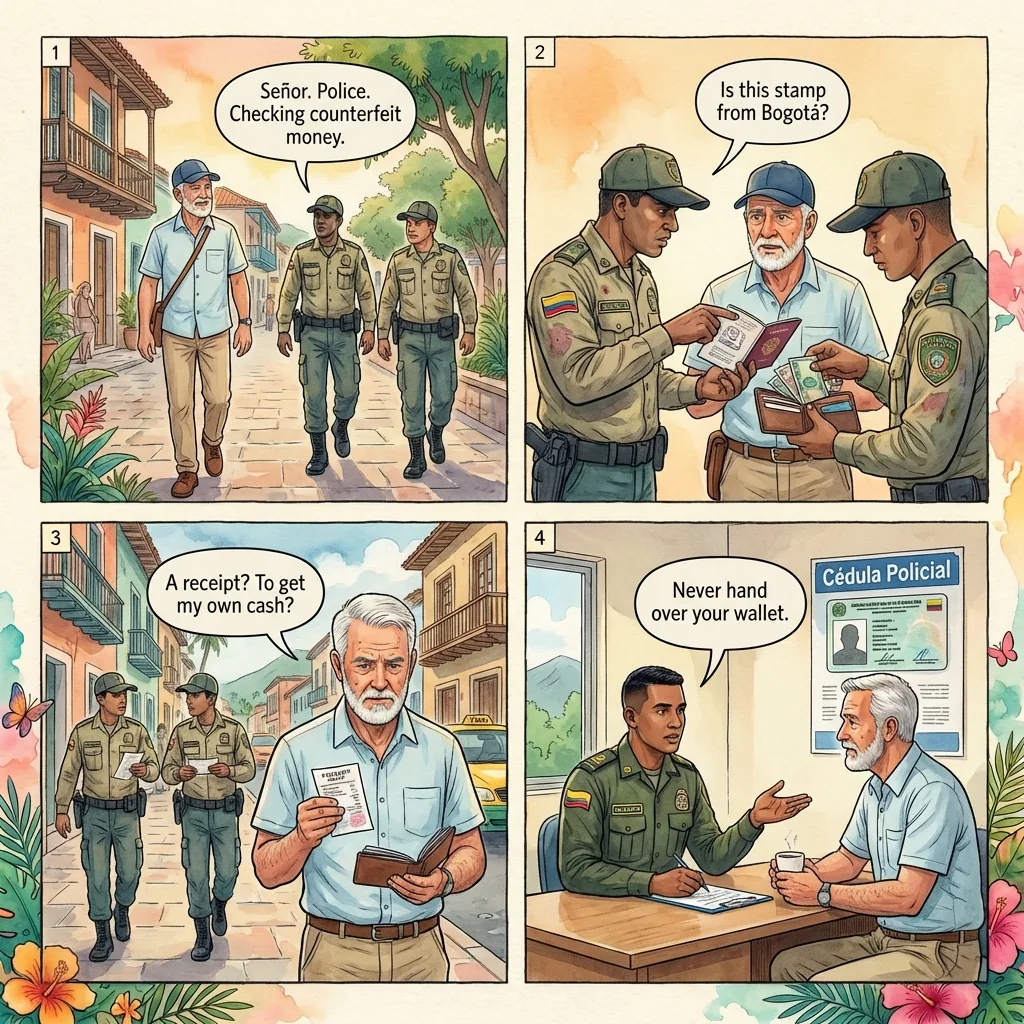
Two men in police-style uniforms stop you near Parque de los Novios, flash a badge, and demand to inspect your wallet for counterfeit bills — by the time they hand it back, the cash is gone, and the "receipt" they give you sends you to a station that has never heard of them.
You're walking back to your hotel along the camellón near Parque de los Novios when two men in dark uniforms step into your path. The shirts have patches that read POLICÍA, the belts carry holsters, and one of them is already opening a leather wallet to flash an ID. "Documentos, por favor — and we need to inspect your cash for falsos." The Spanish is calm and procedural. He has the body language down. You hesitate for half a second; he repeats the request slightly louder, and a second man drifts closer on your other side.
You hand over your passport copy and your wallet. One officer holds your documents up to the streetlight, slowly, while the other thumbs through the bills, pulling them out one by one and feeling the paper. He shakes his head at two of them, mutters "este parece falso," and writes a number on a slip of paper. He hands the wallet back, gives you a "receipt," and tells you to come to the station tomorrow to recover the seized notes. You walk a block before you check — and the wallet is 200,000 or 300,000 pesos lighter than when you handed it over. The slip leads to a station that has no record of any inspection.
The whole performance trades on legal asymmetry: real Colombian police have no authority to seize cash from a tourist for "counterfeit inspection," and any actual multa (ticket) is paid through Banco de Bogotá or the Pago Virtual portal, never on the street. Semana reported in 2022 on falsos uniformados extorting tourists at the entrance to a Minca beach, and Hoy Diario del Magdalena has documented multiple Santa Marta arrests of fake officers working the Centro Histórico–Taganga road corridor. Real Policía Nacional carry photo ID with a six-digit cédula number, ride in marked vehicles, and will radio for backup if asked. If approached, keep your wallet in your hand, decline to surrender it, and say you'll walk with them to the nearest CAI (Centro de Atención Inmediata) — a real officer agrees, a fake one disappears.
Red Flags
- Officer who wants to inspect your cash, wallet, or "look for falsos"
- Anyone who asks to take your passport or documents into their own hands rather than letting you hold them
- Plainclothes "agents" working in pairs without a marked vehicle or radio nearby
- A "receipt" or seizure slip handwritten on a plain slip of paper rather than printed on Policía Nacional letterhead
- Pressure to settle the matter on the street rather than at a station
How to Avoid
- Leave your passport in the hotel safe and carry only a photocopy of the photo page and entry stamp.
- Never hand your wallet to anyone — if asked for ID, hold the document yourself and let them look.
- Ask politely to walk with the officer to the nearest CAI to verify their identity; real police accept, fakes refuse.
- Call 123 (Colombian police emergency) on the spot if the request escalates — a fake officer will leave before the call connects.
- Save the local Policía de Turismo number (601 515 9111) in your phone before you arrive in Santa Marta.
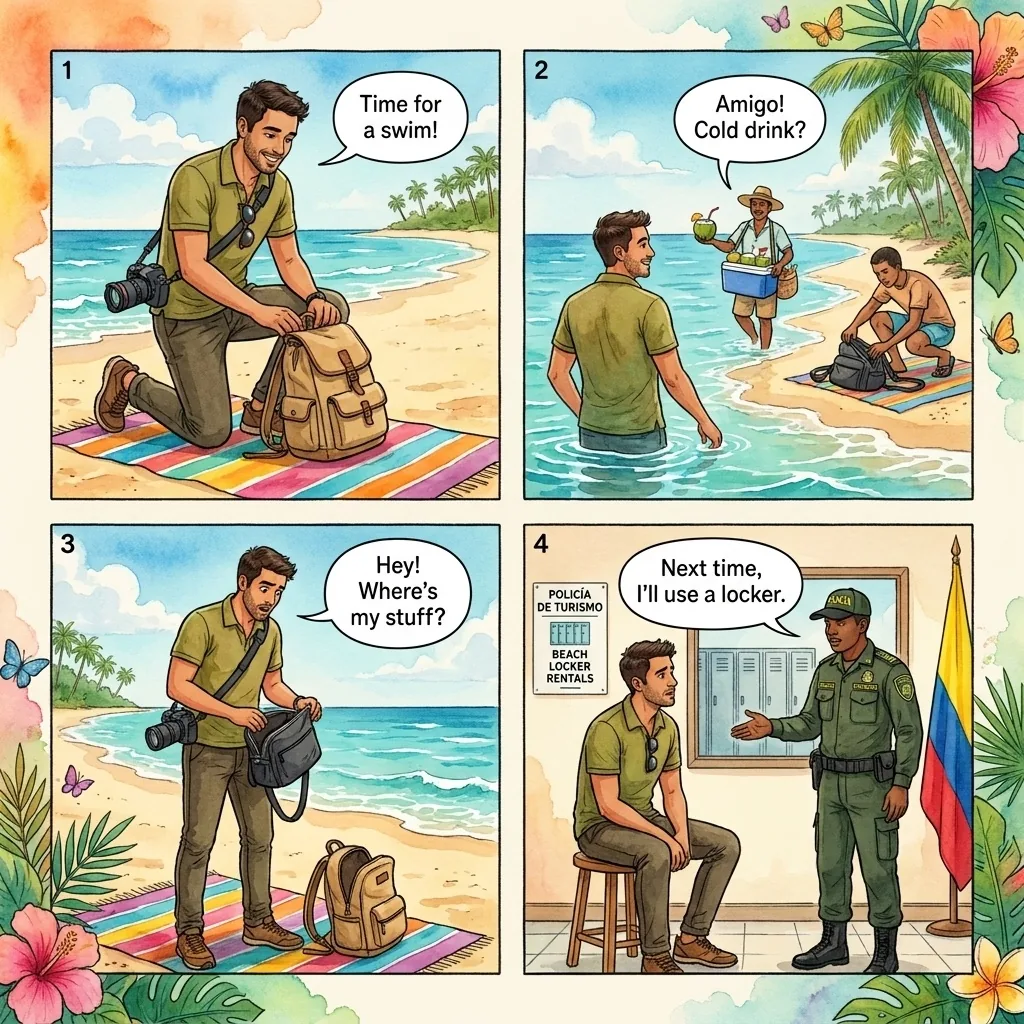
At Playa El Rodadero or Bahía Concha, a vendor approaches your towel while a partner in the surf strikes up a conversation — by the time you wade back, the phone, wallet, and camera are gone, often 1,000,000 to 2,000,000 COP (~$250–$500) in a single hit.
The water at Playa El Rodadero runs warm and shallow, and you can wade out fifty meters before it reaches your chest. You leave your dry bag on the towel, your sandals on top of it, your sunglasses inside. From the water you can see the towel — clearly, you tell yourself, it's right there — and a man your age has just struck up a friendly conversation about where you're from, where you've been in Colombia, whether the surf is better in Taganga. He's cheerful, unhurried, an arm's length away. You spend ninety seconds answering before you realize you can't quite see your towel anymore.
When you walk back up the sand, the bag is still there. The towel is still there. The phone, the wallet, and the camera are not. A vendor with a tray of sunglasses had drifted past while you were in the water, knelt down to "rest" beside your things, then continued on his loop. Hoy Diario del Magdalena reported the arrest of Antonio Tovar and José Acuña in El Rodadero precisely this way — the police video shows the team's exact choreography, one in the water, one at the towel, both gone before the victim climbs out. The pattern repeats at Bahía Concha and at Cabo San Juan inside Tayrona, where boat-tour groups leave bags in piles while they swim.
What makes the beach scam efficient is that the bag is the target, not the person, and the team needs only about a minute of attention away from the towel to clear it out. El Tiempo's "Ladrones se disfrazan de vendedores y roban a turistas" investigation tracked the same vendor-cover technique across El Rodadero and the boat beaches reached from Taganga; the reporters interviewed a Cristian Jiménez who'd just lost his phone to an ice-cream cart drifting past his spot. The defense isn't more vigilance — vigilance fails the second you turn your head. Take turns swimming with your travel companion so the bag is always being watched, or carry only a waterproof phone pouch into the water and leave everything else at the hotel safe.
Red Flags
- Vendor who lingers near your bag rather than continuing along the beach
- Stranger in the water who strikes up an intense conversation while your back is to your towel
- Sudden cluster of activity — a beach ball, a radio, a small commotion — close to where you've left your things
- "Helpful" person offering to watch your bag while you swim
- Two people coordinating across positions: one near the bag, one engaging you elsewhere
How to Avoid
- Take turns swimming with a companion so someone always has eyes on the bag.
- Carry only a waterproof phone pouch into the water and leave passports, laptops, and excess cash at the hotel.
- At Tayrona, use the locker facility near the main park entrance for valuables before you walk in.
- At Bahía Concha and the boat beaches, treat any unattended bag as already lost — do not rely on "I can see it from here."
- Bring only what you need for the day to the beach: enough cash for food and drinks, a cheap phone, and sunscreen.
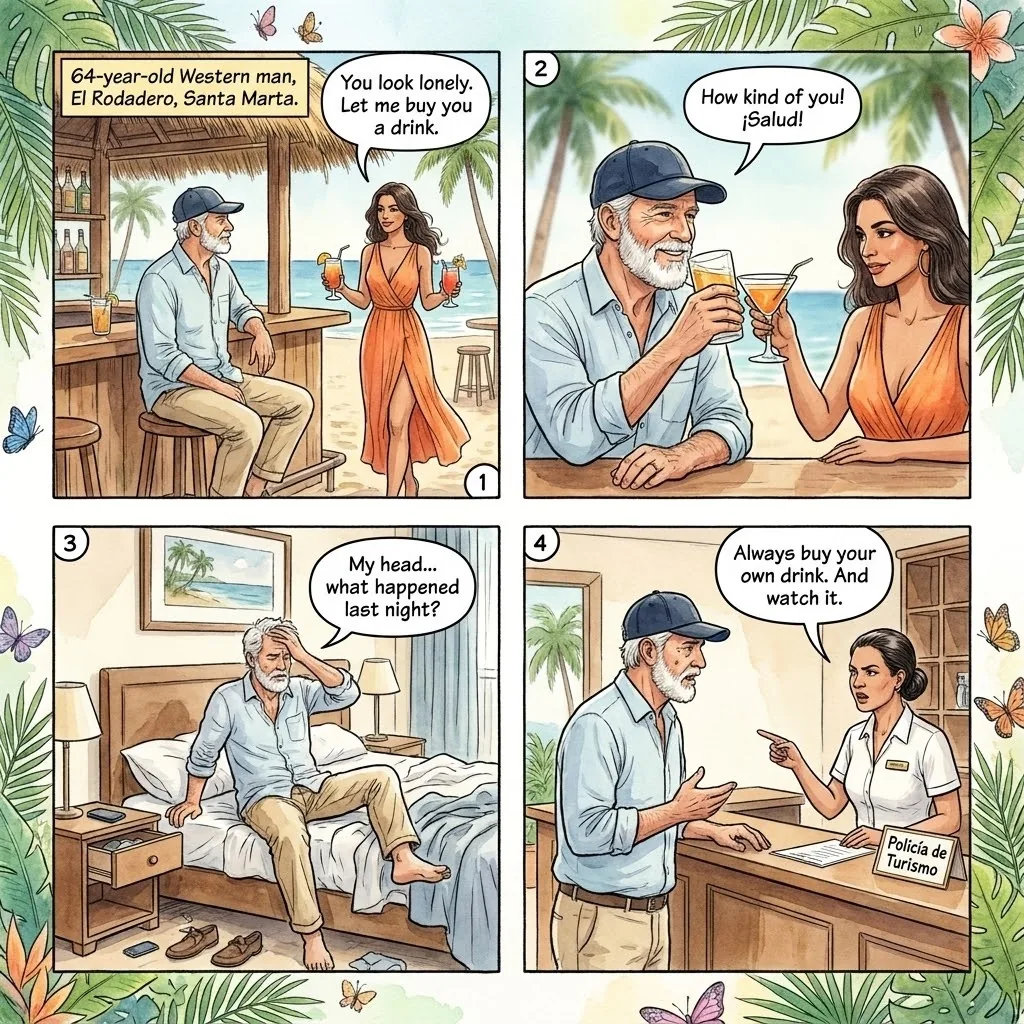
A woman at a bar in El Rodadero or off Parque de los Novios offers to buy you a drink, the drink tastes normal, and twenty minutes later you walk willingly back to your hotel — when the memory returns, the room has been cleaned of phone, laptop, watch, and passport.
You're at a discoteca in El Rodadero after dinner, two beers in, and the woman who slid onto the stool next to you is funny, attractive, speaks reasonable English, and isn't asking for anything. She buys the next round. The cocktail tastes like the cocktail. Twenty minutes in, the room feels softer at the edges, and she suggests stepping outside for air. By the time you reach the curb, you are extremely cooperative — not unconscious, not staggering, just agreeable in a way you cannot afterward explain. You give her your hotel name. You let her into your room. You tell her where the safe code is.
The drug is scopolamine, called burundanga in Colombia, extracted from the borrachero tree — colorless, odorless, effective in a dose smaller than a grain of rice. The Ackerman Group documented a Polish tourist drugged exactly this way in El Rodadero, the woman absconding with his valuables while he remained passive in the hotel room. El Tiempo has run multiple "turistas drogados y robados" reports out of Santa Marta over the past three years. When the memory returns, hours or sometimes days have passed; the phone, laptop, watch, cash, and passport are gone, and the hotel security camera shows you walking the hallway calmly with someone you appear to know.
The reason scopolamine works on tourists is that the lure looks like flirting, and the drug suppresses the very wariness that would normally trigger. The US Embassy in Bogotá issued a security alert on "Increase in Crimes Involving Use of Sedatives" warning that burundanga is "an odorless, tasteless, memory-blocking substance used to incapacitate and rob unwary victims," and El Tiempo's coverage of robos through dating apps in Santa Marta shows the gangs running this play target solo male travelers in El Rodadero hotels and Airbnbs. The defense is structural — you cannot detect the drug, only avoid the setup. Never accept an opened drink from someone you just met, never bring a stranger you met that night to your hotel, and meet dating-app matches in a busy daytime venue first.
Red Flags
- Stranger who buys you a drink before you've established normal small talk
- Drink that arrived already poured, or was out of your sight for any meaningful interval
- Sudden warmth, dizziness, or sense of "going along with it" twenty minutes after a drink
- Dating-app match who pushes hard for a hotel-room or Airbnb meeting on the first night
- Companion who is unusually insistent on leaving the venue with you
How to Avoid
- Never accept an opened drink from a stranger and never leave a drink unattended — order a fresh one if you stepped away.
- Do not bring people you've just met back to your hotel or Airbnb in El Rodadero, especially after dating-app introductions.
- Meet dating-app matches first in a busy daytime venue (a café in the Centro Histórico, a beachfront restaurant in El Rodadero) before any night plans.
- Travel in pairs at El Rodadero nightclubs and watch each other's drinks — if a friend suddenly seems "extremely cooperative," get them out and to a hospital.
- Keep passport, laptop, and large cash in the hotel safe rather than the room.
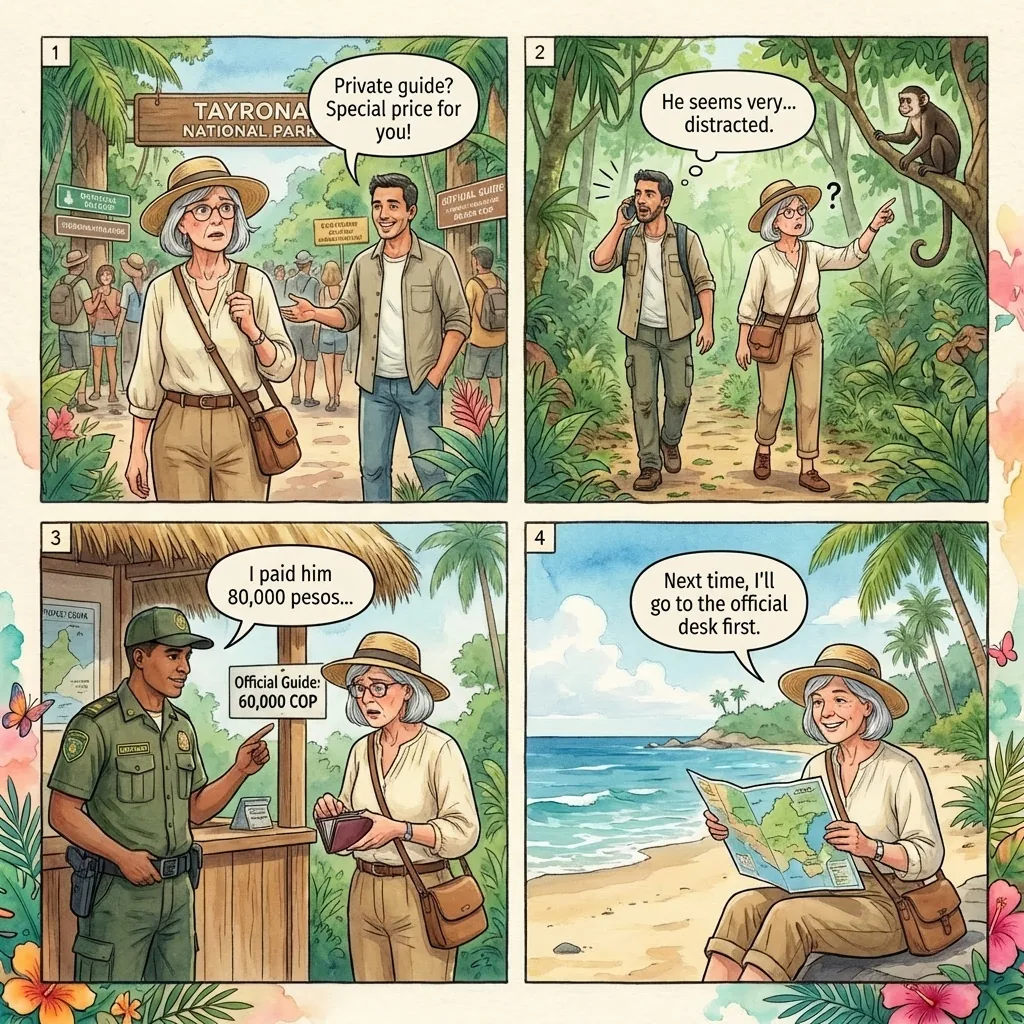
Outside the El Zaino entrance to Tayrona a man offers a "private guided tour" for 80,000 COP (~$20) that turns out to be him walking ahead of you on a trail you could have walked alone for 20,000 — the same play repeats at Minca trailheads and at the unlicensed Lost City booking stalls.
You step off the bus at the El Zaino entrance to Parque Nacional Natural Tayrona and a man in a Tayrona-branded shirt approaches with a clipboard. "Private guided tour, 80,000 pesos, includes the trail to Cabo San Juan and historical commentary." He sounds knowledgeable. He has a friend who is a "park ranger." You're standing in a parking lot with a dozen other arrivals, the official ticket window is fifty meters past him, and he's offering to handle everything in one transaction. You hand him the cash.
What you bought is an escort, not a guide. He walks ahead of you on a clearly marked public trail that any visitor walks for the standard 86,500 COP entrance fee, narrates almost nothing, and disappears at Cabo San Juan saying his shift is over. The same pattern runs at Minca, where men outside the Marinka waterfall path charge 60,000–100,000 COP for a self-guided hike with no entrance ticket, and at unlicensed booking tables on Calle 22 in Santa Marta where "Lost City" packages are sold by operators who are not on the four-company authorized list. El Tiempo's "Cae la red de Los Mágicos" reported on a falsa-agencia network arrested in Santa Marta after defrauding more than 130 families of over 300 million pesos.
What makes the Tayrona/Lost City variant resilient is that licensed and unlicensed sellers stand within meters of each other, and travelers don't yet know that the Lost City trek is restricted to four operators by the Colombian Ministry of Culture: Expotur, Wiwa Tour, Turcol, and Magic Tour. Hoy Diario del Magdalena's piece "Guías turísticos alertan sobre suplantación y estafa a visitantes" quoted the city's licensed-guide association directly on the suplantación pattern — fake operators adopt the look and patter of real ones. Book Lost City only with one of the four licensed operators (Expotur, Wiwa Tour, Turcol, Magic Tour), and at Tayrona walk past anyone outside the gate and buy the official ticket at the El Zaino window for the standard fee.
Red Flags
- Anyone offering "Lost City" treks who is not Expotur, Wiwa Tour, Turcol, or Magic Tour
- Tour seller approaching arriving vehicles or buses at Tayrona's El Zaino entrance with a clipboard
- "Guide" who has no printed permit, no company office address, and wants payment in cash up front
- Price suspiciously below the standard rate (Tayrona entry 86,500 COP, Lost City 1,800,000–2,200,000 COP, Minca self-guided)
- Booking stalls on Calle 22 in Santa Marta with no Registro Nacional de Turismo number visible
How to Avoid
- Book Ciudad Perdida only with one of the four licensed operators: Expotur, Wiwa Tour, Turcol, or Magic Tour.
- At Tayrona, walk past anyone outside the gate and pay the official entry directly at the El Zaino ticket window.
- For Minca trails, ride a moto-taxi straight to the Marinka or Pozo Azul trailhead and walk the marked path — no guide needed.
- Verify any operator's Registro Nacional de Turismo (RNT) number on the Ministerio de Comercio website before paying.
- Get a written itinerary, inclusions, and refund policy on company letterhead before any cash changes hands.
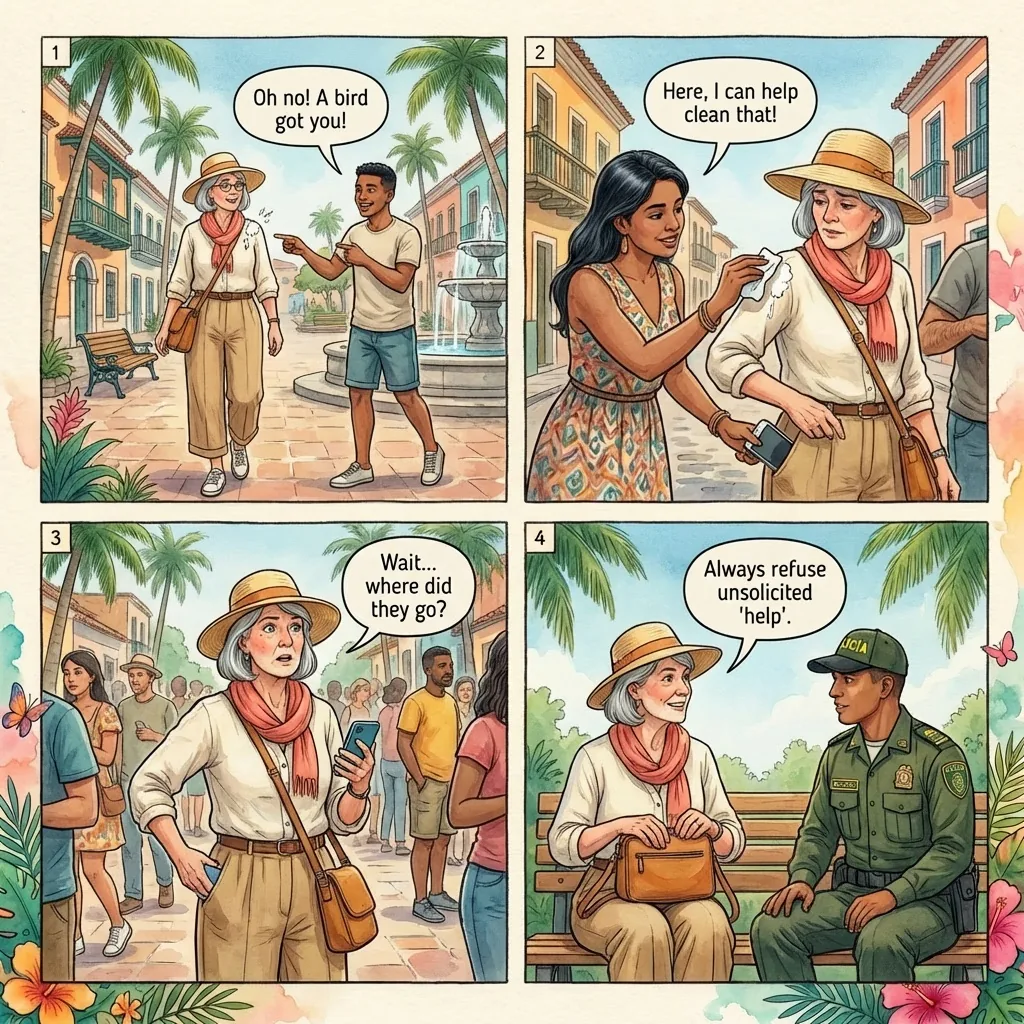
A stranger taps your shoulder and points to a pale streak on your jacket, "bird poop"; while a "helpful" second person dabs at it with a napkin, a third hand goes into your back pocket — or you walk away wearing a "free" bracelet that suddenly costs 50,000–100,000 COP.
You're walking through the Centro Histórico after lunch when someone taps your shoulder and gestures urgently at your jacket. There's a streak of something pale and runny on your shoulder — bird poop, the woman says, pointing up at the cathedral's ledges. She already has a tissue out. A second helpful passerby produces a napkin and starts dabbing. You pull off your jacket to inspect the damage; you bend forward; you set your daypack down by your feet for one second. By the time the strangers wave goodbye, your phone is no longer in your back pocket and the daypack is half a meter further from your shoe than you left it.
The bracelet variant is louder. A friendly woman near Parque de los Novios calls you over and starts tying a colorful threaded bracelet on your wrist as a regalo. While she works the knot, a man positions himself behind your other shoulder. The bracelet finished, she names a price: 50,000 COP for one, 100,000 for the matching pair "for your wife." You try to untie it; she grips your wrist and her partner steps closer. You don't want to make a scene with your kids watching, so you fish out a 50,000 note and walk. Twenty meters later you check your back pocket — wallet shorter by another 200,000.
What both moves share is the body line: a stranger penetrating your personal space, a second stranger moving into your blind spot, and a forced loss of attention while one hand works a bag or pocket. El Tiempo's "Ladrones se disfrazan de vendedores y roban a turistas en Santa Marta" investigation documented exactly this team architecture at the Centro Histórico cathedral and Parque de los Novios, and Semana reported the arrest at Parque de los Novios of two women who lifted 400,000 COP from a tourist using the same distraction template. The squirt itself is mustard, mayonnaise, or shaving cream, and the bracelet "gift" never was free. If a stranger in the Centro Histórico touches your clothes or your wrist, step backward into open space and check your pockets and bag before doing anything else — the move only works if you stop and look down.
Red Flags
- Stranger who taps your shoulder and points out something on your clothes
- A second "helpful" passerby who appears within seconds with napkins
- Anyone who tries to tie a bracelet, ribbon, or thread around your wrist as a "free gift"
- Hands or bodies positioning behind you while a stranger holds your attention in front
- Sudden cluster of people around you in an otherwise calm pedestrian street near the Catedral or Parque de los Novios
How to Avoid
- If someone points at a stain on your clothes, step into open space and walk to a hotel lobby or shop before inspecting.
- Decline any "free" bracelet, flower, or gift firmly — pull your hand away and keep walking.
- Wear your daypack on your front in the Centro Histórico and keep your phone in a zipped inner pocket.
- Move with a companion in the cathedral and Parque de los Novios areas so someone can watch your back.
- If a bracelet does end up on your wrist, do not pay; cut it off later with scissors and walk away rather than escalating on the street.
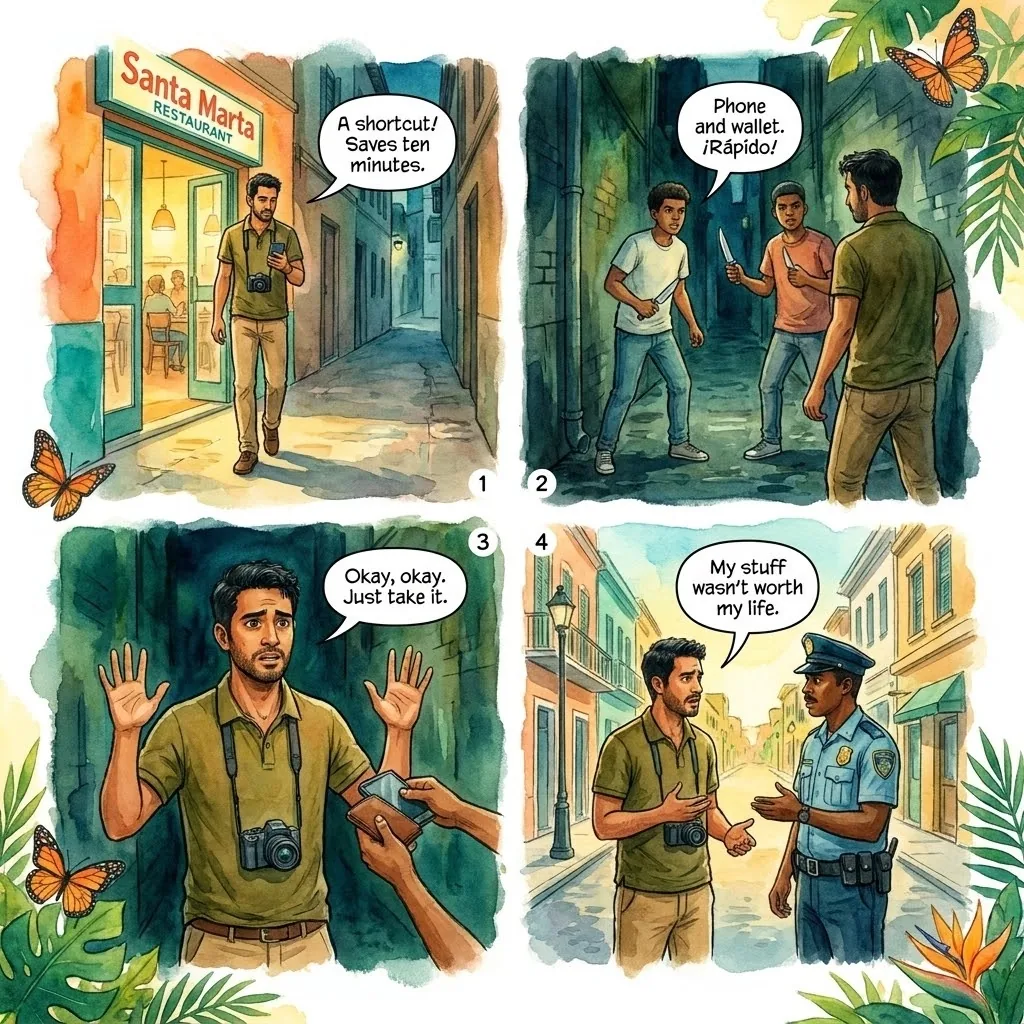
You take a four-block shortcut from Parque de los Novios back to your hotel after dinner. Two men step out of a doorway near Calle 12 and Carrera 3, a knife appears, and the robbery is over in under sixty seconds — resist and the next news article is about you.
Dinner finishes around 10 p.m. at a restaurant near Parque de los Novios, and your hotel is four blocks away. The main strip is busy and well-lit, but the side street is shorter, and a four-block walk feels like nothing. You step off Carrera 1 and the lighting drops by half within thirty meters. Two men emerge from a doorway. One moves to your back, one steps in front, and a folding knife appears at waist level. The Spanish is short. Todo. Celular. Billetera. Reloj. Your wife or your kids are in the doorway behind you, and the calculus of the next four seconds is simple.
Comply and the encounter is over in under sixty seconds. Resist and the Caribbean coast newspapers run your story. El Heraldo reported on January 28, 2025 that a German tourist was stabbed in the abdomen at Carrera 4 with Calle 31 in Manzanares after fighting back, and El Tiempo covered a Spanish tourist on the road to Taganga who was attacked with a machete and ended up with more than 6 million pesos in medical bills. A long-running Tripadvisor thread titled "Attempted robbery at knifepoint in Santa Marta" documents the same template at Calle 12 and Carrera 3, four blocks off Parque de los Novios — a tourist couple ambushed on a "shortcut."
The geography is the key. Santa Marta's main tourist corridors — Carrera 1, Parque de los Novios, and the El Rodadero beachfront — are well-patrolled and statistically safe at night. One block off any of these, the lighting drops, the foot traffic disappears, and the risk profile changes within thirty seconds of walking. El Informador's reporting on the "Los Toderos" gang and Hoy Diario del Magdalena's coverage of the capture of two men robbing tourists at Calle 22 with Carrera 1 both place the active hunting ground at the seam between the tourist zone and the budget hotel cluster — exactly where short walks happen at night. The fix is structural. Use Uber, InDriver, or a hotel-arranged taxi for any night journey in Santa Marta, even three-block distances — the fare is rarely above 8,000 COP and removes the seam from the equation.
Red Flags
- Side street one block or more off Carrera 1, Parque de los Novios, or the El Rodadero strip after dark
- Sudden drop in lighting and pedestrian density as you turn off the main corridor
- Groups of young men loitering in doorways, alleys, or near parked motorcycles on your route
- Visible expensive items — phone in hand, watch, camera, gold chain, designer clothing
- "Shortcut" that locals or hotel staff have not specifically confirmed as safe at that hour
How to Avoid
- Use Uber, InDriver, Didi, or a hotel-arranged taxi for any night journey in Santa Marta — even three-block distances.
- Stay on Carrera 1, the Parque de los Novios square, and the El Rodadero beachfront strip after dark.
- Leave watches, jewelry, and visible electronics in the hotel safe; walk with your phone in a front pocket.
- If confronted, comply immediately — hand over phone, wallet, watch — nothing you carry is worth a stab wound.
- Ask hotel staff before you go out which exact streets are safe between midnight and dawn; do not assume.
🆘 What to Do If You Get Scammed
📋 File a Police Report
Go to the nearest Colombian National Police (Policía Nacional) station. Call 123 (Emergency) or 112. Get an official crime report — you'll need this for insurance claims. You can also report online at policia.gov.co.
💳 Cancel Your Cards
Call your bank immediately. Most have 24/7 numbers on the back of the card (keep a photo saved separately). Block any suspicious transactions before the thieves use your details.
🛂 Lost Passport?
Contact your nearest embassy or consulate. The US Embassy in Bogotá is at Calle 24 Bis No. 48-50, Bogotá. For emergencies: +57 1-275-2000.
📱 Track Your Device
If your phone was stolen, use Find My (iPhone) or Find My Device (Android) from another device. Don't confront thieves yourself — share the location with police instead.
Frequently Asked Questions
You just read 7 scams in Santa Marta. The book has 51 more across 10 Colombian destinations.
Bogotá's paseo millonario yellow-taxi express kidnapping (US State Department: leading cause of financial loss for Americans in Colombia). Medellín's Tinder scopolamine setups (reports tripled 2023–2025). Cartagena walled-city USD-pricing markups. Tayrona park “guide” rackets. Every documented Colombia scam — with the exact scripts, red flags, and Colombian Spanish phrases that shut each one down. Drawn from Colombian press (El Tiempo, Semana, El Espectador), Policía Nacional de Turismo records, and US State Department advisories.
- 58 documented scams across Bogotá, Medellín, Cartagena, Cali & 6 more destinations
- A Colombian Spanish exit-phrase card you can screenshot to your phone
- Updated annually — buy once, re-download future editions free
- Readable in one flight — $4.99 on Amazon Kindle