
Key Takeaways
- The #1 reported scam is the SJO Airport Pirate-Taxi Cartel.
- 4 of 7 scams are rated high risk.
- Use app-based ride services (Uber, DiDi) instead of street taxis — avoid unmarked vehicles, especially at night.
- Never accept unsolicited offers from strangers near tourist sites in San Jose.
⚡ Quick Safety Tips
- From SJO (Juan Santamaria), pay at the orange Taxi Aeropuerto kiosk INSIDE the terminal (~$28–$33 downtown, ~$40 Escazu) and verify the plate starts with 'T' (TA, TSJ, TH, TP, TG) before loading bags — (2025); Interbus/Gray Line shared shuttles are $15–$25 pp.
- Book DIRECT with Adobe (adobecar.com) or Vamos (vamosrentacar.com) for rental cars — never via Expedia, Priceline, Kayak;; only TPL/SLI (~$13–$20/day) is legally required, all CDW is optional with a printed Chase/Amex/Capital One CDW letter.
- SKIP the Claro / Kolbi SIM kiosk at SJO baggage claim ; install Airalo eSIM ($4.50–$17 for 1–10GB) BEFORE flight, or buy at Multiplaza Escazu Kolbi store for ₡5,000–₡10,000 with proper registration.
- Book 24/7-guarded hotels (Intercontinental Real Costa Rica Escazu, Hyatt Place San Jose, Marriott Hacienda Belen, Grano de Oro Barrio Amon) or Airbnb only inside guarded gated communities (Avenida Escazu, Rio Oro, Forum Tower) ; calendar-block +/-2 days and verify 24/7 armed guard + CCTV + panic button in writing.
- SKIP the Coca-Cola (Terminal 7-10) bus terminal and zona roja after dark — book Interbus (interbusonline.com) or Gray Line shared shuttles ($49–$65 pp door-to-door) instead; never change money with street cambistas on Avenida 2 or Parque Central (the 'your bill is counterfeit' swap is the canonical SJO con) — use BAC/Scotiabank/BCR in-branch ATMs, always choose colones, and check ₡20,000 notes for the Carlos Luis Fallas watermark.
Jump to a Scam
- High SJO Airport Pirate-Taxi Cartel
- Medium Fake Uber at SJO Fare-Gouge
- Low SJO Baggage-Claim SIM-Card 'Activation Fee' Fraud
- High SJO Rental-Car 'Mandatory Insurance' $2K Ambush
- High San José Airbnb 'Calendar-Leak' Home-Invasion
- High Coca-Cola Bus Terminal Pickpocket & Luggage Theft
- Medium Parque Central Cambista 'Counterfeit Bill' Swap
The 7 Scams
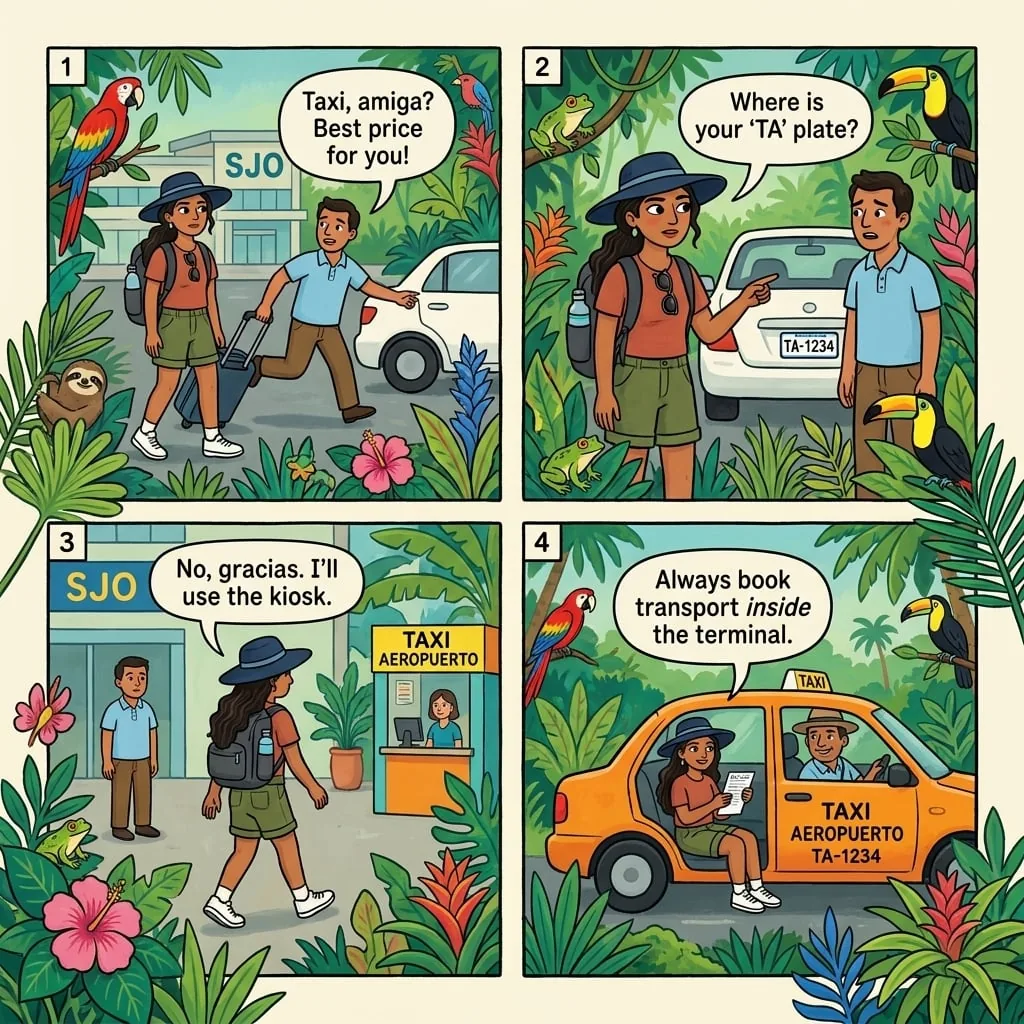
A non-orange "taxi" outside SJO arrivals quotes $40 for a four-minute ride, then either gouges you or detours onto the highway toward accomplices waiting to rob you — the legitimate orange Taxi Aeropuerto kiosk is inside the terminal at fixed $28–$40 fares.
You walk out of baggage claim at Juan Santamaría and a man in a polo shirt steps in front of you with both hands open: "Taxi, amigo? Best price." Before you answer he is already reaching for your suitcase handle. The car he points to is a white sedan parked at the curb with a private plate — six numbers, no leading T. The official Taxi Aeropuerto fleet is bright orange, the plates begin with TA, TSJ, TH, TP, or TG, and every fare is fixed in advance at a kiosk inside the terminal between the carousels and the exit doors. Anyone working the curb in a non-orange car is a pirata, and the friendly opener is the only friendly part of the ride.
The benign version is a $40 charge for a four-minute hop to a hotel that should cost $12, with the driver shrugging and saying there's nothing you can do once the doors are locked. The serious version is the highway shakedown — twenty minutes in you realize you're heading the wrong direction on Route 1, and the driver is on the phone telling someone you'll arrive in five minutes. Travelers describe the same pattern: a stop at an unlit lay-by, a second man at the window, wallets and phones taken, bags dumped on the shoulder. The $40 was the lure; the rest was the plan.
The fix is in the terminal, not at the curb. Walk past every "taxi taxi" voice, refuse every grab for your bag, and head to the orange Taxi Aeropuerto kiosk inside the building — the clerk hands you a printed slip with a fixed fare ($28–$33 to central San José or Paseo Colón, ~$40 to Escazú, $12–$18 to Alajuela) and the number of the orange cab you'll ride in. Photograph the driver's ID and the plate's leading T before you load any luggage. If the car at the curb isn't orange and the plate doesn't start with T, it isn't a taxi — walk back inside to the kiosk and let no one carry your bags. Pre-booked Interbus or Gray Line shuttles ($15–$25 shared) and hotel cars from the Intercontinental or Marriott Hacienda Belén are the safest 1 a.m. arrivals.
Red Flags
- Someone grabs your luggage outside the SJO terminal and 'guides' you to a non-orange car
- Plate does NOT start with 'T' (TA, TSJ, TH, TP, TG) — means it's not a registered taxi
- Driver won't run the meter ('maría por favor') or says 'meter is broken — we fix price'
- Uber driver fails to END the fare at drop-off — app keeps running, price balloons 5x
- Taxi turns onto highway in wrong direction late at night — near-kidnap signature
How to Avoid
- Pay at the Taxi Aeropuerto orange kiosk INSIDE the SJO terminal (~$28–$40 fixed).
- Verify plate starts with 'T' + photograph driver's ID + plate before loading bags.
- If Uber: sit up front, confirm driver ENDS the trip in app before you exit the vehicle.
- Pre-book Interbus/Gray Line ($15–$25 pp) or hotel shuttle as safest 1 AM option.
- Never accept a stranger's grab for your luggage — One traveler: force them to put it down.
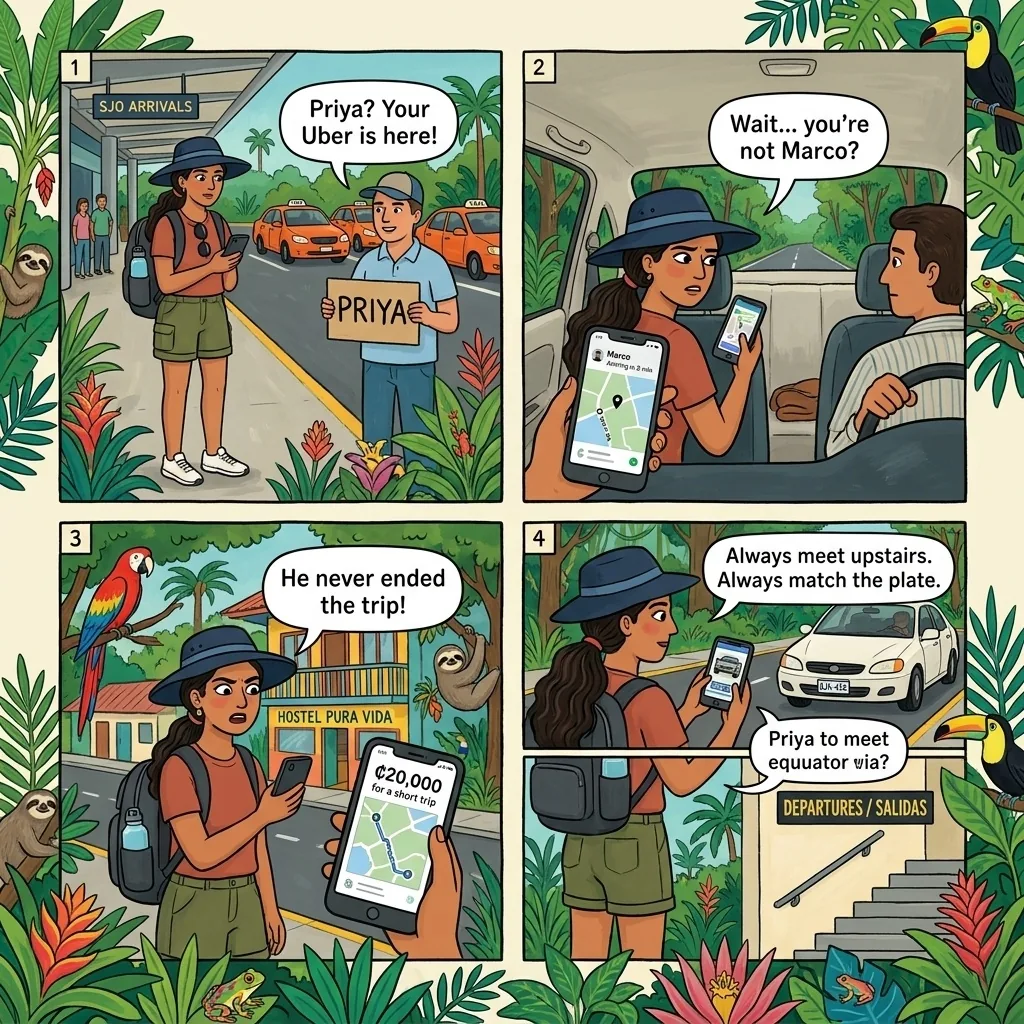
A pirate driver at SJO arrivals waves a sign with your name pulled from a public booking, and once you climb in he either drives loops without ending the trip — turning a ₡3,900 ride into ₡20,000 — or restrains you at drop-off and empties your pockets.
Uber has run in Costa Rica since 2015 but has never been formally legalized, and ARESEP, the transport regulator, still treats rideshare as illegal at airports. SJO's official orange-taxi concessionaires actively police the arrivals curb, which forces real Uber drivers to meet riders one floor up at the departures stairs. That gray zone is what the scam works inside. A pirate-taxi crew watches social-media check-ins, prints a sign with the rider's first name, and stands at arrivals where the real Uber would never be. You see your name, you assume it's the driver, and you climb into a car that has nothing to do with the app on your phone.
The fare gouge runs even on a real Uber. The driver delivers you to the door, then "forgets" to tap End Trip and pulls away with the meter still running, looping the airport access road until the app shows a five-times charge. Travelers describe ₡3,900 quoted rides arriving as ₡20,000, $9 fares billed at $30, $200 for a single airport hop. The worst version is the express-kidnapping tail — a real-looking pickup, a route that veers off plan, a stop where the driver physically restrains the passenger and goes through their pockets for cash and phones. Tico locals are blunt about the math: take the orange airport taxis at SJO, use Uber everywhere else.
When you do book Uber, walk one floor up to the departures level — every Tico Reddit thread points to the same stairs — because airport police only enforce against rideshare at arrivals. Match the in-app plate to the physical plate before you open the door, and ask "¿cuál es mi nombre?" before you sit; a real driver knows, a fake one stalls. Screenshot the quoted fare and pickup time so you have proof for an Uber dispute or a credit-card chargeback (Capital One, Chase Sapphire, and Amex Platinum all process these quickly). Watch the driver tap "End Trip" and wait for the receipt email to arrive on your phone before you step out of the vehicle — if they speed off mid-fare, screenshot the still-open trip and call Uber support. Late at night solo, take the orange taxi or a hotel shuttle.
Red Flags
- Stranger at SJO arrivals holding a sign with YOUR name that you didn't send to anyone
- App driver's plate does NOT match the physical car's plate on arrival
- Driver doesn't 'End Trip' at drop-off — app stays open, fare climbs 3–5x
- Driver asks you to sit in the front seat and then refuses to speak — fake Uber tell
- Quoted fare suddenly 'surged' at drop-off after a route that wasn't flagged for surge
How to Avoid
- Meet Uber on the SJO DEPARTURES level (upstairs) not arrivals — escapes airport-police ban.
- Verify in-app plate MATCHES physical plate + ask 'cuál es mi nombre?' before entering.
- Watch driver 'End Trip' in the app + receipt email arrive before exiting the vehicle.
- Screenshot quoted fare + route in app; dispute overages with Uber + credit-card chargeback.
- Prefer DiDi or InDrive at equivalent prices; late-night solo: orange taxi or hotel shuttle.
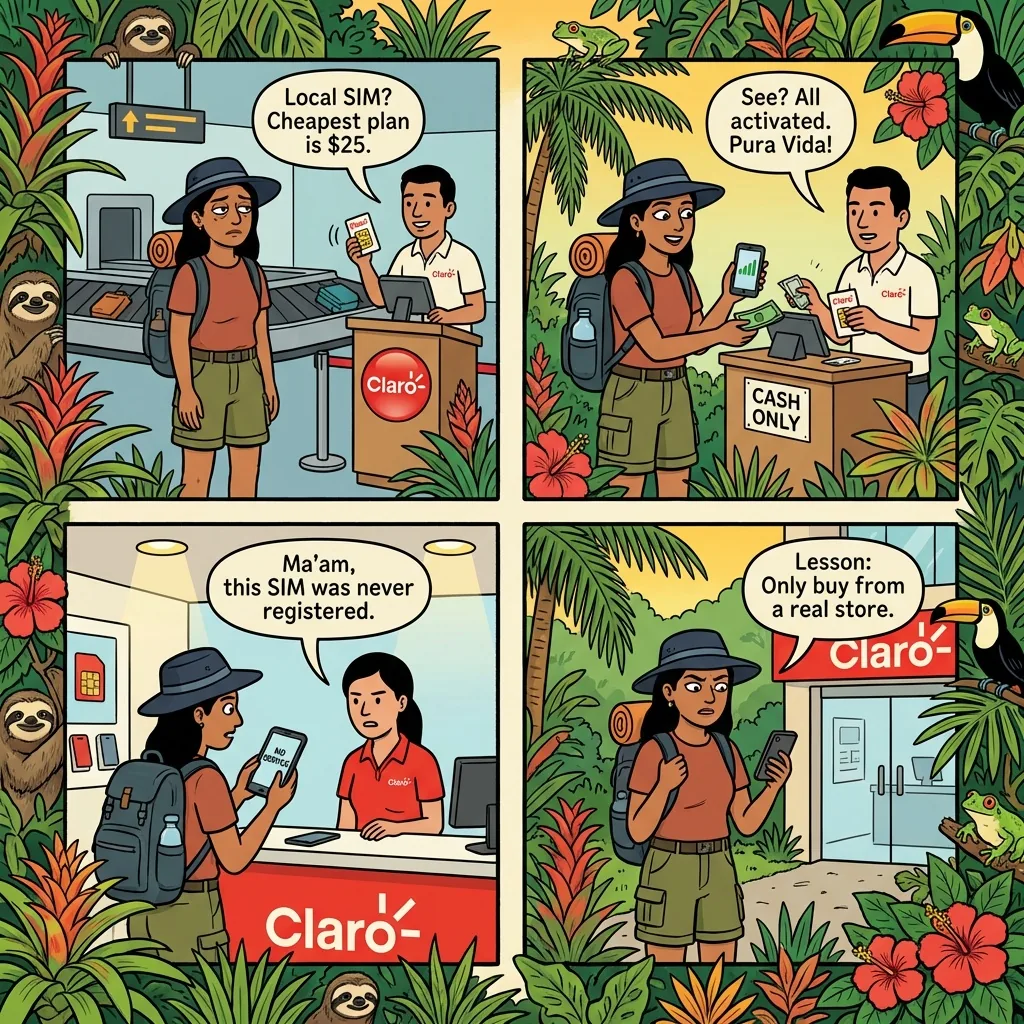
A "Claro" kiosk at SJO baggage claim sells you a $25–$45 cash-only SIM with no receipt and pushes the most expensive prepaid plan as the cheapest — the SIM dies after two hours, and the real Claro store next day tells you nothing was ever activated.
You step off the jet bridge tired and the kiosk is right there in baggage claim, branded with a Claro logo and a clerk waving prepaid SIM packets. He quotes $25 for the "cheapest" plan, which turns out to be the most expensive prepaid tier in Claro's lineup, and he won't take a card. Cash only, no change, no receipt. He pops the SIM into your phone, types something into a handset, hands it back showing signal bars. You walk to the curb, pull up Uber, ride into San José feeling efficient. The SIM works for the entire trip into town.
It dies the next morning. You walk into a real Claro store at Multiplaza Escazú to top up and the clerk there checks the SIM and tells you it was never activated against your passport — the airport kiosk pocketed the cash, registered nothing, and the temporary signal you saw was just the unactivated card phoning home before the network cut it off. The same vendor network runs at Tamarindo and Liberia kiosks, and the math is simple: a legit Claro or Kolbi prepaid SIM with 5 GB costs ₡5,000–₡10,000 ($10–$20) at any in-city store, and the airport kiosk doubles or quadruples it for nothing. The clerk at the real store offers to sell you another one. You pay again.
The clean fix is to never touch the airport kiosk. Install an Airalo eSIM before your flight ($4.50 for 1 GB or $17 for 10 GB at airalo.com) and it activates the moment you land — Holafly, Nomad, and Maya Mobile work the same way on the Liberty, Claro, and Kolbi networks. If your phone can't run an eSIM, skip the kiosk anyway: the real Kolbi store at Multiplaza Escazú is a 15-minute Uber from arrivals, and any Walmart phone counter in San José sells a properly registered SIM. SJO offers free Wi-Fi under "Free-Wifi-AeropuertoSJO" so you can summon your ride without paying a peso for connectivity. If a SIM seller refuses to give you a printed receipt or accept a card, walk away — the cash-only, no-receipt combination is the scam signal under Costa Rica's Ley 7472.
Red Flags
- 'Cash only, no card accepted' at the Claro/Kolbi airport kiosk
- 'We can't give you a receipt' — violates Ley 7472, always illegal
- SIM 'activated and working' but dies after 2 hours — no registration happened
- Clerk pushes the 'cheapest' plan that turns out to be the most expensive pre-paid tier
- Kiosk price of $25–$45 vs. ₡5,000–₡10,000 ($10–$20) at any real in-city Claro store
How to Avoid
- Pre-install Airalo eSIM ($4.50–$17) BEFORE flight — skips the airport kiosk entirely.
- If SIM is required: wait and buy at Multiplaza Escazú Kolbi store or Walmart phone counter.
- At airport kiosk: demand printed receipt + pay only by Visa/Mastercard.
- Test SIM with WhatsApp message before leaving the kiosk — catches dead SIMs immediately.
- If scammed: file at consumidor.go.cr + SUTEL + credit-card chargeback (Ley 7472).
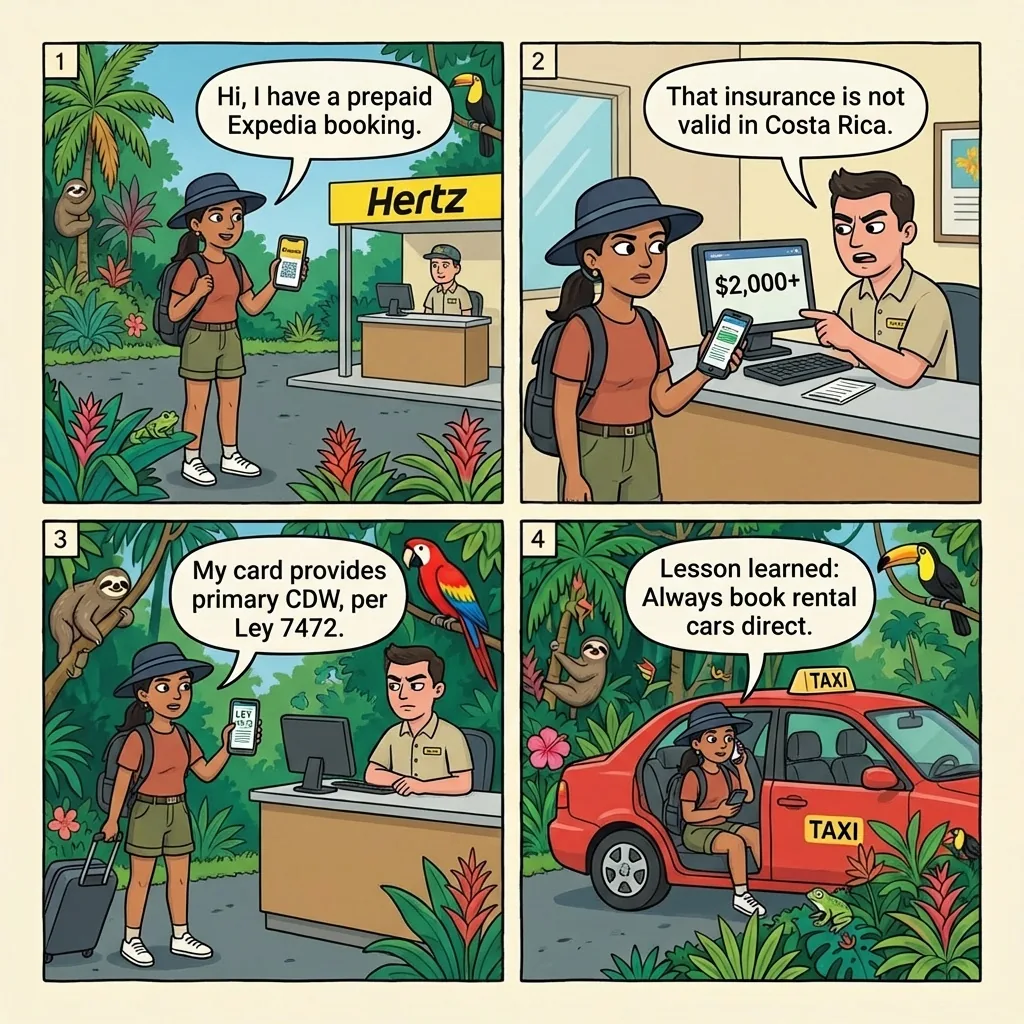
A rental-car counter at SJO's offsite lot — typically Hertz, Fox, or anything booked via Expedia — refuses your prepaid coverage, demands $2,000 in mandatory local insurance plus a $32,000 deposit hold, and strands travelers who refuse on the curb with their suitcases.
You book through Expedia or Priceline at $19 a day with "FULL coverage insurance," pay roughly $1,000 for three weeks, and arrive at SJO expecting to walk to a counter and drive away. The counter is not at SJO — every major rental company runs an offsite lot a shuttle ride west on Route 1, where you arrive with your luggage already off the airport property. The clerk pulls up your booking and shakes his head. The Expedia coverage is "not accepted." Your options are to accept a $2,032 local insurance package on top of what you already paid, or post a $32,000 USD credit-card deposit with 20% withheld for any scratch on return. Travelers who refuse describe being left on the shoulder with five suitcases.
Costa Rica law actually requires only third-party liability (SLI or TPL), which runs $13–$20 a day in 2025–2026 — every other coverage is optional under the consumer-protection statute Ley 7472. The scam runs two ways: third-party-booking sites like Expedia, Priceline, and Kayak quote a headline rate that the local counter refuses to honor, and brand-name counters like Hertz, Fox, Budget, and National stack a "Super CDW" that pushes $29 a day to $90. The legal counter-move is a credit-card primary-rental-coverage letter from Amex Premium, Chase Sapphire Reserve, or Capital One Venture X — printed on bank letterhead, it lets you decline CDW under Costa Rica's own rules. Travelers consistently report Adobe, Vamos, and Alamo honoring those letters with no shakedown; the Expedia-Hertz-Fox cluster is where the trap lives.
Book direct with Adobe (adobecar.com), Vamos (vamosrentacar.com), or Wildrider — all three publish all-in pricing online that the counter actually honors, and travelers report $700 for ten days fully covered. If you must use Hertz, Budget, or National, email the SJO counter for a written all-in quote before you land and arrive with your credit card's CDW coverage letter on the company's letterhead. Plan for a $1,500–$3,000 deposit hold that clears 7–14 days after return, and shoot a video walk-around of every panel at pickup and return so the next "pre-existing damage" charge doesn't land. Decline any "mandatory" CDW above third-party liability if you have a printed credit-card coverage letter — Costa Rica's Ley 7472 makes anything beyond TPL optional, and consumidor.go.cr plus an Amex or Visa chargeback claws back overcharges.
Red Flags
- Counter rep says 'the insurance you bought online isn't accepted here, mandatory $2,000'
- $32,000 credit-card deposit demand with '20% withheld for any damage' ultimatum
- No written all-in quote provided before you arrive at the off-airport shuttle lot
- Rental sourced through Expedia/Priceline/Kayak with a 'too cheap to be true' headline rate
- Refusal to accept Amex/Chase/CapOne primary-CDW coverage letter — not legal under CR law
How to Avoid
- Book DIRECT with Adobe, Vamos, or Wildrider — published all-in pricing, honored at counter.
- If using Hertz/Budget/National: email counter for written quote including TPL before landing.
- Bring printed credit-card CDW coverage letter (Amex Premium, Chase Sapphire Reserve Primary).
- Accept mandatory TPL only (~$13–$20/day) — decline CDW/Super CDW with written proof.
- Video walk-around on pickup + return; dispute via consumidor.go.cr + chargeback if ambushed.
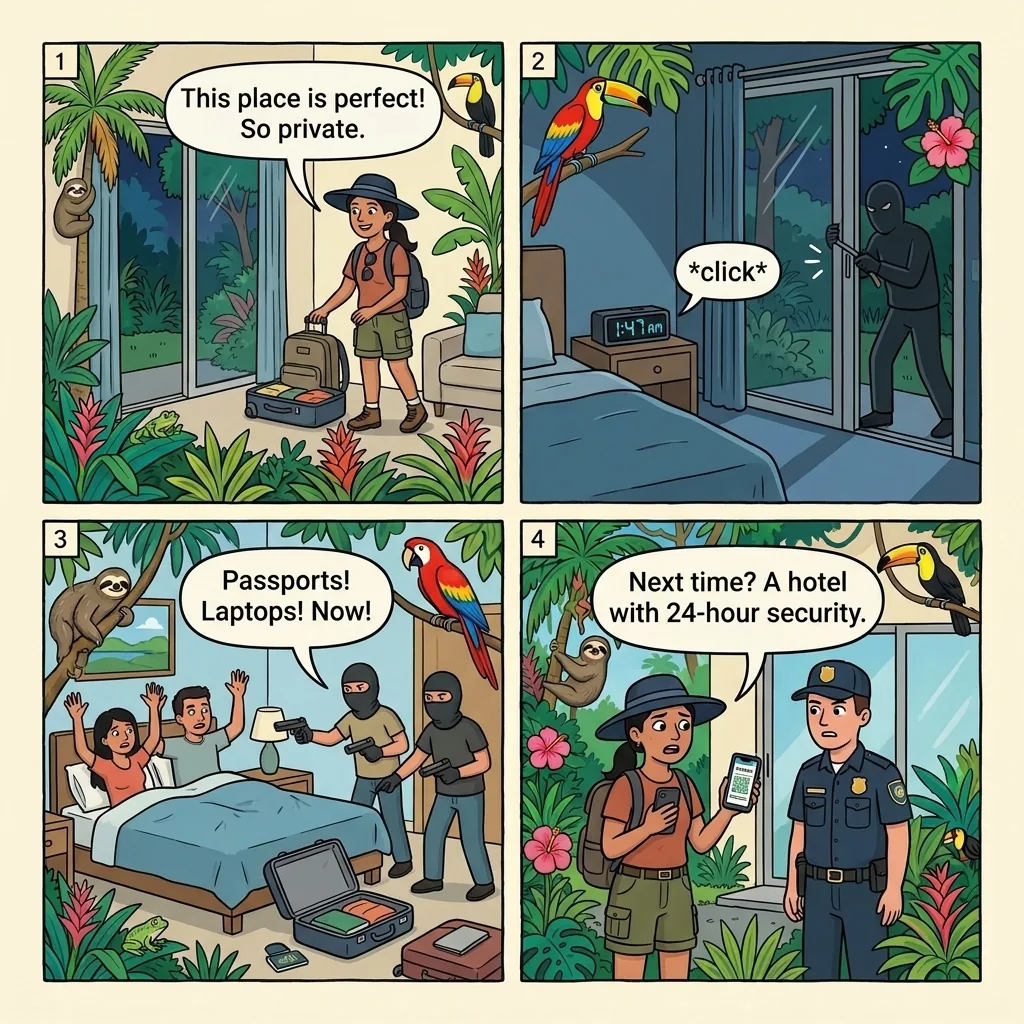
A 4–6-man armed gang reads your Airbnb's public calendar, matches the address via Google Street View, and hits the property between 9 p.m. and 2 a.m. — the US Embassy's Nov 25, 2025 Security Alert specifically warned travelers to avoid vacation rentals without 24-hour armed security.
The pattern OIJ describes is not a random burglary but a planned operation. Airbnb and VRBO calendars publicly display blocked-out dates, which tells anyone reading them exactly when the property will be occupied by a tourist family. Scouts pull the listing's interior photos and cross-reference exterior shots against Google Street View until they have the street address. Four to six men with handguns roll up between 9 p.m. and 2 a.m., when the family is asleep and the perimeter is dark. Escazú, Santa Ana, Barrio Escalante, and the Central Valley outskirts have all hosted documented hits, and the Embassy alert quotes more than 6,300 crimes reported against tourists in Costa Rica in 2024 alone.
The aftermath reports are not subtle. A Guanacaste family was held at gunpoint for thirty minutes before police arrived and a gunfight on the porch killed one robber. A Playa Negra VRBO group barricaded themselves in a bathroom under five flashlights crossing the windows; the host's staff at one Tamarindo rental robbed guests in their sleep. The Embassy's standing recommendation is to "stay only at properties with continuous 24-hour professional security," and Canadian tourist numbers fell 14% in the second half of 2025 in direct response. The variants matter for booking: an isolated home with a single weak door is the highest-risk profile, a porter-desk condo inside a gated community with a guard at the gate is the lowest.
Pick a hotel with 24-hour armed guards on the property — Hotel Grano de Oro in Barrio Amón, the Intercontinental Real Costa Rica in Escazú, Hyatt Place San José, Marriott Hacienda Belén near SJO, or Hampton Inn SJO all run verified 24/7 staff and CCTV. If you must book an Airbnb, book only inside a guarded gated community: Avenida Escazú or Distrito 4 condos, Santa Ana's Río Oro or Forum Tower residences. Get the host to confirm in writing — 24/7 guard, CCTV, panic button, patrol logs — before you transfer any money, and never geo-tag the property on social media. Calendar-block two days on either side of your stay so the public calendar doesn't broadcast your arrival. Book only properties with continuous 24-hour professional security on site, exactly as the US Embassy recommends — an isolated rental outside a guarded community is the precise profile these gangs target. If the worst happens, hide, call 911, and comply; OIJ data shows resistance correlates with shootings.
Red Flags
- Airbnb/VRBO property calendar PUBLICLY displays your arrival date — scouts read it
- Host can't confirm 24/7 armed guard or panic button in writing pre-booking
- Isolated property outside a guarded community, single weak front door/window
- Unknown flashlights on the property perimeter after dark (5–6 crew documented)
- Host pressures to cancel Airbnb review in exchange for refund — cover-up tell
How to Avoid
- Book 24/7-guarded hotels in Escazú/Santa Ana/Barrio Amón — Intercontinental, Hyatt, Marriott.
- If Airbnb: inside a guarded gated community ONLY (Avenida Escazú, Río Oro, Forum Tower).
- Verify 24/7 guard + CCTV + panic button + patrol logs IN WRITING before booking.
- Calendar-block ±2 days on public calendar; never geo-tag the property on social media.
- If invaded: hide, 911, comply; file Fuerza Pública + OIJ within 24h for refund claim.
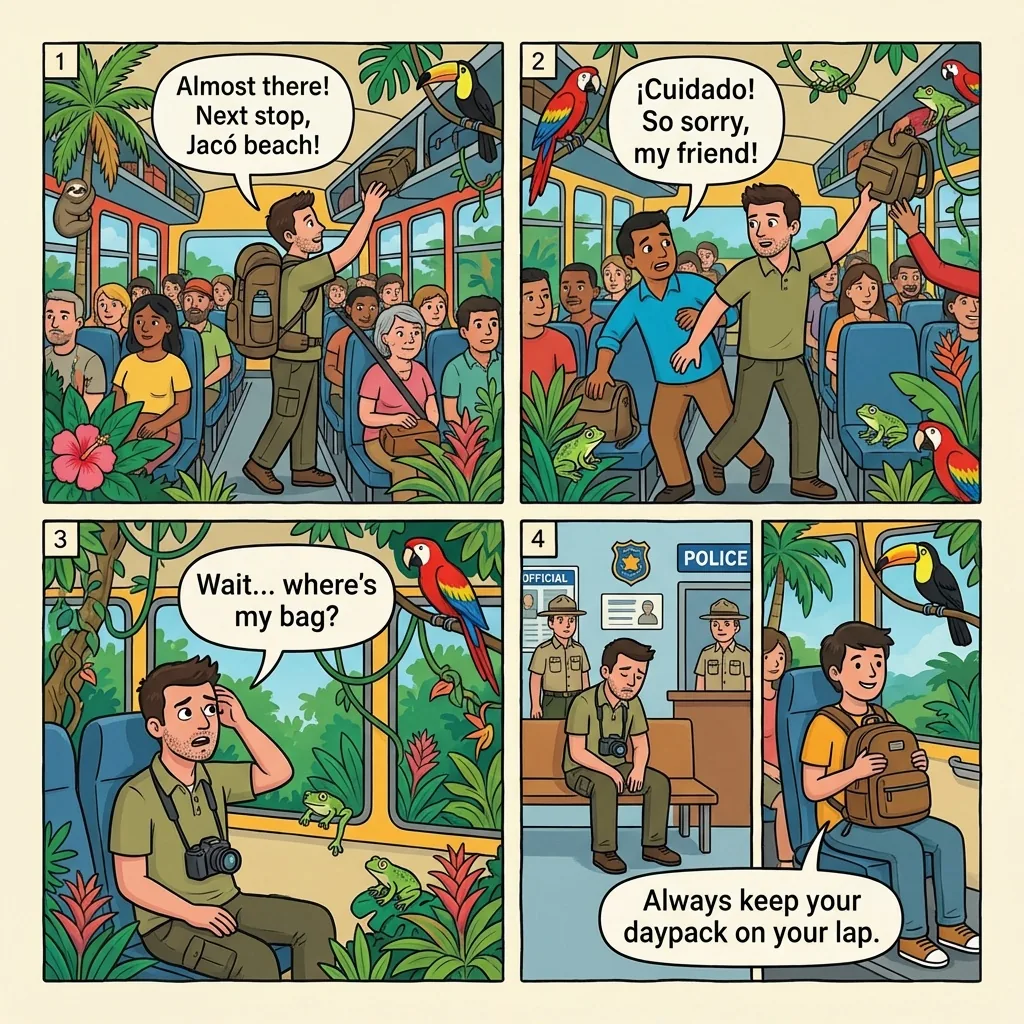
A 2–4-person crew works the Coca-Cola bus terminal and Tracopa platforms — one person collides with you in the doorway, a second lifts your daypack off the overhead rack while you're at a rest stop, and a third disappears into the crowd with your laptop and passport.
Every Western government advisory names the same six blocks of San José as the city's worst zone — Canada's travel.gc.ca calls out "downtown San José areas near the Coca-Cola bus terminal, central market, and public parks," and Australia's Smartraveller flags "petty crime around the central bus terminal in the Coca Cola, most likely on weekends." The terminal isn't optional for budget travelers: Tracopa runs to Jacó and Quepos from here, Alfaro to Montezuma, MEPE to Puerto Viejo, Empresarios Unidos to Puntarenas. The blocks are dense, unlit at night, and the zona roja red-light district sits immediately north of the Mercado Central. The crews who work the terminal are professionals — not opportunists.
The doorway-collision setup is the most common: one person bumps into you at the bus door while you're holding a ticket and luggage, a second reaches into the overhead rack for the daypack you just placed there, and a third walks the goods straight out of the bay. The canonical Tracopa case put a passenger plant on the bus itself — at the rest stop he stripped overhead bins of laptops, phones, and passports while everyone was inside the cafeteria, and a waiting car was already idling in the lot. The urban variants run constantly across Avenida 2 and Plaza de la Cultura: motorcycle-grab phone snatches at stoplights, "bird poop" sprayed on your shirt by an accomplice followed by a wallet lift while a "helpful stranger" wipes you down, "money on the ground" with two strangers claiming it as the third reaches into your bag during the mediation.
If you can route around the terminal, do — Interbus (interbusonline.com) and Gray Line run private door-to-door shuttles for $49–$65 per person, picking you up at the hotel and dropping at the destination with no Coca-Cola touchpoint. If you must use Tracopa, Alfaro, or MEPE, arrive no more than 15 minutes ahead, sit inside the ticket office with bags on your lap until boarding, and never accept "help" with luggage from anyone not in company uniform. Wear a money belt under your shirt for passport and 80% of your cash, keep a decoy wallet in your front pocket with an expired card and ₡5,000, and clip your phone to a wrist strap or a zipped Pacsafe crossbody so the motorcycle-grab can't take it. Skip the Mercado Central and the zona roja blocks north of Hotel Del Rey entirely after dark. Never leave a daypack in the overhead rack during a long-distance bus rest stop — take the bag with you off the bus every single time, because that is the moment the rack gets stripped. Report any loss at the new San José Tourist Police Operations Center or OIJ 800-8000-645 within 24 hours for the insurance paper trail.
Red Flags
- Bus doorway or aisle 'collision' with a stranger at a Coca-Cola terminal bus boarding
- 'Bird poop' on your shirt that appeared in a crowd — classic distraction setup
- Someone 'finds' money at your feet and asks you to help decide whose it is
- Overhead-bin bag moved, unzipped, or 'neat' after a Tracopa/Alfaro rest stop
- Motorcyclist idling near a stoplight with a passenger reaching — phone-snatch signature
How to Avoid
- Skip Coca-Cola: book Interbus/Gray Line private shuttle ($49–$65 pp, door-to-door).
- Never leave valuables in overhead bin during bus rest stops — carry daypack every time.
- Money belt under clothing for passport + 80% cash; decoy wallet in front pocket.
- Avoid Mercado Central / zona roja after dark; daylight only, nothing valuable in pockets.
- Tourist Police 24/7 hub (2025) + OIJ 800-8000-645 within 24h for insurance claim.
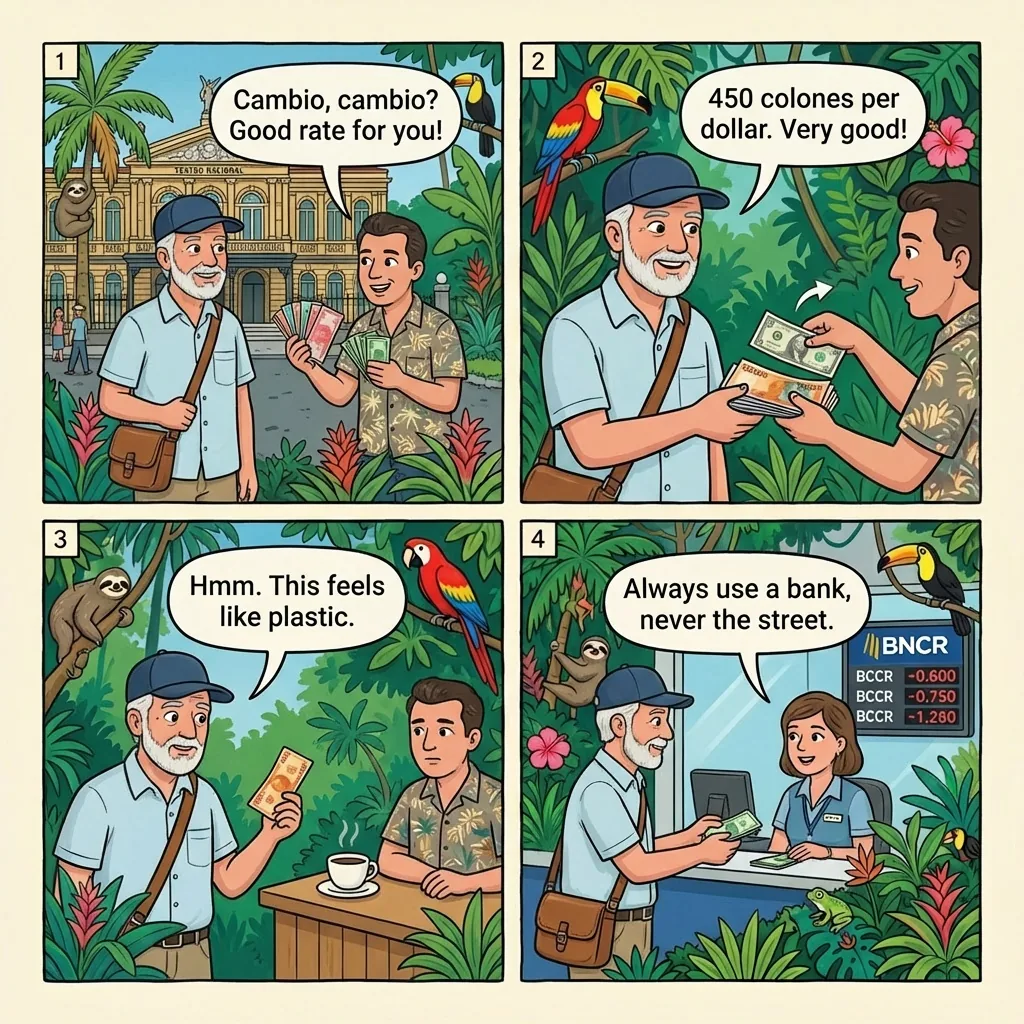
A whispered "cambio, cambio?" on Parque Central or Avenida 2 either gouges you 20% on the rate, palms a counterfeit ₡20,000 into your stack during the count, or hands your dollars to an accomplice mid-transaction — every street money-changer in San José is one of three scams.
Costa Rica's BCCR (the central bank) sets the colón at roughly ₡515–₡530 per USD through 2025–2026 with a tight 2% spread, and any bank branch — Banco Nacional, BAC, Scotiabank, BCR — posts rates within 1% of that benchmark. The street cambistas working Parque Central, the Avenida 2 pedestrian strip, and the edges of Plaza de la Cultura quote 10–20% below market and bank on you not pulling up xe.com before the deal closes. The opener is always the same: a man steps in close, fans a thick stack of ₡20,000 notes, whispers "cambio, cambio?" and quotes a number that sounds plausible if you've just landed and haven't checked the rate. ₡450 per dollar instead of ₡525 — a 15% skim before any sleight of hand begins.
The rate gouge is the soft version. The counterfeit-bill swap runs the moment you hand over a $100 bill: the cambista counts out ₡50,000 in real colones, palms one ₡20,000 out of the stack during the count, and slides a crisp counterfeit into the pile that feels plastic-smooth instead of textured. The snatch-and-run is the third version — he counts, "discovers" a mistake, asks for the dollars back to recount, then passes them to a partner who melts into the crowd while he stalls you for thirty seconds. The same swap runs from inside taxis: the driver claims the ₡20,000 you just handed him is fake, hands you back a prepared counterfeit, and demands a replacement note. Tico Times has been documenting both versions since 2023.
Don't change money on the street, period — every whispered "cambio" approach is one of those three scams. Use a bank branch with your passport during business hours, or pull colones from the ATM inside a Banco Nacional or BCR branch where the spread sits around 1%. Pay shops, restaurants, and taxis in colones rather than USD so they can't gouge the conversion in their head, and put the rest on a no-FTF credit card (Capital One Venture, Chase Sapphire, Amex Platinum). Check every ₡20,000 note before you accept it: a Carlos Luis Fallas watermark, a color-shifting security thread that flips green to blue when tilted, and raised-print texture under your thumb. If a cambista or taxi driver claims your ₡20,000 is "fake," refuse to take any replacement note from their hand — keep your original bill visible in their grip, photograph it, and call 911, because the swap itself is the scam.
Red Flags
- Whispered 'cambio, cambio?' on Avenida 2 or Parque Central — always a scam
- Rate quoted 10–20% below BCCR daily (anything below ₡490/$1 in 2025/2026)
- Cambista palms a note and asks you to 'hand back' the dollars mid-transaction
- Claim 'your ₡20,000 is counterfeit' — they're swapping for a real counterfeit of their own
- No receipt, no shop front, no posted license — legitimate casas de cambio post all three
How to Avoid
- Never change money on the street — only bank branches or in-branch ATMs.
- Check ₡20,000 for Carlos Luis Fallas watermark + color-shift security thread.
- Refuse 'your bill is counterfeit' swap — keep YOUR original note visible + photograph it.
- Pay shops/taxis in COLONES (not USD) — removes the rounding-up gouge.
- Credit card (no-FTF Capital One/Chase/Amex) for hotels/restaurants; report at OIJ 800-8000-645.
🆘 What to Do If You Get Scammed
📋 File a Police Report
Go to the nearest Fuerza Pública / OIJ (Organismo de Investigación Judicial) station. Call 911 (general) or 800-8000-645 (OIJ tip line). Get an official crime report — you'll need this for insurance claims. You can also report online at poder-judicial.go.cr.
💳 Cancel Your Cards
Call your bank immediately. Most have 24/7 numbers on the back of the card (keep a photo saved separately). Block any suspicious transactions before the thieves use your details.
🛂 Lost Passport?
Contact the US Embassy in San José at Calle 98 Vía 104, Pavas, San José. For emergencies: +506 2519-2000 (after hours +506 2220-3127). Policía Turística (Tourist Police) hotline: 2258-1008 / 2258-1022. ICT tourist info: 2286-1473 / 1-800-TOURISM.
📱 Track Your Device
If your phone was stolen, use Find My (iPhone) or Find My Device (Android) from another device. Don't confront thieves yourself — share the location with police instead.
Frequently Asked Questions
You just read 7 scams in San Jose. The book has 62 more across 11 Costa Rican destinations.
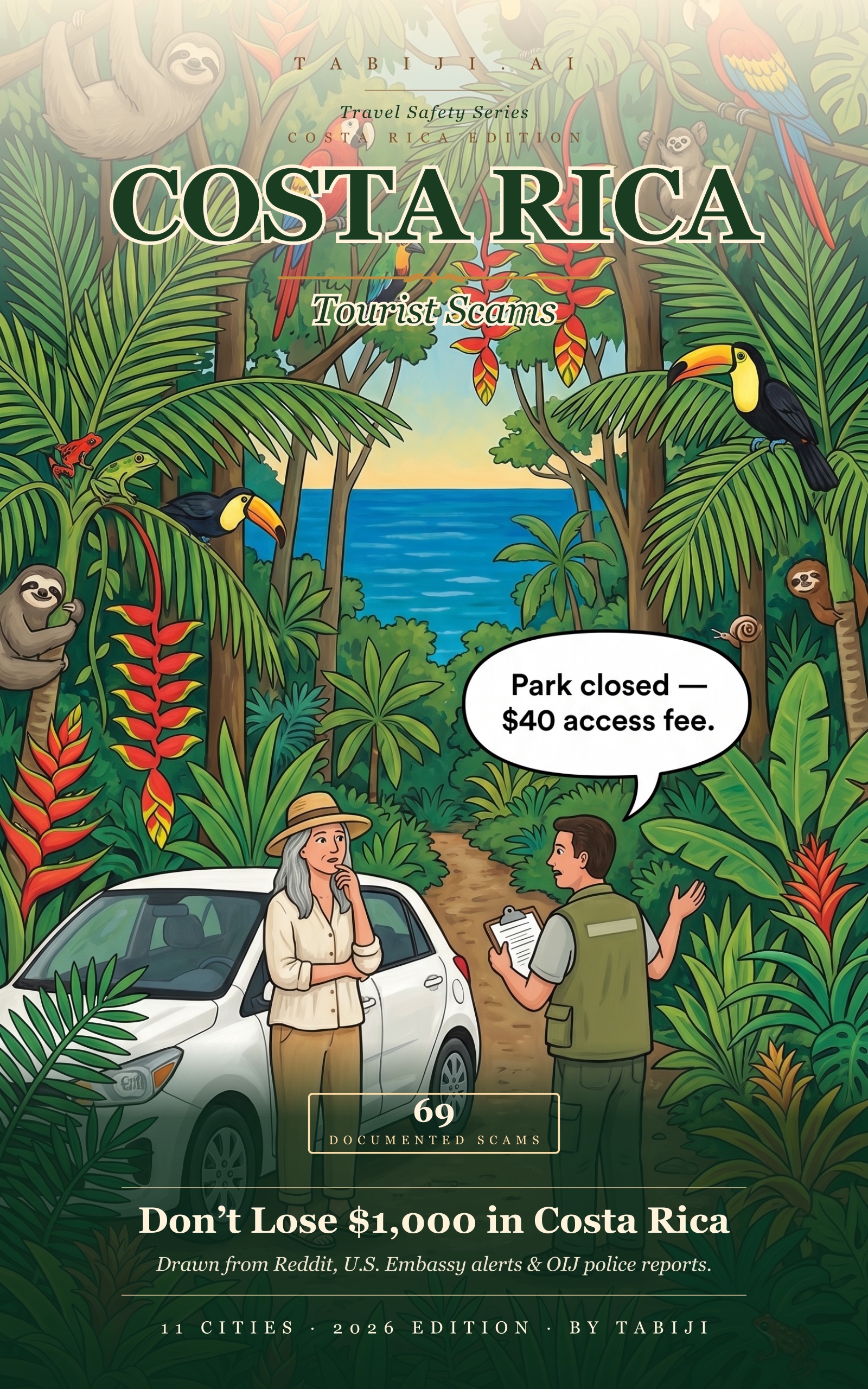
Manuel Antonio “park closed” fake-ranger $40 access-fee shakedowns. SJO airport taxi-meter overcharges. La Fortuna ATV / hot-springs bait-and-switch combos. Tamarindo 90-minute timeshare traps. Tortuguero turtle-tour “guide” demands. Every documented Costa Rica scam — with the exact scripts, red flags, and Costa Rican Spanish phrases that shut each one down. Drawn from Reddit, U.S. Embassy alerts, and OIJ (Organismo de Investigación Judicial) police reports.
- 69 documented scams across San José, Manuel Antonio, La Fortuna, Tamarindo & 7 more destinations
- A Costa Rican Spanish exit-phrase card you can screenshot to your phone
- Updated annually — buy once, re-download future editions free
- Readable in one flight — $4.99 on Amazon Kindle