
Key Takeaways
- The #1 reported scam is the 'Guachimán' Yellow-Vest Parking Extortion.
- 3 of 7 scams are rated high risk.
- Use app-based ride services (Uber, DiDi) instead of street taxis — avoid unmarked vehicles, especially at night.
- Never accept unsolicited offers from strangers near tourist sites in Tamarindo.
⚡ Quick Safety Tips
- Pre-book LIR (Liberia) transfers via Interbus, Gray Line, Tamarindo Transfers, or Easy Ride — $29–$45 pp shared, $120–$135 private 1–4 pax; legitimate LIR fare cap is ₡40,000 (~$77) and official airport taxis are ORANGE, not white — Traveler reports documents a $130 robbery, and 'broken meter' on a town red taxi means exit and take the next cab.
- Book ONLY inside 24/7 guarded gated communities (Hacienda Pinilla, Reserva Conchal, Langosta Beach Club) or armed-guard hotels (Tamarindo Diria, Witch's Rock Surf Camp) — the US Embassy's Nov 25, 2025 Security Alert cited rising vacation-rental armed robberies after the July 2025 fatal shooting of Canadian Christopher Deir in a Los Jobos rental; verify 24/7 armed guard + CCTV + panic button in writing before booking and never post arrival dates on social media.
- Don't leave anything of value in a rental car on Calle Central ; buy a $10 Amazon Faraday key-fob pouch, use the physical button unlock not proximity, park in Plaza Tamarindo ($5) or Cala Luna rather than unpaved strip pullouts.
- Keep ₡500/₡1,000 coins in the cup holder to tip guachimen ₡1,000–₡2,000 (~$2–$4) BEFORE walking off — Watchmen" when parking' is the canonical yellow-vest extortion thread where crews rope off legal spots and demand $10+; refuse the upfront-dollar shakedown, photograph any 'smeared windshield' retaliation and report to Tamarindo Fuerza Publica 2653-0283.
- Book surf lessons ONLY through ICT-certified schools — Iguana Surf (iguanasurf.net, $84 group/$120 private), Kelly's Surf Shop (TripAdvisor 4.4), or Witch's Rock Surf Camp ($54–$85 pp) — and PHOTOGRAPH every side of the board before paddling to kill the $200 'board damage' ambush (TripAdvisor 'Beware predatory surf instructor William'); never accept a bartender's or dancer's request to come home (the pimp-backed $500 extortion script in 2023 is textbook).
Jump to a Scam
- Medium 'Guachimán' Yellow-Vest Parking Extortion
- Medium Beach 'Surf Instructor' $200 Board-Damage Ambush
- High Los Jobos Airbnb Home-Invasion Pattern
- High Rental-Car Relay-Theft outside Witch's Rock / Volcano Brewing
- Medium LIR Shuttle / Pirate-Taxi Tamarindo Gouge
- Medium Tamarindo Banco Nacional ATM Skimming + Counterfeit Swap
- High Tamarindo Nightlife Drink-Spiking & Casino Extortion
The 7 Scams
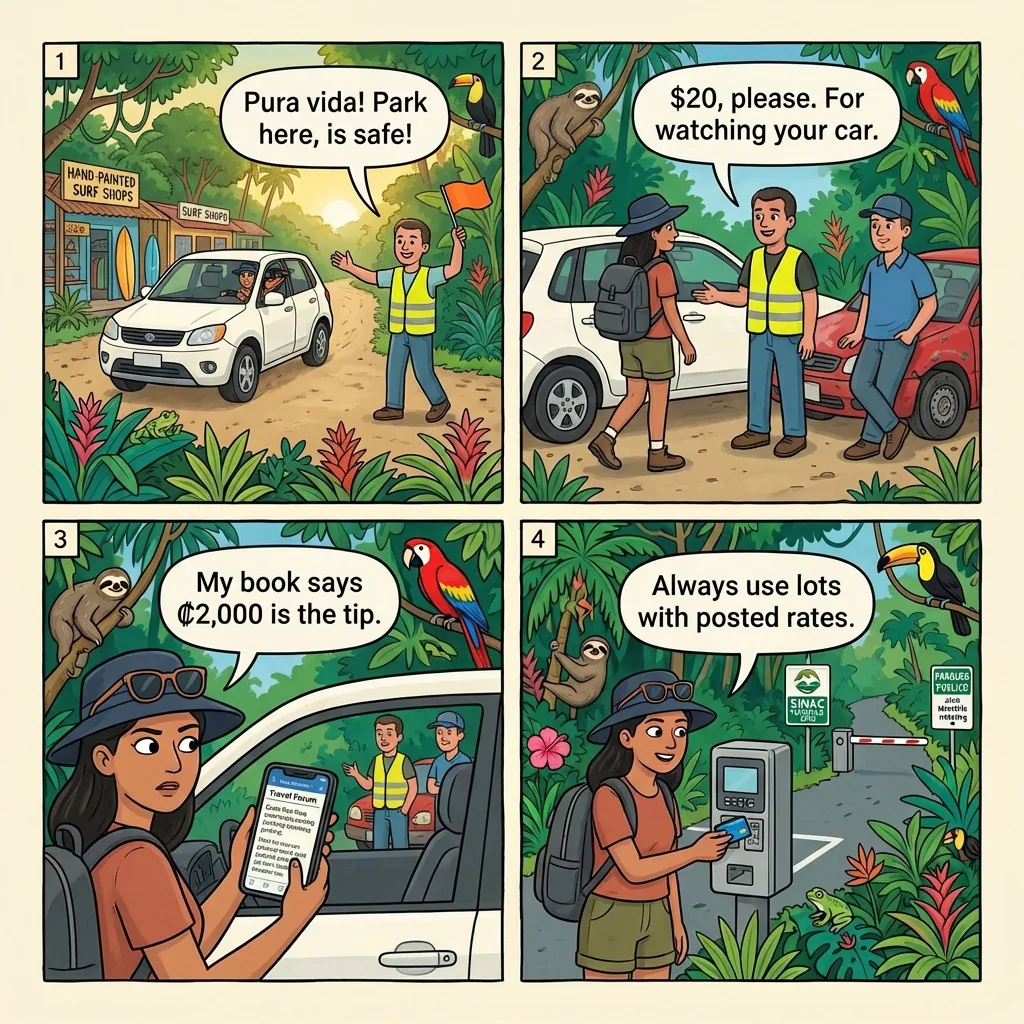
Yellow-vested guachimanes camp every free pullout on Calle Central and the dirt lots behind Volcano Brewing, waving you into a "free" spot and then demanding $10–$20 cash on return — refuse and a second car parks behind yours, blocking the exit until you pay.
You roll into Tamarindo on Route 152 from Villarreal looking for a free spot near the beach, and a man in a yellow safety vest steps off the gravel shoulder waving an orange flag. He motions you into a pullout behind Volcano Brewing or along Calle Central across from the Diria, smiles, gives you a thumbs-up. No price is mentioned. The legitimate version of this job exists across Costa Rica — the guachimán keeps an eye on your car for a ₡1,000–₡2,000 (~$2–$4) tip in coins when you return — but the Tamarindo strip variant has been industrialized into a shakedown that drives the entire parking experience.
You come back to your rental car ninety minutes later, sandy and ready to drive to Langosta. The same man is waiting beside your bumper, but the smile is gone. "$15, amigo. I watched the car." When you reach for coins he shakes his head — bills only, US dollars preferred. If you protest, a second vehicle that wasn't there when you arrived is now parked nose-to-tail behind your rental, and the driver is leaning against it. Three or four guys converge from the other end of the lot. With your family in the back seat watching, $15 to leave starts to feel cheap. Refuse and you can lose a windshield wiper, a side mirror, or have "DON'T PAY" keyed into the door panel by the time you're back from dinner.
The Tamarindo Fuerza Pública (2653-0283) takes guachimán extortion reports, and the legitimate paid lots — Plaza Tamarindo underground at $5/day, Cala Luna behind the Diria, the gravel lot near Langosta bridge — moot the entire script. Keep ₡500 and ₡1,000 coins in the cup holder so a polite watchman gets ₡1,000–₡2,000 in change before he can pivot to a price quote, and never leave anything visible in the cabin because the "watching" racket runs hand-in-hand with the smash-and-grab crews. If the guachimán names a US-dollar price upfront or a second car blocks your exit, roll your windows mostly up and creep forward — they always move — then drive straight to the Fuerza Pública at the town entrance and file the plate number.
Red Flags
- Men in yellow safety vests waving orange flags at every free street-side pullout
- Boxing you in with a second car at pickup time — demanding $10+ USD to release
- Price quoted AFTER you park rather than before — or no price at all until return
- Smeared windshield, flat tire, or 'accidental' scratch when you refuse to pay
- Crew of 3–4 guys converging rather than one polite older watchman
How to Avoid
- Keep ₡500/₡1,000 coins in the cup holder — tip ₡1,000–₡2,000 (~$2–$4) before walking off.
- Park in paid staffed lots (Plaza Tamarindo $5, Cala Luna) — not unpaved shoulder pullouts.
- Never leave bags, phones, sunglasses, or electronics visible — guachis pair with smash-and-grabs.
- If extorted for $10+, roll windows mostly up and creep forward; don't argue roadside.
- Report extortion to Tamarindo Fuerza Pública (entrance to town) or dial 911 / 2511-9260.
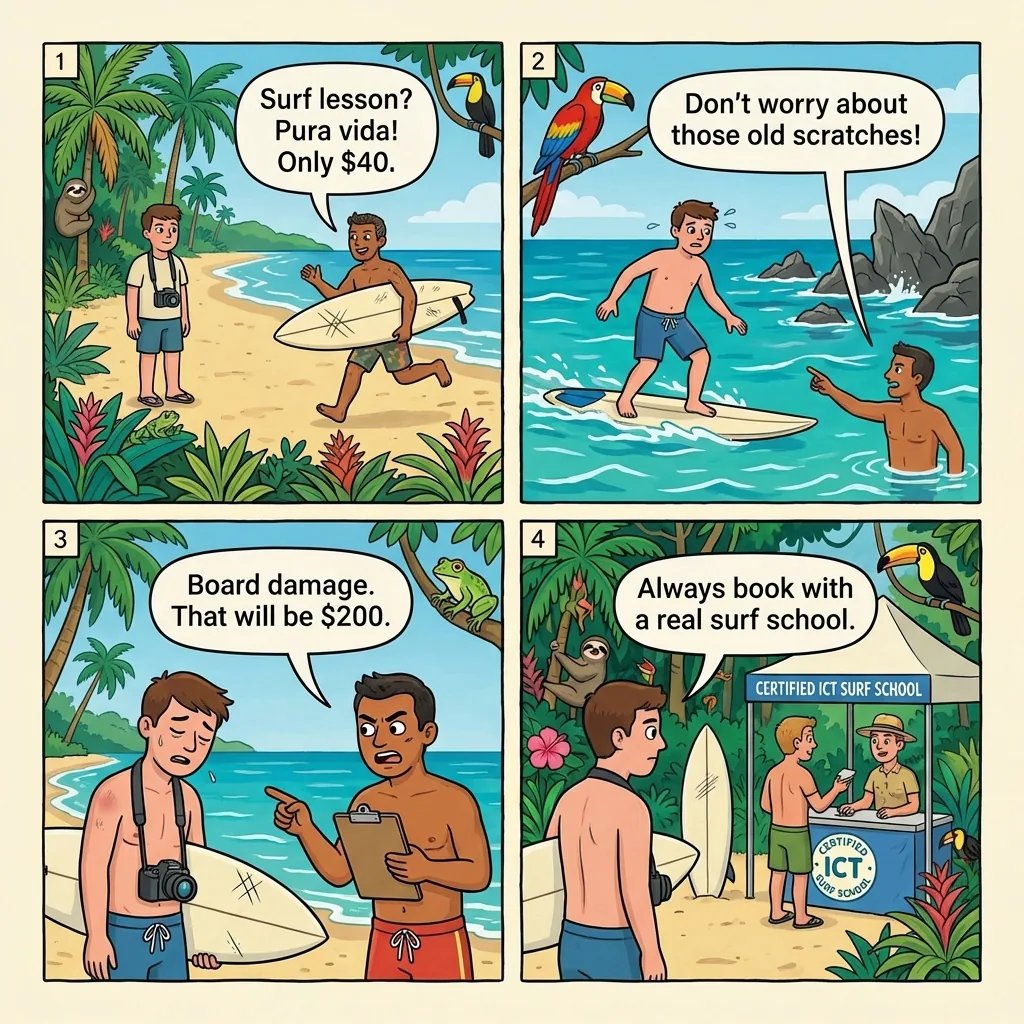
An unlicensed beach-hustler with one board offers a $40 surf lesson on Playa Tamarindo, sends you onto the Langosta rocks with a pre-scratched board, then waves a clipboard "damage fee" at the end demanding $200 cash for scratches that were already there.
You're walking the sand in front of the Diria when a tanned guy with one longboard under his arm jogs over. "Lesson? $40, two hours, I'll take care of you, beginner waves." There is no branded rashguard, no shop-front, no clipboard with a price list — just him, the board, and a confident pitch. The Tico Times has reported on more than fifty unauthorized foreign "instructors" working the Tamarindo beach this way, and the local ICT-certified cooperative openly calls them a scam. The river-mouth break right where you're standing is one of the most beginner-friendly waves in Costa Rica, which is exactly why the hustlers cluster here.
You hand over $40 in cash and he walks you to the board. There are scratches up and down both rails and across the fins. "Just the coating, don't worry, no need to write it down." For ninety minutes he paddles you out, but instead of the soft river-mouth sandbar he steers you down toward the Langosta rocks where the wave is harder and the bottom is sharp. You stand up twice, eat reef once, and crawl back to the beach with a small cut on your shin. He meets you with a clipboard you haven't seen before. "Board damage — $200. Scratches all along the rail." When you point out the scratches were already there, he taps the clipboard. "No paper, no proof. Pay or I keep your driver's license." Documented across the TripAdvisor "Beware predatory surf instructor William" and "Walter Surf Shop" threads, the move is the same every time.
A legitimate Tamarindo lesson runs $54–$85 per person at Iguana Surf, Kelly's Surf Shop, or Witch's Rock Surf Camp at Langosta — and that price includes board, rashguard, and INS insurance, with a written rental form that documents pre-existing damage before you paddle out. Verify the instructor's ICT carnet at visitcostarica.com, and pay by Visa or Mastercard so you have a chargeback path if a "damage fee" surfaces. Anyone selling lessons on the open beach with one board, no shirt, and no paperwork is the version of this scam you read about. Before you paddle out, photograph every side of the rented board — top, bottom, both rails, nose, tail, fins — and text the timestamped photos to yourself, which kills the $200 damage-fee move on the spot.
Red Flags
- Instructor approaches you on the beach with one board and no branded shirt or shop front
- Refuses to write damage onto paper — 'it's just the coating, no need'
- Can't produce ICT-certified carnet or INS insurance policy
- $200+ 'board damage' fee surfaced ONLY after the lesson ends
- Instructor steers beginners into the rocks section at Langosta rather than river-mouth
How to Avoid
- Book via ICT-licensed schools — Iguana Surf, Kelly's Surf Shop, Witch's Rock Surf Camp ($54–$85 pp).
- Ask to see ICT carnet + INS insurance BEFORE paying; verify at visitcostarica.com.
- Photograph all sides of the board + text photos to yourself with timestamp before paddling.
- Pay by credit card (Visa/Mastercard) — cash has no recourse after a $200 'damage' invoice.
- Escalations: Tamarindo Fuerza Pública 2653-0283; tourist police 24/7 line 2511-9260.
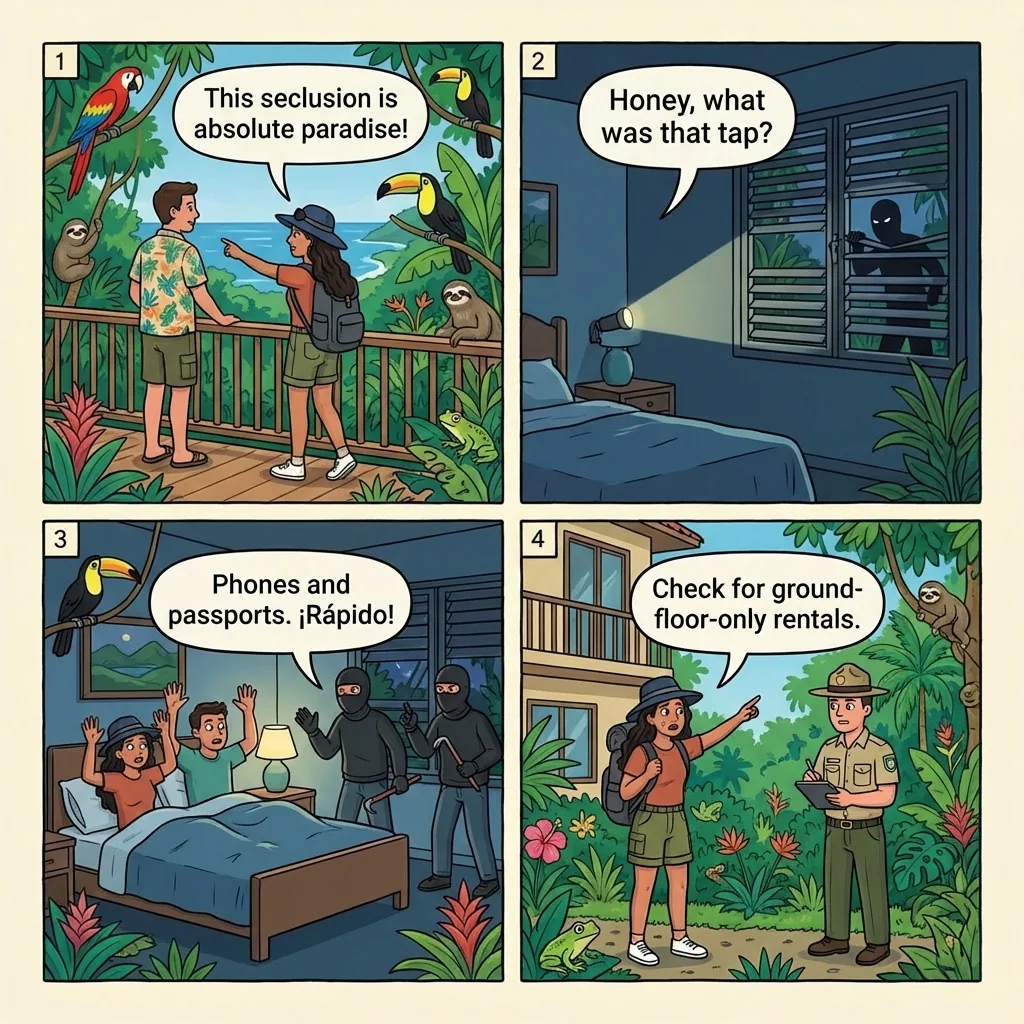
A 4–6-man gang scouts isolated Tamarindo Airbnbs in Los Jobos, Playa Negra, and Playa Langosta off public booking calendars, then breaches a second-floor window between 9 PM and 2 AM — the July 2025 Christopher Deir murder in Los Jobos and the US Embassy's November 25, 2025 Security Alert anchor the pattern.
You book a beachfront villa in Los Jobos or south of Tamarindo at Playa Negra because the photos are gorgeous and the price beats the Diria. The host's calendar on Airbnb or VRBO shows your arrival date and check-out — public information that scouts read like a flight manifest. The villa sits 200 meters off the main road behind palms, no neighbors close enough to hear, and the listing description honestly notes there's no on-site security because it's "tucked away from everything." On arrival you walk the property, note the second-floor windows are louvered glass with no bars, and tell yourself it'll be fine.
Around 11 PM you hear a tap at the louver upstairs. Then flashlight beams crossing the bedroom wall. Four to six men with guns are inside the house before you can stand up. The Costa Rica Embassy in San José issued a Security Alert on November 25, 2025 specifically because this scenario has escalated across Tamarindo-area vacation rentals: armed robberies targeting foreign tourists, multi-man crews, second-floor entry between 9 PM and 2 AM. On July 11, 2025, 40-year-old Canadian Christopher Deir was fatally shot at his Los Jobos rental when his partner's screams drew him into the hallway where the intruders were waiting. A separate Playa Negra VRBO invasion that April involved a 5–6 flashlight crew that breached a second-floor gate the husband had locked; Vrbo's response told the family to "work it out with the property owner."
The fix is the booking choice, not the lock count. The 24/7 guarded gated communities — Hacienda Pinilla, Reserva Conchal, Langosta Beach Club — and the armed-guard hotels — Tamarindo Diria, Witch's Rock Surf Camp — are not on the documented invasion list because the perimeter is patrolled. Before paying, message the host in writing and ask four questions: 24/7 armed guard? CCTV? Panic button? Patrol logs? Anything less than "yes" to all four belongs in the same category as the Los Jobos villas. Never post arrival dates to social media, ask your host to calendar-block two days either side of your stay, and program 911, OIJ at 800-8000-645, and the US Embassy at 2519-2000 into speed dial on landing. If a crew breaches the property, hide, call 911, and do not resist — OIJ casework confirms that resistance correlates directly with being shot.
Red Flags
- Airbnb calendar visibly showing your arrival date with no booking buffer — scouts read it
- Isolated beachfront villa with no 24/7 armed guard (Los Jobos, Langosta-beach, Playa Negra)
- Host dodges 'is there an armed guard and panic button' question in writing
- Weak second-floor window/gate hardware — typical entry point in the Tamarindo pattern
- Repeated flashlights at night at the property perimeter (5–6 is the documented crew size)
How to Avoid
- Stay inside 24/7 guarded gated communities (Hacienda Pinilla, Reserva Conchal) or guarded hotels.
- Message host IN WRITING: 24/7 guard? Panic button? Patrol logs? 'Yes' to all three or skip.
- Don't post arrival dates to social media; ask host to calendar-block two days either side.
- Program 911, OIJ 800-8000-645, US Embassy San José 2519-2000 into speed dial on arrival.
- If invaded: hide, call 911, do NOT resist; file at Tamarindo Fuerza Pública within 24h.
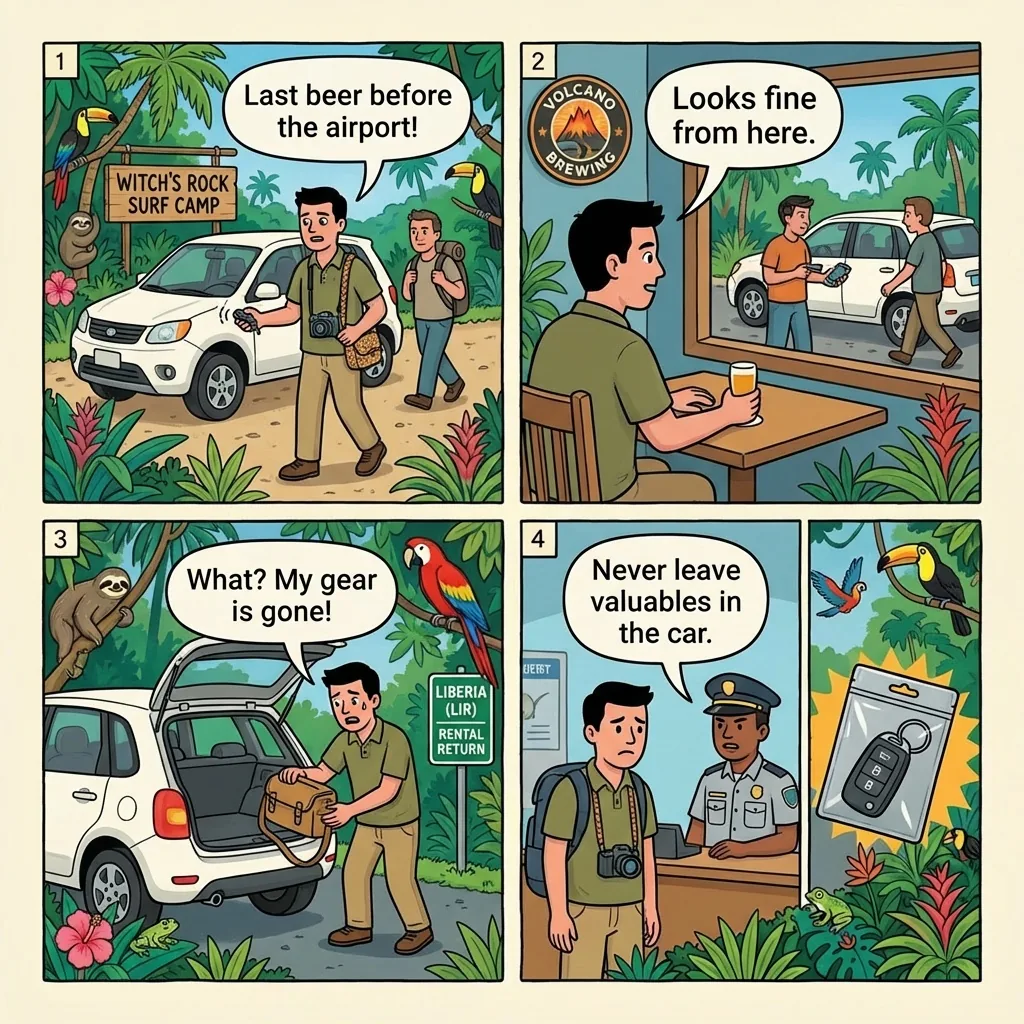
A thief with a key-fob signal amplifier walks past your table at Volcano Brewing or Witch's Rock to capture your rental's key code, relays it to an accomplice at the car who opens it silently — twenty minutes later the cabin is emptied, locked, and looks untouched until you reach for your camera bag.
You park your rental car on Calle Central about 150 feet from your lunch table at Volcano Brewing or Witch's Rock Surf Camp, click the fob, hear the chirp, walk into the restaurant. The car is fully loaded — flight is at 6 PM, you've checked out of the villa, and the camera bag with two pro bodies and three lenses is in the back seat under a jacket. The fob is in your pocket. Through the window from your table you can see the rental's roof, and from where you sit it looks fine the entire meal.
Twenty minutes later you walk out, click unlock, drive to the airport. At LIR the camera bag feels light. You unzip it on the bench: empty. Not slashed, not dumped — emptied and re-zipped. The laptop sleeve is gone, the headphones are gone, and the AirTag tracker that was clipped inside is also gone. A staff member at Volcano Brewing told one traveler the same thing the Fuerza Pública said when they filed: relay theft. A man with a signal amplifier walked within ten meters of your table during lunch, captured the key-fob's rolling code, and relayed it to a partner standing next to your car who opened it without tripping the alarm. The lower-tech smash-and-grab cousin runs the same blocks — gas station stops, two-minute coffee runs, surf sessions where the fob sits in a daypack — and the watchman crew and the relay crew often share territory along Calle Central.
The cure starts before the trip. A $10 Faraday key-fob pouch on Amazon blocks the relay signal entirely; drop the fob inside the moment you sit down at any restaurant on the strip. Use the physical-button unlock on the door rather than proximity unlock so the radio handshake never starts, and prefer the staffed lots — Plaza Tamarindo underground at $5, Cala Luna behind the Diria, the Calle Central Main Lot — over the unpaved shoulder pullouts where the relay crews work fastest. Anything you cannot afford to lose belongs in the villa safe, not the trunk and not "hidden under the seat." A surf-day daypack with passport, phone, and cash inside a dry bag rides into the water with you. If you are hit, file with OIJ at 800-8000-645 and the Tamarindo Fuerza Pública within twenty-four hours, because Amex Platinum, Chase Sapphire Reserve, and Capital One Venture X all require a filed police report to cover rental-car theft. Drop your key fob into a Faraday pouch the moment you sit down at any Calle Central restaurant — it kills the relay attack at the source.
Red Flags
- Nobody visibly nearby when you park on a busy strip — a car is always being watched
- A second person lingering in the restaurant foyer near where you sat with your key fob
- Tile/AirTag tracker disappears from your bag after a lunch — relay-thief signature
- Your rental car has keyless-entry proximity unlock (the only kind vulnerable to relay)
- Bags inside the car moved, re-zipped, or 'neat' after a break-in — pros, not opportunists
How to Avoid
- Don't leave valuables in the car — hotel safe only; treat every parking spot as compromised.
- Use a Faraday key-fob pouch ($10) + physical-button unlock instead of proximity unlock.
- Park in staffed paid lots (Plaza Tamarindo, Cala Luna, Diria) not main-strip shoulder pullouts.
- Waterproof dry-bag in the water with passport/phone/cash every surf; daypack into restaurants.
- If hit: file OIJ 800-8000-645 + Fuerza Pública within 24h for Amex/Chase/CapOne insurance.
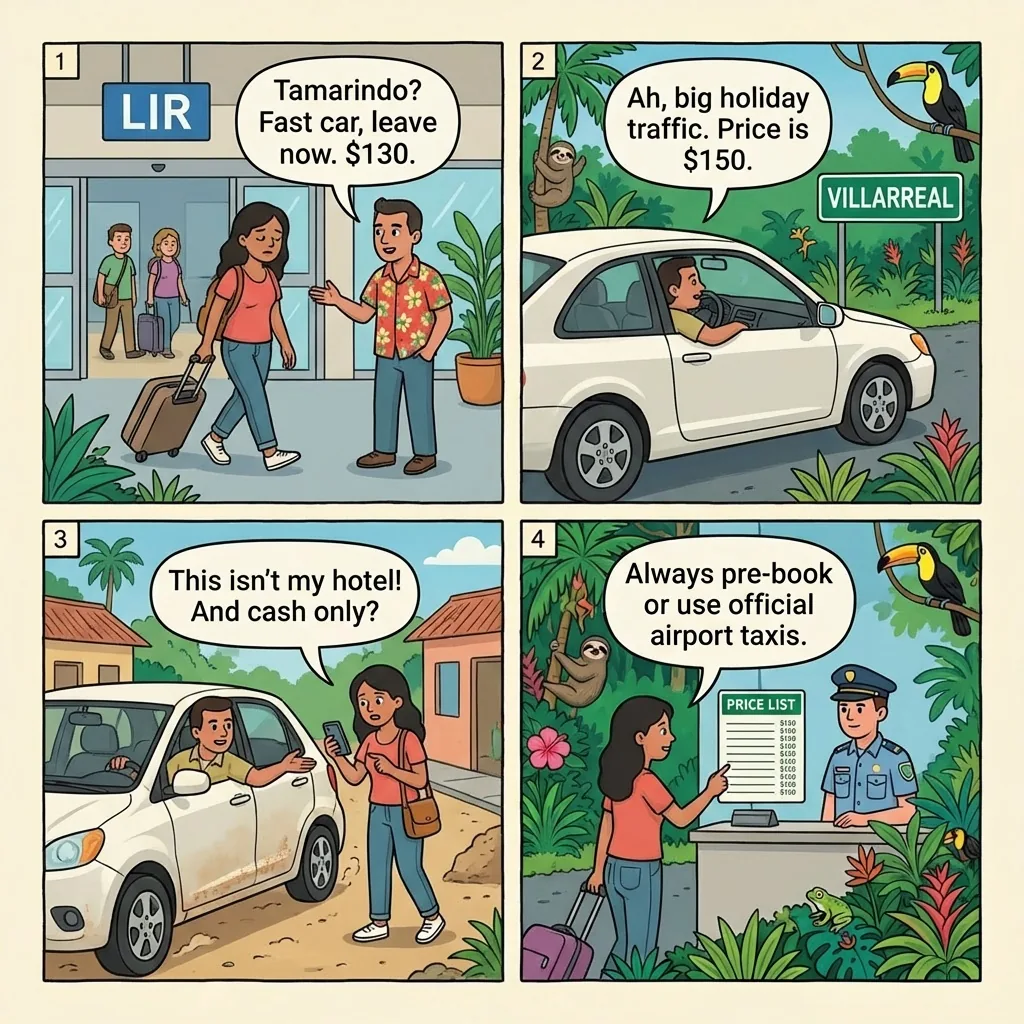
A white unmarked car at the LIR arrivals curb quotes $100–$150 for the Tamarindo run that legitimate orange airport taxis cap at $77 — and the in-town red taxis pull the same trick with a "broken meter" the moment you say "maría por favor."
You walk out of LIR (Liberia / Daniel Oduber) arrivals with luggage and a long flight behind you. A man in a Hawaiian shirt steps off the curb the second you clear the doors. "Tamarindo? I take you, $130, leave now, beat the rush." His car is unmarked, white, parked just past the official taxi rank. The legitimate fare for a private LIR-to-Tamarindo transfer is $120–$135 for one to four passengers through Interbus, Tamarindo Transfers, RideCR, or Easy Ride; the legitimate shared shuttle is $29–$45 per person pre-booked; the MOPT-published cap on the orange airport taxi is ₡40,000 (around $77). The pirate-taxi quote sounds in range, but the car is illegal — and the meter, when you ask, will be "broken" by the time you reach the Villarreal turnoff.
Halfway to Tamarindo the driver says he'll need cash on arrival, no card, and the price is now $150 because of "the rush" or "the new toll" or "the holiday surcharge." He drops you in front of the wrong hotel, three blocks from your booking, and refuses to move until you pay. The same script runs in town: a red taxi off the Plaza Conchal stand quotes ₡15,000 for a ₡5,000 hop to Langosta, and when you say "maría por favor" — the standard request that puts the meter on — the driver shrugs that the meter is broken. The hostel-and-beach-bar "friend with a van" cousin runs through hostel front desks taking commissions on referrals, and traveler reports across the Costa Rica forums describe the same outcome: old beat-up cars missing the official logo, long routes, and at worst a robbery on a remote stretch.
Pre-book the LIR run before you land through Interbus.com, Gray Line, Tamarindo Transfers, or Easy Ride and save the confirmation email with the driver's name and the vehicle plate; at arrivals, walk straight past the curb freelancers and look for the named sign your driver is holding. In town, Uber and DiDi cover most hops at ₡2,000–₡5,000, and RideCR runs a pro service that beats every red-taxi quote you'll see on Calle Central. With a red taxi, "maría por favor" before the wheels move is the test — a "broken" meter means you get out and take the next one, every time. Hostel "cousin with a van" referrals are the version of this scam you only hear about after, so book direct or stick to the licensed companies. If a curb-side car at LIR quotes more than $135 private or $45 shared for Tamarindo, walk away and call your pre-booked driver — the legitimate fare cap is ₡40,000 (around $77) on the orange MOPT taxi.
Red Flags
- White unmarked car at LIR arrivals curb quoting $100–$150 for Tamarindo (real private = $120)
- 'Broken meter' on a red taxi the moment you say 'maría por favor'
- Driver ends ride in Uber app at a location other than your actual drop-off (surge gouge)
- Hostel front desk pushing a 'cousin with a van' who won't show insurance or company tag
- No receipt, no company name, cash-only demand at drop-off — ends with $80+ bill
How to Avoid
- Pre-book via Interbus, Gray Line, Tamarindo Transfers, Easy Ride — $29–$45 shared / $120–$135 private.
- At LIR arrivals walk past 'taxi taxi' freelancers to your named-sign driver only.
- In town use Uber or DiDi (₡2,000–₡5,000 per hop) or RideCR pro service.
- Red taxis: say 'maría por favor' before moving; broken meter = get out; MOPT LIR→Tamarindo $85–$95.
- File complaints at ctp.go.cr/inconformidades or dial 911 / tourist police 2511-9260.
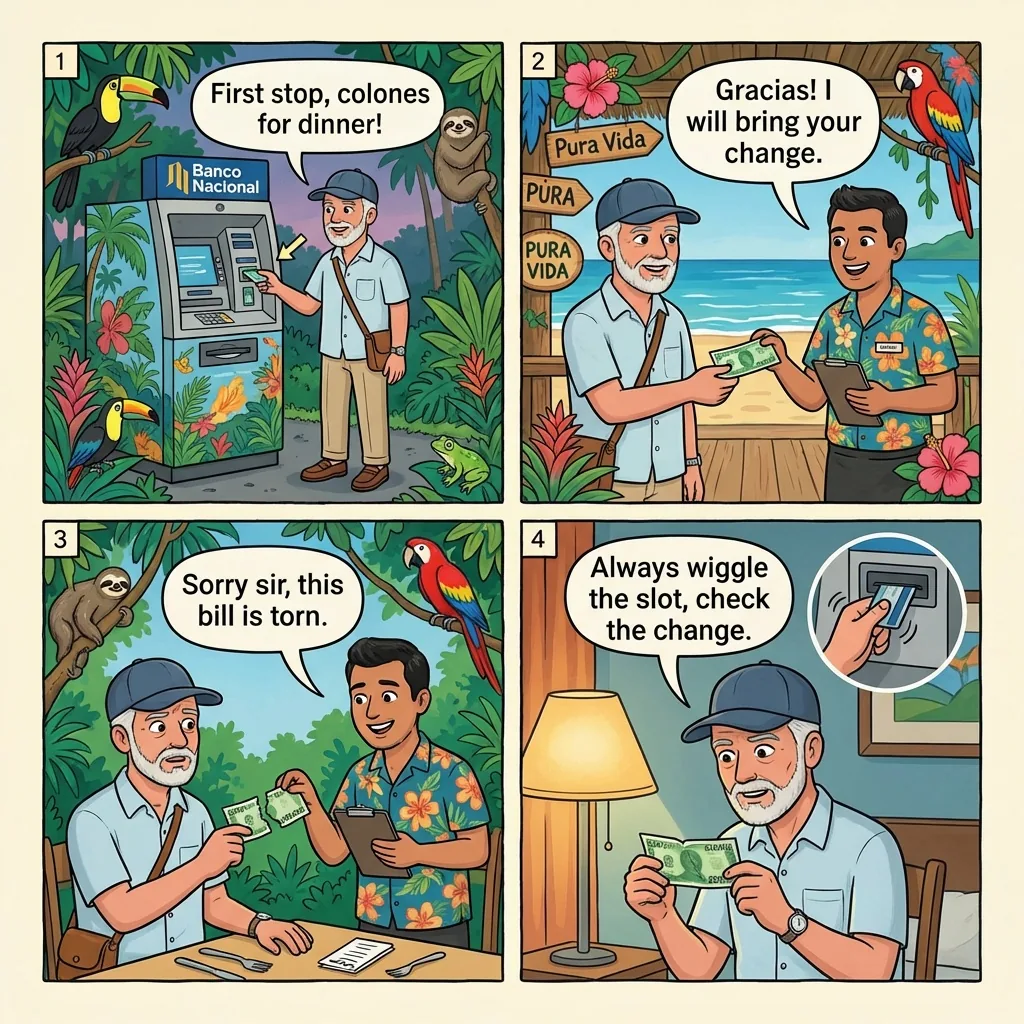
A skimmer overlay on the curb-side Banco Nacional or BAC Credomatic ATM at Plaza Tamarindo clones your card and PIN, and a parallel waiter-and-driver bill-swap returns your real ₡20,000 colón note as a torn counterfeit when the change comes back.
You roll into Tamarindo and head straight for cash. The Banco Nacional standalone unit at Plaza Tamarindo or the BAC Credomatic at Plaza Conchal sits curb-side, and at sundown there's nobody around. The card slot has a slightly bulky molded plastic overlay that looks slightly wrong if you stare, but you don't stare — you slide the card, punch the PIN, take ₡100,000 in colones, and walk to dinner. What just happened is on the boring side of well-documented: the overlay is a skimmer, the slot above the keypad has a pinhole camera reading your PIN, and your card data is on a Telegram channel for sale within the hour.
The other half of the scam runs on the cash you just pulled. At a Calle Central beach restaurant you pay a $74 dinner with a clean post-2013 US $100 bill or a real ₡20,000 colón note. The waiter takes it back to the till, returns four minutes later, and says the bill was torn or marked at the corner. He hands you back what looks like the same note, except now the corner is genuinely ripped and the paper feels plastic-smooth. The Costa Rican counterfeit version of the ₡20,000 misses the Carlos Luis Fallas Sibaja watermark and the color-shifting thread — but you put it in your wallet without checking, and you give it as change to a beach vendor the next morning who waves it back and refuses. The same swap runs in red taxis with "pay in colones, your bill's torn" as the trigger phrase, and at the Plaza Conchal ATM cluster the "ATM ate my card" retention-bracket variant adds a helpful stranger who memorizes your PIN re-entry while pretending to help you.
Withdraw cash only inside a bank branch during business hours — Scotiabank, BAC Credomatic, BCR, or Banco Nacional lobby — because branch ATMs have guards and tamper-checked card slots that the curb units don't. Always pick the colones option, not the USD option, since the on-machine dynamic-currency-conversion runs 5–9% worse than your home-bank rate; the legal foreign-withdrawal cap is ₡400,000 per day (around $770). Pull ₡10,000 and ₡20,000 notes for daily spend so you remove the USD-swap exposure entirely, and pay restaurants and hotels with a no-FTF credit card like Capital One Venture, Chase Sapphire Reserve, or Amex Platinum where the chargeback path exists. Inspect every ₡20,000 note handed back as change for the Carlos Luis Fallas Sibaja watermark and color-shifting thread before it goes in your wallet — counterfeits feel plastic-smooth and the catch happens before the swap, not after.
Red Flags
- Standalone curb-side ATM with a bulky card-reader overlay or wobbly keypad
- ATM 'eats' your card and a helpful stranger tells you to re-enter your PIN
- Restaurant/taxi hands back a ₡10,000 or ₡20,000 that feels plastic-smooth (missing watermark)
- Waiter claims your $100 bill is 'torn' and asks for a replacement — check your original bill back
- ATM offers DCC 'pay in USD' with a rate visibly worse than xe.com — decline (always pick colones)
How to Avoid
- Use ATMs INSIDE bank branches during business hours (Scotiabank, BAC, BCR) — avoid curb units.
- Always withdraw colones not USD — decline DCC; saves 5–9% on every pull.
- Inspect every ₡20,000 note for Carlos Luis Fallas watermark + color-shift thread.
- Bring only pristine post-2013 USD bills; carry a credit card (Capital One, Chase, Amex) for restaurants.
- If skimmed: call bank within 30 min, file at Tamarindo Fuerza Pública + OIJ 800-8000-645.
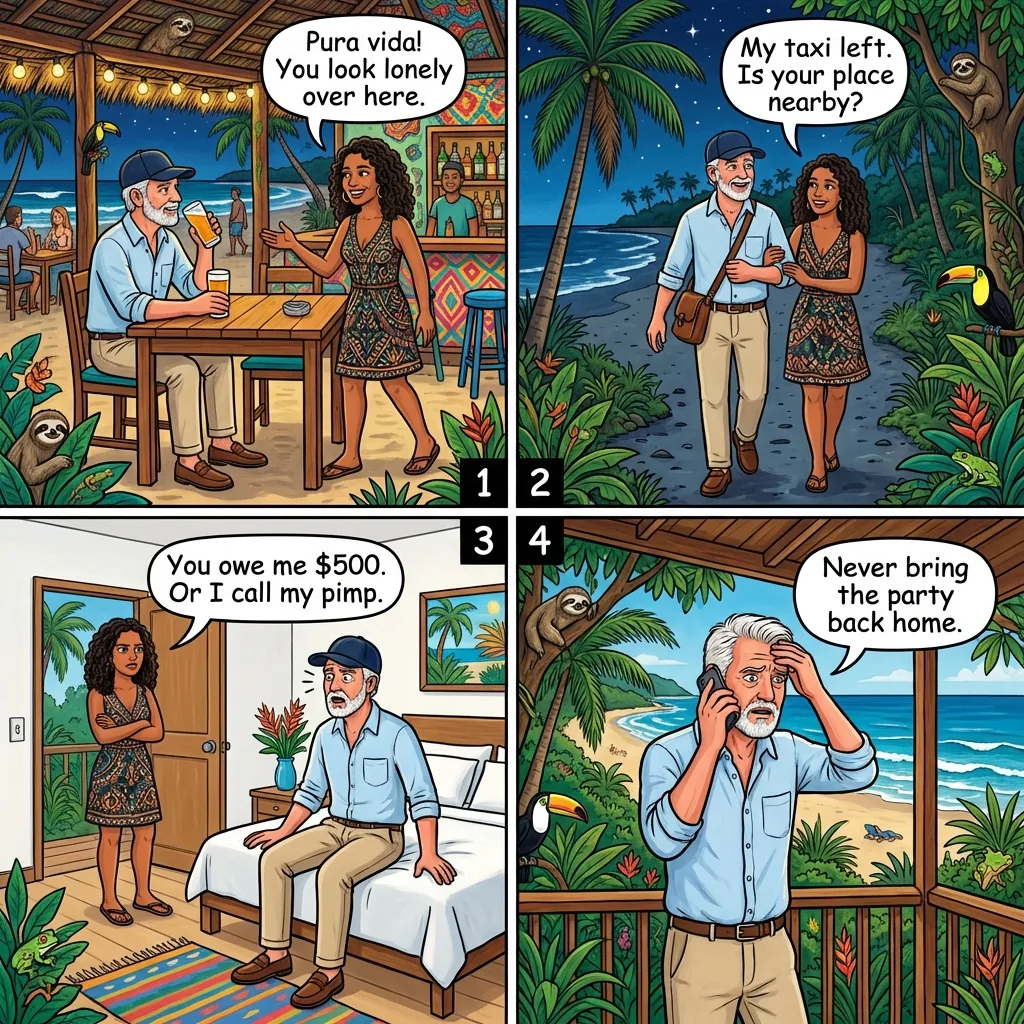
A bartender or dancer in the Monkey Bar district pivots a friendly conversation into "I need somewhere to stay" — the next morning at your Airbnb she demands $500 and threatens to call her pimp; at the Tamarindo Diria casino, drinks get spiked and the ATM walk ends with a clean pickpocket before you reach the lobby.
It's 1 AM in the Crazy Monkey or Sharky's strip and the woman who's been chatting to you for an hour smiles and says her ride bailed and she lives an hour away. She doesn't ask for money. She suggests sharing your Airbnb. The drinks have been flowing, and Costa Rica is supposed to be the easygoing place — so you walk her down the unlit beach path toward Langosta. Drink-spiking with scopolamine ("burundanga"), ketamine, or benzodiazepines is documented across the New Zealand MFAT and Australian Smartraveller advisories for Costa Rica, and the Monkey Bar to Langosta beach corridor at night is a documented mugging stretch. Either threat is live before you reach the front door.
In the morning the script flips. She demands $500 cash before she'll leave the rental, and when you say no she says her boyfriend or her pimp will come by. A Costa Rica condo developer told one traveler the building manager's standing advice in this situation is to pay because the boyfriend retaliation is real, and the same script runs in Jacó so consistently that locals on the Costa Rica forums name Tamarindo and Jacó in the same paragraph. The Tamarindo Diria casino has its own version: free drinks while you play, a quiet pickpocket on the walk between the table and the ATM, and a roofied glass that lands you in the hotel hallway with chips, wallet, and phone gone. Prostitution between consenting adults over 18 is legal in Costa Rica; the pimp-backed "pay or my boyfriend comes for you" extortion is not, and 911 plus the US Embassy at 2519-2000 will route a complaint to the OIJ.
Buy your own drinks at the bar and watch the bartender pour them; if you ever feel uncertain, Nightcap and SipChip test strips on Amazon run about $12 and read in under a minute. Anyone who pivots to "I need somewhere to stay" gets booked an Uber home on your phone instead of a ride to your rental — the move costs eight dollars and breaks the entire script. Costa Rican hotels are required by law to record cédula (national ID) for every overnight guest, so a partner who won't show ID is the same red flag as a missing wedding ring. At the Diria casino, only cash the chip count you're willing to lose, never walk to a street ATM drunk, and use the in-hotel ATM under camera if you must pull more. The beach path between Monkey Bar and Langosta after dark is the documented mugging corridor — take an Uber or walk the lit main road. If a stranger pressures you for $500 the morning after with a pimp threat, refuse, pack your things, and call 911 — the threat is almost always a bluff, and the Tamarindo Fuerza Pública takes drink-spiking reports within the six-hour toxicology window.
Red Flags
- Stranger buying you a drink already poured at the bar — decline, only watch yours poured
- Bartender or dancer pushing to come home 'because she lives an hour away'
- Guest refuses to show cédula at hotel check-in (Costa Rica law requires it)
- Morning demand for $500 with a 'pimp threat' coda — textbook extortion script
- Unlit beach path back to Airbnb late at night — documented mugging corridor Langosta
How to Avoid
- Buy and watch your own drinks; carry Nightcap/SipChip test strips if uncertain.
- Anyone asking to stay the night — Uber them home; decline and still enjoy the date earlier next day.
- Demand cédula at any hotel check-in; a refusal = leave; Costa Rican law requires it.
- If extorted for $500: refuse, pack, call 911 + US Embassy 2519-2000 — don't pay.
- Drink-spiking: file at Fuerza Pública within 6h for toxicology + OIJ + travel-insurance claim.
🆘 What to Do If You Get Scammed
📋 File a Police Report
Go to the nearest Fuerza Pública / OIJ (Organismo de Investigación Judicial) station. Call 911 (general) or 800-8000-645 (OIJ tip line). Get an official crime report — you'll need this for insurance claims. You can also report online at poder-judicial.go.cr.
💳 Cancel Your Cards
Call your bank immediately. Most have 24/7 numbers on the back of the card (keep a photo saved separately). Block any suspicious transactions before the thieves use your details.
🛂 Lost Passport?
Contact the US Embassy in San José at Calle 98 Vía 104, Pavas, San José. For emergencies: +506 2519-2000 (after hours +506 2220-3127). Policía Turística (Tourist Police) hotline: 2258-1008 / 2258-1022. ICT tourist info: 2286-1473 / 1-800-TOURISM.
📱 Track Your Device
If your phone was stolen, use Find My (iPhone) or Find My Device (Android) from another device. Don't confront thieves yourself — share the location with police instead.
Frequently Asked Questions
You just read 7 scams in Tamarindo. The book has 62 more across 11 Costa Rican destinations.
Manuel Antonio “park closed” fake-ranger $40 access-fee shakedowns. SJO airport taxi-meter overcharges. La Fortuna ATV / hot-springs bait-and-switch combos. Tamarindo 90-minute timeshare traps. Tortuguero turtle-tour “guide” demands. Every documented Costa Rica scam — with the exact scripts, red flags, and Costa Rican Spanish phrases that shut each one down. Drawn from Reddit, U.S. Embassy alerts, and OIJ (Organismo de Investigación Judicial) police reports.
- 69 documented scams across San José, Manuel Antonio, La Fortuna, Tamarindo & 7 more destinations
- A Costa Rican Spanish exit-phrase card you can screenshot to your phone
- Updated annually — buy once, re-download future editions free
- Readable in one flight — $4.99 on Amazon Kindle