
Key Takeaways
- The #1 reported scam is the El Zaino "Park Closed Today" Redirect Scam
- 2 of 5 scams are rated high risk
- Use app-based ride services (Uber, DiDi) instead of street taxis — avoid unmarked vehicles, especially at night
- Never accept unsolicited offers from strangers near tourist sites in Tayrona
⚡ Quick Safety Tips
- Buy the Tayrona park ticket only at the official El Zaino or Calabazo gate booth at the posted ~86,500 COP (~$22) high-season foreign rate — touts at the gate falsely claiming 'park closed' redirect tourists to fake private paths
- Take the morning Cabo San Juan-to-El Zaino lancha at the posted 35,000–45,000 COP (~$10) rate — afternoon-return tickets jump to 80,000+ COP once you are stranded at the beach
- Bring water, snacks, and small-denomination bills inside the park — kiosks at Cabo San Juan charge 8,000 COP per water bottle and refuse change on 50,000 or 100,000 COP notes
- Sleep only in the official Cabo San Juan hammock zones (25,000–35,000 COP) and keep your phone, cash, and passport in a waterproof body pouch overnight — informal lockers behind the kitchen are not actually secured
Jump to a Scam
The 5 Scams
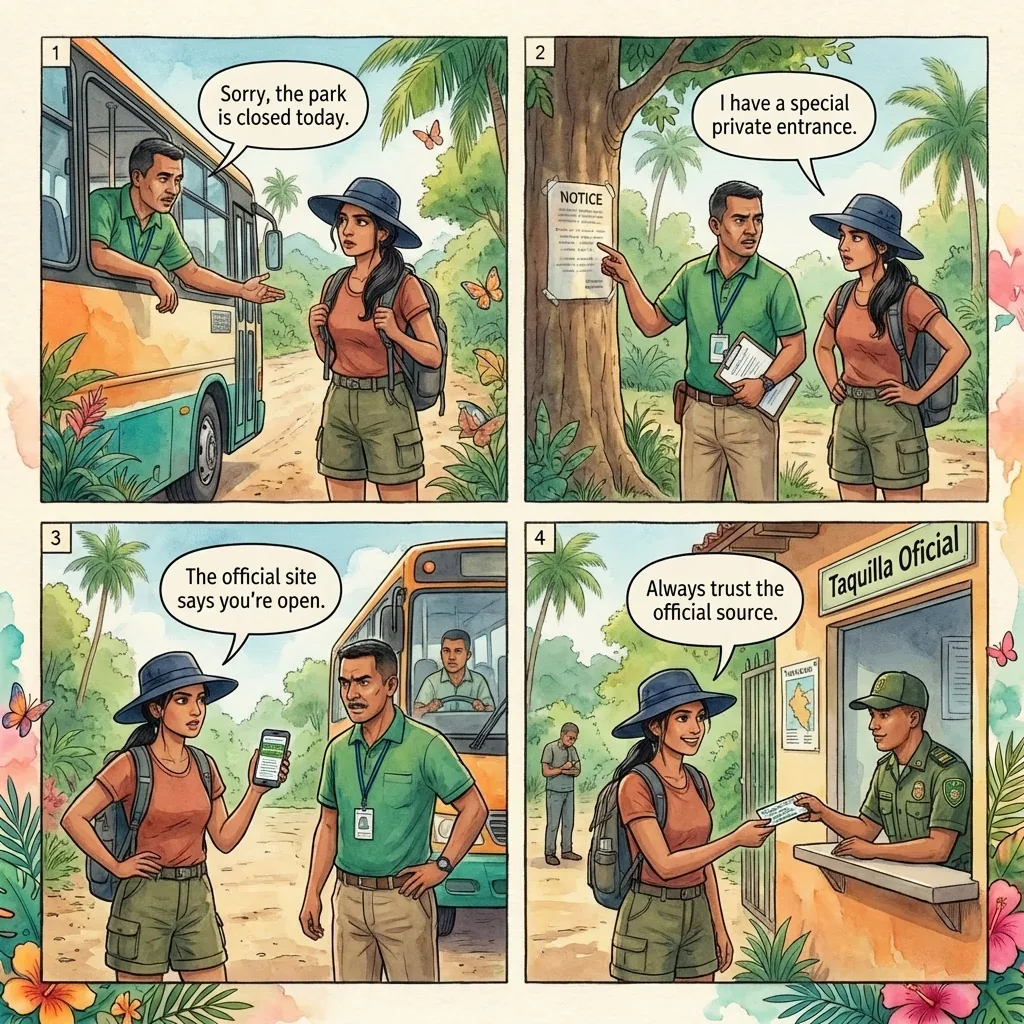
A man in a green polo waves your bus down 200 m short of the El Zaino gate, leans into the window, and tells you Parque Nacional Natural Tayrona is closed today.
The Mercado Público bus from Santa Marta drops you at the El Zaino entrance to Parque Tayrona around 8:15 AM after an hour bumping along the Troncal del Caribe. You're 200 meters short of the official Centro de Visitantes window when the driver eases off the throttle and a man in a green polo steps out into the road, hand raised, palm flat. He has the bored body language of an off-duty park ranger, a clipboard tucked under one arm, a lanyard around his neck with no visible logo on it. He leans into the open bus window and tells the driver — loud enough for the front rows of passengers to hear — that Parque Tayrona is closed today. There is a printed sheet taped to a tree behind him; he gestures vaguely toward it without elaborating.
The closure story is landslide, ecological-restoration day, or indigenous ceremony — but he can take you in by a private path for 150,000 COP (~$38) per person, cash only, leaving in five minutes. The gate is not closed. He has a clipboard, a lanyard with no logo, and a tone of weary helpfulness that maps onto every park ranger you've ever spoken to. When you ask to see the closure notice he points vaguely toward a printed sheet taped to a tree. The bus driver, who has done this route for years, doesn't visibly contradict him — confrontations cost drivers customers. You pay the cash, follow the man down a goat track behind a kiosk, and end up either at a private finca with a 50,000 COP "entrance," or just at the public Cabo San Juan trail you would have walked anyway.
The official entry fee is 64,000–86,500 COP (~$16–$22) depending on season and nationality, payable only at the Centro de Visitantes window inside the El Zaino gate or at Calabazo. Hoy Diario del Magdalena's October 2025 piece on the suplantación-de-agencias problem in Santa Marta cites the licensed-guide federation Fedeguías warning travelers to refuse roadside sellers and ask the Policía de Turismo for help. Real closures of Tayrona are announced weeks in advance on parquesnacionales.gov.co, not by a man in the road.
The psychological hook is the bus stop's powerlessness. You're 4 km from the nearest taxi rank, you've already spent four hours on the highway from Santa Marta, and the man's offer is the only "yes" in front of you. Reddit threads on Reddit and Reddit from 2025 and 2026 document the same closure-claim play running across both El Zaino and the quieter Calabazo entrance. The defensive move is to walk the last 200 m to the official Centro de Visitantes window yourself — if the park is genuinely closed the staff will tell you there, and the rangers can call the Policía de Turismo or 123 (emergency) on your behalf.
Red Flags
- man in a green polo waving down buses or taxis 200 m before the official El Zaino gate
- claim that Tayrona is closed today for landslide, restoration, or indigenous ceremony with no official notice
- offer of a private path or alternate entrance for 100,000–200,000 COP cash only
- lanyard or clipboard with no Parques Nacionales logo and no Registro Nacional de Turismo number
- pressure to commit before the bus driver pulls away or before other arriving passengers see you
How to Avoid
- Walk the last 200 m to the official Centro de Visitantes window at El Zaino or Calabazo and check the closure status with park staff yourself.
- Pay only at the official ticket window — never to anyone in the road, in the parking lot, or at a roadside kiosk.
- Verify any closure on parquesnacionales.gov.co or by calling Parques Nacionales before leaving Santa Marta in the morning.
- Refuse every "private path" or "alternate entrance" offer regardless of the price quoted or how official the seller looks.
- Call 123 (emergency) or ask for the Policía de Turismo at the gate if you are physically blocked or pressured.
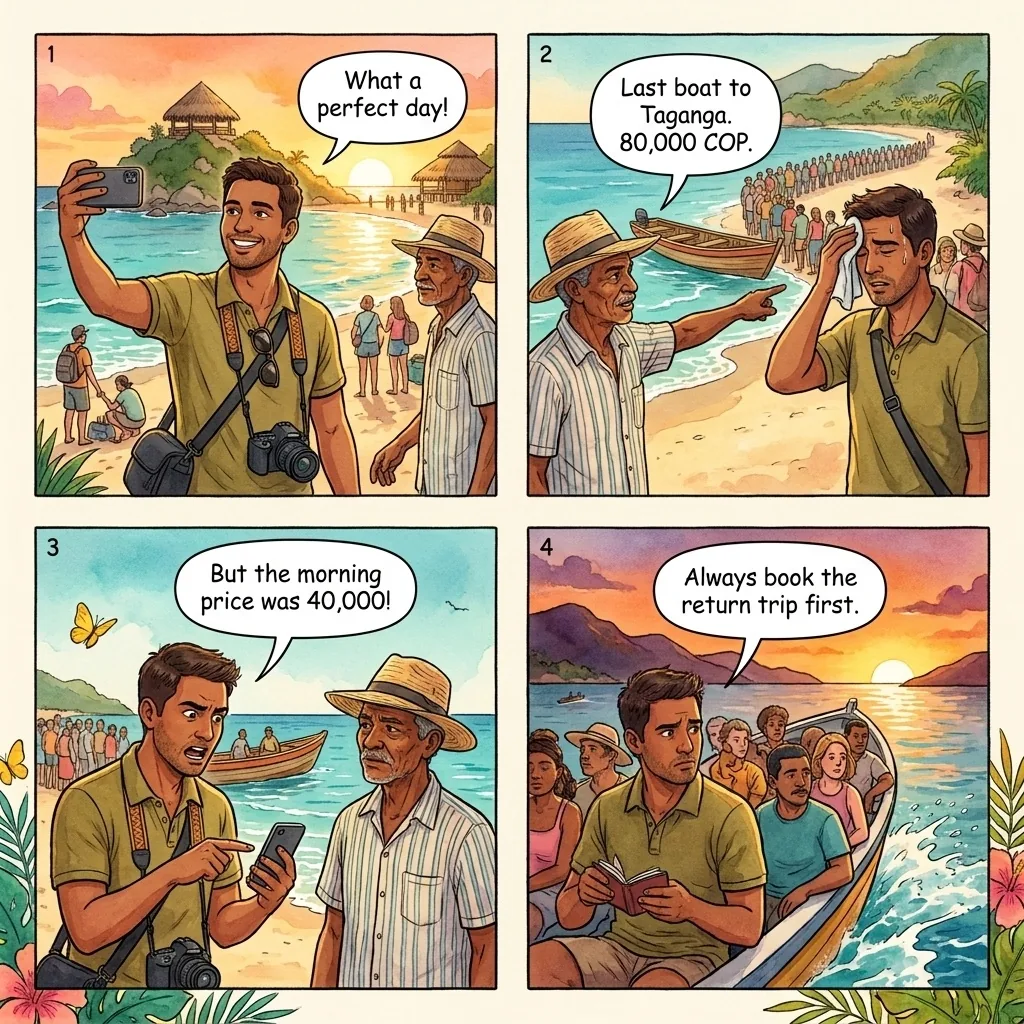
A boatman at Cabo San Juan tells the tired group on the sand that the last lancha to Taganga leaves in twenty minutes.
It's 3:45 PM and you're standing in damp board shorts on the white sand at Cabo San Juan, six hours into a day-trip you'd expected to wrap by 5. The sun is sinking faster than you remember it doing in the morning, the trail back to El Zaino is two and a half hours of jungle in the heat, and the small lancha tied at the end of the wooden pier is loading. A boatman in a faded soccer jersey stands on the sand, one foot on the bow, shouting prices at the cluster of day-trippers who've started to realize what time it is. "Última lancha — 80,000 pesos, cash only, forty seats — vamos." Behind him a smaller group has just paid him with what looks like a 100,000 peso note, and he's already turned to the next family in line.
The seat is 80,000 COP (~$20) per person, cash only — roughly double the morning rate of 35,000–45,000 COP that brought most of them out. The walk back to the El Zaino gate is two to three hours through the jungle in the heat. By 3 PM at Cabo San Juan, half the day-trippers have miscalculated and are now staring at a sunset deadline. The boatman knows the math better than they do. He runs a single fixed price, refuses to break it, and points at the loading queue: "Forty seats, you want one?" If a traveler tries to negotiate, he turns to the next family in line and the seat is gone in thirty seconds.
Morning lanchas from Taganga to Cabo San Juan run a published 35,000–50,000 COP per leg through licensed operators. Round-trip packages bought in Taganga in the morning often include the return for around 80,000 COP total. The afternoon Cabo-to-Taganga leg, sold individually on the beach with no posted rate, is the choke point. Reddit threads from 2024 and 2025 on Reddit and Reddit describe the round-trip-versus-walk-out math, with multiple posters warning future travelers to lock the return in the morning.
A second variant runs at the smaller Playa Cristal pickup on the park's western side. Boatmen quote a posted 40,000 COP fare to bring tourists in but raise it to 90,000 COP at pickup, claiming "high tide" or "extra passengers." The El Hoy Diario del Magdalena coverage of Tayrona-region tourism complaints — where families from Cúcuta paid 75,000 COP per person for promised tours and were left stranded near Playa Grande — anchors the pattern in T2 reporting. The defensive move is to buy a round-trip ticket from a licensed Taganga operator before you sail in the morning, get a paper or photo receipt, and treat any beach-side fare quoted in the afternoon as a pure overcharge.
Red Flags
- lancha operator at Cabo San Juan quoting 70,000–90,000 COP one-way with no posted price list
- afternoon-only fare that is double the published morning rate from Taganga
- "forty seats, last boat" pressure pushing a decision in under a minute
- no paper receipt and no operator name visible on the boat or vest
- tide or weight surcharge added at the dock that wasn't part of the quote
How to Avoid
- Buy a round-trip lancha ticket from a licensed Taganga operator in the morning and keep the paper or photo receipt.
- Confirm the published rate of 35,000–50,000 COP per leg with the operator before you leave the harbor.
- Plan to either return by boat by 3 PM or start the trail walk back to El Zaino by noon to avoid the captive-pricing window.
- Refuse any fare quoted at Cabo San Juan that is more than 50% above the morning rate from Taganga.
- Photograph the boat license plate and the operator's vest before paying, and report overcharges to the Policía de Turismo.
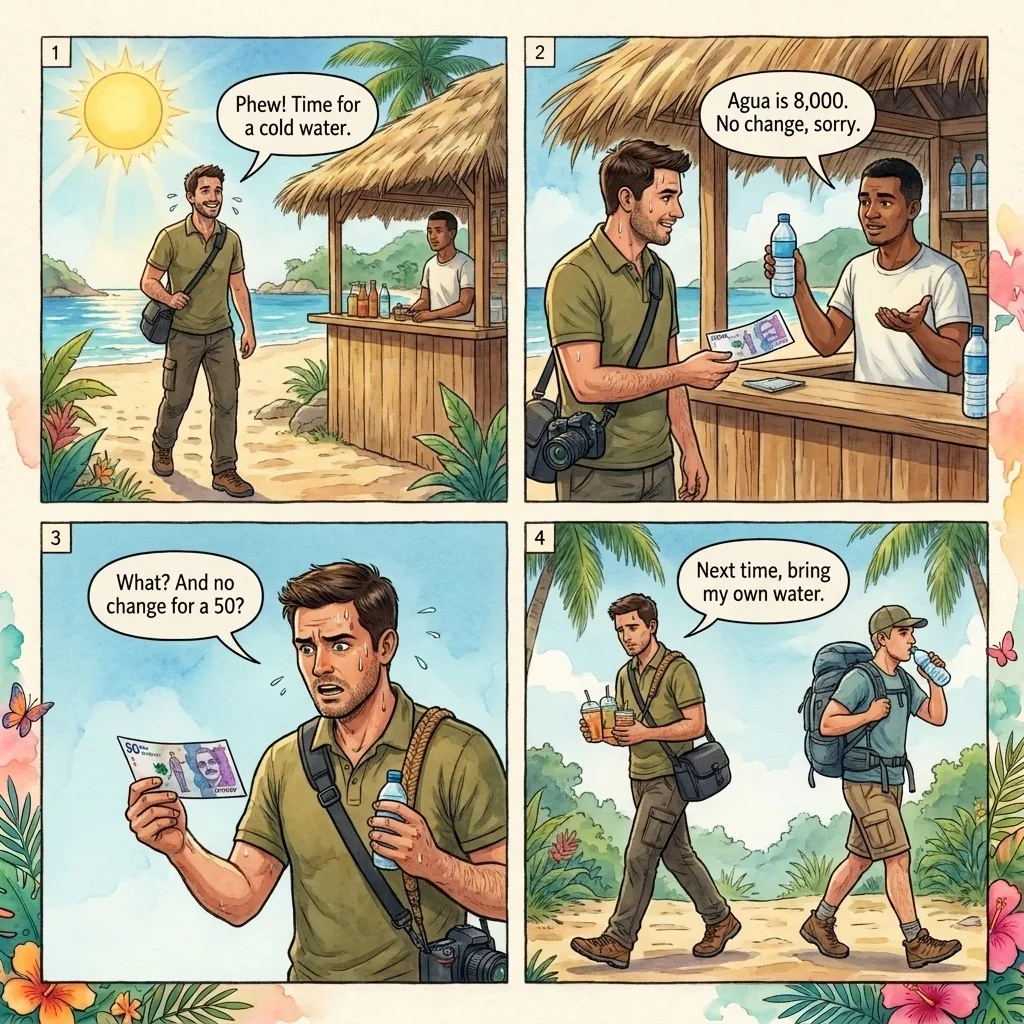
A 600 ml bottle of water at the Cabo San Juan kiosk costs 8,000 COP (~$2) — roughly five times the 1,500–2,000 COP it goes for at any tienda in Santa Marta.
By 1 PM you've been on the trail from El Zaino for two and a half hours and the heat is starting to win. The Cabo San Juan kiosk appears as a thatched roof through the palms, rough wooden tables in the sand and a chalkboard menu propped against a post. You set your daypack down and reach for your wallet. A Coca-Cola sign in the window reads 8,000 COP for a 600 ml bottle of water — five times what the same bottle costs at any tienda in Santa Marta. The closest alternative is a four-hour round-trip back to the gate. The fish-and-rice plate next to it is listed at 45,000 pesos, no posted price for the patacones the woman behind the counter is already adding to your tray. You hand her a 50,000 peso note and she shakes her head — "no tengo cambio."
The menu next to it tops out at 45,000 COP for fish and rice, with no posted price for soft drinks or snacks until you ask. The captive-market math is brutal. Once a hiker is two hours into the trail from El Zaino, walking back to find cheaper water means a four-hour round trip and likely missing the last boat. The kiosks charge what the situation will bear. Sodas run 6,000–10,000 COP, beers 15,000–20,000 COP, and a basic plate of fish, rice, and patacones lands at 35,000–55,000 COP — twice to three times what the same plate costs in Taganga. None of this is a scam in the criminal sense. The trap is arriving without enough water or cash and finding the prices are non-negotiable.
A secondary angle runs on the change. Vendors on the trail and at Arrecifes regularly claim to have no change for 50,000 or 100,000 COP notes — Colombia's two largest common bills — pushing tourists to round up to a full 50,000 COP for a 35,000 COP plate. Sometimes the vendor "goes to find change" and never returns. Reddit threads on Reddit and Reddit from 2025 on Tayrona logistics consistently warn future travelers to bring 4–6 liters of water per person and small bills.
The Hoy Diario del Magdalena coverage of Magdalena-region overcharging complaints — including the Superindustria's mobile consumer-protection units running through Santa Marta tourist zones — positions the in-park markup as part of a broader regional pattern. The prices themselves are legal as long as they're posted, but undisclosed surcharges and refusal-of-change tactics are not. The defensive move is to carry 4–6 liters of water, two days of small-bill cash (5,000s and 10,000s, never above 20,000), and a packed lunch from Santa Marta — the cheapest meal in the park is the one you brought with you.
Red Flags
- no posted price list on a kiosk menu or trail-side stall
- water bottle priced at 7,000–10,000 COP versus 1,500–2,000 COP outside the park
- vendor claiming no change for a 50,000 or 100,000 COP note
- added surcharge for ice, salt, or extra rice that wasn't mentioned at order
- "the price of the day" verbal quote that varies between adjacent tables
How to Avoid
- Carry 4 to 6 liters of water per person and a packed lunch in from Santa Marta or Taganga before you enter the park.
- Withdraw small-denomination bills (5,000 COP and 10,000 COP) at the BBVA or Bancolombia ATM in Santa Marta the night before.
- Ask the vendor to confirm the price out loud before you accept the plate, the drink, or the change-making transaction.
- Refuse any meal whose price is not posted on a printed menu or visible chalkboard at the kiosk.
- Photograph the menu and the receipt and report undisclosed surcharges to the Superintendencia de Industria y Comercio at sic.gov.co.
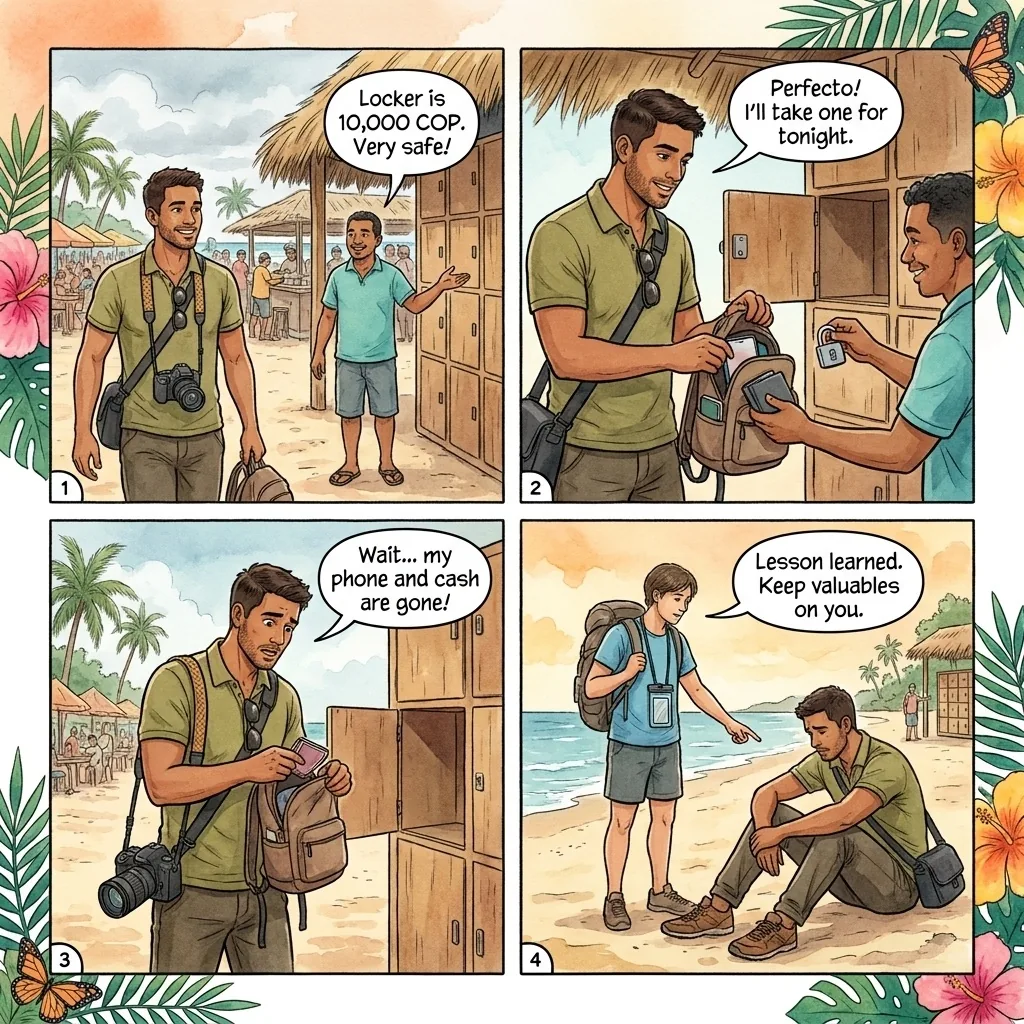
Phones, cash, and passports go missing from the paid "lockers" at Cabo San Juan more often than the operator advertises.
You arrive at the Cabo San Juan hammock loft at 7 PM after the day-trippers have left, the sky turning purple over the Caribbean, the kitchen below already cooking the fixed-menu dinner. A staff member in a faded Tayrona shirt hands you a numbered padlock and points at a row of unmarked wooden cubbies behind the kitchen wall — the 'lockers.' Other backpackers are already stacking their bags inside, two and three to a cubby. There's no log book, no signature, no photo of what you put in. The staff member rotates the padlock from a key ring with thirty other keys on it and tells you in Spanish that the lockers are watched 'all night.' The hammock you'll be sleeping in is fifteen meters away and three meters above the kitchen, in an open-air loft that has no door.
Overnight hammocks run 35,000–50,000 COP (~$9–$13) per person, the open-air "premium" loft on the rocks runs 60,000–80,000 COP, and the paid cubbies behind the kitchen wall cost 5,000–10,000 COP for the day. The locker setup is informal. They are unlabeled wooden cubbies behind the kitchen with shared padlocks the staff hand out and collect. Some travelers describe getting a different padlock back than the one they were given that morning, or finding the locker partially open at pickup. With dozens of bags stacked into a small space and no logged custody chain, theft is functionally untraceable. Overnight, the hammocks above the kitchen sit in a dark and crowded loft where reaching into someone else's bag is a one-second move.
The theft pattern targets mid-trip backpackers carrying multi-day cash and a phone they need for the trail back. Reddit threads from 2024 and 2025 on Reddit and Reddit describe the same loss profile — phone, cash, sometimes a credit card — recovered nowhere because the report goes to a kiosk staff member, not to a police station. The nearest CAI booth is at El Zaino, two hours' walk away. Most victims realize the loss only after they've returned to Taganga.
The defensive context: Tayrona has no on-site police presence at Cabo San Juan, and Parques Nacionales staff are conservation rangers, not law-enforcement officers. The Policía de Turismo for the Magdalena region operates out of Santa Marta on Carrera 1 and answers Colombia's national emergency number 123. The defensive move is to treat Cabo San Juan as a beach with hammocks, not a hotel: split your cash and cards across multiple pockets and a hidden money belt, leave your passport in a Santa Marta hotel safe, and never put a phone or wallet in the paid locker — keep them in a dry bag clipped to you in the water.
Red Flags
- shared padlocks handed out and collected by rotating staff with no custody log
- wooden "locker" cubbies behind a kitchen wall with no labels, numbers, or sealed seams
- no on-site police, CAI booth, or sworn officer at Cabo San Juan
- open-air hammock loft above the kitchen with no door and dim overnight lighting
- kiosk staff response to a missing-phone report that ends in a shrug, not a written record
How to Avoid
- Leave your passport and any cards you don't need that day in the safe at your Santa Marta hotel before traveling to the park.
- Carry valuables on your body in a hidden money belt or zipped under-shirt pouch, never in the paid Cabo San Juan locker.
- Use a dry bag clipped to your waist when you swim, and keep your phone and wallet inside it at all times.
- Split cash across two or three pockets so a single grab from a hammock at night doesn't take everything.
- Report any theft to the Policía de Turismo on Carrera 1 in Santa Marta or call 123 (emergency) once back at El Zaino.
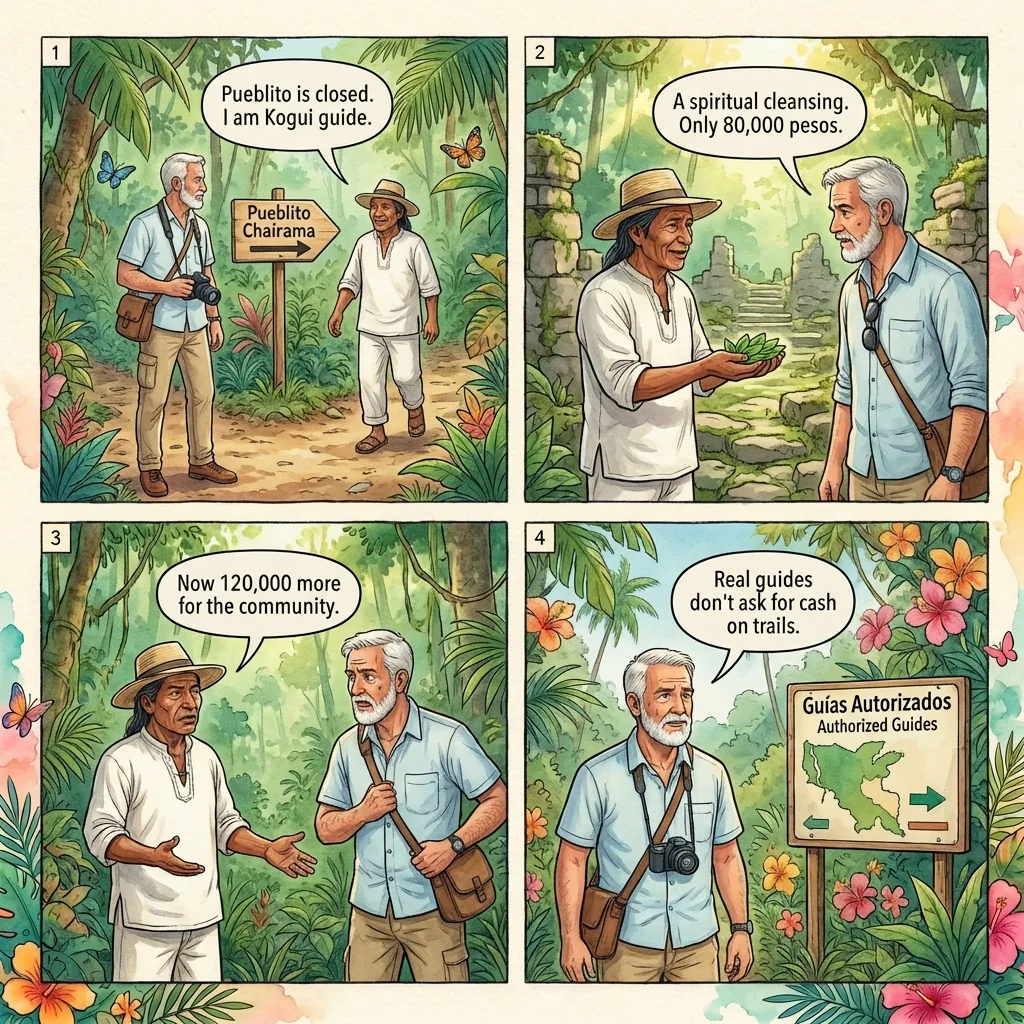
A man in white linen and a small woven mochila steps onto the Pueblito spur trail near Cabo San Juan and says he is a Kogui indigenous guide.
You're forty minutes into the Pueblito spur trail from Cabo San Juan, the path narrowing and steepening through wet jungle, when a man in clean white linen and a small woven mochila steps out from behind a moss-covered stone. He smiles, raises both hands in a soft greeting, and introduces himself as a Kogui guide. "Pueblito está cerrado por la comunidad — but I can take you in. We do a small spiritual cleansing at the site, with coca leaves. 80,000 pesos." His Spanish has no trace of an indigenous accent, his linen is freshly pressed, and the mochila looks like a Santa Marta market piece rather than a Sierra Nevada weave. There is no Organización Gonawindúa-issued permit on him, and the trail behind him is empty all the way back to the last junction.
He offers a "spiritual cleansing" with coca leaves at the archaeological site for 80,000 COP (~$20) per person — by the time the ceremony is over, the price is 200,000 COP and the leaves were never his to give. The Pueblito (Chairama) ruins are a real Tayrona archaeological site at the end of a steep two-hour scramble from the main trail. Access has been periodically restricted by the Organización Gonawindúa Tayrona, the Kogui and Arhuaco governing council. That restriction is the pivot the scam runs on: the man tells the group Pueblito is normally closed, but as a Kogui guide he can take them in. In fact the trail closes and reopens by community decision and isn't gated by individual roadside guides. The "ceremony" is short, the coca leaves are commodity-grade from a Santa Marta market, and the additional 120,000 COP appears at the end framed as a community contribution.
The community-and-context check is straightforward. Real Kogui and Arhuaco leaders do not solicit tourists at trail junctions, do not offer spiritual ceremonies for a fee, and do not take cash on a steep public footpath. Hoy Diario del Magdalena's October 2025 reporting on suplantación of legal tour operators in the Santa Marta area named impersonation of indigenous-cultural operators specifically. The Federación Colombiana de Guías de Turismo (Fedeguías) has published warnings naming roadside sellers without an RNT number as the canonical risk.
Reddit threads on Reddit and Reddit from 2025 — including pieces on hiking the western park — repeat the same advice: book any cultural visit through an Organización Gonawindúa-authorized operator out of Santa Marta or Palomino, never on the trail. The defensive move is to refuse every spiritual-cleansing offer made on a trail or at a roadside, walk on without breaking stride, and book any indigenous-cultural visit only through a licensed operator with an RNT number — call 123 (emergency) or the Policía de Turismo if you are pressured for additional payment after a ceremony has begun.
Red Flags
- stranger on the Pueblito spur trail claiming to be a Kogui or Arhuaco guide with no RNT number
- offer of a "spiritual cleansing" or coca-leaf ceremony for a fixed cash price
- claim that Pueblito is closed but he can get you in via a private route
- price escalation from an opening 80,000 COP to a closing 200,000 COP "community contribution"
- no printed permit, no operator company name, and no visible link to Organización Gonawindúa Tayrona
How to Avoid
- Book any indigenous-cultural visit only through a licensed Santa Marta or Palomino operator with a Registro Nacional de Turismo number.
- Refuse every spiritual-cleansing or coca-leaf offer made on a trail, at a roadside, or at the Calabazo or El Zaino gates.
- Walk on without breaking stride if approached by a self-described guide on the Pueblito spur or the Cabo San Juan trail.
- Verify Pueblito access status through your licensed operator or at the Centro de Visitantes window — never from a stranger on the trail.
- Call 123 (emergency) or the Policía de Turismo on Carrera 1 in Santa Marta if pressured for payment after a ceremony has begun.
🆘 What to Do If You Get Scammed
📋 File a Police Report
Go to the nearest Colombian National Police (Policía Nacional) station. Call 123 (Emergency) or 112. Get an official crime report — you'll need this for insurance claims. You can also report online at policia.gov.co.
💳 Cancel Your Cards
Call your bank immediately. Most have 24/7 numbers on the back of the card (keep a photo saved separately). Block any suspicious transactions before the thieves use your details.
🛂 Lost Passport?
Contact your nearest embassy or consulate. The US Embassy in Bogotá is at Calle 24 Bis No. 48-50, Bogotá. For emergencies: +57 1-275-2000.
📱 Track Your Device
If your phone was stolen, use Find My (iPhone) or Find My Device (Android) from another device. Don't confront thieves yourself — share the location with police instead.
Frequently Asked Questions
You just read 5 scams in Tayrona. The book has 53 more across 10 Colombian destinations.
Bogotá's paseo millonario yellow-taxi express kidnapping (US State Department: leading cause of financial loss for Americans in Colombia). Medellín's Tinder scopolamine setups (reports tripled 2023–2025). Cartagena walled-city USD-pricing markups. Tayrona park “guide” rackets. Every documented Colombia scam — with the exact scripts, red flags, and Colombian Spanish phrases that shut each one down. Drawn from Colombian press (El Tiempo, Semana, El Espectador), Policía Nacional de Turismo records, and US State Department advisories.
- 58 documented scams across Bogotá, Medellín, Cartagena, Cali & 6 more destinations
- A Colombian Spanish exit-phrase card you can screenshot to your phone
- Updated annually — buy once, re-download future editions free
- Readable in one flight — $4.99 on Amazon Kindle