Key Takeaways
- The #1 reported scam is the La Pavona Pirate Boat Fare Inflation
- 2 of 5 scams are rated high risk
- Use app-based ride services (Uber, DiDi) instead of street taxis — avoid unmarked vehicles, especially at night
- Never accept unsolicited offers from strangers near tourist sites in Tortuguero
⚡ Quick Safety Tips
- Buy Tortuguero National Park tickets ($15 USD foreign adult) online at sinac.go.cr before arrival — tickets are not sold at the Cuatro Esquinas gate.
- At La Pavona dock, queue at the white wooden ticket window inside the restaurant for the 4,000 CRC ($8) public boat — ignore unmarked touts quoting $20–$30.
- Book turtle nesting walks (July–October) only through your hotel or the Sea Turtle Conservancy ($25), and ask to see the guide's SINAC photo ID badge.
- Lock cash, watches, and electronics in the in-room safe before every boat tour at Mawamba, Pachira, or Tortuga Lodge — police response from Limón is hours away by boat.
Jump to a Scam
The 5 Scams
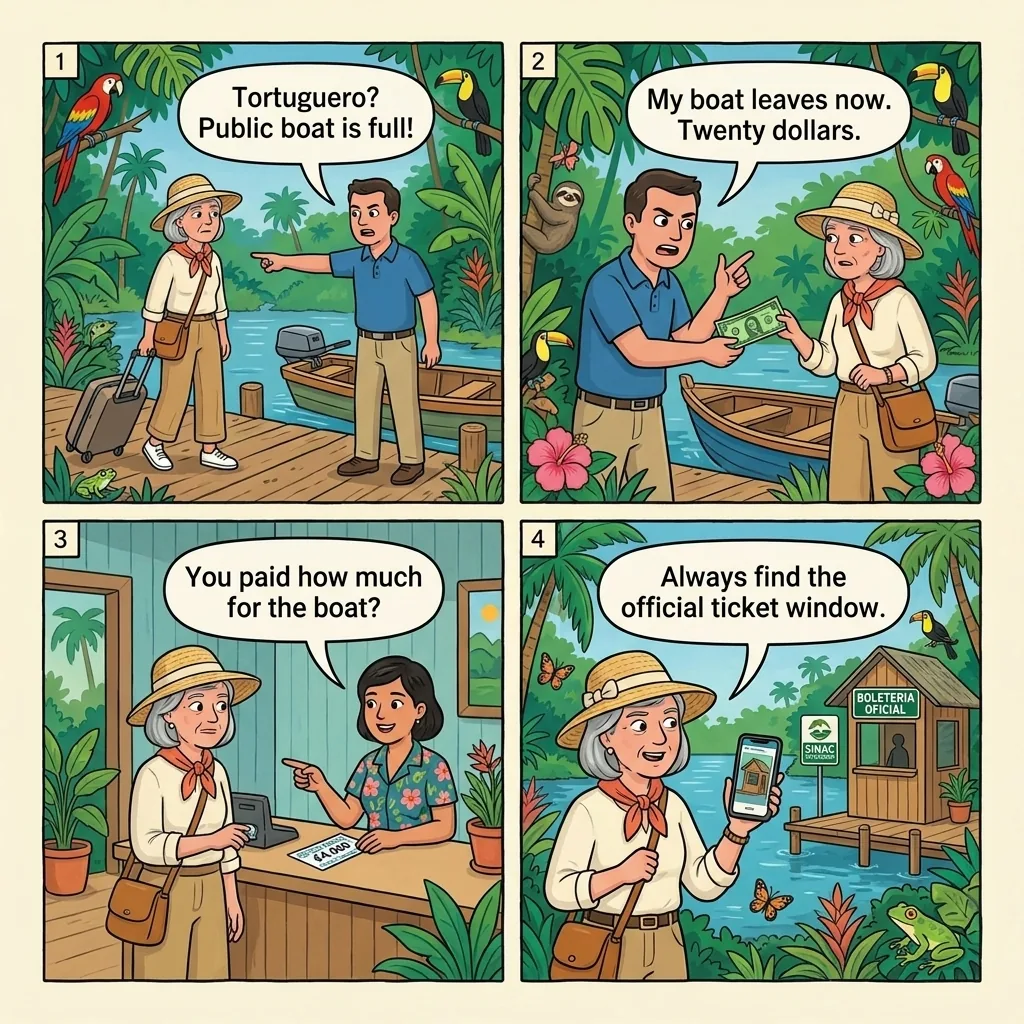
Touts at La Pavona dock push arriving travelers onto unmarked private boats for $20–$30, while the official public boat to Tortuguero is 4,000 CRC ($8).
The pivot lands the moment you climb out of a Caribe Shuttle van or step off the Cariari–Pavona minibus with a suitcase. A man in an unmarked polo waves you over before you can read the schedule board. He says the next public boat is full or canceled and his boat leaves now. There is no signage in English, no posted price list, and the dirt path to the river crossing is a gauntlet of similar offers.
Disoriented after three hours of overland transit, most travelers pay rather than negotiate. Cash only. No printed ticket. The same playbook runs at the parking lot, where attendants quote $20 a night for spaces the posted sign lists at 10,000 CRC. Once you are on the wrong boat the route still ends at the Tortuguero town dock, so you may not realize you overpaid until a hostel host or hotel front desk shows you the real fare two hours later.
The scam works because La Pavona is the funnel: there is no road into Tortuguero, the public-boat schedule is not obvious, and luggage makes you a target. Reddit threads trip reports anchor the real numbers — public boats run 9 a.m. 11 a.m. 12:45 p.m. 3 p.m. and 4 p.m. for around $8 each way. The US Embassy in San José flagged a broader pattern of financial scams targeting visitors in its Nov. 26, 2025 security alert. The defensive move is to walk past anyone calling out fares and queue at the white wooden ticket window inside the Pavona restaurant building.
Red Flags
- Unmarked polo shirts soliciting at the van drop-off point
- Claim that the next public boat is full or canceled
- Cash-only with no printed ticket or company name
- Quoted fare more than double the 4,000 CRC public rate
- Pressure to board immediately before you reach the dock
How to Avoid
- Buy public boat tickets at the official window inside the La Pavona restaurant building.
- Verify the schedule at pavonatortuguero.com before you arrive at the dock.
- Refuse to pay more than 4,000 CRC per person each way for the public boat.
- Ignore anyone in an unmarked shirt who approaches your shuttle van.
- Photograph the posted parking sign before you hand over keys.
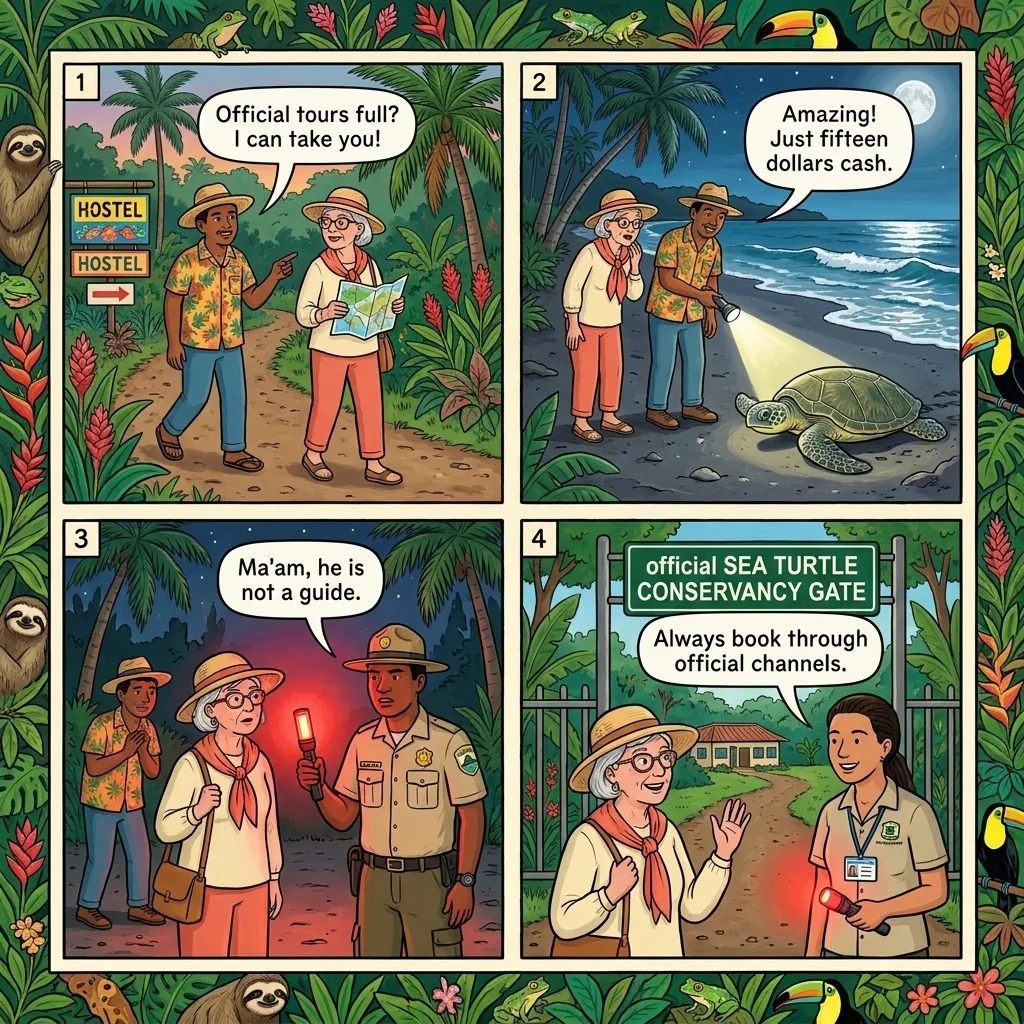
An unlicensed local offers to walk you to a turtle laydown for $15 cash, half the price of the Sea Turtle Conservancy walk and with no SINAC guide ID.
The pitch lands at dusk on the muddy main street between Aracari Garden Hostel and the soccer field, where guides loiter by the public phone and hostel boards. He says he grew up here, that his cousin is a ranger, that the official tours are sold out for the night. He waves a white flashlight, not a red one — the first technical tell.
The meeting point is the second tell. He wants to leave from the beach access behind the cemetery, not from the conservancy gate. From July through October the nesting beach is divided by SINAC into north and south sectors, and only guides carrying a photo ID badge and a red-filtered torch lead visitors after dark. Walk-ins without a registered guide can be fined or removed by rangers, and the legitimate Sea Turtle Conservancy walks are capped at small groups assigned to one specific sector each night.
The damage runs three ways. Sea turtles abandon laydowns when white light hits them, so the unsanctioned walk wastes the very thing you came to see. SINAC ranger sweeps catch unaccompanied tourists and hand out citations. The cash you handed over funds the same guides who poach eggs in low season. Reddit threads from 2025 and 2026 confirm guides without official SINAC ID are operating illegally; the Sea Turtle Conservancy publishes its $25 walk fee at conserveturtles.org. The defensive move is to book the night walk at your hotel front desk or the Sea Turtle Conservancy office and ask to see the guide's SINAC ID badge.
Red Flags
- Walk-up offer on the main street after dark
- White flashlight instead of red filter
- Departure from beach access not the conservancy gate
- No waiver, no group size cap, no badge shown
- Price below $25 for the night turtle tour
How to Avoid
- Book the turtle walk through your hotel or the Sea Turtle Conservancy office.
- Ask to see the guide's SINAC photo ID badge before you leave the meeting point.
- Confirm the assigned beach sector at the Cuatro Esquinas ranger station.
- Refuse to walk the nesting beach with anyone using a white flashlight.
- Verify the Sea Turtle Conservancy fee at conserveturtles.org before paying cash.
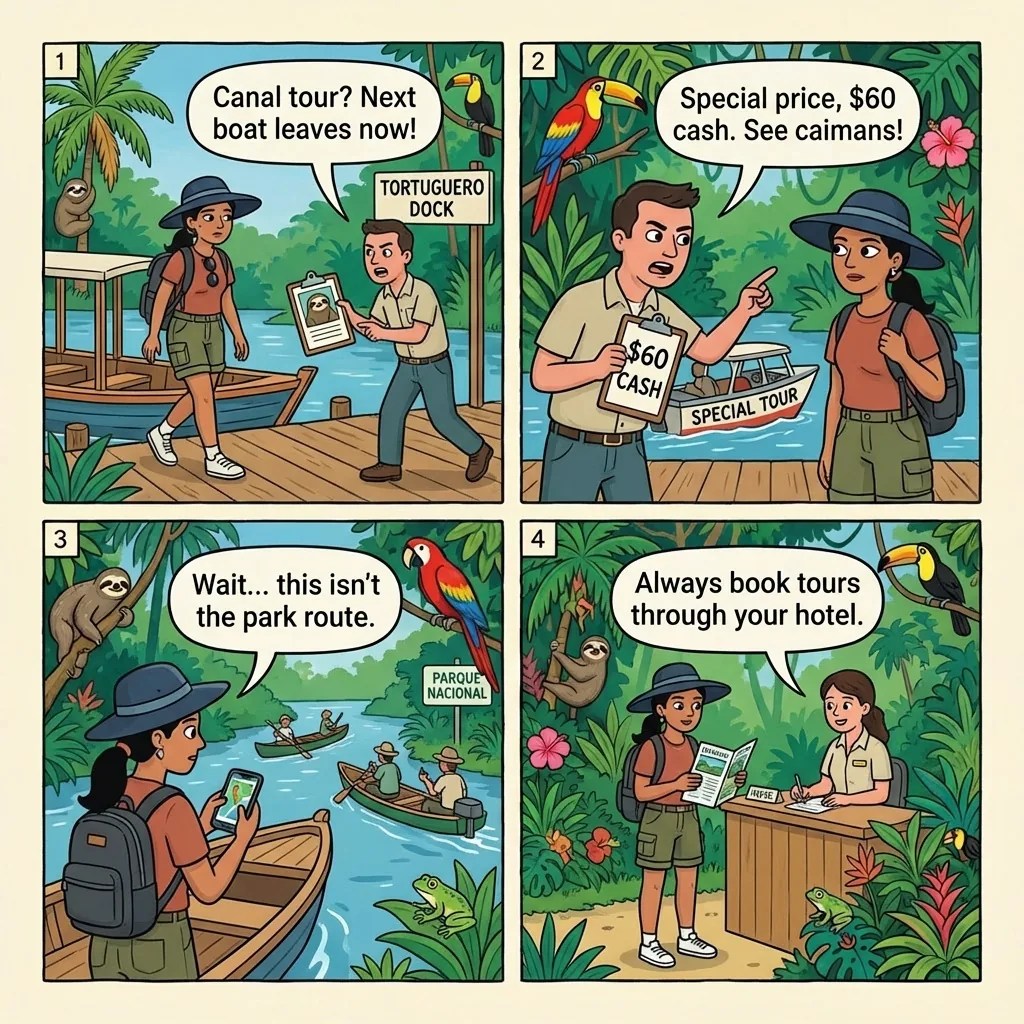
Boatmen at the Tortuguero village dock sell three-hour canal tours for $50–$60 cash, nearly double the $25–$35 rate that hotel-booked guides quote.
The encounter starts the moment you step off the Pavona boat with a daypack still on your shoulders. A man with a clipboard and a laminated wildlife photo asks if you want to see sloths and caimans, says the next park boat leaves in fifteen minutes, names a price in dollars only. The pitch is timed for tired arrivals.
The tour itself may be real, but the details are wrong. The route is shorter than the canals inside the park because powerboats are not allowed on the inner channels. The guide is rarely a certified naturalist. The $15 SINAC park entry — payable only online — is sometimes left off the quote so you pay it twice. By the time you realize the boat is taking the same loop the cheaper hotel canoes already covered, you are an hour into the ride.
The markup is structural. There is no posted price list at the dock, hotels and ASOPROTUR-affiliated guides advertise inside their lobbies rather than on the street, and a tired traveler who just spent four hours on a bus and a boat will pay anything to get on the water. Reddit threads trip reports from 2025 and 2026 anchor the real range — quiet canoe and kayak tours run $25 to $35 per person and reach the inner-park channels powerboats cannot. The Costa Rican park service publishes the SINAC fee on sinac.go.cr. The defensive move is to book the canal tour through your hotel front desk and pay the $15 SINAC park fee online before you leave home.
Red Flags
- Clipboard tout selling tours on the public dock
- Cash-only price quoted in US dollars
- Park-entry fee not included in the quote
- Powerboat for a route a kayak should run
- No certified naturalist guide named on the receipt
How to Avoid
- Book canal and kayak tours through your hotel or an ASOPROTUR-affiliated operator.
- Pay the $15 SINAC park entry online at sinac.go.cr before arrival.
- Confirm the guide is a certified naturalist before you board.
- Refuse cash-only US-dollar tours quoted on the public dock.
- Compare the dock price to hotel rates of $25 to $35 before you commit.
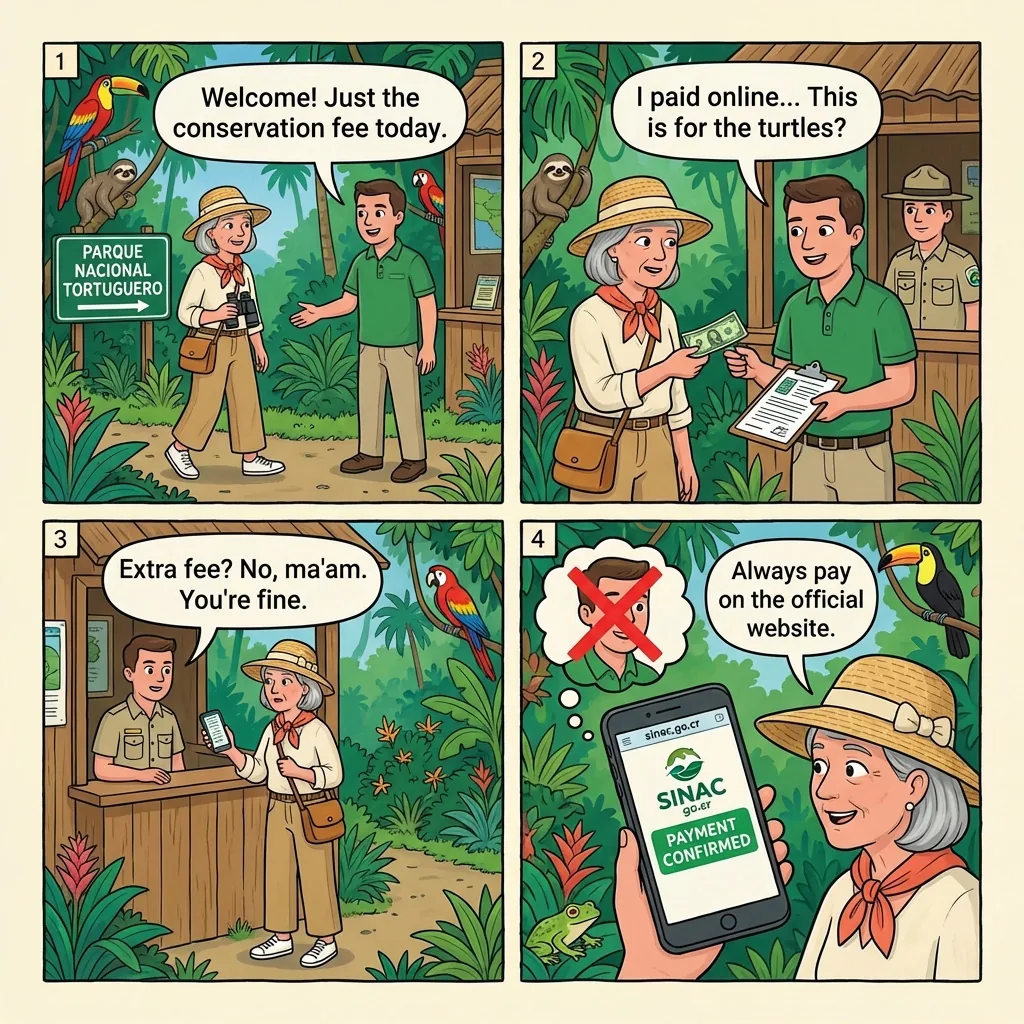
A man in a green polo at the Cuatro Esquinas trailhead asks for $20 cash as a conservation fee on top of the official $15 SINAC park ticket.
He has no printed receipt book and never enters the rangers' kiosk. The move plays on friction in the official process: SINAC switched to advance online tickets at sinac.go.cr a few years ago, the website is clunky, and many travelers arrive at the trailhead unsure whether they paid the right thing.
The collector looks the part. He is middle-aged, polite, in a clean green shirt, and he stations himself a few meters short of the actual rangers' kiosk so he can intercept walk-ups. He tells you the system was down this morning, that he can take cash and stamp your wrist, that the fee covers turtle research. He never asks for ID and never produces a printed ticket. The actual ranger at the gate scans a QR code from your SINAC confirmation email; everything else is street theater.
The fakery survives because most visitors will not push back at a uniformed-looking person near a national park gate. Reddit threads trip reports from 2025 and 2026 confirm the SINAC online fee of $15, the QR-scan workflow, and the absence of any cash collection at the gate. The official rates are published on sinac.go.cr and mirrored on the SINAC visitor app. The US Embassy in San José flagged a broader rise in financial scams targeting visitors in its Nov. 26, 2025 alert. The defensive move is to buy your $15 ticket on sinac.go.cr the night before and refuse to hand cash to anyone outside the rangers' kiosk.
Red Flags
- Cash-only conservation fee at a trailhead
- No printed receipt book and no stamped ticket
- Collector standing outside the rangers' kiosk
- Story about the SINAC website being down
- Charge in US dollars only with no colones option
How to Avoid
- Buy Tortuguero National Park tickets at sinac.go.cr before you travel.
- Show the SINAC QR confirmation email to the ranger at the kiosk.
- Refuse any cash request outside the official rangers' booth.
- Photograph the SINAC fee schedule before you reach the gate.
- Report fake collectors to the rangers at Cuatro Esquinas immediately.
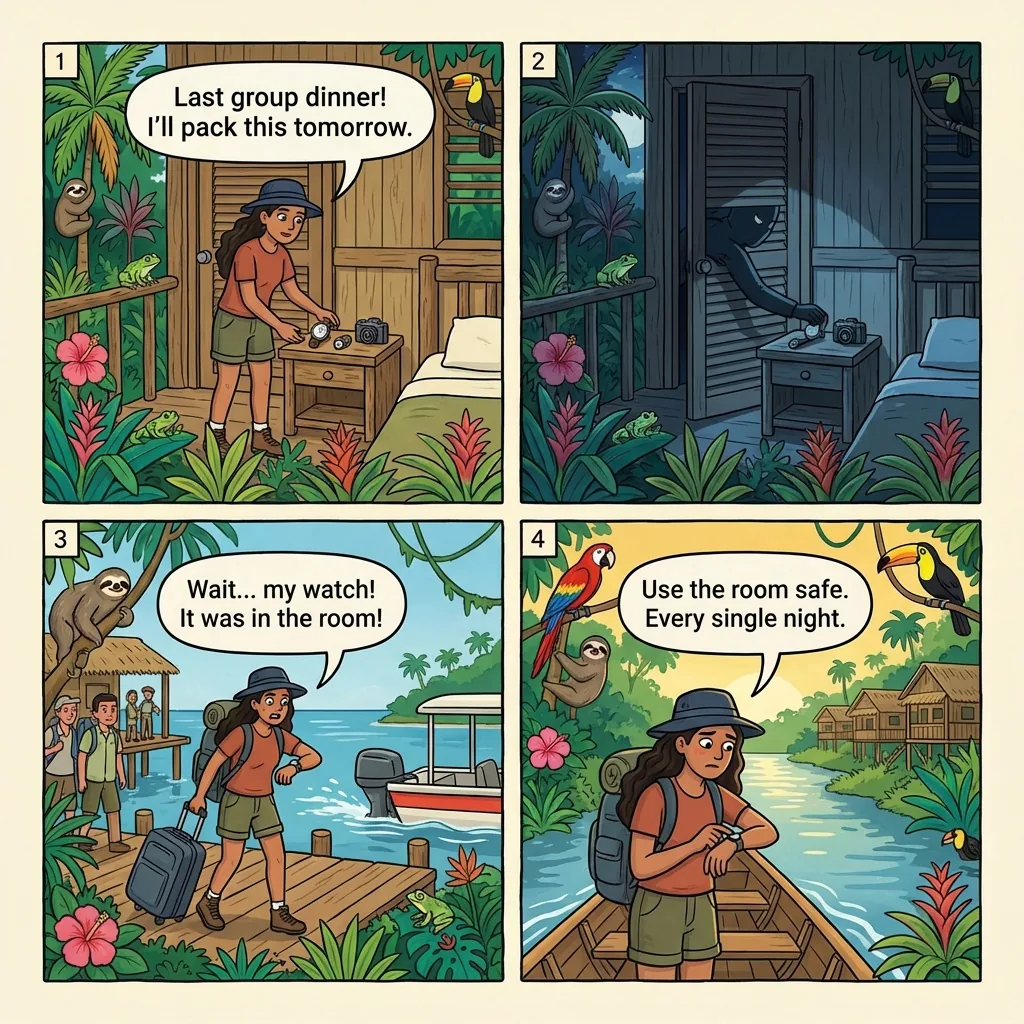
Watches, cash, and electronics go missing from rooms at Mawamba, Pachira, and Tortuga Lodge on the last night of multi-day all-inclusive stays.
The pattern mirrors the rising property-crime trend the US Embassy in San José flagged in its Nov. 26, 2025 security alert. The set-up is the lodge layout itself. Rooms sit on raised stilts along jungle walkways, doors are often louvered for airflow, and all-inclusive packages mean guests are out for hours-long boat tours and group dinners.
Staff turnover at remote properties is high. The thief targets the bag you left behind because everything else is in your safe-deposit box. Except for one thing — the watch you took off for the canal swim, the spare passport copy you slid into a side pocket, the cash envelope you forgot to lock up before dinner. By the time you board the boat back to La Pavona or the airstrip the next morning, the staff has rotated and the trail is cold. The first call from your hostel host or hotel desk is often the one telling you the pattern is well known.
The danger is that Tortuguero's isolation cuts both ways. Police response from Limón is hours away by boat, the US Embassy in San José sits a five-hour overland trip away, and most lodges are not equipped for criminal investigations. The State Department updated Costa Rica to a Level 2 advisory in April 2026 over crime targeting tourists at short-term rentals; Reddit threads in 2025 and 2026 echo the same lodge-and-airbnb theft pattern. The defensive move is to lock everything of value in the in-room safe before any tour, including your last-night repacking, and photograph the safe's contents on check-in.
Red Flags
- Louvered doors with no deadbolt on raised lodge cabins
- Last-night theft after a multi-day all-inclusive stay
- Items missing from bags but not from the in-room safe
- Staff rotation between your tour and your departure
- No deposit-box receipt from the front desk
How to Avoid
- Use the in-room safe for cash, watches, passports, and electronics on every tour.
- Photograph the safe's contents and your room's door on check-in.
- Carry the spare passport copy in a money belt under clothing.
- Request a deposit-box receipt at the front desk for valuables.
- Repack the night before departure and lock everything in the safe again.
🆘 What to Do If You Get Scammed
📋 File a Police Report
Go to the nearest Fuerza Pública / OIJ (Organismo de Investigación Judicial) station. Call 911 (general) or 800-8000-645 (OIJ tip line). Get an official crime report — you'll need this for insurance claims. You can also report online at poder-judicial.go.cr.
💳 Cancel Your Cards
Call your bank immediately. Most have 24/7 numbers on the back of the card (keep a photo saved separately). Block any suspicious transactions before the thieves use your details.
🛂 Lost Passport?
Contact the US Embassy in San José at Calle 98 Vía 104, Pavas, San José. For emergencies: +506 2519-2000 (after hours +506 2220-3127). Policía Turística (Tourist Police) hotline: 2258-1008 / 2258-1022. ICT tourist info: 2286-1473 / 1-800-TOURISM.
📱 Track Your Device
If your phone was stolen, use Find My (iPhone) or Find My Device (Android) from another device. Don't confront thieves yourself — share the location with police instead.
Frequently Asked Questions
You just read 5 scams in Tortuguero. The book has 64 more across 11 Costa Rican destinations.
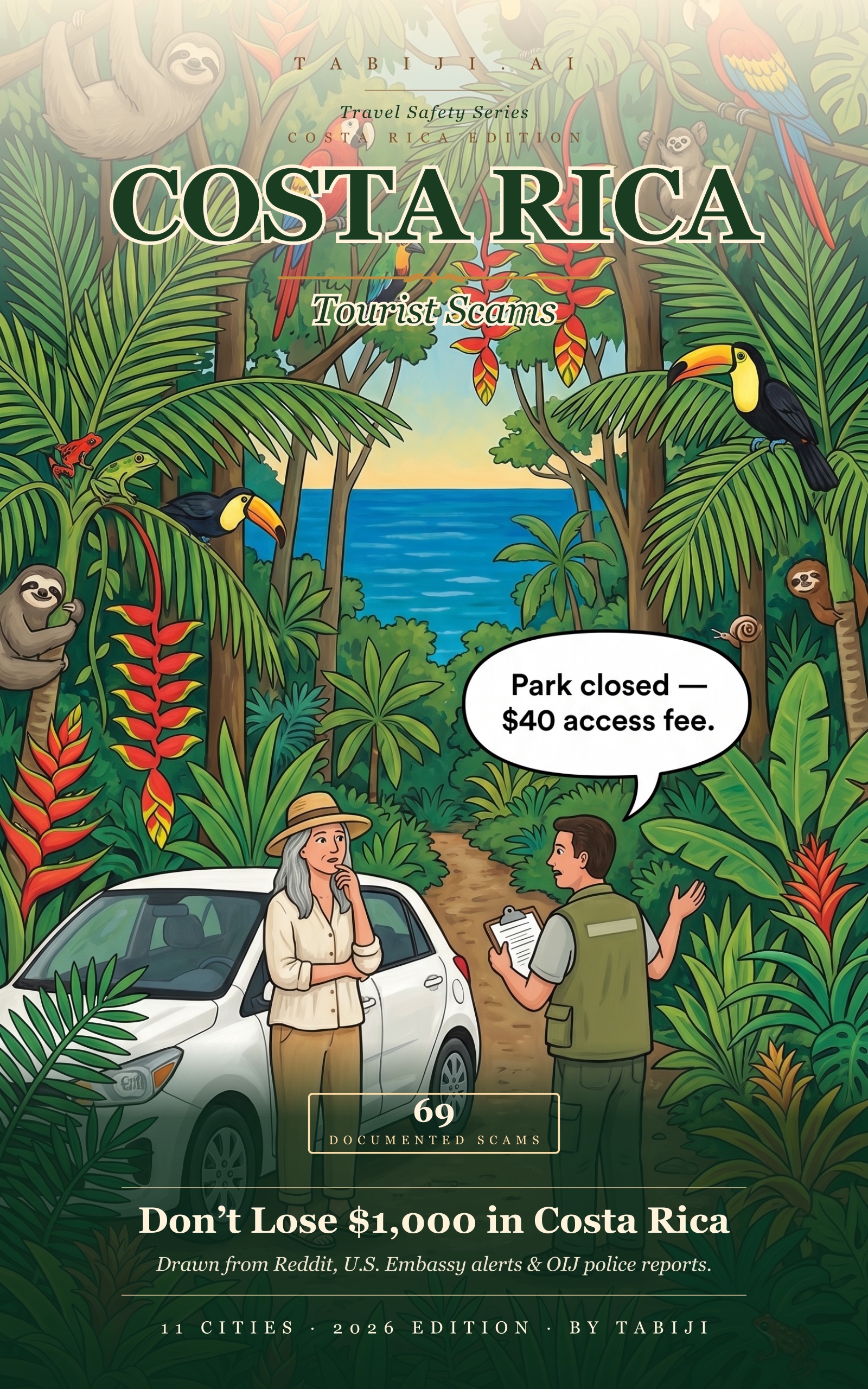
Manuel Antonio “park closed” fake-ranger $40 access-fee shakedowns. SJO airport taxi-meter overcharges. La Fortuna ATV / hot-springs bait-and-switch combos. Tamarindo 90-minute timeshare traps. Tortuguero turtle-tour “guide” demands. Every documented Costa Rica scam — with the exact scripts, red flags, and Costa Rican Spanish phrases that shut each one down. Drawn from Reddit, U.S. Embassy alerts, and OIJ (Organismo de Investigación Judicial) police reports.
- 69 documented scams across San José, Manuel Antonio, La Fortuna, Tamarindo & 7 more destinations
- A Costa Rican Spanish exit-phrase card you can screenshot to your phone
- Updated annually — buy once, re-download future editions free
- Readable in one flight — $4.99 on Amazon Kindle