Key Takeaways
- The #1 reported scam is the Bogotá–Villa de Leyva Hostel Private-Driver Markup
- 3 of 5 scams are rated high risk
- Use app-based ride services (Uber, DiDi) instead of street taxis — avoid unmarked vehicles, especially at night
- Never accept unsolicited offers from strangers near tourist sites in Villa de Leyva
⚡ Quick Safety Tips
- Take the Terminal Salitre bus to Tunja, then a Villa de Leyva colectivo (30,000–45,000 COP / ~$10 all-in) — La Candelaria hostel touts pitching 'private driver' rides at 350,000–500,000 COP are 10x markups
- Book Villa de Leyva accommodation 2–3 weeks ahead for festival weekends (Festival del Viento y las Cometas in August, Festival de Luces / Día de las Velitas December 7) — last-minute hotel rates triple, and 'festival package' touts run upfront-cash markups
- Compare prices on the Plaza Mayor restaurant menu in daylight before sitting down — tourist-menu inflation in the colonial center charges 80,000+ COP for ajiaco that costs 20,000–25,000 COP at locally-frequented spots a block off the plaza
- Use only licensed Iguaque sanctuary guides (RNT-registered, on the Parques Nacionales board at the entrance) and pay the official Pozos Azules entrance at the marked booth — fluorescent-vest 'attendants' on the access road are running fake-fee scams
Jump to a Scam
The 5 Scams
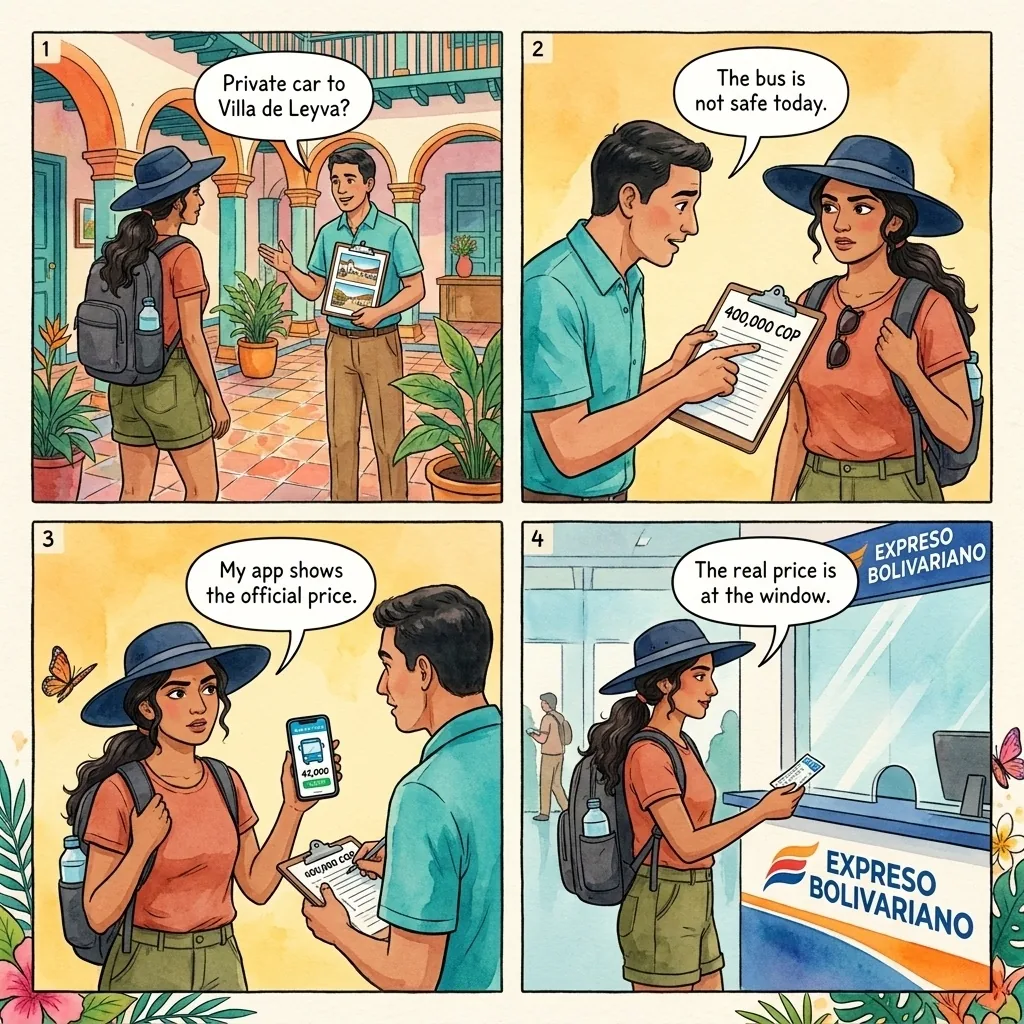
A tout in a La Candelaria hostel lobby quotes 350,000–500,000 COP (~$85–$120) per person for a one-way private-driver run to Villa de Leyva.
It's mid-morning in La Candelaria and you've just stepped out of your hostel onto Calle 11 with a Villa de Leyva day in mind. Before you reach the corner, a man with a clipboard and a few laminated photos of Plaza Mayor steps out from a doorway across the street and angles into your path. "Villa de Leyva today, my friend? Private driver, luxury car, 350,000 pesos cada uno — leaving in fifteen minutes." His Spanish-English blend is fluent, the cards he hands you have no operator name and no RNT number, and the Terminal Salitre bus to Tunja that you read about on Reddit is a 20-minute TransMilenio ride away. He's already gesturing toward an unmarked Renault parked at the curb, where a different driver waits with the engine idling and the trunk popped.
The Terminal Salitre bus to Tunja plus the Villa de Leyva colectivo runs about 30,000–45,000 COP (~$7–$11) all-in. The pitch banks on tourists who never see the inside of Bogotá's bus terminal. The approach starts at the front desk, the El Dorado Airport curb, or the Plaza Bolívar tourist strip. A man with a clipboard and a few laminated photos of the Villa de Leyva Plaza Mayor intercepts you on arrival. He skips the public transport entirely, frames the private car as the only safe way to reach Boyacá in time, and cites highway closures, weekend traffic, or vague safety on the carretera. The price is always cash, always per person, and always quoted before he asks where you actually want to go.
The pivot is the pickup. The driver who arrives is not the man you negotiated with, the rate has crept up by 50,000–100,000 COP for 'tolls' or 'peajes,' and the car is unmarked. Once your bag is in the trunk and you're on the Autopista Norte heading to Tunja, raising the price is the path of least resistance. Tourists who paid by card report mysterious 'fuel surcharges' added at the Tunja bypass, and the printed receipt — if there is one — is handwritten on a notebook page.
Reddit threads on Reddit on Bogotá day trips repeatedly steer travelers toward the Terminal Salitre bus to Tunja and the colectivo onward, precisely because the cooperative fares are posted and the routes are logged. El Tiempo's Boyacá-region transport coverage documented the April 2026 rollover on the Tunja–Villa de Leyva route that injured fourteen passengers, with four in critical condition — a reminder that the unmarked-vehicle market on this corridor is unregulated and accountable to no one.
For defense, ignore every hostel-lobby tout and take a TransMilenio or yellow taxi to Terminal Salitre, then board a Coflonorte or Libertadores coach to Tunja and a Villa de Leyva colectivo from the Tunja terminal. Pay only at the cooperative kiosk window at Terminal Salitre, photograph the bus's RNT-registered cooperative tag before boarding, and call 123 (emergency) or the US Embassy in Bogotá at +57 1 275 2000 if a private driver demands extra payment mid-route.
Red Flags
- hostel-lobby or airport-curb tout quoting a flat private-driver fare in cash before you ask
- claim that the Terminal Salitre bus to Tunja is closed, full, or unsafe for tourists
- unmarked vehicle arriving with a different driver than the one who took your money
- rate creeping up by 50,000–100,000 COP at the Tunja bypass for vague 'peajes' or 'fuel' reasons
- no operator name, no RNT number, and no printed receipt at the time of payment
How to Avoid
- Take TransMilenio or a yellow taxi to Terminal Salitre and board a Coflonorte or Libertadores coach to Tunja for the colectivo onward.
- Pay the bus fare at the cooperative kiosk window inside the terminal directly, never to a curbside driver.
- Refuse every La Candelaria or El Dorado private-driver pitch unless the operator shows a current RNT registration.
- Open Uber or InDriver inside Bogotá for an in-app quote and photograph the license plate before boarding.
- Call 123 (emergency) or the US Embassy in Bogotá at +57 1 275 2000 if a driver demands extra cash mid-route.
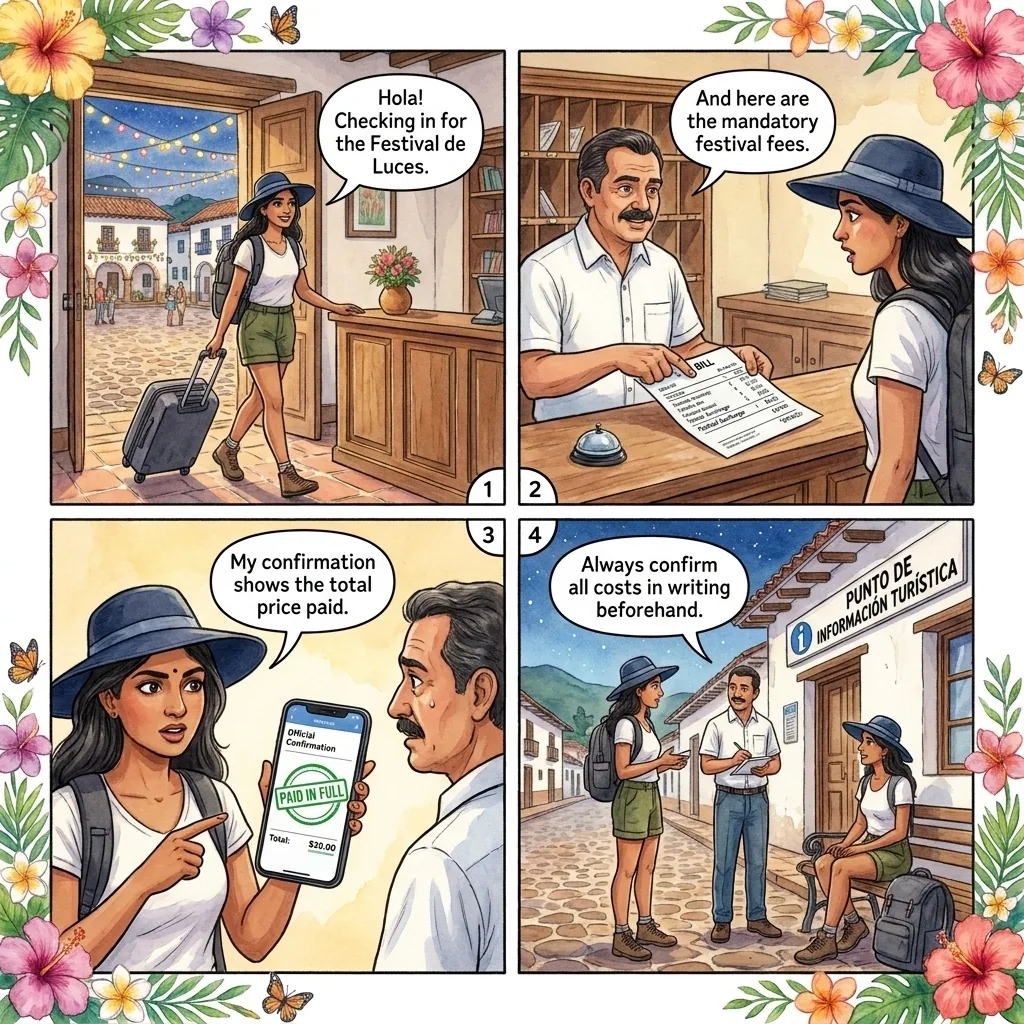
A Plaza Mayor posada quotes 800,000–1,200,000 COP (~$190–$285) per night for a Festival de Luces weekend room that runs 200,000–350,000 COP (~$48–$83) on a normal Tuesday.
You search Booking.com for a Plaza Mayor posada three days before the December Festival de Luces and the listings come back priced at 1,000,000–1,400,000 COP per night — three to five times the rate they show on a normal Tuesday. Most are 'limited availability,' marked in red. One promising posada, prettier than the others in the photos, doesn't appear on Booking — the host's WhatsApp message asks for a 50% deposit by Nequi to a personal Bancolombia account, sends a hand-typed confirmation in the next reply, and promises a Plaza Mayor view from the second-floor balcony. The festival weekend dates match the Alcaldía calendar; the price is 700,000 COP, suspiciously below the Booking listings; the host's WhatsApp profile photo is a stock image you find with a reverse-search in fifteen seconds.
The same pattern hits the Festival del Viento y las Cometas in August and the Festival Nacional de Bandas Sinfónicas in June. The pitch banks on travelers booking days out and not knowing which weekends are the festival peaks. The trap starts on the booking platform. A 'limited availability' listing appears on Booking.com or Airbnb at three to five times the off-peak rate, framed as standard pricing. A second variant is the deposit-to-personal-account pattern — a posada owner asks for a 50% deposit by Nequi, Daviplata, or wire transfer to a personal Colombian bank account, sends a hand-typed confirmation, and the booking quietly does not exist when you arrive. El Tiempo has documented Colombia-wide hotelier WhatsApp-cloning fraud where the deposit is funneled to a fake account.
The pivot lands at check-in. The room you booked is 'overbooked' and the posada has 'kindly relocated' you to a smaller annex three blocks off the plaza, or the hotelier tacks on 'festival surcharges,' 'parking,' and 'late check-in' fees that were not on the original confirmation. Refusing the surcharges means walking through Villa de Leyva at 11pm on the busiest weekend of the year with no Plan B — most tourists pay.
Reddit threads on Reddit on Boyacá weekend trips repeatedly warn that Día de las Velitas (Dec 7–8), the Festival del Viento y las Cometas in August, and the Festival Nacional de Bandas Sinfónicas in June are the three peak surge weekends. The Alcaldía de Villa de Leyva publishes the annual festival calendar on its official site, and El Tiempo confirmed the December 2025 access restrictions and route changes for the Festival de Luces — the surge is real and predictable, and the markup pricing is not.
For defense, cross-check festival dates against the Alcaldía de Villa de Leyva calendar before booking, and book only via Booking.com, Airbnb, or the posada's official RNT-registered website with a card payment that gives you a chargeback window. Refuse any deposit demand routed to a personal Nequi or Daviplata account, and call 123 (emergency) or the Mincomercio consumer protection line at 01 8000 510 420 if a posada relocates you or adds undisclosed fees at check-in.
Red Flags
- rate quoted at three to five times normal for Dec 7–8, August cometas weekend, or June bandas weekend
- deposit demanded by Nequi, Daviplata, or wire transfer to a personal Colombian bank account
- hand-typed booking confirmation with no RNT number, no booking-platform reference, and no payment record
- check-in 'relocation' to a smaller annex blocks off Plaza Mayor with no refund path
- festival surcharges, parking, or late check-in fees added at the desk that were not on the original confirmation
How to Avoid
- Cross-check festival dates against the Alcaldía de Villa de Leyva calendar before booking any weekend room.
- Book only via Booking.com, Airbnb, or the posada's official RNT-registered website with a card payment.
- Refuse every deposit demand routed to a personal Nequi or Daviplata account; ask for the operator's RNT number first.
- Photograph the room and the printed total at check-in before handing over a card or any cash deposit.
- Call 123 (emergency) or the Mincomercio consumer protection line at 01 8000 510 420 if a posada adds undisclosed fees.
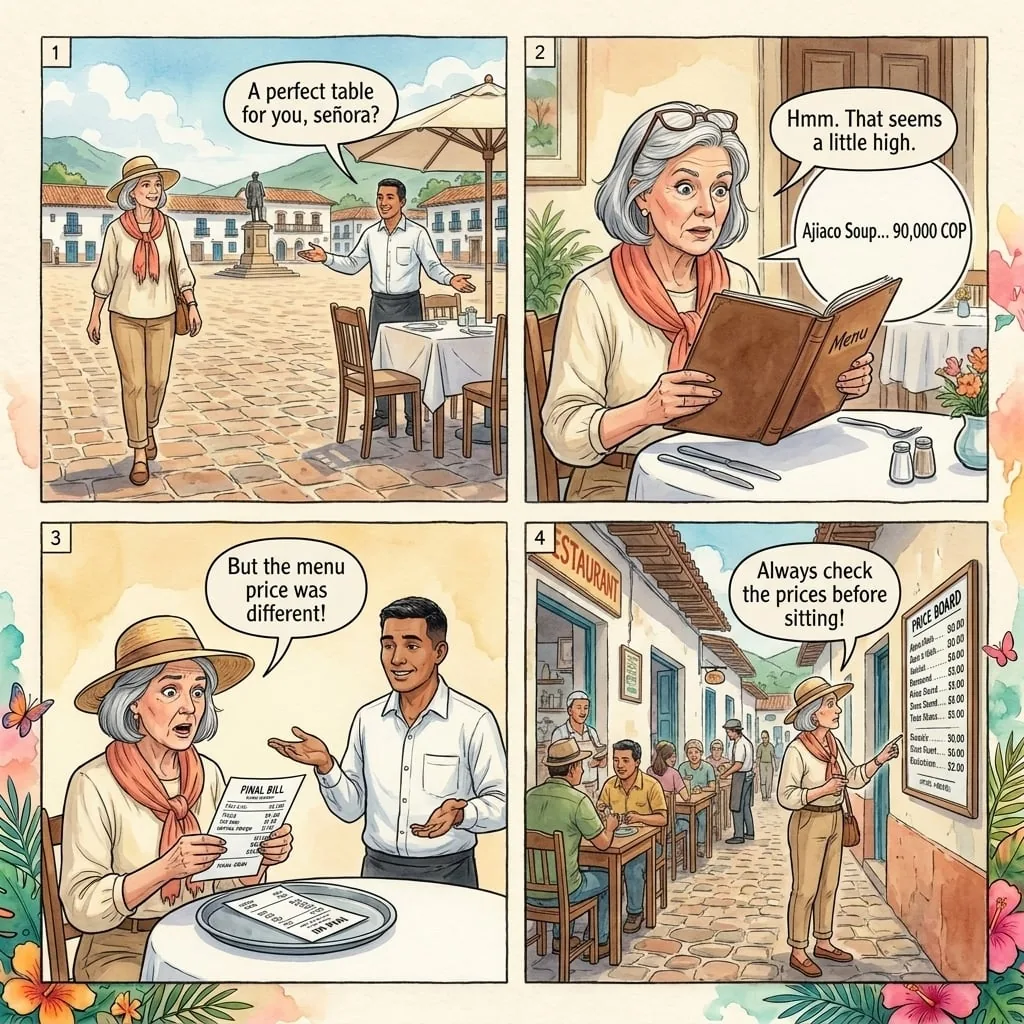
A Plaza Mayor restaurant hands a tourist a glossy English menu showing ajiaco at 80,000–95,000 COP (~$19–$23).
Plaza Mayor is the largest cobblestone square in the Americas — fourteen thousand square meters of pale grey stone fanning out from the colonial church, ringed by white-walled balconied buildings with terracotta roofs. The restaurants on the south side have set out their patio tables under canvas umbrellas, and a waiter in a clean white apron intercepts you on the walkway with a leather-bound menu. "Mesa? Tenemos cocido boyacense recién hecho." He leads you to a corner table with the church bell tower framed behind it. The menu he hands you is in English, glossy, and lists ajiaco at 85,000 pesos. There is no precios board at the entrance to the restaurant, and no menu visible from the street. The Spanish-language menu, you'll discover at the bill, lists the same dish at 25,000 pesos.
The Spanish menu the locals receive lists the same dish at 25,000–35,000 COP (~$6–$8). The pitch banks on cobblestone-stunned visitors who sit down before reading the price, and on the absence of any printed price board at the door. The approach is quiet. A waiter in a clean apron escorts the tourist to a patio table on the Plaza Mayor, drops a leather-bound English menu, and disappears for ten minutes. The mojarra frita is listed at 95,000 COP, the changua at 28,000 COP, and the Saturday-only cocido boyacense at 110,000 COP — all roughly triple the rate at a Calle Caliente almuerzo joint two blocks off the plaza. There is no menu on display at the entrance, and no posted ley-de-precios sign visible from the street.
The pivot lands at the bill. The cuenta arrives with a 10% propina sugerida already included, an additional 'service' line, and IVA itemized separately when it should be embedded in the menu price under Colombian consumer law. Tourists who push back are shown a different menu, told 'that was the lunch menu,' or quoted the higher rate as 'the dinner price' even at 1pm. El Tiempo has documented the broader Colombia tourist-menu pattern — Cali tourists were charged for a 'panoramic bus' ride that runs free, Cartagena's massage-beach 'pruebita' ring became a 2025 enforcement priority, and Anato has flagged menu-swap as a top complaint pattern at high-traffic plazas.
Reddit threads on Reddit on Boyacá day trips warn travelers to ask for the menu in Spanish, look for the printed precios at the door, and cross-reference dish prices against a nearby tienda or restaurante popular before sitting down. The Alcaldía de Villa de Leyva publishes consumer-protection guidance, and Mincomercio runs the national 01 8000 510 420 line for restaurant overcharge complaints — the legal hook is real, and a printed photo of the menu plus the bill is enough to file a denuncia.
For defense, ask for the menu in Spanish at every Plaza Mayor restaurant, photograph the dish prices before ordering, and refuse any establishment that does not post a precios sign at the entrance. If the cuenta does not match the menu, ask the waiter to bring the original menu back to the table, and call 123 (emergency) or the Mincomercio consumer protection line at 01 8000 510 420 to file a denuncia from the restaurant.
Red Flags
- leather-bound English-only menu handed to tourists with no Spanish version visible
- no printed precios sign at the restaurant entrance and no menu board visible from the street
- ajiaco, mojarra, or cocido boyacense priced at three times the rate of a Calle Caliente almuerzo joint
- propina sugerida already included plus a separate 'service' line and IVA itemized on top
- waiter producing a different menu when asked about a discrepancy with the original quoted price
How to Avoid
- Ask for the menu in Spanish at every Plaza Mayor restaurant and photograph the dish prices before ordering.
- Refuse any restaurant that does not post a precios sign at the entrance or a menu board visible from the street.
- Cross-reference dish prices against a Calle Caliente almuerzo joint or a tienda before sitting on the plaza.
- Verify that IVA is embedded in the menu price as required by Colombian consumer law before paying any bill.
- Call 123 (emergency) or the Mincomercio consumer protection line at 01 8000 510 420 to file a denuncia.
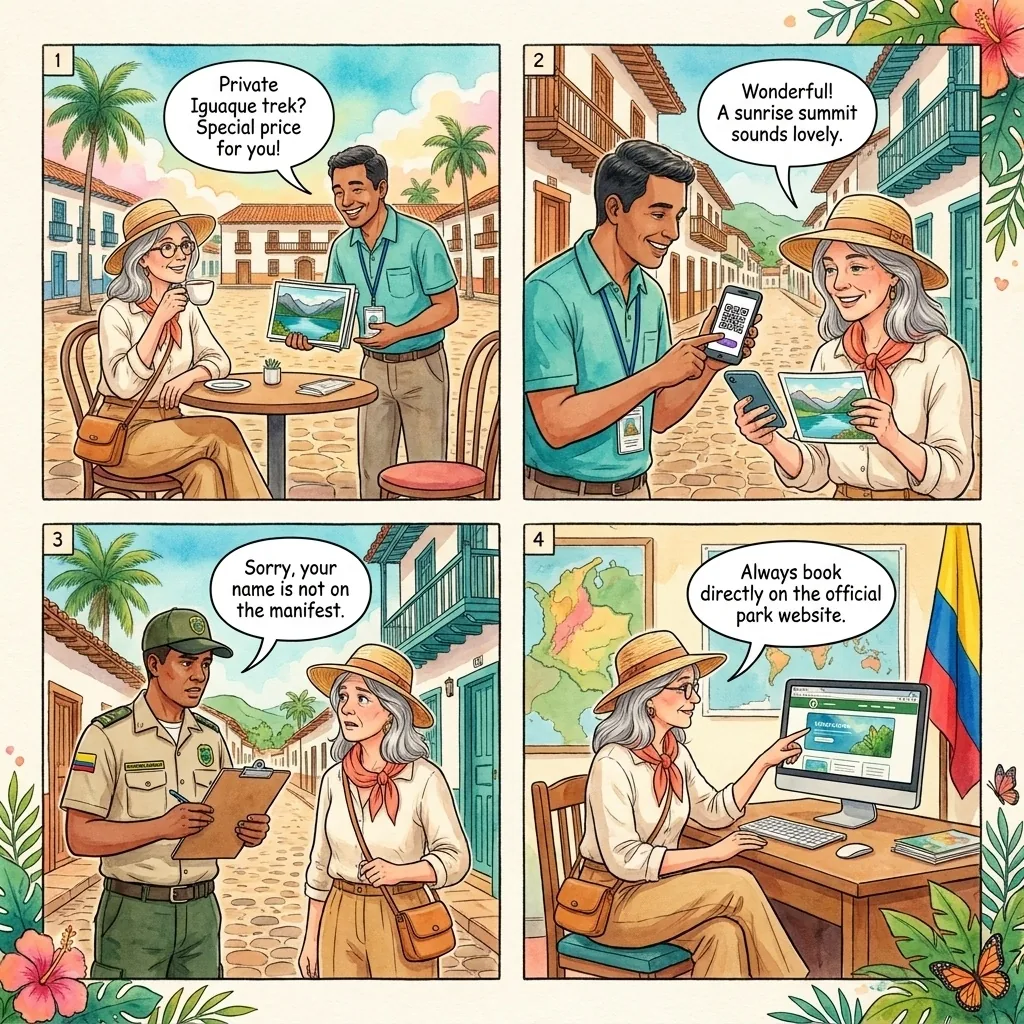
A 'guide' at Plaza Mayor sells a 'private Iguaque trek' for 180,000–250,000 COP (~$43–$60) per person and never registers the booking with the Santuario de Fauna y Flora Iguaque.
You drive west out of Villa de Leyva toward Pozos Azules around 9 AM, a rented Chevy Spark, no GPS signal in the valley. The Iguaque sanctuary turn-off comes up on the right after thirteen kilometers; the Pozos Azules turn-off is two kilometers further. A man in a fluorescent-orange vest stands in the middle of the gravel road a kilometer before the Pozos Azules property gate, hand raised, a small folding table with a hand-marker sign that reads ENTRADA POZOS AZULES — 30,000 COP. Behind him a printed photocopy of what looks like an official receipt is pinned to the table edge. The actual property gate, where the legitimate 10,000-peso wristband is issued, is visible through the trees ahead — but he is blocking the lane and a second vested man has just stepped onto the road behind you.
A second man at the Pozos Azules turn-off charges 30,000 COP (~$7) for a fake 'park entrance' that does not exist — the natural pools are on private land and the legitimate entrance is around 10,000 COP at the property gate, not on the road. The Iguaque approach starts on Plaza Mayor. A man with a printed lanyard and a few laminated photos of the Laguna Sagrada de Iguaque pitches a 'sunrise summit' or 'private guided trek' to tourists at café tables, shows a hand-typed itinerary, and takes a deposit to a personal Nequi account. The Iguaque sanctuary is administered by Parques Nacionales Naturales de Colombia, requires entry at the Carrizal ranger station with a registered guide booked through the official PNN channel, and posts the day-rate on the PNN website. Anyone selling 'private trek' access on the plaza is freelancing, and the sanctuary will turn you away at Carrizal if your name is not on the manifiesto.
The Pozos Azules pivot is geographic. The natural blue pools sit on private land off the Villa de Leyva–Santa Sofía road, and the legitimate entrance fee is around 10,000 COP collected at the property gate. A second 'attendant' in a fluorescent vest sets up a checkpoint a kilometer before the gate, charges 30,000 COP for a fake 'park entrance,' and waves the car through. Tourists who paid the fake fee then pay the legitimate gate fee a few minutes later, double-charged with no recourse. El Tiempo has documented the broader pattern of unauthorized 'guides' and informal park-entrance scams at Colombian natural-park sites, and Anato's 2025 alert flagged the same playbook across Boyacá and the coffee axis.
Reddit threads on Reddit on Iguaque, Pozos Azules, and Casa Terracota day trips repeatedly warn that anyone collecting fees on the road before the official entrance is freelancing, and that Iguaque trek bookings have to come through Parques Nacionales Naturales — not a Plaza Mayor tout. The legitimate Iguaque guide cooperative posts its rates at the Carrizal ranger station, and Pozos Azules issues a printed wristband at the actual gate.
For defense, book the Iguaque trek directly through Parques Nacionales Naturales de Colombia at parquesnacionales.gov.co or with a guide cooperative registered on the PNN website, and pay only at the Carrizal ranger station. Drive past every roadside 'park entrance' checkpoint at Pozos Azules and pay only at the property gate where you receive a printed wristband, and call 123 (emergency) or Mincomercio's consumer protection line at 01 8000 510 420 if a 'guide' or 'attendant' refuses to release your car or refund a deposit.
Red Flags
- Plaza Mayor 'guide' selling 'private Iguaque trek' access with a hand-typed itinerary and a personal Nequi deposit
- no Parques Nacionales Naturales booking reference, no Carrizal ranger station receipt, and no PNN-registered guide name
- roadside 'park entrance' checkpoint a kilometer before the actual Pozos Azules gate charging 30,000 COP cash
- fluorescent-vest 'attendant' with no printed receipt, no cooperative tag, and no posted rate sign
- double-charge pattern where the fake checkpoint fee is collected before the legitimate gate fee a few minutes later
How to Avoid
- Book Iguaque sanctuary access directly through Parques Nacionales Naturales de Colombia at parquesnacionales.gov.co.
- Pay only at the Carrizal ranger station with a registered guide listed on the PNN cooperative roster.
- Drive past every roadside 'park entrance' checkpoint at Pozos Azules and pay only at the property gate for a wristband.
- Refuse every Plaza Mayor tout selling private trek access with a hand-typed itinerary or a personal-account deposit.
- Call 123 (emergency) or Mincomercio's consumer protection line at 01 8000 510 420 to file a denuncia.
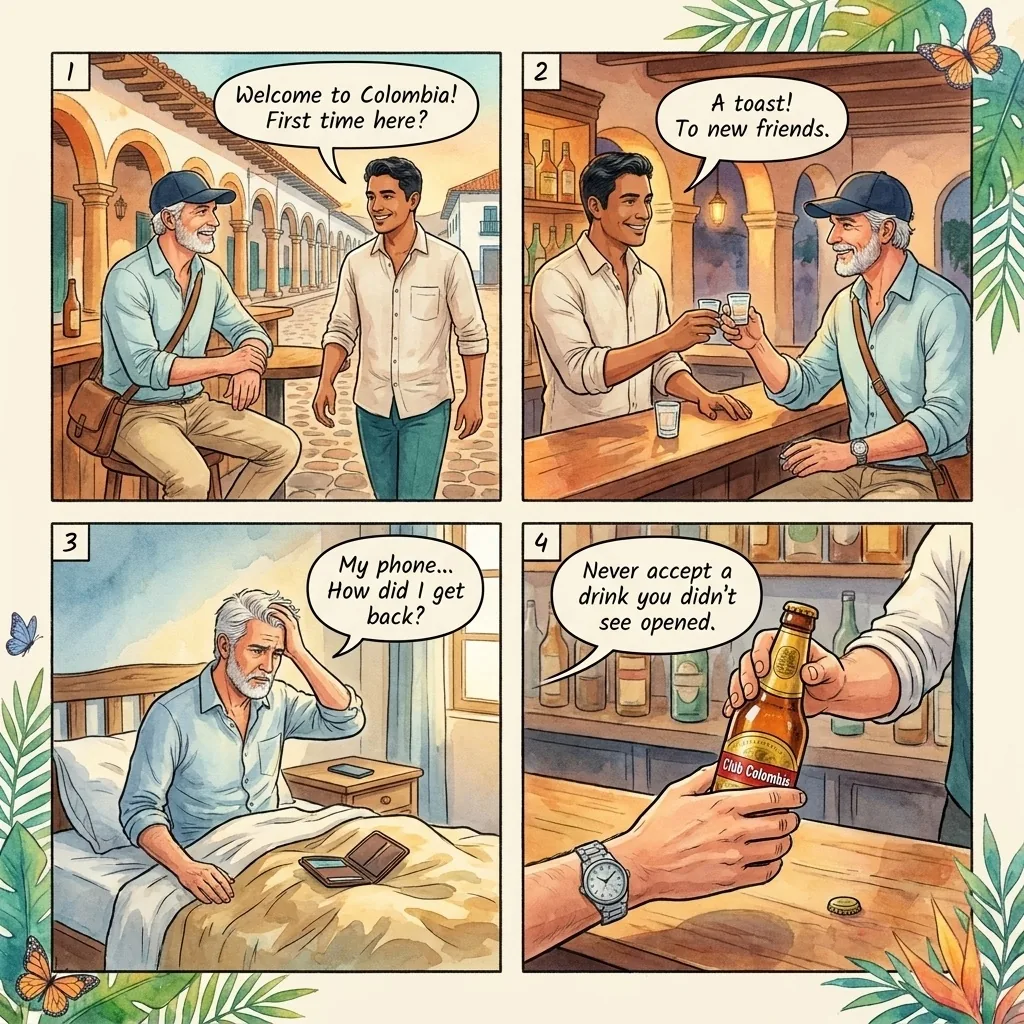
A friendly local at a Calle Caliente bar buys a round, and the tourist wakes up at a Villa de Leyva posada with no phone, no wallet, and no memory of the last six hours.
Calle Caliente on a Friday night is the only loud street in Villa de Leyva — the rest of the colonial core is candlelight and silence after 10 PM. Three blocks of bars off Plaza Mayor fill with weekenders from Bogotá and Tunja from 9 onward, music spilling into the cobblestone, the kind of mixed-group energy that feels safe. A woman at the bar in the third place you walk into — your age, easy English, a quick smile — orders a round of aguardiente shots before you've finished sitting down. The shots arrive on a small plastic tray that she passes to you herself; the bartender did not pour in front of you. She raises her glass, salud, and you toast her back. The walk to your posada is four blocks of dim cobblestone and stone-arched alleyways; you mentioned the address to her in passing twenty minutes ago.
A scopolamine pattern the U.S. Embassy in Bogotá has formally warned about across Colombia. In March 2026, El Tiempo and the Fiscalía judicialized a third suspect in the millonario robo and homicide of a US ex-marine at Villa de Leyva, anchoring the worst-case version of the same playbook. Villa de Leyva is a small town, but Friday and Saturday nights pull in weekend visitors from Bogotá and Tunja, and the Calle Caliente strip and Plaza Mayor bars fill with mixed groups. The opener is conversational. A new acquaintance offers a shot of aguardiente or a cocktail that arrives already poured, sometimes via a 'friend behind the bar' or a server who is part of the script. A few sips in, the target loses time. The posada walk-back routes off Plaza Mayor are dimly lit and the cobblestone makes pursuit on foot impossible.
The pivot is invisible. Scopolamine — the burundanga the U.S. Embassy named in its 2024 security alert — leaves the victim awake, compliant, and unable to form memory. The companion walks the target back toward their posada or short-term rental, watches the keypad code, and either cleans out the room directly or returns later with accomplices. The U.S. Embassy in Colombia has linked at least eight American deaths to involuntary drugging from Medellín-area bar encounters, and the same playbook reaches small Boyacá towns on tourist-heavy weekends. The March 2026 Villa de Leyva ex-marine homicide showed the worst-case escalation when the target resisted.
Reddit threads on Reddit on Boyacá and Bogotá weekends repeat the same defensive lessons after dozens of first-person accounts: never accept a poured drink, never let a glass leave your sight, and treat new dating-app or bar contacts as strangers until daylight. Reddit posters on Colombia threads add the harder lesson — keep banking apps off the phone you carry into a bar, and travel with a small cash float instead.
For defense, watch every drink from the bartender's hand to your own, refuse poured shots from a stranger, and never let a new bar acquaintance walk you back to your posada or short-term rental. If you suspect drugging or theft, call 123 (emergency), reach the US Embassy in Bogotá at +57 1 275 2000, and report to the Villa de Leyva Estación de Policía within 24 hours for travel-insurance validity.
Red Flags
- stranger at a Calle Caliente bar offering a pre-poured aguardiente shot or cocktail you didn't watch made
- drink arriving via a 'friend behind the bar' rather than from the bartender directly
- new acquaintance who insists on walking you back to your posada or rental rather than meeting again next day
- sudden disorientation, slurred speech, or memory gaps within thirty minutes of accepting a drink
- dating-app match pushing to meet at a specific Calle Caliente bar rather than a public daytime venue
How to Avoid
- Watch every drink from the bartender's hand to your own and refuse any pre-poured shot or cocktail from a stranger.
- Never let a new bar or dating-app acquaintance walk you back to your posada or short-term rental.
- Carry a small cash float and leave banking apps off the phone you take into Villa de Leyva bars.
- Stay with a known group on Calle Caliente and Plaza Mayor weekend nights and check in by phone with someone outside the bar.
- Call 123 (emergency) or the US Embassy in Bogotá at +57 1 275 2000 if you suspect drugging or theft.
🆘 What to Do If You Get Scammed
📋 File a Police Report
Go to the nearest Colombian National Police (Policía Nacional) station. Call 123 (Emergency) or 112. Get an official crime report — you'll need this for insurance claims. You can also report online at policia.gov.co.
💳 Cancel Your Cards
Call your bank immediately. Most have 24/7 numbers on the back of the card (keep a photo saved separately). Block any suspicious transactions before the thieves use your details.
🛂 Lost Passport?
Contact your nearest embassy or consulate. The US Embassy in Bogotá is at Calle 24 Bis No. 48-50, Bogotá. For emergencies: +57 1-275-2000.
📱 Track Your Device
If your phone was stolen, use Find My (iPhone) or Find My Device (Android) from another device. Don't confront thieves yourself — share the location with police instead.
Frequently Asked Questions
You just read 5 scams in Villa de Leyva. The book has 53 more across 10 Colombian destinations.
Bogotá's paseo millonario yellow-taxi express kidnapping (US State Department: leading cause of financial loss for Americans in Colombia). Medellín's Tinder scopolamine setups (reports tripled 2023–2025). Cartagena walled-city USD-pricing markups. Tayrona park “guide” rackets. Every documented Colombia scam — with the exact scripts, red flags, and Colombian Spanish phrases that shut each one down. Drawn from Colombian press (El Tiempo, Semana, El Espectador), Policía Nacional de Turismo records, and US State Department advisories.
- 58 documented scams across Bogotá, Medellín, Cartagena, Cali & 6 more destinations
- A Colombian Spanish exit-phrase card you can screenshot to your phone
- Updated annually — buy once, re-download future editions free
- Readable in one flight — $4.99 on Amazon Kindle