Tabiji Field Guides · Volume Three

Before you send a deposit, verify the provider.

A buyer-protection field manual for healthcare decisions abroad. If you are thinking about healthcare abroad, this book is for you. The framework comes before the destination — the Five Rules, the Seven Leverage Points, the Procedure Complexity Ladder, and a 20-Minute Safety Pause for readers who need to interrupt momentum right now. The goal is not to sell you on a country. The goal is a second pair of eyes before money moves.

📖 ~287 pages 📱 Kindle & Paperback 🩺 Foundation volume 📋 20 worksheets
Buy on Amazon → $9.99 Kindle
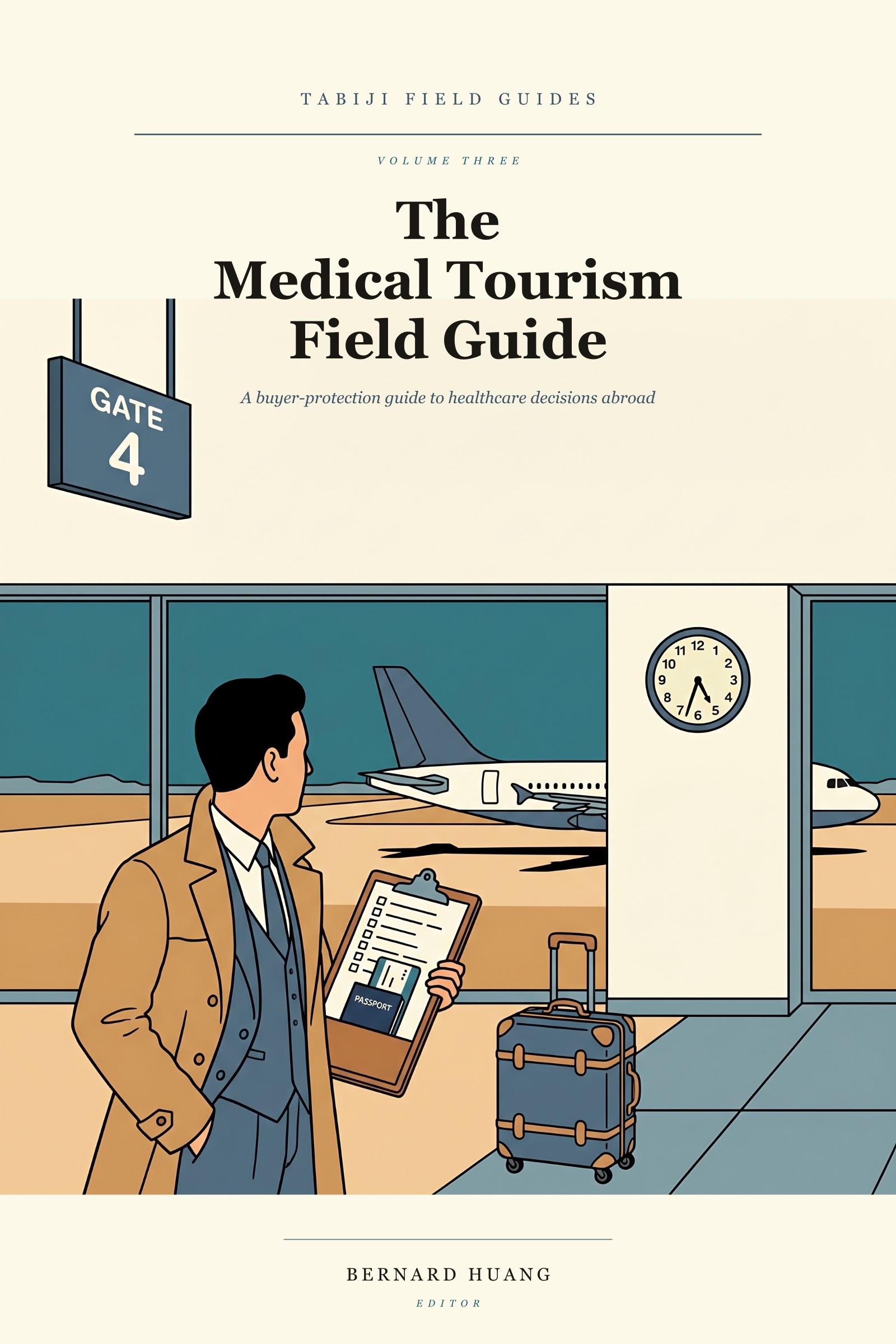
The Medical Tourism Field Guide — front cover

Inside this book

A preview of three chapters — the safety pause that comes before any deposit, the self-test that decides whether to proceed, and the telemedicine second-opinion path that makes a defensible cross-border decision possible.

5 Rules 7 Leverage Points 9 composite scenarios 20 worksheets in back matter
Chapter · Front Matter

The 20-Minute Safety Pause

Eight questions to answer before any deposit, contract, or flight. The questions take twenty minutes. They prevent the most documented patterns of harm in cross-border medical care. The Safety Pause is designed for the reader whose stomach dropped at a number on a sheet of paper, who has a facilitator replying within minutes, and who needs to interrupt momentum right now…

Pattern: Slow down before the money moves — eight questions, twenty minutes.
From the front matter. Companion: the Decision Gate that comes at the end.
Chapter · Chapter 10

Is Medical Tourism the Right Answer for Me?

A 20-question self-test (Worksheet 13) that sorts readers into three categories: proceed with research, pause and reconsider, or seek a different decision pathway. The honest answer for some readers is no. The honest answer for others is yes. Both answers are useful. The test is designed to be taken alone at the kitchen table, with a pen, before any phone call to a clinic or facilitator…

Red flag: if the answer to the self-test is "pause," the next chapter is not a clinic — it is a second-opinion call.
From Chapter 10. For some readers the answer is no. That answer is useful.
Chapter · Chapter 15

Telemedicine Second Opinions from US Academic Centers

Cleveland Clinic Online Medical Second Opinion, Mayo Clinic Online Second Opinion, MD Anderson, MSK International, Mass General Brigham International, Johns Hopkins International. $900–$2,500 per case, 7–14 day turnaround. The independent specialist agreement (or disagreement) in writing that makes a defensible cross-border decision possible…

Pattern: For most readers, the right answer is a $1,500 second opinion before a $20,000 surgery — not after.
From Chapter 15. The six US academic centers, the application path, what each delivers.

The Procedure Complexity Ladder

Not every cross-border medical decision is the same decision. The Procedure Complexity Ladder scales the verification work to the stakes — from a single-tooth consult to complex inpatient surgery. The five rungs the book teaches you to read for, with the verification depth each one demands.

🩺 Step 1 — Low-surprise visits
👁 Step 2 — Outpatient single-procedure
🦷 Step 3 — Outpatient multi-procedure
🦵 Step 4 — Inpatient with implants / GA
❤️ Step 5 — Major combination / complex inpatient

Why tabiji.ai writes these books

The Medical Tourism Field Guide is the foundation volume of the Tabiji Field Guides series — the book a careful adult reads before picking a procedure or a country. Framework before destination. The Tabiji method names where the leverage shifts in a cross-border medical decision, and gives you the questions, scripts, and worksheets that put leverage back on your side.

🧭

Foundation volume of the series

The framework that applies before you've picked a procedure. The Five Rules, the Seven Leverage Points, the Procedure Complexity Ladder, the 20-Minute Safety Pause. Read this volume first; the procedure-specific Dental and Cosmetic Surgery field guides go deeper once you know which category you are in.

🏥

Telemedicine second opinions

Framed as the right answer for most readers. Cleveland Clinic, Mayo, MD Anderson, MSK International, Mass General Brigham International, Johns Hopkins International. $900–$2,500 for an independent specialist opinion in writing before a multi-thousand-dollar deposit. The book teaches you which center fits which case and how to apply.

🛡

No clinic payments. Ever.

Tabiji accepts no payments from clinics, surgeons, anesthesia providers, facilitators, manufacturers, or insurers. The royalties pay for the next book. The body is yours. The decision is yours. The book is the second pair of eyes.

Part of the Tabiji Field Guides Series

The Tabiji Field Guides are buyer-protection manuals for cross-border healthcare decisions. Volume Three is the foundation. The procedure-specific volumes go deeper once you know which category you are in.

Frequently asked

Quick answers about formats, audience, editorial position, and the Tabiji method.

What formats will this book be available in?

Amazon Kindle eBook ($9.99) and paperback ($19.99). The paperback runs ~287 pages, 6 by 9 inches — designed to sit at the kitchen table during the decision and travel in the records folder once it has been made.

Who is this book written for?

Five reader segments. The cost-crisis reader hit by an insurance denial, deductible, or coverage cliff. The diaspora reader considering care in a country of origin, where family is and language is native. The chronic-condition reader evaluating medical tourism as a portfolio decision across multiple procedures. The adult child researching options for a parent. The exploratory reader who has heard from a friend, read an article, or scrolled an Instagram ad and is asking the earlier question of whether medical tourism is a reasonable answer at all.

Does the book ever recommend against medical tourism?

Yes. The book identifies a small number of patterns where the CDC, FDA, and State Department evidence is strong enough that it recommends against. It also includes a 20-question self-test (Worksheet 13) that sorts readers into proceed-with-research, pause-and-reconsider, or seek-a-different-pathway. For some readers the honest answer is no. Both answers are useful.

When does it launch?

Available now on Amazon — both Kindle and paperback. Tap the buy button above to grab it.

What's the Tabiji method?

Framework before destination. The book teaches a decision architecture — the Five Rules, the Seven Leverage Points, the Procedure Complexity Ladder — that applies before you've picked a procedure or a country. The Tabiji method names where the leverage shifts in a cross-border medical decision, and gives you the questions, scripts, and worksheets that put leverage back on your side. No payments accepted from clinics, surgeons, anesthesia providers, facilitators, manufacturers, or insurers.

Reviews

Verified reader reviews appear here once the book is on Amazon.

First reviews coming soon

The Medical Tourism Field Guide is now live on Amazon — verified reader reviews will be quoted here as they accumulate over the first weeks. In the meantime, see the 42+ verified reviews across the country atlases.

Available now on Amazon

The Five Rules. The Seven Leverage Points. The Procedure Complexity Ladder. A 20-Minute Safety Pause. Nine composite scenarios. Twenty worksheets. $9.99 on Kindle, $19.99 paperback. The body is yours. The decision is yours. The book is the second pair of eyes.

Buy on Amazon →