
Key Takeaways
- The #1 reported scam is the Antigua Parque Central ATM Skimming Ring.
- 4 of 6 scams are rated high risk.
- Use app-based ride services (Uber, DiDi) instead of street taxis — avoid unmarked vehicles, especially at night.
- Never accept unsolicited offers from strangers near tourist sites in Antigua Guatemala.
⚡ Quick Safety Tips
- Keep phones and valuables in secure pockets when in crowded areas.
- Use only licensed taxis or app-based ride services.
- Book tours and tickets through verified operators with online reviews.
- Keep a copy of your passport separate from the original.
Jump to a Scam
The 6 Scams
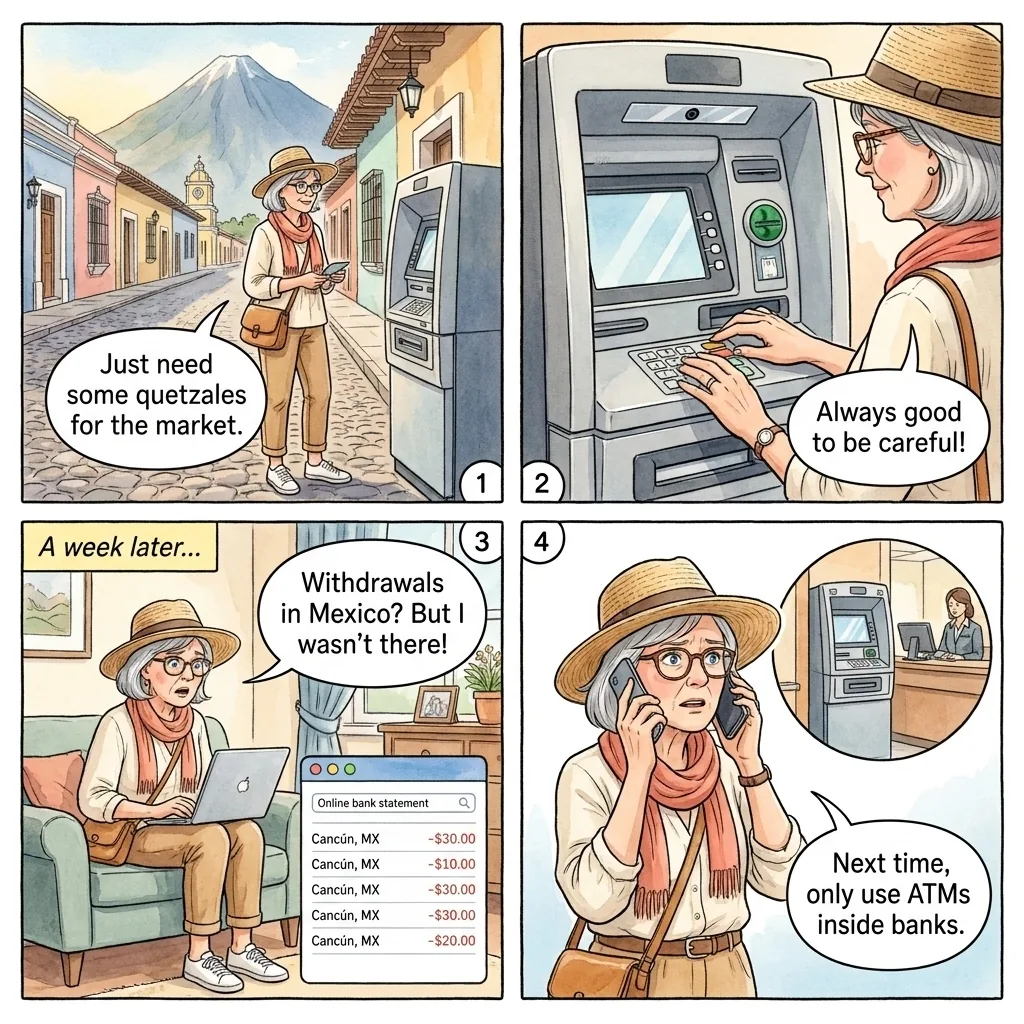
You walk to an ATM around the corner from Parque Central in Antigua, slot in your debit card, and withdraw 1,500 quetzales for the week ahead.
Everything looks normal. The screen prompts in Spanish and English, the cash dispenses cleanly, you cover the keypad with your hand as you have always been taught. You pocket the bills and walk back to your hostel for breakfast. The transaction feels like every other ATM withdrawal you have done in Latin America — completely uneventful.
A week later, back home, you notice three unauthorized withdrawals from your account totaling roughly $2,400 — all made from ATMs in Mexico City and Cancún, two days after you left Guatemala. The card was skimmed at the Antigua ATM. A cloned card was produced from your captured chip data, and the recorded PIN (lifted by a pinhole camera positioned above the keypad despite your hand-cover) gave the criminals everything needed to drain the account elsewhere.
ATM skimming in Antigua Guatemala is well-documented across Reddit, the U.S. Embassy in Guatemala City's traveler advisories, the long-running TripAdvisor Guatemala forum, and the U.S. State Department's Guatemala-specific consumer warnings. Free-standing ATMs around Parque Central, the machines inside La Bodegona supermarkets (Antigua's largest grocery chain), and the corner ATMs on the side streets fanning out from the plaza are the consistent hotspots. Skimmer crews rotate machines weekly to stay ahead of bank security sweeps.
A second variation involves the card-trap overlay, where a thin plastic sleeve traps your dispensed cash or your card itself in the slot. A 'helpful' bystander (sometimes a local skimmer crew member) appears, suggests entering your PIN again to release it, then walks off with both your card details and (after you give up) the trapped contents. The give-away is that ATMs do not, ever, ask you to enter your PIN twice in a single transaction.
Use ATMs only inside trusted bank branches in Antigua — Banrural and BAM (Banco Agromercantil) on 4a Calle Poniente have indoor ATMs in their branches with security cameras and staff supervision. Avoid free-standing Euronet machines and the in-grocery-store ATMs entirely. Tug the card-slot bezel before inserting; a skimmer often wiggles or sits proud of the metal. Cover the keypad with your other hand every single time you enter a PIN, and set up real-time transaction alerts on your banking app. If you suspect skimming, dial 110 (Guatemalan Police), call ASISTUR (Tourist Police) at +502 2290-2810, freeze your card immediately, and dispute via your card issuer.
Red Flags
- The card reader slot looks different from others at the same bank
- There's a loose overlay on the keypad
- The ATM is in an unmonitored public location
- You notice something attached above the screen area
- The machine takes unusually long to process your transaction
How to Avoid
- Only use ATMs inside trusted bank branches like Banrural or BAM.
- Cover the keypad with your hand while entering your PIN.
- Set daily withdrawal limits and real-time transaction alerts.
- Wiggle the card slot before inserting — skimmers are often loose.
- Carry enough cash from a safe ATM to avoid multiple withdrawals.
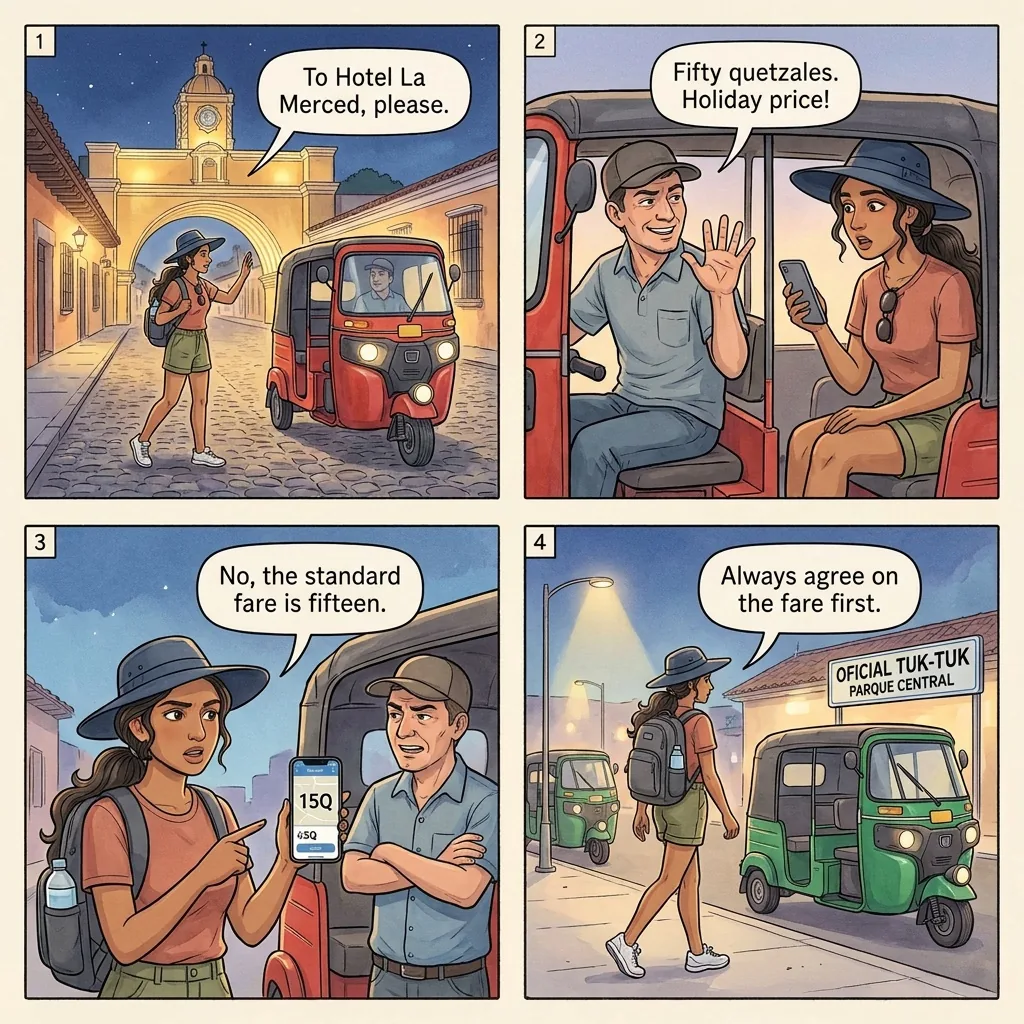
You flag down a tuk-tuk near the iconic Arco de Santa Catalina at 9 p.m., asking for a ride to your hotel near La Merced — a five-minute drive across the colonial grid of Antigua.
The driver names a price of 50 quetzales (about $6.50) without you asking. The legitimate fare for any in-town tuk-tuk ride in Antigua runs 10–15 quetzales ($1.30–2), and the locals you watched climb out of the same driver's tuk-tuk five minutes earlier paid 10. The 50-quetzal quote is roughly four times the local rate, calibrated to the moment when the alternative (walking back through dimly lit cobblestone streets after dark) feels less appealing.
If you protest, the driver shrugs and starts inventing surcharges. It is raining, even when it isn't. It is Semana Santa, even when it's August. It is a holiday, the meter doesn't work after 8 p.m., the route is longer because of one-way streets, the price is per person not per vehicle. Some drivers also try to renegotiate the fare mid-ride: 'oh, I forgot, that hotel is in zone 2, that's 20 quetzales extra.' By the time you arrive, the bill has crept from 50 to 70 quetzales.
The Antigua tuk-tuk overcharge pattern is documented across Reddit, the long-running TripAdvisor Antigua forum, and most updated guidebooks. The pattern intensifies during Semana Santa (Holy Week, March/April) when tourist density peaks, and on weekend nights when alternative transport thins. Honest tuk-tuk drivers do exist (the local cooperative drivers who park at Parque Central typically charge fairly), but the freelance gougers concentrate at tourist-corner pickup spots and the late-night bar district near 5a Avenida Norte.
A second variation works in reverse. Some drivers quote a low fare to undercut competitors at the rank, then 'discover' a route problem (one-way street, traffic, a 'special detour') that justifies a higher fare on arrival. The classic countermove is to know the legitimate rate and have exact change ready in small bills, removing both the negotiation surface and the 'I don't have change for that' ploy.
Always agree on the price before getting in — 10–15 quetzales for any in-town ride is the local rate, 20 quetzales is the upper limit even for longer routes within Antigua. Ask your hotel or hostel for the standard rate to your destination before you walk to the rank, and have exact change ready in small bills. If a driver quotes more than 20 quetzales for a normal in-town ride, walk to the next driver — there are dozens. For longer destinations (San Pedro Las Huertas, Cerro de la Cruz), confirm the price plus any return arrangement upfront. If a driver renegotiates mid-ride or invents surcharges, refuse the inflated amount and call ASISTUR at +502 2290-2810.
Red Flags
- Driver quotes a price without you asking first
- Fare is more than triple what locals pay
- Driver invents surcharges for rain, time of day, or holidays
- They try to renegotiate the price during or after the ride
- Driver avoids the direct route to run up the fare
How to Avoid
- Always agree on the price before getting in — 10-20 quetzales covers most rides in town.
- Ask your hotel or hostel what the fair tuk-tuk rate is.
- Have small bills ready so you can pay exact change.
- Walk away from the first driver and try another if the price is high.
- For longer distances, use a proper taxi or pre-arranged transport.
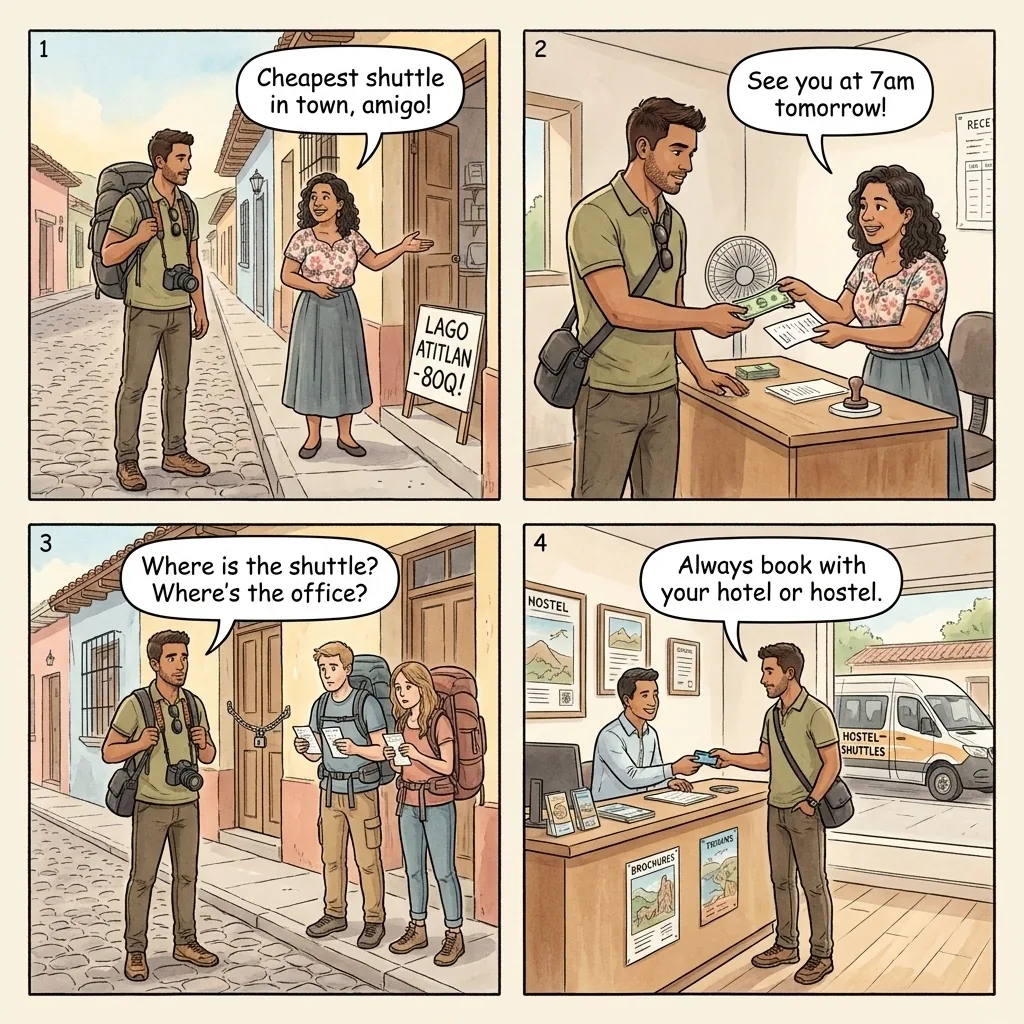
You wander into a small travel agency on a side street near Parque Central to book a shuttle to Lake Atitlan, Semuc Champey, or Tikal — the standard backpacker circuit from Antigua.
The office has a printed sign, a few brochures on the counter, and a friendly woman at the desk who quotes 80 quetzales (about $10) for a Lake Atitlan shuttle — well below the 130-quetzal rate the established agencies charge. You pay in cash, she writes you a handwritten receipt with a stamp, and tells you to be at the corner outside her office at 7 a.m. the next morning with your bag.
In the morning, no shuttle appears. You wait fifteen minutes, then thirty. You walk back to the agency. The door is locked, the brochures are gone, and the small sign that was in the window yesterday is gone too. Other tourists are gathering on the same corner, holding the same handwritten receipts, looking at the same locked door. Within an hour the cluster realizes what happened — the agency was a pop-up operation that ran for a week or two, collected cash from tourists, and vanished.
The phantom travel agency pattern is documented across Reddit, the TripAdvisor Antigua forum, and the U.S. Embassy in Guatemala City's traveler-safety advisories. Documented cases include Vela Travel Agency (multiple backpackers scammed before being reported on TripAdvisor), and the same pattern repeats every few months as new operators rotate in. Side streets near Parque Central, 5a Avenida Norte, and the corner stalls along 6a Avenida are the consistent locations.
A second variation involves established-looking agencies that genuinely run shuttles but on under-licensed vehicles with poor safety standards. The shuttle does arrive, but the driver is uninsured, the vehicle has no operating permit, and any accident or breakdown leaves passengers with no recourse. The shuttle network in Guatemala has serious documented safety issues — the legitimate operators (Adrenalina Tours, GuateGo, Atitrans) maintain proper insurance and licensing.
Book shuttles through your hotel or hostel directly, or through established and well-reviewed operators (Adrenalina Tours, GuateGo, Atitrans) that have years of TripAdvisor history, websites with proper booking systems, and credit-card payment for chargeback protection. Avoid any agency that demands cash, hands you a handwritten receipt, or quotes 30%+ below the established rate. Take photos of the office front, the receipt, and the staff member if you do pay cash. Verify the operator on TripAdvisor and Google before booking. If you have already paid a phantom agency, dispute via your card issuer (if applicable) and report to ASISTUR at +502 2290-2810.
Red Flags
- Cash-only payment with a handwritten or unofficial receipt
- The agency has no website, no Google presence, or very few reviews
- Prices significantly below what established agencies charge
- The office feels temporary — no signage, no business license displayed
- They pressure you to book immediately with a 'today only' discount
How to Avoid
- Book shuttles through your hotel, hostel, or well-established agencies like Adrenalina Tours or GuateGo.
- Pay with a credit card when possible for chargeback protection.
- Check TripAdvisor and Google reviews before booking with any agency.
- If paying cash, take photos of the receipt and office front.
- Be suspicious of agencies that aggressively solicit on the street.
Like what you're reading? Get a full Antigua Guatemala itinerary with safety tips built in.
Browse travel-safety books →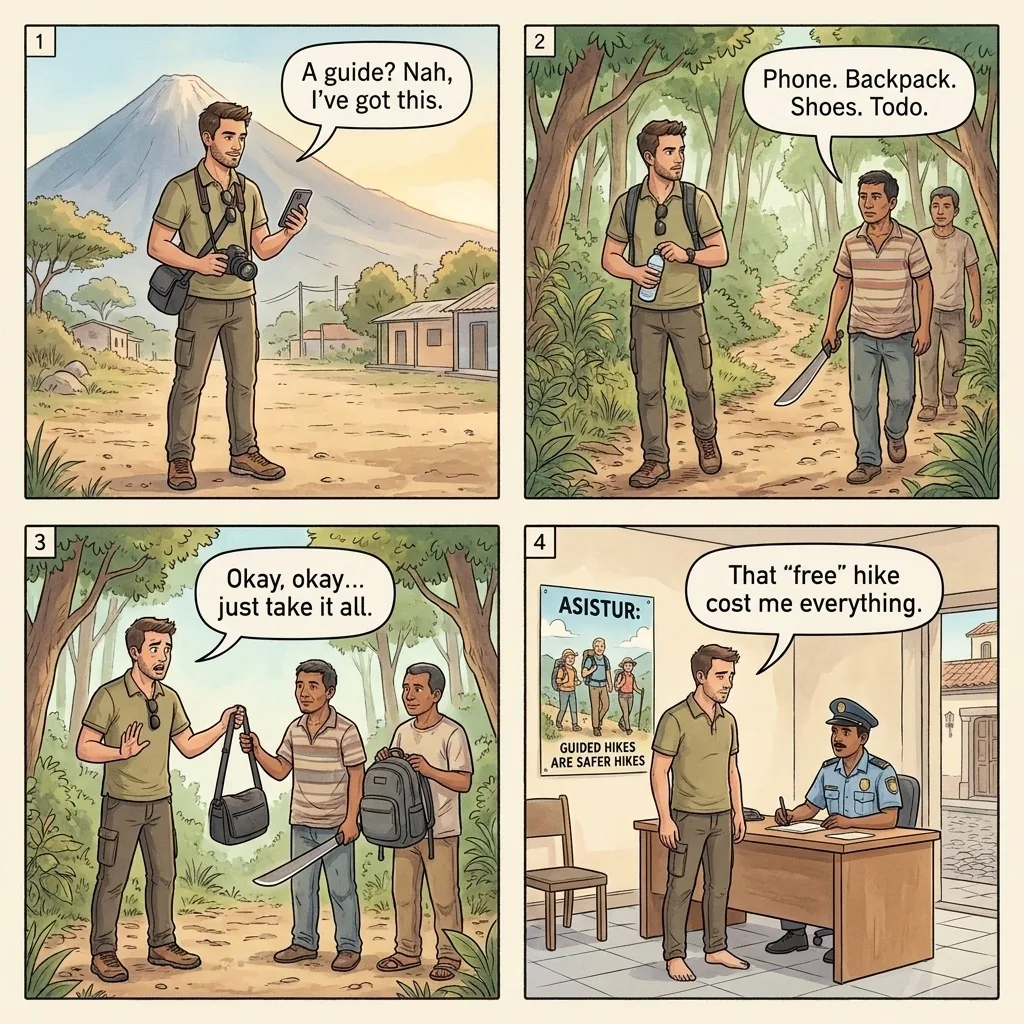
You decide to hike Volcán de Agua independently to save the $60 guided-tour fee, leaving Antigua at 6 a.m. with a daypack, water, and your phone for the GPS track.
The trail starts in Santa María de Jesús, a village at the volcano's base, and you take a chicken bus there. The first kilometer of trail is well-marked and you pass a few other hikers. By the time you have climbed for an hour the trail has thinned, the trees are dense, and you are alone. You stop briefly to drink water and check your phone.
Two men step out from the trees twenty meters ahead. They are calm, not angry, and one of them holds a long machete loosely at his side. They demand your backpack, your phone, your cash, your watch, and your shoes. The whole encounter lasts perhaps three minutes. They take what you have, walk back into the trees, and disappear. You walk down to Santa María de Jesús in your socks, eventually borrow a phone to call a tuk-tuk back to Antigua, and report the robbery to ASISTUR — who tell you these incidents happen multiple times a year on this exact trail.
Volcano-trail robberies near Antigua are well-documented by the U.S. State Department, the Guatemalan Tourism Institute (INGUAT), ASISTUR, and Reddit. Volcán de Agua specifically is considered the highest-risk volcano in the area for unaccompanied hikers, with multiple assault reports each year going back at least a decade. San Pedro Volcano (above Lake Atitlan), the remote sections of the Acatenango approach, and parts of Pacaya have also seen documented incidents. The trails outside the most-trafficked guided routes lack any meaningful police presence.
Even guided groups have been targeted on remote sections, though small armed-tourist-police escorts (Tourist Assistance Patrol) now accompany the largest organized Acatenango overnight tours during peak season. The honest fix is structural: hike volcanoes only with INGUAT-approved tour operators in groups of 8+, carry only what you can afford to lose, and check ASISTUR's current trail safety advisories before any volcano hike near Antigua.
Never hike volcanoes near Antigua alone — always book through INGUAT-approved tour operators (Old Town Outfitters, OX Expeditions, Tropicana Hostel tours) in groups of eight or more. Check ASISTUR's current trail safety reports at +502 2290-2810 before any volcano hike, especially Volcán de Agua. Carry only what you can afford to lose: leave passport, primary cards, and most cash at your hotel safe; bring a cheap phone, a copy of your passport, and a small amount of cash. Acatenango (the most popular overnight tour) has the best security infrastructure of the volcano hikes and is the safer choice for most travelers. If robbed, do not resist; comply, report to ASISTUR immediately at +502 2290-2810.
Red Flags
- Locals or hostel staff warn you not to hike a particular trail alone
- The trail has no other hikers and feels isolated
- You see people loitering at the trailhead who aren't hikers
- A cheap tour company offers unguided volcano hikes
- No police or tourism checkpoint at the start of the trail
How to Avoid
- Never hike volcanoes near Antigua alone — always use a certified guide with a group.
- Book through INGUAT-approved tour operators.
- Check with ASISTUR (Guatemala's tourism police) for current trail safety reports.
- Carry only what you can afford to lose — leave valuables at your hotel.
- Hike Acatenango instead, which has better security infrastructure.
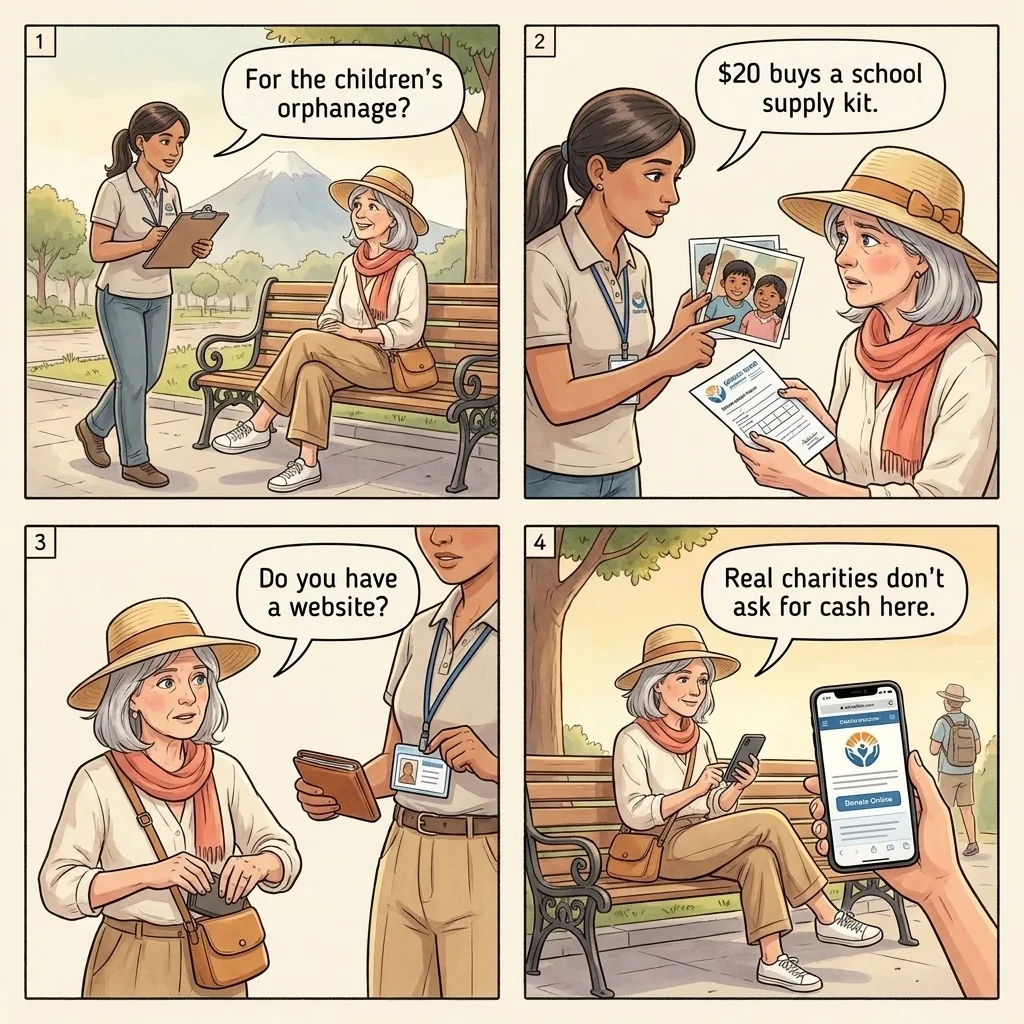
A woman in a clean polo shirt with a clipboard and a laminated ID approaches you on Parque Central as you sit on a bench in the afternoon.
She explains in fluent English that she is collecting donations for a children's orphanage in San Lucas Sacatepéquez, or for earthquake relief, or for a church renovation at La Merced — the cause rotates. She holds out laminated photos of children, a printed donation form with names already filled in, and a quote in dollars: 'just $20 for a school supply kit, $40 for a child's monthly meals.' Her tone is warm and professional.
The orphanage does not exist. The 'charity' has no website, no Guatemalan registration number on the form, no formal connection to any real NGO. The laminated ID is generic, photographed and printed in any of Antigua's small print shops. The same woman cycles between Parque Central, the steps outside the Cathedral, and the corner near La Merced throughout the day, switching causes depending on the demographic she identifies.
The Antigua fake-charity pattern is documented across Reddit, the TripAdvisor Antigua forum, and ASISTUR's consumer-protection materials. Real Guatemalan charities — Common Hope, Niños de Guatemala, As Green As It Gets, and the Mayan Families network — do not solicit cash donations on Antigua streets; they accept donations only through their official websites or at named offices with verifiable addresses. The 'sob story' framing with laminated photos is the consistent tell.
A second variation involves men dressed as Catholic priests or nuns approaching tourists outside La Merced and the Cathedral. Real Catholic clergy do not solicit cash from tourists on the street — donation boxes inside the churches are the official channel. The clerical-costume version is consistently flagged in U.S. Embassy advisories as part of the fake-collector ecosystem rather than genuine religious solicitation.
Never hand cash to any street solicitor in Antigua, regardless of laminated IDs, clerical costumes, or emotional photos. Politely say 'no gracias' and keep walking. If you genuinely want to support Guatemalan children, donate online to Common Hope (commonhope.org), Niños de Guatemala (ninosdeguatemala.org), or As Green As It Gets (asgreenasitgets.org) — all three are vetted, transparent, and produce annual reports. Real charities never solicit cash on the street. If a 'collector' is aggressive or follows you, dial 110 (police) or call ASISTUR at +502 2290-2810.
Red Flags
- Unsolicited approach with an emotional story and request for cash
- They carry laminated cards or photos but no verifiable organization name
- They only accept cash, not bank transfers or donations to a website
- They become pushy or guilt-trip you when you hesitate
- You see the same person collecting at different locations on different days
How to Avoid
- Never give cash to street solicitors — donate directly to verified organizations.
- Ask for the charity's website or registration number and verify it later.
- Politely say 'no gracias' and keep walking.
- If you want to help, donate to established NGOs like Common Hope or Ninos de Guatemala.
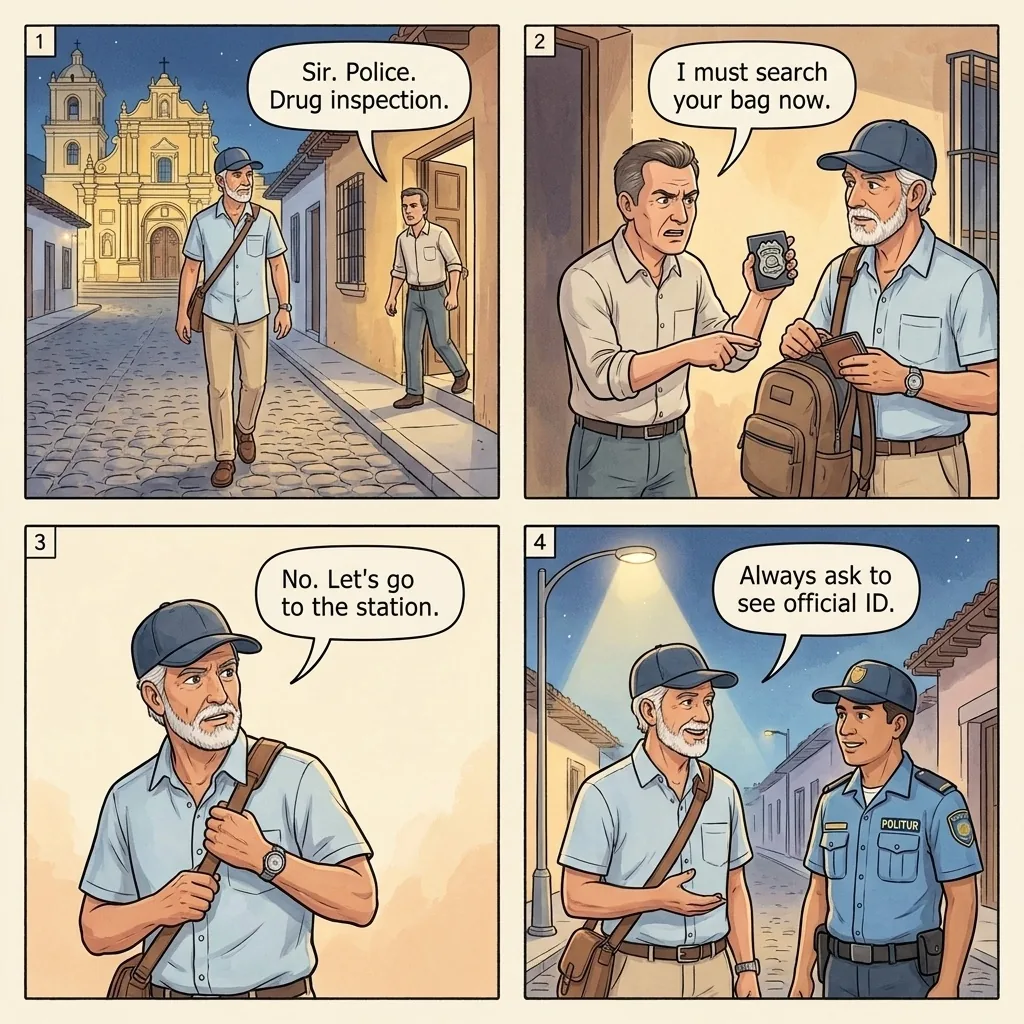
You walk back to your hotel through the quiet side streets near La Merced at 11 p.m. when a man in plain clothes steps out of a doorway, flashes a metal badge, and identifies himself as a drug enforcement officer.
He is calm, professional, and businesslike. He explains in fluent English that there has been a drug trafficking incident in the neighborhood and that he needs to search your bag and check your documents. The badge flips closed before you can read the unit name clearly. He gestures at your daypack and says 'rapido, por favor' as if the entire interaction is routine.
If you comply, two things happen. He searches your bag and during the rummage steals your valuables — phone, cash, sometimes a passport. Or he 'finds' something suspicious he says is yours (a small bag of white powder, some pills) and demands a cash 'fine' on the spot to make the problem go away. The fines start at $200 and grow to whatever cash you have visible. Some impersonators escalate to forcing you to walk to an ATM under their supervision.
The U.S. State Department, ASISTUR, and INGUAT have all warned about criminals impersonating Guatemalan police near Antigua and on the highways out of town. Reddit carries first-person accounts going back years. The pattern is most aggressive on remote roads (the Antigua–Guatemala City highway, the route to Lake Atitlan via Chimaltenango) and on quiet side streets in Antigua after dark. The 'plain-clothes drug enforcement' framing is the most common variant.
Real Guatemalan police — Policía Nacional Civil — wear visible uniforms with name tags and badge numbers, carry properly issued PNC identification with photo and unit, and operate from marked vehicles. Plain-clothes officers do exist but very rarely engage tourists on the street, and on the rare occasions they do, they hold their ID open for as long as you need to read it and immediately escalate to a marked station rather than searching you on the spot.
Refuse any plain-clothes 'police' search on the street in Antigua — real PNC officers do not search tourists for drugs in side streets at night. Ask politely but firmly to see formal ID with a name and badge number, photograph it before it closes, and offer to walk together to the nearest PNC station to verify (Comisaría on 4a Calle Poniente in Antigua). If they walk away when you propose this, the impersonation is confirmed. Never hand over your wallet, passport, or bag for 'search,' and never withdraw cash under pressure. If pressured aggressively, dial 110 (PNC), 1500 (emergency), or call ASISTUR (Tourist Police) directly at +502 2290-2810.
Red Flags
- A plainclothes person flashes a badge and demands to search you on the street
- They approach you in an isolated area with no witnesses
- They refuse to identify their unit or go to a police station
- They specifically ask to check your wallet or bag contents
- They mention drugs or claim you're suspected of a crime
How to Avoid
- Ask to see proper police ID and insist on going to a nearby station.
- Call ASISTUR tourist police at (502) 2290-2810 if something feels wrong.
- Never hand over your passport or wallet to someone on the street.
- Travel on main roads and avoid unlit side streets after dark.
- Keep a photocopy of your passport and leave the original in your hotel safe.
🆘 What to Do If You Get Scammed
📋 File a Police Report
Go to the nearest ASISTUR (Tourist Police) office or Policía Nacional Civil (PNC) station. Call 110 (Police) or 1500 (Emergency), or ASISTUR direct at +502 2290-2810. Get an official crime report — you'll need this for insurance claims.
💳 Cancel Your Cards
Call your bank immediately. Most have 24/7 numbers on the back of the card (keep a photo saved separately). Block any suspicious transactions before the thieves use your details.
🛂 Lost Passport?
Contact your nearest embassy or consulate. The US Embassy is at 33 Nine Elms Lane, London SW11 7US. For emergencies: +44 20 7499 9000.
📱 Track Your Device
If your phone was stolen, use Find My (iPhone) or Find My Device (Android) from another device. Don't confront thieves yourself — share the location with police instead.
Frequently Asked Questions
You just read 6 scams in Antigua Guatemala. The full Travel Safety Series has 780+ more across 20+ countries.
Tokyo's Kabukichō ¥130,000 bar trap. Rome's gladiator photo extortion. Paris's gold-ring trick. Bali's ATM skimmer scams. Bangkok's grand-palace closure ruse. Every documented scam across 20+ destinations — with the exact scripts, red flags, and local-language phrases that shut each one down. Drawn from Reddit traveler reports, embassy advisories, and consumer-protection cases.
- 780+ documented scams across Tokyo, Rome, Paris, Bali, Bangkok, Rio & 100+ more cities
- 20+ countries covered, with country-by-country phrase cards for every destination
- Updated annually — buy once, re-download future editions free
- All titles $4.99 each on Amazon Kindle