
Key Takeaways
- The #1 reported scam is the Old Havana Jinetero Commission Tour.
- Most scams in Havana are low-to-medium risk.
- Negotiate taxi fares before departure and use official yellow taxis or your hotel’s recommended transport.
- Never accept unsolicited offers from strangers near tourist sites in Havana.
⚡ Quick Safety Tips
- Only use official yellow taxis or negotiate with classic car drivers before getting in — unlicensed taxi drivers overcharge dramatically.
- At restaurants and paladares, confirm if prices are in CUP (Cuban pesos) or USD — some menus show CUP prices but charge USD.
- Ignore jineteros (hustlers) who approach offering cheap cigars, restaurants, or casa particular recommendations — they earn commissions that inflate your price.
- Buy cigars only from official La Casa del Habano shops — street cigars are almost always counterfeit, even when they look authentic.
Jump to a Scam
The 6 Scams
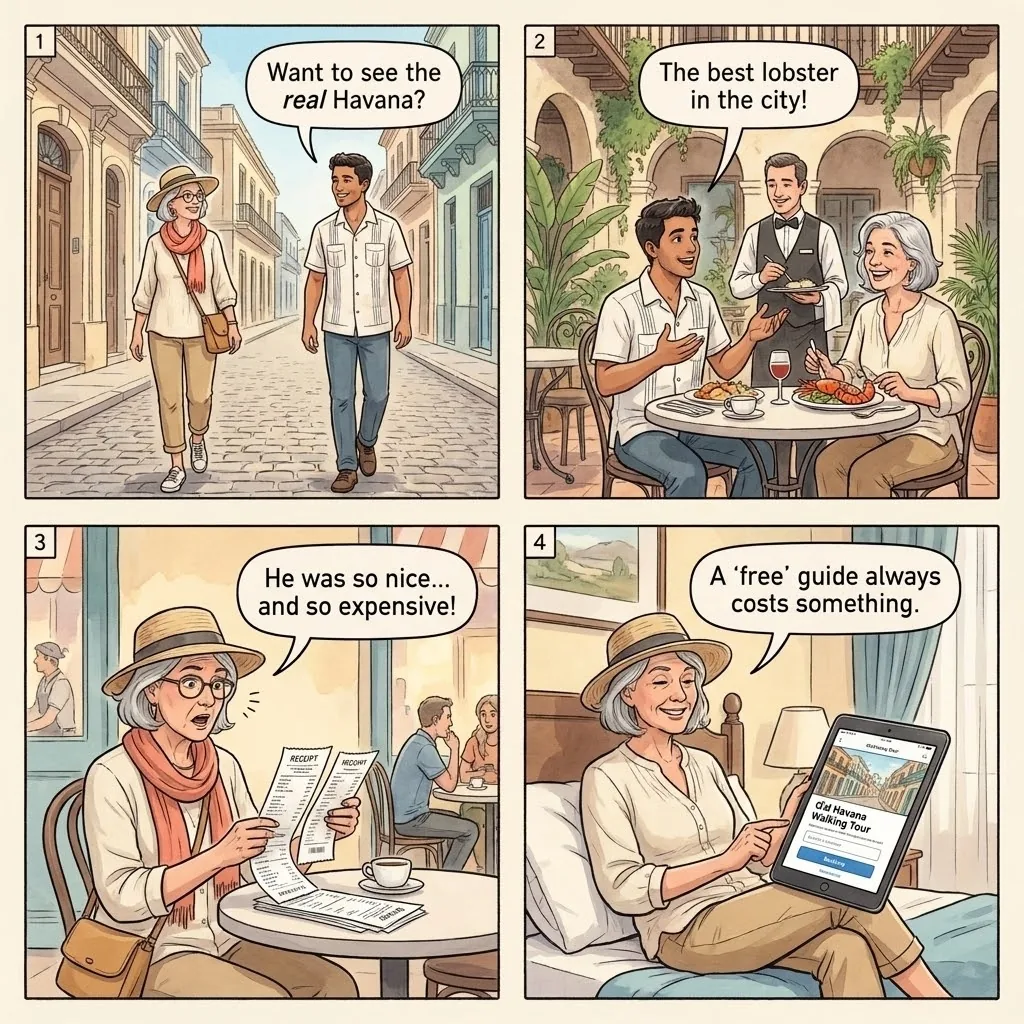
A friendly young Cuban man falls into step with you on Calle Obispo on your first afternoon in Havana, asks where you are from, mentions he is studying English, and offers to show you 'the real Havana, not the tourist stuff.'
His warmth feels effortless. He walks you a few blocks to a paladar (private restaurant) tucked above a courtyard, says the lobster here is the best in Havana, and orders for you in Spanish. The food is fine, the bill comes to 60 CUC equivalent (about $60) for two — high but not unreasonable for a holiday meal. From there he steers you to a rooftop rum bar with a view of the Capitolio, then to a small cigar shop where his 'cousin' offers you a deal on a box of Cohibas, then to a salsa bar where the cover charge appears at the door.
By the end of the afternoon you have spent perhaps $180–250 across the four stops, you have had a genuinely fun day, and your new friend disappears with a hug. What you do not know is that every single venue paid him a 10–25% commission on what you spent — the lobster paladar was overpriced for what it served, the rum bar was a tourist-rate bar with locals nowhere in sight, the 'cousin' cigar shop is one of dozens that pay jineteros for delivered customers, and the salsa cover went straight to him.
'Jinetero' is the Cuban term for the tourist-hustler — the word loosely translates as 'jockey' and describes someone who 'rides' tourists for commission. Jineterismo is documented across every Cuba guidebook, on Reddit, and in the U.S. State Department's Cuba traveler-safety page. The hustle is rarely aggressive — most jineteros are charming, helpful, and will defend the day as a fair exchange — but the pricing model means an informed traveler would have spent perhaps a third of what you did for the same experiences.
A second variation is darker. Some jineteros pivot from the tour to a romantic-encounter pitch ('my friend really likes you, she would love to meet you tonight'), which segues into either an escort service or a setup where the encounter ends at a paid 'private apartment' or in a venue staged for theft. The U.S. Embassy in Havana flags this variant in particular for solo male travelers.
It is fine to chat with locals on Calle Obispo or near the Malecón — the conversation is often genuine — but know that anyone who immediately starts steering you to specific restaurants, bars, cigar shops, or 'cousin' venues is working on commission. Research paladares and bars in advance on Tripadvisor's Cuba forum or Reddit (La Guarida, Doña Eutimia, El Del Frente, Sloppy Joe's are reliable starting points), check menu prices before ordering, and pay each venue separately so the commission flow is visible. Never accompany a new acquaintance to a private apartment or 'friend's place.' If a tour turns coercive, dial 106 for police and call the U.S. Embassy in Havana at +53 7 839 4100 (or your country's equivalent).
Red Flags
- Friendly local approaches you specifically near tourist zones
- Offers a 'local experience' but every stop is a business
- Deflects when you try to navigate somewhere yourself
How to Avoid
- It's fine to chat and explore, but know that most jineteros work on commission.
- Research restaurants and bars in advance on Cuba travel forums.
- Walk away from 'guides' who seem to steer rather than accompany.
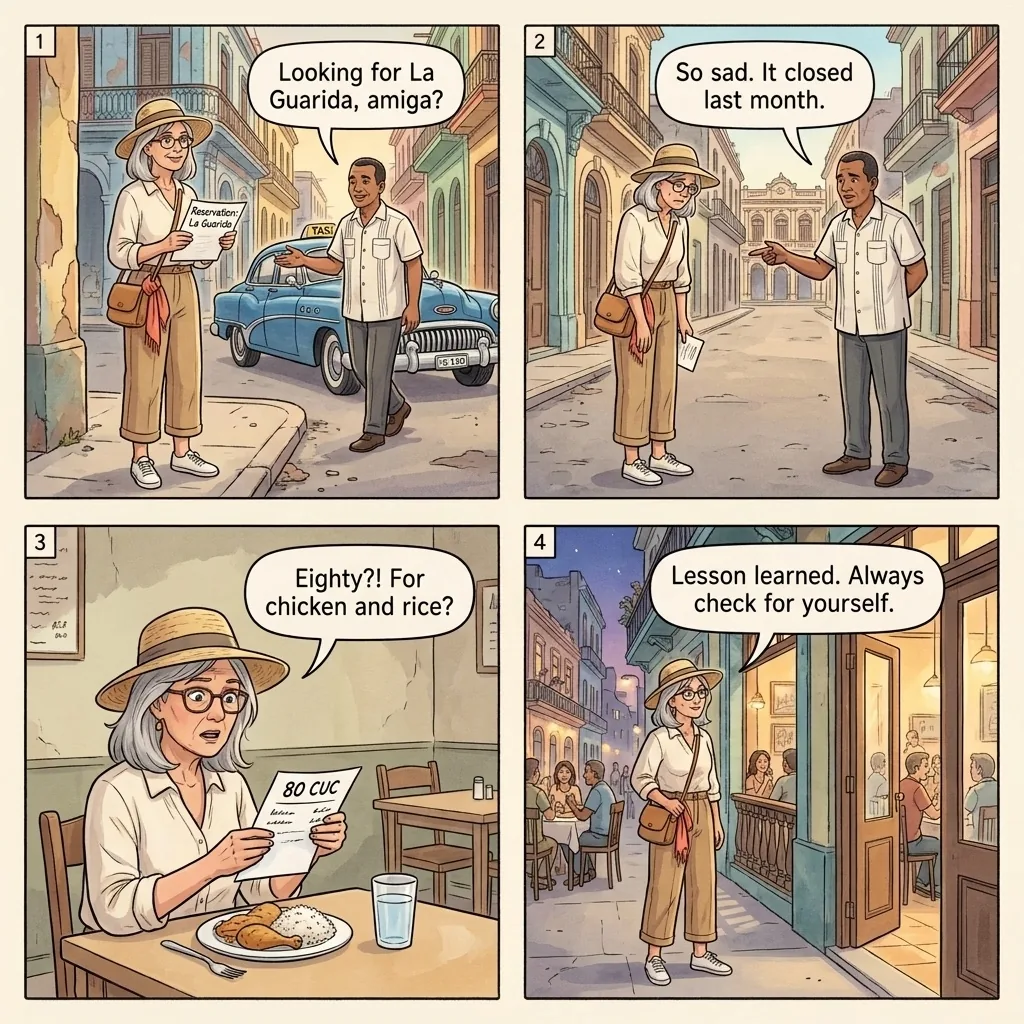
You are walking through Centro Habana toward La Guarida — the famous paladar in a faded mansion you booked weeks ago — when a man on the corner of San Lázaro stops you and asks if you are looking for the restaurant.
You say yes. He shakes his head sadly and tells you La Guarida closed last month after a health inspection — very sad, the owner moved to Miami, no one knew. He gestures up the street and says he knows a paladar 'just as good, maybe better,' run by his wife's family, only two blocks away. The story is delivered with such matter-of-fact confidence that you almost believe him.
If you follow him, you end up at an unmarked second-floor eatery where the menu is in tourist-priced CUC equivalents, the food is mediocre, and the bill comes to 80–120 CUC for what should have been a 30 CUC paladar dinner. Meanwhile, La Guarida — which you walked past, unknowing — was open the entire evening with your reservation. Your booking, of course, was lost when you did not arrive.
The 'closed restaurant' redirect is the single most common scam in Cuba, documented exhaustively across Reddit, the long-running TripAdvisor Cuba forum, every updated Cuba guidebook, and U.S. State Department Cuba advisories. Nearly every multi-day tourist in Havana experiences at least one attempted redirect, often multiple. The targets are restaurants, hotels, museums, and even the famous Floridita and Bodeguita del Medio bars.
The variant that hurts more involves casas particulares (B&Bs). A tourist arrives at a pre-booked casa with a rolling bag, gets stopped half a block away, is told the casa was closed/condemned/the owner moved to a different street, and is steered to a different unlicensed casa where the cancellation fee on the original booking eats most of the savings. A third variant works at hotel entrances — a 'porter' tells you the hotel is fully booked and walks you to a 'partner property' for a commission.
Always walk to your destination and verify with your own eyes that it is closed before believing any stranger who tells you otherwise — this is the universal rule for Havana. Trust your map and your reservation over any verbal claim. If approached, smile, say 'gracias' and keep walking; do not engage. La Guarida, La Bodeguita del Medio, El Floridita, Doña Eutimia, El Del Frente, Sloppy Joe's, and almost every famous Havana venue have all been the named target of this scam. If you are pressured aggressively, dial 106 for Cuban police.
Red Flags
- Stranger tells you your planned destination is closed before you verify it yourself
- They offer an immediate alternative and want to guide you there
- Story about closure is vague — 'health inspection' or 'the owner moved'
How to Avoid
- Always walk to your destination and check for yourself.
- This is the #1 most common scam in all of Cuba — nearly every tourist experiences it.
- Trust your map over any stranger's advice about what's open.
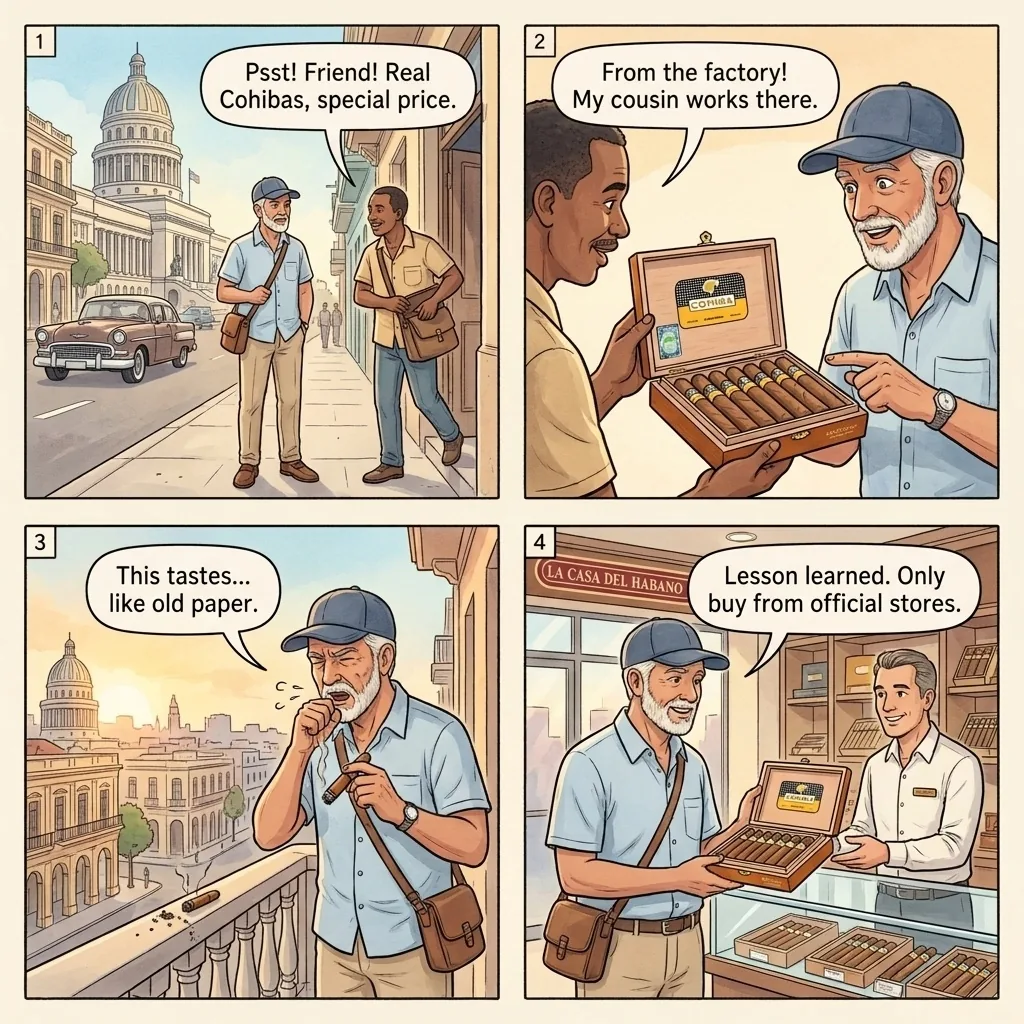
A man steps out of a doorway near the Capitolio with a worn satchel and quietly offers you a box of Cohiba Behikes for $80 — half what they cost at the official La Casa del Habano shops, and he says he works at the factory.
The pitch is calibrated perfectly. He says his cousin is a roller, that this box was 'liberated' from the factory in Pinar del Río, that you are buying direct, no shop markup, no government margin. He opens the box on the spot — the cellophane is intact, the cedar is fresh, the bands look correct, even the green tax seal is in place. The lid carries the embossed Cohiba logo and the holographic 'República de Cuba' sticker. Everything looks right.
It is all fake. The cigars are cheap mass-produced filler in counterfeit packaging, the bands are printed in bulk in workshops outside Havana, and the holographic sticker is a generic security label any vendor can buy in quantity. The cigars themselves smoke flat and harsh — none of the construction, none of the cedar aging, none of the complex finish that makes a real Cohiba worth what the official shops charge. By the time you have figured it out you are home, and the box is worth roughly what scrap tobacco costs.
The 'factory worker' story is a tell. Cuban tobacco workers are state employees, the factories are closely tracked, and there is no plausible mechanism by which a worker could 'liberate' product. The U.S. State Department, the Cuban government, and Habanos S.A. (the official Cuban tobacco monopoly) have all repeatedly warned that any cigars sold outside the licensed Casa del Habano network are counterfeit, full stop. The fakes are documented down to specific Havana street corners.
A second variation runs through 'private factory tours' that some jineteros offer for $20–30 per person. The 'tour' is a back-room operation in a private house with a few rolling tables and a sales pitch at the end for the same counterfeit cigars at slightly more elaborate framing. Real cigar tours in Havana run only through the licensed Partagás, La Corona, and El Laguito factories — bookable through the official Habanos channel.
Buy Cuban cigars only from official La Casa del Habano shops — there are several in Old Havana (Calle Mercaderes, Hotel Conde de Villanueva, Hotel Habana Libre) — or from the duty-free at José Martí Airport on departure. There is no exception, no shortcut, no special deal that produces real Cohibas at half price. If you genuinely want to learn about Cuban tobacco, book an official factory tour through Habanos S.A., not through a stranger on the street. If a vendor pressures you, decline politely and walk to a Casa del Habano.
Red Flags
- Factory worker story — real workers cannot sell product privately
- Price is significantly below official La Casa del Habano shop prices
- Transaction happens on the street or in a doorway
How to Avoid
- Buy cigars only from official Casa del Habano shops — the only guarantee of authenticity.
- Genuine Cohiba at half price from a street vendor is simply not possible.
- If you want to experience Cuban tobacco culture honestly, visit a legal outlet.
Like what you're reading? Get a full Havana itinerary with safety tips built in.
Browse travel-safety books →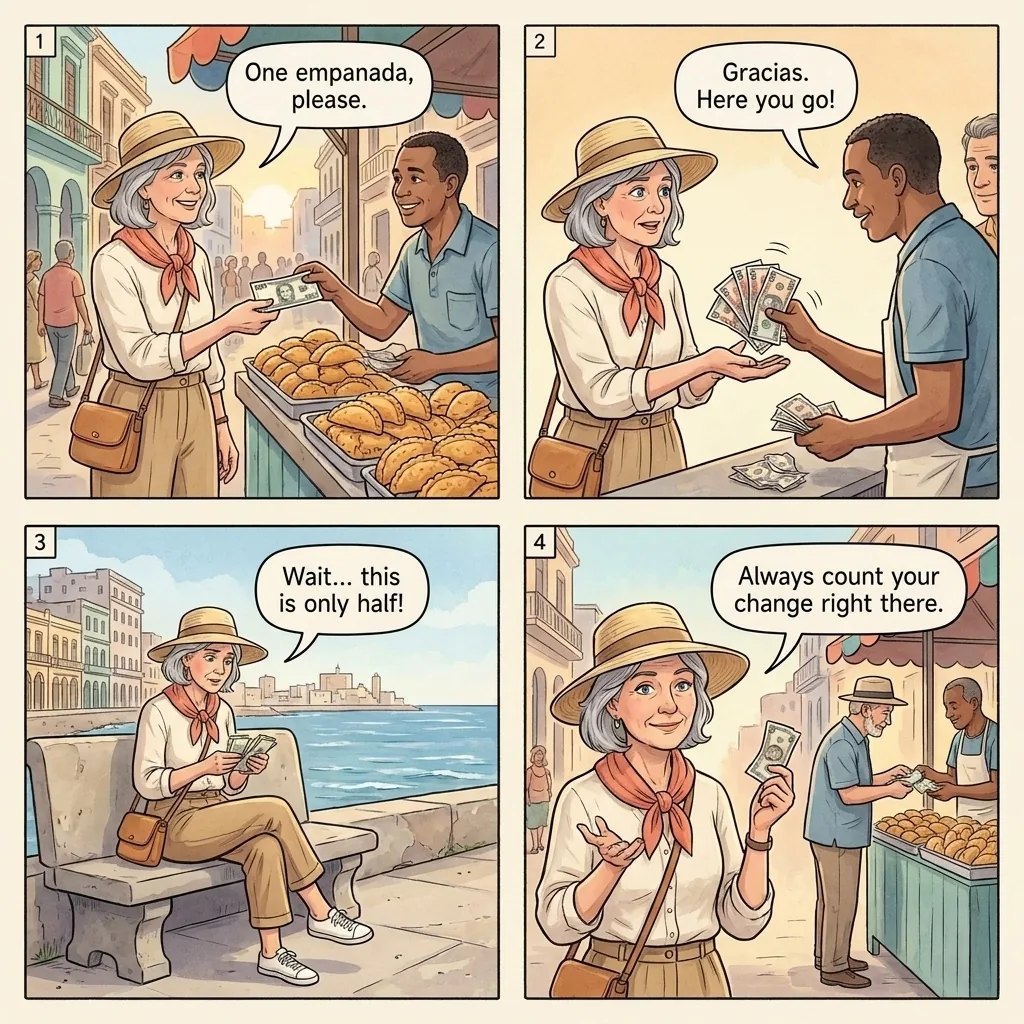
You buy a small empanada from a stall in an agromercado, hand over a 200-peso CUP bill (about $0.80 at the unofficial rate), and the vendor gives you change in a confusing flutter of small bills.
She counts out what looks like the right amount — five small notes plus a coin, fanned across her palm — and turns to the next customer before you have time to look closely. You pocket the change and walk on. Later, sitting on a bench, you actually count what you have. The vendor gave you back roughly half of what was due, in a mix of denominations chosen specifically to look like more than they are.
Cuba unified its currency in 2021 — the old dual CUC/CUP system was replaced by a single CUP (Cuban peso) — but prices between tourist and local venues still vary wildly, and the change-confusion technique has migrated cleanly to the unified currency. The CUP banknotes (10, 20, 50, 100, 200, 500, 1000) all look broadly similar in color schemes that travelers do not yet have committed to muscle memory, and a fast vendor can make 200 pesos of change look like 500 to an unfamiliar eye.
The pattern is documented across Reddit and the long-running Tripadvisor Cuba forum. The deeper complication is the parallel exchange-rate market: the official rate is roughly 24 CUP to 1 USD but the informal rate is closer to 250–340 CUP to 1 USD as of 2026, depending on day and source. Tourists who do not know the actual purchasing-power conversion routinely overpay 10–20× what locals pay for the same item, with the change-confusion short layered on top.
A second variation involves the small paladares in Old Havana that quote prices in 'pesos' without specifying which conceptual peso (and sometimes still in the long-retired CUC), then settle the bill at a rate that benefits the venue. Some operators also accept USD or EUR cash directly at unfavorable conversion rates. The fix is mechanical — know your conversion, count every bill before stepping away.
Familiarize yourself with all CUP banknote denominations (10, 20, 50, 100, 200, 500, 1000) and their relative sizes before your first transaction in Havana — Google Images is enough. Carry small denominations to pay close to exact amounts and remove the change opportunity. Always count change at the counter, bill by bill, before stepping away. Know the current informal exchange rate (check Reddit weekly threads or the latest reports from CubaSi) so you can sanity-check prices on the spot. If a vendor refuses to correct an obvious short-change, walk away — recovery is unlikely, but knowing the technique prevents the next one.
Red Flags
- Vendor hands back change very quickly without letting you count
- Price stated verbally doesn't match what's charged
- Vendor makes change in a complex combination of small bills
How to Avoid
- Familiarize yourself with Cuban peso bills and their values before arriving.
- Always count change before leaving the counter.
- Bring small denominations yourself so you don't need to make change.
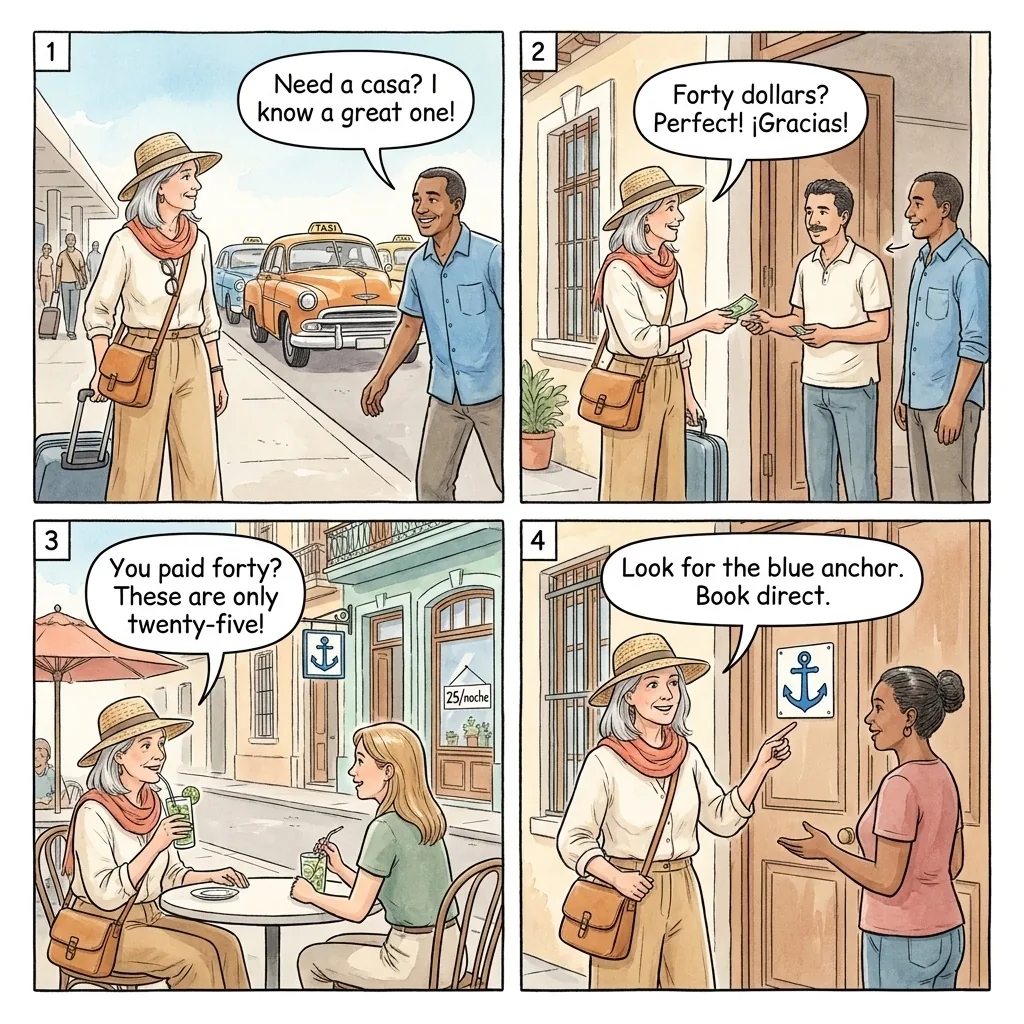
You arrive at José Martí Airport without a hotel reservation, take a taxi into Centro Habana, and a friendly local at the taxi rank says he knows a casa particular nearby — cheap, clean, central, only $40 a night.
It sounds reasonable. He climbs into the taxi with you and the driver, gives directions in Spanish, and twenty minutes later you arrive at a tall colonial building with high ceilings and a faded balcony. The host greets you warmly, the room has a fan and a private bathroom, and the casa is genuinely decent. You hand over $40, sleep well, and only later — in a casual conversation with another traveler — discover that licensed casas of the same quality on the same block rent for $20–25 a night.
Your guide pocketed half your nightly rate. The host pays him a commission of $10–20 per delivered tourist, sometimes for the entire stay, and the markup is built into the inflated quote. Worse, the casa may not be licensed at all. Cuban law requires casa particulares to display a blue triangle or anchor symbol on the front door (registered with the Ministry of Tourism), and unlicensed casas leave you with no legal protection if something goes wrong — theft from the room, refund disputes, an emergency that needs official paperwork.
The pattern is documented across Reddit and the Cuba TripAdvisor forum. The variation runs everywhere — at the airport curb, at the bus station, in Old Havana when a stranger 'helps' you find your booked casa and steers you to a different one, even at the entrance of established casas where a local offers a 'better price' next door. The same scam targets backpackers and budget travelers more aggressively than higher-end tourists.
A subtler version exploits Airbnb directly. Some Havana hosts list rooms at competitive rates online, then on arrival explain that the 'real' room is in a different building (uncle's place, sister's apartment) and walk you there. The Airbnb-listed property may not actually exist; the 'replacement' is a higher-margin private room with no online accountability. Reviews never appear because guests do not realize they were not in the listed property.
Book casa particulares in advance through Airbnb, Booking.com, or established Cuba-specific platforms (Cubaism, CubaCasa) before you arrive in Havana — never accept a casa offered at the airport or by a stranger on the street. Look for the blue triangle or anchor symbol on the front door (the Ministry of Tourism license) and verify the address matches your booking exactly before unloading your bag. If the host claims the 'real room' is somewhere else, leave and find your booked address. If you suspect an unlicensed casa, report it to the Ministry of Tourism (MINTUR) at +53 7 833 3373.
Red Flags
- Guide insists on accompanying you to find accommodation
- Venue not searchable on AirBnB or established Cuba booking sites
- Host and guide seem to know each other immediately upon arrival
How to Avoid
- Book casa particulares in advance through Airbnb or Cuba-specific booking sites.
- Verify your accommodation address independently before following anyone to it.
- Licensed casas have a blue door sign — check for it.
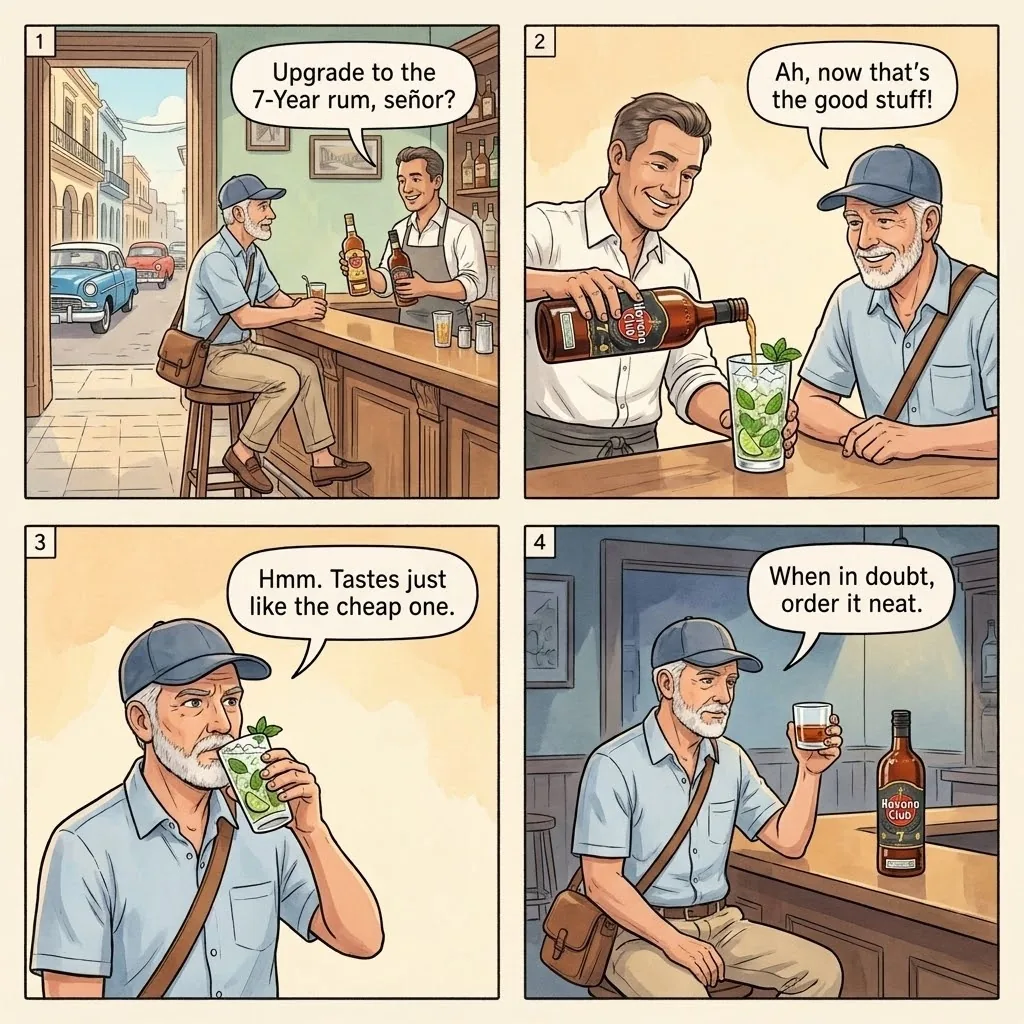
You walk into a tourist-strip bar in Old Havana for the obligatory mojito, and the bartender suggests upgrading to Havana Club 7-Year for an extra $4 — a small premium for a noticeable difference, and you say yes.
He turns to the back bar, pulls a Havana Club 7-Year bottle off the shelf, pours confidently into your highball, and stirs your mojito with the dark rum on top. The bottle goes back on the shelf. The drink looks correct, the color is right, the smell carries the molasses note you would expect. You sip, nod, take a photo for Instagram, and pay the bill with the upgrade.
The bottle was refilled. Real Havana Club 7-Year carries a distinctive aged complexity — dried fruit, vanilla, a long warm finish. What you tasted was Havana Club 3-Year, or worse, an unbranded Cuban aguardiente, poured into the labeled bottle behind the bar. The premium you paid did not buy a premium product; it bought the visual ritual of pouring from a brand-name bottle. The scam relies on most tourists not actually knowing what 7-Year tastes like, and on the mojito's mint-and-sugar disguise muting any rum that ends up in it.
Bottle-refill at tourist-corridor bars in Havana is well-documented. Reddit threads, the Cuba TripAdvisor forum, and several Cuban journalism outlets have reported on bars routinely topping up premium bottles with cheap rum to maintain margin. The practice is most consistent at high-volume tourist bars on Calle Obispo, around La Bodeguita del Medio, El Floridita, and the rooftop strip on Calle Mercaderes. The genuinely reputable bars (the actual Floridita state-run bar, La Vitrola, El Del Frente) are far more careful with their bottles, but the imitators on the same blocks are not.
A second variation involves the mojito itself rather than the rum. Some bars use bottled mint syrup in place of fresh mint, pre-batched lime mix instead of fresh-squeezed, and a single low-cost rum across the entire menu regardless of what you order. The cocktail is technically a mojito, but it is a $2 cocktail being sold at $8–12, and the 'premium' upgrade buys nothing.
Ask the bartender to pour from a sealed bottle, or one you can see is full and freshly handled, and watch the pour. Better still, drink at established bars — the official El Floridita state-run bar, La Bodeguita del Medio (the original location), El Del Frente, La Vitrola, and Sloppy Joe's all have reliable cocktails with fair pricing. Buy your own bottle of Havana Club 7-Year at a state liquor store (La Casa del Habano shops also carry rum) for $20–25 if you want to taste the real thing without bar markup. If a bar refuses to pour from a sealed bottle, walk to the next one — there are dozens.
Red Flags
- Bottle brought to the bar rather than poured from a displayed bottle in your view
- Rum tastes notably different from what you'd expect
- Bar is in an extremely high-traffic tourist location
How to Avoid
- Ask for the bottle to be poured in front of you from a sealed or visibly full bottle.
- Stick to established bars with good reputations rather than random tourist-strip spots.
- Buy bottles from a state liquor store (tienda) if you want to guarantee authenticity.
🆘 What to Do If You Get Scammed
📋 File a Police Report
Go to the nearest Policía Nacional Revolucionaria (PNR) station. Call 106 (Police) or 104 (Ambulance). Get an official crime report — you'll need this for insurance claims. You can also report online at minint.gob.cu.
💳 Cancel Your Cards
Call your bank immediately. Most have 24/7 numbers on the back of the card (keep a photo saved separately). Block any suspicious transactions before the thieves use your details.
🛂 Lost Passport?
Contact the US Embassy in Havana at Calzada between L & M Streets, Vedado, Havana. For emergencies: +53 7-839-4100.
📱 Track Your Device
If your phone was stolen, use Find My (iPhone) or Find My Device (Android) from another device. Don't confront thieves yourself — share the location with police instead.
Frequently Asked Questions
You just read 6 scams in Havana. The full Travel Safety Series has 780+ more across 20+ countries.
Tokyo's Kabukichō ¥130,000 bar trap. Rome's gladiator photo extortion. Paris's gold-ring trick. Bali's ATM skimmer scams. Bangkok's grand-palace closure ruse. Every documented scam across 20+ destinations — with the exact scripts, red flags, and local-language phrases that shut each one down. Drawn from Reddit traveler reports, embassy advisories, and consumer-protection cases.
- 780+ documented scams across Tokyo, Rome, Paris, Bali, Bangkok, Rio & 100+ more cities
- 20+ countries covered, with country-by-country phrase cards for every destination
- Updated annually — buy once, re-download future editions free
- All titles $4.99 each on Amazon Kindle