
Key Takeaways
- The #1 reported scam is the Fake QR Code Parking Meter Scam.
- 4 of 7 scams are rated high risk.
- Use app-based ride services (Uber, Lyft) instead of unmarked vehicles or unlicensed cabs.
- Never accept unsolicited offers from strangers near tourist sites in Austin.
⚡ Quick Safety Tips
- Austin is a generally safe city for tourists, but Dirty Sixth Street (East 6th between Congress and I-35) requires serious caution late at night — fights, aggressive panhandling, and fake rideshare drivers are common after midnight.
- Never scan QR codes on parking meters in Austin — the city does not use QR codes for parking. Use the Park ATX app, coins, or insert your card directly into the pay station.
- During SXSW, ACL, and F1 weekends, scammers are especially active — buy tickets only from official sources, verify vacation rentals through major platforms, and watch for fake parking attendants in downtown lots.
- Use Uber and Lyft for late-night transportation, but always verify the driver's name, photo, and license plate in the app before getting in. Never get into an unmarked vehicle, even if you are tired of waiting.
Jump to a Scam
The 7 Scams

Fraudulent QR-code stickers on Austin's downtown parking pay stations redirect drivers to misspelled phishing sites (poybyphone.com vs the legitimate paybyphone.com); APD located 29 fake stickers on downtown meters in January 2022 — and the city's official pay stations don't accept QR-code payment at all.
The scam first surfaced in San Antonio in late 2021 and spread to Austin and Houston within a month. In January 2022, the Austin Police Department located fraudulent QR stickers affixed to 29 downtown parking pay stations — KXAN, KVUE, and Fox 7 Austin all covered the wave. The critical fact missing from the sticker's design is that Austin's official pay stations do not use QR codes at all. The city accepts payment only through the Park ATX app, coins, or direct credit/debit-card insertion at the meter face.
The mechanic is the misspelled domain. You scan the sticker; your phone opens a clean-looking site with what looks like the city seal, and the URL — poybyphone.com instead of paybyphone.com, or a near-clone of parkATX.com — passes a quick glance. The site asks for your license plate, parking duration, and full credit-card details including CVV. Two days later your card shows $800 in fraudulent transactions; the meter never recorded a payment, so a real ticket may also arrive. CBS Austin documented a second wave in which scammers cloned the Park ATX app's checkout page well enough to fool Google's search snippets, prompting the city to formally request the listing be corrected.
Download the official Park ATX app before your trip and use it for every street-parking payment in Austin — never scan a QR code on a meter. If you pay at the meter face, use coins or insert a card directly into the slot. If you spot a QR sticker on a downtown pay station, do not scan it; report it through the Austin 311 app or by dialing 311. For phishing losses, call your card issuer's 24-hour fraud line immediately to freeze the card; file a report at austintexas.gov/police and with the FTC at reportfraud.ftc.gov.
Red Flags
- A QR code sticker is affixed to a parking meter or pay station — Austin does not use QR codes for parking payment
- The QR code directs you to a website that is not the official Park ATX app or parkATX.com
- The URL has subtle misspellings — 'poybyphone.com' instead of 'paybyphone.com' or similar letter swaps
- The website asks for more information than necessary — full card number, CVV, and personal details beyond what a parking app needs
- The QR code sticker looks like it was placed on top of the meter rather than being part of the original equipment
How to Avoid
- Download the official Park ATX app before your trip and use it for all street parking payments in Austin.
- Pay parking meters with coins or by inserting your credit/debit card directly into the machine — never scan QR codes on meters.
- If you see a QR code on an Austin parking meter, do not scan it — report it to Austin 311 (dial 311 or use the 311 app).
- Check the URL carefully if you ever use a parking website — look for https, correct spelling, and the official .gov domain.
- Use parking garages with automated payment systems rather than street meters in the downtown and 6th Street area.

Scammers in yellow vests collect $20 cash at unattended downtown surface lots near East 6th Street and hand out recycled or expired tickets — APD arrested five suspects on the 400 block of East 7th Street in one sting and continues to find them at SXSW, ACL, and busy weekend nights.
The pattern shows up most reliably on Friday and Saturday nights along the surface-lot corridor between Red River and Trinity, and at SXSW, ACL, and UT football game days when downtown parking is tight. A man in a reflective yellow vest waves you into a vacant lot, takes $20 cash, and hands you what looks like a numbered receipt. Fox 7 Austin reported APD's sting that pulled in five suspects on the 400 block of East 7th Street alone, with one carrying about ten expired and invalid tickets he was reusing as fake receipts.
The trap is that the vest doesn't authorize anyone. The lot is either privately owned (with a separate, real attendant who arrives later) or city-managed with no on-site staff at all. Three hours later the legitimate towing company arrives, finds your car without a valid permit, and either issues a real ticket or hauls it to the city impound at South Congress and Riverside. KXAN flagged a related variant: vehicles parked legally on public streets get illegally booted by a third party, with a sign on the wheel directing the owner to call a phone number — the boot itself was placed without authority.
Pre-book parking through SpotHero or ParkMobile before you head downtown, especially during SXSW, ACL, or any busy event weekend, and use only lots with visible company signage, posted rates, and a phone number. If a person in a vest approaches you for cash, ask for the company name and a card-reader payment; legitimate operators have both. For an unauthorized boot on a public street, call Austin 311 — do not call the number printed on the boot's sign. To file a report after the fact, contact the Austin Police Department's non-emergency line at 311 or austintexas.gov/police.
Red Flags
- A person in a vest waves you into a lot and collects cash but has no branded uniform, name tag, or official-looking booth
- The 'receipt' is handwritten, photocopied, or looks like a recycled ticket with a different date or time
- The parking price is significantly higher or lower than nearby legitimate lots — scammers sometimes undercut to attract victims
- There are no posted rate signs, lot numbers, or company names visible at the entrance to the parking area
- The attendant insists on cash only and cannot process credit cards — legitimate parking operations have card readers
How to Avoid
- Use the SpotHero or ParkMobile app to pre-book verified parking in downtown Austin, especially during events and busy weekends.
- Park only in lots with visible signage showing a company name, phone number, posted rates, and lot number.
- Use parking garages operated by the City of Austin or established companies like LAZ Parking rather than unattended surface lots.
- If someone approaches you to collect parking fees, ask for their company name and verify it by phone before paying.
- If you find an unauthorized boot on your car on a public street, call Austin 311 — do not pay the number posted on the boot sign.

Craigslist and Facebook Marketplace sellers offer ACL or SXSW wristbands at 30–50% below face value outside Zilker Park or the Austin Convention Center, then enter the festival, have the wristband cut off, and resell it within an hour — APD ran an undercover op that arrested three people for exactly this scheme.
Ticket and wristband scams cluster around Austin's two biggest festivals. KXAN ran a dedicated report on safe ticket buying; Fox 7 Austin documented cases where customers paid authorized-looking vendors and received empty envelopes. KVUE's guide describes the most common pattern: sellers walk you to the gate, the wristband scans valid, and you go in — they then have it removed by a complicit security contact and resell it to the next victim outside. KXAN reported on a sting in which three suspects were arrested running this exact scheme. The same template extends to SXSW, where fake badges and wristbands circulate on social-media marketplaces during festival week.
The mechanic is the wristband's single-scan vulnerability. On entry, the scanner reads the unique RFID and the gate logs you in; once a wristband has been cut, the system can flag it as tampered. The seller times the cut for after your scan but before the gate's tamper alert is checked, then is back outside the queue with the wristband refastened in 25 minutes. Inside, security pulls you aside, the wristband shows tamper status, and you are escorted out with no refund. The variant outside SXSW substitutes a fully fake wristband or a screenshot of someone else's mobile barcode, which scans once and never again.
Buy ACL and SXSW credentials only from the official sources — Front Gate Tickets for ACL, sxsw.com for SXSW — or authorized resellers like StubHub with buyer guarantees. If you must use resale, register the wristband to your name on the official site immediately after purchase to lock the original buyer out. Never accept a wristband that looks worn, cut, or re-applied. If the deal is more than 30% below face value, it is a scam — legitimate resale rarely undercuts that line. For losses, file at austintexas.gov/police and dispute the cash payment with your bank if you used a card-funded P2P transfer.
Red Flags
- The ticket or wristband is priced significantly below face value — if a 3-day ACL pass retails for $300 and someone offers it for $150, it is likely fake or stolen
- The seller insists on cash only and wants to meet in person outside the venue rather than transferring through an official platform
- The wristband appears to have been previously worn, cut, or re-attached with tape or glue
- The seller does not have a verifiable identity — no social media history, new account, or refuses to share personal information
- The seller offers to 'walk you in' and stands near the entrance watching — they may plan to reclaim the wristband after you enter
How to Avoid
- Buy tickets only from official sources (ACL's Front Gate Tickets, SXSW's official site) or authorized resellers like StubHub with buyer guarantees.
- If buying resale, use only platforms that offer buyer protection and verify ticket authenticity — never buy from Craigslist, Facebook Marketplace, or strangers outside the venue.
- For ACL wristbands, register the wristband to your name on the official site immediately after purchasing — this prevents the original buyer from deactivating it.
- Never accept a wristband that appears to have been worn, cut, or tampered with — examine it carefully before paying.
- If a deal seems too good to be true, it is — festival wristbands rarely sell below 70-80% of face value on legitimate resale platforms.
Like what you're reading? Get a full Austin itinerary with safety tips built in.
Browse travel-safety books →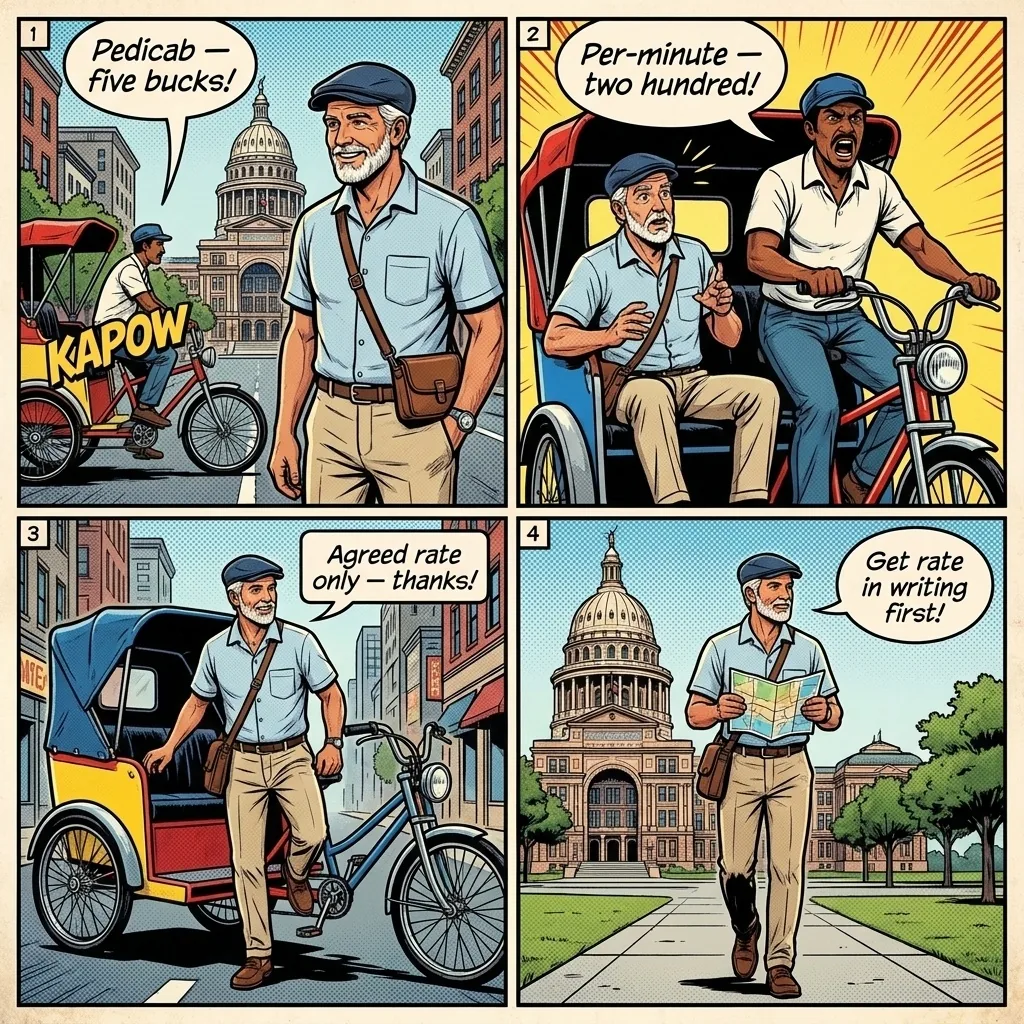
Pedicab drivers along East 6th Street and Rainey Street offer "no set rate" rides to intoxicated passengers and demand $60 for an 8-block trip — Austin pedicabs have no meters and no mandated fares, so the entire price is whatever the driver pressures you into at the destination.
The cluster is on East 6th, Rainey Street, and Red River around closing time, and at SXSW, ACL, and major UT football games when ride-share surge pricing makes a pedicab look like the easier option. A colorful pedicab pulls up, the driver waves you and your friend in, and the ride to your hotel is eight blocks. The Austin Chronicle's coverage of the trade points out the regulatory hole: pedicabs have no meters and the city has not set legally mandated rates, so any quote is informal until the moment of payment.
The mechanic is a structural ambiguity. The driver does not state a price up front; you assume taxi-like flat rates; he assumes a per-passenger, per-minute negotiation he can run after the ride. At the hotel he hands you a "rate card" with $15 per person per five minutes, multiplied by two riders, plus a tip he frames as expected. The Austin Chronicle's reading of the rules is that the price is technically a voluntary tip — meaning you are not legally required to pay at all — but on a sidewalk with a friend watching and other passersby moving through, social pressure produces the $60 the driver wanted.
Always ask "how much for the whole ride?" and get a flat-dollar number with both passengers covered before you sit in any Austin pedicab. For trips under ten blocks, walking is faster than a pedicab in 6th Street pedestrian crowds. For longer hauls back to your hotel, an Uber or Lyft is almost always cheaper and the price is locked in-app. If a driver demands an outrageous fare at the end, calmly offer $1–2 per block per person and walk away; he cannot legally enforce a price you never agreed to. To file a complaint with a pedicab operator's license, contact the Austin Transportation Department through 311.
Red Flags
- The pedicab driver does not mention a fare or rate before you get in — they are counting on the ambiguity to charge more later
- You are intoxicated and the driver targets you specifically — drunk passengers are less likely to negotiate or refuse payment
- The ride is extremely short (a few blocks) but the driver quotes a high fare at the destination
- The driver claims a per-person rate rather than a flat fare — turning a $20 ride into $40 or $60 for a group
- There is no visible rate card or price information on the pedicab
How to Avoid
- Always agree on a total fare for all passengers before getting into any pedicab — ask 'how much to [destination]?' and get a clear number.
- Know that pedicab rides in Austin are technically voluntary tips — you are not legally required to pay, though negotiating upfront avoids conflict.
- For short distances on 6th Street, it is almost always faster and free to walk — pedicabs save no time in pedestrian-heavy areas.
- Use Uber or Lyft for longer distances from 6th Street to your hotel — pricing is transparent and typically cheaper than pedicabs.
- If a driver quotes an outrageous fare at the end of a ride, calmly offer what you think is fair — $1-2 per block per person is reasonable.

Fake Austin vacation rentals listed at half the going rate near South Congress, East Austin, or Zilker collect bank-transfer deposits for "half-off SXSW pricing" and then vanish — one documented Austin listing used the address of a Foundation Communities low-income housing facility with stolen rooftop-pool photos that bore no relation to the actual building.
The pattern peaks around SXSW, ACL, Formula 1 weekend, and UT home games when hotels sell out and visitors get desperate. A listing for a two-bedroom near South Congress at $120 a night — half the going rate — appears on Craigslist, Facebook Marketplace, or a clone of a real-estate site. KVUE and KENS 5 ran joint investigations into fraudulent Austin listings, including one that used the address of a Foundation Communities low-income housing facility with photos that bore no relation to the actual rooms and falsely advertised a rooftop deck and pool. Vice published "I Accidentally Uncovered a Nationwide Scam on Airbnb" documenting fake-host networks operating in multiple cities including Austin; a federal indictment later detailed an $8.5 million Airbnb-and-Vrbo scam across 10 states with Texas operations included.
The mechanic is the off-platform payment. The "host" claims the platform is charging excessive fees and asks you to wire $840 directly via Zelle, Venmo, or a bank transfer to lock in the dates. Once paid, the listing disappears, the email address bounces, and the actual property has no record of you. The scam runs on the rate gap: at $120/night you mentally compare it to $250/night listings and conclude you have caught a great deal, when the real listing the photos came from is on Airbnb in Lisbon at a similar price. Reverse image search would have caught it in 30 seconds.
Book Austin accommodations only through Airbnb, Vrbo, or Booking.com using their in-platform payment system — never wire money, Zelle, Venmo, or send cryptocurrency to a "host" outside the platform. Reverse-image-search any listing's photos with Google Lens before you commit; if the photos appear elsewhere, the listing is stolen. Verify the address on Google Maps Street View. For SXSW or ACL specifically, book at least 90 days out — last-minute desperation is the entire customer base of this scam. For losses, dispute the transfer with your bank within 60 days and file at austintexas.gov/police and IC3.gov.
Red Flags
- The rental price is significantly below market rate for the location and dates — Austin during SXSW or ACL commands premium prices
- The host requests payment via wire transfer, Venmo, Zelle, or cryptocurrency instead of through the booking platform's payment system
- The listing has few or no reviews despite offering an exceptional property at a prime location
- The host communicates only by email and cannot do a video call or show real-time photos of the property when asked
- The listing photos look too professional or are generic — reverse image search them on Google to check for reuse
How to Avoid
- Book only through established platforms like Airbnb, Vrbo, or Booking.com that offer buyer protection and verified listings.
- Never send money via wire transfer, Zelle, Venmo, or cryptocurrency for accommodation — always pay through the platform.
- Verify the property address on Google Maps Street View to confirm it matches the listing photos.
- For properties without reviews, request a video call with the host showing the actual space in real-time before paying.
- Book well in advance for major events — last-minute desperation leads to poor decisions, and scammers know this.

Cars without rideshare decals stop on East 6th and Rainey Street after midnight asking "are you waiting for a ride?" — fake drivers target tired or intoxicated tourists during surge-pricing windows, and documented outcomes range from cash overcharges to robbery and sexual assault.
The setup is concentrated on East 6th between Brazos and Red River, the Rainey Street block, the Warehouse District, and outside Red River Cultural District music venues at closing time. Surge pricing on a Saturday at 2 AM can run 3.5×, the wait climbs past 15 minutes, and a sedan pulls up at the curb with the driver leaning over: "Are you waiting for a ride?" You are tired and slightly drunk and the framing fits, so you get in. RomanAustin.com's safety guide flags this as the standard hotspot pattern — fake drivers cluster at airports, train stations, and event venues where attention is low and demand is high.
The mechanic is the missing rider name. SaferAmerica.com's guide is explicit: legitimate Uber and Lyft drivers ask for your name; fakes ask the vague "are you waiting for a ride?" Once you are inside, the requests escalate — cash up front for the trip, your phone "to verify the booking," or a route into an unfamiliar area where extraction is harder. VanceLawFirm.com documents the range of outcomes from overcharging and robbery up to sexual assault; CBS reported a regional case in which a fake rideshare driver assaulted a passenger picked up under exactly this script.
Make every driver say your name first — never volunteer it — and verify the make, model, color, and license plate against the app before you open the door. Real Uber and Lyft drivers will know your name, the destination, and the trip total; fakes will not. Wait for your ride in a well-lit area with other people and use the in-app safety features (Uber's Verify Your Ride PIN, Lyft's share-trip status). Never get into a car you did not request through the app. If something feels off after you are in, ask the driver to stop in a public area and exit. For incidents, call 911 and file in-app; APD has a non-emergency line at 311.
Red Flags
- The driver asks 'Are you waiting for a ride?' instead of asking for your name — real Uber and Lyft drivers confirm the rider's name first
- The vehicle does not match the make, model, color, or license plate shown in your ride-hailing app
- The driver does not have a visible Uber or Lyft decal on the windshield or does not appear in the app as 'arriving'
- The driver asks you to pay cash or requests payment outside the app — Uber and Lyft never require cash payment
- The driver's photo in the app does not match the person behind the wheel
How to Avoid
- Always verify the driver's name, photo, vehicle make/model, and license plate in the app before getting into any car.
- Ask the driver 'Who are you here for?' and make them say your name — never volunteer your name first.
- Wait for your ride in a well-lit area with other people, and share your ride status with a friend using Uber's or Lyft's built-in safety features.
- Never get into a car you did not order through the app, no matter how long the wait or how high surge pricing is.
- If something feels wrong after getting in, ask the driver to stop in a public area and exit — trust your instincts.

Instagram and TikTok ads sell "VIP Bar Crawl on 6th Street" tickets at $30 for "5 bars + free drinks" — on the night, the meeting point is empty and the organizer's number is dead, or the "crawl" is a printed list of bars you could have walked into yourself for free.
The ads target Austin nightlife between Thursday and Saturday and saturate Instagram during SXSW, ACL, Formula 1 weekend, and UT football game days. The pitch is sharp: $30 for a wristband that opens five 6th Street bars with free drinks and skip-the-line access. AlwaysTheVIP.com's guide "Modern Bar Crawl Scams Exposed" describes the pattern bluntly — scammers sell fake tickets for crawls they have no actual connection to, and the buyer ends up paying for a list of bars they could have walked into for free. KUT Radio (Austin's NPR station) flags the same template specifically during SXSW.
The mechanic is the social-media-only sales channel. The Instagram account is two months old, the website is a one-page Squarespace, and the payment goes to a Stripe account or a Venmo handle that disappears the morning after the event. On the night, one of two things happens. The first: the meeting point at 6th and Brazos is empty, the organizer's WhatsApp doesn't load, and the wristband barcode comes back invalid at every bar's door. The second: a real wristband exists, but it is just a paper bracelet that gets you a single well shot at one bar — every other "free drink" is full price.
Book bar crawls only through Eventbrite, Fever, or directly through a venue's verified website with an actual business name and phone number — and check that the organizing account has at least a year of post history and real engagement. Most 6th Street bars charge no cover on regular nights, so paying $30 for "access" is paying for nothing. For SXSW specifically, use the official sxsw.com schedule; unofficial "SXSW parties" are not affiliated with the festival. If your card was charged for a no-show event, dispute it with your bank within 60 days as "services not provided" and file at austintexas.gov/police.
Red Flags
- The event is advertised only on social media with no verifiable business name, address, or organizer identity
- Tickets are 'surprisingly cheap' compared to similar legitimate events — real Austin bar crawls cost $40-80 for genuine VIP experiences
- The website or payment page looks hastily assembled, with no reviews, no social proof, and generic stock photos of nightlife
- The organizer communicates only through DMs or email and cannot provide a business registration or physical address
- The event promises unrealistic benefits — 'unlimited free drinks,' 'skip all lines,' 'meet celebrities' — that legitimate promoters do not offer
How to Avoid
- Book nightlife events through established platforms like Eventbrite, Fever, or directly through venue websites with verifiable business information.
- Search for the event organizer's name and reviews before purchasing — legitimate promoters have a track record and online presence.
- For SXSW, use the official SXSW schedule and wristband system — unofficial 'SXSW parties' may not be affiliated with the festival at all.
- Remember that most bars on Sixth Street have no cover charge on regular nights — you do not need to pay for 'access' to walk in.
- If buying from social media, check how old the account is, verify it has real engagement (not just bots), and search for complaints.
🆘 What to Do If You Get Scammed
📋 File a Police Report
Go to the nearest Austin Police Department (APD) station. Call 911 (emergency) or 311 (non-emergency). Get an official crime report — you'll need this for insurance claims. You can also report online at austintexas.gov/police.
💳 Cancel Your Cards
Call your bank immediately. Most have 24/7 numbers on the back of the card (keep a photo saved separately). Block any suspicious transactions before the thieves use your details.
🛂 Lost Passport?
Contact the nearest passport office. The closest regional passport agency is in Houston at the Mickey Leland Federal Building, 1919 Smith Street. For emergencies, call the US State Department at 1-888-407-4747. Foreign nationals should contact their country's nearest consulate.
📱 Track Your Device
If your phone was stolen, use Find My (iPhone) or Find My Device (Android) from another device. Don't confront thieves yourself — share the location with police instead.
Frequently Asked Questions
You just read 7 scams in Austin. The full Travel Safety Series has 780+ more across 20+ countries.
Tokyo's Kabukichō ¥130,000 bar trap. Rome's gladiator photo extortion. Paris's gold-ring trick. Bali's ATM skimmer scams. Bangkok's grand-palace closure ruse. Every documented scam across 20+ destinations — with the exact scripts, red flags, and local-language phrases that shut each one down. Drawn from Reddit traveler reports, embassy advisories, and consumer-protection cases.
- 780+ documented scams across Tokyo, Rome, Paris, Bali, Bangkok, Rio & 100+ more cities
- 20+ countries covered, with country-by-country phrase cards for every destination
- Updated annually — buy once, re-download future editions free
- All titles $4.99 each on Amazon Kindle