
Key Takeaways
- The #1 reported scam is the Fenway Park Ticket Scalping.
- 1 of 7 scams are rated high risk.
- Use app-based ride services (Uber, Lyft) instead of unmarked vehicles or unlicensed cabs.
- Never accept unsolicited offers from strangers near tourist sites in Boston.
⚡ Quick Safety Tips
- Boston is one of the safest major US cities for tourists — the main risks are petty theft, overcharging, and parking-related scams rather than violent crime.
- Walk two to three blocks away from the Freedom Trail and Faneuil Hall to find restaurants with local pricing and no hidden surcharges.
- The MBTA is generally safe but keep valuables secured on crowded Green and Red Line trains — pickpockets target distracted riders during rush hour.
- If driving, use the official ParkBoston app and ignore any QR code stickers on meters or text messages about unpaid tickets — these are phishing scams.
Jump to a Scam
The 7 Scams

Scalpers outside Fenway Park print or screenshot the same Red Sox barcode multiple times and sell it to several buyers — only the first person to scan gets in, and Massachusetts's 1924 anti-scalping law (capping resale at $2 above face value) is barely enforced on game day.
The pitch zone is the corridor along Yawkey Way, Lansdowne Street, and Kenmore Square in the two hours before first pitch, especially for sold-out rivalry games against the Yankees, Mets, or Astros. A man steps off the curb with two tickets at $120 each — roughly double face value but plausible for a sold-out game — and accepts cash only. The TripAdvisor Boston Forum has documented this pattern across years; the more sophisticated version is a single legitimate digital ticket whose barcode is screenshotted and resold to three or four buyers in twenty minutes, while the original holder uses it to enter themselves first.
The mechanic is the single-scan vulnerability of MLB's barcode system. The first scan turns the ticket green; every subsequent scan returns "already used" and the bearer is turned away from the gate. The scalper is back across Yawkey Way before you finish arguing with the gate attendant — your $240 cash is gone with him. The variant played on cooler nights is a printed paper "ticket" with valid-looking design and a barcode that has either never been a real ticket at all or was generated from a screenshot of someone else's mobile pass.
Buy Red Sox tickets only through redsox.com, the MLB Ballpark app, or authorized resellers like StubHub and SeatGeek that guarantee the ticket — never from someone holding paper tickets on Yawkey Way. Check the official "no scalp" zone near the Ted Williams statue, where fans legally resell at face value. Single tickets sometimes appear at the Fenway box office on game day. If you've already paid cash for a duplicated barcode, the cash is unrecoverable but report the scalper to BPD on (617) 343-4200; if you used a card-funded P2P payment, dispute it as services not provided.
Red Flags
- Anyone selling tickets on the street outside Fenway rather than through official channels
- The seller insists on cash only and cannot provide a digital transfer through an official platform
- Tickets are printed on plain paper rather than having a secure mobile barcode from the team's app
- The price seems reasonable for a sold-out game — scammers price just below market to attract buyers quickly
- The seller becomes agitated when you ask to verify the ticket's validity before paying
How to Avoid
- Buy tickets only through the official Red Sox website, MLB Ballpark app, or authorized resellers like StubHub and SeatGeek.
- Check the designated 'no scalp' zone near the Ted Williams statue where fans sell extra tickets at face value — this is legal and safer.
- Single tickets sometimes become available at the Fenway box office on game day — check before resorting to resellers.
- Never pay cash for street tickets — use platforms with buyer protection and guaranteed authenticity.
- If a deal seems too good for a sold-out game, it almost certainly involves duplicated barcodes.

SMS messages claiming to be from the City of Boston ("You have an unpaid parking invoice") link to phishing sites that harvest credit-card data — the city does not send parking notices by text, and a parallel scam involves fake QR-code stickers on real meters that the Massachusetts State Police have warned about formally.
The text saturation hit Boston area codes hard enough that Boston25 News covered the wave. The message reads "City of Boston: You have an unpaid parking invoice. Pay immediately to avoid additional penalties," includes a city-seal-looking logo, and links to a domain that looks plausible — payboston.com, bostonpark-pay.com, or similar — but is not boston.gov. In parallel, the Massachusetts State Police issued a formal warning about fake QR-code stickers placed on real parking meters as a "quick pay" option, redirecting drivers to a phishing site that captures full card details. NBC10's Seaport-District investigation also documented the "Phantom Meter": a fully functional meter installed in a location signed as a no-stopping zone, so even drivers who pay get a legitimate ticket.
The mechanic is urgency plus a near-miss URL. The text creates immediate pressure — "additional penalties" lands harder when you have a rental car at risk. The phishing page shows a clean form requesting card number, CVV, expiration, billing ZIP, and your "license plate" for verification. Once you submit, the card is sold or used within hours; the meter never recorded any payment, so a real ticket may still arrive in the mail months later. The QR-sticker variant works the same way at the meter face: the sticker is overlaid on the legitimate machine, and the URL behind the QR is a clone of the official ParkBoston page.
The City of Boston does not send parking-ticket notifications by text — any such SMS is a phishing scam. Pay parking only through the official ParkBoston app or by inserting a card directly into the meter's slot; never scan a QR code on a meter, even a real-looking one. To verify a ticket, check boston.gov/parking or call (617) 635-4410. Read all signage around any meter before paying — conflicting signs mean the restriction takes priority. For phishing losses, freeze the card with your issuer's 24-hour fraud line, file at boston.gov/police, and report the SMS at reportfraud.ftc.gov.
Red Flags
- A text message about a parking violation that includes a link to a non-.gov website
- QR code stickers on parking meters that look hand-applied or different from the machine itself
- Urgent language demanding immediate payment to avoid penalties or towing
- The text comes from a phone number rather than an official city notification system
- A parking meter in a location where signage also indicates no stopping or no parking
How to Avoid
- The City of Boston does not send parking ticket notifications via text message — any such text is a scam.
- Pay parking meters only through the official ParkBoston app or the meter itself — never scan QR stickers on meters.
- If you receive a parking ticket, verify it at boston.gov/parking or call (617) 635-4410.
- Always read all posted signage around a meter before paying — conflicting signs mean the restriction takes priority.
- Use a credit card for all parking payments for dispute protection if charges turn out to be fraudulent.

Bars and restaurants inside Faneuil Hall and along the Freedom Trail print menus with no prices, add 20% "service charges" in tiny menu footnotes, and tag bills with "entertainment fees" or "tourist taxes" — four beers and two appetizers can clear $187 before you've registered the markups.
The captive-tourist zone runs from Quincy Market through Faneuil Hall along the early stretch of the Freedom Trail and into the bars on the North End side. TravelSafe Abroad and multiple safety guides flag restaurant overcharging here as one of Boston's most reported tourist-trap categories. The classic case file: a group sits at a bar, the menus have no prices, the server says prices are "standard," and the bill arrives at $187 for four drafts and two appetizer platters. A 20% service charge has been added automatically, disclosed only in 6-point footnote text at the bottom of page one of the menu.
The mechanic is the inertia of being seated. Once your group has chairs, drinks in hand, and an order placed, the social cost of leaving and demanding a different restaurant is high. The line items are also legal — Massachusetts allows automatic service charges and "entertainment fees" if disclosed anywhere on the menu, no matter how small the print. The price differential to the same dish two blocks off the trail (a $16 draft on Quincy Market is a $7 draft on Salem Street) is the actual scam: the proximity to Faneuil Hall is being charged for, not the food. Some restaurants run entirely separate menus for dine-in tourists versus delivery-app customers.
Always ask for a printed menu with prices before you sit down at any Faneuil Hall or Freedom Trail restaurant — if the server can't or won't produce one, walk out. Read the line at the bottom of the first page where service charges, gratuities, and entertainment fees are disclosed. Walk two to three blocks off the trail (Salem Street in the North End, the side streets of Beacon Hill, the Seaport away from the waterfront) for restaurants with local pricing. Cross-reference Google reviews from the past 90 days for "service charge" and "surprise bill" complaints. For disputed bills, pay the agreed items and contest the surprise charges with your card issuer within 60 days as "amount different from authorized."
Red Flags
- A restaurant or bar near major tourist attractions does not display prices on the menu
- The server avoids answering direct questions about pricing or says 'it depends'
- A 'service charge,' 'entertainment fee,' or 'tourist tax' appears on the bill that was not disclosed upfront
- The establishment is located directly on the Freedom Trail or inside Faneuil Hall Marketplace with aggressive sidewalk touts
- The menu differs from what you see online — some restaurants use higher-priced menus for dine-in tourists
How to Avoid
- Always ask for a menu with prices before sitting down — if the restaurant refuses, leave immediately.
- Check the bill line by line before paying and question any charges you did not agree to.
- Walk two to three blocks away from Faneuil Hall and the Freedom Trail for restaurants with local pricing.
- Read recent Google and Yelp reviews before dining at any tourist-area restaurant — overcharging complaints are well-documented.
- Ask upfront whether a service charge or gratuity will be added automatically, especially for groups.
Like what you're reading? Get a full Boston itinerary with safety tips built in.
Browse travel-safety books →
Men in branded-looking lanyards on Boston Common sell "discounted" whale-watch tickets at $37 instead of $74 with photocopied vouchers that aren't real bookings — the same template runs for fake CharlieCards on Craigslist and "insider Freedom Trail tours" sold by unlicensed guides at premium prices.
The pitch zone is Boston Common near the Freedom Trail's start, the area outside the New England Aquarium, the Faneuil Hall plaza, and Park Street T station exit. A man in a polo shirt with a fake-official lanyard intercepts you with whale-watch tickets at half price, "leftover inventory from a group that canceled." The tickets are photocopied vouchers with a printed booking number that has no record at the cruise company's dock. The Massachusetts Attorney General's office has warned generally that third-party street tickets significantly increase fraud risk; the MBTA has issued specific warnings about fake CharlieCards and transit passes sold on the street and Craigslist.
The mechanic is the partial truth. The whale-watch operator is real, the boat does sail at the time the voucher claims, and the price ($74 standard) is real — only the voucher itself is fake. By the time you reach the dock, the "leftover inventory" man is back on the Common with the next set of vouchers. The Freedom Trail variant is a more sophisticated upsell: an unlicensed "guide" offers a private tour at $50 per person of a route that is free, self-guided, and supplemented by free National Park Service ranger-led tours from the Boston Common Visitor Center. The CharlieCard variant is a single-fare card sold as a 7-day pass, or a stolen card whose balance has already been drained.
Buy attraction tickets only from the official venue website or its on-site box office — for whale watching, that means Boston Harbor City Cruises or the New England Aquarium directly. The Freedom Trail is free to walk on your own; the National Park Service offers free ranger-led tours from the Boston Common Visitor Center at 139 Tremont Street. Buy CharlieCards only from MBTA fare-vending machines at T stations or the CharlieCard Store at Downtown Crossing. Discounts at street level on big-ticket Boston experiences are almost always a scam — verify with the venue before paying. For losses, dispute with your card issuer and file at boston.gov/police.
Red Flags
- Someone on the street offers discounted attraction tickets and claims to represent the official company
- The tickets are paper vouchers rather than digital confirmations with scannable barcodes
- The seller creates urgency by claiming limited availability or a group cancellation
- An unsolicited 'guide' offers a private Freedom Trail tour at premium prices
- MBTA passes or CharlieCards are being sold on the street or Craigslist at a discount
How to Avoid
- Buy attraction tickets only from official websites or authorized ticket desks at the venue.
- The Freedom Trail is free to walk on your own — the National Park Service offers free ranger-led tours from the Boston Common Visitor Center.
- For whale watching, book directly through the New England Aquarium or Boston Harbor City Cruises websites.
- Buy MBTA CharlieCards only from official machines at T stations or the CharlieCard store at Downtown Crossing.
- If a deal seems too good to be true for a popular Boston attraction, verify directly with the venue before paying.
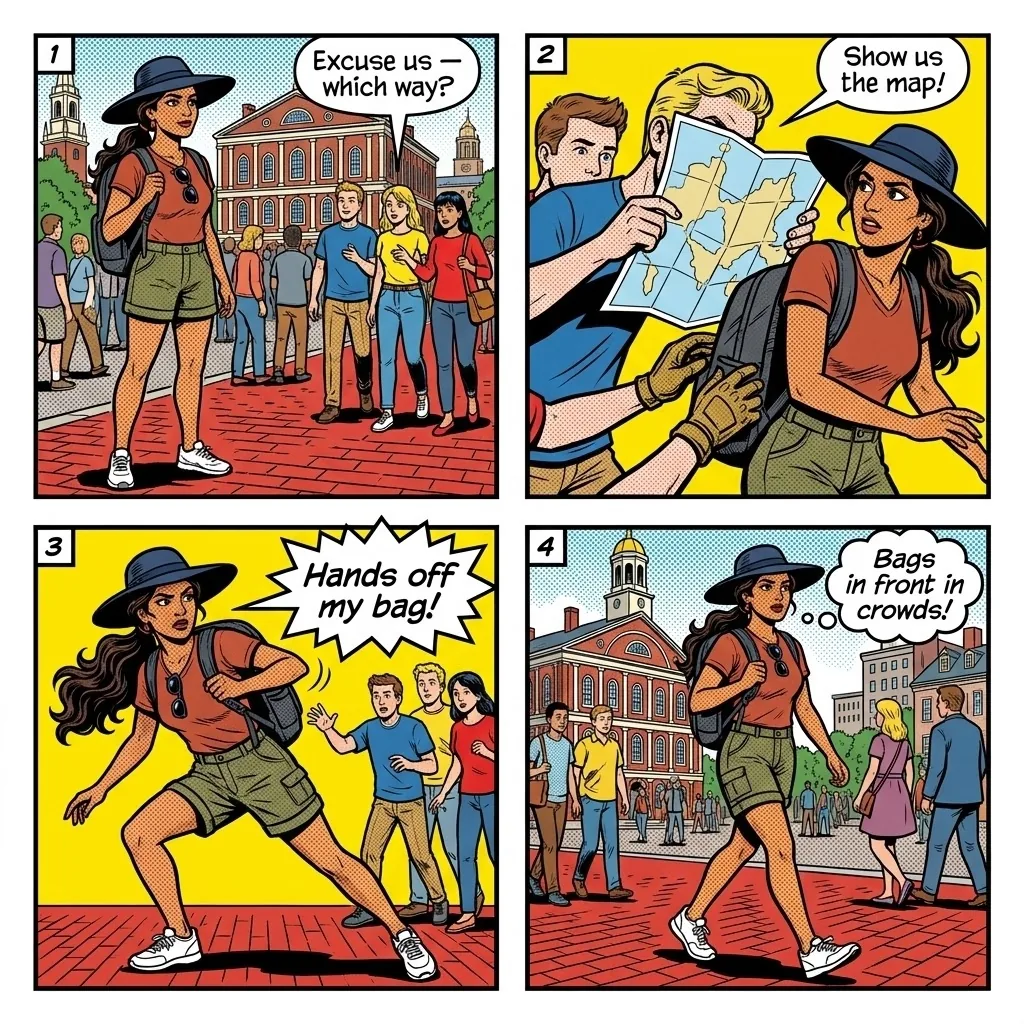
Pickpockets at Faneuil Hall street performances and on the MBTA Green Line use the "spill and clean" technique — one operator spills a drink on you and apologizes profusely while an accomplice lifts your wallet from your open tote — and the Boston Globe identified this as the city's most common method.
The hotspots are the Faneuil Hall street-performer crowds, MBTA platforms during peak hours (especially Park Street, Downtown Crossing, and Government Center), the Freedom Trail's narrow stretches, the Harvard Square subway exits, and the dense Boston Common gatherings around Park Street and Boylston. A tourist watching a juggler at Faneuil Hall in a 30-person semicircle has her wallet lifted from an open tote and doesn't notice until she tries to pay at her next stop. The Boston Globe ran a detailed investigation into city pickpocket techniques; Holidify's safety guide describes pickpocketing as "very common" in tourist areas; TravelSafe Abroad flags the same hotspots.
The spill-and-clean is the canonical mechanic. The first operator "accidentally" spills a coffee or soda on your sleeve, immediately produces napkins, and apologizes loudly enough to draw your full attention. While you're managing the stain, an accomplice working in tandem lifts the wallet from your bag or back pocket. The whole operation runs in twelve seconds. Variants on the Green Line use a manufactured argument or a sudden door-chime crowd surge to create the distraction; the Faneuil Hall street-performer version uses the natural crowd density around a juggler or musician.
Keep bags zipped and worn across your body in front, with the zipper toward your chest — never an open tote on your shoulder, and never a wallet in a back pocket on the MBTA or in tourist crowds. If someone spills something on you, secure your belongings with one hand on your bag before you accept any napkin or help. On the MBTA, hold your bag on your lap or between your feet. Carry only the cash and one card you need for the day; leave passports and backup cards in the hotel safe. For losses, file at boston.gov/police, freeze cards via your issuer's 24-hour fraud line, and use Find My or Find My Device for stolen phones — share the location with police rather than confronting.
Red Flags
- Someone bumps into you in a crowded area and is excessively apologetic
- A stranger spills something on your clothing and immediately offers to help clean it up
- You are in a dense crowd watching a street performer and feel pressure from people behind you
- Someone stands unusually close to you on the T when there is room to spread out
- A distraction — argument, dropped items, or sudden commotion — draws your attention while someone else moves close
How to Avoid
- Keep bags zipped and held in front of your body, never hanging loosely on your back or shoulder.
- Do not keep cash or wallets in back pockets — use a front pocket or money belt.
- If someone spills something on you, secure your belongings first before dealing with the stain.
- On the MBTA, hold your bag on your lap or between your feet and remain aware of who is around you.
- Carry only the cash and one card you need for the day — leave extras in the hotel safe.

Fake Boston vacation rentals listed at $150/night when neighborhood market rate is $300+ collect bank-transfer "deposits" outside the booking platform — the photos are stolen from real listings, the address belongs to an unaware tenant, and Boston Marathon weekend plus Red Sox season drive the volume.
The scam concentrates around peak Boston demand windows: Boston Marathon weekend, Red Sox home stands, fall foliage season, college move-in week, and major TD Garden events. A listing in Beacon Hill, Back Bay, the Seaport, or Cambridge appears at $150–$180/night when comparable hotels and registered short-term rentals are at $350+. The "host" responds quickly via email, has professional photos, and asks the renter to wire $1,800 directly to "avoid platform fees." The Boston Police Department issued a formal advisory: scammers fraudulently pose as landlords or rental agents using listings that either don't exist, have already been rented, or were copied from legitimate advertisements. GBH News and NBC Boston have reported on the surges during peak weekends.
The mechanic is moving the payment off-platform. Once you wire the deposit (typically through Zelle, Venmo, or a wire transfer), the listing disappears, the email bounces, and the address turns out to be a real apartment whose actual tenant has no idea anyone was offered a rental. The photos are reverse-image-searchable to a real Airbnb in another city. The "platform fees" framing is the social key — it sounds like a friendly tip from a host trying to save you money, when it's actually the entire point of the scam.
Book Boston accommodations only through Airbnb, Vrbo, or Booking.com using their in-platform payment systems — never wire money, Zelle, Venmo, or send cryptocurrency to any "host" outside the platform. Reverse-image-search every listing's photos with Google Lens; if they appear elsewhere, the listing is stolen. Verify the address on Google Maps Street View. The City of Boston maintains a short-term rental registry — verify the listing is registered at boston.gov before booking. For losses, dispute the wire with your bank within 60 days, freeze any cards used, and file at boston.gov/police and IC3.gov.
Red Flags
- The listing price is significantly below market rate for the neighborhood and season
- The host asks you to pay outside the booking platform via wire transfer, Zelle, or gift cards
- Communication quickly moves from the listing platform to personal email or WhatsApp
- The host is unable or unwilling to show you the property in person or via video call
- The listing has few or no reviews, and the host account was recently created
How to Avoid
- Book only through established platforms like Airbnb, VRBO, or Booking.com that hold funds in escrow.
- Never send money outside the official booking platform — no wire transfers, Zelle, Venmo, or cryptocurrency.
- Verify the property exists by cross-referencing the address on Google Maps Street View.
- If a Boston rental during peak season is priced 30% or more below similar listings, it is almost certainly a scam.
- The City of Boston maintains a short-term rental registry — verify the listing is registered at boston.gov before booking.

Pedicab drivers outside TD Garden and Fenway Park quote "just a few bucks" for a six-block ride to the North End and demand $60 at the destination, claiming a per-person-per-minute rate posted on a placard you never saw — the bait-and-switch is most aggressive on event nights when rideshare surge makes a pedicab look easier.
The hotspots are the TD Garden exits after Bruins and Celtics games, the Fenway crowd after Red Sox night games, the Faneuil Hall plaza on weekend nights, and Boston Common after concerts. A pedicab driver offers "a quick ride to the North End — just a few bucks." Six blocks and four minutes later he demands $60 at the destination, citing a $15-per-person-per-five-minutes rate posted on a small placard you never saw before getting in. The pattern mirrors the documented pedicab scam template that has prompted regulatory pushes for upfront fare disclosure in multiple US cities.
The mechanic is the vague verbal quote. "Just a few bucks" is intentionally ambiguous — once you're in the seat, the driver applies a fare structure that turns a $10 walk-distance ride into $60 by multiplying per-person-per-minute. Boston pedicabs operate in a regulatory gap similar to Austin's: there is no city-mandated meter, no posted rate floor, and the placards required to be visible are often the size of a postcard in dim light at midnight. Tourists leaving events at TD Garden or Fenway with rideshare surge pricing showing 4× and a 20-minute wait are the entire customer base.
Always confirm an exact total fare for all passengers — in dollars, for the whole ride — before you sit in any Boston pedicab. Ask "is that per person or for the trip?" and "is there a time-based charge on top?" If the driver hedges, walk away. After events at TD Garden or Fenway, the closest T station (North Station for TD Garden, Kenmore for Fenway) is typically a five-minute walk and costs $2.40 — almost always faster and cheaper than a pedicab. Photograph any rate placard before boarding so you have documentation. For overcharges, pay the agreed amount, get a receipt, and report the driver to 311 with the pedicab's license number.
Red Flags
- The pedicab driver gives a vague verbal quote like 'just a few dollars' without specifying the total
- Pricing is posted in tiny print on a sign you cannot read before getting in
- The rate is per person per minute rather than a flat fare for the trip
- The driver aggressively solicits riders outside venues after major events
- No receipt is offered and the driver insists on cash payment
How to Avoid
- Always confirm the exact total fare for all passengers before getting into any pedicab.
- Ask explicitly whether the fare is per person or per trip and whether it includes time-based charges.
- Take a photo of the posted rate card before getting in so you have documentation.
- After events at TD Garden or Fenway, walk to the nearest T station instead — it is usually faster and costs $2.40.
- If the final charge is far higher than quoted, you can dispute it — pay what was agreed and report the driver to 311.
🆘 What to Do If You Get Scammed
📋 File a Police Report
Go to the nearest Boston Police Department (BPD) station. Call 911 (Emergency) or (617) 343-4200 (Non-Emergency). Get an official crime report — you'll need this for insurance claims. You can also report online at boston.gov/police.
💳 Cancel Your Cards
Call your bank immediately. Most have 24/7 numbers on the back of the card (keep a photo saved separately). Block any suspicious transactions before the thieves use your details.
🛂 Lost Passport?
For international visitors, contact your country's consulate in Boston. Many nations maintain consulates in the city. US State Department emergency line: +1-888-407-4747 (from US) or +1-202-501-4444 (international).
📱 Track Your Device
If your phone was stolen, use Find My (iPhone) or Find My Device (Android) from another device. Don't confront thieves yourself — share the location with police instead.
Frequently Asked Questions
You just read 7 scams in Boston. The full Travel Safety Series has 780+ more across 20+ countries.
Tokyo's Kabukichō ¥130,000 bar trap. Rome's gladiator photo extortion. Paris's gold-ring trick. Bali's ATM skimmer scams. Bangkok's grand-palace closure ruse. Every documented scam across 20+ destinations — with the exact scripts, red flags, and local-language phrases that shut each one down. Drawn from Reddit traveler reports, embassy advisories, and consumer-protection cases.
- 780+ documented scams across Tokyo, Rome, Paris, Bali, Bangkok, Rio & 100+ more cities
- 20+ countries covered, with country-by-country phrase cards for every destination
- Updated annually — buy once, re-download future editions free
- All titles $4.99 each on Amazon Kindle