
Key Takeaways
- The #1 reported scam is the Shell Game Hustle.
- 4 of 7 scams are rated high risk.
- Use app-based ride services (Uber, Lyft) instead of unmarked vehicles or unlicensed cabs.
- Never accept unsolicited offers from strangers near tourist sites in Chicago.
⚡ Quick Safety Tips
- Keep your phone in a front pocket or zipped crossbody bag, especially on the CTA and along the Magnificent Mile — organized pickpocket teams actively work these areas.
- Use only official rideshare apps (Uber/Lyft) or taxis from designated stands — never accept rides from anyone who approaches you inside O'Hare or Midway terminals.
- Stick to well-lit, busy areas in the Loop, River North, and Streeterville after dark — most violent crime in Chicago occurs in neighborhoods far from tourist zones.
- Report scams or non-emergency incidents by calling 311 or (312) 746-6000 — save these numbers in your phone before arriving.
Jump to a Scam
The 7 Scams

Three-cup shell games on the Magnificent Mile and CTA Red Line trains use planted "winners" to lure tourists into $50–$200 bets — the dealer's sleight of hand guarantees the mark never wins, and pickpocket accomplices work the crowd while everyone watches the cups.
The hotspots are the Magnificent Mile (Michigan Avenue between the river and Oak Street), State Street near the Theatre District, and CTA Red Line cars during peak ridership. A small crowd gathers around a man shuffling three green cups on a handheld board with a red ball hidden under one. A woman bets $20 and wins. A man bets $50 and wins easily. CBS Chicago confirmed the pattern after a Streeterville resident reported operators near the Mag Mile; the same template runs on Red Line trains with portable boards.
The mechanic is the planted shill plus pickpocket cover. Every "winner" you see is a confederate whose job is to make the game look beatable. Once you put down $100, the dealer's sleight of hand makes the ball vanish from under any cup you select. Meanwhile, the crowd watching is the actual mark zone — embedded crew members lift wallets and phones from spectators while attention is fixed on the cups. The entire setup folds flat in seconds if CPD approaches, and the crew scatters before officers can identify roles.
Never gamble with any street dealer in Chicago — shell games are mathematically rigged cons, not games of skill, and even watching the crowd puts your wallet and phone at risk from embedded pickpockets. If you see a crowd around a portable cup or card game on Michigan Avenue or in a CTA car, change direction or move to the next train car. Keep your phone and wallet secured even if you only pause to look. Report shell-game operators to CPD non-emergency at 311 or (312) 746-6000; CTA-specific incidents go to (888) 968-7282 or 911.
Red Flags
- A crowd has gathered around someone shuffling cups or cards on a portable surface
- Multiple people seem to be winning easily — they are planted accomplices
- Someone in the crowd nudges you or encourages you to bet, saying 'it's easy'
- The setup is on a foldable table or board that can disappear in seconds
- You notice people standing unusually close to you in the crowd — potential pickpockets
How to Avoid
- Never gamble with street dealers — shell games are mathematically rigged cons, not games of skill.
- The 'winners' you see are always planted accomplices working with the dealer.
- If a crowd has gathered around a street game, walk the other direction immediately.
- Keep your phone and wallet secure if you even pause near a game — pickpockets work the audience.
- Report shell game operators to CPD non-emergency at 311 or (312) 746-6000.

"Pirate taxi" drivers solicit rides inside O'Hare arrivals and Union Station, charge $248 for a 10-minute ride or kidnap passengers to ATM-withdrawal loops — WGN-TV found four unauthorized drivers in 45 minutes at O'Hare, and CWB Chicago documented a November 2024 prosecution for fake-Uber kidnappings of women from the airport.
The pickup zones are O'Hare arrivals and baggage claim, Midway, Union Station's main hall, and the curbs outside Loop and River North hotels. The benchmark case: a Minnesota woman approached at Union Station agreed to a 10-minute ride to her Michigan Avenue hotel; her card was later charged $248. WGN-TV's airport hustle investigation logged four unauthorized drivers soliciting in 45 minutes inside O'Hare. CWB Chicago reported in November 2024 that prosecutors charged a man with kidnapping women picked up from O'Hare in a fake Uber, then forced into ATM-withdrawal loops.
The mechanic is the inside-the-terminal solicitation. Real Uber and Lyft drivers wait at official rideshare zones outside arrivals; real Chicago taxi drivers wait at the marked taxi stand. Anyone approaching you inside the terminal or baggage claim has bypassed both systems and is operating without insurance, city licensing, or background checks. Some vehicles display both taxi markings and a rideshare sticker simultaneously — one investigator caught a "$29 flat fee" car with both, leading to deceptive-practice citations. Overcharges of 3–5× the standard rate are routine; the kidnapping variant is rarer but well-documented.
Always request rides through the official Uber or Lyft app and verify driver name, car model, and license plate before opening the door — never accept a ride from anyone who approaches you inside an O'Hare terminal, Midway, or Union Station. For licensed taxis, walk to the official taxi stand and use the meter (or the Curb/Arro apps for vetted drivers without surge). Standard O'Hare-to-downtown metered fare is $40–$50. Report suspicious solicitors to airport police or 311 immediately. If you've been overcharged, dispute the card charge within 60 days as "amount different from authorized."
Red Flags
- Any driver who approaches you inside the terminal or baggage claim offering rides
- A vehicle displaying both taxi markings and a rideshare app sticker simultaneously
- The driver quotes a flat fee rather than using a meter or app-based pricing
- No visible city-issued taxi medallion number or chauffeur license on display
- The driver insists on cash payment or processes your card on a personal device
How to Avoid
- Always request rideshares through the official Uber or Lyft app and verify the driver, car model, and license plate before entering.
- Use only taxis from the official taxi stand — never accept rides from anyone who approaches you inside the terminal.
- For licensed taxis, use the Curb or Arro apps which connect you with vetted drivers at no surge pricing.
- Report suspicious drivers to 311 or airport police immediately.
- The standard taxi fare from O'Hare to downtown Chicago is approximately $40-50 with meter — anything quoted as a 'flat rate' inside the terminal is suspect.
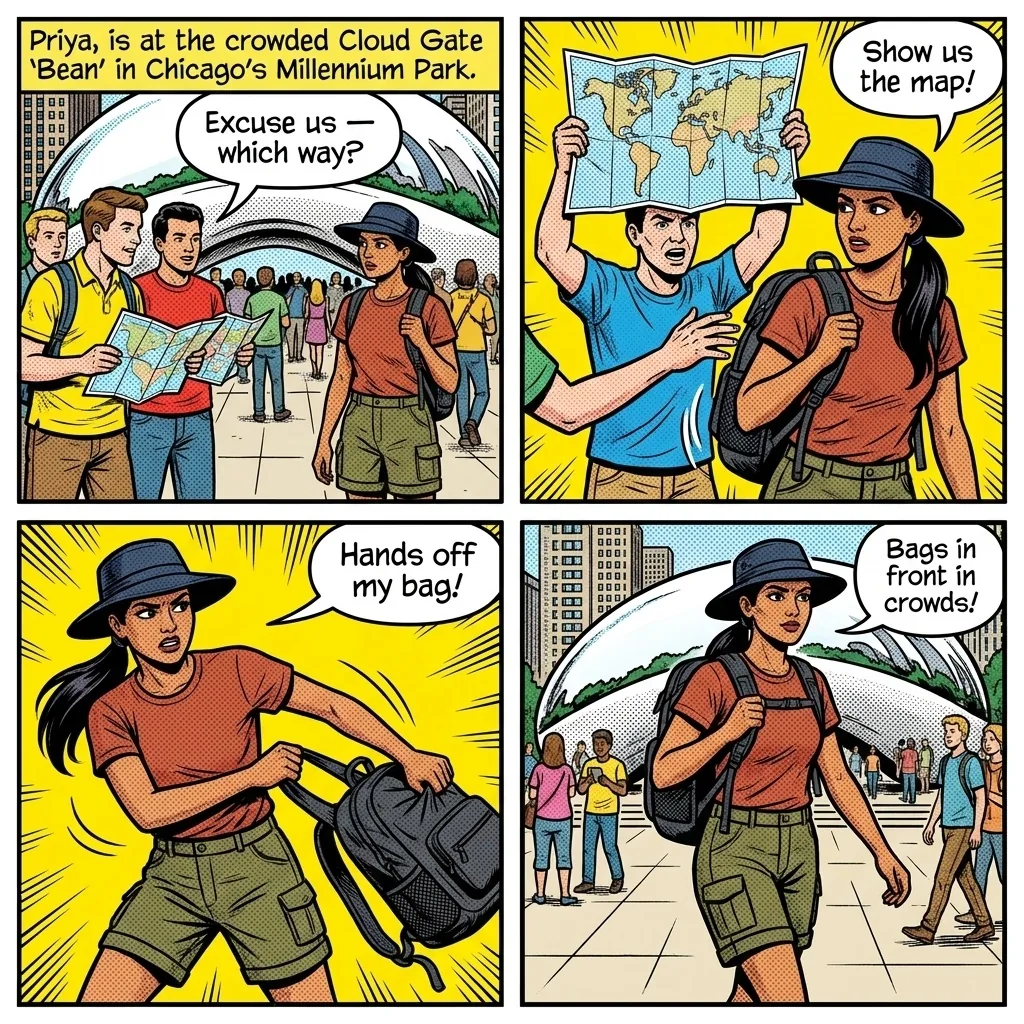
Organized pickpocket teams on the Magnificent Mile and in Streeterville lift wallets through "spill and clean" or bump-and-distract techniques and rack up $10,000+ in Venmo/Zelle transfers from stolen phones before victims notice — NBC Chicago identified a three-person ring operating downtown during peak shopping season.
The hotspots are N. Michigan Avenue between the river and Oak Street, the Streeterville blocks near the Apple flagship and Water Tower Place, State Street shopping corridors, and the Millennium Park crowds. NBC Chicago reported a Streeterville case in which a tourist's wallet was lifted near the Magnificent Mile and $10,000 in fraudulent charges hit before she noticed; police identified a three-person crew connected to a larger ring. The CBS Chicago Better Business Bureau investigation confirmed that operators specifically target tourists during peak shopping periods.
The mechanic is distraction plus instant digital cashout. The classic version is bump-and-distract: one operator stages a commotion or bumps into the victim, while an accomplice lifts the phone or wallet from the open tote or back pocket. The "spill and clean" variant uses an "accidental" coffee or sauce spill and the helpful cleanup as cover. The new layer that makes this more damaging than 1990s pickpocketing: stolen phones are immediately used to send Venmo and Zelle transfers before the victim notices the theft, and police documents show suspects hitting accounts within 60 seconds of the lift.
Keep your phone in a front pocket or zippered crossbody bag with the zipper toward your chest — never in a back pocket or open tote on the Magnificent Mile. If someone spills something on you, clutch your bag with one hand and step away before dealing with the stain. Enable instant transaction alerts on Venmo, Zelle, and your bank apps so unauthorized transfers appear immediately. After any bump or jostle in a Chicago tourist crowd, check phone, wallet, and pockets right away — the digital theft window closes within minutes. For losses, file at chicago.gov/cpd, freeze cards via your issuer's 24-hour fraud line, and lock Venmo/Zelle accounts.
Red Flags
- Someone bumps into you and is excessively apologetic in a crowded shopping area
- A sudden commotion or argument breaks out right next to you — classic misdirection
- A stranger accidentally spills something on you and rushes to help clean it up
- A group of people seem to be coordinating movements around you or watching specific targets
- Someone stands unusually close to you in a space where there is room to spread out
How to Avoid
- Keep your phone in a front pocket or zippered crossbody bag — never in a back pocket or open purse.
- If someone spills something on you, immediately clutch your belongings and step away before dealing with the stain.
- Be especially vigilant during holiday shopping season when the Magnificent Mile is most crowded.
- Enable instant transaction alerts on all banking and payment apps so unauthorized charges appear immediately.
- If bumped or jostled, check all your belongings immediately — do not wait until you reach your hotel.
Like what you're reading? Get a full Chicago itinerary with safety tips built in.
Browse travel-safety books →
"Youth basketball team" donation pitches near Navy Pier and Millennium Park, deaf-mute charity petitions on Michigan Avenue, and fake-veteran solicitations hit downtown Chicago tourists — the teams don't exist, the petitions are extraction tools, and the Chicago Loop Alliance ran a public awareness campaign because the pressure has gotten worse year over year.
The pitch zones are the approach to Navy Pier, the Cloud Gate area in Millennium Park, the Magnificent Mile sidewalks, and outside major museums. The benchmark case: a couple walking toward Navy Pier is stopped by a young man in a basketball-logo t-shirt with a flyer for a youth team called the "Raptors" and a story about keeping kids off the streets. They donate $20; a local later confirms the team doesn't exist. The pattern is documented on TripAdvisor's Chicago forum and across local guides as one of downtown's persistent street scams.
The mechanic is the manufactured charitable framing. Variants run alongside the basketball pitch: clipboard-wielding "petition" runners for a deaf-mute charity ask you to sign first, then demand a donation after your signature is on the page; fake-veteran solicitations use a uniform and a service-animal vest; pet-evoked sympathy pitches use a dog and a sob story about needing veterinary care. The Chicago Loop Alliance's awareness campaign confirms the volume; Loop and River North restaurants have reported solicitors entering dining areas and going table to table demanding cash from seated diners.
Never donate cash on the street to anyone in Chicago — legitimate charities don't fundraise from pedestrians on Michigan Avenue or outside Navy Pier, and your signature on any street petition can be used to register you for unwanted services. Say "no, thanks" without breaking stride or making eye contact. To support real Chicago youth programs, donate through After School Matters (afterschoolmatters.org), the Chicago Park District Foundation, or the United Way of Metro Chicago. If a solicitor enters a restaurant and harasses diners, ask staff to call 311 or, for aggressive cases, 911.
Red Flags
- Someone approaches with a flyer or clipboard asking for donations to an organization you have never heard of
- The charity has no verifiable website, EIN number, or physical address
- A person claims to represent a youth sports team and asks for cash donations on the street
- You are asked to sign a petition first, then pressured for a donation after signing
- The person becomes aggressive or follows you when you decline
How to Avoid
- Never donate cash on the street — legitimate charities do not solicit donations from pedestrians this way.
- Say 'no thank you' firmly and keep walking without breaking stride or making eye contact.
- If you want to support youth programs, donate through verified organizations like Chicago Park District or After School Matters.
- Do not sign any petitions or clipboards on the street — your signature and information can be misused.
- If someone enters a restaurant and harasses diners, alert staff immediately — businesses can call 311.

Groups of 2–7 people surround late-night CTA Red Line and Blue Line riders, stage a loud argument as cover, and snatch phones from passengers' hands — Chicago Police issued a 2025 community alert covering at least seven such robberies, with Roosevelt station logging the highest incident rate.
The hotspots are the CTA Red Line late at night between Cermak and Howard, the Blue Line stops between O'Hare and the Loop, the Roosevelt station (highest documented incident rate per the Illinois Policy Institute analysis), and the Lake/State Loop transfer point. The benchmark case: a woman riding the Red Line is suddenly surrounded by a group of four; one starts a loud argument in front of her while another bumps her from behind, the phone is snatched, and the group exits at the next stop and scatters before she processes what happened. CPD's 2025 community alert documented at least seven such robberies on the Red and Blue Lines.
The mechanic is choreographed distraction in a confined car. The crew of two to seven enters together, identifies a target (typically holding a visible phone), and divides into roles — one ahead, one behind, one staging the argument or asking a question, one or two as the actual lifter. The Illinois Policy Institute analysis identifies battery and "deceptive practices" (meaning scams) as the two most common CTA crime categories. The shell-game variant runs in the same cars, with lookouts and pickpockets embedded in the spectators around the game.
Keep your phone secured and out of sight on CTA trains — never hold it loose in your lap or display it while standing — and ride in the car closest to the train operator after 10 PM, which is the most monitored. If a group surrounds you or moves to bracket you on the platform, stand up immediately and move to another car at the next station; do not wait to confirm intent. Avoid riding alone late at night; use Uber or Lyft after 10 PM if traveling solo. Report incidents to CTA security at (888) 968-7282, text "CTA" to 78328, or call 911 in an emergency.
Red Flags
- A group of people suddenly surrounds you or positions themselves on both sides of you on the train
- Someone starts a loud argument or creates a distraction nearby while others move closer
- Your phone is visible in your hand and someone keeps glancing at it
- You are riding alone late at night on a sparsely populated car
- People enter your train car and do not sit down, instead standing close to doors and near passengers
How to Avoid
- Keep your phone secured and out of sight on CTA trains — do not hold it loosely or rest it on your lap.
- Ride in the car closest to the train operator, which is typically the most monitored.
- Avoid riding alone on the CTA late at night — use rideshare services after 10 PM if traveling solo.
- If a group moves to surround you, stand up immediately and move to another car at the next station.
- Report incidents to CTA security at (888) 968-7282 or text 'CTA' to 78328 in an emergency.

Scalpers outside Navy Pier, Wrigley Field, United Center, and Soldier Field sell photocopied tickets with duplicated barcodes — only the first person to scan each barcode gets in, and CPD arrested an eight-person ring operating this template for over a decade with the Illinois Attorney General issuing a formal consumer alert.
The pitch zones are outside Navy Pier on event nights, the Wrigleyville sidewalks before Cubs games, the United Center perimeter for Bulls and Blackhawks games, and the Soldier Field approach for Bears games and major concerts. The benchmark case: a family pays $300 cash for three sold-out concert tickets at $20 above face value, and all three barcodes are rejected at the gate — the tickets are photocopies with already-scanned barcodes. CPD arrested an eight-person counterfeit-ticket ring after a decade-long operation; the Illinois Attorney General issued a formal consumer alert.
The mechanic is the single-scan vulnerability of the modern barcode system. The scalper either prints the same legitimate ticket multiple times and sells the duplicates to several buyers (only the first scan opens the gate), or screenshots a real mobile ticket and resells the screenshot. Some scalpers now hold legitimate single tickets and simply mark them up 3–5× for desperate last-minute buyers — that's not counterfeiting, just exploitation. The cash-only insistence and refusal to step toward the gate scanner with you before payment are the consistent tells.
Buy tickets only from official box offices, Ticketmaster, or authorized resale platforms (StubHub, SeatGeek) that guarantee authenticity — and pay by credit card so you have chargeback recourse if the barcode is dead. Never buy tickets from someone holding paper or showing a phone screenshot on the street, even if the price looks reasonable; duplicated barcodes are visually undetectable. For Cubs, White Sox, Bears, Bulls, and Blackhawks games, check the team's official resale marketplace first. If you've been sold a counterfeit, file at chicago.gov/cpd, dispute the cash if it went through a P2P app, and report to the Illinois Attorney General's consumer fraud line.
Red Flags
- Anyone selling tickets on the street outside a venue rather than through official channels
- Ticket prices that seem too good to be true for a sold-out event
- The seller insists on cash only and refuses to show identification
- The tickets are printed on plain paper rather than official ticket stock
- The seller becomes agitated when you want to verify the ticket before purchasing
How to Avoid
- Buy tickets only from official box offices, Ticketmaster, or other authorized resellers.
- If buying resale, use platforms like StubHub or SeatGeek that guarantee ticket authenticity.
- Never buy tickets from someone on the street — even if they look real, duplicated barcodes are undetectable visually.
- Pay with a credit card for dispute protection — never cash for street ticket purchases.
- For Red Sox, Bears, or Blackhawks games, check the official team resale marketplace first.

"Free gift" friendship bracelets at Cloud Gate and "free CD" mixtapes on Michigan Avenue are tied to your wrist or pressed into your hand in under three seconds — then $20 demands follow with physical pressure if you refuse, and Islands travel guide identifies these as Chicago's most common downtown street hustles.
The hotspots are Millennium Park's Cloud Gate ("the Bean"), Buckingham Fountain, the Magnificent Mile, the Riverwalk near Michigan Avenue, and outside major museums. The benchmark cases: a solo traveler near Cloud Gate has a braided bracelet tied on her wrist by a man calling it a "free gift" and a "blessing from the city," then a second person places beads around her neck and they demand $20 each; on Michigan Avenue, an aspiring "musician" thrusts a homemade CD into a tourist's hand, calls it free, then aggressively demands $10–$20 once the CD is held.
The mechanic is speed plus social pressure. The bracelet tie is practiced — by the time you process what's happening, it's secured around your wrist and removing it requires scissors. The CD version exploits the moment between accepting and refusing, when the operator switches from "free gift" framing to "support an artist" demand. If you decline, accomplices appear — a second bracelet, a third CD, a small group closing your exit angle on a sidewalk where two against one is enough. The pressure escalates until most tourists pay $20 just to make the situation end.
Keep your hands in your pockets or crossed at your chest when walking through Millennium Park, the Bean, the Magnificent Mile, or the Riverwalk — physical distance is the entire defense. Step back with palms up the moment a stranger reaches toward your wrist or extends a CD; say "no" loudly without slowing down. If a bracelet has already been tied on against your will, you owe nothing — remove it (scissors at any drugstore) and walk away. Never accept anything handed to you on the street in downtown Chicago. For aggressive incidents, dial 911 or use the CPD non-emergency line at 311 / (312) 746-6000.
Red Flags
- Someone approaches and places a bracelet, beads, or any item on your body without asking permission
- A stranger hands you a CD and calls it 'free' before immediately demanding payment
- The item is described as a 'blessing' or 'gift from the city' but a payment demand follows
- Multiple people close in around you, creating a sense of being trapped
- The person becomes verbally aggressive when you try to decline or return the item
How to Avoid
- Keep your hands in your pockets or crossed when walking through heavy tourist areas.
- Do not allow anyone to place anything on your body — step back immediately with palms up.
- If a bracelet is tied on you, you owe nothing — remove it and place it on the ground.
- Never accept a CD or item handed to you on the street — say 'no' before it reaches your hands.
- Walk with purpose and confidence — scammers target people who appear hesitant or easily stopped.
🆘 What to Do If You Get Scammed
📋 File a Police Report
Go to the nearest Chicago Police Department (CPD) station. Call 911 (Emergency) or 311 / (312) 746-6000 (Non-Emergency). Get an official crime report — you'll need this for insurance claims. You can also report online at chicago.gov/cpd.
💳 Cancel Your Cards
Call your bank immediately. Most have 24/7 numbers on the back of the card (keep a photo saved separately). Block any suspicious transactions before the thieves use your details.
🛂 Lost Passport?
For international visitors, contact your country's consulate in Chicago. Many nations maintain consulates downtown. US State Department emergency line: +1-888-407-4747 (from US) or +1-202-501-4444 (international).
📱 Track Your Device
If your phone was stolen, use Find My (iPhone) or Find My Device (Android) from another device. Don't confront thieves yourself — share the location with police instead.
Frequently Asked Questions
You just read 7 scams in Chicago. The full Travel Safety Series has 780+ more across 20+ countries.
Tokyo's Kabukichō ¥130,000 bar trap. Rome's gladiator photo extortion. Paris's gold-ring trick. Bali's ATM skimmer scams. Bangkok's grand-palace closure ruse. Every documented scam across 20+ destinations — with the exact scripts, red flags, and local-language phrases that shut each one down. Drawn from Reddit traveler reports, embassy advisories, and consumer-protection cases.
- 780+ documented scams across Tokyo, Rome, Paris, Bali, Bangkok, Rio & 100+ more cities
- 20+ countries covered, with country-by-country phrase cards for every destination
- Updated annually — buy once, re-download future editions free
- All titles $4.99 each on Amazon Kindle