
📌 The 30-Second Version
Charity and disaster scams concentrate after major weather events, mass-casualty incidents, and high-profile tragedies. Per industry reporting, scammers stole $34M across 2025's Hurricane Helene + Milton + California wildfires alone. Five variants dominate: fake GoFundMe pages for fabricated victims using stolen photos; fake-charity sound-alike organizations registered within days of the disaster with no operational history; FEMA impersonation (door-to-door, phone, email) demanding payment for assistance FEMA provides free; post-disaster door-to-door contractor scams exploiting urgency to demand same-day deposits; and donation-phishing emails impersonating major charities. The unifying defense fits in two rules: (1) verify any charity through Charity Navigator (charitynavigator.org) or Candid (candid.org) before donating; (2) FEMA never charges for disaster assistance. For disaster relief specifically, donate only to long-established organizations (American Red Cross, World Central Kitchen, Team Rubicon, Salvation Army) verified through third-party rating services.
⚡ Quick Safety Rules
- Verify charities via Charity Navigator + Candid. Free, independent ratings. If the organization isn't listed, it isn't a verified 501(c)(3) charity.
- Donate to established disaster-relief orgs. American Red Cross, World Central Kitchen, Team Rubicon, Salvation Army, United Way, Direct Relief, GlobalGiving — decades of operational history.
- Type the URL directly; never click email donation links. redcross.org, salvationarmyusa.org, savethechildren.org. Phishing emails route to credential-harvest sites.
- FEMA never charges for disaster assistance. Any "FEMA rep" demanding payment is a scam. Real FEMA assistance is via disasterassistance.gov.
- Pay only by credit card. Gift cards, wire, crypto are diagnostic for scam donation requests.
- Skip individual GoFundMes for strangers. Donate to established disaster-relief orgs that have field operations + vetted distribution.
🪞 Is this charity / donation request a scam? — 30-second self-check
Two or more "yes" answers and the answer is yes.
- Was the organization registered or the page created within the past few weeks (post-disaster)?
- Is the organization not listed on Charity Navigator or Candid?
- Is the donation request asking for gift cards, wire transfer, or cryptocurrency?
- Did the request arrive unsolicited via email, social media DM, phone, or door-to-door?
- Does a "FEMA representative" demand payment for assistance or inspection?
2+ yes: Charity / disaster scam. Don't donate. Verify via Charity Navigator + report. → Skip to What to Do
Jump to a Variant
The Anatomy of the SNAP-Suspension Food-Bank Fundraiser
The post is on r/Scams, headlined "[US] Scam Fundraiser Stealing From Food Banks Here on Reddit." The author opened with the context: in November 2025, SNAP funding was suspended and many people were trying to support food banks. They had clicked on a Reddit post that "appeared great at first," from someone claiming to be a volunteer and a chef at a food bank trying to raise money for No Kids Hungry — a real, large, and legitimate organization. The link in the post, however, was to an Angellink fundraiser, which is generally used for personal fundraisers similar to GoFundMe. The poster had simply typed the name "No Kids Hungry" into the title of their Angellink fundraiser; there was no way to verify the beneficiary actually was the legitimate charity.
The author did the diagnostic that catches almost every fake-charity variant. They clicked through to the Angellink profile, named "Kerri Reed," and ran a reverse Google image search on the profile picture. The picture turned out to be ripped from the Twitter profile of a British actress also named Kerri Reed. The scammer had built a fictitious volunteer identity by stealing the name and photo of a real person. By the morning the post went up, both the fake Reddit profile and the Angellink fundraiser had been taken down — but the Reddit account itself remained, ready to spin up under a new charity name.
A reply captured the canonical pattern: "Make sure to report the reddit profile, but even that is like playing whack-a-mole. Scammers use any hardship or disaster to create these fake donation sites, and are the absolute worst of humanity by preying on the goodwill of others. Good advice. ONLY donate to the actual valid" charity directly. The author's closing line: "People using this moment to steal food out of hungry kids mouths are the lowest of the low." [r/Scams · as of Apr 2026]
What These Scams Actually Are
Charity and disaster scams share a single structural feature: exploit urgency and sympathy in the hours and days after a major event. The variants differ in delivery channel and impersonation target, but the underlying mechanic is identical.
- Speed of registration. Within 24-72 hours of any major disaster, scammers register sound-alike charity domains, create GoFundMe pages with stolen victim photos, and launch donation-phishing email campaigns. The window between disaster and legitimate-charity response is the scammers' opportunity.
- Emotional bypass of due diligence. Real disasters create a strong impulse to donate quickly. Scammers calibrate the messaging to that impulse — "donate now to help families who lost everything" — and use payment rails (gift cards, crypto, wire) that bypass normal credit-card chargeback protections.
- FEMA / official-agency pretext. Door-to-door and phone-based variants impersonate FEMA, Red Cross, or state emergency-management officials. The variant works because real disaster-response agencies do canvas affected neighborhoods, but they never charge for assistance.
- Stolen photos + fabricated stories. Photos from news outlets are reused on fake GoFundMe pages with fabricated victim names. Real authorized fundraisers are rare relative to the volume of scam pages after major events.
🔑 The single rule that defeats every variant — verify through Charity Navigator + donate only to established orgs
Real established disaster-relief organizations have decades of operational history, IRS 501(c)(3) registration, Charity Navigator and Candid ratings, and field operations with vetted distribution. American Red Cross, World Central Kitchen, Team Rubicon, Salvation Army, United Way, Direct Relief, Habitat for Humanity, and GlobalGiving are the most-cited safe donation channels for disaster relief. The verify-through-third-party-rating-service rule defeats the four impersonation variants and the fake-GoFundMe variant; the FEMA-never-charges rule defeats the FEMA-impersonation variant.
The 5 Variants
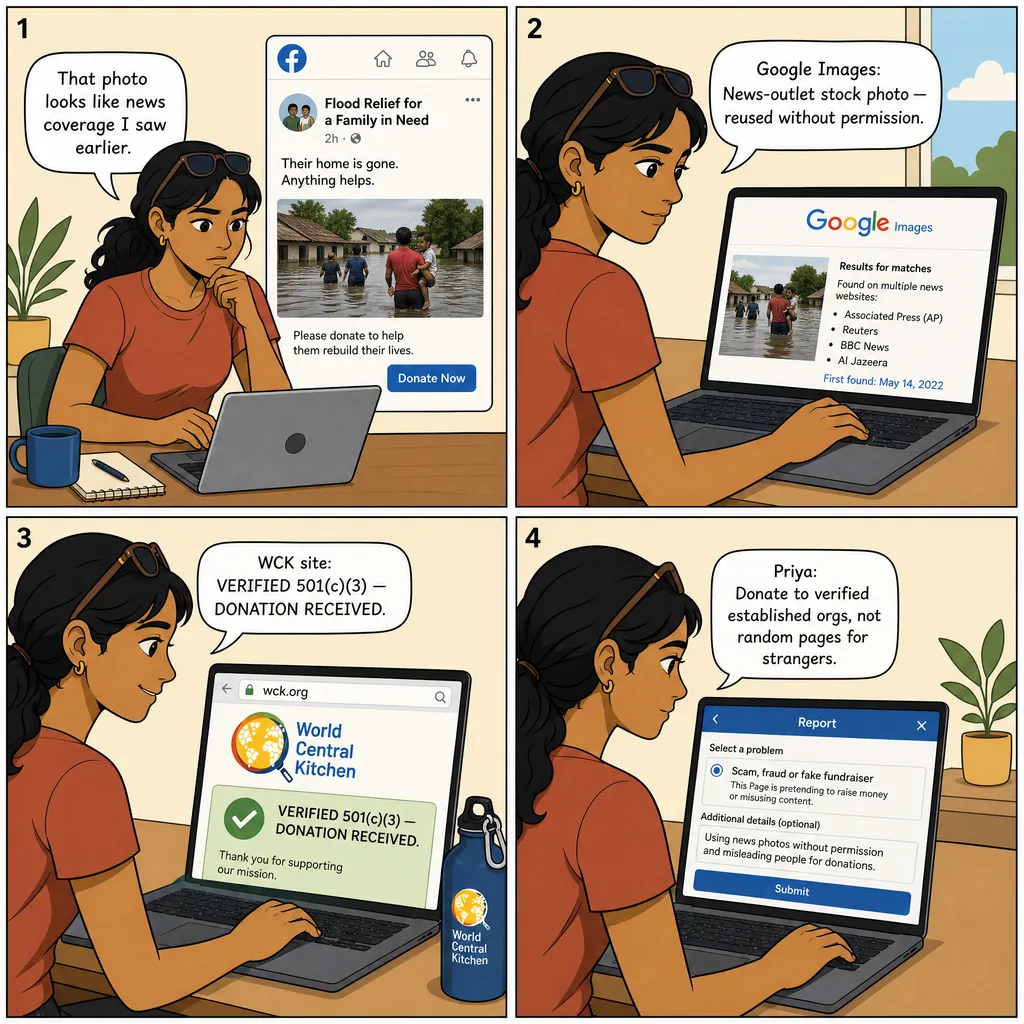
Scammers create GoFundMe / Kickstarter / Facebook Fundraiser pages claiming to help specific disaster victims — using fabricated names, stolen news photos, and made-up backstories. Real authorized family fundraisers are rare relative to scam-page volume after major events. The protective rule: donate to established disaster-relief organizations rather than to individual GoFundMe pages for strangers.
Per industry reporting on the 2024 Hurricane Helene aftermath, within 48 hours of Helene's landfall in western North Carolina, dozens of GoFundMe pages appeared claiming to support specific Asheville families "who lost everything." Many pages used victim photos pulled from news coverage of the disaster, family-name combinations that didn't appear in any local property record, and donation goals of $50,000-$200,000. Investigative reporting later determined that several pages had no connection to any actual families — the fundraisers were created by scammers using AI-generated story details and stolen photos. Total losses across fake Helene-related fundraisers reached $18M per industry tracking.
GoFundMe and similar platforms maintain trust-and-safety teams that remove fraudulent pages, but the response is reactive rather than preventive — pages typically remain live for 24-72 hours before flagging. The protective architecture for donors: don't donate to individual fundraisers for strangers. Established disaster-relief organizations have field operations on the ground within hours of major events, vet distribution, and produce financial transparency reports. American Red Cross, World Central Kitchen (which deployed to Asheville within 24 hours of Helene), and Team Rubicon (military-veteran-led disaster response) all maintain real-time disaster-response operations.
What stops it is the established-org rule. If you want to help disaster victims, donate to established disaster-relief organizations rather than to individual GoFundMe pages for strangers. If you personally know a family affected and want to support them directly, send funds via Zelle / Venmo to a phone number or email you already had for them — not to a GoFundMe page that may or may not be theirs. Report suspected fake fundraisers to the platform's trust-and-safety team.
Red Flags
- Page created within hours/days of disaster
- Photos appear in news-outlet coverage of the disaster (reverse-image search)
- Victim names don't appear in any local property record / news source
- Donation goal disproportionate to claimed need
- Page creator's identity cannot be verified as connected to the named victim
Defenses
- Donate to established disaster-relief orgs (Red Cross, World Central Kitchen, Team Rubicon, etc.)
- If supporting someone you personally know, send funds via Zelle/Venmo to a number you already have for them
- Reverse-image-search photos before donating
- Report suspected fake fundraisers to platform trust-and-safety
Typical Money Demanded
$5–$500 per donation across many donors · cumulative $18M Helene + $12M Milton + $4M CA wildfires = $34M across 2025 disasters per industry reporting.
— The second variant is more durable. Scammers register charity-sounding domains and operate them for weeks, exploiting the gap between disaster and legitimate-charity response. —

Scammers register charity-sounding domains and social-media accounts that mimic legitimate organizations. Real established charities are 501(c)(3) IRS-registered with decades of operational history and Charity Navigator / Candid ratings. Sound-alike scam organizations are typically registered within days of the disaster, have no operational history, and are not listed on any third-party charity-rating service.
FTC consumer-protection records capture the canonical version: after the January 2025 California wildfires, a domain "EatonFireSurvivorsFund.org" appeared with a polished website, victim testimonials, and a credit-card donation form. The domain was registered three days after the wildfires began. The "organization" was not registered with the IRS, had no Charity Navigator rating, no Candid profile, and no verifiable address or board of directors. Donations via the site routed to a payment processor associated with multiple previously-flagged scam fundraisers. Per DOJ investigation, the operators ultimately faced federal fraud charges. Cumulative California-wildfire-related scam losses reached $4M across multiple sound-alike organizations.
The protective architecture is mature and easy to use. Charity Navigator (charitynavigator.org) and Candid (candid.org) — both free, independent third-party rating services — list every IRS-registered 501(c)(3) charity and provide ratings on financial health, accountability, and program impact. The IRS Tax Exempt Organization Search at irs.gov/charities-non-profits/tax-exempt-organization-search is the federal authoritative source. If a "charity" is not listed in any of these three databases, it is not a registered 501(c)(3) charity and donations are neither tax-deductible nor accountable.
What stops it is the third-party verification rule. Search the exact charity name on charitynavigator.org or candid.org before donating. If the organization isn't listed, walk away. Real established charities welcome the verification — they list their Charity Navigator rating prominently on their own website. Scam organizations have no Charity Navigator rating because they were registered too recently and never went through the IRS 501(c)(3) process.
Red Flags
- Charity name closely mimics a legitimate established charity
- Domain registered within days of the disaster
- Not listed on Charity Navigator, Candid, or IRS Tax Exempt search
- No verifiable physical address, board of directors, or operational history
- Website features prominent disaster-related imagery + urgent donation form
Defenses
- Verify on Charity Navigator + Candid + IRS Tax Exempt search
- Real charities list their Charity Navigator rating publicly
- Donate to established orgs with decades of history
- Report fake charities to FTC + state AG charity-registration office
Typical Money Demanded
$10–$500 per donation · scammers operate these for weeks/months, accumulating thousands per fake organization.
— The third variant adds personal contact. Door-to-door, phone, email — the scammer claims to be a federal agency representative and demands payment. —

Scammers impersonate FEMA officials — door-to-door, by phone, by text, or by email — and offer disaster grants, home inspections, or expedited assistance for a fee. FEMA never charges for disaster assistance. Real FEMA inspectors carry official photo ID, work for federal contractors with verifiable badges, and the inspection / assistance process is documented through the homeowner's DisasterAssistance.gov account.
An FTC consumer-protection alert from after Hurricane Helene describes the pattern: a homeowner in western North Carolina answered the door to a man wearing a polo shirt with an embroidered "FEMA Disaster Inspector" patch, holding a clipboard and a tablet. He said he was conducting damage inspections for FEMA disaster-grant processing and needed to verify her FEMA registration number, last four of her SSN, and bank-account information for "grant disbursement." He also asked for a $300 "expedite fee" payable by Zelle. The homeowner gave him the requested info and paid the $300. Two weeks later her bank account was empty and her FEMA grant application had been hijacked — someone using her info had filed for additional grants and had them disbursed to a different account. Real FEMA inspectors don't ask for SSN, banking info, or fees; the inspection process is documented in the homeowner's existing DisasterAssistance.gov account.
FEMA's published guidance is unambiguous: FEMA does not charge for disaster assistance. Real FEMA inspectors carry photo IDs that homeowners can verify, the inspection process is initiated through DisasterAssistance.gov by the homeowner (not by FEMA cold-canvassing neighborhoods), and disbursement happens through verified bank-account information already on file in the homeowner's account. The FTC's July 2025 consumer alert and the FBI's IC3 PSA 250116 both emphasize the same rule: any "FEMA representative" demanding payment is impersonation.
What stops it is the FEMA-never-charges rule plus DisasterAssistance.gov verification. Real FEMA assistance is initiated by the homeowner through disasterassistance.gov, with all communication and document upload happening through the homeowner's account portal. Any "FEMA representative" who shows up at the door demanding payment, banking info, or registration-number verification is a scammer. Take their card if offered, close the door, log into your DisasterAssistance.gov account directly to verify any pending inspection or document request, and report the impersonation to the National Center for Disaster Fraud at 1-866-720-5721.
Red Flags
- "FEMA inspector" demands payment for inspection or assistance
- Asks for SSN, banking info, or FEMA registration number for "verification"
- Embroidered patch on polo shirt rather than verifiable federal-contractor uniform
- No verifiable photo ID or refuses to allow ID verification
- Pressure to act immediately ("grant disbursement deadline")
Defenses
- FEMA never charges for disaster assistance — period
- Verify via your DisasterAssistance.gov account directly
- Real FEMA inspectors carry verifiable photo IDs from federal contractors
- Report impersonation to NCDF: 1-866-720-5721
- File at FEMA fraud hotline + FTC + state AG
Typical Money Demanded
$200–$1,000 in "expedite fees" per scammed homeowner + identity-theft losses from harvested SSN / banking info.
— The fourth variant overlaps with our door-to-door-contractor guide, but the disaster-specific framing adds urgency and makes verification harder. —

Within hours of a major disaster, contractors arrive offering quick repairs for cash deposits. Many are unlicensed, uninsured, or outright fraudulent — they collect deposits and disappear, or perform shoddy work. Variant overlaps with our door-to-door-contractor-scams guide. The protective rule is the same: never sign or pay on the day of contact.
FBI Houston advisories after Hurricane Beryl document the pattern: a homeowner with roof damage from the storm answered the door to a contractor with out-of-state plates offering immediate roof repair for $4,000 cash deposit, with the rest payable when work was complete. The contractor said state inspectors would penalize unrepaired homes within 72 hours and that homeowners insurance would cover the full cost. The homeowner paid the $4,000 deposit; the contractor returned the next day with two laborers, climbed onto the roof for an hour, and left without completing any visible work. The contractor's phone went disconnected within a week. State contractor-licensing lookup showed no record of the LLC name. Variant follows the canonical storm-chaser script covered in detail in our door-to-door-contractor-scams guide.
The protective architecture is the same as for non-disaster contractor scams: state contractor-licensing boards, BBB Scam Tracker, the FTC Cooling-Off Rule's 3-business-day cancellation right, and pay-only-by-credit-card discipline. The disaster-specific addition is that your homeowner's insurance carrier maintains a list of vetted preferred-vendor contractors and will dispatch them at no cost — call your insurance carrier first before signing with any door-to-door contractor. Real legitimate contractors after disasters are typically already booked with carrier-vetted work; the contractors knocking unsolicited are the structurally unverifiable ones.
What stops it is the same never-sign-on-the-day rule. Call your insurance carrier directly (number on your policy) before signing any post-disaster repair contract. Use the FTC Cooling-Off Rule (16 CFR Part 429) for 3-business-day cancellation if you signed under pressure. Pay only by credit card. See our full guide at door-to-door-contractor-scams for the complete protective playbook.
Red Flags
- Contractor with out-of-state plates arrives within hours/days of disaster
- Pressure for same-day cash deposit
- Claims state inspector will penalize unrepaired homes within 72 hours (false)
- LLC name not in state contractor-licensing database
- "Insurance will cover everything" framing
Defenses
- Call your insurance carrier first; use carrier-vetted preferred-vendor contractors
- Verify state contractor license + BBB + 5+ years of local Google reviews
- FTC Cooling-Off Rule (16 CFR Part 429): 3-business-day cancellation
- Pay only by credit card
- See door-to-door-contractor-scams for full playbook
Typical Money Demanded
$2,000–$15,000 in cash deposit per scammed homeowner · plus subsequent property damage from shoddy work that fails state insurance inspection.
— The fifth variant runs at email-marketing scale. Donation phishing exploits the same urgency the legitimate charities depend on. —

Donation-request emails arrive purporting to be from major charities, with links to fake donation forms that capture credit-card details. Real established charities don't send unsolicited urgent emails to non-subscribers, and the email links should always route to the charity's official .org domain — not a lookalike. The protective rule: don't click email donation links. Type the charity's URL directly.
A representative case: after a major disaster, an email arrives reading "American Red Cross Emergency Appeal — donate now to help families displaced by the disaster." The email is well-formatted with Red Cross branding and includes a "Donate Now" button. The button routes to "redcross-disaster-appeal.org" (lookalike domain — not redcross.org). The page mimics the Red Cross donation flow, asks for credit-card details, and captures them. The donation never reaches the Red Cross; the credit-card details are used for fraud weeks later. Real Red Cross emails route to redcross.org; any other domain is the diagnostic.
The protective rule is identical to the rule for Amazon, package-text, and other brand-impersonation phishing variants. Don't click links in unsolicited donation-request emails. If you want to donate to the Red Cross, Salvation Army, World Central Kitchen, or any other established charity, type the charity's URL directly into your browser. Real established charities have memorable .org domains: redcross.org, salvationarmyusa.org, savethechildren.org, wck.org (World Central Kitchen), teamrubiconusa.org, directrelief.org. Anything else is a lookalike.
What stops it is the type-the-URL rule. Type the charity's URL directly; never click email donation links. If the email is a real charity appeal you want to honor, you'll find the same appeal on the charity's official website. Report donation-phishing emails to the impersonated charity (most have published abuse / phishing addresses) and to the FTC at reportfraud.ftc.gov.
Red Flags
- Unsolicited donation-request email after a major disaster
- "Donate Now" button routes to lookalike domain
- Email sender domain is lookalike (redcross-disaster.org vs redcross.org)
- Urgency framing ("hours-old disaster, immediate appeal")
Defenses
- Type charity URL directly into browser; never click email links
- Real charity domains: redcross.org, salvationarmyusa.org, savethechildren.org, wck.org
- Report phishing to charity's published abuse address + FTC
- Use credit card (FCBA chargeback rights)
Typical Money Demanded
$25–$500 in fake donations + $200–$5,000 in subsequent fraudulent card charges on the captured credit-card details.
🆘 What to Do If You've Been Charity / Disaster-Scammed
💳 Credit Card Chargeback
Dispute fraudulent donation charges with your card issuer under the Fair Credit Billing Act (60-day window).
📋 FTC ReportFraud
File at reportfraud.ftc.gov. Aggregated reports inform federal alerts.
🏛 NCDF Hotline (Disaster Fraud)
Call the National Center for Disaster Fraud at 1-866-720-5721. NCDF is the federal coordination point for disaster-fraud investigations.
🏛 IC3 — Loss Over $1,000
File at ic3.gov (FBI Internet Crime Complaint Center).
⚖️ State Attorney General Charity Office
File with your state AG's charity-registration office. Most states require charities to register before soliciting donations from state residents.
🏛 IRS Tax Exempt Investigation
Report fraudulent "charities" to the IRS at irs.gov. The IRS investigates 501(c)(3) fraud.
📋 BBB Wise Giving Alliance
Report at give.org (BBB Wise Giving Alliance). Their accreditation is widely respected.
🚫 Ignore Recovery DMs
After any public victim post, "donation recovery" DMs offering to recover your donations for an upfront fee will arrive. Block all of them.
If You're Reporting Outside the United States
- United Kingdom: Charity Commission for England and Wales (gov.uk/government/organisations/charity-commission). Report fraud to Action Fraud.
- Canada: Canada Revenue Agency Charities Directorate + CAFC.
- Australia: ACNC (Australian Charities and Not-for-profits Commission) + Scamwatch.
- European Union: National charity-registration authorities + national consumer-protection agencies.
- Ireland: Charities Regulator (charitiesregulator.ie) + An Garda Síochána.
Frequently Asked Questions
What is a charity / disaster scam?
What's the single best defense?
What is a fake GoFundMe / crowdfunding scam?
What is FEMA impersonation?
What is the post-disaster contractor scam?
What is a fake-charity sound-alike scam?
What is donation-phishing email?
I want to donate after a disaster — what's the safest path?
Related Reading
- Door-to-Door Contractor Scams — The post-disaster contractor variant on this page is a sub-category of broader door-to-door contractor fraud.
- Phone-Impersonation Government Scams — FEMA impersonation by phone is structurally identical to IRS / SSA / sheriff impersonation.
- Social Media Account Takeover — Hijacked friend accounts often pivot to fake-disaster donation requests during major events.
- AI Voice-Clone Scams — "Stranded relative" voice-clone calls spike during disasters, weaponizing the real-event chaos to bypass donor skepticism.
- Recovery Scams — Disaster-fraud victims who post publicly become recovery-scam targets within weeks; the no-upfront-fee rule applies to victims of every variant on this page.