
Key Takeaways
- The #1 reported scam is the Plaza Murillo Fake-Police Drug Check.
- 3 of 3 scams are rated high risk.
- Use app-based ride services (Uber, DiDi) instead of street taxis — avoid unmarked vehicles, especially at night.
- Never accept unsolicited offers from strangers near tourist sites in La Paz.
⚡ Quick Safety Tips
- Keep phones and valuables in secure pockets when in crowded areas.
- Use only licensed taxis or app-based ride services.
- Book tours and tickets through verified operators with online reviews.
- Keep a copy of your passport separate from the original.
Jump to a Scam
The 3 Scams
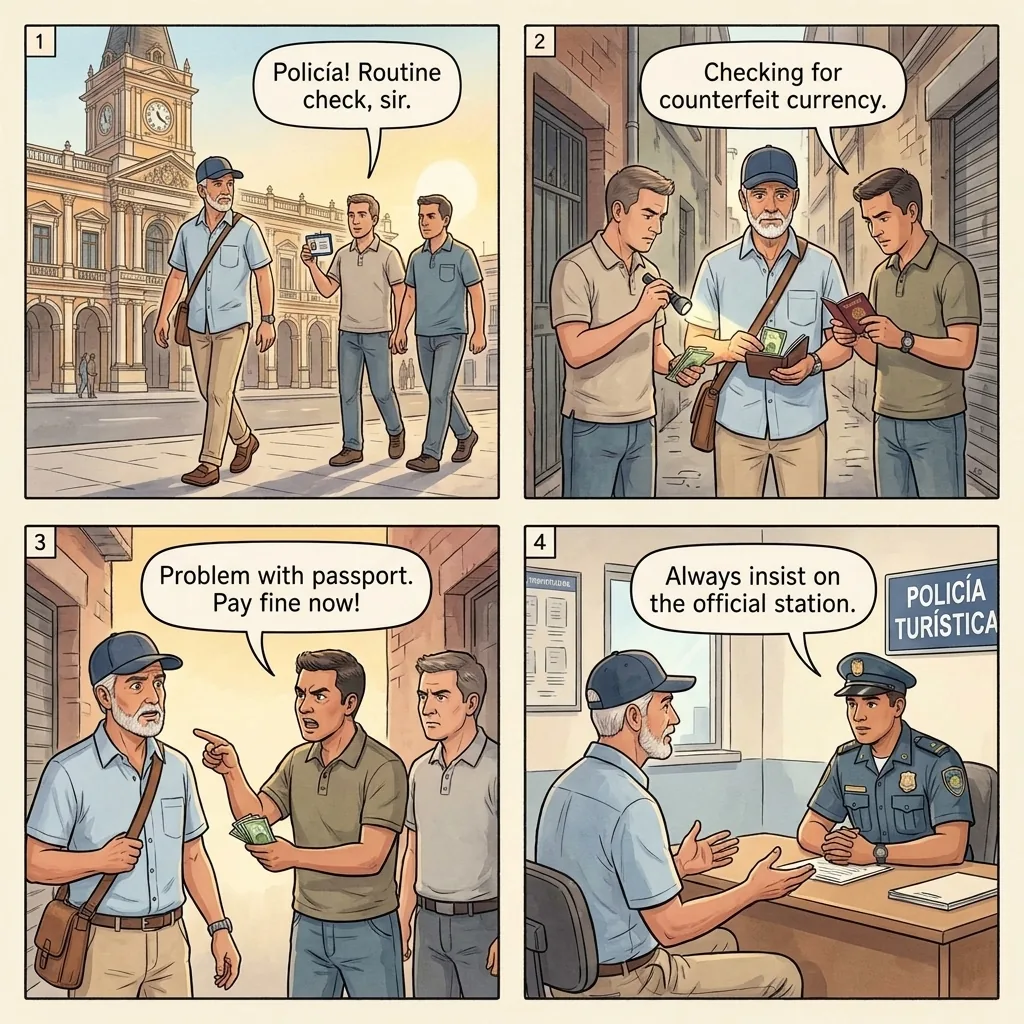
It's a Wednesday afternoon and you're walking from Plaza Murillo back toward your hotel in the Sopocachi neighbourhood when two men in police-style polos approach, one of them holding a laminated badge, the other in plain clothes flashing what looks like a Policía Boliviana ID.
They speak quickly in Spanish. They say there has been a recent rise in cocaine trafficking and they need to do a 'routine check' on tourists. They ask you to step into a quieter side street, then ask to see your passport and to inspect your wallet for 'counterfeit currency.' The plain-clothes partner produces a small flashlight and a magnifying glass. They examine your bills with theatrical care.
Within ninety seconds, several things have happened: bills have been palmed during the inspection, your passport has been 'confiscated' on the basis of an alleged irregularity, and the price of getting your documents back is the equivalent of $50–200 in cash, paid 'as a fine, not a bribe.' Sometimes the entire wallet is taken on the pretext of being 'evidence.' Real Bolivian police almost never stop tourists on the street for random drug or counterfeit-currency checks; they operate at posted checkpoints and do not perform wallet inspections in side streets. As travelers report across Reddit, the TripAdvisor La Paz forum, the Lonely Planet South America thorntree, the U.K. Foreign Office Bolivia travel advice, and the U.S. Department of State Bolivia country information, the fake-police shakedown is one of the most-reported tourist crimes in central La Paz.
The script has variants. The 'narcotics check' version focuses on inspecting your bag for drugs, with a small sample 'discovered' (planted) that requires immediate cash settlement. The 'counterfeit currency' version focuses on your wallet, with bills palmed during inspection. The 'plain-clothes partner' version uses two operators, with one wearing a partial uniform to lend authority. All three converge on the same mechanism: ask for your wallet or passport in a private side-street setting, find a 'problem,' and resolve it with cash.
The U.S. Embassy in La Paz and the Bolivian Tourist Police (POLITUR) have repeatedly warned travelers that legitimate Bolivian police checks happen at marked checkpoints and uniformed station houses, not on the street. The defence is procedural and verbal — a refusal to hand over your wallet or passport, an offer to walk together to the nearest police station, and visible willingness to call POLITUR. Almost every fake-police operator backs off the moment a real station visit is on the table.
Carry a colour photocopy of your passport for daily use; leave the original in your accommodation safe. If 'police' stop you on the street, do not hand over your wallet or original passport — offer to walk together to the nearest uniformed police station or POLITUR (Tourist Police) office to verify their identity. Real officers will accept this; fake officers will lose interest. Ask for the officer's badge number and request radio confirmation. If pressured for an on-the-spot 'fine,' refuse and call POLITUR (+591 2 222 5016) or 911 directly. Carry small cash separately from any larger sum so even a successful palming gets you only a fraction. Emergency: 110 (Police) or 911 (national emergency); the U.S. Embassy in La Paz is at +591 2 216 8000.
Red Flags
- Approached by 'police' on the street rather than at a checkpoint
- Asked to show your wallet contents, not just ID
- The 'officer' isn't near a police station or vehicle
- A second person appears mid-interaction
How to Avoid
- Carry a color photocopy of your passport — never hand over the original.
- Real police checks happen at checkpoints, not on sidewalks.
- If stopped, offer to walk to the nearest police station together.
- Ask for badge numbers and radio confirmation before complying.
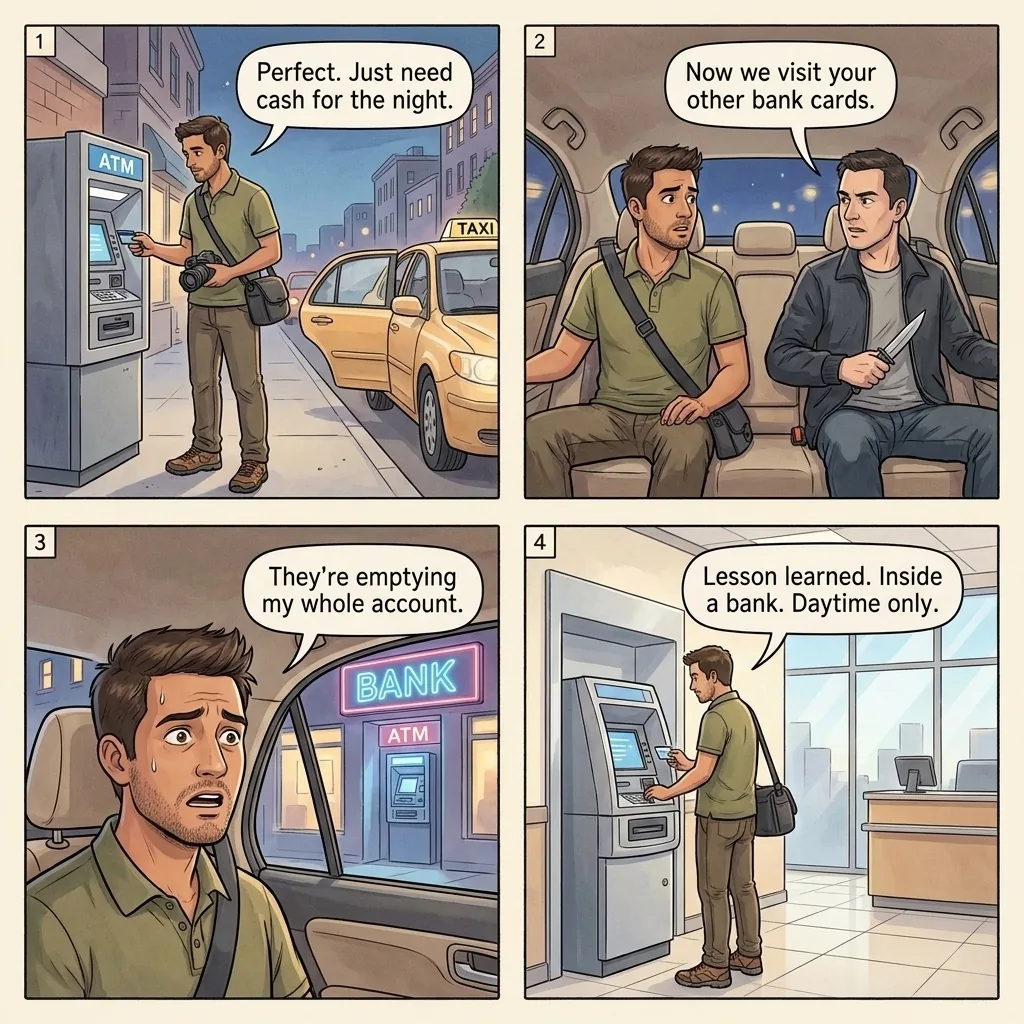
It's an evening in La Paz, you've just stepped away from a standalone street ATM in Sopocachi with B$2,000 (about $290 USD) in your pocket, and a taxi pulls up to the kerb almost immediately — friendly driver, lights flashing, door already open.
You get in because it's late, the next-cab wait at this hour is fifteen minutes, and the driver knows your hotel name when you say it. He pulls into traffic without starting the meter. Two blocks later, the back door opens at a stoplight and a second man slides into the seat beside you. He shows you a knife handle in his jacket pocket without taking it out. The driver, calmly, in basic English, tells you that you will now stop at three more ATMs and withdraw your daily limit at each.
The 'express kidnapping' (secuestro express) is one of the highest-cost tourist crimes in La Paz. The financial damage typically lands at $500–$3,000 per incident — the daily ATM limit on most international cards is $300–500, and the operators run you to multiple machines until the per-day cap is hit on every card you carry. Some operators take you back to the hotel to retrieve the second wallet; some hold you until the card resets at midnight to extract a second day's withdrawals. As travelers report across Reddit, the TripAdvisor La Paz forum, the Lonely Planet thorntree, the U.K. Foreign Office Bolivia travel advice, and the U.S. State Department's Bolivia country information page, this is one of the most-reported and highest-cost tourist crimes in the city.
The mechanism relies on three structural weaknesses: standalone street ATMs (rather than ATMs inside bank lobbies during business hours), unlicensed taxis (rather than radio-dispatched or app-booked), and operators who watch ATM clusters and time the pickup to a withdrawal. The operators are not random; they cluster the highest-tourist ATM corridors at the highest-tourist hours and wait for the right kind of target — alone, end-of-day, large withdrawal visible.
The Bolivian Policía Boliviana, the Tourist Police (POLITUR), and the U.S. Embassy have all issued repeated public guidance about taxi safety in La Paz: use only radio-dispatched taxis (calling from a hotel or restaurant) or rideshare apps (Uber and InDrive operate in La Paz), never hail a taxi off the street near an ATM. Use ATMs inside bank lobbies during business hours rather than the cheaper-feeling standalone street machines.
Use ATMs ONLY inside bank lobbies during business hours, never standalone street machines after dark. Take taxis ONLY by radio dispatch through your hotel or via the InDrive or Uber apps — never hail off the street, especially near an ATM. Withdraw smaller amounts more often rather than carrying large cash. Use the Mi Teleférico cable-car network instead of taxis at night where possible (it covers most of central La Paz, runs until 11 p.m., and is the safest mode in the city). If a taxi route diverges from your stated destination, get out at the next stoplight; if blocked, comply with the driver and report immediately to POLITUR after. Emergency: 110 (Police) or 911; the U.S. Embassy in La Paz is at +591 2 216 8000.
Red Flags
- Taxi appears immediately after you use an ATM
- Driver doesn't start a meter or discuss price
- Driver takes an unexpected route
- Another person enters the cab
How to Avoid
- Use ATMs inside banks during business hours only.
- Never get into a taxi that's waiting near an ATM.
- Use the Teleférico (cable car) instead of taxis at night.
- If you need a taxi, call a radio taxi through your hotel.
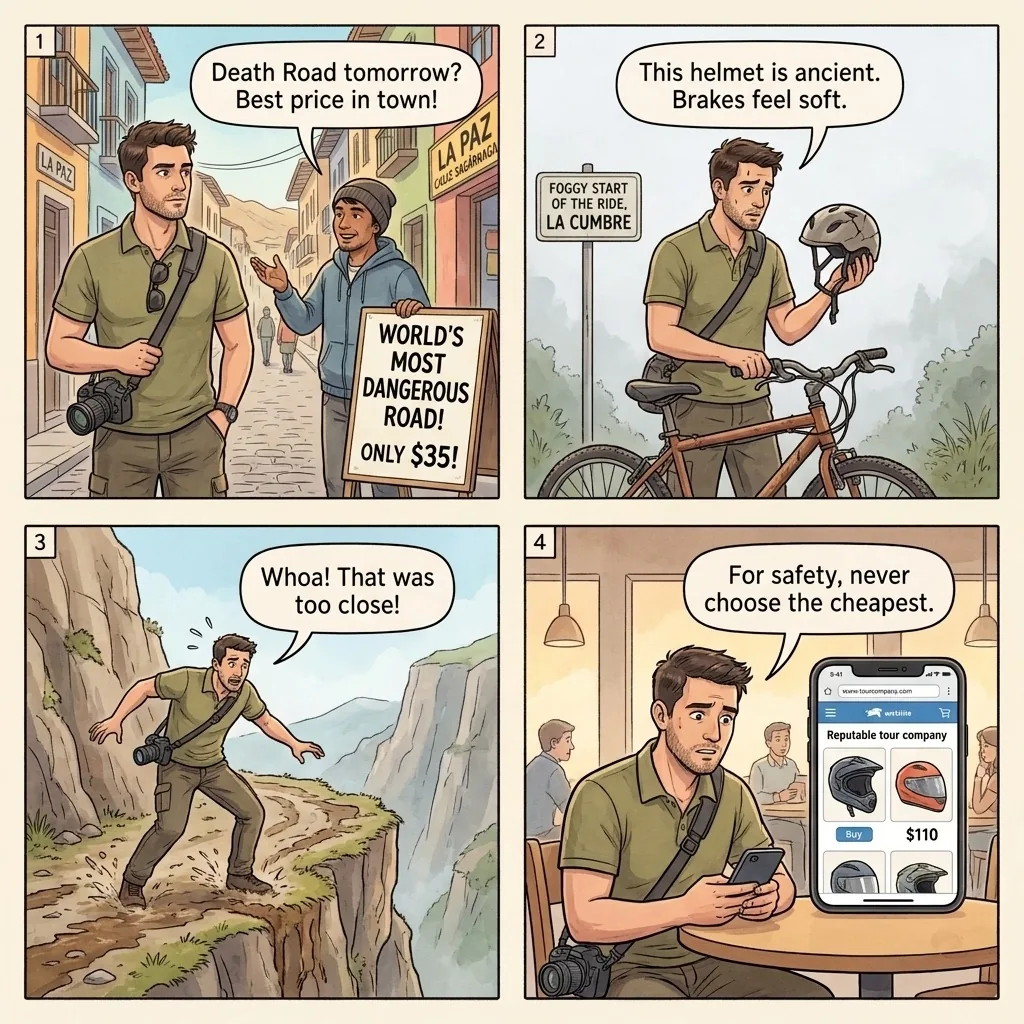
Bolivia's 'Death Road' (Camino de la Muerte / North Yungas Road) — the 64 km descent from La Cumbre at 4,650 m to Coroico at 1,200 m — is a bucket-list mountain-bike experience, and a tour-agent on Calle Sagárnaga is offering it tomorrow morning for $35 with bike, gear, and lunch included.
The reputable Death Road operators — Gravity Bolivia, Barracuda Biking, Vertigo Biking, Madness Adventures — charge $80–130 for the same trip. The agency on Calle Sagárnaga offering it for $35 is making the math work somewhere, and that somewhere is the safety equipment. The bikes are old steel-frame mountain bikes with worn pads, mechanical disc brakes that need pumping, helmets that have been in use for ten years, no full-face protection, no body armour, no support vehicle following the group, and a guide who completed the route himself for the first time three months ago.
The North Yungas Road is the world's deadliest cycling descent. Single-track 3-metre-wide cliffside sections drop 600+ metres straight down to the Yungas valley with no guardrail, no margin for error, and rain, mud, and fog that materialise without warning. Approximately 25–30 cyclists have died on the route since the bike tours began in 1998, with the highest mortality rates concentrated on budget operators. The Bolivian Tourism Vice-Ministry has flagged the route's safety record annually since the 2010s. As travelers report across Reddit, the TripAdvisor La Paz Death Road forum, the Lonely Planet South America thorntree, and the U.S. Department of State Bolivia country information, the budget-operator gap is the single highest-stakes safety choice a La Paz visitor will make.
The mechanics of the safety gap are concrete. Reputable operators run dual hydraulic disc brakes, full-face helmets, body armour, gloves, a support van that follows behind the group, two guides (one front, one back), satellite radio for the no-cell sections, and a published safety record. Budget operators run mechanical V-brakes, half-shell helmets, no body armour, no support van, one guide, no comms in the no-cell sections, and an opaque safety history. The $50–80 difference between the two is the difference between 'manageable risk' and 'meaningful risk of death.'
The Calle Sagárnaga tour-agent corridor sells both kinds of operator from the same storefront — a bait quote in front, a real operator behind. The structural giveaway is the inability to answer specific safety questions: dual hydraulic brakes vs. mechanical, full-face vs. half-shell, support vehicle present vs. absent. A budget operator who cannot answer these questions confidently in detail is the operator you avoid.
Book Death Road only with operators with verifiable safety records — Gravity Bolivia, Barracuda Biking, Vertigo Biking, or Madness Adventures — at the $80–130 price point. Verify before paying: dual hydraulic disc brakes, full-face helmet, body armour, support vehicle following the group, two guides minimum, satellite or radio comms. Read recent TripAdvisor reviews specifically searching for the words 'safety,' 'accident,' or 'crash' to filter past the marketing. Check that the company's published safety record matches what they tell you in the office. Decline any 'free' helmet that has been used for years; ask how often equipment is replaced. The $50 you'd save on a budget tour is paid back in the form of a measurable increase in fatality risk on a route where multiple cyclists have died. Emergency: 110 (Police) or 911; the U.S. Embassy in La Paz is at +591 2 216 8000.
Red Flags
- Price below $60 for the Death Road tour
- No mention of bike maintenance, hydraulic disc brakes, or full-face helmets
- No support vehicle following the group
- Guide can't answer specific safety questions
How to Avoid
- Book with Gravity Bolivia, Barracuda Biking, or another operator with verifiable safety records.
- Expect to pay $80-120 for a safe, well-equipped tour.
- Ask specifically about bike maintenance, brake type, helmet quality, and support vehicle.
- Read recent TripAdvisor reviews focusing on safety, not just fun.
🆘 What to Do If You Get Scammed
📋 File a Police Report
Go to the nearest Bolivian Police (Policía Boliviana) station — the Tourist Police (POLITUR) office is at Plaza del Estudiante. Call 110 (Police) or 911 (national emergency). Get an official crime report (denuncia) — you'll need this for insurance claims. POLITUR direct line: +591 2 222 5016.
💳 Cancel Your Cards
Call your bank immediately. Most have 24/7 numbers on the back of the card (keep a photo saved separately). Block any suspicious transactions before the thieves use your details.
🛂 Lost Passport?
Contact your nearest embassy or consulate. The U.S. Embassy in La Paz is at Avenida Arce 2780, Sopocachi. For emergencies: +591 2 216 8000.
📱 Track Your Device
If your phone was stolen, use Find My (iPhone) or Find My Device (Android) from another device. Don't confront thieves yourself — share the location with police instead.
Frequently Asked Questions
You just read 3 scams in La Paz. The full Travel Safety Series has 780+ more across 20+ countries.
Tokyo's Kabukichō ¥130,000 bar trap. Rome's gladiator photo extortion. Paris's gold-ring trick. Bali's ATM skimmer scams. Bangkok's grand-palace closure ruse. Every documented scam across 20+ destinations — with the exact scripts, red flags, and local-language phrases that shut each one down. Drawn from Reddit traveler reports, embassy advisories, and consumer-protection cases.
- 780+ documented scams across Tokyo, Rome, Paris, Bali, Bangkok, Rio & 100+ more cities
- 20+ countries covered, with country-by-country phrase cards for every destination
- Updated annually — buy once, re-download future editions free
- All titles $4.99 each on Amazon Kindle