
Key Takeaways
- The #1 reported scam is the Costumed Character Photo Shakedown.
- 3 of 7 scams are rated high risk.
- Use app-based ride services (Uber, Lyft) instead of unmarked vehicles or unlicensed cabs.
- Never accept unsolicited offers from strangers near tourist sites in Las Vegas.
⚡ Quick Safety Tips
- Keep phones and valuables in secure pockets when in crowded areas.
- Use only licensed taxis or app-based ride services.
- Book tours and tickets through verified operators with online reviews.
- Keep a copy of your passport separate from the original.
Jump to a Scam
The 7 Scams

Costumed showgirls and superheroes on the Strip near Caesars Palace and the LINQ wrap an arm around tourists for a "photo," then demand $20 per character per person — a former Strip security guard documented that the performers regularly had to be removed from casinos for following tourists inside to continue the shakedown.
The hunting ground is the Strip pedestrian crossings near Caesars Palace, the LINQ Promenade, the Bellagio fountain plaza, and the bridges over Las Vegas Boulevard. The classic case: you're walking the Strip at dusk and a showgirl in feathers and sequins sashays up, wraps an arm around your shoulder, says "let's get a photo!" — before you blink, a friend with a camera snaps the shot and both performers are in your face demanding $20 each. Traveler reports document the same template across years; many tourists believe (incorrectly) that they must pay because the photo was taken.
The mechanic is the unsolicited physical contact plus the manufactured photo moment. The performer initiates the contact before you can decline; the camera-holding accomplice triggers immediately to lock in the "transaction." Once the photo exists, refusing to pay creates a public scene the performers escalate aggressively — blocking your exit, raising voices to draw attention, and following you for blocks if necessary. A former Strip security guard documented that performers were regularly removed from casinos for following marks inside to continue the demand. You owe nothing under Nevada law for an unsolicited photo.
Keep walking and say "no thank you" firmly without making eye contact — and never let a costumed performer put an arm around your shoulder or place a prop in your hand on the Strip. If you genuinely want a photo with one, agree on the price in dollars before any posing begins. If a performer follows you or blocks your path, walk into the nearest casino lobby — security will move them along. You owe nothing for unsolicited photos. For aggressive incidents, dial 911 or report to Metro Police at 702-828-3111.
Red Flags
- Performer approaches you and initiates physical contact without invitation
- A second person with a camera materializes immediately to 'capture the moment'
- No prices are shown before the photo is taken
- Performer becomes aggressive or blocks your path when you try to walk away
- Multiple costumed characters suddenly surround you
How to Avoid
- Keep walking and say 'no thank you' firmly without making eye contact.
- Never let someone put something in your hands or around your shoulders.
- If you want a photo, agree on a price before any posing begins.
- Walk into a nearby casino if you're being followed or harassed.
- Remember: you owe nothing to unsolicited performers on the Strip.
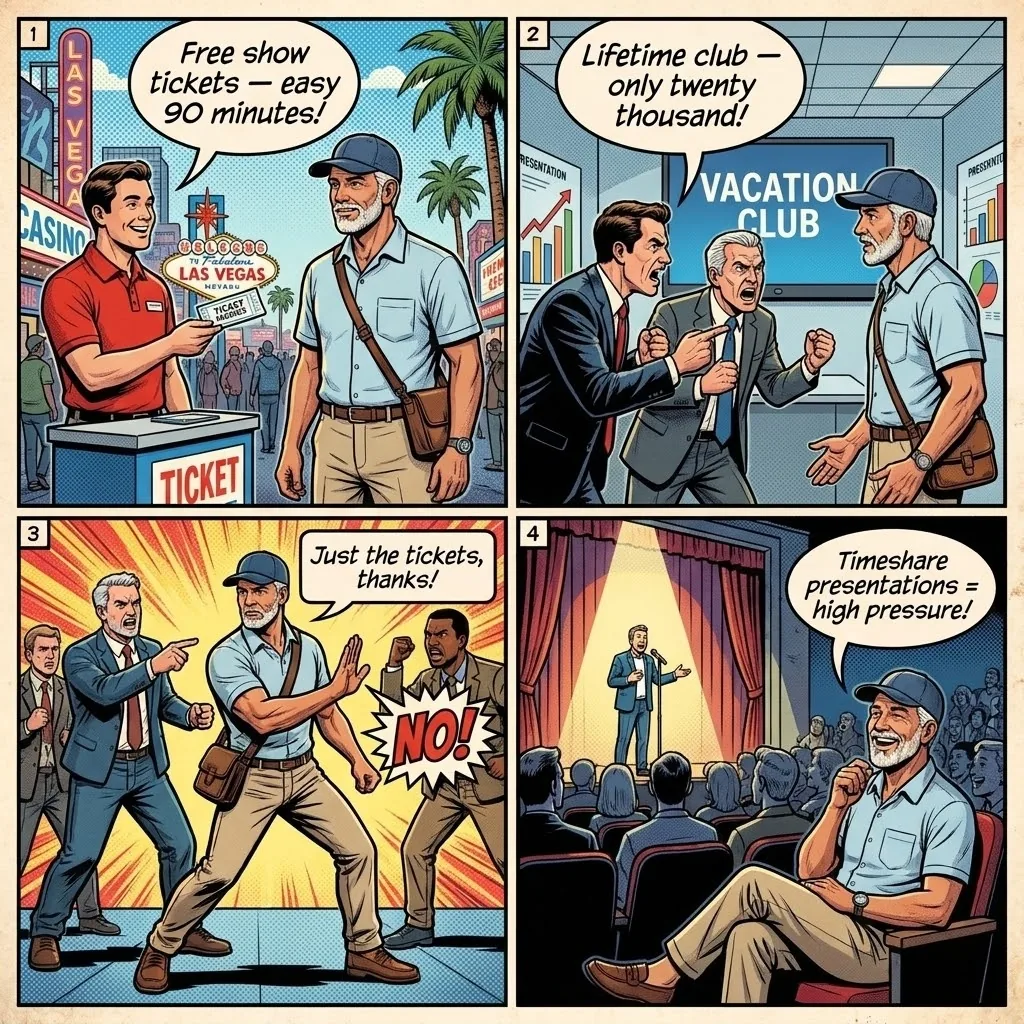
Clipboard-wielding "vacation club" promoters on the Strip and around the Convention Center promise free buffets and show tickets in exchange for "90 minutes" — the session stretches to 4–6 hours of high-pressure rotating salespeople breaking down resistance until you sign a tens-of-thousands-of-dollars timeshare contract just to leave.
The pitch zones are the Strip sidewalks (especially Las Vegas Boulevard between the Mirage and MGM), the Convention Center perimeter, and major hotel lobbies — particularly during conventions when foot traffic spikes. The promoter offers free buffet credits, show tickets, or casino chips in exchange for a "brief 90-minute presentation." The promise is real: you do receive the comp. The cost is a multi-hour high-pressure sales ordeal inside a controlled room where trained salespeople cycle through you in shifts. Traveler reports has documented the pattern across years, with warnings now circulating in multiple languages.
The mechanic is exhaustion plus social pressure. The 90-minute promise routinely stretches to 4–6 hours. The room is windowless or sealed; a closer is brought in after the original salesperson "fails," and a manager arrives if the closer fails. The technique cycles through "drop the price," "limited-time bonus," and "sign now or this offer expires" while you sit at a small table for hours. By the end, signing the contract — for a timeshare with annual maintenance fees that often exceed any vacation savings — feels easier than holding firm. The contracts include rescission windows under Nevada law, but most buyers don't read the fine print.
Never accept "free" buffet vouchers, show tickets, or casino chips from a stranger on the Strip — the value is always recaptured tenfold during the timeshare presentation, and Vegas tickets cost less than the day you'll lose to the pitch. If you're already inside, you have the legal right to leave at any time — stand up and walk out regardless of what the closer says. Ask upfront "is this a timeshare presentation?" — Nevada law requires they answer honestly. Never sign anything under time pressure; take any contract to read overnight. If you've signed, Nevada law provides a five-day rescission window — file the cancellation in writing within that window.
Red Flags
- Someone offers you free tickets, buffet credits, or casino chips on the street
- They ask for just '90 minutes of your time' for a 'brief presentation'
- You're taken to an off-Strip location or a nondescript hotel conference room
- Sales staff rotate through you in shifts and the session keeps getting extended
- You feel unable to leave and the room seems designed to disorient you
How to Avoid
- Never accept free gifts from strangers on the Strip — the value will be recaptured tenfold.
- If you're already inside, you can legally leave at any time; stand up and walk out.
- Ask upfront: 'Is this a timeshare presentation?' — they're legally required to answer honestly.
- Never sign anything under time pressure; take any contract to read overnight.
- Research the company name on Google before agreeing to anything.

Fake or predatory cannabis dispensaries off the Strip charge $80 for a gram that licensed dispensaries sell at $12 — some use names confusingly similar to legitimate brands, others operate entirely unlicensed without state quality controls, and "recommendation fees" and "packaging fees" stack invisible add-ons at checkout.
Nevada's legal cannabis market is licensed by the Nevada Cannabis Control Board, and legitimate dispensaries display a state-issued Marijuana Establishment License number prominently. The scam operates in adjacent strip malls and tourist corridors where unlicensed or predatory storefronts exploit the assumption that any cannabis store visible to tourists must be legal. The benchmark case: a tourist enters what looks like a legit shop — professional branding, glass cases, branded budtender in black polo — and pays $80 for a gram of mid-grade flower that any licensed Nevada dispensary would price at $10–$15. A 2023 traveler-thread warning went viral after exactly this experience.
The mechanic has three layers. First is the licensing dodge — operators use names confusingly similar to Planet 13, NuWu, or Essence to pass quick visual inspection, but they're not actually on the Cannabis Control Board's licensee list. Second is the markup — 5–8× the legitimate retail price for inferior or untested product. Third is the fee stack at checkout: "recommendation fees" for the budtender, "packaging fees," "delivery minimums" that the menu board never mentioned. Beyond price, untested products from unlicensed shops can carry mold, pesticide residue, or wildly mislabeled THC content, which presents real safety risks for inexperienced users.
Buy cannabis only from dispensaries on the Nevada Cannabis Control Board's licensee list — verify by looking for the state-issued Marijuana Establishment License number displayed at the entry, and use Weedmaps or Leafly to find verified locations near the Strip. Legitimate Las Vegas dispensaries (Planet 13, Essence, NuWu, Reef) charge roughly $10–$20 per gram for standard flower; anything substantially higher is a red flag. Ask to see the product's state-issued Certificate of Analysis (COA) before purchasing. If a deal sounds unrealistic or staff resist questions about licensing, walk out. For losses, dispute the card charge within 60 days and file with Nevada's Attorney General consumer protection.
Red Flags
- Store is located in a strip mall far from major casino corridors
- No Nevada Marijuana Establishment License number displayed prominently
- Prices are not clearly labeled or vary dramatically from what was quoted
- Staff push you toward expensive products and resist questions
- The 'dispensary' name sounds similar to a well-known legitimate brand
How to Avoid
- Only visit dispensaries licensed by the Nevada Cannabis Control Board — check the list online.
- Use apps like Weedmaps or Leafly to find verified, reviewed dispensaries near the Strip.
- Prices in legit dispensaries run roughly $10–$20 per gram; anything higher is a red flag.
- Ask to see the product's state-issued test results (COA) before purchasing.
- If a deal sounds too good to be true or staff seem aggressive, walk out.
Like what you're reading? Get a full Las Vegas itinerary with safety tips built in.
Browse travel-safety books →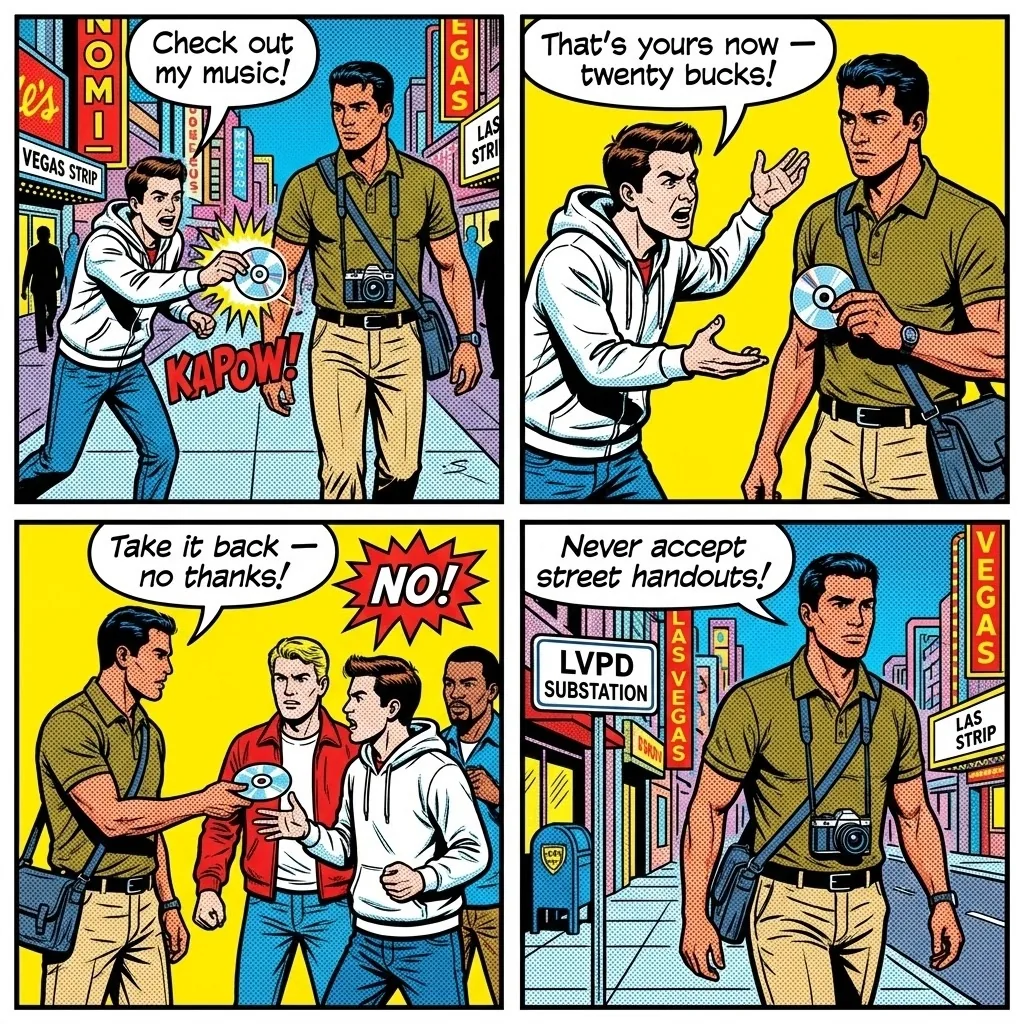
"Aspiring musicians" on the Strip near Planet Hollywood and MGM press a homemade CD into your hand calling it free, then demand $20 "donations for the recording studio" — once the CD is in your hand, social pressure kicks in and the longer you hold it the harder it is to refuse.
The hotspots are the Strip pedestrian walkways near Planet Hollywood, MGM Grand, the bridges over Las Vegas Boulevard, and the LINQ Promenade. The pitch is fast: a man rushes toward you with something extended in his hand, calls it free, and frames himself as an aspiring artist trying to share his music. The benchmark Reddit guide nails the dynamic: keep your hands busy, in your pockets or holding a partner's hand, because once you're holding something a stranger gave you, social pressure kicks in and refusing feels rude. The CD has nowhere to land if your hands are occupied.
The mechanic is the physical-transfer trap. The moment the CD is in your hand, the operator pivots from "free gift" to "donation for the recording studio" or "support my kids' college fund." The longer you hold the CD while listening to the story, the higher the social cost of giving it back. Most marks pay $20 just to end the encounter. The street-musician variant runs the same template: performers deliberately play in your direct path, make eye contact, and demand payment if you slow to watch for more than a few seconds.
Keep your hands in your pockets or visibly occupied while walking the Strip — and if a stranger extends a CD or any object toward you, step around without slowing or accepting it. Don't make extended eye contact with people trying to flag you down. If something has already been placed in your hand, simply hand it back without explanation and keep walking. Say "I'm good" loudly and stride; hesitation invites escalation. Accepting anything from a stranger on the Strip is never truly free. For aggressive incidents, walk into the nearest casino lobby and ask security for help.
Red Flags
- A stranger rushes toward you with something in their outstretched hand
- They place the object in your hand before you've agreed to take it
- The word 'free' is used to lower your guard
- A sad or compelling backstory follows immediately after the 'gift'
- Multiple people nearby seem to be watching the interaction
How to Avoid
- Keep your hands in your pockets or visibly occupied while walking the Strip.
- Don't make extended eye contact with people who are trying to flag you down.
- If something is placed in your hand, simply hand it back and keep walking.
- Say 'I'm good' loudly and keep your stride — hesitation invites escalation.
- Remember: accepting something from a stranger on the Strip is never truly free.

Las Vegas Strip hotels add mandatory $30–$50 per night "resort fees" on top of advertised rates — turning a $49 nightly rate into $189 at checkout — plus minibar sensors that charge for lifting items, in-casino ATMs at $8–$12 per withdrawal, and "facility fees" on show tickets layered onto the room cost.
The pattern operates at every major Strip property and most off-Strip casino hotels. The advertised room rate captures the headline number ($49 a night at a major Strip casino looks like a great deal); the bill at checkout adds a daily resort fee of $30–$50 plus tax, plus parking ($15–$25 per night), plus minibar charges from a sensor base that detects when items are lifted for more than a few seconds, plus "facility fees" on every show ticket booked through the hotel. A booked $49 nightly rate becomes $189 in totals. Traveler threads surface regularly with confused tourists who didn't see the fine print at booking.
The mechanic is regulatory. Resort fees aren't illegal in Nevada — they're disclosed in the fine print of every booking — but the disclosure is intentionally minimal until checkout. The fee covers Wi-Fi, gym, pool, and "in-room amenities" whether you use them or not, and it's mandatory regardless of room class. The minibar sensor charges $5+ for moving items even if you don't consume them. In-casino ATMs charge $8–$12 per withdrawal — among the highest in the country. Show ticket "facility fees" layer 10–20% on top of the listed price. None of these fit the legal definition of fraud, but the cumulative effect is a true cost that's 3–4× the headline rate.
Search hotel total price including all mandatory fees on ResortFeeChecker.com or Kill Resort Fees before booking — the all-in number is what matters, not the headline rate. Ask the front desk to waive the resort fee if you're a Caesars Diamond, MGM Gold, or Wyndham Diamond status member; they often will. Use a bank ATM outside the casino (7-Elevens nearby have low-fee ATMs). Do not touch the minibar unless you intend to buy — even lifting items can trigger a charge. Budget $40–$50 per night above the listed rate for mandatory fees. For disputed checkout charges, contest with the front-desk manager before paying and request a fee waiver in writing.
Red Flags
- Hotel advertises a rate that seems dramatically lower than comparable properties
- Terms like 'resort fee,' 'destination fee,' or 'amenity fee' appear in small text
- Check-in staff casually mention fees as though they're standard
- ATM machines inside the casino lobby charge $8–$12 per transaction
- Minibar has a sensor base that charges you if you lift items for more than a few seconds
How to Avoid
- Search hotel total price including fees on sites like ResortFeeChecker.com before booking.
- Ask hotel front desk to waive the resort fee if you're a rewards member or arrived via a cashback card.
- Use a bank ATM outside the casino (7-Elevens nearby often have low-fee ATMs).
- Do not touch the minibar unless you intend to buy — even lifting items can trigger a charge.
- Budget at least $40–$50/night above the listed room rate for mandatory fees.

Three-card monte and shell-game tables on Fremont Street and Strip side streets use planted shills who "win" easily to draw tourists into $50–$200 bets they cannot mathematically win — operators are mobile, lookouts signal police movements, and the crew vanishes in seconds before any complaint can be filed.
The hotspots are downtown Las Vegas (Fremont Street Experience after dark) and less-frequented side streets off the Strip where crowd density and low light support quick setup-and-disappear cycles. The benchmark case: a fast-talking dealer is flipping three cards on a folding table; a bystander bets $20 and wins, another wins, you watch the queen move and think you've spotted the pattern. You put down $50, lift the card, and lose. A first-responder who works the Strip put it bluntly on traveler reports: any stranger engaging you with quick-money offers is probably running one of these games.
The mechanic is the planted-shill structure. Three-card monte, shell games, and similar cons are mathematically unwinnable once shills are involved — the dealer's sleight of hand makes the queen vanish from under any cup or card you select, and every "winning" bystander is a confederate whose job is to make the game look beatable. The operators work in coordinated crews of 4–6 with rotating roles: dealer, shills, lookouts who signal law enforcement movements. The setup folds flat and the crew scatters within 10 seconds of a police presence. Victims typically lose $50–$200 before recognizing the rig.
Never gamble on the street in Las Vegas — every legal gambling option in the city happens inside licensed casinos with regulated odds, and every street game is mathematically rigged. Anyone winning "too easily" in front of a folding table is part of the operation. Walk past any street game without slowing or engaging; lingering signals willingness. If you want card games, the casinos offer the real thing with house-edge odds that are at least transparent and audited. Report street gambling operations to Metro Police at 702-828-3111 or to the nearest casino security desk.
Red Flags
- A crowd has formed around a portable table or cardboard box on the street
- Multiple people seem to win easily before you place a bet
- The dealer talks very fast and uses misdirection hands
- Someone in the crowd enthusiastically encourages you to play
- The game is set up in a location with easy escape routes
How to Avoid
- Never gamble on the street — legal gambling in Vegas happens inside licensed casinos.
- Understand that anyone winning 'too easily' is part of the operation.
- Walk past without slowing down or engaging — lingering signals willingness.
- Report street gambling operations to casino security or Metro Police at 702-828-3111.
- If you want card games, the casinos offer the real thing with house-edge odds that are at least transparent.

Limo and party-bus drivers at Harry Reid (formerly McCarran) Airport and Strip pickup zones quote a fair-sounding fare, then hand a bill 3× the agreed price at the destination citing "champagne charge," "waiting time," "auto-gratuity," and "fuel surcharge" — bachelor and bachelorette party groups in social-pressure mode are the primary target.
The pickup zones are Harry Reid International Airport arrivals (the limo curb), Strip hotel lobbies, and bachelor/bachelorette pickup points outside major casinos. The benchmark case: you've just landed, a man in a black suit offers a limo ride to your hotel at a fair-sounding price, you climb in and accept the champagne handed over, and at arrival he produces a bill three times what was agreed — citing a champagne charge, waiting time, auto-gratuity, and a fuel surcharge that wasn't mentioned in the original quote. Reddit's traveler reports documents the pattern repeatedly, with bachelor and bachelorette groups identified as the primary targets because party-mode social pressure makes disputing the bill in front of friends costly.
The mechanic is the verbal quote with no paper trail. The driver hedges the price up front ("about a hundred bucks for the run"), accepts a verbal agreement, and offers complimentary-seeming amenities (champagne, water, snacks) that turn into line items at the destination. The party-bus variant adds another layer: promoters on the Strip hand out flyers for "free limo rides to the best clubs" that resolve at the bus into paid club-entry packages, bottle-service minimums, and private transportation fees the rider didn't agree to — by the time you're two drinks in and being driven somewhere, the paperwork on the dashboard has your implied consent.
Get a written price quote before you sit in any Las Vegas limo or party bus — including base fare, gratuity policy, every "extra," and the precise destination — or use Uber, Lyft, or Las Vegas's official taxi rank where the rate is metered. Refuse free champagne or amenities you didn't request; they will be billed. For airport transport, Harry Reid has a clearly marked taxi rank, and Uber/Lyft pickup at Terminal 1 Door 1 or Terminal 3 Door 1 (rideshare zones) gives a fixed price in the app. For party buses, demand a written contract before any group payment is made. For overcharges, dispute the card transaction within 60 days as "amount different from authorized."
Red Flags
- Driver doesn't show you a written price quote before you get in the vehicle
- Drinks or amenities appear without you requesting them
- The vehicle is unmarked or the driver doesn't have a visible license/permit
- Promoters on the Strip are handing you flyers for 'free transportation'
- The driver is evasive when you ask for the per-mile or per-hour rate
How to Avoid
- Use rideshares (Uber/Lyft) from designated airport zones — rates are transparent and fixed upfront.
- If using a car service, get a written quote including all fees before boarding.
- Do not consume anything in an unofficial vehicle that you didn't bring yourself.
- Reputable limo companies are licensed by the Nevada Taxicab Authority — ask for credentials.
- Your hotel's bell desk can arrange legitimate transportation at known rates.
🆘 What to Do If You Get Scammed
📋 File a Police Report
Go to the nearest Local Police Department station. Call 911. Get an official crime report — you'll need this for insurance claims. You can also report online at usa.gov/crimes.
💳 Cancel Your Cards
Call your bank immediately. Most have 24/7 numbers on the back of the card (keep a photo saved separately). Block any suspicious transactions before the thieves use your details.
🛂 Lost Passport?
Visit the nearest US Passport Agency. For international visitors, contact your country's consulate or embassy directly. US State Department emergency line: +1-888-407-4747 (from US) or +1-202-501-4444 (international).
📱 Track Your Device
If your phone was stolen, use Find My (iPhone) or Find My Device (Android) from another device. Don't confront thieves yourself — share the location with police instead.
Frequently Asked Questions
You just read 7 scams in Las Vegas. The full Travel Safety Series has 780+ more across 20+ countries.
Tokyo's Kabukichō ¥130,000 bar trap. Rome's gladiator photo extortion. Paris's gold-ring trick. Bali's ATM skimmer scams. Bangkok's grand-palace closure ruse. Every documented scam across 20+ destinations — with the exact scripts, red flags, and local-language phrases that shut each one down. Drawn from Reddit traveler reports, embassy advisories, and consumer-protection cases.
- 780+ documented scams across Tokyo, Rome, Paris, Bali, Bangkok, Rio & 100+ more cities
- 20+ countries covered, with country-by-country phrase cards for every destination
- Updated annually — buy once, re-download future editions free
- All titles $4.99 each on Amazon Kindle