
Key Takeaways
- The #1 reported scam is the Sakkaline Road Alms-Ceremony Sticky Rice Hustle.
- Most scams in Luang Prabang are low-to-medium risk.
- Use official taxi ranks or local ride apps where available — always confirm the fare before departure.
- Never accept unsolicited offers from strangers near tourist sites in Luang Prabang.
⚡ Quick Safety Tips
- Keep phones and valuables in secure pockets when in crowded areas.
- Use only licensed taxis or app-based ride services.
- Book tours and tickets through verified operators with online reviews.
- Keep a copy of your passport separate from the original.
Jump to a Scam
The 3 Scams
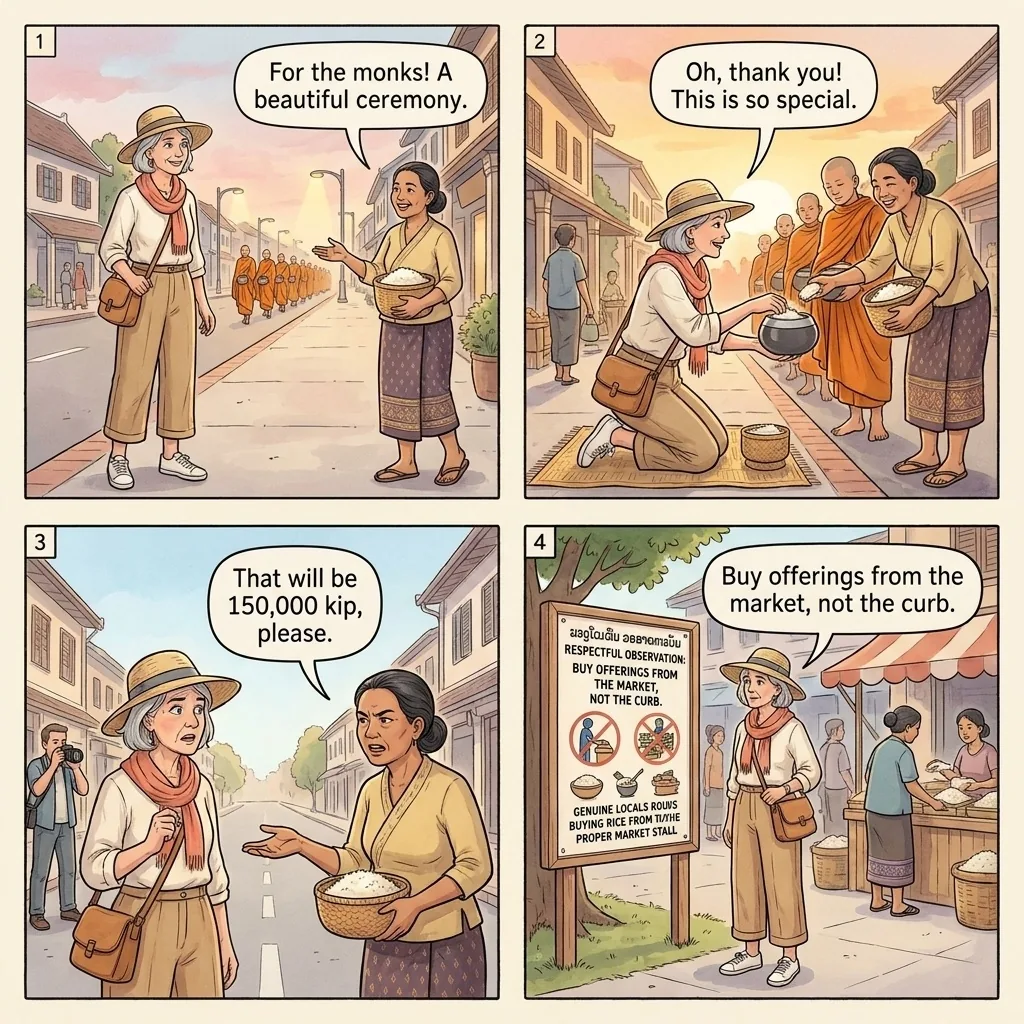
You set an alarm for 5:00 a.m. and walk down to Sakkaline Road in the soft pre-dawn dark, ready to watch the famous tak bat — the centuries-old Theravada alms procession where saffron-robed monks walk the city accepting offerings of sticky rice from kneeling devotees.
Before you even find a place to stand, a local woman materializes beside you with a folded reed mat, a metal basket of warm sticky rice, and a small wooden stool. She unrolls the mat at the curb, gestures for you to sit, and presses the basket into your hands with a warm smile. She kneels beside you, demonstrates the offering posture, and tells you in fluent English to drop a small handful of rice into each monk's bowl as the procession passes.
The monks walk by in single file. The light changes. You make several offerings. It is moving — a real ceremony, hundreds of years old, in a UNESCO World Heritage town — and for ten minutes you feel the privilege of participating. Then the line ends, the woman rolls up her mat, and her tone shifts. The rice and the 'experience' cost ₭150,000 — about $7 USD. The actual sticky rice in the basket cost her about ₭5,000 to make.
If you balk, she points to a friend with a camera who has been photographing you the entire time, and offers to sell you the photos for another ₭100,000. Both prices are non-negotiable in her telling. The whole transaction was set up before dawn, and the prime curbside spot was chosen because it photographs well at sunrise. UNESCO and the Lao National Tourism Administration have repeatedly warned that this commercialization is damaging the ceremony itself — monks have reported getting sick from poor-quality tourist-supplied rice, which has historically been a strict no.
The alms-ceremony hustle is the most consistently reported Luang Prabang tourist scam, documented in the long-running TripAdvisor Laos forum, on Reddit, and in formal advisories from the Lao National Tourism Administration. The deeper problem is not the price — it is that participation by uninformed tourists has shifted the spiritual character of the ceremony toward a photography spectacle, with monks expressing public concern about food quality, flash photography, and physical proximity that violates Theravada custom.
Watch the alms procession respectfully from the opposite side of the street, at least two meters back, with no flash photography and no sound — this is what UNESCO and the Lao Tourism Administration explicitly request. If you genuinely want to participate, buy your own fresh sticky rice from the morning market on Setthathirath Road for ₭5,000–10,000 a few hours earlier, learn the offering protocol from a guesthouse host or guide first, and never accept materials from a curbside vendor. If a vendor pressures you for payment after a setup, refuse, walk to your guesthouse, and report the operator to the Lao Tourist Police at 1191 or to the UNESCO heritage office near Wat Mai.
Red Flags
- Local approaches you with a pre-made kit before dawn
- No price discussed before materials are provided
- You're positioned in a prime photo spot (for their photographer friend to sell you photos)
How to Avoid
- Watch respectfully from a distance — the ceremony is not a tourist activity.
- If you want to participate, buy your own sticky rice from the morning market (5,000 kip).
- Keep at least 2 meters distance and never use flash photography.
- UNESCO has asked tourists to observe, not participate, to preserve the tradition.
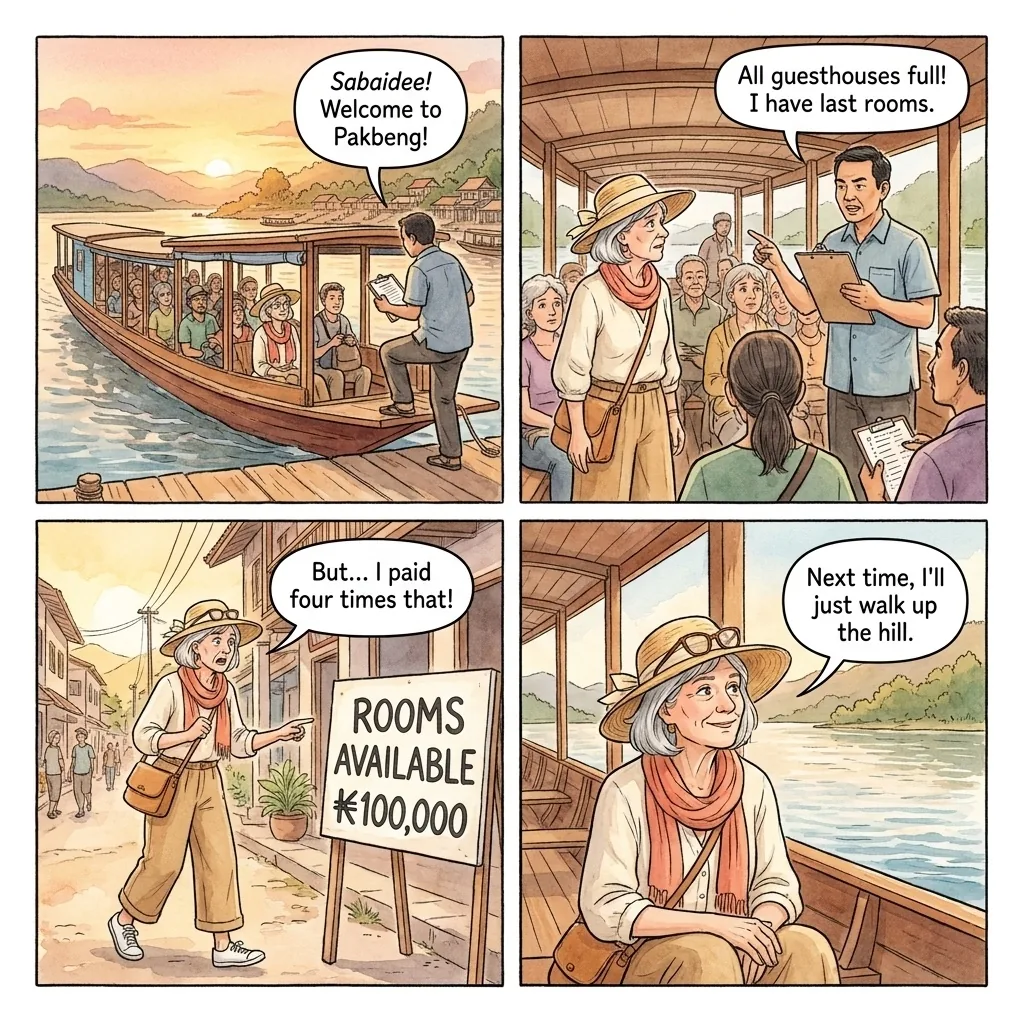
You are halfway through the popular two-day slow boat down the Mekong from Huay Xai to Luang Prabang, the boat is pulling into Pakbeng for the overnight stop, and a man with a clipboard climbs aboard before passengers can disembark.
He stands at the front of the boat, in passable English, and announces that all of Pakbeng's guesthouses are fully booked tonight — except for one place he can put you. He says the village is small, there are only a handful of rooms, and the season is busy. The price he names is ₭400,000–500,000 ($20–25), three to five times the normal Pakbeng rate of ₭80,000–150,000. He targets the obvious foreigners on the boat first, especially solo travelers who look anxious, and a small queue forms.
The pitch works because Pakbeng is genuinely small (one main street, perhaps thirty guesthouses), the boat arrives in late afternoon as the light is fading, and the prospect of walking village streets after dark in a place you have never been with a forty-litre backpack is unappealing. Most travelers hand over the cash, follow the tout to a basic room above a restaurant, and only realize the next morning that the village had plenty of availability and the going rate was a quarter of what they paid.
The Pakbeng accommodation tout is the most consistent slow-boat scam, documented across Reddit, the Travelfish Laos forum, and most updated guidebooks. The 'sold out' claim is essentially never true. Pakbeng's guesthouses run at perhaps 60% capacity even during peak November–February travel season, and the village's economy depends on slow-boat overnighters, so room supply is calibrated to demand. The tout is paid a fat commission by a single guesthouse — sometimes $5–10 per delivered tourist, sometimes a flat percentage — to redirect travelers away from the dozens of cheaper options.
A second variation runs on the boats themselves: the boat captain or his assistant offers 'their cousin's' guesthouse at a 'special price' that turns out to be the same overpriced room. The tells are consistent — a clipboard, a guarded list of 'available' rooms, and language pressure designed to short-circuit comparison shopping. The actual best Pakbeng guesthouses (Phetsokxai, Monsavanh, Mekong Riverside) are bookable on Booking.com and Agoda for ₭80,000–150,000 with photos, reviews, and English contact.
Pre-book your Pakbeng overnight on Booking.com or Agoda before you board the slow boat in Huay Xai — Phetsokxai, Monsavanh, and Mekong Riverside Lodge are all reliable at ₭80,000–150,000 ($4–8). Ignore anyone who boards the boat to sell accommodation; they are commission touts. If you arrive without a booking, walk five minutes uphill from the dock past the first row of touts and check guesthouses directly — there will be plenty of availability. If a tout pressures you, walk away and call the Lao Tourist Police at 1191 if you feel cornered.
Red Flags
- Someone boards the boat specifically to announce accommodation is sold out
- Claims to be the 'only' option available
- Price much higher than listed on booking apps
- Targets anxious-looking tourists first
How to Avoid
- Pre-book Pakbeng accommodation on Booking.com or Agoda before the boat trip.
- Ignore anyone boarding the boat to sell accommodation.
- Walk 5 minutes from the dock and you'll find plenty of guesthouses.
- Typical Pakbeng room: 80,000-150,000 kip ($4-8).
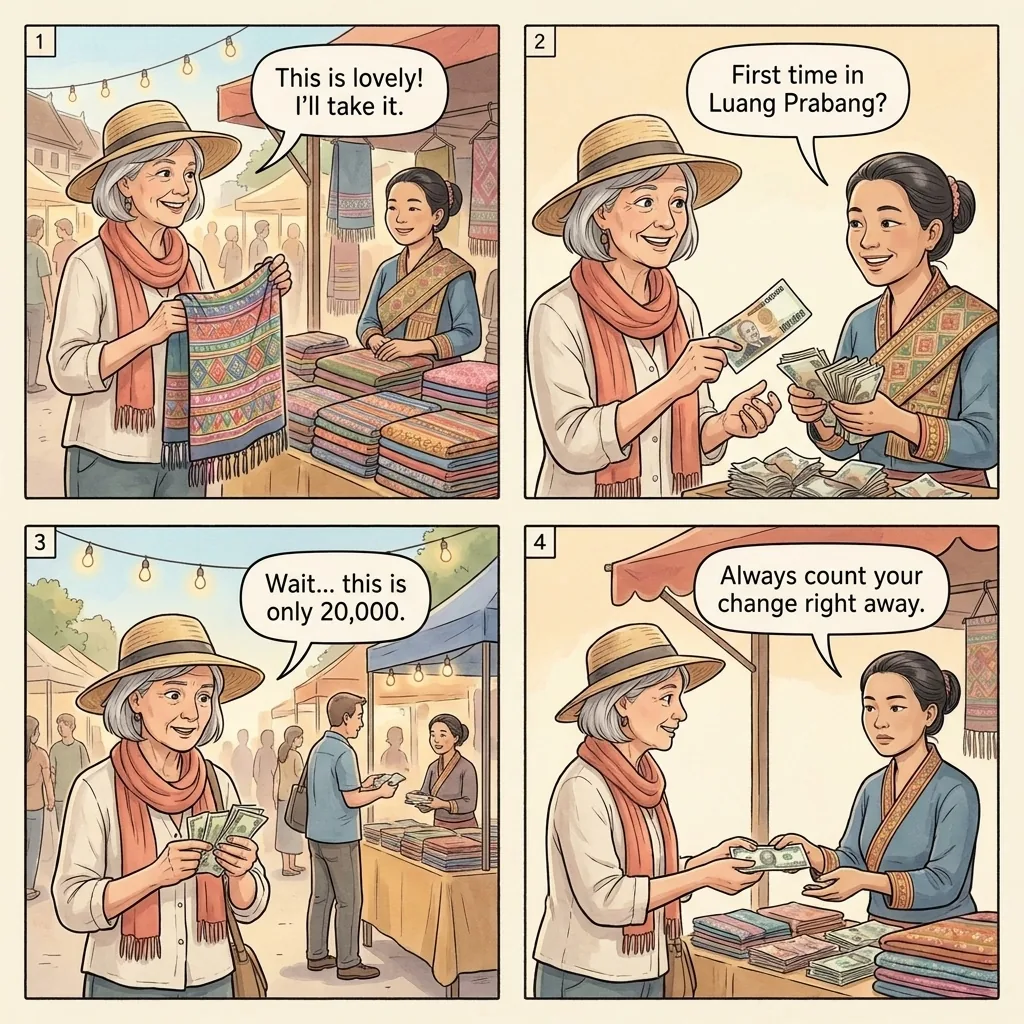
You wander the Luang Prabang Night Market on Sisavangvong Road around 7 p.m., pick up a hand-loomed Hmong textile scarf, and the vendor quotes ₭50,000 — about $2.50.
It is a fair price. You hand over a ₭100,000 note. She looks at it, smiles, and reaches into a small pouch around her waist that holds a thick wad of crumpled small-denomination bills. She digs through the wad, fanning it once, twice, while keeping up a friendly chat about your trip and where you are from. The conversation slows you down. She presses a folded stack of change into your hand, says 'thank you, sir,' and immediately turns to the next customer behind you in the aisle.
You step aside, count the change in better light, and find ₭20,000. You should have received ₭50,000. You are short by ₭30,000 — about $1.50. When you go back and point it out, she acts surprised, shuffles through the wad again as if recounting, and eventually hands you the missing ₭30,000 with a smile. There is no apology, no explanation, no consequence. If you had not counted before walking away, the $1.50 would simply be hers.
Multiply $1.50 by a hundred tourists a night across thirty stalls in the market, and the short-change technique generates several thousand dollars in nightly margin without ever quoting an inflated price. The mechanic is consistent and does not rely on math errors — Lao kip notes look very similar across denominations (₭5,000, ₭10,000, ₭20,000, ₭50,000, ₭100,000 are all variations of red-pink-purple), the wad of crumpled bills is genuinely confusing, and the friendly chat is calibrated to break your concentration during the count.
The pattern is well-documented on Reddit, in the Travelfish forum, and in most updated Laos guides. It runs at the Luang Prabang Night Market more than at the Hmong morning market because the night market caters almost exclusively to tourists, while the morning market serves locals who would notice a short-change instantly. The same technique appears in Vientiane and Vang Vieng but with smaller scale. The fix is mechanical — count the change at the stall before stepping away — and the vendor will quietly correct without escalation when caught.
Count every bill of your change at the stall before walking away — say 'one moment' out loud, hold up the bills one at a time, and confirm the total before pocketing. State the amount you are handing over before any transaction: 'This is one hundred thousand kip.' Carry small bills (₭5,000, ₭10,000, ₭20,000) so you can pay with near-exact change and remove the short-change opportunity entirely. Lao kip denominations all look similar in red-purple tones — familiarize yourself with the size and number on each note. If a vendor refuses to correct an obvious short-change, photograph the stall and report it to the Lao Tourist Police at 1191.
Red Flags
- Vendor handles a confusing pile of small crumpled bills
- Change given slowly in small denominations
- Distraction or conversation during the change-giving
How to Avoid
- Count your change carefully every single time.
- Carry small bills so you can pay with near-exact change.
- State the amount you're handing over: 'This is 100,000.'
- Lao kip bills look similar — familiarize yourself with each denomination.
🆘 What to Do If You Get Scammed
📋 File a Police Report
Go to the nearest Lao Police station. Call 1191 (Police) or 1195 (Ambulance). Get an official crime report — you'll need this for insurance claims. You can also report online at laopdr.gov.la.
💳 Cancel Your Cards
Call your bank immediately. Most have 24/7 numbers on the back of the card (keep a photo saved separately). Block any suspicious transactions before the thieves use your details.
🛂 Lost Passport?
Contact your nearest embassy or consulate. The US Embassy in Vientiane is at Thadeua Road, Km 9, Ban Somvang Tai, Hatsayfong District, Vientiane. For emergencies: +856 21-48-7000.
📱 Track Your Device
If your phone was stolen, use Find My (iPhone) or Find My Device (Android) from another device. Don't confront thieves yourself — share the location with police instead.
Frequently Asked Questions
You just read 3 scams in Luang Prabang. The full Travel Safety Series has 780+ more across 20+ countries.
Tokyo's Kabukichō ¥130,000 bar trap. Rome's gladiator photo extortion. Paris's gold-ring trick. Bali's ATM skimmer scams. Bangkok's grand-palace closure ruse. Every documented scam across 20+ destinations — with the exact scripts, red flags, and local-language phrases that shut each one down. Drawn from Reddit traveler reports, embassy advisories, and consumer-protection cases.
- 780+ documented scams across Tokyo, Rome, Paris, Bali, Bangkok, Rio & 100+ more cities
- 20+ countries covered, with country-by-country phrase cards for every destination
- Updated annually — buy once, re-download future editions free
- All titles $4.99 each on Amazon Kindle