
Key Takeaways
- The #1 reported scam is the SeaTac Airport Fake Uber & A1 Taxi Overcharge.
- 2 of 4 scams are rated high risk.
- Use app-based ride services (Uber, Lyft) instead of unmarked vehicles or unlicensed cabs.
- Never accept unsolicited offers from strangers near tourist sites in Seattle.
⚡ Quick Safety Tips
- Always verify the license plate, vehicle make, model, and driver name in the Uber or Lyft app before opening any door at SeaTac's congested Level 3 pickup zone.
- Use Link Light Rail from SeaTac to downtown Seattle for $3.00 one-way in about 40 minutes — the scam-proof backup when the rideshare queue is a mess.
- Never tap a handheld card reader on a Seattle sidewalk outside Lumen Field, Pike Place, Capitol Hill, or the U-District — it is always a scam.
- On First Avenue, Pike Place, and Westlake Center, keep hands in pockets — a 'monk' slipping a bracelet onto your wrist triggers a $20 to $100 donation demand.
Jump to a Scam
The 4 Scams
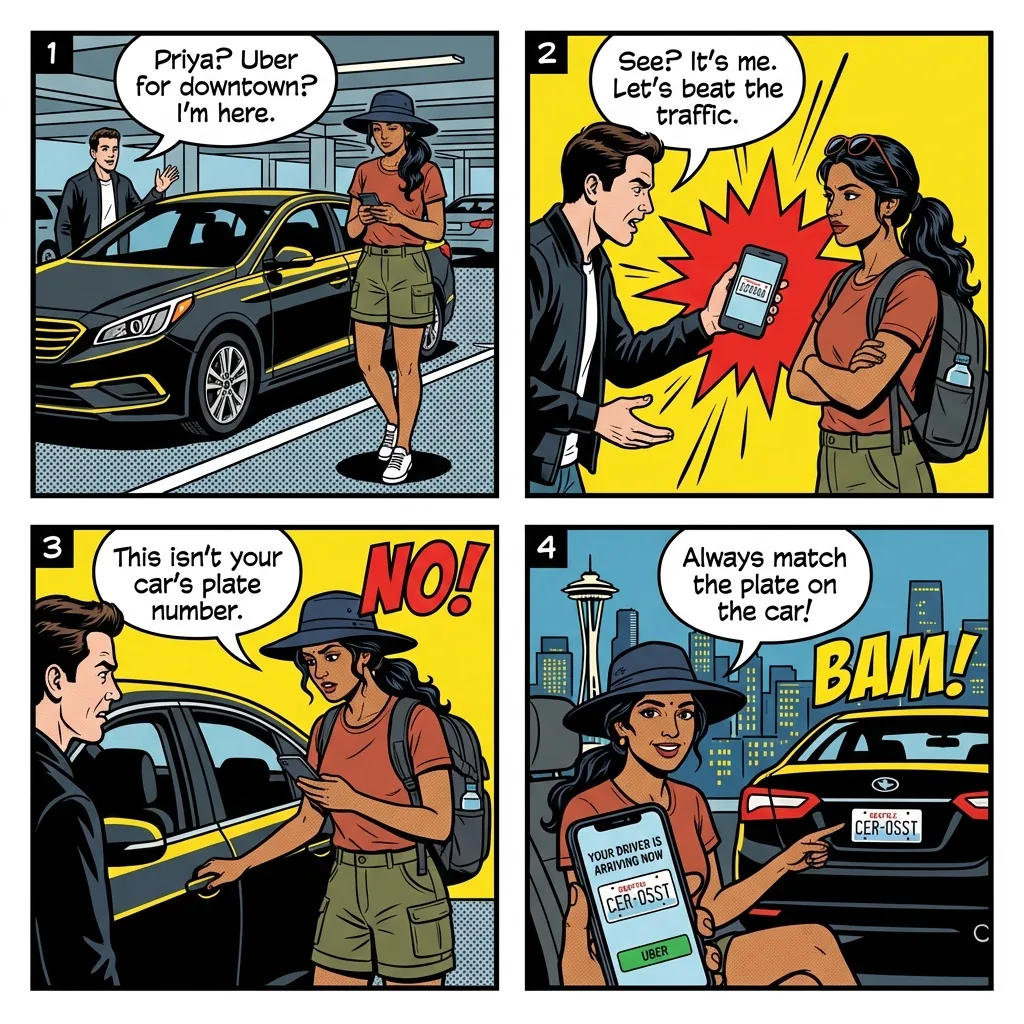
A 2025 traveler report titled 'SeaTac Uber Scam' circulated widely and a personal reply from Port Commissioner Sam Cho, putting Seattle's most-reported airport scam on the public record.
Fake drivers intercept real Uber and Lyft riders at the congested Level 3 pickup zone, call out matching car colors and models, and walk passengers to unmarked vehicles.
The pitch is precise. A driver pulls up in a car matching the app-assigned vehicle color and model, shows a fake license plate on a phone, and calls the rider by name. The real driver is delayed by SeaTac congestion, the fake driver gets there first, and the rider follows without double-checking the plate. FOX 13 Seattle reported the pattern on 27 October 2025 after SEA Airport issued a traveler warning.
The taxi variant runs a parallel con. A 2024 traveler report titled 'Horrible experience with A1 Seattle Taxi from Seatac' documented drivers at the Level 3 taxi queue quoting flat rates of $50 to $100 for downtown runs, despite the meter being required. A 2024 traveler threads on the same 'A1 Seattle Taxi' operator confirmed the pattern is repeat-offender behavior.
A 2023 traveler threads captured the 'ghost ride' variant — Uber driver accepts the ride, parks and waits 5 minutes, never moves, then cancels on the passenger forcing a second booking at surge pricing. A 2026 traveler threads titled 'Leaving SeaTac, are taxis still worth it' showed the community consensus shifted firmly toward app-based rideshare as the only safe option.
For defense: always verify the license plate, vehicle make, model, and driver name in the Uber or Lyft app before opening any door at SeaTac. Do not respond to a driver who approaches you by name — the scammers see your name on the app-assigned vehicle board. If your assigned driver is delayed, wait in the designated zone; never follow a 'substitute.'
If overcharged or misled, call SeaTac Airport Police non-emergency at 206-787-5388 or Port of Seattle staff at the curb. Seattle Police non-emergency is 206-625-5011 for downtown incidents. For formal complaints, Washington State Attorney General Consumer Protection is at 800-551-4636 and the King County Prosecuting Attorney's office accepts reports. Port Commissioner Sam Cho's email [email protected] is the publicly-posted direct channel.
Red Flags
- driver at Level 3 SeaTac pickup zone calling out your name with no trip in your actual Uber or Lyft app
- vehicle color and model matching your app-assigned ride, but the license plate is different or obscured
- taxi driver at Level 3 queue quoting a 'flat rate' of $50 to $100 for downtown instead of the meter
- Uber driver who accepts your ride, does not move for 5 minutes, then cancels forcing a surge-priced re-book
- request to pay in cash upfront, or insistence that the meter is 'broken' or that SeaTac taxis do not use meters
How to Avoid
- Always verify the license plate, vehicle make, model, and driver name in the Uber or Lyft app before opening any door.
- Do not respond to a driver who approaches you by name at SeaTac — scammers see your name on the app-assigned vehicle board.
- Use Link Light Rail from SeaTac to downtown Seattle for $3.00 one-way in about 40 minutes — the scam-proof backup.
- Insist on the meter in any Seattle taxi; refuse every 'flat rate' quote from the airport taxi queue.
- If overcharged, call SeaTac Airport Police non-emergency at 206-787-5388 before paying and file a formal complaint.
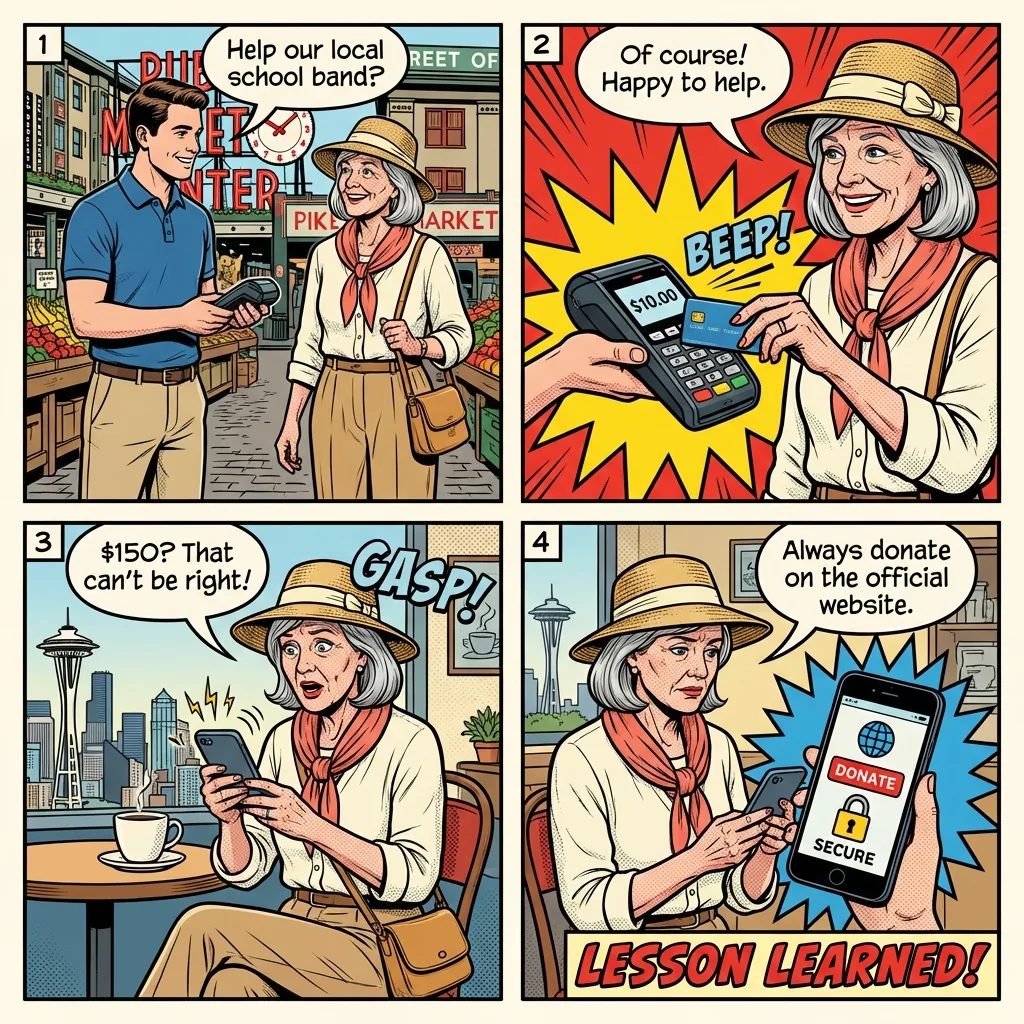
A 2026 traveler report titled 'Scammed outside Lumen' circulated widely and became Seattle's latest viral scam warning.
Men approach tourists outside Lumen Field on Seahawks and Sounders game days, claiming to raise money for a local high school basketball team, band, or kids music program, and produce a handheld tap-to-pay card reader.
The pitch is always charity-framed. A well-spoken stranger names a specific Seattle-area school, describes an 'underfunded' program, and insists on a small donation — $5 or $10 is quoted. A handheld card reader is produced. The tourist taps their card. The actual charge posts later at $50, $150, or higher, because the reader's visible amount is not the amount authorized.
The same script runs citywide. A 2024 traveler threads documented the pattern outside the Capitol Hill Link Station with 'kids music program' framing. A 2026 traveler report named the U-District 45th-and-the-Ave corner in front of Chase Bank with 'Garfield High School band club' framing. KING 5 Seattle reported on the tap-to-pay variant in late 2025 after the pattern went viral.
A 2025 traveler threads captured a foreign-tourist variant on Stewart Street downtown — a European couple showed a supposed EU driver's license and asked the target to rent them a car, escalating to credit-card-details request. A 2025 traveler threads on Capitol Hill Pike-Broadway added a CD-strongarm variant with QR-code tap-to-pay.
For defense: never tap a card reader that is handed to you on a Seattle sidewalk, regardless of the cause claimed. Legitimate charities do not fundraise with handheld readers outside sports stadiums or MRT stations. If the pitch sounds plausible, ask for the organization's website and donate directly later — most scammers disengage the moment deferral is suggested.
If you already tapped and a fraudulent charge appears, dispute it with your card issuer within 48 hours citing unauthorized transaction amount. File a Seattle Police report at 206-625-5011 non-emergency. Report the pattern to the Washington State Attorney General Consumer Protection line at 800-551-4636 and to the FTC at reportfraud.ftc.gov.
Red Flags
- well-spoken stranger near Lumen Field, Pike Place, or U-District claiming to raise money for a specific local high school
- handheld card reader produced after a quoted donation of $5 or $10 — the visible amount is not the charged amount
- charity framing around 'underfunded band,' 'kids music program,' or a local basketball team at an unverified Seattle school
- pressure to tap or sign 'now' with no written materials, no receipt, and no nonprofit registration number
- second-person accomplice stepping in to intimidate if the target hesitates or starts walking away
How to Avoid
- Never tap a handheld card reader on a Seattle sidewalk, regardless of the charity or cause claimed.
- Ask for the organization's website and donate directly later; legitimate charities accept this without pressure.
- Refuse every 'sign this CD' or 'scan this QR code' pitch in downtown Seattle, Capitol Hill, or the U-District.
- Keep walking without breaking stride when approached — engaging in conversation is the scammer's first win.
- If fraudulent charges appear, dispute with your card issuer within 48 hours and file a Seattle Police report at 206-625-5011.

A 2025 traveler report titled 'PSA: don’t fall for monk and/or bracelet scams downtown' circulated widely after the poster watched multiple tourists fall for the scam near Pike Place Market.
Individuals in saffron robes approach tourists, slip a bracelet onto the wrist or press a trinket into the hand, and demand a $20 to $100 donation for 'the temple' or 'peace and blessings.'
The mechanic is physical and time-pressured. The scammer positions at Pike Place's First Avenue approach, the Westlake Center plaza, and the Pier 55-57 waterfront. Opening lines are always soft — 'For you, for peace' or 'Blessing for your family' — and the object transfer happens in the same second as the greeting, before the tourist can decline.
Once the bracelet is on, the 'donation' request begins. The scammer produces a laminated card showing prior 'donations' with dollar amounts next to foreign-language names, implying the target owes the same. A 2026 traveler threads asking about tourist scams drew a top reply: 'The monks are not real monks, ignore them.' That community consensus is the detection shortcut.
The scam is national. In Seattle, it peaked around major cruise-ship dock arrivals at Pier 66 and during summer tourist weekends. The robes vary — saffron, orange, or plain religious attire — but the script is identical.
For defense: keep hands in pockets when walking First Avenue or the Pike Place approach. If a stranger reaches for your wrist or puts anything in your hand, step back and say 'No' loudly. Never pay a donation for a bracelet or trinket placed on you without consent; refuse the object and walk away without breaking stride.
If followed, step into any Pike Place Market vendor, Pike Brewing, or Westlake Center retail entrance. Seattle Police non-emergency is 206-625-5011 for formal complaints. The Washington State Attorney General Consumer Protection line (800-551-4636) accepts reports of organized aggressive solicitation patterns, and Pike Place Market's own security office near the fish-throwers can intervene in real time.
Red Flags
- person in saffron or orange robes approaching tourists near Pike Place Market, Westlake Center, or Pier 55-57
- object placed on the wrist or pressed into the hand within the first second of the interaction
- laminated card showing prior 'donations' with dollar amounts beside foreign-language names
- physical grip on the tourist's hand during the donation request, preventing walking away for up to a minute
- 'blessing,' 'peace,' or 'temple donation' framing that pivots to a specific dollar demand within 10 seconds
How to Avoid
- Keep hands in pockets when walking First Avenue, Pike Place Market, Westlake Center, or the Seattle Waterfront.
- Step back and say 'No' loudly if a stranger reaches for your wrist or places anything on your body.
- Never pay a donation for a bracelet or trinket placed on you without consent; refuse the object and walk away.
- If followed, step into any Pike Place Market vendor, Pike Brewing, or Westlake Center retail entrance.
- Report aggressive patterns to Seattle Police non-emergency at 206-625-5011 with the location and time.
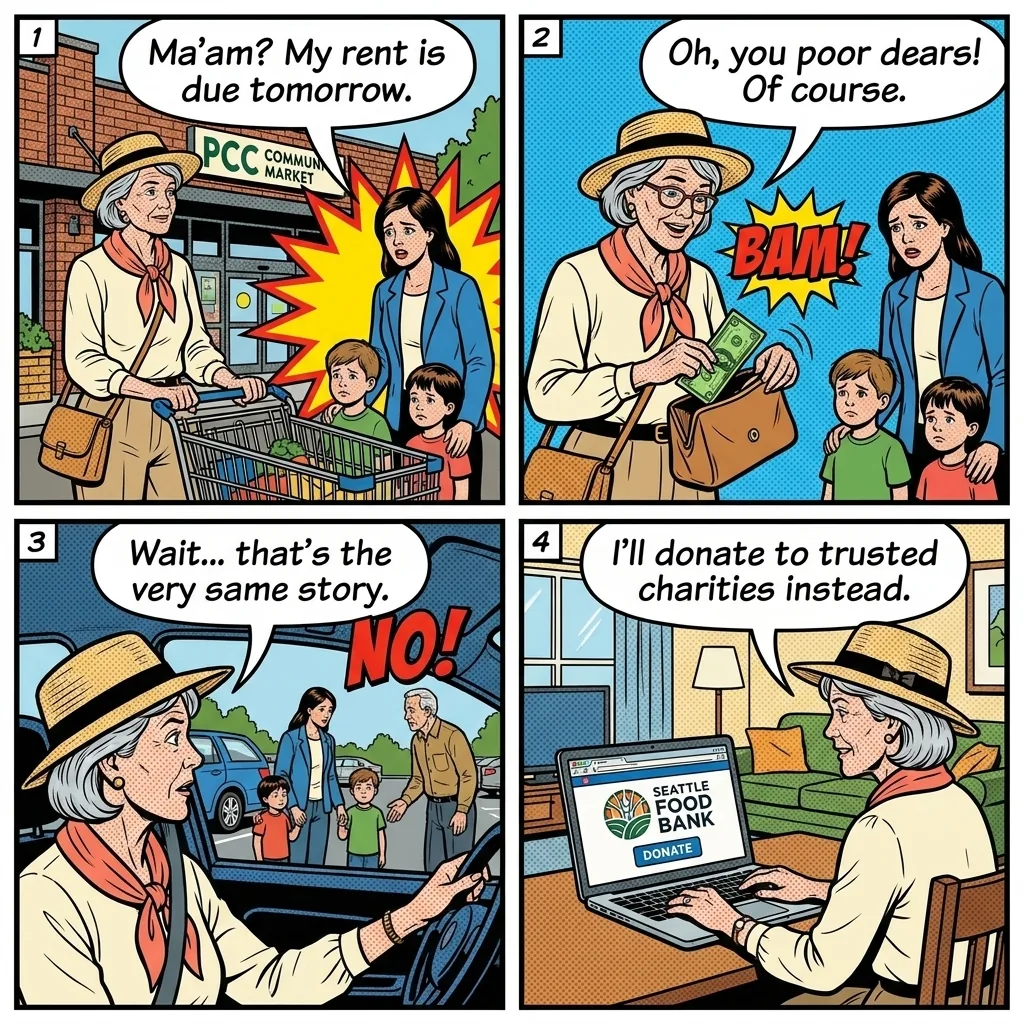
A 2025 traveler report titled 'Mom & kid begging for cash SCAM' documented three separate mother-and-children groups begging at Seattle grocery-store parking lots on a single Friday. The pattern has hardened across 2024 and 2025 — a 2025 traveler threads named specific corners where the same woman and children show up daily during school hours.
The parking-lot variant works sympathetically. A woman and two young children stand near the entrance of a PCC Community Markets or Trader Joe's, sometimes at Factoria Mall, sometimes at I-5 and I-90 exit medians. The pitch names a specific emergency — 'my rent is due tomorrow' or 'the kids haven't eaten.' Comments on the 2025 traveler threads noted the same children appear daily, even on 100+ degree summer days.
The door-to-door variant is newer and escalatory. A 2025 traveler threads titled 'Door-to-Door Panhandling' documented strangers ringing doorbells in South Lake Union and Fremont neighborhoods with prepared stories about 'just moved in' needing help. The narrative is scripted — the same story appears across multiple neighborhoods within a day.
A 2024 traveler threads contextualized the broader pattern, and a 2016 traveler report showed that downtown aggressive panhandling has been a documented Seattle issue for over a decade. The 2025 variants differ in their child-staging and scripted neighborhood rotation.
For defense: do not roll down your car window to engage with parking-lot or median panhandlers in Seattle. Say 'No' firmly and keep moving. Never open your front door to an unexpected visitor with a cash-needed story; ask through a closed door or a video doorbell. If a child appears to be in genuine distress, call 911 — Child Protective Services is the correct response, not cash.
If pressured or followed, step into any Seattle business or public space. Seattle Police non-emergency is 206-625-5011 for aggressive-panhandling reports. For suspected child-exploitation in panhandling, the Washington State Department of Children, Youth, and Families accepts reports at 866-363-4276. The Washington State Attorney General Consumer Protection line (800-551-4636).
Red Flags
- mother and two young children at a PCC, Trader Joe's, or Factoria Mall entrance on a weekday during school hours
- same individuals appearing daily at the same corner, sometimes at 100+ degree temperatures or during heavy rain
- door-to-door stranger in South Lake Union or Fremont with a 'just moved in and need help' story
- scripted opening lines that appear across multiple Seattle neighborhoods within the same day
- claim of a specific time-pressured emergency — 'rent due tomorrow,' 'kids haven't eaten,' 'can't afford gas'
How to Avoid
- Do not roll down your car window to engage with parking-lot or highway-median panhandlers in Seattle.
- Say 'No' firmly and keep moving when approached at a grocery store, mall, or transit station entrance.
- Never open your front door to an unexpected visitor with a cash-needed story; ask through a closed door or video doorbell.
- If a child appears to be in genuine distress, call 911 for Child Protective Services rather than giving cash.
- Report aggressive or suspected-trafficking panhandling to Seattle Police at 206-625-5011 or DCYF at 866-363-4276.
🆘 What to Do If You Get Scammed
📋 File a Police Report
Go to the nearest Seattle Police Department (SPD) station. Call 911 (Emergency) or (206) 625-5011 (Non-Emergency). Get an official crime report — you'll need this for insurance claims. You can also report online at seattle.gov/police.
💳 Cancel Your Cards
Call your bank immediately. Most have 24/7 numbers on the back of the card (keep a photo saved separately). Block any suspicious transactions before the thieves use your details.
🛂 Lost Passport?
For international visitors, contact your country's consulate. Many nations maintain consulates in Seattle. US State Department emergency line: +1-888-407-4747 (from US) or +1-202-501-4444 (international).
📱 Track Your Device
If your phone was stolen, use Find My (iPhone) or Find My Device (Android) from another device. Don't confront thieves yourself — share the location with police instead.
Frequently Asked Questions
You just read 4 scams in Seattle. The full Travel Safety Series has 780+ more across 20+ countries.
Tokyo's Kabukichō ¥130,000 bar trap. Rome's gladiator photo extortion. Paris's gold-ring trick. Bali's ATM skimmer scams. Bangkok's grand-palace closure ruse. Every documented scam across 20+ destinations — with the exact scripts, red flags, and local-language phrases that shut each one down. Drawn from Reddit traveler reports, embassy advisories, and consumer-protection cases.
- 780+ documented scams across Tokyo, Rome, Paris, Bali, Bangkok, Rio & 100+ more cities
- 20+ countries covered, with country-by-country phrase cards for every destination
- Updated annually — buy once, re-download future editions free
- All titles $4.99 each on Amazon Kindle