
Key Takeaways
- The #1 reported scam is the Clarke Quay Seafood 'Market Rate' Bill Surprise.
- Most scams in Singapore are low-to-medium risk.
- Use official taxi ranks or local ride apps where available — always confirm the fare before departure.
- Never accept unsolicited offers from strangers near tourist sites in Singapore.
⚡ Quick Safety Tips
- Singapore is one of the safer cities in Asia but stay alert at Orchard Road and MRT station exits with phones out.
- Ignore anyone who approaches you in the tourist districts with unsolicited 'lucky draw' or 'free gift' offers.
- Book taxis through GrabTaxi or ComfortDelGro app — never accept touts at the airport.
- Buy gem or jewelry items only from certified jewelers — fake gem quality claims are a known issue at Sim Lim Square.
Jump to a Scam
The 5 Scams
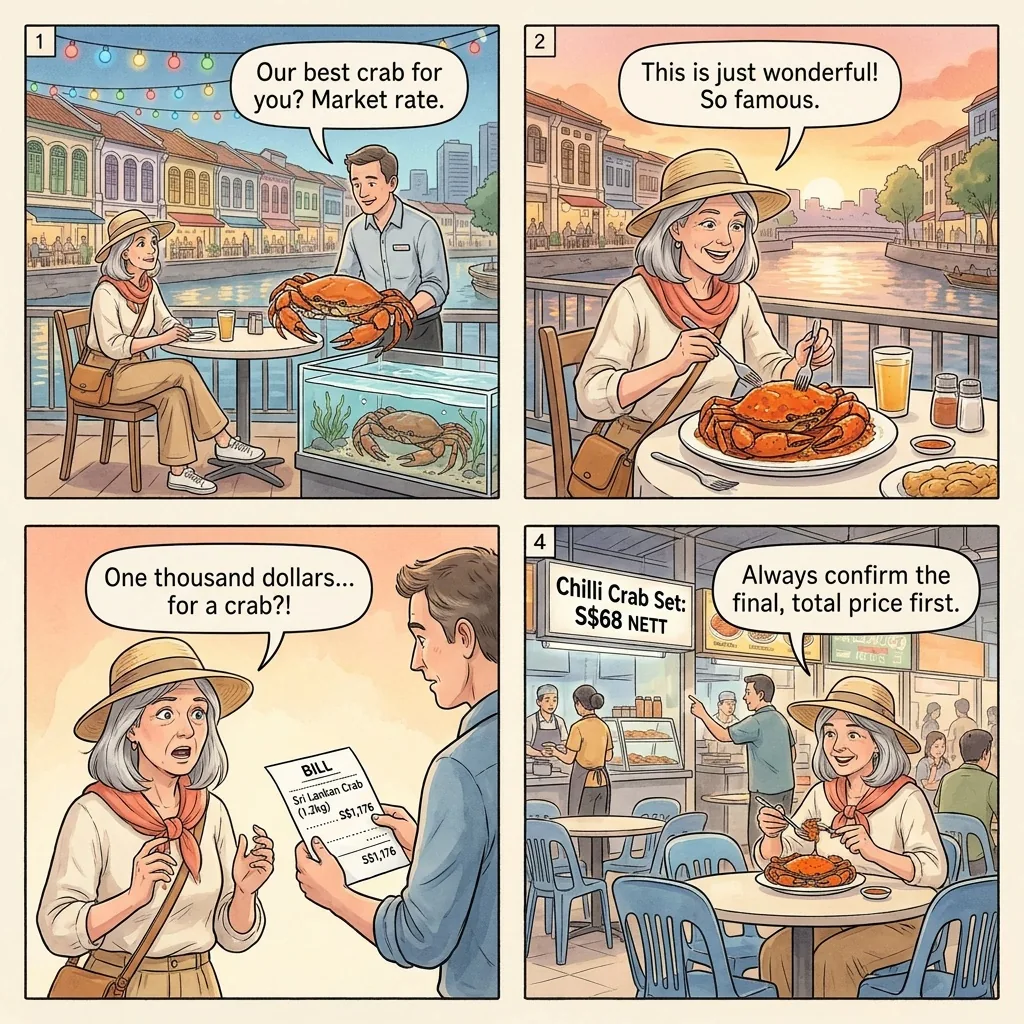
It's a Friday evening on Clarke Quay, the river lit up by a thousand restaurant signs, and a waiter at one of the seafood places lifts a live Sri Lankan crab from a tank and asks if you'd like it for dinner — it weighs 1.2 kg and the price is 'market rate.'
You say yes because the crab is iconic, the restaurant terrace is full of other tourists, and 'market rate' sounds like a reasonable framing. The chilli crab arrives, you enjoy it, and the bill drops at the end of the meal showing the crab at S$98 per 100g (rather than per kilogram, which is how seafood is priced in markets and at non-tourist restaurants). The 1.2 kg crab is now S$1,176. Add a S$25 'seasonal surcharge,' a 10% service charge, 9% GST, and the dinner-for-two is S$1,500.
The Singapore Tourism Board and the Consumer Association of Singapore (CASE) have weighed in repeatedly on Clarke Quay seafood pricing transparency — bills landing 3–10× normal rates, prices listed per-100g rather than per-kilogram, and 'seasonal' or 'live-tank' surcharges added without disclosure. Singaporean food blogger Daniel Ang and the local Mothership.sg consumer-affairs desk have run multiple exposés on specific Clarke Quay operators. As travelers report across Reddit, the TripAdvisor Singapore forum, the Lonely Planet Singapore thorntree, and CASE's published complaint logs, the 'market rate' framing without specific dollar quotes is the single most-reported Singapore tourist friction.
The mechanism is structural. Live seafood is priced in Singapore by weight, but the legitimate base rate (S$8–15 per 100g for crab; S$5–10 per 100g for prawns) varies wildly with size, source, and freshness, and the 'market' framing exists in real seafood markets like Senoko and Jurong. Tourist-trap operators clone the framing but multiply the rate without disclosure, weaponising the legitimate ambiguity. The Singapore Restaurant Association's Code of Conduct requires per-piece or per-100g pricing to be disclosed in writing before order, but enforcement against tourist-strip operators is light.
The defence is verbal and pre-order. Ask for the specific dollar price, in writing on the menu, before you say yes. Get an estimate of the total bill before any live tank item is killed (which makes refund impossible). Ignore the 'market rate' framing entirely — it is operationally vague enough to mean anything. The legitimate Clarke Quay and East Coast seafood places will quote a specific number on request; the operators that won't are the ones running the surprise model.
Before ordering any 'market rate' or 'seasonal' seafood at any Singapore tourist-strip restaurant, ask the waiter for the specific dollar price in writing — per the actual unit (per kg, not per 100g — clarify which) — and a total-bill estimate including any surcharges and service charge. If the waiter cannot or will not quote a specific number, walk out before the live tank item is killed. Pay by credit card so chargeback is available. Cross-check operator reviews on Google Maps for the words 'bill,' 'price,' or 'shock' before sitting down. Report aggressive bill surprises to the Consumer Association of Singapore (CASE) at 6100-0315 and the Singapore Tourism Board hotline. Emergency: 999 (Police) or 995 (ambulance/fire); SPF non-emergency 1800-255-0000.
Red Flags
- 'Market rate' or 'seasonal rate' pricing without a specific number
- Waiter shows you the live animal rather than a price list
- Multiple additional charges listed in small print on menu
- Aggressive upselling of 'set menus' or additions
How to Avoid
- Ask for the specific price in dollars before ordering any market-rate item.
- Get a price estimate for the total meal before you order.
- Check Google reviews specifically mentioning 'bill' or 'price surprise.'
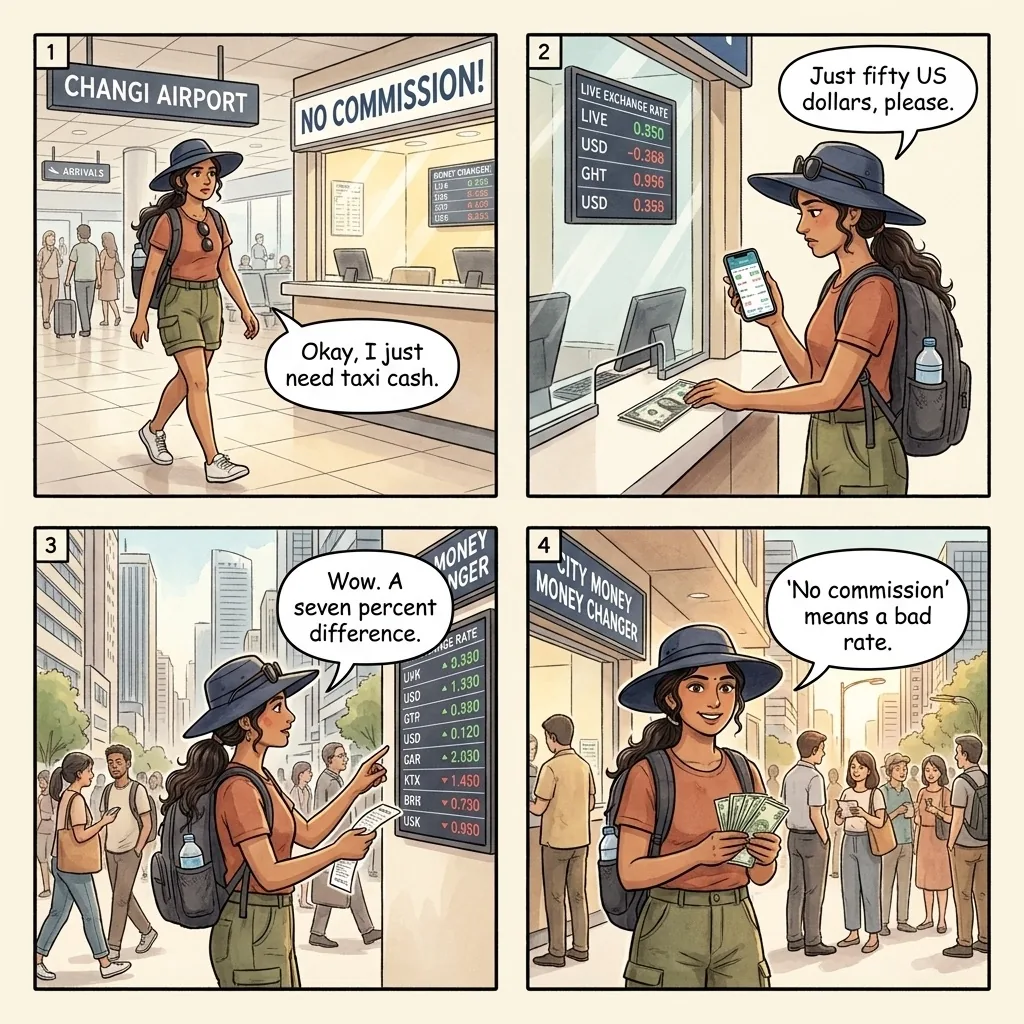
It's the morning your flight lands at Changi, you walk through customs into Terminal 3 arrivals, and the first thing you see is a brightly-lit money-changer booth advertising 'NO COMMISSION!' with a queue of three or four other tourists.
You exchange US$200 because you need cash for the taxi to your hotel and the booth is convenient. The headline rate looks competitive — within a few percent of what Google says the SGD/USD rate is — but the buy/sell spread on the airport board is much wider than at any city money changer. The airport booth gives you, say, 1.27 SGD per USD when the interbank rate is 1.34 SGD per USD; the city money changers along Orchard or in Chinatown give you 1.32–1.33 SGD per USD. You've lost roughly S$14 on the S$254 transaction — about 5–6% — to a 'no commission' booth that recovered its margin entirely through the spread.
Singapore is a global currency-exchange capital with one of the densest competitive money-changer ecosystems in the world. The legitimate city money-changer clusters at Lucky Plaza on Orchard Road, the Mustafa Centre, the licensed booths in Raffles Place MRT, and the Tanjong Pagar Plaza basement run rates 4–8% better than airport rates with zero commission and zero spread games. Singaporean residents never exchange at Changi — they exchange in town, often on the same day they need the cash. As travelers report across Reddit, the TripAdvisor Singapore forum, and the Monetary Authority of Singapore consumer-affairs guidance, the airport-exchange premium is the most-reported low-grade financial friction visitors encounter.
The framing as a 'scam' is generous — the airport operators are licensed, regulated, and disclosing their rates honestly on the board. The spread is large but visible. The friction is informational rather than fraudulent: visitors don't know that Singapore has a thriving city money-changer market that runs at near-interbank rates, so they accept the airport rate as a reference point. The defence is to skip airport exchange entirely and use the city changers (or a Wise/Revolut card at near-interbank rates everywhere) for any meaningful sum.
A useful taxi-fare workaround makes airport exchange almost unnecessary. The Changi taxi rank accepts Visa, Mastercard, and contactless mobile payments at the meter; the Singapore MRT runs from Changi to the city for S$2.50 with EZ-Link or contactless card; Grab (Singapore's main rideshare) accepts foreign cards in-app. None of these require Singapore cash on arrival. The S$50–100 most travelers exchange at the airport is rarely needed before getting to a city money changer.
Skip the Changi airport money-changer booths entirely — pay your taxi or Grab fare by contactless card at the meter, take the MRT to town for S$2.50 with a contactless card, and exchange your USD/EUR/GBP at the city money changers (Lucky Plaza on Orchard, Mustafa Centre, Raffles Place MRT, or Tanjong Pagar Plaza) at near-interbank rates with zero commission. If you must exchange at the airport, do only S$30–50 for emergency cash and exchange the bulk in town. Use a Wise or Revolut card for ATM withdrawals at near-interbank rates anywhere in Singapore. Currency-exchange disputes can be reported to the Monetary Authority of Singapore at 6225-5577.
Red Flags
- Airport exchange booths advertising 'No Commission!' but terrible rates
- Rate displayed looks competitive but spread between buy/sell is huge
How to Avoid
- Exchange only a small emergency amount at the airport.
- Head to Tanjong Pagar Plaza or Lucky Plaza in Orchard for Singapore's best exchange rates.
- Wise or Revolut debit cards offer near-interbank rates anywhere.
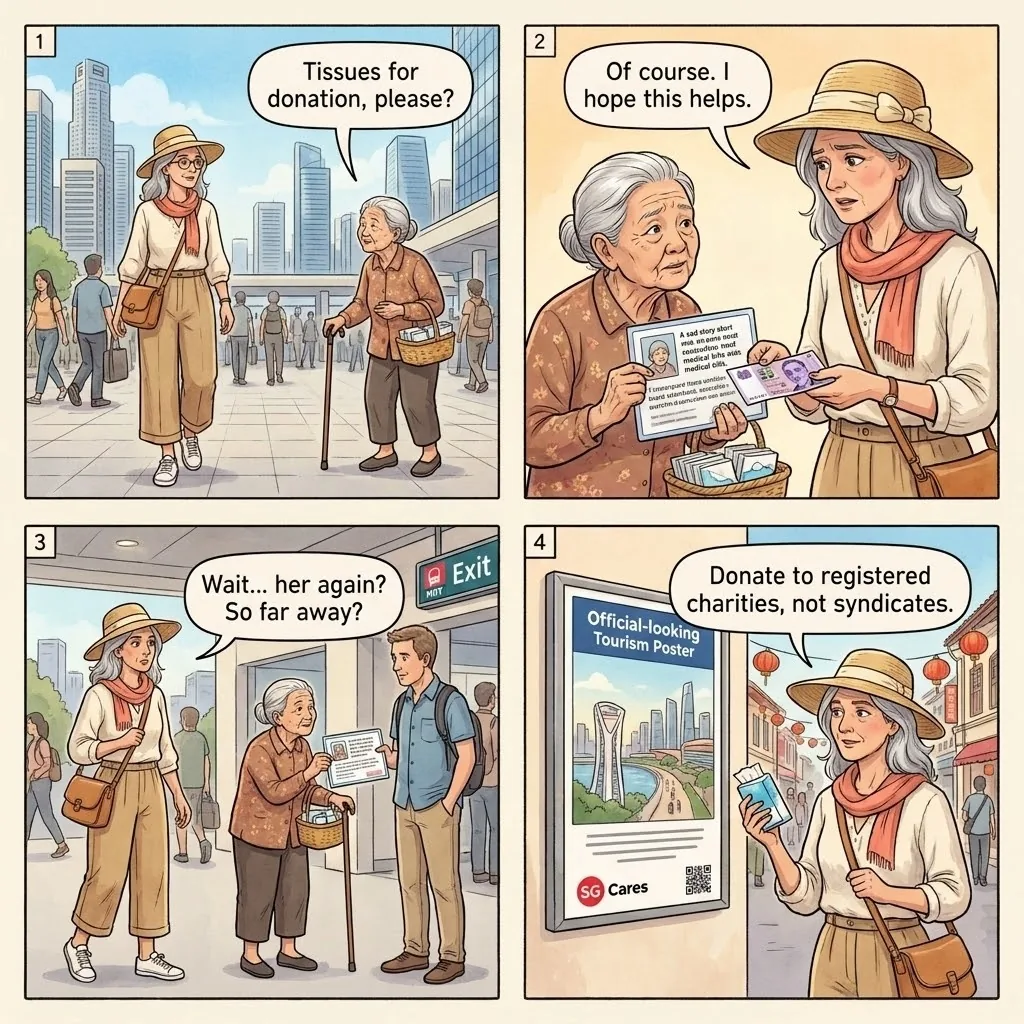
It's a Monday lunch hour in the CBD, you've just exited the Raffles Place MRT, and an elderly woman with a cane and a small basket of tissue packets approaches you with a quietly sad smile and a laminated card explaining she needs money for medical treatment.
She offers you a packet of tissues in exchange for a 'donation.' The framing is gentle and the dollar ask is small — S$2–5 per packet. The card lists a relative's medical expense, sometimes shows photos. You give her S$5 and walk on. Later that afternoon you see the same woman, with the same basket and the same laminated card, working a different MRT exit half a kilometre away.
The 'charity tissue' phenomenon in Singapore is a documented gray-zone fundraising practice that sits between legitimate hardship and organised solicitation. Some sellers are individuals with real financial difficulty — Singapore's social-services system covers most residents but has gaps, and tissue-selling is a long-standing low-key way to make S$30–80 a day. But a meaningful fraction of the operators in the Singapore CBD work for syndicates that rotate individuals through different MRT exits on a schedule, with the day's collected money going to a coordinator and the seller earning a fixed wage. The Singapore Ministry of Social and Family Development and the National Council of Social Service have weighed in on the distinction repeatedly, and the Singapore Police Force has prosecuted a small number of clearly organised cases over the years.
The structural giveaways for the syndicated version are subtle. The same individual at multiple locations across the day. A laminated card with a story that doesn't match the seller's circumstances when questioned. A coordinator visible in the background (often an able-bodied younger man near the same MRT exit). A schedule that seems too organised — peak commute times, lunch hour, evening rush — for an unaffiliated seller. As travelers report across Reddit, the TripAdvisor Singapore forum, and Mothership.sg consumer-affairs reporting, the syndicated operations are the minority but the meaningful one.
The dollar damage on a single S$5 tissue purchase is small, and the moral framing of 'this might actually help' is the entire pull of the interaction. The defence is structural rather than confrontational: donate to verifiable Singapore charities (the Community Chest, the National Council of Social Service, the Salvation Army Singapore) where 100% of the donation lands at programs, rather than to street solicitors where the fraction reaching the seller is uncertain. The legitimate hardship cases are real but reaching them indirectly through registered charities is the higher-leverage path.
Donate to registered Singapore charities (Community Chest, National Council of Social Service, Salvation Army Singapore) rather than to street solicitors where the fraction reaching the actual person in need is uncertain. If you do want to support a tissue seller, S$2–5 is fine but recognise it as a small gesture rather than a meaningful donation. Decline persistent or aggressive approaches, especially the same seller appearing at multiple locations across a day. Report aggressive or organised solicitation to the Singapore Police Force at 1800-255-0000. Emergency: 999 (Police) or 995 (ambulance).
Red Flags
- Tissue packet or printed card given as an 'exchange'
- Persistent after initial refusal
- Same person appearing in different locations across days
How to Avoid
- Donate to registered charities rather than street solicitors.
- Singapore has robust social services — genuine destitution is rarely this organized.
Like what you're reading? Get a full Singapore itinerary with safety tips built in.
Browse travel-safety books →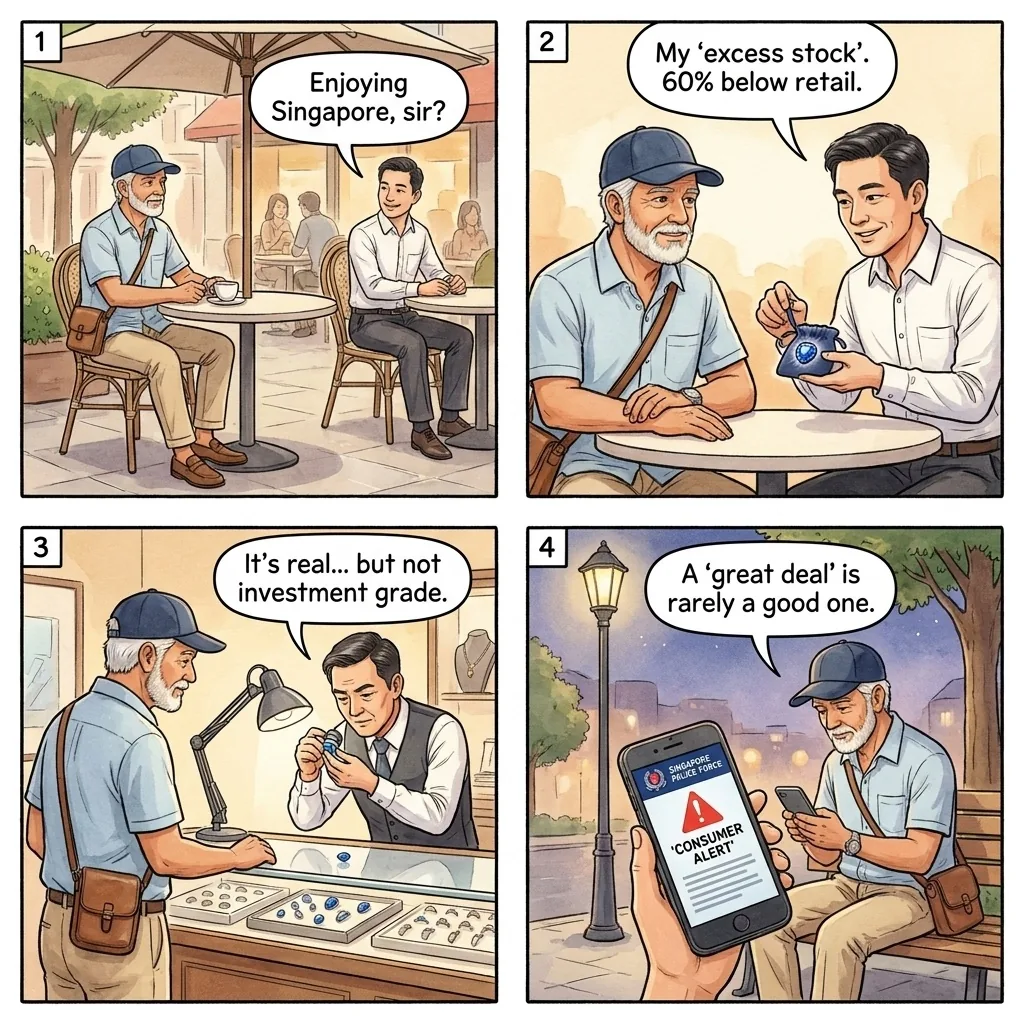
It's an evening on Orchard Road, you're sitting alone at a Starbucks reading your phone, and a polite well-dressed man in his forties — apparent business attire, cultivated English, an air of polish — sits down at the next table and strikes up a friendly conversation about your trip.
After fifteen minutes of pleasant chat about Singapore food and your hotel, he mentions in passing that he works in the gem-import business — sapphires from Sri Lanka, jade from Burma, ruby from Mogok. He says his company has 'excess stock' they need to clear before quarter-end to avoid import-duty liability, and he is selling some pieces personally at 60% below retail to friends and 'serious buyers.' He offers to show you a sample at his shop nearby. The pitch is courteous, the framing is exclusive, and the urgency is calibrated.
The shop is real. The gem he shows you is real. The 'investment-grade' rating he describes is theatre — heat-treated commercial-grade stones with synthetic colour enhancement that resell at 10–20% of the price he is quoting. A 'wholesale' jade bracelet at S$1,200 that he says retails at S$3,500 is, at any reputable Singapore jeweller, worth S$200–400. The pitch has its origins in 1990s Bangkok and Kuala Lumpur gem-shop scams that migrated to Singapore tourist hubs in the 2000s and 2010s. As travelers report across Reddit, the TripAdvisor Singapore forum, the U.K. Foreign Office Singapore travel advice, and the Singapore Police Force consumer alerts, the gem-investment pitch is the highest-dollar tourist scam in the city outside of online financial fraud.
The Singapore Police Force has flagged the gem-investment pitch in seasonal advisories. The Consumer Association of Singapore (CASE) has run multiple cases against operators using the 'excess stock' framing. The Singapore Tourism Board's consumer-protection materials specifically name 'jade investment' and 'gemstone tax-deferred sales' as scam frames to refuse. Despite enforcement, the operators rotate front companies, addresses, and personal aliases faster than the police can shut them down.
The structural giveaways are consistent. The pitch starts with an 'unsolicited friendly conversation' — never an actual gem-shop visit you initiated. The 'excess stock / import duty / friends-only price' framing is universal across the operators. The urgency is calibrated to 'this opportunity ends today.' The shop is shopfront-only with no online presence, no Singapore Diamond Industry Association membership, and no certifying gemological lab paperwork. Real Singapore gem retailers (Goldheart, Lee Hwa, Tiffany Singapore) do not pitch you on the street.
Decline any 'friendly conversation' from a stranger that pivots toward a gem-investment pitch. Genuine investment-grade gemstone purchases happen at established Singapore retailers (Goldheart, Lee Hwa, Tiffany Singapore, the Singapore Mint) with documented gemological-lab certification (GIA, AGS, or the Singapore Diamond Industry Association registry) and prices that match international wholesale benchmarks. Never pay cash; always credit card with chargeback path. If you have already paid for a 'wholesale' gem you suspect is overvalued, get a third-party gemological appraisal in Singapore before leaving the country and dispute the charge with your bank if appraisal confirms misrepresentation. Report gem-investment fraud to the Singapore Police Force at 1800-255-0000 or CASE at 6100-0315.
Red Flags
- Unprompted 'business opportunity' in a tourist area
- Mention of import duty / excess inventory as justification for low prices
- Sense of urgency or 'limited time' deal
How to Avoid
- Genuine investment-grade gem deals don't happen on the street.
- Any claim you're getting a special price unavailable to locals is a red flag.
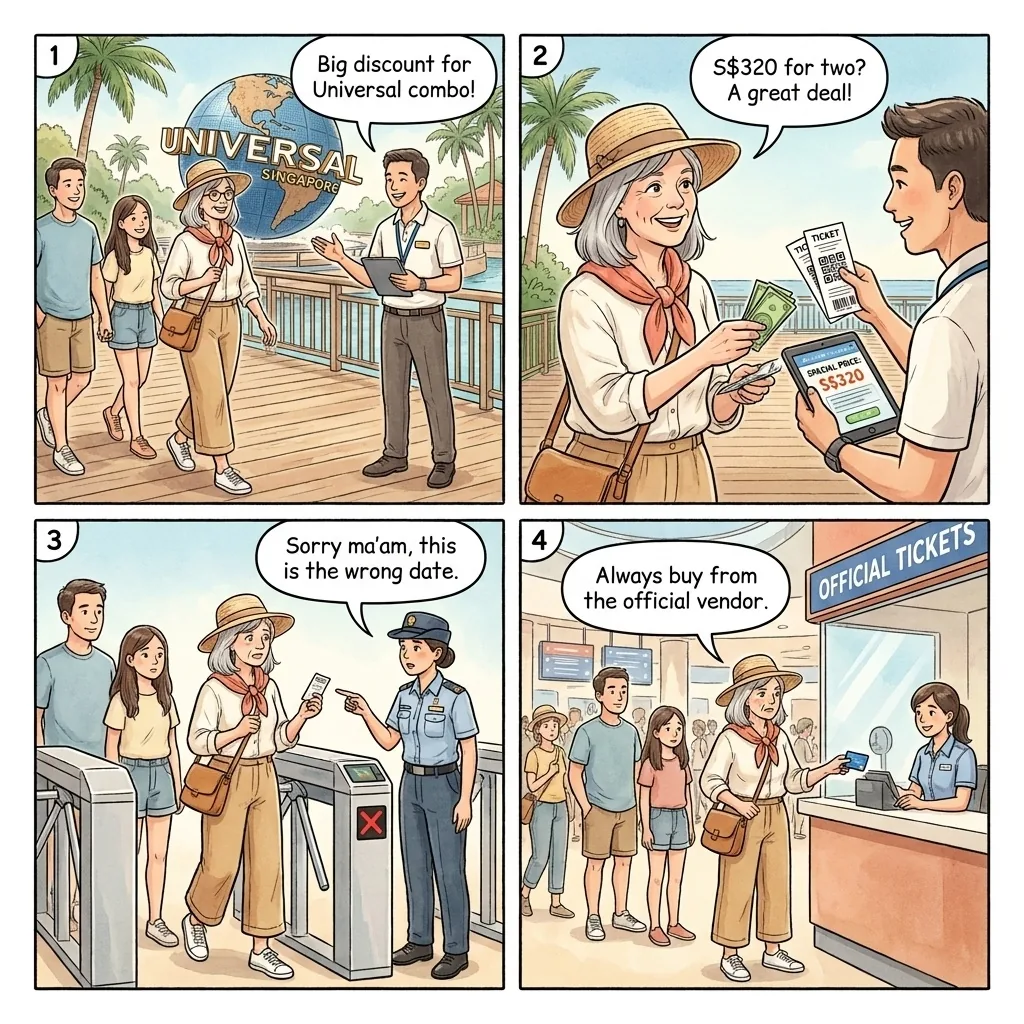
It's a Saturday morning at the Sentosa Boardwalk, you're walking toward Universal Studios with your family, and a friendly man with a tablet and a lanyard intercepts you offering a 'combo ticket' for Universal, S.E.A. Aquarium, and Gardens by the Bay at S$160 — a 'big discount' over the official S$220 you'd pay buying separately.
The price is real. The savings are plausible. He explains that he is a 'tour-package agent' for a Singapore aggregator that has bulk-bought tickets and is reselling them at margin. You pay S$320 cash for two adult combos. He hands you printed PDF tickets with QR codes. You walk to the Universal Studios entrance, scan the QR code at the gate, and the gate-attendant tells you the ticket is for a date three days from now. The seller has disappeared.
The Sentosa attraction-ticket scalping economy operates in the gap between official ticket pricing and the legitimate Singapore tour-aggregator ecosystem (Klook, GetYourGuide, KKday, Trip.com, the Singapore Tourism Board's TravelStorys). Real aggregators pre-buy tickets at corporate rates and resell at a 5–15% discount with documented date-of-visit, real-time confirmation, and customer support. Street-corner scalpers on the Sentosa Boardwalk imitate the framing but use stolen card numbers, expired-promo tickets, or wrong-date inventory that the buyer doesn't notice until the gate scan. As travelers report across Reddit, the TripAdvisor Singapore forum, and the Singapore Tourism Board's consumer alerts, the Sentosa ticket-scalping pattern is the most-reported attraction-area friction in the city.
The structural giveaways are consistent. The pitch happens on the approach to the attraction (not at the official ticket counter). Cash payment with no card option. Printed PDF tickets rather than the official mobile pass with the attraction's app integration. A 'discount' that exceeds what Klook or KKday show on their apps for the same combo. A seller without a Singapore Tourism Board guide-licence card or a corporate ID linked to a verifiable aggregator.
The defence is to pre-book online before arriving at any Sentosa attraction. Universal Studios Singapore, S.E.A. Aquarium, Gardens by the Bay, the Singapore Cable Car, and Adventure Cove all have official mobile-app sales with 5–15% advance-booking discounts that match or beat what street scalpers offer, with no risk of wrong-date inventory. The aggregator apps (Klook in particular) work for combo tickets and have customer support paths if anything goes wrong.
Pre-book all Singapore attraction tickets through the official attraction app/website (Universal Studios, S.E.A. Aquarium, Gardens by the Bay) or through licensed aggregators (Klook, KKday, GetYourGuide). Decline street-tout 'combo ticket' offers no matter how plausible the discount — the legitimate advance-booking discounts on the official channels match or beat what scalpers quote. Pay by credit card so chargeback is available. If you have been sold a wrong-date or non-functional ticket, contact the attraction's customer service desk immediately and dispute the charge with your bank. Report ticket-scalping fraud to the Singapore Tourism Board hotline or the Singapore Police Force at 1800-255-0000.
Red Flags
- Unsolicited ticket offer near attraction entrances
- Discount is unusually deep (>30%)
- Tickets are physical printouts rather than official mobile passes
How to Avoid
- Buy all attraction tickets directly from official websites or apps.
- Singapore's major attractions are almost always cheaper to pre-book online officially.
🆘 What to Do If You Get Scammed
📋 File a Police Report
Go to the nearest Singapore Police Force station. Call 999. Get an official crime report — you'll need this for insurance claims. You can also report online at police.gov.sg.
💳 Cancel Your Cards
Call your bank immediately. Most have 24/7 numbers on the back of the card (keep a photo saved separately). Block any suspicious transactions before the thieves use your details.
🛂 Lost Passport?
Contact your nearest embassy or consulate. The US Embassy is at 27 Napier Road, Singapore 258508. For emergencies: +65 6476-9100.
📱 Track Your Device
If your phone was stolen, use Find My (iPhone) or Find My Device (Android) from another device. Don't confront thieves yourself — share the location with police instead.
Frequently Asked Questions
You just read 5 scams in Singapore. The full Travel Safety Series has 780+ more across 20+ countries.
Tokyo's Kabukichō ¥130,000 bar trap. Rome's gladiator photo extortion. Paris's gold-ring trick. Bali's ATM skimmer scams. Bangkok's grand-palace closure ruse. Every documented scam across 20+ destinations — with the exact scripts, red flags, and local-language phrases that shut each one down. Drawn from Reddit traveler reports, embassy advisories, and consumer-protection cases.
- 780+ documented scams across Tokyo, Rome, Paris, Bali, Bangkok, Rio & 100+ more cities
- 20+ countries covered, with country-by-country phrase cards for every destination
- Updated annually — buy once, re-download future editions free
- All titles $4.99 each on Amazon Kindle