
Key Takeaways
- The #1 reported scam is the Fake Parking Ticket QR Code.
- 2 of 7 scams are rated high risk.
- Use app-based ride services (Uber, Lyft) instead of unmarked vehicles or unlicensed cabs.
- Never accept unsolicited offers from strangers near tourist sites in Washington DC.
⚡ Quick Safety Tips
- Stick to well-lit, populated areas around the National Mall, Georgetown, and Dupont Circle; avoid walking alone east of the Capitol or in Southeast DC at night.
- Use the Metro or official DC taxi services (identified by dome lights and proper licensing) rather than accepting rides from strangers outside Metro stations.
- All Smithsonian museums and National Mall memorials are completely free; never pay anyone claiming to offer skip-the-line access or reserved entry.
- Download the official WMATA app for Metro schedules and use SmarTrip cards instead of carrying large amounts of cash for transit.
Jump to a Scam
The 7 Scams

On Georgetown streets and National Mall parking areas, scammers place convincing fake DC Department of Transportation tickets with QR codes on out-of-state vehicles — the codes link to spoofed .com payment sites that harvest credit card numbers and charge $75–$150.
Out-of-state plates are the primary target because visitors are unfamiliar with local parking rules and less likely to question a citation. Scammers use handheld thermal printers to produce tickets that closely mimic official DC Department of Transportation citations, complete with city logos, violation codes, and plausible fine amounts. Georgetown streets, National Mall parking areas, and Dupont Circle metered spots see the highest concentration during peak tourist season, March through October.
The ticket instructs payment via a QR code that resolves to a .com domain — it looks official on a quick glance but is the key tell. Victims who scan and pay typically lose $75–$150 immediately, and some discover their credit card details are then used for additional unauthorized charges. All legitimate DC parking citations come from the DC Department of Transportation or police and are payable only through official .gov websites; the DC DMV itself never issues parking tickets.
Every legitimate DC parking violation can be looked up by license plate on the official DC DMV website — if the citation doesn't appear there, the ticket is fake. Never scan a QR code on a parking citation; go directly to dmv.dc.gov and search by plate number. If the violation doesn't appear, photograph the fake ticket and report it to the DC DMV at (202) 737-4404.
Red Flags
- The ticket has a QR code directing you to a website ending in.com instead of.gov
- The citation lists the DC DMV as the issuing agency, which never issues parking tickets
- The payment website asks for full credit card details rather than offering multiple payment options
- The ticket appears on your windshield in an area where you are confident you parked legally
- The paper quality or font looks slightly different from official government documents
How to Avoid
- Only pay DC parking tickets through the official DC DMV website at dmv.dc.gov or by mail to the address listed on legitimate tickets.
- Check the issuing agency: legitimate DC tickets come from the DC Department of Transportation (DDOT) or Metropolitan Police, never from 'DC DMV.'
- Never scan a QR code on a parking ticket; instead, go directly to the official website and search for your violation by plate number.
- Take a photo of the ticket and compare it with official DC citation examples available on the DC government website.
- Report suspicious tickets to the DC DMV at (202) 737-4404 and file a complaint with the Better Business Bureau.

Inside DC Metro stations, scammers approach tourists with a bill-change request — holding out two $10s for a $20 — then palm the $20 and claim you only handed over a $1, a switch that nets them $19 in seconds.
The Smithsonian Metro station, Gallery Place-Chinatown, and Union Station handle thousands of tourists daily, and scammers work the crowd near fare gates and the Metro map displays, where visitors are distracted navigating transit for the first time. They target people with phones out, bags in hand, and eyes off their surroundings.
The approach is simple: a person holds up two $10 bills and asks whether you can swap them for a $20. When you produce it and extend your hand, they take it, briefly shuffle the bills, and then show you a $1 note, insisting that is all you gave them. In a variant with $50 bills, they hand back a fan of $5s folded to resemble $20s — a stack you do not verify until you are two blocks away. Losses run $19–$45, too small for most victims to involve police, which is exactly what operators count on.
The only legitimate change-making in a Metro station happens at the fare machine or the station manager window, not from strangers. Decline any request to make change from a stranger in the Metro, say no politely without breaking your stride, and keep walking. If someone genuinely seems to need fare help, direct them to the station manager booth instead of making a cash transaction.
Red Flags
- A stranger approaches you specifically inside a Metro station asking to make change for bills
- The person is overly friendly and creates a sense of urgency about needing change quickly
- A second person appears nearby and creates a distraction while the exchange happens
- The scammer insists on handling your bills rather than letting you count the exchange yourself
- The person targets tourists who are visibly consulting maps or looking at their phones
How to Avoid
- Never make change for strangers in Metro stations or on the street; politely say 'no' and keep walking.
- If someone needs Metro fare help, direct them to the station manager booth rather than giving cash.
- Keep large bills in a secure wallet and avoid displaying cash in crowded transit areas.
- Be especially alert at Smithsonian, Gallery Place, and Union Station Metro stops, which are prime hunting grounds.
- If you feel pressured, walk toward the station manager booth or a Metro Transit Police officer.

On the National Mall, unlicensed pedicab operators quote no price upfront and demand $50–$100 after a short ride, exploiting tourists who do not know that pedicab pickups on Park Service property are illegal under the Mall's exclusive transport concession.
The National Mall stretches two miles from the Capitol to the Lincoln Memorial, and on hot summer days or during cherry blossom season, the walk between monuments is taxing enough that pedicab offers feel welcome. Operators — some licensed, many not — work the walkways between monuments, targeting families and visitors who are slowing down between sites.
An unlicensed driver offers a ride without quoting a fare: just a smile and a gesture toward the open seat. The Tourmobile bus holds the exclusive concession for commercial transportation on Mall grounds, meaning the pedicab is already operating illegally. At the destination, the driver announces a rate of $5–$8 per minute or simply demands $50–$100, becoming aggressive if you refuse to pay. Legitimate licensed operators like Nonpartisan Pedicab post rates of $84–$90 per hour clearly before boarding.
A driver who will not quote a price before you sit down is signaling everything you need to know. Confirm the full fare or per-hour rate and get verbal agreement before you board, and photograph the driver's license plate. For getting across the Mall, the free National Mall Tram operates in season and the DC Circulator bus costs $1.
Red Flags
- The pedicab driver does not display a posted rate card or National Park Service authorization
- No price is quoted before you get in, or the driver says 'we'll work it out after'
- The driver is parked on park service property rather than at a designated pickup zone
- The pedicab lacks visible business branding, licensing numbers, or insurance information
- The driver aggressively solicits you rather than waiting at a designated stand
How to Avoid
- Only use pedicab services that display clear per-hour pricing and are licensed by the National Park Service, such as Nonpartisan Pedicab.
- Always confirm the total fare, whether it is per trip or per hour, and get a verbal agreement before boarding.
- Take a photo of the rate card and the pedicab's license number before the ride begins.
- Walk the National Mall instead; the distance from the Capitol to the Lincoln Memorial is about 2 miles and manageable for most visitors.
- Use the free National Mall shuttle or DC Circulator bus ($1) as cheaper legitimate alternatives.
Like what you're reading? Get a full Washington DC itinerary with safety tips built in.
Browse travel-safety books →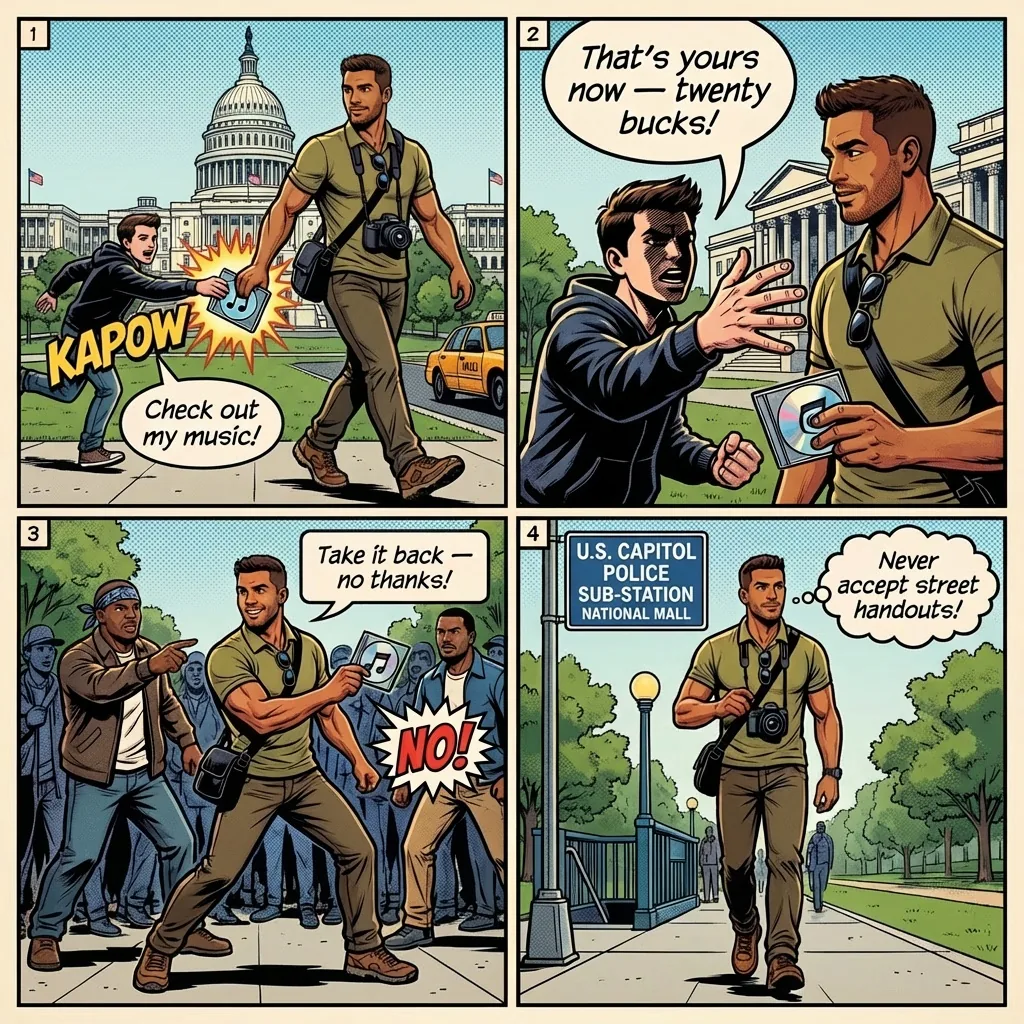
Near the Washington Monument and outside Smithsonian museums, street vendors tie friendship bracelets on tourists' wrists or press CDs into their hands without asking, then demand $10–$20 while a partner works nearby pockets.
The National Mall's open pedestrian zones near the Washington Monument and the Smithsonian museum entrances are primary locations for bracelet and CD hustles. Operators target people who are stopped: taking photos, consulting a map, or adjusting bags — moments when hands are occupied and attention is split.
In the bracelet version, someone takes your hand or reaches for your wrist and begins tying a colorful woven bracelet before you can react, narrating it as a free gift from a local artist. Once it is on, the demand for a $10–$20 donation comes immediately with social pressure. The CD version involves a person pressing a disc into your hands while claiming to be a local rapper sharing their music for free, then demanding payment moments later. In both cases, a second person sometimes stands close enough during the interaction to pick a pocket.
The item's physical transfer is the mechanism — refuse the transfer and the hustle stops. Keep your hands in your pockets or at your sides near the Mall, and decline any unsolicited physical gift firmly without stopping; step back if someone reaches toward your wrist. If a bracelet is already on, remove it and set it down — you owe nothing for an item placed on you without your consent.
Red Flags
- Someone approaches you on the street and immediately tries to put something in your hand or on your wrist
- The person claims the item is 'free' but then asks for a donation or payment
- A second person lingers unusually close during the interaction
- The person becomes aggressive or guilt-trips you when you try to decline or walk away
- You are targeted specifically because you are taking photos, consulting a map, or carrying shopping bags
How to Avoid
- Keep your hands in your pockets or at your sides and firmly say 'No thank you' without breaking stride.
- Never allow a stranger to place anything on your body; physically step back if someone reaches for your wrist.
- If a bracelet is tied on, remove it and place it on the ground; you are not obligated to pay for unsolicited items.
- Keep your bag zipped and in front of you during any street interaction, especially near the National Mall.
- If someone becomes aggressive, walk toward the nearest Park Police officer or into a Smithsonian museum entrance.

Near Union Station and along Pennsylvania Avenue, street operators run Three-Card Monte with planted shills who win openly — tourists who bet $50–$100 after watching win after win always lose, because the dealer controls the outcome through sleight of hand.
Three-Card Monte teams of four to six people set up on busy sidewalks near tourist routes — outside Union Station, along Pennsylvania Avenue toward the Mall, and around Gallery Place-Chinatown. The team includes a dealer, two or three shills posing as ordinary passersby, and one or two lookouts watching for Metropolitan Police who can signal the pack-up in seconds.
The shills win repeatedly and visibly, drawing a crowd of curious tourists. The first small bet — $10 or $20 — is allowed to win. Confidence builds. The tourist bets $50 or $100. The dealer's sleight of hand ensures the winning card is never where it appears to be, and the tourist loses. By the time the group disperses, the victim is $50–$300 lighter with no recourse and, often, too embarrassed to report illegal gambling to police.
The Metropolitan Police Department states it plainly: the only time you win is when the operator lets you, and the only reason they let you is to set up a larger loss. Walk past any sidewalk card game without stopping — even as a spectator — since pickpockets sometimes work the crowd the game draws. Report active operations to Metro Police at (202) 727-9099.
Red Flags
- A small crowd gathers around a person shuffling cards on a box or makeshift table on the sidewalk
- Several 'spectators' seem to be winning easily and encourage you to try your luck
- The dealer lets you win your first small bet to build your confidence
- The game is set up near busy tourist walking routes between the Mall and downtown attractions
- Lookouts are positioned at nearby corners watching for police
How to Avoid
- Never participate in street gambling games; the game is mathematically rigged through sleight of hand and you cannot win.
- Walk past without stopping to watch, as even spectators can be targeted by pickpockets working with the group.
- Understand that the people 'winning' are planted accomplices, not random lucky tourists.
- Report Three-Card Monte operations to the Metropolitan Police at (202) 727-9099 or 911.
- Remember that street gambling is illegal in DC and participants can be cited as well as victims.
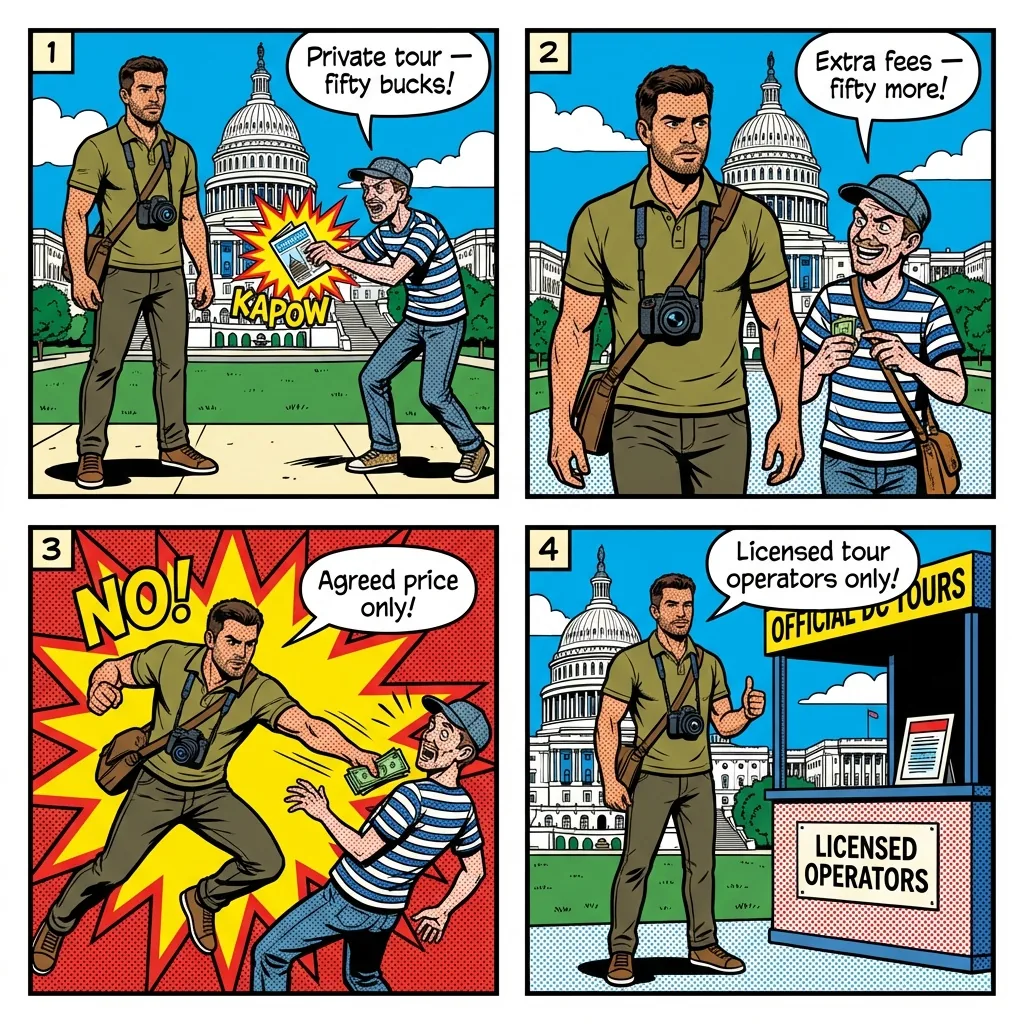
Outside the White House, Capitol steps, and Lincoln Memorial, self-appointed guides offer personalized tours at $20–$50 per person, collect cash upfront, deliver fifteen minutes of freely available facts, and sometimes end the tour abruptly or steer you to commission-paying souvenir shops.
DC's major landmarks — the White House exterior, the Capitol grounds, the Lincoln Memorial, and Arlington Cemetery — see enormous foot traffic and no controlled entry that filters out solicitors. Unlicensed guides exploit this open-access setting, approaching tourists who look like they want context for what they are seeing, particularly families with children.
The offer sounds appealing: a personalized walk covering stories not in the guidebooks, tailored to your group, for $20–$50 per person. The guide collects cash upfront and opens with a few accurate facts before the tour degrades to fifteen to thirty minutes of information available on the NPS plaques. It ends with an abrupt schedule conflict, or routes through souvenir shops where the guide earns a commission. Some guides claim to have reserved spots inside attractions — the Capitol, the White House, the Bureau of Engraving — that are in fact free or require only advance online registration.
The National Park Service offers free ranger-led talks at every major Mall memorial on a rotating daily schedule — the same content with verified accuracy and no fee. Book any paid tour only through established companies on Viator, GetYourGuide, or the NPS website where reviews and refund terms are transparent. All Smithsonian museums and most Mall monuments are free to enter; never pay anyone for skip-the-line access to these institutions.
Red Flags
- Someone approaches you unsolicited outside a major landmark offering a personalized tour
- The guide demands cash payment upfront before the tour begins
- The guide promises access to places that are actually free to enter, like the Capitol or Smithsonian museums
- The person cannot show any form of licensing, business card, or affiliation with a known tour company
- The tour route includes stops at specific souvenir shops presented as 'local favorites'
How to Avoid
- Book tours only through established companies with verifiable websites, TripAdvisor profiles, and posted reviews.
- Take advantage of free National Park Service ranger-led walks and talks at all Mall memorials and monuments.
- Reserve free Capitol, White House, and Bureau of Engraving tours through official.gov websites well in advance.
- All Smithsonian museums are free; never pay anyone for 'skip the line' access to these institutions.
- If you want a paid tour, book through platforms like Viator or GetYourGuide where reviews and refund policies are transparent.

On crowded Orange, Blue, and Silver line trains and on the escalators at Smithsonian, Gallery Place, and Metro Center stations, teams use bumps and misdirection questions to lift wallets and phones — losses range from the device value ($300–$1,200) to the downstream damage of stolen card details.
DC Metro runs through the heart of the tourist corridor — Smithsonian for the Mall, Gallery Place for Chinatown and sports events, Metro Center as a major transfer hub. During peak hours and event days, trains and platforms are dense enough that physical contact feels normal, and tourists with maps, open shoulder bags, and phones out are concentrated in the most crowded cars.
A standard team works two roles: a distractor and a dipper. The distractor bumps you, drops something near your feet, or asks a complicated question while standing unusually close on an escalator. While your attention shifts to the interaction, the dipper lifts a wallet from a jacket pocket, an open bag, or a back pocket. A second variant — the door rush — presses close during the chaotic boarding and exiting at major transfer stations. Victims often realize the loss only when they try to pay for something an hour later.
A wallet in a back pocket or an open shoulder bag is the dipper's target — the solution is to remove that target. Carry your wallet in a front pocket and keep your bag zipped and held in front of you on Metro trains and escalators, and use a money belt or neck wallet for your passport and backup card. Be especially alert at Smithsonian, Metro Center, and Gallery Place — the three highest-volume tourist transfer points on the system.
Red Flags
- Someone bumps into you unnecessarily hard in a Metro station or on a train
- A stranger drops something near you and makes a production of picking it up while you are in a tight space
- You feel someone pressing unusually close to your bag or pockets in a crowd that is not dense enough to justify it
- Someone asks you an overly complicated question while standing very close on a platform or escalator
- A group of people suddenly surrounds you during boarding or exiting the train
How to Avoid
- Carry your wallet in a front pocket and keep your bag zipped and positioned in front of your body at all times on the Metro.
- Use a money belt or neck wallet for your passport, large cash, and backup credit card when touring the city.
- Be especially vigilant on escalators at Smithsonian, Metro Center, and Gallery Place stations during peak tourist season.
- Keep your phone secured and avoid using it while walking through crowded station corridors.
- Report pickpocketing immediately to Metro Transit Police at (202) 962-2121 and cancel stolen cards right away.
🆘 What to Do If You Get Scammed
📋 File a Police Report
Go to the nearest Metropolitan Police Department (MPDC) station. Call (202) 727-9099. Get an official crime report — you'll need this for insurance claims. You can also report online at MPDC Online Reporting.
💳 Cancel Your Cards
Call your bank immediately. Most have 24/7 numbers on the back of the card (keep a photo saved separately). Block any suspicious transactions before the thieves use your details.
🛂 Lost Passport?
Contact your embassy on Embassy Row along Massachusetts Avenue NW; most embassies are located between Dupont Circle and the Naval Observatory
📱 Track Your Device
If your phone was stolen, use Find My (iPhone) or Find My Device (Android) from another device. Don't confront thieves yourself — share the location with police instead.
Frequently Asked Questions
You just read 7 scams in Washington Dc. The full Travel Safety Series has 780+ more across 20+ countries.
Tokyo's Kabukichō ¥130,000 bar trap. Rome's gladiator photo extortion. Paris's gold-ring trick. Bali's ATM skimmer scams. Bangkok's grand-palace closure ruse. Every documented scam across 20+ destinations — with the exact scripts, red flags, and local-language phrases that shut each one down. Drawn from Reddit traveler reports, embassy advisories, and consumer-protection cases.
- 780+ documented scams across Tokyo, Rome, Paris, Bali, Bangkok, Rio & 100+ more cities
- 20+ countries covered, with country-by-country phrase cards for every destination
- Updated annually — buy once, re-download future editions free
- All titles $4.99 each on Amazon Kindle