
Key Takeaways
- The #1 reported scam is the 'Real Guerrero' Cartel-Zone DM Trap
- 3 of 6 scams are rated high risk
- Use app-based ride services (Uber, DiDi) instead of street taxis — avoid unmarked vehicles, especially at night
- Never accept unsolicited offers from strangers near tourist sites in Acapulco
⚡ Quick Safety Tips
- Acapulco sits in Guerrero state under US State Department Level 4 'Do Not Travel' advisory — stay inside Diamante or Costera tourist zones and refuse every Instagram or WhatsApp 'authentic Guerrero village' tour invitation
- Fly between Mexico City and Acapulco (Aeromexico, VivaAerobus, Volaris MX$1,800–MX$3,500); do not drive the Autopista del Sol — cartel checkpoints are documented on the Mexico City–Acapulco corridor
- From ACA airport, walk past the curb to the official Transporte Terrestre prepaid booth (MX$450–MX$600 to Costera) or open Uber on airport Wi-Fi (MX$300–MX$450, 10–20 min wait) — ignore every arrivals kiosk quoting MX$1,200+
- Refuse every Diamante and Costera resort welcome-desk 'free breakfast plus US$ 200 credit' pitch — 'Acapulco rebuilding investment' and 'snowbird membership' offers are timeshare presentations; 5-business-day PROFECO cooling-off applies if you signed
- La Quebrada cliff divers are free from the public plaza viewpoint or MX$50–MX$80 at the official gate ticket booth for the 9:30 PM torch dive — refuse every 'VIP platform MX$500' and 'private photographer MX$300–MX$800' tout. Save Acapulco Tourist Police +52 744 484 4583 and US Embassy 24-hour line +52 55 8526 2561
Jump to a Scam
The 6 Scams

A WhatsApp or Instagram DM offers a half-day 'real Guerrero village experience' for MX$1,500–MX$2,500 per person, routed through cartel-checkpoint country the US State Department flags Level 4 Do Not Travel.
The pitch arrives the day after you check in. A friendly profile with a stock photo of a smiling guide and a few generic Acapulco beach pics messages you with an offer the resort tour desk does not advertise. A small-group drive into the Sierra de Guerrero to meet a 'real Mexican family,' tour a coffee farm, lunch on home-cooked mole. The price beats every licensed operator. You pay a 50% deposit by Mexican bank transfer to lock the spot.
The car arrives the next morning. It is unmarked. The driver speaks no English. The route leaves the Autopista del Sol corridor within thirty minutes and climbs into rural villages with no Pemex stations and no cell signal. Somewhere on a back-road, the car stops at what looks like a routine military checkpoint — except the men holding rifles are not soldiers, the bandanas covering their faces are wrong, and the demand is for your phones, your cash, and the PIN to your bank card.
The scam has two modes. Sometimes the 'tour guide' is the cartel cell, harvesting tourists who self-deliver into the kidnap zone. Sometimes the operator is genuine but the route is unsafe and the cartel taxes whoever passes. Either way, you are deep in a state the US Embassy describes as having active armed-group control over rural roads. The Acapulco-to-Taxco day-trip pitch is the same risk wrapped differently. The defensive move is to refuse every rural Guerrero day-trip and stay inside Diamante and Costera tourist zones for the entire visit.. Threads on Reddit and Reddit document the same pattern across multiple seasons.
Red Flags
- Instagram or WhatsApp DM offering 'authentic Guerrero village' tours
- Tour price 40-60% below licensed Acapulco operator rates
- Bank transfer deposit demanded before route or vehicle is confirmed
- Route described as crossing rural Guerrero or back-road Pie de la Cuesta
- Acapulco-to-Taxco day-trip pitched from your Acapulco hotel
How to Avoid
- Refuse every Instagram or WhatsApp 'authentic Guerrero' tour invitation.
- Stay inside Diamante or Costera tourist zones; do not cross into rural Guerrero.
- Visit Taxco from Mexico City (3-hour drive) rather than from Acapulco.
- Book any tour only through licensed operators with TripAdvisor or Viator listings.
- Save US Embassy 24-hour line +52 55 8526 2561 and Tourist Police +52 744 484 4583.
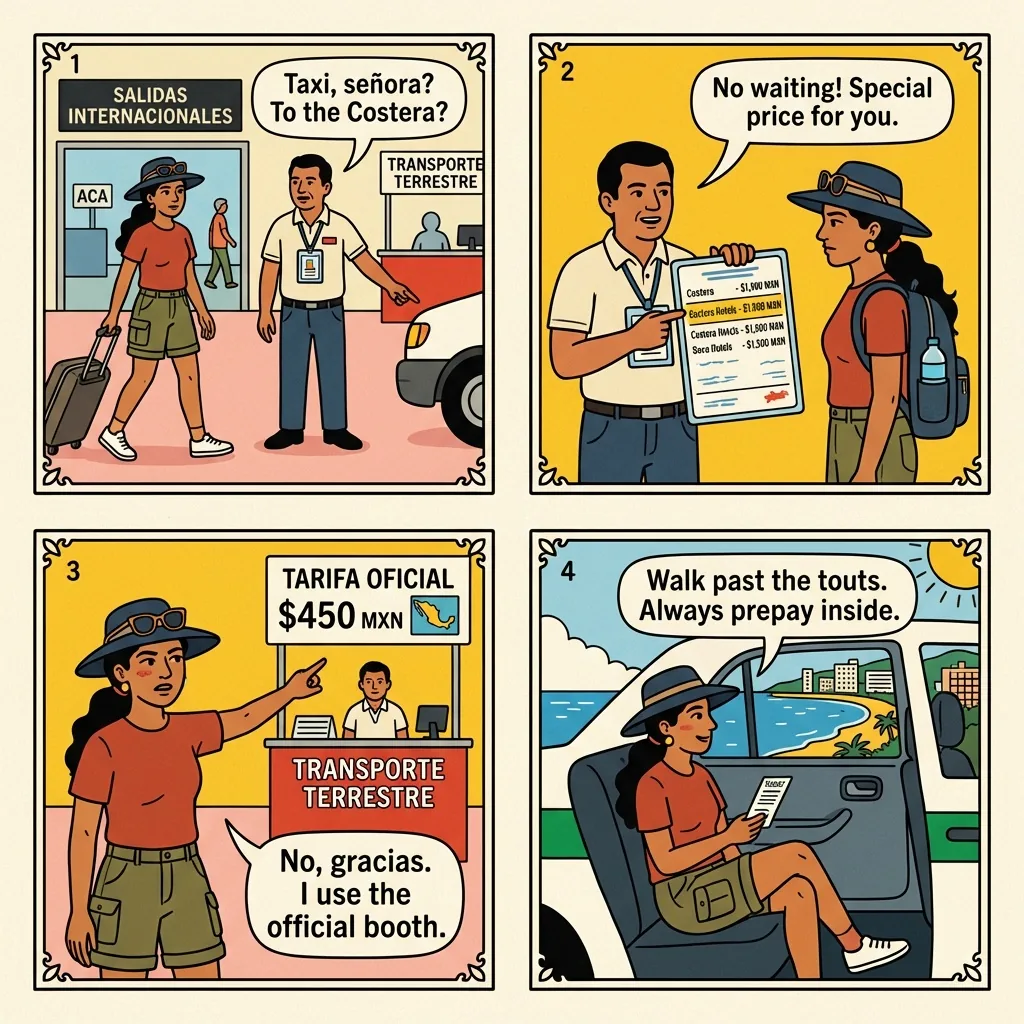
A taxi tout at Acapulco International Airport arrivals quotes MX$1,200–MX$2,500 for the ride to your Costera hotel.
Three to five times the real fare — and the cruise pier runs the same play in US dollars.
You clear customs and roll your bag toward the arrivals doors. Before you reach the official Transporte Terrestre prepaid booth, a man in a polo shirt with a laminated badge intercepts you. 'Taxi, my friend? Where's your hotel? I have a sedan ready, no waiting.' The badge looks official. The price he says — 'just MX$1,500 to the Costera, no traffic right now' — sounds reasonable to a tourist who has never been to Acapulco. The actual prepaid rate posted inside the booth ten meters away is MX$450–MX$600.
If you push back he switches scripts. 'Uber doesn't work here at the airport,' he says (it does). 'There's a security escort fee tonight, MX$300 extra' (there isn't). 'My driver is the one your hotel sent' (he isn't). At the cruise pier the version is dollarized — 'authorized taxi US$ 50 to the cliff divers' for a trip that runs MX$200–MX$300 on the metered SECTUR stand fifty feet behind him.
The overcharge ecosystem expanded after Hurricane Otis flattened the city in October 2023 and tourism stayed thin: drivers compete for fewer fares and the easiest catch is the new arrival. The same crew works the airport return, the cruise pier, and the Costera hotel concierge kickback chain. Hotel front-desk 'recommended driver' rates run double Uber. The defensive move is to walk past the curb to the official Transporte Terrestre booth inside arrivals, or open Uber on airport Wi-Fi and wait the ten to twenty minutes — never accept a fare quoted at the curb.
Red Flags
- Curbside tout intercepting you before the official prepaid booth
- Quote of MX$1,200+ to Costera (real prepaid MX$450–MX$600)
- Driver claiming Uber is banned at ACA or 'not safe tonight'
- 'Security escort fee' or 'safety surcharge' added after the trip
- Cruise-pier 'authorized taxi US$ 50' to nearby Costera or cliff divers
How to Avoid
- Walk to the official Transporte Terrestre prepaid booth INSIDE ACA arrivals.
- Or open Uber on airport Wi-Fi; ACA-Costera runs MX$300–MX$450 with 10-20 min wait.
- Pre-book the hotel airport-pickup option; most Diamante and Costera hotels include it.
- At the cruise pier use the official SECTUR taxi stand (rate posted): MX$200–MX$300 to Costera.
- Refuse every 'security escort' or 'safety surcharge' demand and call Tourist Police +52 744 484 4583.
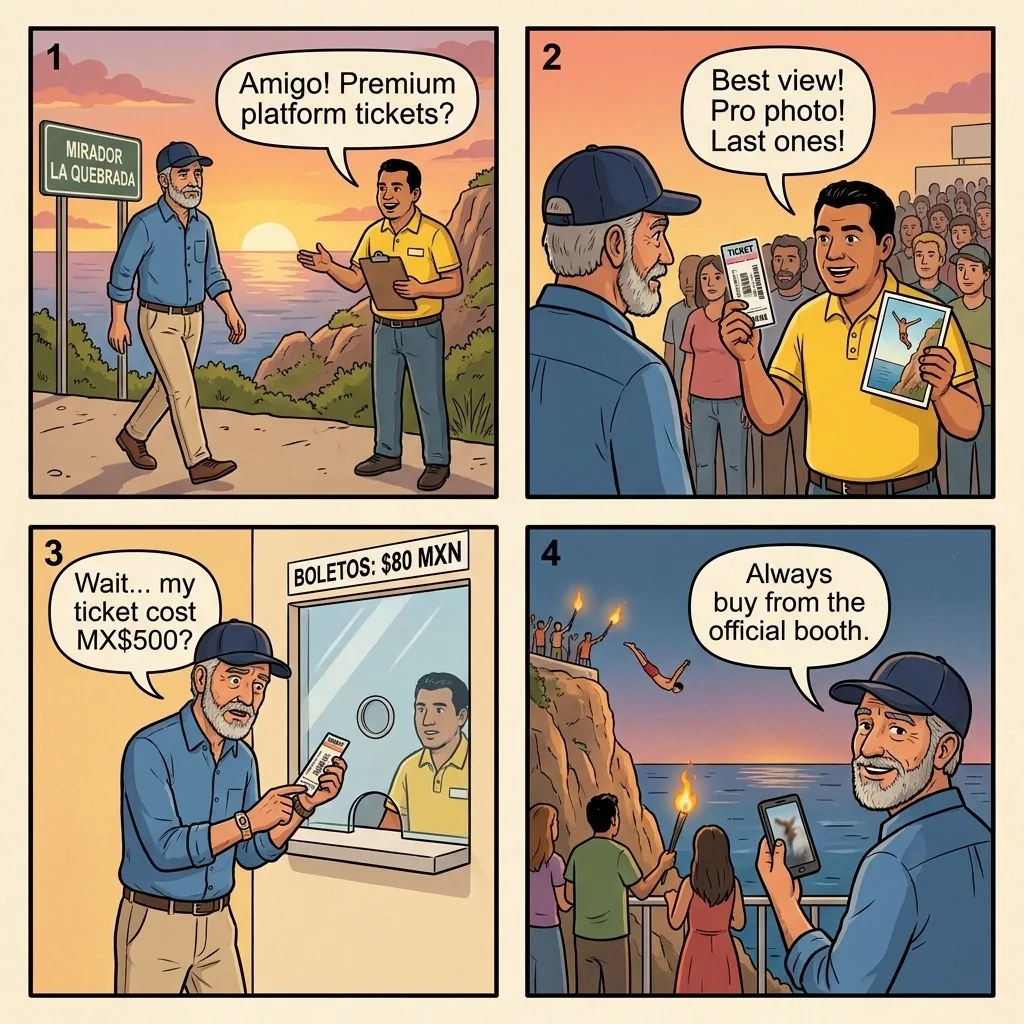
A tout at the La Quebrada plaza approach sells a 'VIP viewing area' ticket for MX$500 and a 'professional dive photographer' package for MX$300–MX$800 — both invented.
The public plaza viewpoint is free and the official torch-dive ticket is MX$50–MX$80.
You walk up the steep street toward the Mirador de la Quebrada about 9:00 PM, ahead of the 9:30 torch dive. Halfway up, a man in a polo shirt with a clipboard and a stack of laminated tickets steps into your path. 'The good viewing area is sold out, but I have premium-platform tickets, the divers association sells them, MX$500, includes a sunset photographer.' He shows you a sample print of a cliff diver in mid-air. You can hear the crowd already filling the plaza twenty meters above.
If you hesitate, his colleague joins. There are only four left, they tell you. You will never get a spot at the public viewpoint now. The price drops to MX$400, then MX$300 just for you. If you pay, you get a wristband and a vague pointer toward the Mirador entrance. The actual ticket booth there is selling the legitimate plaza seat for MX$50–MX$80 to anyone who walks up. The 'photographer' is a man with a phone who texts you blurry shots after the show.
There is no premium platform at La Quebrada. The dives are visible from the public plaza for free, from a paid plaza seat for MX$50–MX$80, and from the La Perla bar terrace at Hotel El Mirador for the price of a margarita (about MX$200). The official divers association sells mid-dive prints from a booth inside the plaza for MX$80–MX$100. The defensive move is to walk past every 'VIP' tout, pay the MX$50–MX$80 plaza ticket at the gate or buy the La Perla margarita, and ignore everyone outside the official entrance.
Red Flags
- Tout on plaza approach selling 'VIP platform' or 'premium viewing' tickets
- Price quoted at MX$500 then dropping to MX$300 under pressure
- 'Professional dive photographer' package at MX$300–MX$800
- Claim that the public plaza viewpoint is sold out or unavailable
- Wristband or laminated ticket from a person not standing inside the official booth
How to Avoid
- Buy the plaza ticket for MX$50–MX$80 only at the official Mirador booth.
- For the best angle, order a MX$200 margarita at La Perla bar inside Hotel El Mirador.
- Buy official cliff-diver prints from the divers' association booth inside the plaza for MX$80–MX$100.
- Tip individual divers MX$30–MX$50 in person after the show if you want to thank them.
- Verify show times at quebradacliffsdivers.com before climbing the hill.
Like what you're reading? Get a full Acapulco itinerary with safety tips built in.
Browse travel-safety books →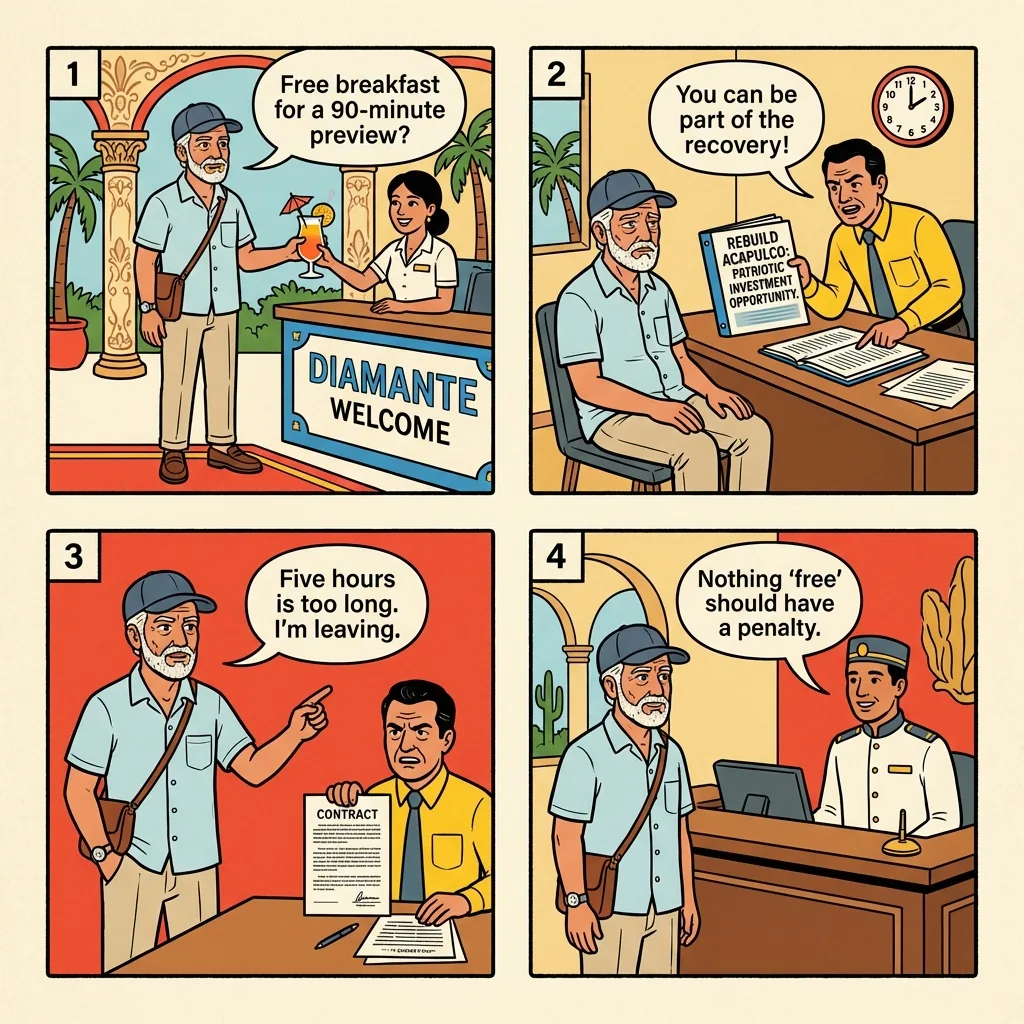
A Diamante welcome-desk pitch offers a 'free breakfast and US$ 200 resort credit' for a 90-minute preview, then runs five hours of pressure sales for an Acapulco 'rebuilding investment' and demands a US$ 5,000 'fideicomiso admin fee' that real Mexican notarios charge at US$ 600–US$ 1,500.
You walk into the resort lobby off a Diamante airport transfer. A friendly representative at the welcome desk hands you a complimentary fruit drink and asks for ninety minutes for the 'Diamante owners preview' — free breakfast, a US$ 200 dinner credit, no obligation. You sit down at 9 AM expecting to leave at 10:30. At noon you are still there, on your third closer, looking at a glossy binder titled 'Rebuild Acapulco — Patriotic Investment Opportunity.'
The pitch is calibrated for the post-Otis era. Hurricane Otis (Category 5, October 2023) destroyed huge sections of Acapulco hotel infrastructure, and the recovery is real but slow. The closers fold that into a story. 'You can be part of bringing Acapulco back. Fractional ownership, US$ 25,000 in, guaranteed 8 to 12 percent rental yield.' If you balk, the script switches to 'snowbird membership' at US$ 15,000–US$ 30,000. If you ask to leave, suddenly there is a 'US$ 500 cancellation fee' for the breakfast.
The Mexican federal consumer-protection agency PROFECO grants a five-business-day cooling-off period on every timeshare signed in Mexico. The 'fideicomiso' (the bank trust foreigners need to hold coastal property) is a real structure that costs MX$10,000–MX$25,000 in notario fees, not US$ 5,000. No legitimate Acapulco property guarantees an 8-percent yield in a state under US Level 4 advisory. The defensive move is to refuse every welcome-desk 'free breakfast plus credit' pitch on arrival, and if you have already signed, file a PROFECO complaint at profeco.gob.mx within five business days.
Red Flags
- Welcome desk offering 'free breakfast plus US$ 200 credit' for a 'Diamante preview'
- 'Rebuild Acapulco patriotic investment' or 'fractional ownership 8-12% guaranteed yield' pitch
- Closer escalating the session past the promised 90-minute mark with a new representative
- 'Fideicomiso admin fee US$ 5,000' (real notario range MX$10,000–MX$25,000)
- 'Cancellation fee US$ 500' demanded if you try to walk out before signing
How to Avoid
- Refuse every welcome-desk 'free breakfast and resort credit' pitch on check-in.
- If you do attend, set a hard 90-minute stop and stand up to leave regardless of script.
- Never authorize a credit-card hold or deposit during the presentation.
- If you signed, file a PROFECO complaint at profeco.gob.mx within 5 business days.
- For real Mexican property advice, consult an independent notario público not affiliated with the resort.
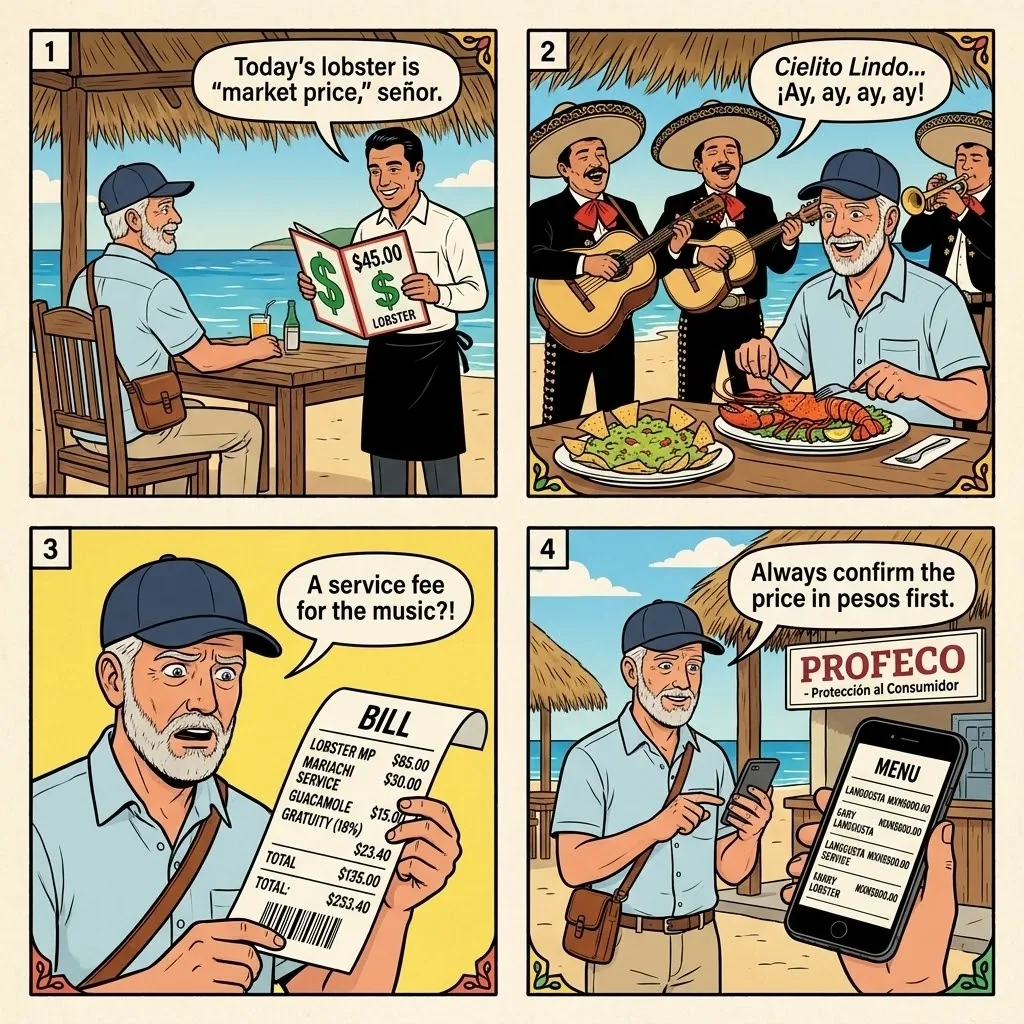
A Costera beachfront mariscos restaurant runs a USD-only menu at two to three times peso prices, quotes 'market price' for shrimp and lobster without disclosing weight, then drops a MX$2,500 bill with a pre-added 18% gratuity and a 10% card surcharge.
You sit down at a beachfront table on the Costera with a view of the bay. The host hands you a glossy menu printed in US dollars — huachinango fish 'market price,' shrimp cocktail US$ 22, lobster 'priced by weight.' When you ask the shrimp price, the waiter waves vaguely. 'Depends on the size, very fresh today.' A complimentary chips-and-guacamole arrives unrequested. A mariachi trio drifts over and starts a serenade you did not ask for.
The bill arrives in dollars, padded by a 10–15% currency conversion the menu did not flag. The 'complimentary' chips are a MX$280 line item. The mariachi serenade is a 'service charge MX$100 per person.' The lobster you assumed was MX$600 is MX$1,800 because they weighed it at 1.5 kg without showing you the scale. An 18% gratuity is pre-added and the card slip still has a tip box — a double-tip trap. A 10% 'card processing fee' closes the bill.
The play runs on every Mexican beach strip but Costera is an active 2025 hotspot, and Old Acapulco zócalo restaurants now run the same script on cruise-day tourists. Mexican federal law NOM-051 requires every restaurant to publish prices in pesos and to weigh seafood in front of the diner. Mariachi is freelance and any 'service charge' for unrequested music is invented. The defensive move is to ask for the peso menu before you sit, agree on per-kilogram price for any seafood in writing, and refuse every uninvited chip basket and mariachi tune.
Red Flags
- USD-only menu on a Costera beachfront with no peso prices shown
- 'Mariscos market price' quoted without weight or per-kilogram rate disclosed
- Complimentary chips-and-guacamole arriving unrequested at the table
- Pre-added 18% gratuity on the bill plus a separate tip box on the card slip
- 10–15% 'credit-card processing fee' announced only when the bill arrives
How to Avoid
- Ask for the peso (MX$) menu before sitting; refuse USD-only menus.
- Agree on per-kilogram price for shrimp or lobster in writing before the kitchen cooks it.
- Refuse every uninvited 'complimentary' chip basket and mariachi serenade.
- Inspect the bill: refuse double-tipping and demand the card surcharge be removed.
- Eat at La Cabaña de Caleta, El Cabrito, or 100% Natural where prices are posted in pesos.
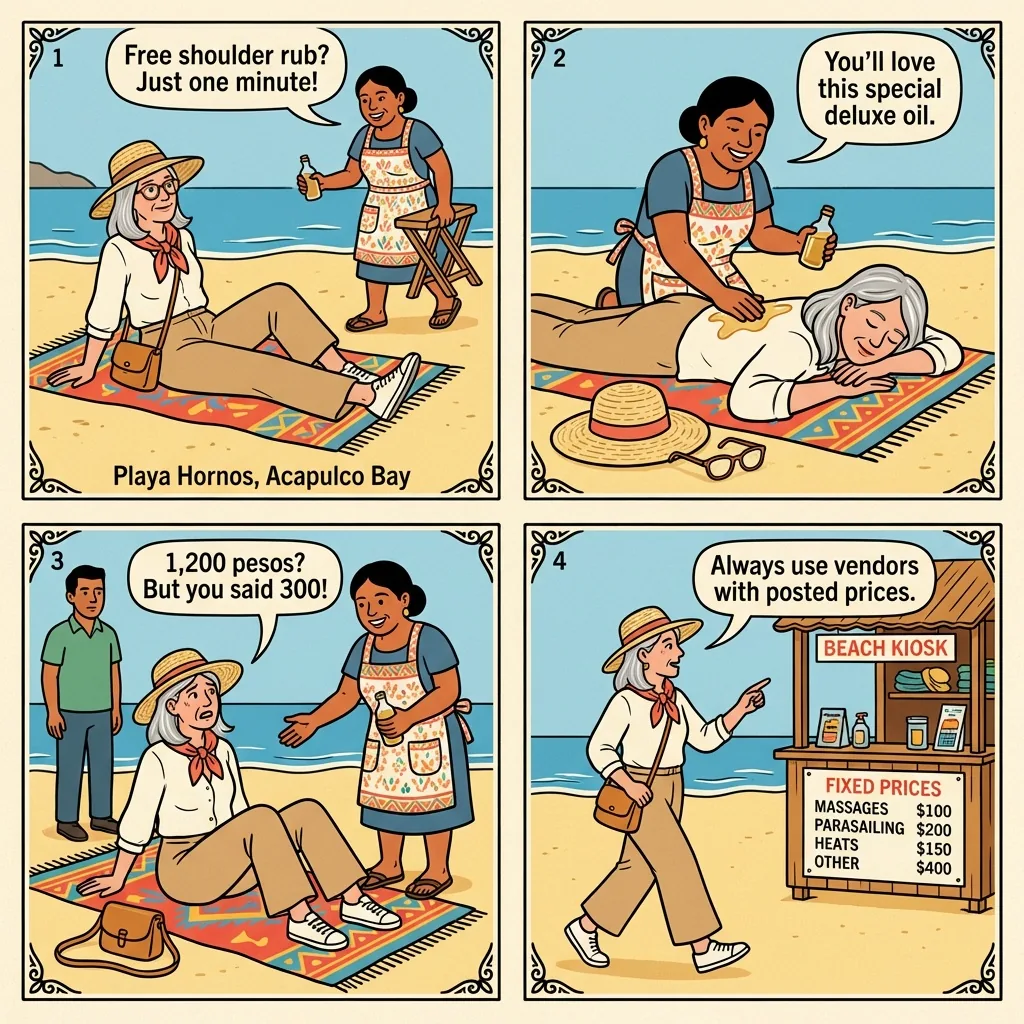
A walking masseuse on Costera offers a 'free shoulder rub' or '60-minute beach massage MX$300,' then bills MX$1,200 for an 'extended deluxe' you never agreed to and stands by the towel with a colleague until you pay.
You are reading on a public-beach towel on Playa Hornos. A woman in a printed apron with a folding stool walks up offering a free shoulder rub, just to try, only sixty seconds. If you accept, the sixty seconds become five minutes. She switches to your back and quotes a sixty-minute full massage at MX$300. A different vendor offers free henna that becomes MX$400 when you try to leave. A beach photographer offers a photo with a parrot for MX$500. A man with a clipboard collects a 'beach safety fee US$ 10 per day' that does not exist.
You agree to the MX$300 massage. Forty minutes in, she announces this was the 'standard' and the 'deluxe' you actually had — because she used aromatherapy oil — is MX$1,200. Her colleague has materialized at the corner of the towel. Your phone, wallet, and bag are all within her reach. The 'free henna' next door has the same closing scene: a tattoo you did not commission and a price you did not agree to.
Mexican beaches are public federal property — no entrance fee, no chair-rental obligation, no legitimate 'beach safety surveillance' charge. Walking vendors are not licensed to sell on most Acapulco beaches. Legitimate operators run from posted-price kiosks with signage at parasail MX$600–MX$900, jet-ski MX$700–MX$1,000, banana-boat MX$200–MX$300. Hotel-spa massages run MX$800–MX$1,500 for a real 60–90 minute session in a clean room. The defensive move is to say 'no gracias' and keep walking, refuse every 'free' offer, and book massage only at a hotel spa where price and duration are written down first.
Red Flags
- Walking vendor offering a 'free' shoulder rub, henna, or photo on the sand
- '60-minute beach massage MX$300' that becomes a MX$1,200 'deluxe' bill
- 'Beach safety surveillance fee US$ 10 per day' demanded by a person with a clipboard
- Photo with parrot, iguana, or macaw priced at MX$300–MX$500
- Vendor's colleague materializing beside the towel at billing time
How to Avoid
- Say 'no gracias' and keep walking; do not engage walking beach vendors.
- Refuse every 'free' offer on the sand: massage, henna, photo, fruit cup.
- For watersports, comparison-shop posted-price kiosks: parasail MX$600–MX$900, jet-ski MX$700–MX$1,000.
- Book massages at the hotel spa for MX$800–MX$1,500 with price and duration on paper.
- Refuse any 'beach safety fee' or 'surveillance fee' — Mexican beaches are free public federal land.
🆘 What to Do If You Get Scammed
📋 File a Police Report
Go to the nearest Mexican Police (Policía) station. Call 911. Get an official crime report — you'll need this for insurance claims. You can also report online at gob.mx.
💳 Cancel Your Cards
Call your bank immediately. Most have 24/7 numbers on the back of the card (keep a photo saved separately). Block any suspicious transactions before the thieves use your details.
🛂 Lost Passport?
Contact your nearest embassy or consulate. The US Embassy is at Paseo de la Reforma 305, Cuauhtémoc, 06500 Mexico City. For emergencies: +52 55-5080-2000.
📱 Track Your Device
If your phone was stolen, use Find My (iPhone) or Find My Device (Android) from another device. Don't confront thieves yourself — share the location with police instead.
Frequently Asked Questions
You just read 6 scams in Acapulco. The full Travel Safety Series has 780+ more across 20+ countries.
Tokyo's Kabukichō ¥130,000 bar trap. Rome's gladiator photo extortion. Paris's gold-ring trick. Bali's ATM skimmer scams. Bangkok's grand-palace closure ruse. Every documented scam across 20+ destinations — with the exact scripts, red flags, and local-language phrases that shut each one down. Drawn from Reddit traveler reports, embassy advisories, and consumer-protection cases.
- 780+ documented scams across Tokyo, Rome, Paris, Bali, Bangkok, Rio & 100+ more cities
- 20+ countries covered, with country-by-country phrase cards for every destination
- Updated annually — buy once, re-download future editions free
- All titles $4.99 each on Amazon Kindle