
Key Takeaways
- The #1 reported scam is the Amsterdam Centraal Unlicensed-Taxi Gang.
- 1 of 5 scams are rated high risk.
- Use app-based ride services (Uber, Bolt) or official metered taxis instead of unmarked vehicles.
- Never accept unsolicited offers from strangers near tourist sites in Amsterdam.
⚡ Quick Safety Tips
- Use only official metered taxis (TCA) or Uber/Bolt — never accept rides from people who approach you at Centraal.
- Buy cannabis only from licensed coffeeshops — street dealers sell unknown substances and are illegal.
- Be extra careful at ATMs near tourist areas, especially Leidseplein and the Red Light District.
- Bicycle theft is endemic — rent from an established shop and use the provided lock religiously.
Jump to a Scam
The 5 Scams
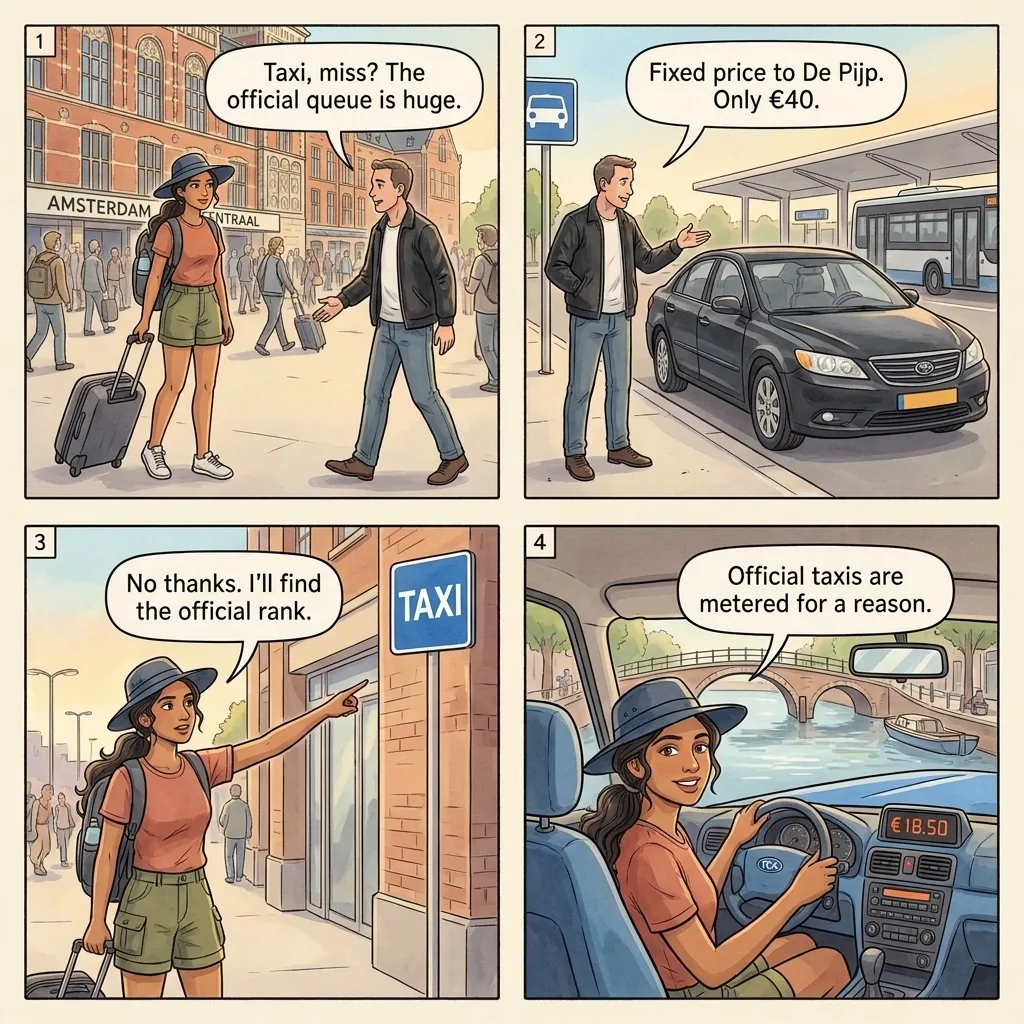
It's a Friday evening at Amsterdam Centraal, you've just stepped off the Schiphol airport train with a roller bag and a hotel address in De Pijp, and a friendly man in a black jacket walks straight up to you on the station forecourt and offers you a taxi.
He says his cab is right around the corner, that the queue at the official rank is forty-five minutes long, and that he can do De Pijp for €40 — 'fixed price.' He picks up your bag without waiting for an answer and walks you toward an unmarked black sedan parked half on the kerb behind the bus loop. The journey is real, the driver knows the route, and twelve minutes later you are at your hotel — but the bill on arrival is €80, not €40, and the 'fuel surcharge' and 'airport surcharge' he tacks on are non-negotiable.
The Amsterdam Centraal unlicensed-taxi operation is one of the longest-running tourist scams in Northern Europe. The legitimate Centraal taxi rank — TCA Taxis with the blue TCA logo, located on the western side of the station — is metered by Dutch law, fully regulated, and rarely has more than a fifteen-minute wait. The fair fare from Centraal to De Pijp on the meter is €15–22. The 'fixed price' you're being quoted by the forecourt operator is double-to-triple. As travelers report across Reddit, the TripAdvisor Amsterdam forum, the Lonely Planet Netherlands thorntree, and the Gemeente Amsterdam consumer-protection logs, the unlicensed-taxi gang at Centraal has been the subject of repeated court cases — including one prominent 2019 conviction for organised intimidation of tourists who refused to pay.
The script variants are well-documented. The 'fixed price' version is the entry-level — a quoted price doubled by 'surcharges' on arrival. The aggressive version uses physical intimidation when a tourist refuses to pay the inflated rate. The 'no card reader' version takes you to an ATM and waits while you withdraw the demanded cash. The most extreme version, prosecuted in Dutch courts, involved drivers locking the doors until payment was made.
The Gemeente Amsterdam and the Dutch police have run periodic crackdowns on the Centraal forecourt, but the operators rotate plates and faces faster than enforcement can react. The defence is structural: never accept a taxi offer made by someone walking up to you at Centraal. The legitimate transport options from Centraal — GVB tram lines 2, 12, 13, 17 from the front of the station; the Metro from the underground level; Uber and Bolt booked through the app before exiting the building; and the official TCA rank on the western side — all run at metered or app-fixed rates with no negotiation needed.
Never accept a taxi from anyone who walks up to you at Centraal Station — book Uber or Bolt through the app before you exit the building, or take the GVB tram or Metro from the front of the station, or use the official TCA Taxis rank on the western side. Insist on the meter (verplicht in Nederland — required by law) and a printed receipt. If a driver demands an inflated 'fixed price' or 'surcharge' on arrival, refuse to pay above the meter, photograph the licence plate and the driver's badge, and report to the Politie at 0900-8844 or the Vervoerregio Amsterdam complaint line. Pay by credit card where possible for chargeback protection. Emergency: 112; non-emergency Politie: 0900-8844; the U.S. Consulate Amsterdam is at +31 70 310 2209.
Red Flags
- Driver approaches you at the station exit rather than waiting at a rank
- No meter running, or meter starts at an unusually high number
- Quote sounds high but driver says 'fixed rate'
- Luggage loaded before you agree on price
How to Avoid
- Use the official taxi rank (TCA taxis) or pre-book through the Uber app.
- Bolt and Uber both operate in Amsterdam at metered rates.
- Official taxis are metered by law and must provide receipts — insist on both.
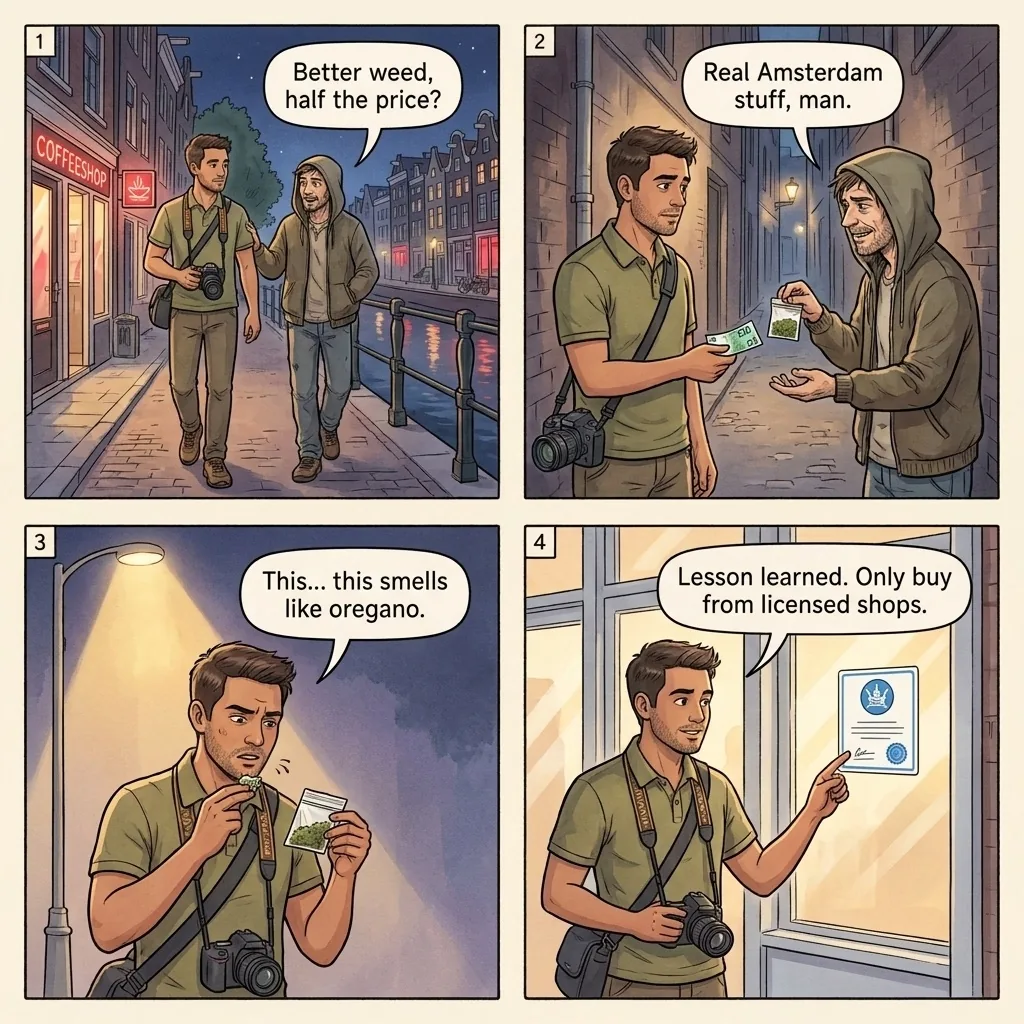
It's a warm Saturday night in De Wallen, you've just left a busy coffeeshop on Warmoesstraat after a longer wait than you wanted, and a man falls into step beside you on the canal-side and quietly offers 'better weed, half the coffeeshop price.'
He shows you a small plastic bag of greenish material that looks plausibly like cannabis. He says €15 for a gram (versus €15–25 at a coffeeshop), that it's 'real Amsterdam,' and that the coffeeshops are charging tourist prices anyway. The exchange happens in a side street; he pockets your cash; he disappears around the corner before you've stopped walking; you continue toward the next bridge with a small bag in your jacket and a slight feeling of having beat the system.
What you bought is rarely cannabis. The Dutch police lab analyses of confiscated street-sold 'weed' in Amsterdam have repeatedly found dried oregano, henna leaves, tobacco, and synthetic cannabinoids of unknown provenance — none of which is the regulated, lab-tested product sold inside licensed coffeeshops. The synthetic-cannabinoid version is the most dangerous: brief but intense psychoactive effects, sometimes paranoia and tachycardia, occasionally requiring emergency medical attention. As travelers report across Reddit, the TripAdvisor Amsterdam forum, the Trimbos Institute (the Dutch national addiction-research agency), and the Gemeente Amsterdam public-health advisories, street-sold cannabis in Amsterdam is not the cheaper version of coffeeshop product — it is a different and lower-quality product.
The legal framing matters too. Cannabis is technically illegal in the Netherlands but tolerated within strict regulatory boundaries: licensed coffeeshops, age 18+, no advertising, maximum 5g per transaction, and lab-tested supply. Buying from a street dealer falls outside the gedoogbeleid (tolerance policy) and is straightforwardly illegal. The fine for possession from a street source can reach €100–300, and the legal path is a Dutch police record that follows you home in many countries' visa systems.
The economic logic of the street sale is simple: a coffeeshop pays €4–8 per gram wholesale and sells at €15–25 retail with regulated supply, taxes, and overhead. A street dealer with €0.50 worth of oregano in a baggie and an alley pitch can clear €15 per transaction at zero supply cost — it is a 30× margin product because the product itself is fake. Every economic incentive aligns against the street operator selling you real cannabis at a discount.
Buy cannabis exclusively from licensed Amsterdam coffeeshops — they are everywhere, regulated, lab-tested, and operate inside the Dutch gedoogbeleid (tolerance policy). The product on the menu is real, the price reflects real supply economics, and the staff can advise on potency (Dutch cannabis is significantly stronger than most tourists expect; start with the lowest-THC option). Decline any street offer of 'cheap' or 'better' cannabis no matter how plausible the pitch — the product is almost never real cannabis. If a transaction has already happened and you experience unusual psychoactive effects, do not consume more and seek medical attention; synthetic-cannabinoid adulterants are the most common substitution. Emergency: 112; non-emergency Politie: 0900-8844; Trimbos drug-info hotline runs DIMS testing across the city.
Red Flags
- Unsolicited quiet approach near coffeeshop areas
- Price significantly below coffeeshop prices
- Transaction in a side street or alley
- Dealer is nervous or watching for police
How to Avoid
- Buy exclusively from licensed coffeeshops — they're everywhere and perfectly legal.
- Street dealers have zero accountability and zero quality control.
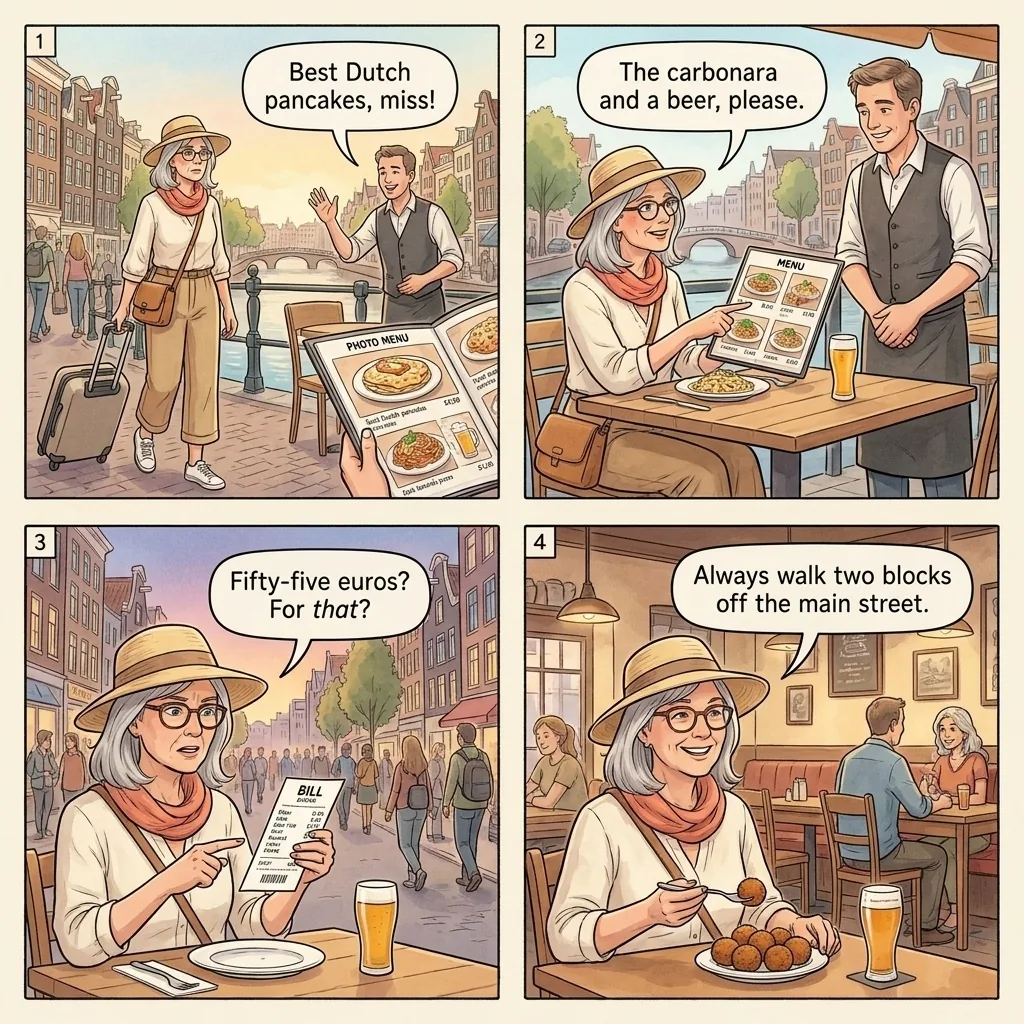
It's late afternoon, you're walking from Centraal Station toward Dam Square along the Damrak strip, and a smiling host outside a brightly-lit restaurant with a laminated photo menu of carbonara, schnitzel, and 'authentic Dutch pancakes' waves you toward an empty terrace table.
You sit down because the photos look fine and the chairs are comfortable. You order two pasta dishes and two beers from the English menu without looking too carefully at the prices. An hour later the bill arrives at €55 for what was, generously, a microwaved meal — the carbonara was bland, the beers were €6 each (Heineken at the corner shop is €1.50), and a 'kuvert' (cover charge) of €4 has been added per person. You overpaid by 60% for food that was 40% as good as the small bistro two streets back from the canal.
The Damrak strip and the immediate cafés inside the Red Light District operate on what hospitality economists call 'one-time tourist economics' — the customer base is overwhelmingly cruise-ship passengers, day-trippers, and first-night Amsterdam visitors who will not be back, so there is no economic incentive to provide value. The same restaurant five blocks inland, in De Pijp or the Jordaan, would close within a year at these prices because the local-customer feedback loop would punish the bad food. On Damrak, the feedback loop never closes. As travelers report across Reddit, the TripAdvisor Amsterdam forum, and the Lonely Planet Netherlands thorntree, the Damrak strip is the most-flagged tourist-trap dining corridor in the city.
The structural giveaways are visible from the sidewalk. A host actively waving tourists in. A laminated photo menu (real Amsterdam restaurants don't have these). A menu in 5+ languages without a separate Dutch menu. Prices listed without VAT included or with a 'service' charge added at the bottom. A location directly on a major tourist strip with no locals visible inside. The defence is geographic: walk five minutes off the Damrak corridor and the food economics realign with normal Dutch standards.
A useful rule of thumb is the 'Google Maps test.' Filter for 4+ stars from 200+ reviews. Check whether the recent reviews are written in Dutch (a positive indicator that locals also eat there) or exclusively in English (a strong negative). The Jordaan, De Pijp, the Negen Straatjes, and the southern stretches of Vondelpark all have small bistros at €15–25 per person for the same kind of pasta or schnitzel that Damrak charges €25–35 for, with food that actually tastes like the photos.
Walk five minutes off the Damrak corridor and the immediate Red Light District before sitting down for any meal — the Jordaan, De Pijp, the Negen Straatjes, and the streets behind the Rijksmuseum all have well-priced bistros locals also eat in. Filter Google Maps for 4+ stars and 200+ reviews; check that recent reviews include Dutch-language ones. Avoid restaurants where a host actively waves tourists in, where a laminated multi-language photo menu is on display, or where prices exclude VAT. Refuse cover charges ('kuvert') above €2 per person, and check the bill line by line before paying — disputed lines can be removed if you ask. Pay by card for chargeback options. Disputes can be reported to the Politie at 0900-8844; for emergencies dial 112.
Red Flags
- Host stands outside actively waving tourists in
- Laminated photo menu with suspiciously appealing images
- Location is directly on a major tourist strip
How to Avoid
- Walk 2-3 blocks off the main tourist corridors for dramatically better value.
- Apps like Google Maps filtered for 4+ stars from >200 reviews work well.
- Avoid anywhere a host is actively recruiting customers.
Like what you're reading? Get a full Amsterdam itinerary with safety tips built in.
Browse travel-safety books →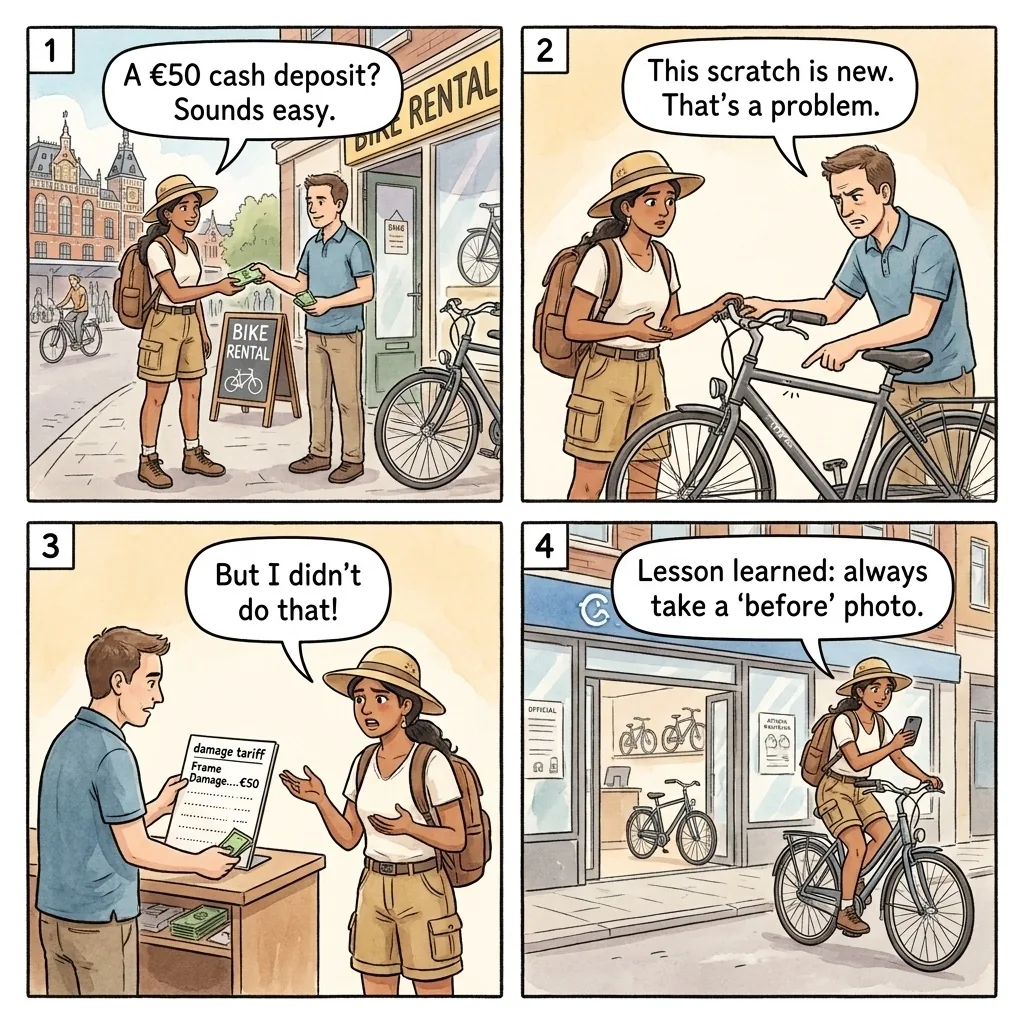
It's your second morning in Amsterdam, you've decided you absolutely have to ride a bike along the canals, and a small shop near Centraal Station rents you a beat-up city bike for €15 per day plus a €50 cash deposit.
You ride for six hours through the Jordaan and along the Amstel without incident, lock the bike on every stop, and return it without a scratch more than it had before. The shop owner takes the bike, walks it carefully to the rear of the shop, and stops at a small chip in the paint near the front fork. He says the chip is new. He pulls out a written 'damage tariff' that lists 'frame damage' at €50 — the entire deposit. You did not take a photo of the bike before leaving the shop. He keeps the deposit.
The Centraal bike-rental damage-deposit trap is one of the most-reported low-grade tourist frictions in Amsterdam. The mechanism relies on a structural information asymmetry: the rental shop has visibility on every scratch, dent, and pre-existing chip on the bike; the customer does not. The owner can either claim a new scratch happened during the rental (false attribution) or simply choose to enforce a damage clause that he ignores for local repeat customers but enforces selectively against tourists. As travelers report across Reddit, the TripAdvisor Amsterdam forum, and the Gemeente Amsterdam consumer-protection logs, the trap clusters at the cheaper independent shops near Centraal and not at the major chains.
The Dutch consumer-protection authority (Autoriteit Consument & Markt) has weighed in on rental disputes that escalate, and the Amsterdam Kleine Klachten (small-claims) tribunal has ruled multiple times against shops that enforced damage clauses without documented pre-rental inspections. But realistically, by the time the dispute would resolve, the tourist has already flown home and the €50 cash deposit is gone. The defence has to happen at the rental moment, not after.
The legitimate Amsterdam bike-rental ecosystem runs at €15–22 per day with documented pre-rental inspections at the major chains: MacBike, A-Bike, Black Bikes, Yellow Bike, Bike City, and the city's own OV-fiets share scheme. These chains photo-document the bike's condition at rental, accept card-only deposits (no cash), and have years-long Google review histories. The independent storefronts near Centraal that don't offer any of these are where the deposit traps cluster.
Rent from a major Amsterdam bike chain (MacBike, A-Bike, Black Bikes, Yellow Bike, Bike City) or the city's OV-fiets share scheme — they photo-document the bike's condition at rental, accept card-only deposits, and have years of Google reviews. Avoid independent storefronts near Centraal that take cash deposits without a written rental agreement and a pre-rental inspection. If you must use a smaller shop, take dated photos with your phone of every scratch, dent, and chip BEFORE leaving the shop, with the bike's serial number visible. Pay the deposit by card, never cash, so a chargeback is available. If a damage claim materialises on return, refer to your photos and the rental contract; if the shop refuses to release the deposit, file a Kleine Klachten complaint. Disputes can be reported to the Politie at 0900-8844 or the Gemeente Amsterdam consumer-protection line.
Red Flags
- Shop refuses to document existing damage before rental
- Deposit is high and cash-only
- No written rental agreement provided
- Shop owner examines bike very carefully on return
How to Avoid
- Take dated photos of every scratch before leaving the shop.
- Use the city's official OV-fiets bike share scheme instead.
- Rent from established shops with hundreds of Google reviews.
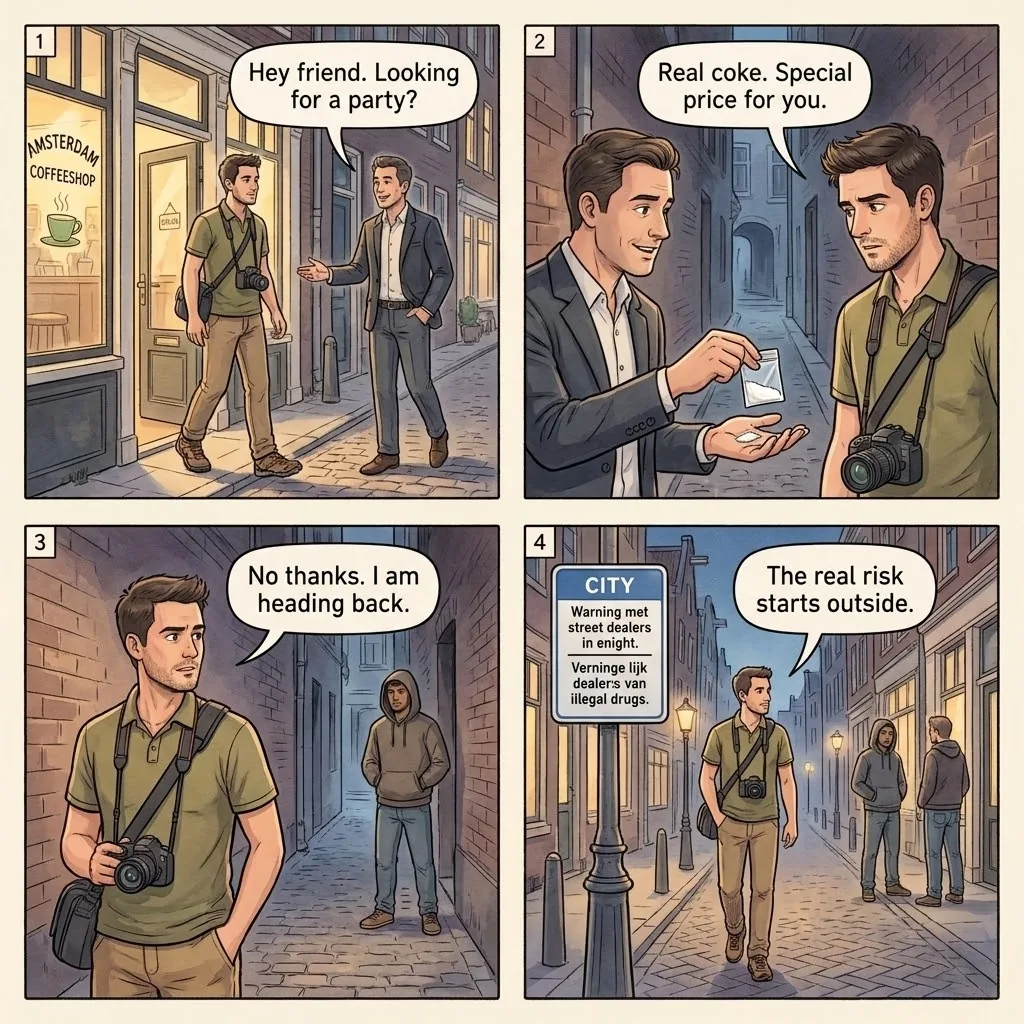
It's just past midnight on Leidseplein, you've come out of a coffeeshop slightly elevated and walking back toward your hotel, and a man falls into step beside you and quietly offers MDMA, cocaine, or 'real Moroccan hash' at 'tourist-friendly prices.'
He is calm, well-dressed, and speaks fluent English. He shows you a small foil package or a baggie — the contents look plausibly like the real product. He names a price that is below what you'd pay through any other channel and emphasises that he 'only sells to people from coffeeshops.' The transaction would happen in the next thirty seconds, in a corner away from the streetlight, with cash exchanged and the pitch concluded before you've fully processed the situation.
The pitch has three failure modes, all bad. First, the product is rarely what it's labelled — the 'cocaine' is more often caffeine cut with lidocaine, the 'MDMA' is sometimes synthetic cathinones with unpredictable effects, the 'Moroccan hash' is sometimes pressed sawdust with a small amount of oil. The Trimbos Institute's DIMS drug-checking program publishes ongoing analyses of street-sold material in Amsterdam and the substitution rates are high. Second, the same operator sometimes adds a 'robbery surprise' to the interaction — you pay, then a second person appears and lifts your wallet during the brief disorientation. Third, even if the product is real, possession of MDMA or cocaine in the Netherlands is a Schedule I criminal offence, not the regulated cannabis-tolerance regime; arrests carry meaningful legal consequences in your home country's visa systems.
The Dutch police have flagged the post-coffeeshop hard-drug pitch in seasonal advisories, and the Gemeente Amsterdam has run periodic awareness campaigns aimed at tourists who conflate coffeeshop tolerance with general drug-law tolerance. The conflation is the entire economic basis of the scam: the operator counts on the customer assuming that 'Amsterdam = anything goes,' which is not true. The cannabis tolerance policy (gedoogbeleid) does not extend to MDMA, cocaine, or any 'hard drug' under Dutch law.
As travelers report across Reddit, the TripAdvisor Amsterdam forum, the Trimbos Institute, and the U.S. Department of State Netherlands country information, the post-coffeeshop pitch is consistently the highest-risk drug interaction tourists encounter in Amsterdam — higher-risk than the coffeeshop itself, which is regulated and safe.
Decline all street drug pitches in Amsterdam regardless of how plausible the pitch or how 'tourist-friendly' the price. Cannabis is available legally and safely from licensed coffeeshops; MDMA, cocaine, and hard drugs are not legal in the Netherlands and the street-sold version is rarely what it claims to be. If you have already taken something street-sold and feel unwell, do not consume more — Amsterdam has the Trimbos DIMS testing service and OLVG hospital emergency department for cases of unknown-substance ingestion. If a 'pitch' shifts into a robbery attempt, walk into the nearest open café or hotel lobby and call 112. Emergency: 112; non-emergency Politie: 0900-8844.
Red Flags
- Unsolicited offer of harder drugs outside coffeeshops
- Person walks alongside you specifically
- Very low prices for the product offered
How to Avoid
- Ignore all street drug approaches entirely.
- Coffeeshops are legal and regulated — use them exclusively for cannabis.
🆘 What to Do If You Get Scammed
📋 File a Police Report
Go to the nearest Dutch Police (Politie) station. Call 0900-8844 (non-emergency) or 112 (emergency). Get an official crime report — you'll need this for insurance claims. You can also report online at politie.nl.
💳 Cancel Your Cards
Call your bank immediately. Most have 24/7 numbers on the back of the card (keep a photo saved separately). Block any suspicious transactions before the thieves use your details.
🛂 Lost Passport?
Contact your nearest embassy or consulate. The US Consulate Amsterdam is at Museumplein 19, 1071 DJ Amsterdam. For emergencies: +31 70 310 2209.
📱 Track Your Device
If your phone was stolen, use Find My (iPhone) or Find My Device (Android) from another device. Don't confront thieves yourself — share the location with police instead.
Frequently Asked Questions
You just read 5 scams in Amsterdam. The full Travel Safety Series has 780+ more across 20+ countries.
Tokyo's Kabukichō ¥130,000 bar trap. Rome's gladiator photo extortion. Paris's gold-ring trick. Bali's ATM skimmer scams. Bangkok's grand-palace closure ruse. Every documented scam across 20+ destinations — with the exact scripts, red flags, and local-language phrases that shut each one down. Drawn from Reddit traveler reports, embassy advisories, and consumer-protection cases.
- 780+ documented scams across Tokyo, Rome, Paris, Bali, Bangkok, Rio & 100+ more cities
- 20+ countries covered, with country-by-country phrase cards for every destination
- Updated annually — buy once, re-download future editions free
- All titles $4.99 each on Amazon Kindle