
Key Takeaways
- The #1 reported scam is the La Rambla Pickpocket Gangs.
- 5 of 9 scams are rated high risk.
- Use app-based ride services (Uber, Bolt) or official metered taxis instead of unmarked vehicles.
- Never accept unsolicited offers from strangers near tourist sites in Barcelona.
⚡ Quick Safety Tips
- Wear your backpack across your chest on packed L3 metro trains near Passeig de Gràcia, Liceu, and Sagrada Família stations names this the single rule locals give every new arrival.
- From El Prat Airport (BCN), use the Aerobús (€7.25) or RENFE R2 Nord train (€4.90 with T-Casual) to the city — taxi is €39 fixed, but the airport train is 'lousy with pickpockets'; Uber, Bolt, FreeNow, and Cabify all work with app-regulated fares.
- Book Sagrada Família tickets only at sagradafamilia.org — 2025 traveler reports and traveler threads document fake 'skip-the-line' sites (sagradafamilietickets.org and similar) charging double for invalid QR codes.
- Never let a stranger touch your wrist, tie a bracelet on you, or hand you rosemary, flowers, or petitions on La Rambla, near Plaça de Catalunya, or outside Sagrada Família — walk past with 'no, gracias' and hands in pockets.
- Save the Mossos d'Esquadra tourist police office (La Rambla 43, +34 932 903 000) and call 112 for emergencies — a denuncia filed within 48 hours is required for travel-insurance claims.
Jump to a Scam
- High La Rambla Pickpocket Gangs
- High Bird Poop Distraction Robbery
- High Fake Police Officer Wallet Check
- Medium Street Performer Photo Trap
- High Three-Card Monte on La Rambla
- Medium Restaurant Overcharging and Ghost Items
- Medium Friendship Bracelet Hustle
- Medium The Petition Clipboard Pickpocket
- High The Metro Crowding Pickpocket
The 9 Scams

Coordinated teams of three to eight pickpockets work La Rambla in shifts — one creates a distraction, another lifts your phone or wallet, a third blocks the path so you can't follow. Pickpocketing accounts for 48.1% of all reported crimes in Barcelona.
You're walking down La Rambla in the late afternoon, phone in hand to map out the next stop. The crowd is thick: a cellist plays in the median, a human statue draws a knot of tourists fifteen feet ahead, a man with a parakeet on his shoulder is engaging two backpackers. You don't notice the woman who steps in front of you, the man who drifts to your left, or the third person walking just behind your right shoulder.
The woman in front stops abruptly to "tie her shoe" or check her map, forcing you to slow. In the second you spend deciding whether to step around her, the man on your left bumps your hip — not hard, just enough — and the man behind your shoulder dips into your back pocket. The crew breaks formation in three different directions before you've registered the contact. Five seconds, no shouting, no sudden movement. You walk on. At dinner two hours later you reach for your phone and realize.
Pickpocketing accounted for 48.1% of all reported crimes in Barcelona in 2023, and even after a 6.3% drop in 2024, it remains deeply entrenched — repeat offenders are typically released within an hour because Spanish law treats it as a minor offense. A 2024 civic-guard movement of ordinary residents now films and exposes pickpockets working in broad daylight, and many of those clips show the same crews at the same La Rambla blocks day after day. The highest-risk moments are when you stop to watch a street performer, when you board or exit the Metro, and when you sit at an outdoor café with your phone on the table. Wear a crossbody bag on your front with the zipper facing your body, never put your phone or wallet on a café table, and use a front-zip pocket — never a back pocket — for cards and cash.
Red Flags
- A group of strangers suddenly surrounds you in a crowded tourist area or metro exit
- Someone bumps into you, spills something on you, or engages you with an unusual request
- An older person stares directly at you while younger accomplices move behind you
- Groups of two or three press unusually close as you board or exit the metro
- Someone waves paper, a map, or cardboard near your table or body to block your line of sight
How to Avoid
- Wear a crossbody bag on your front with the zipper facing your body and keep a hand on it in crowds.
- Never place your phone or wallet on a table at outdoor restaurants or cafés.
- Use a money belt or hidden-pocket clothing to carry your passport and backup cards separately.
- Stay especially alert when entering and exiting metro carriages, which is the peak moment for lifts.
- Avoid back pockets entirely and use front zip pockets for your phone and wallet.

Walking down a side street near La Rambla, something wet lands on your shoulder — a "helpful stranger" appears within seconds offering tissues, and while you're distracted by the cleanup their accomplice rifles your bag. The "bird poop" is mustard or a custom mixture squirted from a concealed bottle.
You're walking down a quieter side street off La Rambla — Mallorca Street near the Napols intersection, or one of the narrower lanes through the Eixample — when something wet and foul-smelling lands on your shoulder, hits the back of your jacket, or splashes across your bag. You stop, twist around to look, and a man in his 20s appears almost instantly with a packet of tissues and an apologetic smile. "Oh, the birds — let me help you, this happens here, come over here where there's better light."
He's already steering you toward a doorway or building entrance "to clean up properly." A second man you didn't notice is now standing just behind your bag. While the first one dabs at the stain on your shoulder and keeps your eyes on the front of you, the second unzips your daypack or works your back pocket. In a documented 2024 case on Mallorca Street, six victims were lured into the same nearby apartment building "to wash up" and robbed of roughly €1,000 across cash, cards, and ID. The substance was never bird droppings — it was mustard or a yellowish custom mixture squirted from a concealed plastic bottle.
The scam works because it weaponizes the helpful demeanor — the perpetrators look completely normal and their kindness overrides your natural suspicion in the two seconds it takes them to close the gap. The Rick Steves travel forum has a dedicated thread confirming the bird-poop scam in Spain is real and actively running; Reddit cross-references show the same crews moving seasonally between Barcelona, Madrid, Rome, and Paris. A motorcycle-courier variant runs at the Arc de Triomf with a "bird-feed seller" as the squirt source. If something lands on you, do not stop and do not accept help from strangers — walk into the nearest shop or restaurant to clean up, and never follow anyone into a doorway, alley, or building entrance no matter how helpful they seem.
Red Flags
- A mysterious substance suddenly appears on your clothing or bag while walking on a relatively quiet street
- A stranger immediately appears offering to help clean you up, seemingly too quickly to be coincidence
- The helpful person is steering you toward a doorway, alley, or building entrance
- You notice a second person nearby who seems to be lingering or following along
- The substance does not look or smell like actual bird droppings and may have a yellowish tint
How to Avoid
- If something lands on you, do not stop and do not accept help from strangers; walk into the nearest shop or restaurant to clean up.
- Never follow a stranger into a building, doorway, or alleyway no matter how helpful they seem.
- Keep your bag zipped and secured against your front before dealing with any stain.
- Be aware that the spill and the helper appearing together is the signature pattern of this scam.
- Report the incident immediately; the tourist police station on La Rambla 43 handles these cases.
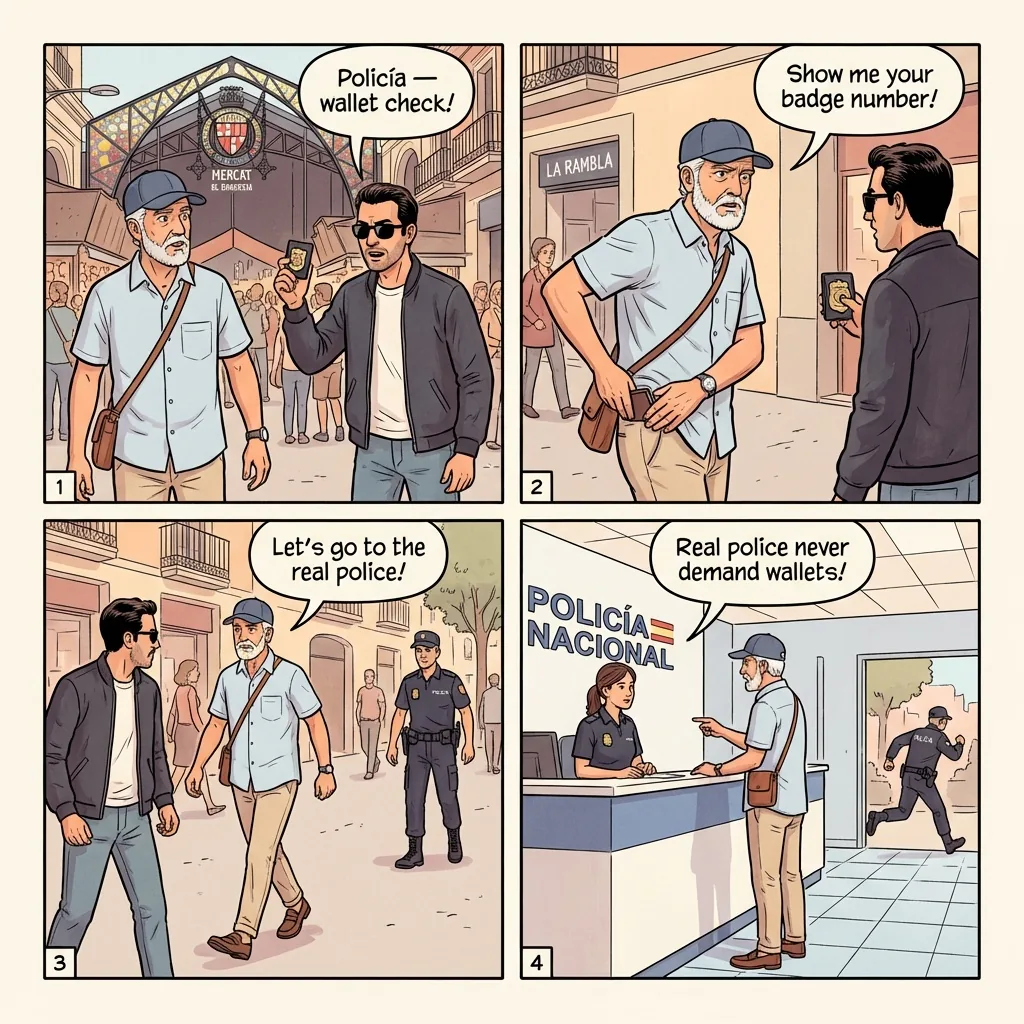
Two men on a side street off La Rambla flash badges, claim they're undercover officers investigating counterfeit currency, and ask to inspect your wallet — they hand it back lighter, or one of them simply walks away with it while the other blocks your path.
You're cutting through a narrower lane just off La Rambla — one of the Gothic Quarter alleys behind Plaça Reial — when two men step out from a doorway and flash folded leather wallets with what look like badges. "Policía. Documentos, por favor — and we need to check your wallet for counterfeit euros, there's a problem in this neighborhood." The Spanish is fluent. The badges flash too quickly to read clearly. There are no marked cars, no uniformed officers, and the lane is empty.
One of them holds out a hand for your wallet while the other moves to your blind side, ostensibly checking for accomplices. You hand it over because being detained by Spanish police on a side street feels worse than complying. He thumbs through it slowly — passport, cards, cash — then hands it back with a polite "todo en orden, gracias." Two blocks later you check it: €200 short, or a card has been swapped, or one of the cards you had on you is just gone. The whole interaction took 90 seconds. Neither "officer" was real.
Real Spanish police have the right to ask for ID, but they will never ask to inspect your wallet or count your cash on the street, and a legitimate plainclothes officer will always show a proper credential card with photo, name, and badge number that they let you examine — and they will never object to being walked to the nearest commissaria. A variant uses a staged drug-deal accusation: someone nearby pretends to sell you something illegal, then the "police" appear and demand a cash on-the-spot fine. Both Barcelona tourism authorities and the Mossos d'Esquadra explicitly warn about these crews working La Rambla, the Gothic Quarter, Plaça Reial, and Eixample streets near ATMs. Never hand your wallet to anyone on the street — show your ID but keep it in your hand, demand to walk to the nearest police station for any "check," and call 088 (Mossos d'Esquadra) or 091 (Policía Nacional) if anyone refuses.
Red Flags
- Someone claiming to be police asks to see your wallet or count your money on the street
- The officers are not in uniform and flash a badge only briefly without letting you examine it
- They ask for cash payment for a supposed fine instead of issuing a written citation
- A staged interaction with a street vendor or seller happens just before the police appear
- The officers become agitated or threatening when you suggest going to a police station
How to Avoid
- Never hand your wallet to anyone on the street; you may show your ID but you keep hold of it.
- Ask to see the officer's official credential card and memorize their badge number.
- Insist on going to the nearest police station to verify their identity; real officers will agree.
- Call 062 (English-speaking national police helpline) or 088 (Mossos d'Esquadra) if you are unsure.
- Remember that real police never demand cash fines on the spot; fines in Spain come by post.

A human statue or balloon-holder on La Rambla springs to life the second your child touches their prop or your phone clicks a photo — they aggressively demand €10–€20, and an accomplice often works the gathered crowd as a pickpocket while the scene plays out.
On La Rambla and in front of the Gothic Cathedral, costumed performers stand frozen as living statues — silver-painted angels, gold Roman soldiers, a man in white face paint holding a bundle of heart-shaped balloons. Children love them. You step closer to take a photo. Your toddler reaches for one of the balloons. The performer doesn't move; the balloon dangles invitingly within reach. The phone clicks the shutter. Your kid's hand closes on the balloon string.
The "statue" springs to life with a theatrical bow and an outstretched palm. "Twenty euros, señor — for the photo and the balloon." If you protest, the performer doesn't release the balloon string while your child is still holding it. The balloon-holding variant near Park Güell or Ciutadella Park puts a live parakeet on your shoulder before you can object, then insists you pay for "the experience." Walk away and the performer follows you down the sidewalk for ten or fifteen meters; meanwhile the small crowd that gathered around the photo opportunity has covered an accomplice working pockets and bags.
These performers operate in a legal gray area — some have permits, but the aggressive payment demands and the way they pair with pickpocket teams cross into scam territory. Reddit regulars repeatedly warn new visitors that the human statues are not just performers but the visible "stage" of a crowd-control operation designed to bunch tourists into a predictable spot for lifts. Every traveler thread on Park Güell calls out the parakeet operators specifically as "pose, then pay" merchants who escalate to grabbing arms. Do not let anyone place an animal, balloon, or prop on you or your children without agreeing on a price first — and if you want a photo, settle on €1–€2 before engaging, never after. Keep one hand on your bag the entire time the crowd is gathered.
Red Flags
- A street performer or costumed figure thrusts props, balloons, bird seed, or birds toward you or your children
- No price is posted and the performer only mentions money after you engage
- The performer becomes aggressive or blocks your path when you try to leave without paying
- Other people near the performer seem to be watching the crowd rather than the show
- Someone places a live animal on you without your consent
How to Avoid
- Do not touch props, accept balloons, or allow anyone to place animals on you without agreeing to a price first.
- If you want a photo, agree on the price before engaging; one to two euros is reasonable for a posed shot.
- Keep children close and coach them not to grab items offered by strangers on the street.
- Be extra vigilant about your bags and pockets when a crowd gathers around any street performer.
- Walk away firmly if demands seem excessive; you are not legally obligated to pay for unsolicited interactions.
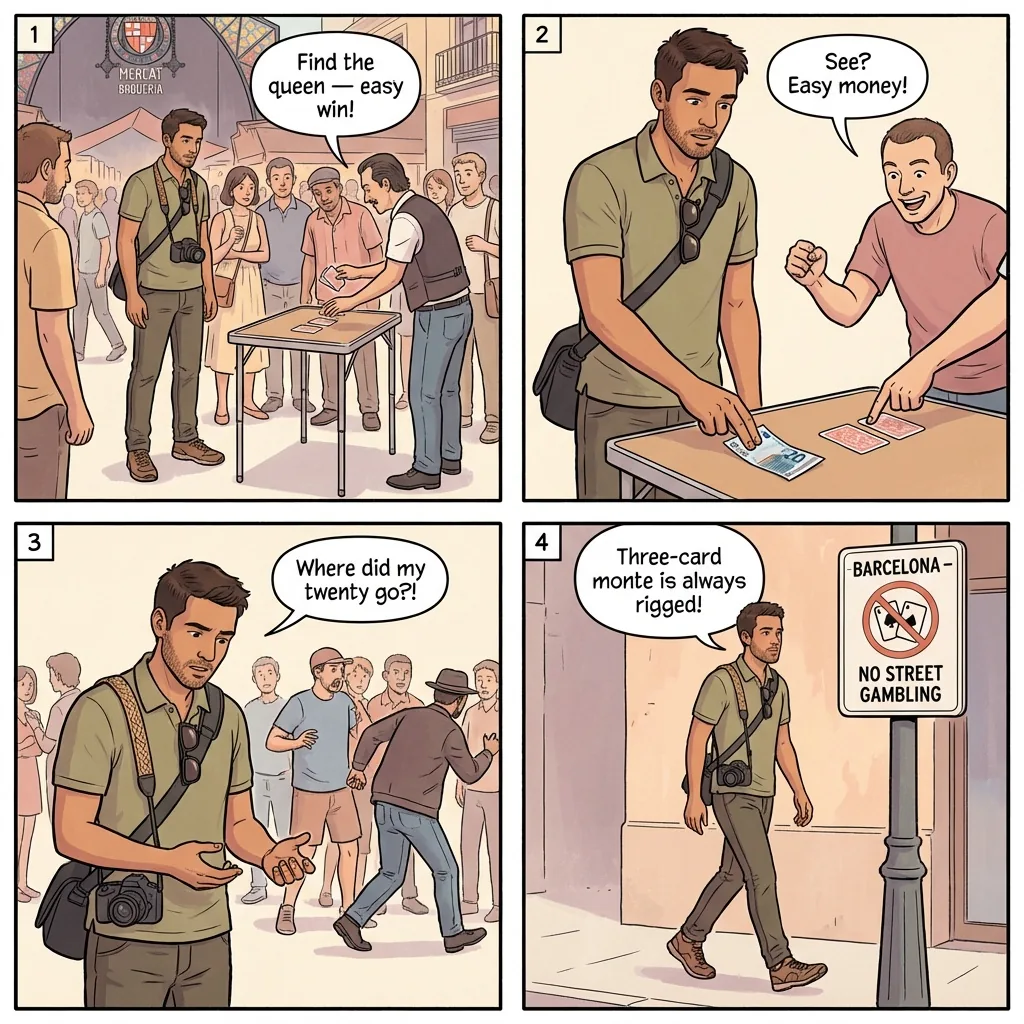
A small crowd around a man shuffling three cards on a cardboard box on La Rambla looks like a fun street game — every "winner" is a planted shill, the dealer uses sleight of hand so real players never win, and lookouts collapse the table the second police approach.
Walking down La Rambla mid-section, you pass a small crowd of eight or ten people gathered around a cardboard box on the sidewalk. A man with quick hands is shuffling three playing cards face-down — "find the queen, find the queen." A woman in the crowd lays down a €20 note and points confidently at the middle card. The dealer flips it: queen. He hands her €40. A young man tries next with €50, picks the right card again, walks off €100 richer, grinning.
It looks easy. You step closer. The dealer's hands move slower this time — you can almost track the queen as he shuffles. You put down €100. The dealer flips the card you pointed at: blank. You insist on going again, double down to €200 to make it back, and lose that too. The dealer is already restarting; the three "winners" you saw earlier are now standing at the edge of the crowd nudging the next mark. Six minutes after you walk away, the man who watched you lose €300 is in another crowd two blocks down doing the same.
Every winner in that crowd was a shill — a planted accomplice whose entire job was to make the game look beatable. The dealer uses sleight of hand to ensure that real players never actually win; the "queen" is palmed during the shuffle so it isn't under any card when you bet. Travelers have reported seeing five or more games running simultaneously on La Rambla during peak season, each with lookouts watching for police and rovers carrying cash away from the table. Reddit threads warn new arrivals that any street-gambling setup along the Rambla is organized crime running a rotation of tables. Players who win too much or cause trouble have been followed and robbed by crew members after walking away. The game is unwinnable — every "winner" is paid by the dealer. Don't even stop to watch, because lingering marks you as a target for both the game and the pickpockets working the crowd around it.
Red Flags
- A crowd has gathered around someone shuffling cards or cups on a makeshift table or cardboard box
- Multiple people in the crowd seem to be winning easily and encouraging others to play
- The setup is portable with no fixed structure, positioned in a high-traffic pedestrian area
- Someone in the crowd nudges you and says it is easy or that they just won
- Lookouts are stationed nearby watching for police rather than watching the game
How to Avoid
- Never play any street gambling game; three-card monte is a rigged con, not a game of chance or skill.
- Every person who appears to win is a planted accomplice; no legitimate player ever wins.
- Do not even stop to watch, as lingering makes you a target for both the game and pickpockets working the crowd.
- Walk away immediately if someone encourages you to bet or says they just won big.
- Report street gambling operations to local police at 092 or the Mossos d'Esquadra at 088.

A restaurant near the Gothic Cathedral has no prices on the menu, brings you bread and olives you didn't order, and the bill arrives with a €12.90 tinto de verano (should be €2.50), a "terrace supplement," and an item nobody at the table ordered.
You sit down at a sidewalk table at a restaurant near the Gothic Cathedral or along the Barceloneta seafood strip. The host is friendly, the menu is in English with photos, and there are no prices listed — they're "ask the waiter" or printed in tiny font on the back page. You order a tinto de verano (Spain's summer red-wine spritzer) and a plate of patatas bravas. Bread arrives. Olives arrive. A small bottle of water lands on the table. You didn't order any of it.
The bill is €68. The tinto de verano is €12.90 instead of the €2.50 it should cost. The bread service is €4. The olives are €5. The bottled water you assumed was tap is €4.50. There's a "cover charge" of €3.50 and a "terrace supplement" of 10%. There's also one item on the bill — a half-bottle of cava, €18 — that absolutely nobody at your table ordered. When you point at it the waiter shrugs: "Maybe the table next to you. We can take it off." He does. Everything else stays.
This pattern repeats across every tourist-heavy zone in Barcelona — Gothic Quarter, the Barceloneta seafood strip, restaurants directly facing Sagrada Família and Park Güell, Plaça Reial. These places rely on the fact that tourists eat there once and never return. Reddit threads document the pattern: bars with signs advertising "2 Aperol Spritz for 9€" out front, then bills that look nothing like the sign. Locals offer one blunt rule: if a restaurant has a guy out front working tourists into the door, the kitchen isn't worth eating in. The terrace supplement is technically legal but rarely disclosed before the bill. Always check the menu for listed prices before you sit down — if there are no prices, leave. Send back any bread, olives, or water that arrives without being ordered, and request an itemized receipt before paying.
Red Flags
- The restaurant has no visible prices on the menu or prices are in very small print at the back
- Items appear on your table without being ordered, such as bread, olives, or water
- The waiter is vague about prices when asked directly or says they will check
- The restaurant is located directly adjacent to a major tourist attraction with aggressive touts outside
- The bill includes charges labeled as coperto, servizio, or terrace supplement that were never mentioned
How to Avoid
- Always check the menu for listed prices before sitting down; if there are no prices, leave.
- Send back any items placed on your table that you did not order, including bread and olives.
- Ask explicitly about cover charges, service charges, and terrace supplements before ordering.
- Request an itemized receipt and dispute any charges that do not match what you ordered.
- Eat one or two blocks away from major tourist sights where restaurants rely on repeat local customers.
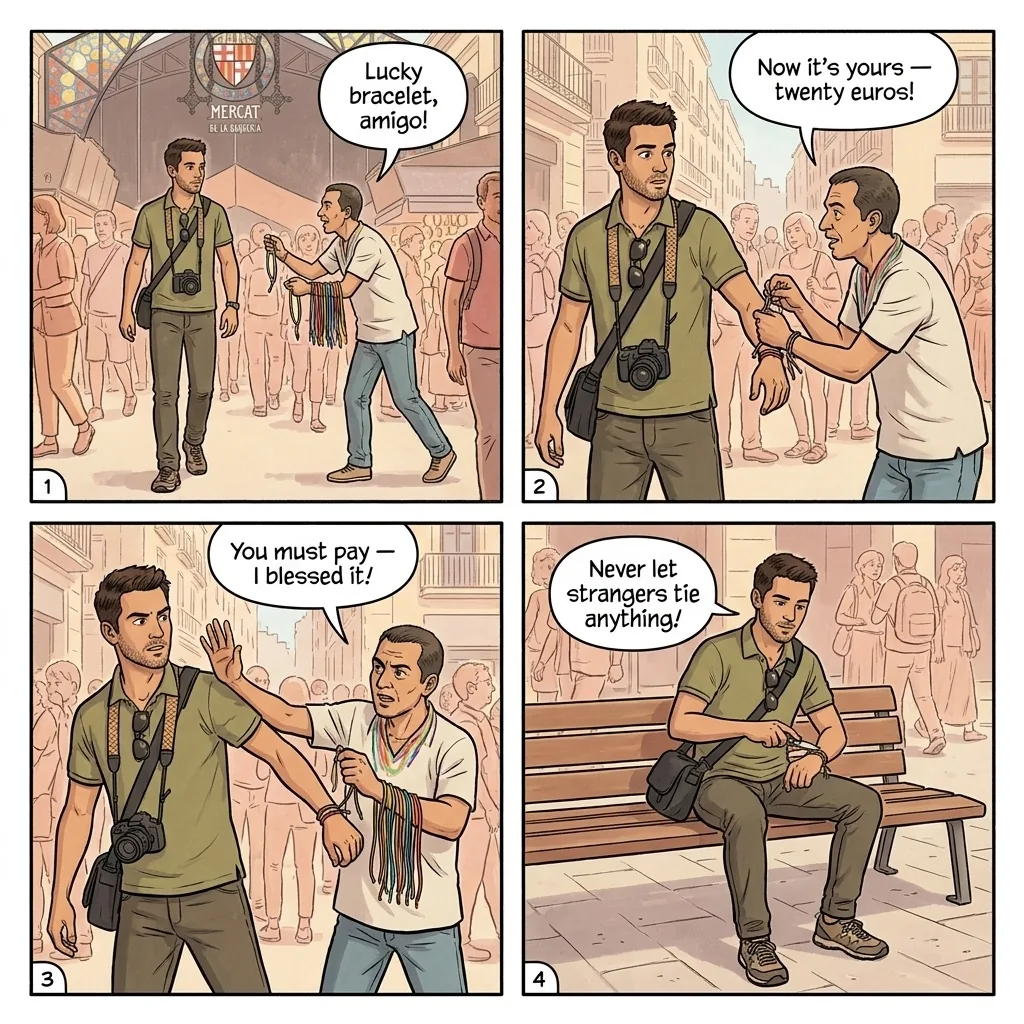
A friendly stranger on La Rambla begins tying a woven bracelet onto your wrist before you can react — by the time it's secured, they're demanding €5–€10, and an accomplice has often picked your pocket while the bracelet was the focus.
You're walking down La Rambla, or sitting on the steps of Plaça de Catalunya, or approaching the Sagrada Família entrance, when a man with a stack of colored woven cords intercepts you with a big smile. "Friendship! For good luck — from Africa, very lucky." Before you can step back his hand is on your wrist and he's already started looping the cord around your fingers. The technique is fast and practiced — three seconds and the first knot is in.
The bracelet is tied. The smile changes. "€5 for the bracelet, my friend. €10 for the gold one." If you try to pull it off, you can't — it's tied tight and would need scissors. If you walk away, he follows you and gets louder. If you raise your voice in protest, two of his friends drift in from the sides of the plaza. Meanwhile, while your eyes were on the bracelet being woven, an accomplice has had thirty seconds of clear access to your back pocket and the unzipped section of your bag.
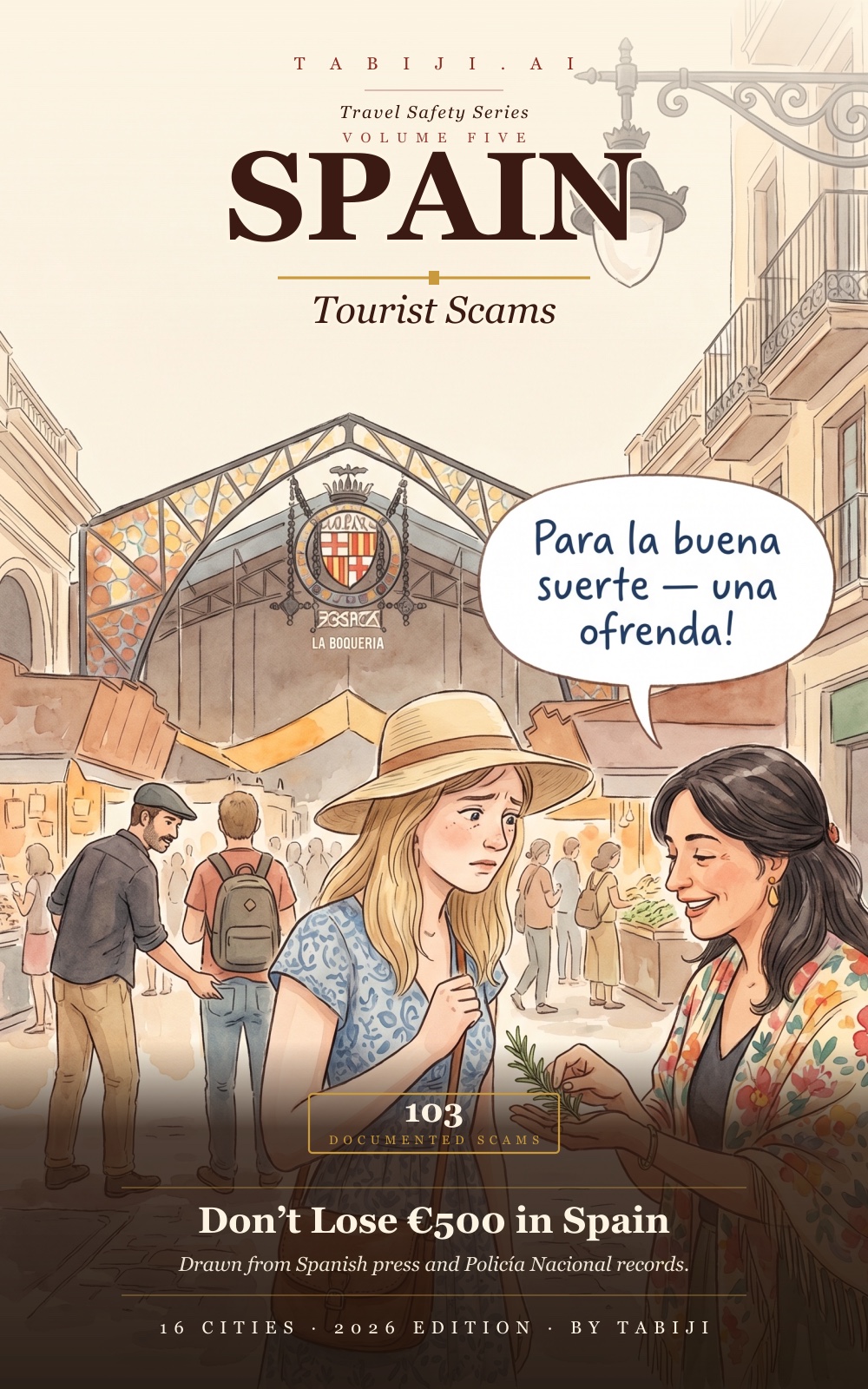
Reddit is unambiguous: this scam is one of the most-warned-about in the city, and the operators target tourists they read as easily intimidated. A flower or rosemary-sprig variant runs the same play — a sprig is pressed into your palm or "blessed" onto your bag, then payment is demanded. Near Barceloneta Beach, a related hustle offers "free" henna tattoos, then demands €20 once the design is partially applied. The whole con runs on the social cost of refusing a "gift" while a stranger is touching you. Keep both hands in your pockets when you see anyone holding a stack of cords on La Rambla — and the moment a stranger reaches for your wrist, pull back hard and say "no" before they make contact. If a bracelet does get tied on, you are under no legal obligation to pay; walk away.
Red Flags
- A stranger approaches offering something for free while reaching for your wrist or hand
- The person begins tying or placing something on you before you give consent
- No price is mentioned until after the item is on your body
- The person becomes loud, aggressive, or follows you when you try to decline
- An accomplice lingers nearby watching your bags while your attention is on the bracelet seller
How to Avoid
- Keep your hands in your pockets or at your sides and say no firmly without slowing down.
- Never let a stranger touch your wrist or hand, no matter how friendly the approach.
- If a bracelet is tied on you, you are under no legal obligation to pay; walk away.
- Watch for accomplices targeting your bags while the bracelet seller has your attention.
- If offered a flower, rosemary, or any item, do not take it; keep your hands closed.
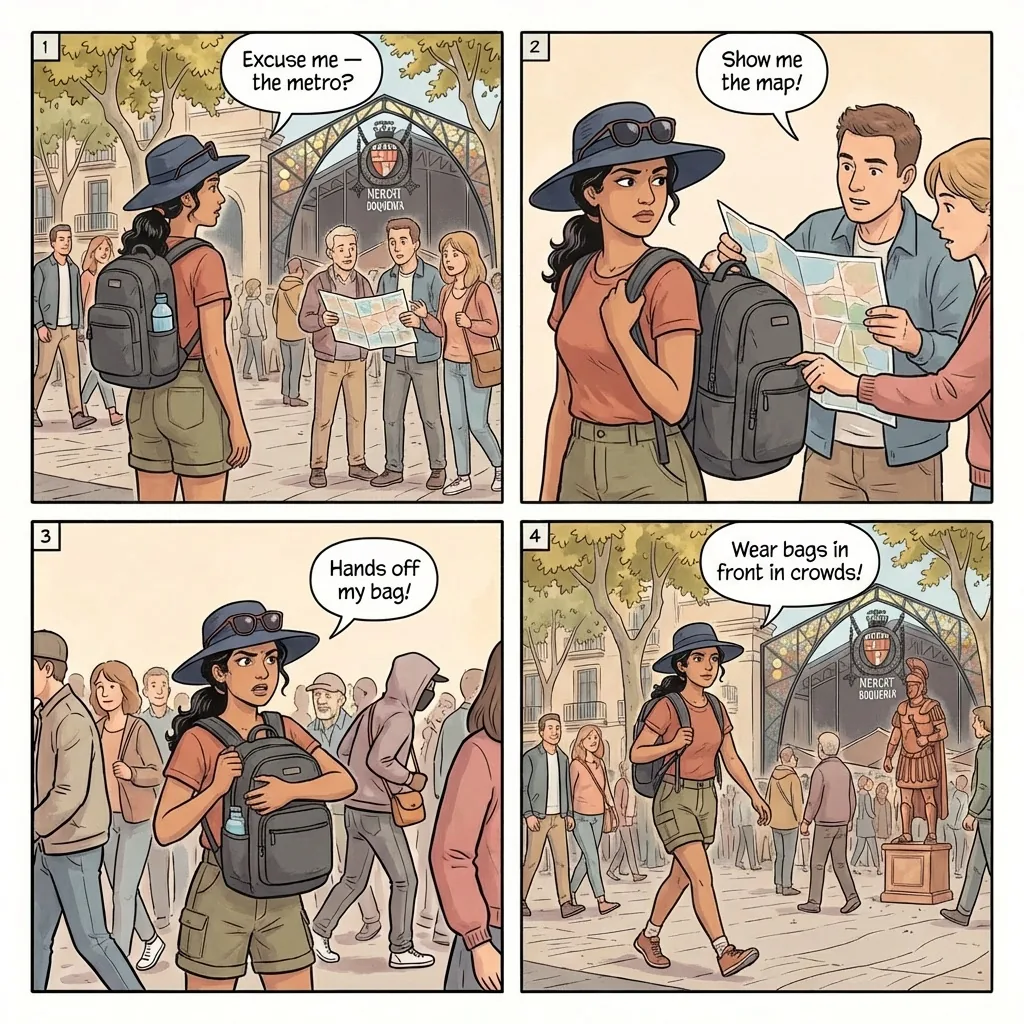
A young woman in Plaça de Catalunya hands you a clipboard and asks you to sign a petition for "deaf rights" or "a local school" — while you lean forward to read, her partner unzips your daypack from behind. She often follows up with a €20 donation demand whether you sign or not.
You're standing in Plaça de Catalunya looking for the right Metro entrance and a young woman with an earnest expression and a clipboard intercepts you. The petition on top is for deaf-children advocacy, against drugs in schools, or — in the variant near Sagrada Família — to "fund a local school." She points to her ears and mouth (deaf-mute), or just gestures to the clipboard with a sad smile. The cause sounds legitimate. You take the pen.
While you lean forward to read the petition and write your name, you don't see the second person who has come up behind your right shoulder. Your daypack is on your back; your back pocket is exposed. The clipboard angle pulls your eyes down and your body forward. Three to five seconds is all the partner needs. The pen comes back; the clipboard flips to a "donation" page where prior signers gave €20, €50, €100, and the woman's expression hardens — "donate, please, donate." Whether you donate or not, your phone is already in someone else's pocket.
The clipboard is the distraction; the pickpocket is the actual scam. Barcelona police have issued specific warnings about petition-clipboard gangs operating around Plaça de Catalunya, the Gothic Quarter, the Sagrada Família ticket-gate approach, and the Park Güell entrance. Reddit regulars group the petition clipboard with the metro-crush and human-statue patterns as the "three main tourist approach scams." The Sagrada Família "local school" variant has been confirmed by tourists who paid: the cash never reaches any school. Never lean forward over a clipboard or tablet held by a stranger — that posture is the entire setup. If a clipboard appears, say "no" without breaking stride and keep your bag zipped against your front.
Red Flags
- Someone approaches you with a clipboard or tablet asking you to sign a petition
- They stand very close to you and position the clipboard so you have to lean forward, exposing your pockets
- A second person lingers behind you during the interaction
- The petition is vague or in a language you cannot read, making it hard to tell what you are signing
- After signing, they demand a cash donation and become aggressive if you refuse
How to Avoid
- Firmly say 'no' and keep walking without stopping when anyone approaches with a clipboard or petition.
- Keep your wallet in a front pocket and your backpack zippers facing your body in crowded tourist areas.
- Never lean forward over a clipboard or tablet held by a stranger, as this is the moment your pockets are accessed.
- If you want to support a cause, donate online to verified organizations rather than to strangers on the street.
- Travel with a cross-body anti-theft bag in Barcelona rather than a backpack for all daytrips.

Standing on a packed L3 train as it pulls into Passeig de Gràcia, three or four people push hard to board — by the next stop, the crew exits together and your phone is gone. Barcelona's Metro is the city's #1 pickpocket location.
You're on the L3 Green Line headed to Passeig de Gràcia or the L1 Red Line through Catalunya — the two lines that connect the airport, the train stations, and every major tourist zone. The car is full but moving. The train pulls into the station. Doors open. Passengers shuffle. The departure chime sounds.
As the chime fades, three or four people rush the doors to "make" the train, pressing the existing passengers tight together for two or three seconds. You take the bump like everyone else. They're now in the car with you, hands-on-bars, phones-out, looking like normal commuters. By the next stop they all step off together — Diagonal, or back at Catalunya — moving as a group toward the connecting platform. You reach for your phone at your stop. Empty pocket. Or your wallet is gone from the inside of your jacket. The crew is already on the next L3 train northbound.
Pickpocketing accounts for 48.1% of all reported crimes in Barcelona, and the Metro is the single highest-density location — the L3 connecting tourist hotspots is the most-affected line, with the airport-to-Catalunya RER also heavily worked. Reddit's specific rule is the local survival guide: when the train is packed, wear your backpack on your front, never your back. The five-second boarding crush at major tourist stations is the peak-risk window because you can't distinguish deliberate pressure from normal rush-hour contact. Move your phone and wallet to front pockets before entering any Metro station, wear your backpack on your chest during the ride, and if a group rushes the doors at the closing chime — let them have the car and wait for the next train.
Red Flags
- An unusual number of people push to board the train at a station near tourist attractions
- You feel hands brush against your pockets, bag, or jacket during boarding
- A group that boarded together all exits at the next stop
- Someone drops something or creates a commotion just as the doors are opening or closing
- Your train is crowded but the adjacent cars appear noticeably emptier
How to Avoid
- Move your wallet and phone to front pockets before entering any metro station in Barcelona and keep your hand over them.
- Wear your backpack on your front chest during metro rides or hold it between your feet on the floor.
- Stand with your back against the metro wall or door rather than in the middle of the car where you can be surrounded.
- If you feel a suspicious crush at the doors, step back and wait for the next train rather than pushing in.
- Consider buying a T-Casual card to avoid queuing at ticket machines, another pickpocket hotspot.
🆘 What to Do If You Get Scammed
📋 File a Police Report
Go to the nearest Policía Nacional or Guardia Civil station. Call 091 (Policía Nacional) or 112 (emergency). Get an official crime report — you'll need this for insurance claims. You can also report online at policia.es.
💳 Cancel Your Cards
Call your bank immediately. Most have 24/7 numbers on the back of the card (keep a photo saved separately). Block any suspicious transactions before the thieves use your details.
🛂 Lost Passport?
Contact your nearest embassy or consulate. The US Embassy is at Calle de Serrano, 75, 28006 Madrid. For emergencies: +34 91 587-2200.
📱 Track Your Device
If your phone was stolen, use Find My (iPhone) or Find My Device (Android) from another device. Don't confront thieves yourself — share the location with police instead.
Sources & further reading
Every scam here is cross-checked against official government advisories, police bulletins, and established reporting. Confirm current details with the primary sources below before you travel.
-
Government of Canada (travel.gc.ca) — Travel advice and advisories for Spain
Government advisory
“Individuals posing as plainclothes police officers may ask to see your passport, IDs or wallets.”
-
UK Foreign, Commonwealth & Development Office (GOV.UK) — Safety and security - Spain travel advice
Government advisory
“Thieves posing as police officers may ask to see your wallet, claiming they need to see it for identification.”
-
U.S. Department of State — Spain Travel Advisory | Travel.State.gov
Government advisory
“Pickpocketing and other types of theft are very common in Spain.”
-
Mossos d'Esquadra (Police of Catalonia, Generalitat de Catalunya) — For safe holidays
Police bulletin
“Do not trust anyone who comes excessively close to you or offers you help if you have not asked for it.”
Frequently Asked Questions
You just read 9 scams in Barcelona. The book has 94 more across 16 Spanish destinations.
Barcelona's La Rambla rosemary-sprig clavel circuit. Madrid's Puerta del Sol three-card trile. Seville's Plaza de España palm-reading gambit. Granada's Alhambra skip-the-line reseller industry. Ibiza and Mallorca scooter deposit-hold cycle. Every documented Spain scam — with the exact scripts, red flags, and Spanish phrases that shut each one down. Drawn from El País, La Vanguardia, ABC, El Mundo, and Policía Nacional and Mossos d'Esquadra records.
- 103 documented scams across Barcelona, Madrid, Seville, Granada & 12 more cities and islands
- A Spanish exit-phrase card you can screenshot to your phone
- Updated annually — buy once, re-download future editions free
- Readable in one flight — $4.99 on Amazon Kindle