
Key Takeaways
- The #1 reported scam is The Shoe Shine Drop Trick.
- 2 of 8 scams are rated high risk.
- Use BiTaksi, InDriver, or Uber instead of unmarked vehicles or unlicensed cabs.
- Never accept unsolicited offers from strangers near tourist sites in Istanbul.
⚡ Quick Safety Tips
- Around Sultanahmet (Blue Mosque / Hagia Sophia / Topkapi), ignore anyone who initiates conversation with 'Where are you from?' or 'Let me show you a tea house' documents the carpet-shop pipeline that starts with these openers.
- At the Grand Bazaar, treat all first-quoted prices as 50%+ inflated; polite negotiation is expected; never enter a shop's back room or 'private viewing area.'
- Use IstanbulKart for all public transport (Metro, Marmaray, ferries, buses) — buying single tickets is 2–3x more expensive; load €10–€20 on arrival at any kiosk.
- Don't accept unsolicited invitations to a 'local bar' from men near Taksim Square or Istiklal Caddesi documents the basement-bar drink-scam pattern with bills of €500–€2,500.
- Don't get scammed at Hagia Sophia warns about the calculator-trick where the cashier shows one ticket price but charges a higher amount on the credit card terminal; book Hagia Sophia + Topkapi tickets in advance via the official Müze app at muze.gov.tr.
Jump to a Scam
The 8 Scams
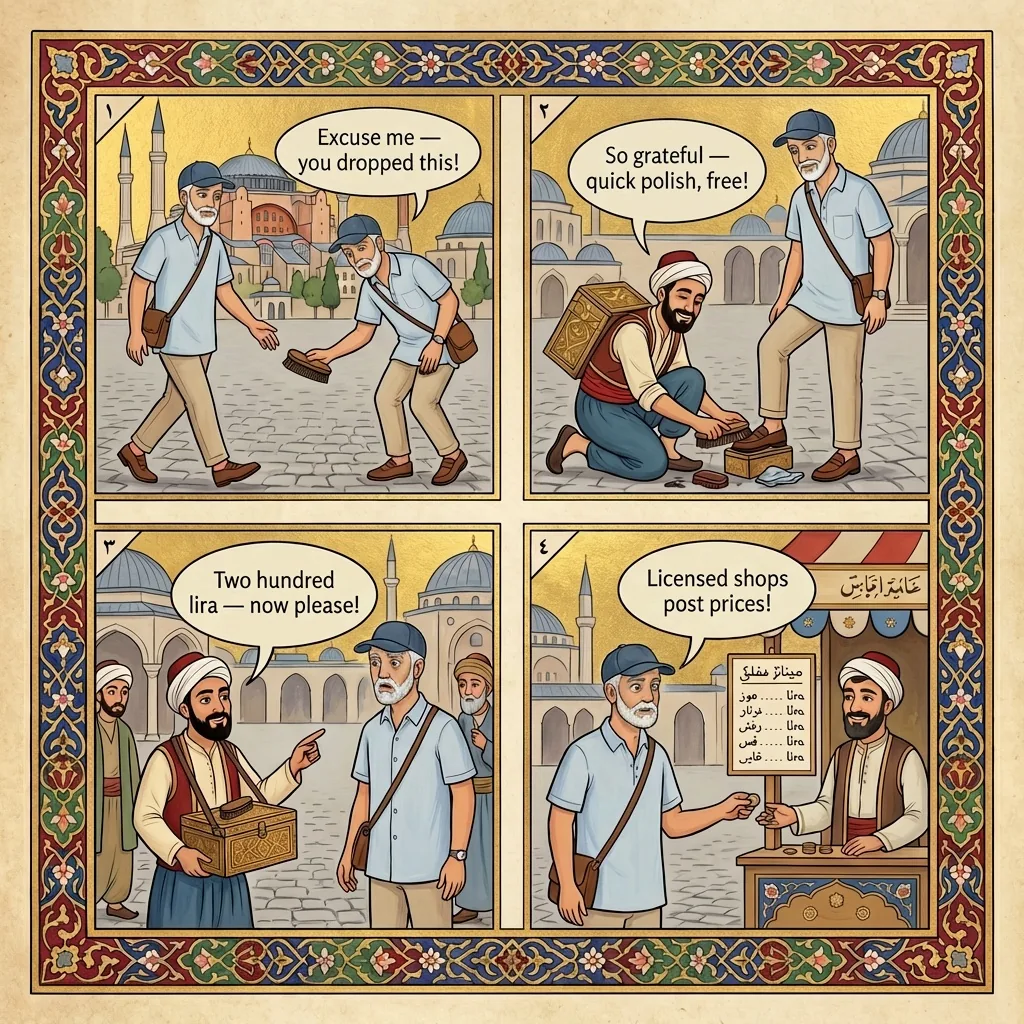
Shoe-shine men near Galata Bridge and Istiklal Avenue stage an 'accidental' brush drop at your feet; when you return it, they insist on polishing your shoes for free and then present a bill for 200–500 lira, turning hostile if you refuse — the drop is deliberate, one of Istanbul's oldest and most-documented tourist traps.
The operation runs on Galata Bridge, along Sultanahmet's main pedestrian corridor, and at the top of Istiklal Avenue — the three places where tourists walk slowly and look helpful. A man with a wooden shoe-shine box walks slightly ahead of you on the same pavement. A brush tumbles from his kit right at your feet, the geometry suspiciously perfect. You pick it up and hand it back. He erupts in gratitude, shakes your hand, points at your shoes, and insists on a polish as a gesture of thanks. The whole exchange takes thirty seconds and feels entirely unrehearsed.
The shine itself takes a minute or two. Then comes the bill: 200–500 lira for a job that a legitimate booth on the same bridge charges 30–50. When you offer a smaller amount, the tone shifts immediately — he crowds your space, talks over you, calls out to a friend nearby. The encounter is engineered to end with you paying to make the scene stop. The dropped brush converts a stranger into someone who has "done you a favor," and that manufactured obligation is the only thing the price is actually exploiting.
The defense is straightforward: when an object falls near you on a tourist street in Istanbul, step past it and keep walking. Do not pick it up. If a shine has already started before you understood the setup, firmly agree on a specific amount before he continues — say "thirty lira" and mean it. If he refuses, walk away; passersby have seen this a thousand times and will not blame you. Legitimate shoe shines are available at fixed-price booths on Galata Bridge itself, where the rate is posted and the transaction is transparent. If you feel followed or physically threatened, call 155 (Turkish Police) — the Sultanahmet tourist police unit knows this scam well.
Red Flags
- A shoe shiner drops his brush or tools directly in your path
- He thanks you warmly for picking it up and immediately offers a 'free' shine
- No price is mentioned before the work begins
- The final bill is outrageously high for what was done
- He becomes upset or follows you if you don't pay the full amount
How to Avoid
- If you see a brush fall, simply step around it rather than picking it up.
- If you do pick it up out of reflex, decline the offered shine firmly: 'No, thank you.'
- Never let anyone touch your shoes without agreeing on a price first.
- The shoe shine drop trick is so well-known it's cited in every Istanbul travel guide — awareness is your protection.
- If caught mid-shine, agree only to a specific amount before he continues.
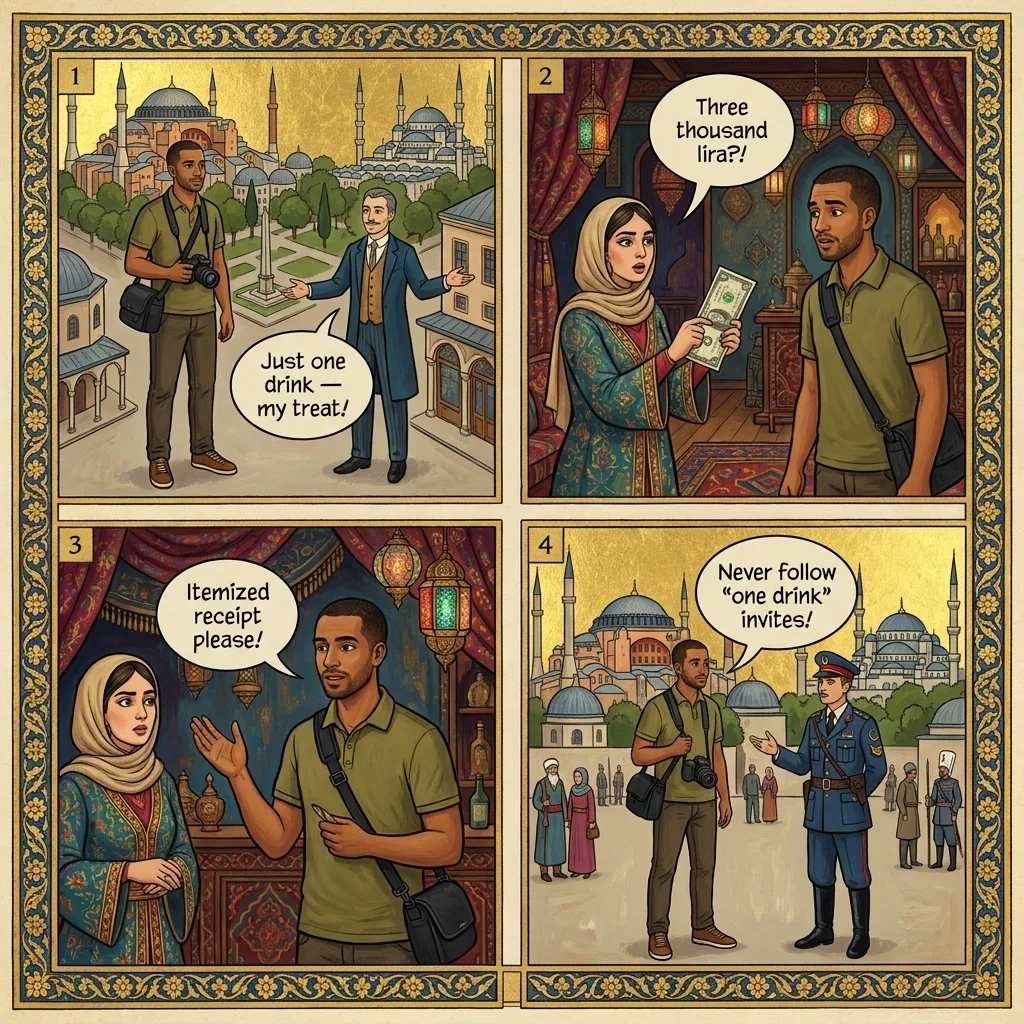
Planted 'friendly locals' around Taksim Square and Beyoğlu side streets befriend solo travelers, lead them to basement bars through narrow alleys, and present bills of 8,000–20,000 lira for a few drinks — exit corridors are blocked by large men until you pay, and your new 'friend' disappears before the bill arrives.
The approach happens on İstiklal Avenue, just off Taksim Square, or in the streets between Beyoğlu and Karaköy. A well-dressed Turkish man in his thirties strikes up a conversation, asks where you're from, and within a few minutes mentions he knows a great local bar that foreigners never find — "not touristy, real Istanbul." He is warm, curious, and entirely plausible. He is a commission employee working for the bar, and this pitch has been refined over thousands of repetitions.
The bar is typically in a basement down a narrow side street. Shortly after you arrive, two or three women join the table uninvited. No menu is shown and no prices are discussed. Drinks arrive that you may not have ordered. An hour later the bill materializes: 8,000–20,000 lira for the table, including hostess fees that were never mentioned. The exit corridor is narrow and there are large men positioned at it. Your recruiter has long gone. The operation is fully coordinated — the recruiter, the bar, the women, and the door staff divide the proceeds and the bill is non-negotiable by design.
Refuse any bar invitation from a stranger you met on the street in the last ten minutes, regardless of how genuine they seem. Real Turkish hospitality begins in someone's home or at a restaurant with a posted menu — not a basement you were guided to. If you are already inside and the bill is wrong, do not pay: call 155 (Turkish Police) from your phone at the table. Announcing this intention typically causes the bill to drop sharply or disappear. The Istanbul Tourist Police have a specialist unit for exactly this situation, and filing a same-night report adds formal pressure on the bar's operating license.
Red Flags
- An overly friendly local approaches specifically to invite you to a bar
- The bar is down an alley, in a basement, or noticeably away from the main street
- Attractive companions join your table shortly after you arrive
- Drinks arrive you didn't order; no prices were shown when you entered
- The bill is ten to twenty times what you'd expect; the exit is guarded
How to Avoid
- Decline any bar or club invitation from a stranger you just met on the street.
- Choose bars that are street-level, have visible price menus posted, and are clearly busy with regular patrons.
- If you're already inside and the bill arrives unexpectedly high, call 155 (police) immediately — do not pay.
- Share your location with someone before going out and check in every hour.
- The Turkish Tourist Police have a specific unit for these cases — asking to call them often resolves the situation fast.
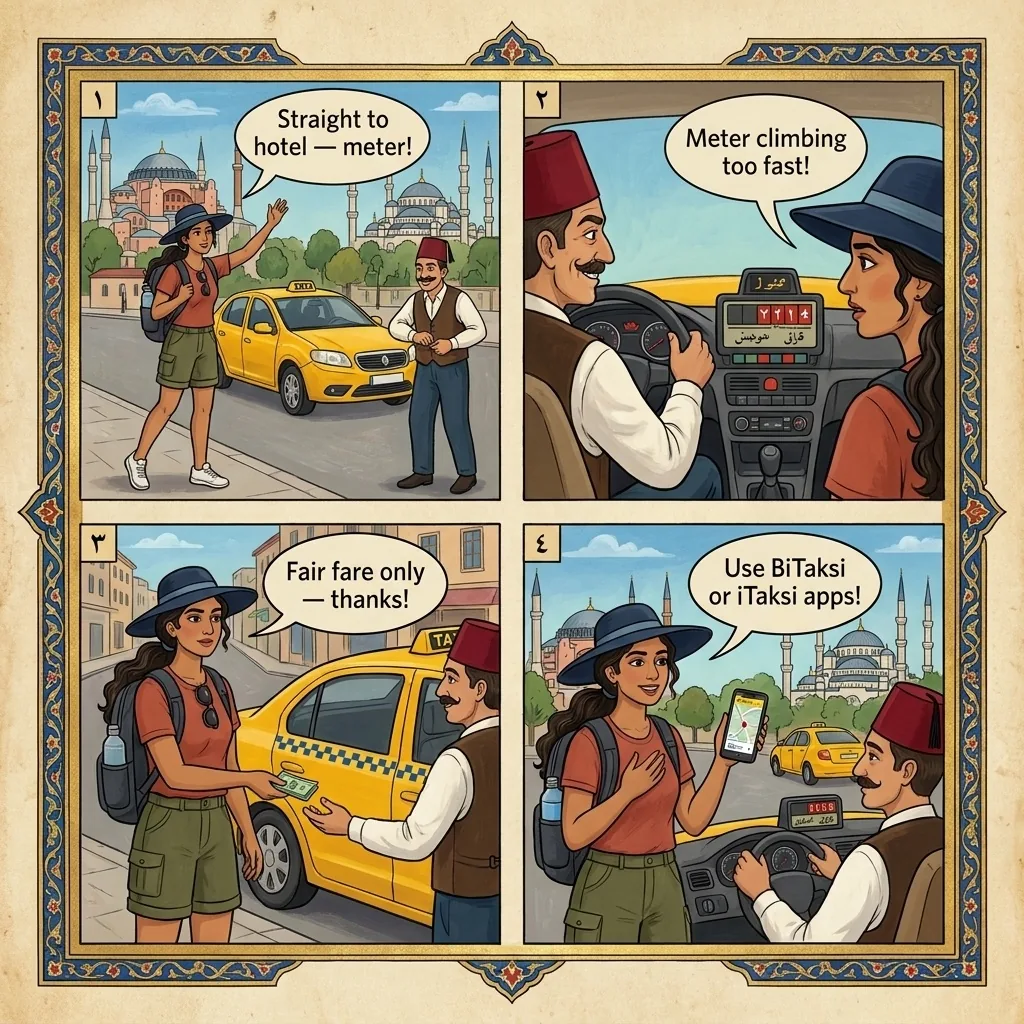
Istanbul taxi drivers from Sabiha Gökçen and the city center use tampered meters, banknote-swap cons, and fabricated detours to double legitimate fares — a Sultanahmet-to-Taksim run that should cost 150–200 lira regularly ends at 400–600 for tourists who haven't prebooked through an app.
The overcharge problem is well-documented across both of Istanbul's main airports and the central taxi ranks. The routes most commonly targeted are Sabiha Gökçen Airport to Sultanahmet (legitimate metered fare 350–500 lira), Istanbul Airport (IST) to Sultanahmet (250–350 lira via the O-3 highway), and Sultanahmet to Taksim (150–200 lira). The official fare calculator at ibb.gov.tr shows these ranges; the taxi rank outside arrivals at both airports is where the gap between posted and actual fare is widest.
Three mechanics account for most of the overcharges. First, the route detour: the driver claims the direct highway is "blocked by police" or "under construction," takes the coastal road instead, and shows you a Google Maps screenshot that was already set to maximize toll roads. Second, the banknote swap: you hand over a 100-lira note; the driver palms it and holds up a 5-lira note, insisting you underpaid. Third, the meter tamper: the display is set to gece (night rate, double the day rate) even at 2 PM, or the meter is physically adjusted to run at 1.5× normal speed. Any one of these can push a 250-lira ride to 700 before you register the problem.
Open BiTaksi, InDriver, or Uber in the arrivals hall before you exit the terminal — all three show a GPS-tracked fixed price before you board, cutting out every meter variable. If you take a rank cab, verify the meter shows gündüz (day rate) before the car moves, photograph the meter start reading, and name the denomination of every note you hand over. Night rate (gece) applies only midnight to 6 AM; if you see it at any other hour, point at it and ask the driver to reset before you move. The Havaist airport bus from IST to Taksim costs around 140 lira with no meter uncertainty at all.
Red Flags
- Driver claims your direct route is blocked and suggests an alternative
- The meter appears to tick faster than expected
- Driver handles your cash payment and quickly claims you gave a smaller bill
- No receipt is offered and the driver is evasive about the final total
- Ride takes significantly longer than Google Maps estimated
How to Avoid
- Use BiTaksi or inDriver apps for fixed-price or metered Istanbul taxis with GPS tracking.
- Photograph the meter reading at trip start and monitor it against your expected route.
- Hand over cash in full view, name the denomination clearly: 'Here is 200 lira.'
- Know the approximate fare before you get in — Sultanahmet to Taksim is roughly 80–120 lira.
- The Istanbul Metro (M1, M2) and tram (T1) serve all major tourist zones cheaply and reliably.
Like what you're reading? Get a full Istanbul itinerary with safety tips built in.
Browse travel-safety books →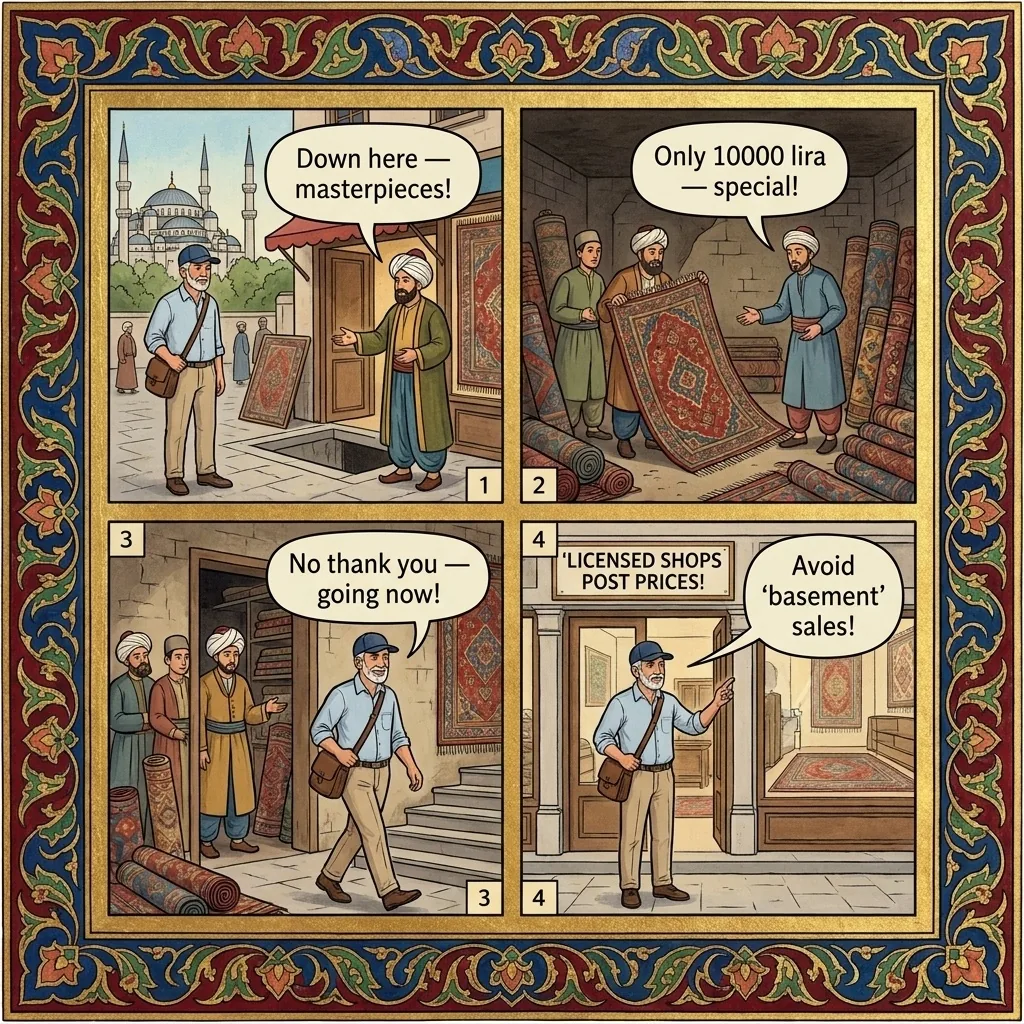
Carpet shops near Sultanahmet's Blue Mosque use a "just to look, tea is free" invitation to seat tourists for a choreographed hour-long session in which prices drop from €2,000 to €400, manufacturing a false sense of a deal — the carpets are often genuine, but the sustained social engineering is the actual product being sold.
The invitation happens at the corner of Torun Sokak and the Arasta Bazaar lane, along Divanyolu Caddesi, and near every exit of the Blue Mosque. A pleasant man with fluent English steps toward you: "Just to look, no obligation, tea is free." The shop inside is real — stacked floor-to-ceiling with kilims and machine-pile rugs — and the tea arrives within thirty seconds of you sitting on a low cushion. The seller begins with the cheapest items and works carefully upward. His grandmother's village in eastern Anatolia features prominently in the story.
An hour passes. The price quotes open at €2,000 and work their way down to €400 across a sequence of carpets, each reduction presented as a personal concession made specifically for you. The social arithmetic is the trap: you have accepted hospitality — tea, time, a family story — and leaving now without buying feels rude. The prices at €300–400 may represent a genuine markup, or they may be roughly fair for a machine-made piece; the point is that you were never intending to spend that money and the session manufactured the desire through controlled emotional pressure.
You can stand up and leave at any point — accepting tea creates exactly zero legal or moral obligation to buy. Say calmly "we're not buying today" and walk out; this is socially normal and the seller will not follow you beyond the door. If you are genuinely interested in a carpet, leave and return the next day: if the same piece is available at the same price, it's a real offer; if the price has changed, you know the first quote was theater. For serious purchases, ask the seller to demonstrate knot density per square centimeter and dye type — a shop that cannot or will not answer technical questions is selling for the story rather than the rug.
Red Flags
- An invitation to 'just look' immediately transforms into a full sales session
- Tea and hospitality are used to create social obligation
- Prices start absurdly high and drop rapidly to create a false sense of a deal
- Salespeople use personal family stories and emotional appeals
- You feel unable to leave without buying something after accepting hospitality
How to Avoid
- Politely decline carpet shop invitations near the Blue Mosque and Hagia Sophia.
- It's fine to enter and look, but know that accepting tea creates social expectation — you can still walk out.
- If interested in buying, research carpet values independently before entering any shop.
- Leave the shop, sleep on it overnight, and return only if you genuinely want to buy.
- Real carpet quality can be assessed (knot density, dye tests) — ask for these demonstrations and walk away if refused.
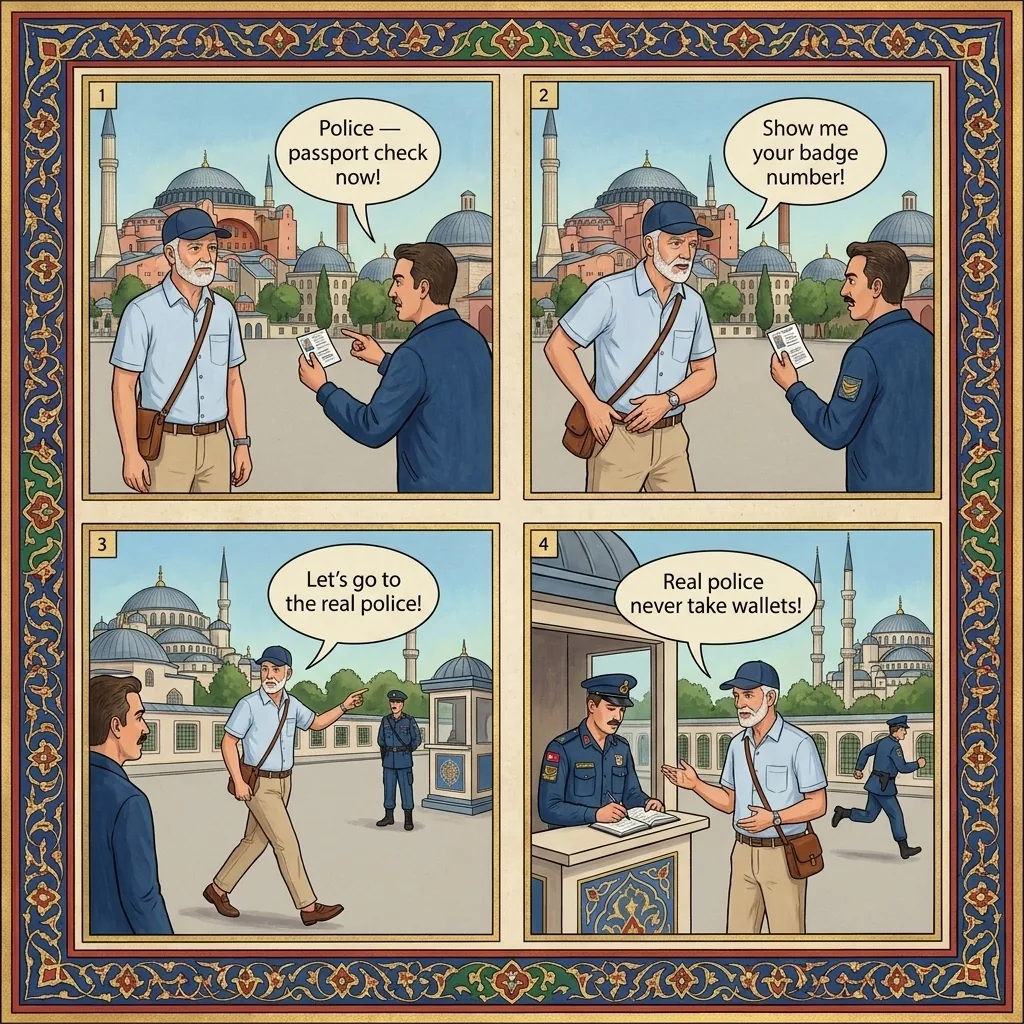
Two men in plain clothes near the Grand Bazaar flash laminated badges, claim they are running a counterfeit-currency or drug check, separate your passport from your wallet under the guise of "verification," and return the passport short of significant cash — real Turkish Emniyet officers on plainclothes patrol never demand wallet access on the street.
The encounter typically happens after dark on the side streets west of the Grand Bazaar, in the quieter stretch of Sultanahmet between the bazaar's western gates and the tram line, or on the approach roads toward Topkapı. Two men in civilian clothing approach; one quickly flashes a laminated card — too fast to read, credible enough to register as official. They explain in serviceable English that they are undercover police conducting a check because counterfeit currency is circulating in the area, or running a tourist drug-screening operation following a recent incident. The framing is calm and carries just enough authority to freeze a traveler who doesn't know what real Turkish police procedure looks like.
They ask to see your passport and your wallet simultaneously — ostensibly to confirm identity and verify you aren't carrying marked bills. One officer takes your documents a few steps away to "run a check" while the second holds you with questions: where are you staying, how long have you been in Istanbul. The separation is the entire mechanic. When the first man returns, your passport is intact but a significant amount of cash has been palmed during the "check." The operation takes under three minutes and the men disappear into the side streets before you have processed what happened.
Real Turkish police officers on a street ID check will never ask to handle your wallet. If plain-clothes men demand documents and cash inspection simultaneously, say calmly: "I will walk with you to the nearest police station," and begin dialing 155 (Turkish Police) on your phone. Genuine undercover officers will agree; fake ones will leave. Carry a color photocopy of your passport's photo page and keep the original in the hotel safe — a copy satisfies the legal ID requirement for most street encounters. If you have already had cash stolen, go directly to the nearest karakol (police station), file a formal report, and record any physical descriptions; the Sultanahmet Tourist Police unit is familiar with this pattern.
Red Flags
- Plain-clothes men approach at night flashing laminated ID cards quickly
- They request your wallet as well as your passport — real police need only documents
- They separate the interaction: one officer talks while another handles your belongings
- The interaction happens on a quiet street rather than a public, populated area
- They ask you to come 'just over here' away from the main street or witnesses
How to Avoid
- Request to go to the nearest police station (karakol) — real officers will agree; scammers refuse.
- Call 155 (Turkish police) immediately on your phone while they are present.
- Never hand your wallet to anyone claiming to be police.
- Keep passport in hotel safe and carry a color photocopy instead.
- Travel in groups or well-lit, populated routes at night near the bazaar areas.
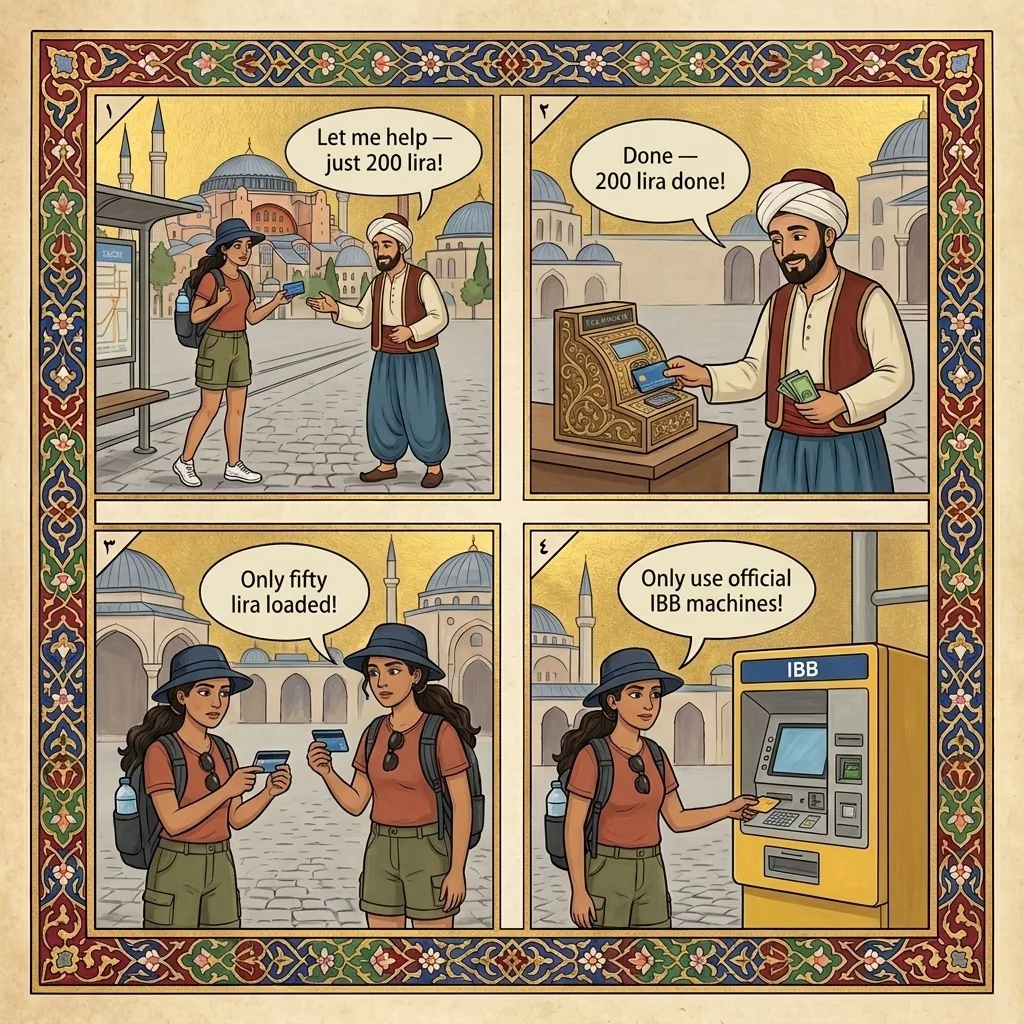
"Helpful" strangers at Taksim Metro and Eminönü ferry terminals insert themselves between tourists and the Istanbulkart machine, load 200 lira while charging 350 in cash, or swap the newly loaded card for a depleted one — the machine has a working English menu that makes all unsolicited assistance a red flag.
The Istanbulkart is Istanbul's tap-and-go transit card, used on the Metro, tram, bus, and Bosphorus ferry. You buy it at the machine inside the station: select English, insert cash, choose how much to load, take the card. The machines at Taksim, Eminönü, and the main airport transit hub are the ones most first-time visitors encounter. Before you reach the machine, a man near the entrance — already watching the arrivals flow — spots your luggage or tourist map and offers to help: "The machine is confusing, I know how it works, let me show you."
Two mechanics account for most cases. In the simpler version, the helper operates the machine himself, loads 200 lira onto the card, and asks you for 350 lira in cash, pocketing 150 lira. In the more sophisticated version, he loads the card correctly in front of you, then casually swaps it during the handover for a near-depleted card he prepared earlier, keeping the loaded one for resale. Both versions exploit the same window: you have just arrived, the machine looks unfamiliar, you have a connection to make, and the final handover step is quick enough to miss if you're not watching the card itself.
Decline all unsolicited help at transit machines and operate the Istanbulkart terminal yourself — every machine has a working English interface from the first screen and the steps take about 90 seconds. The card costs 100 lira plus your chosen load; confirm that number before you approach and verify the balance reads correctly the moment the card is in your hand (balance shows on the turnstile reader). If the balance is wrong, go directly to the official IETT kiosk inside the station — staff can check the card's transaction history. To file a formal complaint, call the Istanbul Metropolitan Municipality public transport line at 153.
Red Flags
- A stranger at a transit machine offers to help before you've even asked
- They handle your cash directly rather than pointing to where you insert it
- They complete the transaction very quickly before you can track the amounts
- The card they hand you feels different from the one you held initially
- They ask for more cash than the machine's price list shows
How to Avoid
- Use the Istanbulkart machines yourself — English interface is available on all machines.
- Decline all unsolicited help at transit stations politely but firmly.
- Buy your Istanbulkart at the official IETT kiosk inside the station rather than the machine if overwhelmed.
- Verify the balance on your card at the turnstile immediately — it shows on the reader.
- The card costs 100 lira plus however much you load — know this number before you approach the machine.
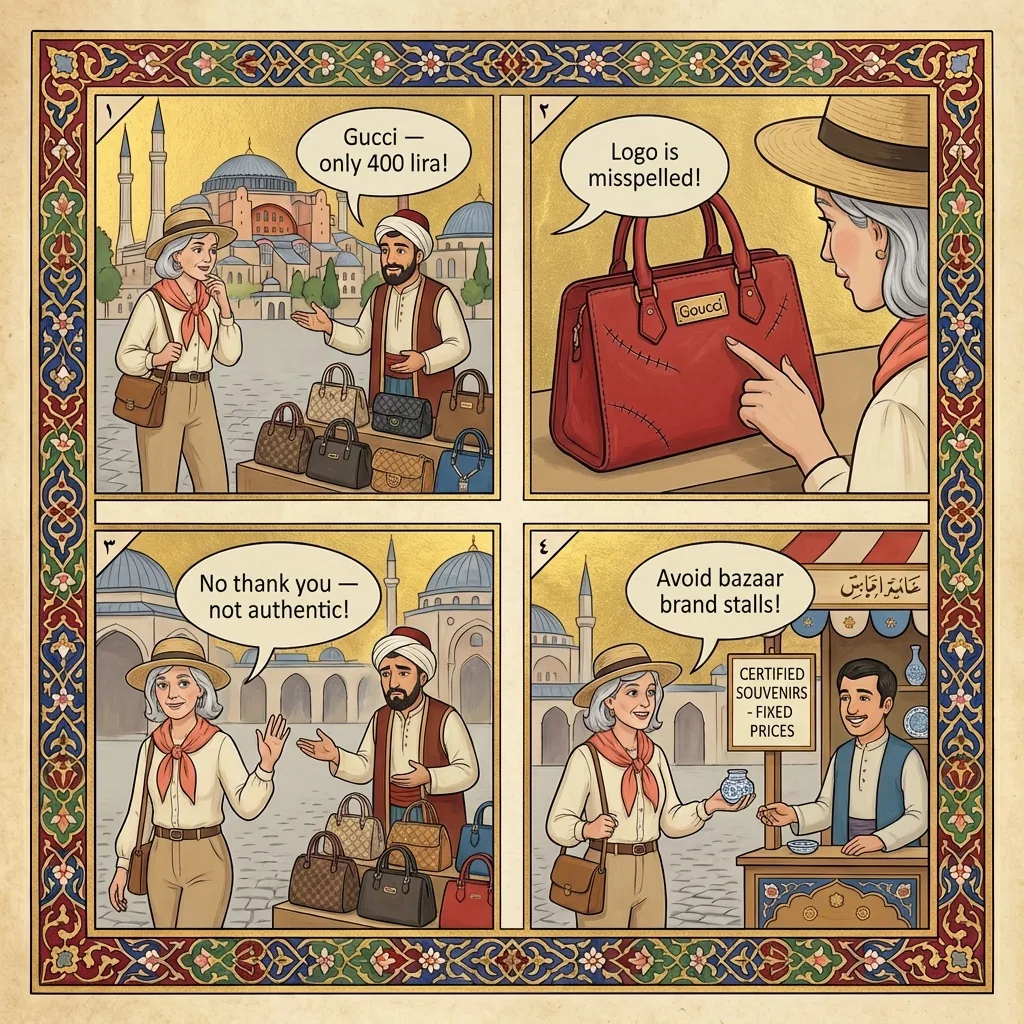
Grand Bazaar carpet and textile shops seat tourists for 45–90 minutes with apple tea and a family-weaving story, open at 8,000 lira, and drop theatrically to 3,000 when you stand to leave — the "special final price" is still double the street market value, and the dramatic drop itself is the psychological trap.
The Grand Bazaar's covered lanes between the Beyazıt and Nuruosmaniye gates hold the densest concentration of carpet and textile shops in Turkey. A seller near a shop entrance catches your eye: "Just to look, come inside, I show you something special." The interior is stacked with folded kilims and machine-pile rugs. Apple tea arrives within thirty seconds of sitting down. The seller is knowledgeable, friendly, and unhurried — he starts with the cheapest items and works carefully upward while telling you about his grandmother's village in Anatolia and thirty years in the trade.
The price sequence is the mechanic. The first carpet costs 8,000 lira. After it fails to land, a second appears at 6,500. A third at 5,000. When you stand to leave, he stops you: "For you, friend, 3,000 — my cost price, I cannot go lower." The genuine bazaar price for a comparably sized machine-made rug at competing stalls outside the tourist zone is 1,200–1,800 lira. The drop from 8,000 to 3,000 creates the sensation of a 62% saving — a figure that feels real because the anchor was stated with confidence forty minutes earlier. The tea, the time, and the personal story are tools to make walking away feel costly to a relationship that has been carefully constructed in one hour.
Stand up and say "not today" at any point — you owe nothing because you drank tea and listened. If you want a carpet at a fair price, walk out of the Grand Bazaar to shops in the Fatih district outside the tourist zone, where prices are fixed and posted. For any item over 2,000 lira, ask the seller to demonstrate knot count per square centimeter, dye type (wool versus silk versus synthetic), and weaving region — a legitimate seller can do all three; one who cannot or will not is selling for the story, not the rug. The Grand Bazaar Merchants' Association (grandbazaaristanbul.org) lists licensed vendors by category if you want a verified source before you enter.
Red Flags
- Shopkeeper offers tea immediately and begins showing merchandise you didn't ask for
- Prices drop dramatically (50%+) when you move toward the door
- Claims the carpet is hand-woven antique silk when it could be machine-made polyester
- Pressure to pay now because 'this price is only for today'
- A 'certificate of authenticity' is offered with no independent verification
How to Avoid
- It's fine to browse and drink tea -- just know you can always walk away.
- Research carpet types and fair prices before entering the Grand Bazaar.
- Compare prices at multiple shops before buying anything over 500 lira.
- If you want quality carpets, visit shops outside the bazaar with fixed prices and Google reviews.
- Never feel obligated to buy because you accepted tea -- it's a sales tactic, not a gift.

Taxi drivers at Istanbul Airport (IST) and Sabiha Gökçen (SAW) toggle meters to the gece (night) rate during daytime hours or take the long coastal route instead of the O-3 highway — a legitimate IST-to-Sultanahmet fare of 250–350 lira becomes 450–600 before the driver says a word.
Istanbul has two main airports on opposite sides of the city. Istanbul Airport (IST) on the European side serves most international arrivals; Sabiha Gökçen (SAW) on the Asian side handles budget carriers and sits an extra 25 kilometers from Sultanahmet. Both have official taxi ranks outside arrivals, and both are persistent overcharge zones. The official fare from IST to Sultanahmet via the O-3 highway runs 250–350 lira; from SAW, 350–500 lira. These figures are posted on the Istanbul Metropolitan Municipality taxi-fare calculator at ibb.gov.tr, which you can check before you land.
The mechanics at both airports are well-documented. The gece (night) rate doubles the meter; daytime is 6 AM to midnight, but drivers toggle it anyway and hope the passenger misses the small indicator on the display. The route detour is the other standard play: the driver claims the O-3 highway is "closed today," takes the coastal road, and the meter climbs through an extra 35–45 minutes. At SAW an additional variant is the flat "airport transfer fee" offered instead of the meter — always higher than the real metered fare. Banknote swaps (handing back a 5-lira note in exchange for your 100-lira note) are also reported at both airports when passengers hand over cash while distracted by luggage.
Open BiTaksi, InDriver, or Uber in the arrivals hall before you exit the terminal doors — all three show a GPS-tracked fixed price before you board, removing every meter variable from the equation. If you take a rank cab, verify the meter shows gündüz (day rate) before the car moves, photograph the meter's start reading, and name every note you hand over. Night rate applies only midnight to 6 AM; if you see gece at any other hour, point at it and ask the driver to reset before the car moves. For a budget alternative, the Havaist airport bus from IST to Taksim costs around 140 lira and runs every 30 minutes with no meter uncertainty at all.
Red Flags
- The meter shows 'gece' (night rate) during daytime hours
- Driver takes the scenic coastal route instead of the highway
- Fare seems to climb unusually fast in the first few kilometers
- Driver insists his meter is correct when you question the rate
How to Avoid
- Use BiTaksi app for GPS-tracked, metered rides from the airport.
- Know that IST Airport to Sultanahmet should cost 200-300 lira via highway.
- Check the meter starts at the correct base fare (approximately 30 lira as of 2025).
- Night rate (gece) only applies from midnight to 6 AM.
- Take the Havaist airport bus to Sultanahmet for 140 lira as an alternative.
🆘 What to Do If You Get Scammed
📋 File a Police Report
Go to the nearest Turkish National Police (Emniyet) station. Call 155 (Police) or 112 (Emergency). Get an official crime report — you'll need this for insurance claims. You can also report online at egm.gov.tr.
💳 Cancel Your Cards
Call your bank immediately. Most have 24/7 numbers on the back of the card (keep a photo saved separately). Block any suspicious transactions before the thieves use your details.
🛂 Lost Passport?
Contact your nearest embassy or consulate. The US Consulate General in Istanbul is at Kaplicalar Mevkii No. 2, İstinye, 34460 Istanbul. For emergencies: +90 212-335-9000.
📱 Track Your Device
If your phone was stolen, use Find My (iPhone) or Find My Device (Android) from another device. Don't confront thieves yourself — share the location with police instead.
Sources & further reading
Every scam here is cross-checked against official government advisories, police bulletins, and established reporting. Confirm current details with the primary sources below before you travel.
-
U.S. Department of State — Turkey International Travel Information
Government advisory
“Confidence schemes occur where travelers are tricked into ordering food or drinks at a restaurant, and then are charged incredibly high prices.”
-
UK Foreign, Commonwealth & Development Office (GOV.UK) — Safety and security - Turkey travel advice - GOV.UK
Government advisory
“Be wary of strangers approaching you to change money, or to take you to a restaurant or nightclub.”
-
World Nomads — How to Avoid Common Travel Scams in Turkey
Travel-safety guide
“When they handed over a 50 or 100 lira note the drivers said they'd given him a 5 or a 20.”
Frequently Asked Questions
You just read 8 scams in Istanbul. The full Travel Safety Series has 780+ more across 20+ countries.
Tokyo's Kabukichō ¥130,000 bar trap. Rome's gladiator photo extortion. Paris's gold-ring trick. Bali's ATM skimmer scams. Bangkok's grand-palace closure ruse. Every documented scam across 20+ destinations — with the exact scripts, red flags, and local-language phrases that shut each one down. Drawn from Reddit traveler reports, embassy advisories, and consumer-protection cases.
- 780+ documented scams across Tokyo, Rome, Paris, Bali, Bangkok, Rio & 100+ more cities
- 20+ countries covered, with country-by-country phrase cards for every destination
- Updated annually — buy once, re-download future editions free
- All titles $4.99 each on Amazon Kindle