
Key Takeaways
- The #1 reported scam is the Camel Ride Hostage at Giza.
- 3 of 6 scams are rated high risk.
- Use app-based ride services (Uber, Bolt) instead of unmarked taxis — always confirm the fare before departure.
- Never accept unsolicited offers from strangers near tourist sites in Cairo.
⚡ Quick Safety Tips
- At the Pyramids, anyone who approaches you on a horse, camel, or on foot offering help is not free — agree on a firm price for everything before accepting.
- Use Uber or Careem for all transport in Cairo — metered taxis rarely use meters with tourists.
- Never accept 'papyrus' or other items placed in your hands near temples or museums — you'll be pressured to pay.
- Ignore claims that a museum or attraction is 'closed today' from anyone not wearing an official uniform — it's a scam to redirect you to a shop.
Jump to a Scam
The 6 Scams

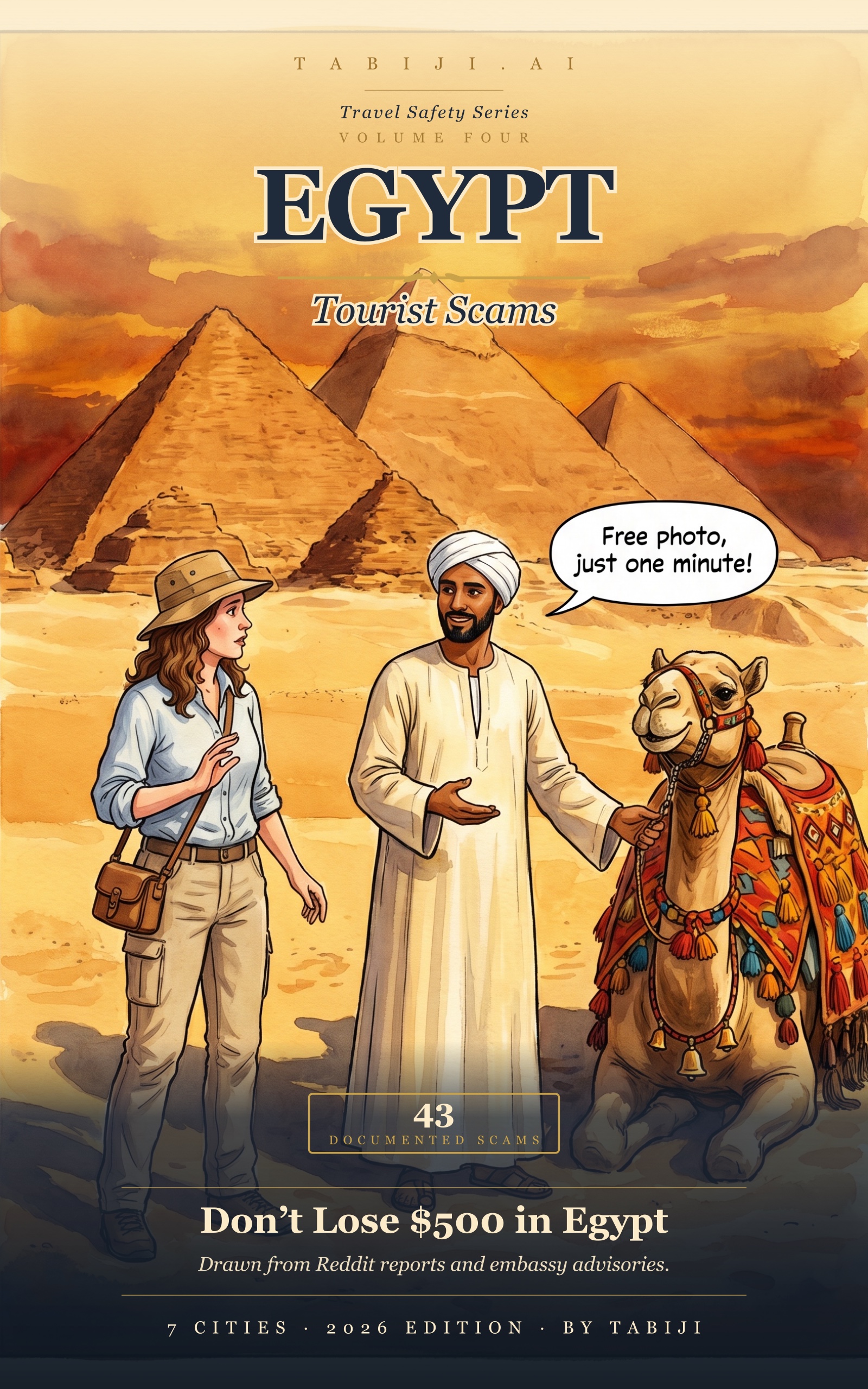
A camel handler at the Giza Plateau quotes 50 pounds for a 'very short ride,' helps your kid into the saddle, then once the camel stands demands 500 pounds for the 'full experience' while telling you it won't kneel until you pay.
Walk past the Sphinx ticket gate at Giza and a man with two saddled camels steps into your path. "My friend — Cleopatra, very gentle, fifty pounds, ten minutes, the best photo of your trip." He's already helping your kid into the saddle before you finish the math, then offers a hand up beside them. The camel rises. Suddenly you're four meters in the air on the Giza plateau, and the price has changed.
"Now it is five hundred pounds — the full experience, twenty minutes, the loop around the Khafre pyramid." When you ask to get off, the handler shrugs. "The camel cannot kneel here, the ground is bad — we go a little more first." Two of his cousins on horses materialize on either side. The plateau is wide and empty in every direction, and your child is on the saddle in front of you and can't dismount alone.
The hustle works because the price flip lands after the camera goes away and you've lost physical agency — once you're four meters up with a kid in front of you, refusing feels confrontational and impossible. Reddit and Reddit threads name the same play running every morning at the Sphinx ticket gate and along the Khafre-pyramid trail. The defensive move is to refuse to mount any animal until the full price, the route, and the dismount point are typed on your phone screen and the handler photographs it back to you.
Red Flags
- Handler quotes an extremely cheap initial price to get you on the camel
- Price suddenly changes once you're physically on the animal
- Camel handler is accompanied by other men on horses or camels who surround you
- Handler claims the camel 'needs to walk a bit more' before it will kneel to let you off
- Any handler who approaches you unprompted near the pyramids — official handlers don't solicit
How to Avoid
- Agree on every detail in writing (or on your phone screen) before mounting any animal.
- The official fee for camel rides inside the Giza complex is regulated — ask at the ticket office.
- Bring a friend who stays on the ground and can document and assist if things go wrong.
- Book camel experiences only through vetted tour operators, not through touts at the gate.
- If trapped, stay calm and loudly call for tourist police (identifiable by white uniforms at Giza).

A man in casual khaki and a lanyard "badge" outside the Giza ticket office tells you your entry needs to be 'registered,' walks you to a side desk near the Solar Boat Museum, and demands a $30 cash fee that doesn't exist.
Cross the parking lot toward the Giza ticket office and a man in a tan polo, dark trousers, and a plastic lanyard ID falls into step beside you. "You have your ticket already? Good — but it has not been registered. Come, the office is just here." He gestures toward a side door near the Solar Boat Museum, the kind of building you'd assume is official because it's inside the complex.
Inside, a second man in a similar uniform tells you the registration fee is $30 in cash, per person, and points to a hand-laminated sheet of paper as evidence. Real Egyptian tourist police wear light blue uniforms with shoulder insignia and do not collect ticket fees of any kind. When you push back, the first man's tone hardens: "Without registration, the security at the gate will turn you away." That's also fabricated — the only ticket check is at the official turnstile.
The con works because the Giza complex is genuinely confusing on a first visit — multiple buildings, multiple gates, official-looking touts in tan polos who can pass for police at a glance. Reddit and Reddit threads flag the side-office variant running near the Solar Boat Museum and at the Egyptian Museum's secondary entrance on Tahrir Square. The defensive move is to refuse to follow anyone in casual khaki to a side office — real tourist police wear light blue uniforms with shoulder insignia, the dialable Tourist Police line is 126, and the only ticket check is at the official turnstile.
Red Flags
- Official-looking badge worn around the neck rather than on a uniform
- Approach is proactive — real police don't usually initiate contact with tourists
- Request for additional payment beyond your already-purchased ticket
- Office or 'registration booth' is off to the side of the main entrance area
- Request for personal passport information as part of the 'registration'
How to Avoid
- Buy tickets only at the official booth — there is no secondary 'registration' required.
- Real tourist police in Egypt wear light blue uniforms with official insignia — not casual khaki.
- If approached by someone claiming authority, walk to the main ticket desk and verify with staff there.
- Don't hand over your passport to anyone at the pyramids unless it's the official ticket window.
- The Giza tourist police hotline is 02-3376-7888 — save it before visiting.

Your driver detours to a "government-licensed papyrus institute" en route to Khan el-Khalili where a man in a lab coat sells you three banana-leaf prints for $150 — and pockets a 30 percent commission on the sale.
Twenty minutes into the ride to Khan el-Khalili, your driver pulls over at a low building with a polished sign reading "Egyptian Papyrus Institute — Government Licensed." He waves it off as a quick stop: "Free to look, no pressure to buy, the demonstration is interesting." Inside, a man in a starched lab coat unrolls a sheet of papyrus, soaks it in water, and presses a pyramid of strips into a sheet for your kids to watch.
After the demo, the price ladder appears. Small scrolls are $30 each, framed pieces $80, the "museum-grade" Cleopatra print $150. He frames it as a single-day price, gestures at a wall of certificates, mentions a discount because your driver brought you. You buy three, thinking they're handmade. At home, a friend who studied Egyptology takes one look and tells you they're banana-leaf prints, dye-printed, worth about $5 each.
There is no government licensing body for papyrus shops — the term "government-licensed" is marketing painted on the door, and your driver was paid roughly 30 percent of whatever you spent. Reddit threads document the same routine running on the Giza-to-Khan el-Khalili tour route, with the same lab coat and the same demonstration script. The defensive move is to tell your driver before departure that the only stop is the destination — and to buy papyrus only at the Egyptian Museum gift shop or from a Khan el-Khalili stall after comparing prices at three or four sellers first.
Red Flags
- Driver, guide, or hotel staff suggests a 'factory' or 'government institute' unprompted
- The shop claims official government certification but has no verifiable registration number
- Staff demonstrate production on-site to build trust before the hard sell
- Papyrus has extremely vibrant colors that don't fade — real papyrus is more muted
- Prices are negotiated heavily — real artisan shops don't usually start 300% above market
How to Avoid
- Buy papyrus only at the Cairo Egyptian Museum gift shop or UNESCO-recommended stores.
- Authentic papyrus should be slightly translucent when held to light and feel like pressed plant fiber.
- Decline all tour stops not on your pre-agreed itinerary — tell your driver before departure.
- Khan el-Khalili has legitimate papyrus sellers — compare prices across multiple stalls.
- Search 'Egypt government shop scam' before your trip to recognize the exact pitch.

A felucca captain on the Garden City waterfront agrees to a 100-pound one-hour cruise, then ten minutes in pivots to a 400-pound bill made of a captain tip, a fuel surcharge, and an assistant share — and won't return to dock until you pay.
A felucca captain on the Garden City waterfront waves you over to a wooden boat tied at the steps. He quotes 100 pounds for a one-hour Nile cruise, sunset included. You confirm the price twice, watch him nod twice, and step aboard with your partner. He pushes off as the late light turns the river the color of old brass, and for ten minutes the cruise is exactly what you came for.
Then the captain mentions the captain tip. Then the assistant share — for the silent man in the bow you hadn't realized was on staff. Then the fuel cost, even though feluccas have no engine. Each is presented as "normal," a separate line item not part of the original price. By the time the boat begins drifting back toward the dock, the bill has climbed past 400 pounds. When you point at the original price, the captain stops rowing and lets the current take you upstream.
The bait-and-switch runs because the captain controls the only way back to land, and the line items sound plausible to a first-time felucca passenger. Reddit threads name the Garden City and Dokki Corniche piers as the most-cited locations for the four-line-item upcharge play. The defensive move is to type the total price on your phone before boarding and ask aloud, "Is there any extra charge for fuel, tip, or assistant?" — then photograph the captain's nod and pay only after the boat is back at the dock.
Red Flags
- Price negotiated verbally without anything written down or shown on a sign
- Captain introduces 'extras' (fuel, assistant, docking fee) after you're already on the water
- Boat doesn't return to dock when you ask to end the ride early
- Multiple people board who weren't there during price negotiation
- Captain becomes cold or threatening when you question the final amount
How to Avoid
- Write the agreed price on your phone and show it to the captain before boarding.
- Ask explicitly: 'Is there any extra charge for fuel, tip, or assistant? Is the total 100 pounds?'
- Book felucca rides through your hotel or a reputable Nile cruise company.
- The going rate for a fair 1-hour felucca ride is 150–250 EGP (2024) — budget for this.
- Pay only when back on the dock — never pay in full while still on the water.

A man in an orange vest at Cairo International arrivals leads you to an "official airport taxi," quotes $50 to your hotel in Zamalek, and pockets a kickback on a fare that should run 150 to 250 Egyptian pounds on the meter.
Walk out of Cairo International Terminal 2 with luggage and a man in an orange high-visibility vest waves you to follow him. "Official airport taxi, this way, my friend." His vest looks identical to the ground-crew vests inside the terminal, and he steers you past the formal taxi rank to a white sedan idling at the curb. The driver quotes $50 in dollars to your hotel in Zamalek — the round number that sounds like a fixed airport rate.
It is not a fixed airport rate. Licensed white Cairo taxis are required to run meters, and a metered Zamalek run is 150 to 250 Egyptian pounds — closer to $4 than to $50. The man in the vest is not airport staff; he's a freelancer paid roughly half the markup by the driver. When you push back at the door, he switches to "OK my friend, $40, last price," and the driver opens the trunk for your bag in the same motion.
The con depends on three weak signals you can't read at 1 a.m. with a sleeping toddler — the vest, the dollar quote, the curbside positioning past the official rank. Reddit and Reddit threads document the orange-vest play running at both Terminal 2 arrivals and the Tahrir Square taxi pull. The defensive move is to walk past every vest to the official taxi rank or, better, to open Uber or Careem from the airport Wi-Fi before your luggage hits the curb — both apps quote a fixed price in Egyptian pounds and operate at the airport.
Red Flags
- Man in official-looking vest approaches before you reach the official taxi rank
- Quote is in USD or euros rather than Egyptian pounds
- Driver takes a much longer route than Google Maps suggests
- Driver claims there's a 'new road' or 'construction' requiring a detour
- No meter running and driver refuses to start one when asked
How to Avoid
- Use Uber or Careem — both work at Cairo airport and price is fixed before you enter the car.
- Walk past all touts to the official white taxi rank where meters are required.
- The standard airport-to-central Cairo fare is 150–250 EGP (2024) by metered taxi.
- Have your hotel address in Arabic on your phone to show the driver.
- Never follow anyone in a vest who approaches you in the arrivals hall — they are not airport staff.

A man in a museum-staff lanyard at the Egyptian Museum tells you camera photography costs 50 pounds extra per shot — the fee is fabricated, your ticket already includes photography for phones and cameras alike.
You're inside the Egyptian Museum on Tahrir Square, raising your phone for a shot of the Tutankhamun gold mask, when a man in a navy polo and a museum-style lanyard steps in. "Photography is fifty pounds extra, my friend, per shot — you did not pay this at the door?" He has the right uniform color and a confident demeanor. The shutter sound is still ringing in the gallery.
The fee is fabricated. Photography in the Egyptian Museum is included in the standard ticket — the policy is on the printed ticket and at the entry desk. The "staff member" is either a freelance day-laborer or a real attendant working an unauthorized side hustle; the same play runs at the Citadel of Saladin where it gets dressed up as a "DSLR permit." Both extractions work on tourists who don't know the rules and don't want to argue inside a hushed museum hall.
The hustle leans on the social cost of pushing back inside a museum gallery — most travelers pay 50 pounds rather than make a scene. Reddit and Reddit threads name the Tahrir Square Egyptian Museum and the Citadel of Saladin's interior courtyards as the most-reported sites. The defensive move is to point at your printed ticket and say "show me the official sign" — there is no official sign, and the request will be dropped or repeated to the next visitor.
Red Flags
- Someone in a uniform approaches specifically when you raise your camera
- Request for a 'photography permit' at a site that didn't mention it when you bought your ticket
- No official receipt or ticket offered for the photography fee
- Request is for cash only, no card payment option
- Demeanor becomes more aggressive if you ask for written documentation of the fee
How to Avoid
- Check the official site's photography policy at the ticket window when you enter.
- Photography in the Egyptian Museum is included in the ticket — smartphones and cameras allowed.
- If anyone demands money for photos, say 'show me the official sign' — there won't be one.
- Have your ticket visible and refer to it as proof of what's included.
- Report persistent unofficial fee collectors to the official ticket desk inside the venue.
🆘 What to Do If You Get Scammed
📋 File a Police Report
Go to the nearest Egyptian Police / Tourist Police station. Call 122 (Police) or 123 (Emergency). Get an official crime report — you'll need this for insurance claims. You can also report online at moi.gov.eg.
💳 Cancel Your Cards
Call your bank immediately. Most have 24/7 numbers on the back of the card (keep a photo saved separately). Block any suspicious transactions before the thieves use your details.
🛂 Lost Passport?
Contact your nearest embassy or consulate. The US Embassy in Cairo is at 5 Tawfik Diab Street, Garden City, Cairo. For emergencies: +20 2-2797-3300.
📱 Track Your Device
If your phone was stolen, use Find My (iPhone) or Find My Device (Android) from another device. Don't confront thieves yourself — share the location with police instead.
Frequently Asked Questions
You just read 6 scams in Cairo. The book has 37 more across 7 Egyptian destinations.
Giza pyramid camel-tout “free photo, just one minute” hostage shakedowns. Khan el-Khalili papyrus “school” markups (plant fiber sold as art). Luxor Valley of the Kings fake-guide tomb lock-ins. CAI airport “official taxi” USD overcharges. Aswan felucca captain price-doubling. Every documented Egypt scam — with the exact scripts, red flags, and Arabic phrases that shut each one down. Drawn from Reddit (Reddit, Reddit), U.S./UK/Canadian Embassy advisories, and Egyptian Tourism & Antiquities Police reports.
- 43 documented scams across Cairo, Luxor, Aswan, Hurghada & 3 more destinations
- An Arabic exit-phrase card you can screenshot to your phone
- Updated annually — buy once, re-download future editions free
- Readable in one flight — $4.99 on Amazon Kindle