
Key Takeaways
- The #1 reported scam is The Philae Temple Boat Gouge.
- Most scams in Aswan are low-to-medium risk.
- Use only hotel-arranged transport — Aswan has no Uber, Bolt, or InDrive coverage, and street taxis are unmetered. Always confirm the fare in Egyptian pounds before departure.
- Never accept unsolicited offers from strangers near tourist sites in Aswan.
⚡ Quick Safety Tips
- At the Shellal motorboat dock for Philae Temple, the official posted crossing rate is 10 EGP — refuse the 500 EGP 'tourist tax' demanded by boatmen circling solo travelers.
- Use Uber or InDrive from Aswan International Airport — taxi-rank drivers quote 500 EGP for the same run the apps post at about 150 EGP.
- Confirm felucca duration AND tow-back terms in writing along the Corniche near Ferial Garden — captains lose the wind on purpose, then sell a 'cousin's Luxor trip' for the return.
- At the Aswan Souk on Sharia as-Souq, refuse all 'free gift' hibiscus and oil samples — they reappear on the bagged-up bill at 200–500 EGP each.
Jump to a Scam
The 6 Scams

A boatman cartel at the Shellal motorboat dock dismisses the official 10-pound posted rate and quotes 500 EGP round-trip to Philae Island — there is no other route to the Temple of Isis, and every boatman on the dock holds the same line.
You arrive at the Shellal motorboat dock south of Aswan ready to cross to Philae Island for the Temple of Isis. The official rate posted on a sign beside the dock is 10 Egyptian pounds. The first boatman you approach laughs at the sign. "That price is old, my friend — five hundred pounds, round trip, with one hour wait. You want to see the temple, you take my boat."
You walk to the next boat. Same quote. The next, the same. The boatmen at Shellal operate as a cartel: nobody undercuts, and there is no land bridge or alternative ferry to the island. Around twenty minutes of negotiation typically lands the price at 200 EGP — still twenty times the official rate, but the only way to actually reach Philae before sunset. They accept payment up front and then idle on the island, daring you to leave them to walk back across the water.
The monopoly is structural. The dock has one operator group, no competing routes, and no government enforcement of the posted rate, and Reddit and Reddit threads name the Philae crossing as the most-cited price-cartel scam in Upper Egypt. The defensive move is to book Philae as part of your hotel's organized day-tour package (the boat is bundled at a fixed rate inside the package), or to negotiate the round trip down to 150 to 200 EGP per boat (not per person) with the full price paid only on return to Shellal.
Red Flags
- Boatmen dismiss the official posted price as outdated or irrelevant
- All boatmen at the dock quote the same inflated price — they coordinate
- They rush you by saying the temple closes soon, pressuring a quick deal
- The quoted price doesn't specify whether it's per person or per boat
- They demand payment upfront before the crossing rather than upon return
How to Avoid
- Negotiate firmly — a fair round-trip price is 150-200 EGP per boat (not per person) with a one-hour wait.
- Clarify all terms before boarding: round trip, total price, wait time on the island, and no extras.
- Visit early morning when fewer tourists mean less demand and easier negotiation.
- Book the boat through your hotel or a tour package that includes Philae transport at a fixed price.
- Bring your own water and snacks — the cafe on Philae Island charges extreme markup as the only vendor.

A wall of taxi drivers at Aswan International grabs your luggage before you can ask a price, then quotes 500 EGP to your hotel — the actual fair fare for the 25-kilometer ride into central Aswan is closer to 150.
You walk out of Aswan International Arrivals into dry desert heat and a wall of taxi drivers descends. The first one grabs your suitcase handle before you've made eye contact. "Taxi? Five hundred pounds to your hotel, my friend." Five hundred pounds is roughly $30 — for a 25-kilometer ride that should run about 100 to 150 EGP.
You try to negotiate; every driver at the rank quotes the same number. They coordinate, refuse to undercut, and the airport rank has no metered taxis or ride apps to fall back on. If you walk to the second cluster of drivers down the curb, the price drops slightly — but rarely below 350. The drivers know that Aswan is a stopover for Nile-cruise tourists who don't have time to argue.
The cartel works because Aswan is small, the airport rank is small, and ride-hailing apps do not operate there. Reddit threads name the Aswan airport rank as one of the most-cited Egyptian airport-taxi cartels. The defensive move is to arrange airport pickup through your hotel before you fly — every Aswan hotel offers it for a fixed 150 to 200 EGP — or to walk past the first cluster of drivers and split a taxi with another arriving traveler down to 250 to 300 EGP.
Red Flags
- Drivers physically grab your luggage before you've agreed to a price
- All drivers at the stand quote an identical inflated price — a coordinated cartel
- There are no metered taxis or ride-hailing apps available at Aswan airport
- Drivers refuse to negotiate below a certain floor price
- They claim your hotel is farther than it actually is to justify the cost
How to Avoid
- Arrange airport pickup through your hotel before arriving — most Aswan hotels offer this at fair rates.
- If negotiating at the stand, walk away from the first cluster of drivers and look for solo taxis further down.
- Know the approximate distance: Aswan airport to central Aswan is about 25 km, fair price 100-150 EGP.
- Share a taxi with other arriving tourists to split the inflated cost.
- Have your hotel's phone number ready to call for pickup if taxi prices are unreasonable.

A felucca captain on the Aswan Corniche agrees to a 100-pound one-hour sunset sail, then once aboard pivots to upselling a multi-day Luxor cruise, his cousin's "Nubian village dinner," and a half-dozen other paid stops — and cuts the sail short if you decline.
You're walking the Aswan Corniche near the Ferial Garden at sunset, the lateen sails of a dozen feluccas catching the last orange light. A captain steps over and offers a one-hour sail for 100 EGP — fair, beautiful timing. You agree, step aboard, and he pushes off into the soft current of the Nile.
Five minutes in, the conversation shifts. He's pitching a multi-day felucca trip down to Luxor. Then his brother's Nubian village. Then dinner at his cousin's restaurant on Elephantine Island. When you decline, the warmth cools. He claims the wind has died, cuts the sail to 30 minutes, and steers back to the Corniche. The agreed price still costs 100 EGP, but the experience is two-thirds shorter and noticeably resentful.
The bait-and-pressure works because the captain controls the boat and the only return point. Reddit threads name the Corniche between the Ferial Garden and the Elephantine Island ferry as the most-cited launch zone. The defensive move is to set the terms in writing on your phone before stepping aboard — "one-hour sunset sail, no stops, no upsells, 100 EGP all-in" — pay only on return to the Corniche steps, and book through your hotel concierge for a captain with a track record.
Red Flags
- The captain agrees to the short sail price too quickly and enthusiastically
- Once aboard, the conversation turns immediately to other paid services
- He steers toward Elephantine Island or a Nubian village that happens to have shops
- When you decline the upsell, the original service quality noticeably drops
- He claims your one-hour sail needs to end early due to wind, current, or darkness
How to Avoid
- Set expectations clearly: 'One-hour sail only, no stops, no shopping, agreed price of [X] EGP.'
- A fair price for a one-hour felucca sail in Aswan is 150–250 EGP.
- Ask your hotel to recommend a trusted felucca captain they regularly work with.
- Sail in the late afternoon when winds are reliable and the experience is genuinely beautiful.
- Pay half upfront and half when you return to the dock at the agreed time.

A spice seller in the Aswan souk lets you smell a vial of pure jasmine oil, measures your order from a different bottle of diluted product, and adds "free" hibiscus tea and spice mix to your bag — items that magically appear on your bill at premium prices.
You wander into the Aswan souk on Sharia as-Souq, the air heavy with cardamom and saffron. A spice seller calls you in, smiles, hands you a small vial. "Smell — pure jasmine oil, from the Fayoum oasis." The fragrance is rich and unmistakable. You ask the price; he names a number that sounds reasonable for the small bottle in his hand.
He moves behind the counter to measure your order. You watch him pour, but he reaches for a different bottle from a lower shelf — one you have not smelled. The seal goes on, the receipt is hand-written, and as he wraps the bottle he tucks two extra packets — hibiscus tea, "Egyptian seven-spice" — into your bag. "Free gifts, my friend." When the bill arrives, the gifts are line items. The oil you smelled and the oil you bought are two different products.
The bait-bottle and free-gift switch is widespread enough across Aswan's souk that travelers who buy without watching the pour go home with diluted product and an inflated bill. Reddit and Reddit threads document the same routine across multiple Sharia as-Souq stalls. The defensive move is to insist the seller pours from the exact bottle you smelled, smell the sealed final product before paying, and politely refuse all "free gifts" with a firm "only what I asked for, nothing more" — then pay the agreed price in exact change.
Red Flags
- The seller lets you smell one bottle but reaches for a different one to measure your order
- He adds items to your bag saying they are free gifts, then charges for them
- Prices are quoted while measuring rather than before, so you feel committed
- The salesman provides an elaborate, entertaining performance to distract from the actual transaction
- You're unable to smell the final sealed product before paying
How to Avoid
- Insist on watching the entire pouring process from the exact bottle you smelled.
- Smell the sealed final product before handing over any money.
- Agree on the price and specific items BEFORE any measuring begins.
- Politely refuse all free extras — say 'only what I asked for, nothing more.'
- Compare prices at multiple stalls in the souk before buying — the Aswan souk has dozens of spice vendors.

A tour guide brings you to the "traditional Nubian village" at Gharb Soheil where every interaction has a price tag — the crocodile photo is 50 EGP, the "free" henna is 200, the home-served tea is 100, all marked up 300 to 500 percent above Aswan-souk rates.
Your tour guide brings you across the Nile to Gharb Soheil, advertised as a traditional Nubian village. The houses are painted in striking blues and yellows, kids run up smiling, and a man holds up a crocodile in a painted basin offering a photo opportunity. The first impression is genuine.
Then every interaction starts costing money. The crocodile photo is 50 EGP. The henna artist who took your hand smiling charges 200 EGP for a small palm pattern. The "traditional Nubian tea" served in a home is 100 EGP per cup. A child leads you to her family's gift shop, where prices on woven baskets and embroidered scarves run three to five times the going rate at the Aswan souk. The guide collects a commission from each shop you enter.
The village is real — but it has been engineered into a curated tourist gauntlet where the guide and the vendors have rehearsed the same sequence with every busload. Reddit threads name Gharb Soheil as the most-cited Nubian-village tourist trap in Upper Egypt. The defensive move is to visit Nubian villages independently — hire a private motorboat from the Aswan Corniche for a fixed price, ask every vendor for a price before accepting any service, and walk past the tour-bus loop to the streets the guide didn't bring you to.
Red Flags
- Your guide steers you into specific homes and shops rather than letting you explore freely
- Activities like crocodile holding, henna, or tea are offered without mentioning prices upfront
- Children lead you to their family's shop or home where adult sellers are waiting
- Your guide translates prices in a way that benefits the seller
- The village feels more like a curated tourist attraction than an authentic community
How to Avoid
- Visit Nubian villages independently by hiring a motorboat from the Corniche rather than through a tour.
- Ask prices before accepting any service, activity, or hospitality.
- Bargain respectfully — starting at 30-40 percent of the first quoted price is normal.
- Carry small bills so you can pay exact amounts without change disputes.
- Walk past the main tourist strip to find more authentic Nubian experiences further from the dock.

An Aswan taxi driver agrees to "25 pounds" to the train station, drives you there, then claims the agreement was "25 dollars" — and threatens to drive away with your luggage in the trunk until you pay six times the fare.
You flag a taxi outside the Nubian Museum heading for the Aswan train station to catch the night sleeper to Cairo. You agree on 25 EGP — a fair fare for the short ride. The driver nods, smiles, gestures for your luggage, and starts driving.
At Aswan Station you hand over a 50 EGP note and wait for change. He pockets it and shakes his head. "No, my friend — twenty-five dollars, not pounds. One hundred fifty pounds, please." When you point at your luggage in the trunk, he gestures back: pay or he drives away. The currency ambiguity was deliberate; "pounds" in the spoken pitch could mean Egyptian pounds, US dollars, or even British pounds, and the verbal agreement leaves no proof.
Aswan taxis are unmetered and the currency-switch trick runs reliably between the Nubian Museum, the train station, the Old Cataract Hotel, and the Unfinished Obelisk. Reddit and Reddit threads document the same play with the same script year after year. The defensive move is to type the price on your phone before boarding — "25 Egyptian pounds, total ride, khamsa w-ishreen gineih masri" — have the driver photograph it back, keep your luggage in the back seat with you when possible, and pay only at the destination from a small-denomination stack.
Red Flags
- The driver agrees to the price very quickly without any negotiation
- He doesn't confirm the currency when you state the price
- At the destination, he claims a different price or currency than what was agreed
- He keeps your luggage in the trunk while demanding the higher amount
- He threatens to drive away with your belongings if you don't pay
How to Avoid
- State the price clearly: 'Twenty-five Egyptian pounds. Khamsa w-ishreen gineih Masri.' Get verbal confirmation.
- Write the agreed price on your phone and show it to the driver before departing.
- Keep your luggage with you in the back seat rather than in the trunk when possible.
- Ask your hotel for typical taxi fares between major sites so you know fair prices.
- If a driver tries to hold your luggage hostage, tell him you'll call the Tourist Police.
🆘 What to Do If You Get Scammed
📋 File a Police Report
Go to the nearest Egyptian Police / Tourist Police station. Call 122 (Police) or 123 (Emergency). Get an official crime report — you'll need this for insurance claims. You can also report online at moi.gov.eg.
💳 Cancel Your Cards
Call your bank immediately. Most have 24/7 numbers on the back of the card (keep a photo saved separately). Block any suspicious transactions before the thieves use your details.
🛂 Lost Passport?
Contact your nearest embassy or consulate. The US Embassy in Cairo is at 5 Tawfik Diab Street, Garden City, Cairo. For emergencies: +20 2-2797-3300.
📱 Track Your Device
If your phone was stolen, use Find My (iPhone) or Find My Device (Android) from another device. Don't confront thieves yourself — share the location with police instead.
Frequently Asked Questions
You just read 6 scams in Aswan. The book has 37 more across 7 Egyptian destinations.
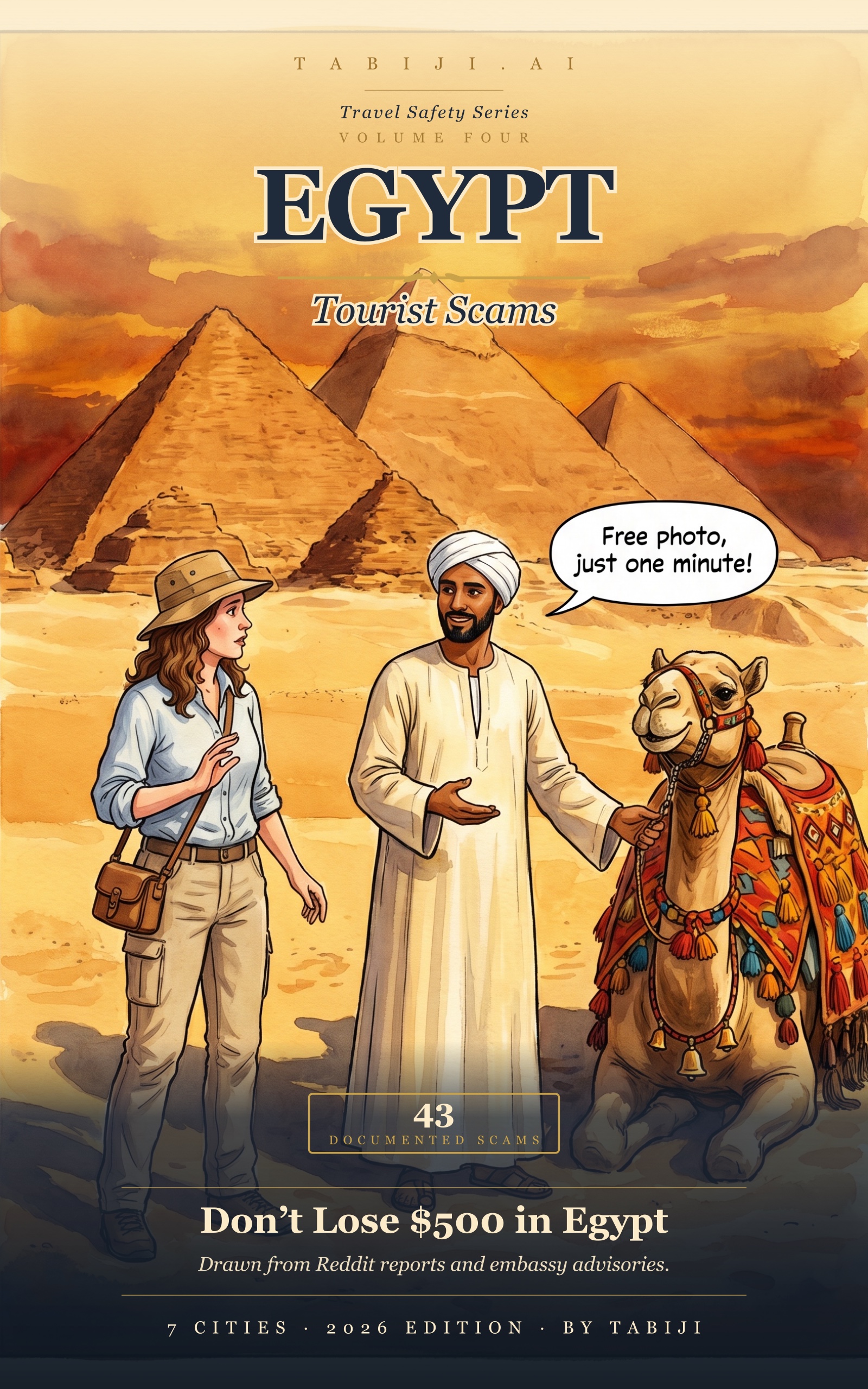
Giza pyramid camel-tout “free photo, just one minute” hostage shakedowns. Khan el-Khalili papyrus “school” markups (plant fiber sold as art). Luxor Valley of the Kings fake-guide tomb lock-ins. CAI airport “official taxi” USD overcharges. Aswan felucca captain price-doubling. Every documented Egypt scam — with the exact scripts, red flags, and Arabic phrases that shut each one down. Drawn from Reddit (Reddit, Reddit), U.S./UK/Canadian Embassy advisories, and Egyptian Tourism & Antiquities Police reports.
- 43 documented scams across Cairo, Luxor, Aswan, Hurghada & 3 more destinations
- An Arabic exit-phrase card you can screenshot to your phone
- Updated annually — buy once, re-download future editions free
- Readable in one flight — $4.99 on Amazon Kindle